

What do you think?
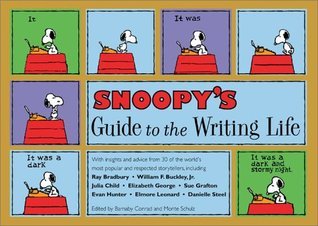
Snoopy's Guide to the Writing Life
Presents a collection of "Peanuts" comic strips that revolve around writers and the art of writing along with advice and insights from such authors as Clive Cussler, Elmore Leonard, and Daniele Steele.
Foreword / Monte Schulz
Introduction / Barnaby Conrad
Danielle Steel
Clive Cussler
Sidney Sheldon
Cherie Carter-Scott
Thomas McGuane
Leslie Dixon
Oakley Hall
Catherine Ryan Hyde
Fannie Flagg
John Leggett
Dominick Dunne
William F. Buckley, Jr
David Michaelis
Frances Weaver
Herbert Gold
Sue Grafton
Jay Conrad Levinson
Barnaby Conrad
Elizabeth George
Budd Schulberg
Monte Schulz
A. Scott Berg
Sol Stein
Ed McBain
Jack Canfield
Shelly Lowenkopf
Ray Bradbury
Charles Champlin
Laird Koenig
Julia Child
Elmore Leonard
J.F. Freedman
Foreword / Monte Schulz
Introduction / Barnaby Conrad
Danielle Steel
Clive Cussler
Sidney Sheldon
Cherie Carter-Scott
Thomas McGuane
Leslie Dixon
Oakley Hall
Catherine Ryan Hyde
Fannie Flagg
John Leggett
Dominick Dunne
William F. Buckley, Jr
David Michaelis
Frances Weaver
Herbert Gold
Sue Grafton
Jay Conrad Levinson
Barnaby Conrad
Elizabeth George
Budd Schulberg
Monte Schulz
A. Scott Berg
Sol Stein
Ed McBain
Jack Canfield
Shelly Lowenkopf
Ray Bradbury
Charles Champlin
Laird Koenig
Julia Child
Elmore Leonard
J.F. Freedman
192 pages, Hardcover
First published September 15, 2002
About the author
Barnaby Conrad
65 books12 followersBarnaby Conrad, Jr. was an American artist, author, nightclub proprietor, bullfighter and boxer.
NB: Father of writer Barnaby Conrad III.
Washington Post obituary:
http://articles.washingtonpost.com/20...
NB: Father of writer Barnaby Conrad III.
Washington Post obituary:
http://articles.washingtonpost.com/20...
Ratings & Reviews
Friends & Following
Create a free account to discover what your friends think of this book!
Community Reviews
Displaying 1 - 30 of 79 reviews

August 2, 2009
I have really mixed feelings about "Snoopy's Guide to the Writing Life." On one hand, it's a fine collection of "Peanuts" comic strips devoted to Snoopy's failed attempts to become a novelist; on the other hand, it's also a ridiculously awful collection of some of the most simple-minded, unhelpful, self-promoting advice by professional writers ever collected between two covers.
Among the contributors are such bestselling hacks as Danielle Steel, Clive Cussler and Sidney Sheldon, giving such worthless tips as "pray a lot" (Steel), "don't use desperately boring description" (Cussler), and begin with "an idea you really, really like" (Sheldon). And these writers' essays are so short -- Sheldon's is fourteen brief sentences -- that most need over-sized pull-quotes to beef them up. I know this sounds a bit like that old joke about the old Jewish lady who hates a particular restaurant because the food's terrible -- and the portions so small! -- but, really, how much wisdom can any writer, good or bad, convey about the writing life in fourteen sentences?
There are a few better writers mixed in here, Elmore Leonard and Ray Bradbury among them, but even their entries are uninspiring. Leonard has a couple good lines -- "Try to leave out the parts that readers skip," for one -- but they've been recycled so many times, including in his own book on writing, that many if not most readers have probably already heard them. Perhaps the best lines contributed to this book by any writer come from John Updike, who turned down a request to participate: "If I knew something that would make a crucial difference, I would keep it to myself, since the field is so overcrowded."
But the professional writers' mini essays are only part of "Snoopy's Guide to the Writing Life" -- perhaps a fourth of the book's total space. The rest is turned over to reprints of "Peanuts" strips, which are mostly brilliant and likely will evoke warm feelings in anyone who grew up reading Charles M. Schulz's comics. Given the nature of these strips -- most are of Snoopy sitting on the roof of his doghouse with his typewriter -- they have a sameness that makes them hard to read in one sitting. (They'd fare better in a traditional anthology, mixed in with Lucy pulling away the football before Charlie Brown can kick it, Linus advising Charlie Brown on the pitcher's mound, and Schroeder playing his toy piano.) Still, though, the unrelenting bleakness of the strips in this book -- the soul-crushing rejection letters Snoopy receives from publishers, the never-ending criticism from Lucy, Snoopy's own self-aggrandizement immediately giving way to self-loathing -- never stops being enjoyable.
Plus, there's one amazingly bizarre "Peanuts" strip in here that I've never had the pleasure to come across before. In it, Woodstock sits on a tree stump staring off into space, and a clearly anguished Snoopy, leaning against an adjacent tree, thinks to himself, "You're emotionally bankrupt... Scott Fitzgerald was emotionally bankrupt... We're all emotionally bankrupt..." That's it. That's the set-up, the punchline, the whole damned strip. This ran on on the funny pages?! Holy crap! That's a thousand times more depressing than even the typical angst-ridden "Peanuts" strip. How many kids did we lose when they read this comic and immediately went into the kitchen and swallowed a bottle of Drano?
Sadly, original publication dates for the "Peanuts" strips in this collection aren't given, so linking childhood mortalities to that particular strip would be difficult. (The book uses the strips as an excuse for publishing the crappy essays that accompany them rather than serving as a showcase for the strips themselves, which would be preferred.) Fortunately, the all-time classic Snoopy-typing-atop-his-doghouse comic is included here: Snoopy's story begins, "It was a dark and stormy night. Suddenly, a shot rang out! A door slammed. The maid screamed. Suddenly, a pirate ship appeared on the horizon! While millions of people were starving, the king lived in luxury. Meanwhile, on a small farm in Kansas, a boy was growing up." Then a pause, followed by, typed on the page, "Part II," then Snoopy thinking to himself, "In Part Two, I tie all of this together." Brilliant!
It's a shame though that this book doesn't include a reprint of the 1971 Schulz book that strip inspired, "Snoopy and 'It Was a Dark and Stormy Night,'" which is sadly out of print. Its inclusion would provide a far better service to readers than execrable writing advice from William F. Buckley Jr. and the creator of the "Chicken Soup for the Soul" books.
Among the contributors are such bestselling hacks as Danielle Steel, Clive Cussler and Sidney Sheldon, giving such worthless tips as "pray a lot" (Steel), "don't use desperately boring description" (Cussler), and begin with "an idea you really, really like" (Sheldon). And these writers' essays are so short -- Sheldon's is fourteen brief sentences -- that most need over-sized pull-quotes to beef them up. I know this sounds a bit like that old joke about the old Jewish lady who hates a particular restaurant because the food's terrible -- and the portions so small! -- but, really, how much wisdom can any writer, good or bad, convey about the writing life in fourteen sentences?
There are a few better writers mixed in here, Elmore Leonard and Ray Bradbury among them, but even their entries are uninspiring. Leonard has a couple good lines -- "Try to leave out the parts that readers skip," for one -- but they've been recycled so many times, including in his own book on writing, that many if not most readers have probably already heard them. Perhaps the best lines contributed to this book by any writer come from John Updike, who turned down a request to participate: "If I knew something that would make a crucial difference, I would keep it to myself, since the field is so overcrowded."
But the professional writers' mini essays are only part of "Snoopy's Guide to the Writing Life" -- perhaps a fourth of the book's total space. The rest is turned over to reprints of "Peanuts" strips, which are mostly brilliant and likely will evoke warm feelings in anyone who grew up reading Charles M. Schulz's comics. Given the nature of these strips -- most are of Snoopy sitting on the roof of his doghouse with his typewriter -- they have a sameness that makes them hard to read in one sitting. (They'd fare better in a traditional anthology, mixed in with Lucy pulling away the football before Charlie Brown can kick it, Linus advising Charlie Brown on the pitcher's mound, and Schroeder playing his toy piano.) Still, though, the unrelenting bleakness of the strips in this book -- the soul-crushing rejection letters Snoopy receives from publishers, the never-ending criticism from Lucy, Snoopy's own self-aggrandizement immediately giving way to self-loathing -- never stops being enjoyable.
Plus, there's one amazingly bizarre "Peanuts" strip in here that I've never had the pleasure to come across before. In it, Woodstock sits on a tree stump staring off into space, and a clearly anguished Snoopy, leaning against an adjacent tree, thinks to himself, "You're emotionally bankrupt... Scott Fitzgerald was emotionally bankrupt... We're all emotionally bankrupt..." That's it. That's the set-up, the punchline, the whole damned strip. This ran on on the funny pages?! Holy crap! That's a thousand times more depressing than even the typical angst-ridden "Peanuts" strip. How many kids did we lose when they read this comic and immediately went into the kitchen and swallowed a bottle of Drano?
Sadly, original publication dates for the "Peanuts" strips in this collection aren't given, so linking childhood mortalities to that particular strip would be difficult. (The book uses the strips as an excuse for publishing the crappy essays that accompany them rather than serving as a showcase for the strips themselves, which would be preferred.) Fortunately, the all-time classic Snoopy-typing-atop-his-doghouse comic is included here: Snoopy's story begins, "It was a dark and stormy night. Suddenly, a shot rang out! A door slammed. The maid screamed. Suddenly, a pirate ship appeared on the horizon! While millions of people were starving, the king lived in luxury. Meanwhile, on a small farm in Kansas, a boy was growing up." Then a pause, followed by, typed on the page, "Part II," then Snoopy thinking to himself, "In Part Two, I tie all of this together." Brilliant!
It's a shame though that this book doesn't include a reprint of the 1971 Schulz book that strip inspired, "Snoopy and 'It Was a Dark and Stormy Night,'" which is sadly out of print. Its inclusion would provide a far better service to readers than execrable writing advice from William F. Buckley Jr. and the creator of the "Chicken Soup for the Soul" books.

September 19, 2016
I so so wanted to love this book, even though I saw it was published by none other than Writer's Digest Books. Augh! I am a writer, and a teacher of writing, and I love Peanuts, and grew up watching Snoopy fail at writing as I failed right with him. So the best thing about this book is reprinting all the actual Snoopy novel writing strips, which means you get to at the very least smile on every page.
So the editor Conrad contacts more than thirty writers and ask them to give advice to Snoopy (and, by association, we readers). But almost all of the advice is lame and obvious. And most of the writers are the caliber of ones we might associate with Writer's (and Reader's) Digest: Danielle Steel, Sidney Sheldon, Clive Cussler, Fannie Flagg, and so on. Just because I used that word "caliber" above, I am NOT a snob about these people and their books, I'm not, but there may be a reason their writing about writing is so boring to me and such lame advice.
But! Ray Bradbury actually responded to their requests to write advice to Snoopy and wrote the best--and practically the only decent--one, detailing all of his own failures, which he calls a "snowstorm" of rejection slips that flowed over him through almost two decades until he started to see some success. Overall, however, this book was SO disappointing. 3 stars ONLY for the Snoopy strips.
So the editor Conrad contacts more than thirty writers and ask them to give advice to Snoopy (and, by association, we readers). But almost all of the advice is lame and obvious. And most of the writers are the caliber of ones we might associate with Writer's (and Reader's) Digest: Danielle Steel, Sidney Sheldon, Clive Cussler, Fannie Flagg, and so on. Just because I used that word "caliber" above, I am NOT a snob about these people and their books, I'm not, but there may be a reason their writing about writing is so boring to me and such lame advice.
But! Ray Bradbury actually responded to their requests to write advice to Snoopy and wrote the best--and practically the only decent--one, detailing all of his own failures, which he calls a "snowstorm" of rejection slips that flowed over him through almost two decades until he started to see some success. Overall, however, this book was SO disappointing. 3 stars ONLY for the Snoopy strips.

September 2, 2016
I absolutely love this book, namely because I have such a heartfelt love for Charles Schulz, Snoopy and writing. My favorite thing about this book was not the segments from various authors (who include Danielle Steele and Ray Bradbury just to name a couple) who each wrote a short note to Snoopy with writing advice for his as yet unpublished novel that he's been working on for years, but the treasury of Snoopy writing-themed strips (ie: It was a dark and stormy night). While the advice given isn't that informative at times, the strips are always brilliant and sometimes hilarious. But that being said there were some pieces of advice that I will be applying to my writing. I recommend this for writers of every genre, whether published or not.

November 30, 2015
I(b laughed on just about every page. There were some good tips throughout the book.
A writer would enjoy this book.
A writer would enjoy this book.

August 26, 2022
After fairy tales, my life as a reader took off with biographies, girls' stories, and comic books. In elementary school, my two sisters and I had the biggest and best comic book collection in town: Archies, Richie Rich, Little Lotta, and a not-insignificant number of scary comic books (none of which were touched after 5 p.m.). As we grew up, the language of Peanuts, Calvin and Hobbes, and Cathy offered taglines to our everyday vocabulary. And why not? As one of my best friends discovered, in home-schooling her reluctant reader of a son: acting upon the advice of an educator, my friend, with some trepidation, handed her 10-year-old son a collection of Calvin and Hobbes--and not only did he become a reader, but his vocabulary blossomed. Comic strips are not namby-pamby reading!
The last contributor to this book on writing, J.F. Freedman, puts it well: "Great comic strips...are a fine introduction into literature....If we're trying to promote literacy and enjoyment of reading in our young generations, distributing comic strips and comic books in our schools might be one of the best ways to get students' heads out of video games and television sets and into literature" (pp. 186-187). Full disclosure: I re-read more comic strip collections than are listed in my Goodreads list! They are great cleansers for my reading palate.
The last contributor to this book on writing, J.F. Freedman, puts it well: "Great comic strips...are a fine introduction into literature....If we're trying to promote literacy and enjoyment of reading in our young generations, distributing comic strips and comic books in our schools might be one of the best ways to get students' heads out of video games and television sets and into literature" (pp. 186-187). Full disclosure: I re-read more comic strip collections than are listed in my Goodreads list! They are great cleansers for my reading palate.

February 18, 2019
Snoopy has a way with words like no other, and a calm outlook on life that is inspiring - such as his (mostly) nonchalant attitude to the mountain of rejection letters sent by publishing houses. This was a fun book to read, a mixture of Peanuts comic strips with essays written by a number of world-famous authors.

October 18, 2023
It was fun to read renowned authors' advice to Snoopy as he tries to write a novel!

February 22, 2017
Like a lot of kids around the world, a lot of my time was spent with my nose in a Peanuts book. I loved reading about the philosophy of these kids, their adventures, and everyone's favorite beagle. In particular, some of my favorite strips were when Snoopy was bent over his little typewriter. I managed to talk my mother into buying me an old fashioned spring typewriter from a thrift store because of it. In a way, Snoopy had a hand in my love of writing as a kid.
This is a fantastic collection if you loved those particular Snoopy strips as much as I did. As far as the advice from the guest authors goes... Well, I can't really say it's advice as much as it is encouraging words. A how-to book this is not in the slightest. A lot of it is just single-paragraphs in length over how one recommends getting over a slump or getting too many rejection letters. I'll be honest, I never read anything from any of these authors (aside from one or two, particularly Ray Bradbury) so I can't really stand on a pedestal and judge the weight of the advice itself. To be fair, it's not really a guide, just a little nudge and a "you can do it".
If you're looking for legit advice and writing help, yeah, you're not going to get it here. But if you want a coffee book table collection of Snoopy's writing adventures, check it out!
This is a fantastic collection if you loved those particular Snoopy strips as much as I did. As far as the advice from the guest authors goes... Well, I can't really say it's advice as much as it is encouraging words. A how-to book this is not in the slightest. A lot of it is just single-paragraphs in length over how one recommends getting over a slump or getting too many rejection letters. I'll be honest, I never read anything from any of these authors (aside from one or two, particularly Ray Bradbury) so I can't really stand on a pedestal and judge the weight of the advice itself. To be fair, it's not really a guide, just a little nudge and a "you can do it".
If you're looking for legit advice and writing help, yeah, you're not going to get it here. But if you want a coffee book table collection of Snoopy's writing adventures, check it out!

October 6, 2015
The advice is hit and miss (like a writer is going to just give away their trade secrets in a feelgood coffeetable book), but the real treasures here are the Snoopy The Writer strips all under one red two-dimensional roof.
It was a minor disappointment to learn in the intro that John Updike turned down the editors (kindly), but it does strike one as amusing to wonder what other authors would advise Snoopy. I could see Neil Gaiman or Jonathan Lethem taking a swing at it. But how about...Michel Houellebecq, say. Clive Barker. I'd attempt the ventriloquism, the pastiche (Peanutstiche), but ain't feeling ambitious right now.
If you have advice for Snoopy, though, feel free to add it in the comments section.
Note: Monte Schulz (Charles' son), an author in his own right, and A. Scott Berg (Charles' biographer) provide essays on the joys of Thomas Wolfe - possibly as skeleton keys towards understanding the sentimental aesthetic of the Peanuts universe.
It was a minor disappointment to learn in the intro that John Updike turned down the editors (kindly), but it does strike one as amusing to wonder what other authors would advise Snoopy. I could see Neil Gaiman or Jonathan Lethem taking a swing at it. But how about...Michel Houellebecq, say. Clive Barker. I'd attempt the ventriloquism, the pastiche (Peanutstiche), but ain't feeling ambitious right now.
If you have advice for Snoopy, though, feel free to add it in the comments section.
Note: Monte Schulz (Charles' son), an author in his own right, and A. Scott Berg (Charles' biographer) provide essays on the joys of Thomas Wolfe - possibly as skeleton keys towards understanding the sentimental aesthetic of the Peanuts universe.

February 2, 2013
Great little book for the aspiring writer in all of us.
Like all Informational Books not everything within the pages could be used for your own purposes, but if there are/is a couple of tips you were able to find useful then the Book was worthwhile in viewing.
Like all Informational Books not everything within the pages could be used for your own purposes, but if there are/is a couple of tips you were able to find useful then the Book was worthwhile in viewing.
August 24, 2008
i give this one 5 starts because it's one of the sweetest b-day presents i ever got
(yes, i am lame)
(yes, i am lame)

October 22, 2011
It was a BARK and stormy night.

November 26, 2013
Insightful text is made all the more vivid by the comic strip. Not only for writers. Highly recommend to anyone who wants an insider's look at work from a variety of writers.

October 24, 2016
An excellent collection of advice and reflection on writing from a variety of authors. I liked it so much I gave a copy to an aspiring novelist.

May 15, 2017
Funny and full of a number of great essays by good writers. The "Literary Ace" is my second favorite Snoopy persona behind "The Flying Ace."

January 15, 2020
30+ authors. Countless writing tips. And one cute dog!
Like most creators or writers, we are always caught in a rut. And so is Snoopy! Through this book, a stellar band of authors comes together to offer him (and the reader) thoughtful advice. And the advice is not just on writing, it’s also on publishing, on dealing with rejection and pushing yourself to reach your writing goal.
The book alternates between hilarious Snoopy comics about him writing and then an anecdotal advice page from each writer. We first see Snoopy as he struggles to write and tries to publish his novels, going around in endless circles. And then the writer jumps in with specific, enlightening advice that could possibly save the day!
I absolutely loved the unique concept of this book. It can be read for 5 minutes as well as an hour. The comic strips are light-hearted and the advice is short and insightful. Also, where else would you get more than 30 famous writers to give you their best pointers on becoming a writer! So, whether or not you are a writer, this book will definitely tickle your funny bone, enlighten you and charm you. I recommend it.
Like most creators or writers, we are always caught in a rut. And so is Snoopy! Through this book, a stellar band of authors comes together to offer him (and the reader) thoughtful advice. And the advice is not just on writing, it’s also on publishing, on dealing with rejection and pushing yourself to reach your writing goal.
The book alternates between hilarious Snoopy comics about him writing and then an anecdotal advice page from each writer. We first see Snoopy as he struggles to write and tries to publish his novels, going around in endless circles. And then the writer jumps in with specific, enlightening advice that could possibly save the day!
I absolutely loved the unique concept of this book. It can be read for 5 minutes as well as an hour. The comic strips are light-hearted and the advice is short and insightful. Also, where else would you get more than 30 famous writers to give you their best pointers on becoming a writer! So, whether or not you are a writer, this book will definitely tickle your funny bone, enlighten you and charm you. I recommend it.

May 12, 2018
A dozen or so famous or slightly famous writers have each contributed a few paragraphs containing some small gem of wisdom for aspiring authors. "Writing the book is 20 percent of the job; marketing is the other 80 percent." "I discovered that writing is not about degrees or vocabulary or diagramming a sentence. It is simply about the desire to tell a story." That sort of thing.
But the real delight of this book is the many Peanuts strips featuring Snoopy's attempts to write and be published. Be prepared to laugh out loud. "It was a dark and stormy night," writes Snoopy. (He returns often to this sentence.) Lucy reads and criticizes: "You know what's wrong with your stories? They lack subtlety." Snoopy tries again. "It was a sort of dark and kind of stormy night."
I hope you're the kind of person who enjoys Charles Schulz's humor.
But the real delight of this book is the many Peanuts strips featuring Snoopy's attempts to write and be published. Be prepared to laugh out loud. "It was a dark and stormy night," writes Snoopy. (He returns often to this sentence.) Lucy reads and criticizes: "You know what's wrong with your stories? They lack subtlety." Snoopy tries again. "It was a sort of dark and kind of stormy night."
I hope you're the kind of person who enjoys Charles Schulz's humor.

February 4, 2023
This was a light and fun read. Interspersing writing tips with Snoopy comics was a pleasant way to digest this. The writing tips may not have been deep, and of course, I didn't agree with all of them, but I learned something and enjoyed it in the process. Funny, even though the writers chosen to give advice were considered quality and quantity writers, several of them couldn't keep my attention for even the page of two of their writing.
The bio of Charles Shultz in the intro was a glimpse into the man from his son's point of view. I loved that.
The bio of Charles Shultz in the intro was a glimpse into the man from his son's point of view. I loved that.

July 24, 2020
I've been an (aspiring) writer for most of my life. I always liked Peanuts, but I wasn't a particularly avid fan. Except for the stuff about writing. For a long time, I had a Peanuts strip cut out from the paper (that dates me) and taped to my typewriter cover. (The one on page 68.) Now, as a midlifer returning to my writing aspirations, I found this book to be a quick, engaging, funny, and inspiring read. It's been om my wishlist for a long time, but it was worth the wait.

May 20, 2024
The advice from well-known writers is mostly fluff (and thankfully brief), but that isn't the point of this book. The generous selection of cartoons, all featuring Snoopy's hapless and amusingly cynical attempts to write a commercially viable book, wrestle with writer's block, handle critics (a.k.a. Lucy) and deal with rejection will be depressingly familiar and often laugh-out-loud funny to any writer at any stage in their craft or career.
June 20, 2020
I really enjoyed reading this..contains both comic strips of Snoopy the writer and insightss and advice on how to write. I really enjoyed what Fannie Flagg wrote. This gave great insight on how some authors write

March 24, 2023
I had no idea there were so many strips of snoopy typing. Lots of fun to read the strips and the commentary by famous authors, mostly consoling about rejection letters! Snoopy: "file them with the others". Woodstock walks by with a shovel. Classic.

February 16, 2025
A terrific, insightful, entertaining, and even useful combination of succulent, pithy advice about writing, in all its forms, plus a healthy dose of Schulz’s strips featuring Snoopy as a practicing novelist. A very fun, memorable read.

June 6, 2025
Funny, inspiring, and helpful. I know I'll reread it often. Thanks for including such a wide range of authors. In addition to reading some of my favorites, it was a nice and interesting intro to authors I haven't read. Thanks to everyone who worked on this!
March 28, 2019
The essays are garbage, but the comic strips are great.

August 4, 2019
It was a dark and stormy night.

December 6, 2020
I've always loved the Snoopy-as-Writer subplot in the Peanuts comics, so this collection strikes a note with me. The essays are interesting too.

December 6, 2020
A fantastic blend of Peanuts' humor and terrific advice on the writing life from many highly successful (and profoud) authors.
January 27, 2023
Snoopy's 'typing' strips are some of the best.
Want to Read
March 12, 2023Ok
Displaying 1 - 30 of 79 reviews