

What do you think?

A Theology of History
Man has long wrestled with the problem of finding meaning in history. It is not surprising that, as a Christian, Hans Urs von Balthasar finds the meaning of history in Christ, its center and Lord. What may surprise and stimulate us is the theological mastery with which von Balthasar traces the effects of Christ’s lordship upon the daily life of the Christian. In this book we have one of the indispensable sources for understanding Balthasar’s Catholic Christocentrism. Here we find elaboration of the striking statement that Jesus Christ is “the Idea made concrete, personal, universale concretum et personale ”—which means that Christ is the universally valid in the here and now. Characteristic of von Balthasar, the book inspires spiritually as much as it informs theologically. Von Balthasar follows Saint Irenaeus in viewing theology through the drama of history, and presents Jesus Christ as the norm by which all history—secular history as well as salvation history—ought to be interpreted. As God, Jesus is the universal norm for all humanity who stands outside of history; as man he became particular within history. By seeking to become one with him, our own history becomes meaningful, purposeful, and significant.
154 pages, Paperback
First published January 1, 1964
About the author
Hans Urs von Balthasar
436 books339 followersHans Urs von Balthasar was a Swiss theologian and priest who was nominated to be a cardinal of the Catholic Church. He is considered one of the most important theologians of the 20th century.
Born in Lucerne, Switzerland on 12 August 1905, he attended Stella Matutina (Jesuit school) in Feldkirch, Austria. He studied in Vienna, Berlin and Zurich, gaining a doctorate in German literature. He joined the Jesuits in 1929, and was ordained in 1936. He worked in Basel as a student chaplain. In 1950 he left the Jesuit order, feeling that God had called him to found a Secular Institute, a lay form of consecrated life that sought to work for the sanctification of the world especially from within. He joined the diocese of Chur. From the low point of being banned from teaching, his reputation eventually rose to the extent that John Paul II asked him to be a cardinal in 1988. However he died in his home in Basel on 26 June 1988, two days before the ceremony. Balthasar was interred in the Hofkirche cemetery in Lucern.
Along with Karl Rahner and Bernard Lonergan, Balthasar sought to offer an intellectual, faithful response to Western modernism. While Rahner offered a progressive, accommodating position on modernity and Lonergan worked out a philosophy of history that sought to critically appropriate modernity, Balthasar resisted the reductionism and human focus of modernity, wanting Christianity to challenge modern sensibilities.
Balthasar is very eclectic in his approach, sources, and interests and remains difficult to categorize. An example of his eclecticism was his long study and conversation with the influential Reformed Swiss theologian, Karl Barth, of whose work he wrote the first Catholic analysis and response. Although Balthasar's major points of analysis on Karl Barth's work have been disputed, his The Theology of Karl Barth: Exposition and Interpretation (1951) remains a classic work for its sensitivity and insight; Karl Barth himself agreed with its analysis of his own theological enterprise, calling it the best book on his own theology.
Balthasar's Theological Dramatic Theory has influenced the work of Raymund Schwager.
Born in Lucerne, Switzerland on 12 August 1905, he attended Stella Matutina (Jesuit school) in Feldkirch, Austria. He studied in Vienna, Berlin and Zurich, gaining a doctorate in German literature. He joined the Jesuits in 1929, and was ordained in 1936. He worked in Basel as a student chaplain. In 1950 he left the Jesuit order, feeling that God had called him to found a Secular Institute, a lay form of consecrated life that sought to work for the sanctification of the world especially from within. He joined the diocese of Chur. From the low point of being banned from teaching, his reputation eventually rose to the extent that John Paul II asked him to be a cardinal in 1988. However he died in his home in Basel on 26 June 1988, two days before the ceremony. Balthasar was interred in the Hofkirche cemetery in Lucern.
Along with Karl Rahner and Bernard Lonergan, Balthasar sought to offer an intellectual, faithful response to Western modernism. While Rahner offered a progressive, accommodating position on modernity and Lonergan worked out a philosophy of history that sought to critically appropriate modernity, Balthasar resisted the reductionism and human focus of modernity, wanting Christianity to challenge modern sensibilities.
Balthasar is very eclectic in his approach, sources, and interests and remains difficult to categorize. An example of his eclecticism was his long study and conversation with the influential Reformed Swiss theologian, Karl Barth, of whose work he wrote the first Catholic analysis and response. Although Balthasar's major points of analysis on Karl Barth's work have been disputed, his The Theology of Karl Barth: Exposition and Interpretation (1951) remains a classic work for its sensitivity and insight; Karl Barth himself agreed with its analysis of his own theological enterprise, calling it the best book on his own theology.
Balthasar's Theological Dramatic Theory has influenced the work of Raymund Schwager.
Ratings & Reviews
Friends & Following
Create a free account to discover what your friends think of this book!
Community Reviews
Displaying 1 - 14 of 14 reviews

July 9, 2024
Can always count on von Balthasar for a good time!

November 8, 2024
Profound, sublime reading. Fr. von Balthasar meditates on the significance of Jesus Christ in and for history and in so doing gathers afresh the riches of the Incarnation. His is a deeply Roman Catholic perspective (as should be expected), but his fundamental bases are accessible and profitable for the wider church Catholic. Read it.

February 6, 2016
Jesus is the norm of history.

July 8, 2014
En principio me gustaría aclarar que esto no es una reseña sobre el libro, sino más bien el comentario sobre algunas cosas que el libro me hizo pensar. Muchas de las cuales ya habían estado dando vueltas por mi cabeza. En principio eso me dice que el libro es muy bueno, que me gustó, que lo leí en el momento justo. Por otro lado me dice que posiblemente no lo entendí y que mis ideas taparon a las de Hans, y pensé que él decía lo que en realidad “yo decía”. Quien quiera saber que dice Hans, que lea el libro. Sin embargo, una pequeña justificación de la calificación aparece al final. Aclarado esto, avanzo.
Hay una concepción histórica materialista, y hay una concepción idealista. Esta dualidad, desde Platón, puede distinguirse con distintos nombre en toda filosofía occidental, y con reminiscencias en otras filosofías. Por razones que serán claras más adelante grafico la primera con una línea (lo ético), y la segunda con un círculo (lo estético). No reclamo la aceptación de un dogma dualista, pero la interpretación es interesante.
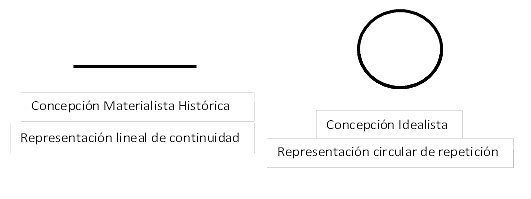
El tiempo también tiene dos representaciones posibles. Una de continuidad y otra de repetición. El de continuidad usualmente se representa con una “línea de tiempo” desde el origen del cosmos (explosión cosmológica, o el origen de la secuencias de expansiones y contracciones poco probables, no viene al caso) hasta el final de la historia si es que lo hubiera (tampoco viene al caso). La otra representación nos es familiar por la forma en la que se acostumbra a diseñar los relojes. Todos los días tienen un amanecer, todas las semanas un domingo, todos los años un invierno (su siembra y cosecha), etc. Estas formas se corresponden con las concepciones históricas antedichas. Ya debería quedar claro, porque se utilizó anteriormente una línea y un círculo.
La ciencia usualmente se basa en la representación circular, porque los eventos que se repiten funcionan bien para la contrastación de hipótesis. Se experimente y si frente a iguales impulsos se obtienen iguales respuestas, se encuentra una ley (perdón señor epistemólogo, pero la idea es hacer la review de un libro, no escribir otro). Esa es también la vinculación entre la representación circular y el mundo de las ideas. Ley en el sentido más puro es la repetición exacta, lo perfecto. Esto también encaja con la idea de perfección inherente al círculo. Esto, por razones obvias, representa un problema para las ciencias sociales, que fue parcialmente resuelto por el materialismo histórico Hegeliano. Sin embargo esto deviene en un determinismo que falló tanto para predecir el fin del capitalismo, como para predecir el fin de la historia. En parte, porque al mirar una historia (lineal), olvida la otra (circular).
Este conflicto Marx lo leyó, pero no pudo darle explicación acabada. ¿Por qué es necesaria una revolución proletaria con conciencia de clase si el devenir histórico no tiene otra escapatoria que la destrucción del sistema por acumulación capitalista? Los verdaderos revolucionarios deberían almorzar siempre en McDonalds (para acelerar las contradicciones).
Jesús es el Señor (Kyrios) de la historia. El irrepetible. En tanto tal, acerca con su “hacerse humano” la divinidad, y eleva la humanidad a Dios, a la ley, al mundo de las ideas. Jesús Señor de la historia es el Jesús histórico, presente en un momento específico del devenir histórico (no menor, en el centro mismo de la historia, que parte la historia en medio) pero también en cada momento en forma circular (entrega en cruz en cada Pascua, no en forma representativa sino real, en cada domingo día del Señor, y en cada día en la Eucaristía centro de la vida).

De esta forma, la entrega de Jesús, y la entrega de cada uno es la respuesta, la posibilidad de escape frente al determinismo histórico, el quiebre, la ruptura, la posibilidad de agregar algo nuevo. La verdadera revolución. Jesús no se obtiene por (no se llega a Jesús via) meditación, o introspección sino por entrega, la entrega concretiza a Jesús (Dios) haciéndolo material (Jesús hombre), trae e Dios, eleva al humano. La historia de salvación de una persona puede ser toda una vida de pecado, y conversión en el último segundo de su vida. Esta dinámica solo tiene sentido por el carácter temporal aquí descripto.
Pero en forma real, no haciendo trampa en forma de pecado-revolución, en forma de “salto por encima del tiempo”. La entrega, trae, acerca, pero de acuerdo a la voluntad del Padre que da todo a su debido tiempo. Entrega y Paciencia (“mi hora no ha llegado todavía”).
Salvación es la ruptura del determinismo histórico. Milagro es la ruptura de la repetición circular (por eso asombra a la ciencia). La voluntad de Jesús y la voluntad del Padre pueden diferir por un problema temporal. Jesús puede querer nuestra salvación/vida/salud/felicidad pero su hora no haber llegado todavía. El milagro y la salvación se producen cuando llega la hora (ésjaton).
Todo tiempo que no trae lo divino, es tiempo de pecado, es tiempo perdido. A esta altura ya debería quedar claro, pero vale decirlo para no olvidarlo: fidelidad es más importante que felicidad. Porque estando “en el tiempo” es la forma de alcanzar a Dios que está “fuera del tiempo”. Nosotros podemos no ser fieles, porque tenemos tiempo, no “es”, por tanto no puede no ser fiel. Fiel al amor (a la entrega) que es la conexión entre lo humano y lo divino.
También es posible hacer una interpretación donde el círculo representa a (es) Dios Padre, el ideal, el creador, el dador de ley y nuevamente Jesús (es) la línea vertical, en este espacio-tiempo (ni pasado, ni futuro, solo “ahora”) como medida de la distancia entre Dios y los hombres, y la línea horizontal es el Espíritu Santo, que acompaña el devenir histórico, une la humanidad con la divinidad, a Jesús con el Padre. Pero cabe recordar que los tres no son sino uno solo.
En el momento presente, cuando se entrecruza la línea horizontal y la línea vertical, Dios padre está por encima de ese tiempo, abarcando todo tiempo. Y al haber conexión posible, ese es el momento favorable (kairos). En el tiempo del Padre toda promesa es “ya realidad”, el Evangelio está en su pleno cumplimiento. Por eso puede decirse que Reino de Dios es “ya”, y “todavía no”.
Jesús es Dios, porque cumple a la perfección. Es en el tiempo perfectamente fiel. Siendo libre es perfectamente obediente. Y como Jesús-hombre, posibilidad para todo hombre. La entrega (la de Jesús y la de cada vez, la de cada uno) es a su vez ésjaton y kairos, ¡cada vez!
Queda la cuestión del espacio-tiempo. Jesús es Dios en espacio-tiempo. El Reino de Dios “ya” es en espacio-tiempo, pero el Reino de Dios “todavía no” debe ser semejante a en espacio-tiempo (porque la promesa no podría ser disímil al Reino de Dios “ya”). Dios Padre idea-ideal-ley y Espíritu Santo: ¿son en espacio-tiempo? Respuesta posible: si para la Fe. Como así también Jesús resucitado es durante “cuarenta días” (eternidad) en espacio-tiempo, por Fe. Jesús Eucaristía es presente en espacio-tiempo también por Fe. Sin embargo son (aparentemente) invisibles en este espacio-tiempo. Si no hay tiempo, por tanto no hay espacio, por tanto no hay “visibilidad” posible. Creo que hay individualidad en el Reino “todavía no”, pero por estar en espacio-tiempo no puedo comprender la ausencia de espacio-tiempo.
También es posible hacer una relectura del problema de la justificación desde esta perspectiva: desde el punto de vista de esta temporalidad (este espacio-tiempo) la justicia depende de los actos, desde el punto de vista de Dios-eterno la justificación ya está asignada.
Bajo esta mirada también es interesante replantearse la cuestión del progresismo iluminista (y su evolucionismo universal). Ni panacea comunista, ni fin de los tiempos, ni tampoco colapso social ecológico o político. Solo Cristo salva. Aún sin necesidad de una teología evolucionista (neo Joaquín Florista), sin necesidad de un “progreso”, porque salvación “puede” no estar “adelante” sino “arriba”.
Esto obliga a una conversión permanente, a una fidelidad en la conversión. El cristianismo corre el riesgo de convertirse en un chauvinismo religioso si dice “soy cristiano” sin más, sin una conversión permanente, porque en este transcurso histórico (este espacio-tiempo) solo puede haber cristianismo real cuando hay “salto”, cuando hay “entrega”, cuando hay “cruz”.
Puede parecer ridículo intentar hacer un resumen de una interpretación que cada vez es más enmarañada pero diría: la perpendicularidad histórica del kyrios hace posible un nuevo kairos en cada instante, por el hecho mismo que crea cada instante, crea tiempo y espacio. En Jesús hay tiempo y espacio. Es el punto que une, por tanto puede ser kairos y ésjaton al mismo tiempo, en este espacio-tiempo y fuera de este espacio-tiempo en un espacio tiempo de Dios.
Comentario final: Heidegger, no te tenemos miedo.
Justificación. Cuatro estrellas porque es demasiado volado. Por más que sea un libro de teología de la historia, y no de historia, creo que me hubiera gustado más si hubiera estado más basado en la historia de la humanidad, creo que eso es posible. No es un libro difícil (me parece), es cortito y más sencillo que esta reseña delirante. La teología no es para todos claramente, pero me parece que este libro camina firmemente por la cornisa del delirio sin caer en la abyecta discusión bizantina. Creo que lo que aporta ayuda a entender la historia y da pautas para el discernimiento de la acción cotidiana, eso lo salva, la loa al kyrios, la recomendación de aprovechar el kairos, y la búsqueda de ésjatón.
Hay una concepción histórica materialista, y hay una concepción idealista. Esta dualidad, desde Platón, puede distinguirse con distintos nombre en toda filosofía occidental, y con reminiscencias en otras filosofías. Por razones que serán claras más adelante grafico la primera con una línea (lo ético), y la segunda con un círculo (lo estético). No reclamo la aceptación de un dogma dualista, pero la interpretación es interesante.
El tiempo también tiene dos representaciones posibles. Una de continuidad y otra de repetición. El de continuidad usualmente se representa con una “línea de tiempo” desde el origen del cosmos (explosión cosmológica, o el origen de la secuencias de expansiones y contracciones poco probables, no viene al caso) hasta el final de la historia si es que lo hubiera (tampoco viene al caso). La otra representación nos es familiar por la forma en la que se acostumbra a diseñar los relojes. Todos los días tienen un amanecer, todas las semanas un domingo, todos los años un invierno (su siembra y cosecha), etc. Estas formas se corresponden con las concepciones históricas antedichas. Ya debería quedar claro, porque se utilizó anteriormente una línea y un círculo.
La ciencia usualmente se basa en la representación circular, porque los eventos que se repiten funcionan bien para la contrastación de hipótesis. Se experimente y si frente a iguales impulsos se obtienen iguales respuestas, se encuentra una ley (perdón señor epistemólogo, pero la idea es hacer la review de un libro, no escribir otro). Esa es también la vinculación entre la representación circular y el mundo de las ideas. Ley en el sentido más puro es la repetición exacta, lo perfecto. Esto también encaja con la idea de perfección inherente al círculo. Esto, por razones obvias, representa un problema para las ciencias sociales, que fue parcialmente resuelto por el materialismo histórico Hegeliano. Sin embargo esto deviene en un determinismo que falló tanto para predecir el fin del capitalismo, como para predecir el fin de la historia. En parte, porque al mirar una historia (lineal), olvida la otra (circular).
Este conflicto Marx lo leyó, pero no pudo darle explicación acabada. ¿Por qué es necesaria una revolución proletaria con conciencia de clase si el devenir histórico no tiene otra escapatoria que la destrucción del sistema por acumulación capitalista? Los verdaderos revolucionarios deberían almorzar siempre en McDonalds (para acelerar las contradicciones).
Jesús es el Señor (Kyrios) de la historia. El irrepetible. En tanto tal, acerca con su “hacerse humano” la divinidad, y eleva la humanidad a Dios, a la ley, al mundo de las ideas. Jesús Señor de la historia es el Jesús histórico, presente en un momento específico del devenir histórico (no menor, en el centro mismo de la historia, que parte la historia en medio) pero también en cada momento en forma circular (entrega en cruz en cada Pascua, no en forma representativa sino real, en cada domingo día del Señor, y en cada día en la Eucaristía centro de la vida).
De esta forma, la entrega de Jesús, y la entrega de cada uno es la respuesta, la posibilidad de escape frente al determinismo histórico, el quiebre, la ruptura, la posibilidad de agregar algo nuevo. La verdadera revolución. Jesús no se obtiene por (no se llega a Jesús via) meditación, o introspección sino por entrega, la entrega concretiza a Jesús (Dios) haciéndolo material (Jesús hombre), trae e Dios, eleva al humano. La historia de salvación de una persona puede ser toda una vida de pecado, y conversión en el último segundo de su vida. Esta dinámica solo tiene sentido por el carácter temporal aquí descripto.
Pero en forma real, no haciendo trampa en forma de pecado-revolución, en forma de “salto por encima del tiempo”. La entrega, trae, acerca, pero de acuerdo a la voluntad del Padre que da todo a su debido tiempo. Entrega y Paciencia (“mi hora no ha llegado todavía”).
Salvación es la ruptura del determinismo histórico. Milagro es la ruptura de la repetición circular (por eso asombra a la ciencia). La voluntad de Jesús y la voluntad del Padre pueden diferir por un problema temporal. Jesús puede querer nuestra salvación/vida/salud/felicidad pero su hora no haber llegado todavía. El milagro y la salvación se producen cuando llega la hora (ésjaton).
Todo tiempo que no trae lo divino, es tiempo de pecado, es tiempo perdido. A esta altura ya debería quedar claro, pero vale decirlo para no olvidarlo: fidelidad es más importante que felicidad. Porque estando “en el tiempo” es la forma de alcanzar a Dios que está “fuera del tiempo”. Nosotros podemos no ser fieles, porque tenemos tiempo, no “es”, por tanto no puede no ser fiel. Fiel al amor (a la entrega) que es la conexión entre lo humano y lo divino.
También es posible hacer una interpretación donde el círculo representa a (es) Dios Padre, el ideal, el creador, el dador de ley y nuevamente Jesús (es) la línea vertical, en este espacio-tiempo (ni pasado, ni futuro, solo “ahora”) como medida de la distancia entre Dios y los hombres, y la línea horizontal es el Espíritu Santo, que acompaña el devenir histórico, une la humanidad con la divinidad, a Jesús con el Padre. Pero cabe recordar que los tres no son sino uno solo.
En el momento presente, cuando se entrecruza la línea horizontal y la línea vertical, Dios padre está por encima de ese tiempo, abarcando todo tiempo. Y al haber conexión posible, ese es el momento favorable (kairos). En el tiempo del Padre toda promesa es “ya realidad”, el Evangelio está en su pleno cumplimiento. Por eso puede decirse que Reino de Dios es “ya”, y “todavía no”.
Jesús es Dios, porque cumple a la perfección. Es en el tiempo perfectamente fiel. Siendo libre es perfectamente obediente. Y como Jesús-hombre, posibilidad para todo hombre. La entrega (la de Jesús y la de cada vez, la de cada uno) es a su vez ésjaton y kairos, ¡cada vez!
Queda la cuestión del espacio-tiempo. Jesús es Dios en espacio-tiempo. El Reino de Dios “ya” es en espacio-tiempo, pero el Reino de Dios “todavía no” debe ser semejante a en espacio-tiempo (porque la promesa no podría ser disímil al Reino de Dios “ya”). Dios Padre idea-ideal-ley y Espíritu Santo: ¿son en espacio-tiempo? Respuesta posible: si para la Fe. Como así también Jesús resucitado es durante “cuarenta días” (eternidad) en espacio-tiempo, por Fe. Jesús Eucaristía es presente en espacio-tiempo también por Fe. Sin embargo son (aparentemente) invisibles en este espacio-tiempo. Si no hay tiempo, por tanto no hay espacio, por tanto no hay “visibilidad” posible. Creo que hay individualidad en el Reino “todavía no”, pero por estar en espacio-tiempo no puedo comprender la ausencia de espacio-tiempo.
También es posible hacer una relectura del problema de la justificación desde esta perspectiva: desde el punto de vista de esta temporalidad (este espacio-tiempo) la justicia depende de los actos, desde el punto de vista de Dios-eterno la justificación ya está asignada.
Bajo esta mirada también es interesante replantearse la cuestión del progresismo iluminista (y su evolucionismo universal). Ni panacea comunista, ni fin de los tiempos, ni tampoco colapso social ecológico o político. Solo Cristo salva. Aún sin necesidad de una teología evolucionista (neo Joaquín Florista), sin necesidad de un “progreso”, porque salvación “puede” no estar “adelante” sino “arriba”.
Esto obliga a una conversión permanente, a una fidelidad en la conversión. El cristianismo corre el riesgo de convertirse en un chauvinismo religioso si dice “soy cristiano” sin más, sin una conversión permanente, porque en este transcurso histórico (este espacio-tiempo) solo puede haber cristianismo real cuando hay “salto”, cuando hay “entrega”, cuando hay “cruz”.
Puede parecer ridículo intentar hacer un resumen de una interpretación que cada vez es más enmarañada pero diría: la perpendicularidad histórica del kyrios hace posible un nuevo kairos en cada instante, por el hecho mismo que crea cada instante, crea tiempo y espacio. En Jesús hay tiempo y espacio. Es el punto que une, por tanto puede ser kairos y ésjaton al mismo tiempo, en este espacio-tiempo y fuera de este espacio-tiempo en un espacio tiempo de Dios.
Comentario final: Heidegger, no te tenemos miedo.
Justificación. Cuatro estrellas porque es demasiado volado. Por más que sea un libro de teología de la historia, y no de historia, creo que me hubiera gustado más si hubiera estado más basado en la historia de la humanidad, creo que eso es posible. No es un libro difícil (me parece), es cortito y más sencillo que esta reseña delirante. La teología no es para todos claramente, pero me parece que este libro camina firmemente por la cornisa del delirio sin caer en la abyecta discusión bizantina. Creo que lo que aporta ayuda a entender la historia y da pautas para el discernimiento de la acción cotidiana, eso lo salva, la loa al kyrios, la recomendación de aprovechar el kairos, y la búsqueda de ésjatón.

May 11, 2017
Balthasar gives a good introduction and overview to a Christian theology of history. As a Protestant, I found disagreement with his explanation of the Spirit's relationship to and function in the Church, but that's to be expected. I disagree with his minimization of the ascension and it's place in Christ's identity and place over history. He overemphasizes the 40 days of resurrection appearances, in my opinion, but it plays a big role in his sacramental theology, so it fits well in his system. It just fails to recognize Christ's own insistence that "going to the Father" was apparently significant for Him (I suspect in an ontological/historical sense).
On the positive side, I really benefitted from his explanation of the heightening of the "eidos" of humans and the cosmos, and the logical precondition of the Christ event for creation as we know it. Additionally, the clarification around universal and particular (I.e. Cosmic and salvation) histories was helpful.
All in all, very helpful and a good companion to the last section of Moltmann's "Theology of Hope" in which he communicates his views on Christ, the promise, and history.
On the positive side, I really benefitted from his explanation of the heightening of the "eidos" of humans and the cosmos, and the logical precondition of the Christ event for creation as we know it. Additionally, the clarification around universal and particular (I.e. Cosmic and salvation) histories was helpful.
All in all, very helpful and a good companion to the last section of Moltmann's "Theology of Hope" in which he communicates his views on Christ, the promise, and history.

September 14, 2018
A really excellent study of the nature of history, the crux of which is Christ. Balthasar argues not only the conventional Catholic belief that the incarnation redeems history by making God immanent within it at all times (both through Christ's own being simultaneously fully human and fully divine as well as through the sacraments); he further argues that history is itself the space opened up by the Trinitarian relation between God and the Son, as characterized by the Son's total receptiveness to God's will (which we are thereby called and enabled to follow). The Holy Spirit makes of this space of history, so opened, an inexhaustible sequence of possible christological situations and interpretations that are neither simply a repetition of what is already known nor a trajectory of progressively fuller understanding. Sin lies, then, not in the over-involvement in history but the desire to extract oneself from it (one calls to mind a hundred pop cliches along the lines of "forever young") and the struggle in time that is the Church.

June 2, 2023
Balthasar is one of those writers that many critique without knowing him well
This book is a must to any theologian or seminarian interested in the relationship of Patristics and communio theology. Balthasar deeply demostrates the union of the Eucharist, the church as an institution and the body of believers with that of Christ. He likes St. Maximus, the Confessor, present history and reality as a Christocentric repair. A reality slowly progressing towards this metaphysical reality of fully reflecting Christ into nature and all.
It is absolutely one of the best reads I have encountered. Digest it slowly, so you don't miss anything!
This book is a must to any theologian or seminarian interested in the relationship of Patristics and communio theology. Balthasar deeply demostrates the union of the Eucharist, the church as an institution and the body of believers with that of Christ. He likes St. Maximus, the Confessor, present history and reality as a Christocentric repair. A reality slowly progressing towards this metaphysical reality of fully reflecting Christ into nature and all.
It is absolutely one of the best reads I have encountered. Digest it slowly, so you don't miss anything!
January 7, 2017
This book, as with much of von Balthasar's theological writing, is a tremendous undertaking - not only because of the scope of the subject itself (which, if seriously considered to be too lofty a goal, would exclude humanity from all theological inquiry), but rather the breadth of material and experience considered.
HUVB is famously breathtaking in his theological scope and inclusion, and - in part due to his massive historical and cultural understanding and breadth of insight - he paints on one of the largest canvasses in the history of human thought.
This book was, like most other works of his, a slow, methodical and keenly constructed symphony, weaving themes and motifs into an orchestral masterpiece of insight and consequence. There is no rush to it at all, and by the time the final chapter begins, he brings each and every theme home to roost, and the pace quickens until the reader is practically flying along, witnessing multiple dense cosmic ideas fall into place as if they were the simplest Sunday-afternoon reflections shared among friends.
HUVB is famously breathtaking in his theological scope and inclusion, and - in part due to his massive historical and cultural understanding and breadth of insight - he paints on one of the largest canvasses in the history of human thought.
This book was, like most other works of his, a slow, methodical and keenly constructed symphony, weaving themes and motifs into an orchestral masterpiece of insight and consequence. There is no rush to it at all, and by the time the final chapter begins, he brings each and every theme home to roost, and the pace quickens until the reader is practically flying along, witnessing multiple dense cosmic ideas fall into place as if they were the simplest Sunday-afternoon reflections shared among friends.

Read
May 11, 2022whoosh 🫤

Read
March 19, 2024I can't rate this as so much was over my head - but what I did glean was interesting to say the least and foundation shifting at the best. Balthasar is hard, but brilliant.

July 9, 2024
Balthasar at his usual: flashes of brilliance, too much meandering. I respect the man a lot but this book is so full of waffle that not even a good editor could have saved it.
March 4, 2024
Garbled theologizing with no central thesis other than something akin to “Jesus is at the center of history.”
I would love to be devastated by a counter argument in which someone lays out Balthasar’s actual thesis/claims/main points or, heck, even a coherent shape of his thought. Please someone enlighten me as to what I’m missing that unlocks the appeal to reading this kind of meandering writing.
I would love to be devastated by a counter argument in which someone lays out Balthasar’s actual thesis/claims/main points or, heck, even a coherent shape of his thought. Please someone enlighten me as to what I’m missing that unlocks the appeal to reading this kind of meandering writing.

November 13, 2010
Deep...very deep. I truly enjoyed interacting with this guy's thought, though much of what he had to say went over my head. There are definitely areas where I couldn't agree with his approach, but some of the things he had to say about history, Christ, and the Church blew my mind!

March 29, 2023
This masterpiece never gets old. Five times through and new discoveries, new treasures.
Displaying 1 - 14 of 14 reviews