

What do you think?
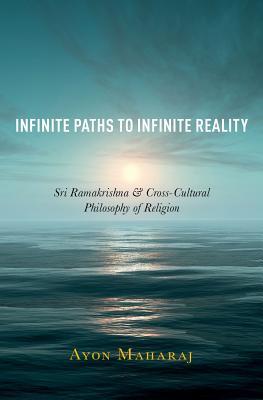
INFINITE PATHS TO INFINITE REALITY
Sri Ramakrishna is widely known as a nineteenth-century Indian mystic who affirmed the harmony of all religions on the basis of his richly varied spiritual experiences and eclectic religious practices, both Hindu and non-Hindu. In Infinite Paths to Infinite Reality , Ayon Maharaj argues that Sri Ramakrishna was also a sophisticated philosopher of great contemporary relevance.
Through a careful study of Sri Ramakrishna's recorded oral teachings in the original Bengali, Maharaj reconstructs his philosophical positions and analyzes them from a cross-cultural perspective. Sri Ramakrishna's spiritual journey culminated in the exalted state of " vijñana , " his term for the "intimate knowledge" of God as the Infinite Reality that is both personal and impersonal, with and without form, immanent in the universe and beyond it. This expansive spiritual standpoint of vijñana , Maharaj contends, opens up a new paradigm for addressing central issues in cross-cultural philosophy of religion, including divine infinitude, religious pluralism, mystical experience, and the problem of evil.
Sri Ramakrishna's vijñana -based religious pluralism--when grasped in all its subtlety--proves to have major philosophical advantages over dominant Western models. Moreover, his mystical testimony and teachings not only cut across long-standing debates about the nature of mystical experience but also bolster recent defenses of its epistemic value. Maharaj further demonstrates that Sri Ramakrishna's unique response to the problem of evil resonates strongly with Western "soul-making" theodicies and contemporary theories of skeptical theism. A pioneering interdisciplinary study of one of India's most important philosopher-mystics, Maharaj's book is essential reading for scholars and students in philosophy of religion, theology, religious studies, and Hindu studies.
Through a careful study of Sri Ramakrishna's recorded oral teachings in the original Bengali, Maharaj reconstructs his philosophical positions and analyzes them from a cross-cultural perspective. Sri Ramakrishna's spiritual journey culminated in the exalted state of " vijñana , " his term for the "intimate knowledge" of God as the Infinite Reality that is both personal and impersonal, with and without form, immanent in the universe and beyond it. This expansive spiritual standpoint of vijñana , Maharaj contends, opens up a new paradigm for addressing central issues in cross-cultural philosophy of religion, including divine infinitude, religious pluralism, mystical experience, and the problem of evil.
Sri Ramakrishna's vijñana -based religious pluralism--when grasped in all its subtlety--proves to have major philosophical advantages over dominant Western models. Moreover, his mystical testimony and teachings not only cut across long-standing debates about the nature of mystical experience but also bolster recent defenses of its epistemic value. Maharaj further demonstrates that Sri Ramakrishna's unique response to the problem of evil resonates strongly with Western "soul-making" theodicies and contemporary theories of skeptical theism. A pioneering interdisciplinary study of one of India's most important philosopher-mystics, Maharaj's book is essential reading for scholars and students in philosophy of religion, theology, religious studies, and Hindu studies.
372 pages, Hardcover
Published November 8, 2018
Ratings & Reviews
Friends & Following
Create a free account to discover what your friends think of this book!
Community Reviews
Displaying 1 - 2 of 2 reviews

April 11, 2022
This is a fascinating attempt at bringing Sri Ramakrishna into conversation with contemporary philosophers of religion (a subset of philosophy in which I am deeply unexperienced). I think this is required reading for those (like me from a while back) who believed that Sri Ramakrishna was an unlearned mystic, and it was only his disciple Vivekananda who transformed Ramakrishna's mysticism into a coherent world philosophy. Instead, this book has made me increasingly interested in exploring Sri Ramakrishna beyond the shadow of his most famous disciple. I hope to read his Gospel sometime this year, and expand my spiritual gluttony.

July 8, 2023
One of the best books of religious philosophy I have read lately. Ramakrishna's pluralist perspective is much more constructive and appealing than Hick's. While I cannot say I agreed with every argument or opinion (particularly on the subjects of karma, rebirth, and theodicy) I nonetheless found the entire read lucid and well thought out. Highly recommended.
Displaying 1 - 2 of 2 reviews