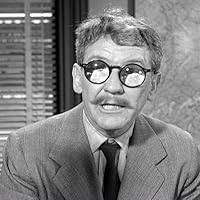
Fredric Brown was an American science fiction and mystery writer. He was one of the boldest early writers in genre fiction in his use of narrative experimentation. While never in the front rank of popularity in his lifetime, Brown has developed a considerable cult following in the almost half century since he last wrote. His works have been periodically reprinted and he has a worldwide fan base, most notably in the U.S. and Europe, and especially in France, where there have been several recent movie adaptations of his work. He also remains popular in Japan.
Never financially secure, Brown - like many other pulp writers - often wrote at a furious pace in order to pay bills. This accounts, at least in part, for the uneven quality of his work. A newspaperman by profession, Brown was only able to devote 14 years of his life as a full-time fiction writer. Brown was also a heavy drinker, and this at times doubtless affected his productivity. A cultured man and omnivorous reader whose interests ranged far beyond those of most pulp writers, Brown had a lifelong interest in the flute, chess, poker, and the works of Lewis Carroll. Brown married twice and was the father of two sons.
Wow I didn't know what to expect except that this was heralded as one of the best humorous alien invasion novels of all time. Upon reading, it worked quite nicely as pure satire. It didn't even have a tongue in cheek vibe to it. Instead, overnight, we've got 60 million little green aliens from Mars standing around in our living rooms heckling everything we do.
Yikes! This is the complete reversal of MST3K!
And nothing is off limits. Humanity is their version of animals in a zoo, and we can't even blast them away since they just teleport by thought. Yikes!
Better yet, things get wonky in a completely different way, too. Writers and fans of writers who write about writing will get a big kick out of this twist. No spoilers. But it was delightfully hackneyed.
Now, in case you're wondering, it really doesn't have much in common with Mars Attacks, but you know, I like both of these, so for me it's a win/win.
This is a great quick read, and it's thoroughly enjoyable. Absolutely fun, fast paced, and utterly solipsistic. Not that it's a bad thing, mind you. In fact, in this novel, it's pretty fantastic.
Frederic Brown (1906-1972) was an American science fiction, fantasy, and mystery writer. He was also a very funny writer, one of a very few in the SFF field (another being Robert Sheckley). This book, "Martians, Go Home" (love the title!) is perhaps his most famous work. Certainly, the paperback cover showing a Martian as rendered by Kelly Freas is one of the most memorable covers in science fiction and a good reason to read the book ( all right, all right, I know-don't judge a book by its cover!). The book was published in 1955, as an expansion of a story published in "Astounding Science-Fiction" in 1954. Brown looked ahead to the futuristic world of 1964. There's no President Lyndon Johnson; it's a President Ralph Wendell. The space race is on; the USA is constructing a space station to enable it to reach the Moon. And then the Martians arrive--one billion little green men, capable of teleporting anywhere they want. And they speak all human languages. They are annoying and obnoxious-- and everywhere. They do not deliberately harm humans but they are certainly the cause of many accidents, as you might imagine. And they can't be driven away or harmed.. What can be done about them? I enjoyed the story, especially as it didn't go on too long ( at 163 pages). However, I give it 3 stars rather than 4 or 5 because of Brown's depiction of Africans. It was actually embarrassing for me just to read. I think making black people merely figures of fun for purposes of the story showed a lot about the sensibility of the 50s culture, dominated as it was by white males-- but beginning to change.....Aside from the section of the book dealing with the Africans, this is an excellent--and fun--read.
From the title we could expect another invasion from Mars novel, but in light/humor tone. After read it, I put this story as feel-good story. There is not much trope conflicts.
I admit the invasion on this novel is different, I never imagine this kind of invasion. It is not the standard invasion by using UFO and laser beam weapons.
Can't say much without risking a spoiler. I don't rate it five star because I wish the story could be longer and has more explanations.
Oh Mr. Brown, master of the short form, why was this a three part novella? I know the publishing world of the time liked serials and extended shorts, but your lovely idea almost completely suffocated beneath the weight of all those words.
Your idea of the annoying alien is classic. It doesn’t kill or even touch. It does ruin life and every kind of human enterprise, big or small. Whether by announcing to a tribe’s quarry that the hunters are trying for a meal, so often that the tribe is plunged into starvation, or by making it impossible for humans to gather in groups for work or fun. Workers unable to produce anything over the noise of “bronx cheers” and insults and Martians giving away everyone’s cards at a relaxing poker evening. Even the soup kitchens are made intolerable by the Martians’ sickening pantomimes in the food. Not to mention that all forms of privacy disappear overnight. Soon everyone needs a minimum of ear plugs and eye shades to try to sleep, and a wish on a star, that when they do dream, it’s not of more martians.
I think this book may be one of the best example of why one shouldn't judge a book by the film that was based on it. The film that was based on this novel stared Randy Quaid, and was in my view dreadful. The film makers lost pretty much all the humor from the novel when they made it into film. Granted it is a low budgeter, but still, with talent they could have done something with it.
The book on the other hand is pretty good. It tackles the idea of what happens to a society that all of a sudden has to deal with the truth that it is hiding. All secrets come to the surface which causes, to put it mildly, some problems for everyone. I think James K. Morrow uses the idea of total truth better in City of Truth, but Martians, Go Home is way funnier. In fact it got me seeking out stories by Fredric Brown.
In 1964, the planet Earth was invaded by Martians. Turns out, they really were little green men. Standing about two and a half feet tall, they were more like evil leprechauns than extraterrestrials.
And, it turns out, their sole purpose for visiting was to annoy us.
Because they used their own version of astral projection, they weren't really there, and it was impossible to punch, shoot, or strangle them as they mocked, argued with, and basically drove people out of their minds . . . though the ones that were driven mad turned out to be the lucky ones.
This fun, silly read would make a good palate cleanser between heavier novels.
less outright hilarious or funny, than it is infinitely amusing in the best of ways. i just kept reading on, perpetually amused by what was happening and grinning to myself.
the story? alright — imagine it’s 1955 and one day you wake up and “little green martians” have invaded earth. except no one can touch or harm them since they’re more like apparitions or holograms and there’s millions of them all around the world, everywhere.
Martians invade the Earth, mostly just behaving obnoxiously and trying to watch grown-ups having sex; not much different from teenage boys when it comes right down to it. As often happens with humorous Sci-Fi, most of the laughs end up merely as smirks, and in this case the 50s slang - all men are "Mack" and dames, I mean women, are all "toots" - didn't age well. But the story actually takes a shallow dive into metaphysical solipsism, adding some welcome depth to what could have been merely a pulpy trifle.
Welcome to a planet size Zoo! I have good news and bad news!
The good news is that we are not alone in the Universe. There is intelligent Life out there, and the aliens have decided they want to contact us here on our tiny planet.
The bad news is that same aliens have a very poor opinion of humanity, are derisive of our claims to be an intelligent species (what’s with all these wars, nuclear bombs and extinction events?) and they treat us way worse than we treat other inferior species that we put in cages for our entertainment.
We are the inmates and not the tourists in this Zoo!
>>><<<>>><<<
The Martians have come, not in a single flying saucer or with advanced teams of scientists to prepare the ground, but all at once in a horde of a billion or so little green, bald, angry men. About one for every three humans living on Earth in 1964. They’re everywhere, popping in and out of existence [they call this ‘kwimming’], speaking fluently every language known to Man, curious about everything we do, in particular about our love life and our military secrets. Oh, and they are definitely not shy about sharing their opinions about Earth and about humans.
... one and all they were abusive, aggravating, annoying, brash, brutal, cantankerous, caustic, churlish, detestable, discourteous, execrable, fiendish, flippant, fresh, galling, hateful, hostile, ill-tempered, insolent, impudent, jabbering, jeering, knavish killjoys. They were leering, loathsome, malevolent, malignant, nasty, nauseating, objectionable, peevish, perverse, quarrelsome, rude, sarcastic, splenetic, treacherous, truculent, uncivil, ungracious, waspish, xenophobic, yapping, and zealous in making themselves obnoxious to and in making trouble for everyone with whom they came in contact.
>>><<<>>><<<
This is a classic alien invasion novel, modelled on H G Wells and presented in Pulp Magazine fashion [fast and entertaining]. Fredric Brown delights in sabotaging the genre expectations of heroic earthlings fighting against devious invaders while holding on to a damzel in scant, ripped clothing. His tongue is firmly placed in his cheek right from the start, but there is something solid, something sharp and observant behind the comedy. Brown is not satisfied with milking the premise for laughs, he goes for the social satire: maybe we have invited such abusive behaviour from the Martians with the way we have been treating each other and the planet lately. Maybe a society that collapses so easily under the onslaught of denial of privacy was built on rotten principles to start with.
What could the little green goblins want with us? To help us overcome our own idiocy? Or to try to stop us from exporting it to the stars? Since they are not stopping down to explaining their motives to us, bumbling unevolved monkeys, how can we convince them we are smart? How can we make them go away?
>>><<<>>><<<
I really like the way Fredric Brown presents his ideas, here and in the few other novels and stories by him that I read. Trained in the pulps, he never loses sight of the need to tell an engaging story, and he never fills the page with unnecessary bloat. And he has a mean and dirty sense of humour. I don’t think he gets enough credit for helping transition science-fiction from cheap entertainment to ‘serious’ literature. Probably because he is overshadowed by the big guns that came to fame soon after him (Asimov, Clarke, Heinlein), even as the same big guns pay homage to him in their introductions to more famous novels. Heinlein in particular dedicates ‘Stranger in a Strange Land’ to Brown, and when you stop and think about it, there is a connection there: from the ‘kwimming’ of Brown to the ‘grokking’ of Heinlein. Both novels look at our planet through the eyes of visiting Martians, either in derision or with a Messiah complex.
Science itself is not thrown overboard in this light novel, even as the main attraction remains the satire and the unexpected consequences of having a permanent green ‘internet troll’ do a running commentary on your sorry excuse for a life [including your bedroom sports].
Could they not be two-dimensional beings whose appearance of having a third dimension was an illusory effect of their existence in a three-dimensional universe? Shadow figures on a movie screen appear to be three-dimensional until you try to grab one by the arm. Or perhaps they were projections into a three-dimensional universe of four- or five-dimensional beings whose intangibility was due to their having more dimensions than we could see and understand.
Most of the actual science is purely speculative, or pays once again homage to the Pulp Era [we might need a bigger anti-extraterrestrial subatomic supervibrator ]
For myself, most of the fun came not so much from the satirical look at society but from the metafiction angle that holds the novel together. Luke Devereaux is the first human to see a Martian, in his lonesome cabin somewhere in the Nevada desert, where he is struggling with writer’s block and while his editor is demanding the promised science-fiction adventure for the advanced money he already paid. We follow Luke as he tries to hold on to his sanity while the world around him collapses into a deep recession. This is a losing battle that apparently the Martians consider highly entertaining. Is this whole Martian invasion simply the product of the alcohol-pickled and anxiety-tortured mind of a cheap writer? Read to find out!
This has to be one of the most hilarious science fiction novels ever written. Frederic Brown (1906-72), who had spoofed space opera with What Mad Universe in 1949, returned a few years later to write the perfect alien invasion novel, Martians, Go Home. Brown was in rare form with this book. It was the triumph to his prolific writing streak in the 1950's. Luke Deveraux is a failed writer specializing in science fiction who's decided to shack it up with a friend in the desert so he can work on another book. He's also failed in his marriage and is smarting from the divorce wounds. One morning, after suffering from the latest drunken binge, he awakes to find a little green man at the front door. Thinking this is the result of too much alcohol he makes his way to a nearby diner only to discover there are little green men everywhere. Earth has been invaded. But this isn't the usual 'People Of Earth" invasion. The martians, and there are millions of them, have come to earth not to conquer, but to amuse themselves. They can teleport anywhere they want and see through objects. But anyone who tries to kick a martian finds their foot going through empty space. The martians have no material substance. Mass chaos breaks out as humanity has to concern itself with little green men who appear everywhere, making fun of people. The entertainment industry goes into a slump since it's impossible to produce anything when the martians teleport in and start making comments. A psychologist trying to conduct a seminar dealing with the aliens finds himself reduced to a gibbering mass. When a martian appears in his office, it begins revealing secrets about his personal life. Even primitive tribes suffer. They can't easily hunt wild game when little green men show-up and start scaring off the quarry. And everyone hears the martians make insults in their native tongue. Sexual activity nearly draws to a standstill. No one wants to make love when a little green man is likely to appear in their bedroom and start laughing. Although the over-riding issue of Martians Go Home seems to be about privacy and secrets, the novel also discusses solipsism towards the end of the book. Luke Deveraux suffers a shock and becomes one of the few people on the planet who can't see the martians. From here, he begins to wonder if the martians were created by his own imagination. It's an issue which the book never really resolves, down to the authors own postscript where he points out: "I invented Luke. So where does that leave him or the martians? Or any of the rest of you?" I'd like to answer, but there's this little green man who keeps telling me to type faster.
”Harassed, heckled, hounded, helpless, hamstrung, harried and harrowed, the average citizen of the average country looked with heartfelt horror to a hideous future and hankered hungrily for a return to the good old days when his only worries were death, taxes and the hydrogen bomb.”
From 1955 Martians appear all over our world, irritating us, flying all around, seeing and hearing all. Some people think they are not aliens but green devils sent from Hell. This book gets very thorough, detailing the ways these Martians destroy our economy and international political relations. But was the whole thing actually the creation of a Science Fiction writer?
I expected a comedic book about annoying Martians, and I got a book about a solipsistic writer instead. If Frederic Brown were still alive today, I would punch him in the mouth and ask him if he imagined it.
Sorry. I just have strong feelings about solipsism.
Allow me to start again. Martians, Go Home has a killer premise. It’s a Martian invasion, but with a twist: the little green men are just here to annoy humanity for kicks. The Martians are intangible, inescapable, and intolerable. They can go anywhere at any time, and all they want to do is harass us lesser beings. They allow no secrets; everything from infidelity to secret military installations are revealed to the world. That sounds like the setup for a comedic classic to me.
I expected Looney Toons antics, but the humor is much more reserved and much drier. I think it was counting on the situations being so inherently funny that a straight account would make the reader laugh. Based on my mother’s reaction to my retelling of the book, it worked.
I found the writing to be on the better end of 1950s science fiction. It is no great literary achievement, I guess, but it is straightforward and serviceable. It is firmly tongue-in-cheek. If you are interested in the concept, the writing style should not be an obstacle.
For a 1950s novel, there is thankfully not much sexist, racist, or homophobic content. To be fair, there are not many women or PoC characters, and I cannot remember any queer characters. The primary female character, Margie, has a job and is treated with respect. (The Martians do call all women “toots”, but it is portrayed as inappropriate and obnoxious.) Unfortunately, the only PoC characters are African cannibals and a Japanese leader who commits harakiri. Yikes.
I find the cultural details in novels of the era fascinating. You get a window into what life was like back then. Of course, I checked all the prices in an inflation calculator. I also noticed little things like coin operated radios in hotel rooms and job agencies that required payment for registration. Little things like that really make it clear that life in the 1950s was very different.
To be perfectly honest, I cannot recommend Martians, Go Home. It was a fine diversion, but I do not think it will stick with me anymore than the notion I had before reading.
Underrated! I thoroughly enjoyed this light read, that offers multitudes of chuckles, and a story that initially appears to be shallow but has a number of interesting ideas regarding paranoia, faith, and the futility of war.
Martians invade Earth. No one knows why they’ve arrived. The only objective they seem to have is to observe, mock and belittle everyone. No one can harm them as they are almost transparent and can teleport at any moment. In turn, they cannot directly hurt anyone either, although their juvinile behaviour proves to be chaotic.
Clearly, this isn’t your standard invasion story. Earthlings are treated as primitive, emotionally driven, and self destructive creatures. Privacy is non-existent, and they are essentially impotant against their green, pesky, mischievous invaders.
Whilst I understand it could be considered too light for some Sci-Fi fans, the solipsistic themes and highly entertaining plot makes Martians, Go Home a great experience.
This book isn't spectacular, but rather a nice amusing little tale that one can devour in a couple of hours. Simply put, the book is about a Martian invasion of Earth. Unlike The War of the Worlds however, the Martians here aren't out to conquer the Earth. Instead they've come to observe and heckle it. To quote the back cover of the Del Rey October 1981 edition, Brown's Martians were "obnoxious green creatures who could be seen and heard, but not harmed, and who probed private sex lives as shamelessly as they probed government secrets." It makes for an amusing tale, and for something first published in 1954, it reads quite well. Aside from obvious anacrhonisms like typewriters (remember those?) and the cold war, the story could have been written today. (Or maybe I'm just getting old.)
Género. Ciencia-Ficción (marginalmente, en realidad).
Lo que nos cuenta. Luke Deveraux es un escritor en horas bajas que busca en el alcohol y el aislamiento una inspiración para crear cuando, a la puerta de su cabaña, llega un pequeño hombrecillo verde. Es uno de los marcianos que nos han invadido, pero sin ánimos belicosos y si con enorme curiosidad, capacidades muy superiores a las nuestras, tendencia al cotilleo, falta de tacto y gusto por molestar. El mundo cambiará por completo.
¿Quiere saber más de este libro, sin spoilers? Visite:
“But one and all they were abusive, aggravating, annoying, brash, brutal, cantankerous, caustic, churlish, detestable, discourteous, execrable, fiendish…. uncivil, ungracious, waspish….”
The year is 1964. Thirty-seven-year-old Luke Deveraux, experiencing some serious writer’s block while sitting in his shack in Indio, California, is on his way to getting roaring drunk. Things will be getting quite a bit more complicated for our protagonist—and everyone else-- in the next few minutes, the moment that “they” arrived.
This is my second science fiction read from Frederic Brown and what I can gather so far is he has quite an imaginative and creative way to bring a science fiction story to life. And he has quite the knack for satire and humor, which is perfectly displayed in Martians, Go Home.
When we think of Martian invasions from films and books, we often think of menacing invaders coming to Earth and destroying us with sophisticated means. This Martian invasion here to planet Earth is a different one altogether. They observe, they mock, they annoy, they yell, and by doing so, they are driving humans out of their minds.
So, Brown really does a whole number on what we think of when we think of the alien invasion scenarios or those classic 50s science fictions with beings coming to terrorize us. By all means, the Martians in Brown’s novel do terrorize (that is, if being the most annoying thing ever is a form of terrorizing).
Brown satirizes the science fiction genre to a tee. So many prominent members of society have fallen victim to the annoyance of these little creatures, but what can be done?
Can we possibly count on Luke to be the answer to making these annoyances go away?
This is a light, silly, humorous read, one that I think is perfect for a summer reading experience or to divert your attention from a more serious read.
Creo que es una de las historias de invasiones extraterrestres (o no, la verdad es que tampoco estoy seguro) más disparatada, entretenida y divertida que he leído. Y, de paso, una de las lecturas que da más pie a reinterpretaciones y discusiones frikiológicas.
ENGLISH: The description of the catastrophic effects on human society of the invasion of the Earth by one billion Martians at the same time, reminds strongly the effects of the COVID-19 pandemia. In this sense, this novel is prophetic. Brown has foreseen exactly the social effects of a catastrophic stop to the normal process of human society. Therefore this book complies quite well with the two golden rules of science fiction (see this post in my blog: http://populscience.blogspot.com/2021...)
But Brown makes Martians too lewd for my liking, especially given the date the novel was published (1955). And the ending was perfectly predictable.
ESPAÑOL: La descripción de los efectos catastróficos sobre la sociedad humana de la invasión de la Tierra por mil millones de marcianos al mismo tiempo, recuerda enormemente los efectos de la pandemia COVID-19. En este sentido, esta novela es profética. Brown ha previsto exactamente los efectos sociales de una parada catastrófica del proceso normal de la sociedad humana. Por lo tanto, este libro cumple muy bien las dos reglas de oro de la ciencia ficción (ver este artículo en mi blog: http://divulciencia.blogspot.com/2021...)
Lamentablemente, Brown hace a los marcianos demasiado procaces para mi gusto, especialmente dada la fecha en que se publicó la novela (1955). Y el final fue totalmente previsible.
Fredric Brown is one of those authors I would have skipped over all together if not for an online article that mentioned how good (and how funny) his novels were. This same article noted that some of his best ebooks were on sale, and ebooks being what they are, I felt pretty good about spending a dollar or two to check out the book. I'm glad I did.
Martians, Go Home is a clever book. It walks the fine line of serious fiction and absurdity, since it has something serious to say about humanity by tormenting us relentlessly with obnoxious Martians who want nothing more than to annoy us. On the one hand, we have Luke Devereaux, who is struggling with his writing, his wife, and his life in general, and that's the main character story; on the other hand, we have the Martians who force Luke and everyone else on the planet to reconsider how they treat one another, and that's the main theme. It reminds me a little of Terry Pratchett's work, as he was also able to balance the serious and the absurd.
The Martians take center stage in the story, as billions of them arrive on Earth at the same time. They're incorporeal, but that doesn't mean they're helpless; they have X-ray vision and the aptitude to learn languages in a matter of hours, so they're able to learn all of everyone's secrets. They also have the ability to teleport from place to place, so whenever someone tries to speak, the Martians interfere, telling hidden truths and exposing people in their own half-truths. There seems to be no point to their antics, save to annoy everyone on Earth, since they can't touch or otherwise interact with humans. And they just. Won't. Leave.
This novel incorporates the adage "He who is enemy to my enemy is my friend", as even those countries embroiled in the Cold War are forced to work together to try to rid the world of the Martians. The story jumps between what's going on with Luke and what's going on with the world in general, and it's a good way of pacing the story. Luke as a character serves as our connection to the story, but the world in general is where the science fiction aspect of the story comes into play. Considering that this novel was written in the 1950s makes it even more impressive.
Unfortunately, because the novel was written in the 1950s, there are a couple of unfortunate cultural stereotypes. I have to give Brown credit for not making Margie, Luke's wife, some simpering housewife (she is, in fact, a smart, strong, no-nonsense, hard-working character), but near the end of the story, he travels to Africa, which is populated with cannibalistic, medicine-man-populated savages. It was one of those moments where, if you were having a conversation with someone and they said something like that, you would have pulled that face (you know the one I mean), leaned back, and said, "Really?"
Otherwise, though, the novel is well-written, well-paced, intriguing and engaging, and has an ease of reading I wouldn't have expected for a novel its age. And it's funny! My favorite gag is when the unnamed, omniscient narrator asks someone with a thick Cockney accent to explain something in his own words, and then after a paragraph of that, he breaks in and says, "Maybe you'd better let me tell what happened, in my words."
From the twisted mind of Fredric Brown comes this comical tale of one man battling little green pains in the butt from Mars. The Martians couldn't be less friendly as they invade Earth and cause total...Destruction? ....Annihilation? ...Chaos? No, just...minor inconvenience. But, why? Why not!? Struggling writer, Luke Deveraux tries desperately to fix his crumbling life in the wake of an extremely annoying alien invasion. What would happen if Martians could pop up anywhere at any time in any situation? Luke Deveraux is about to find out in Martians, Go Home. Watch my full review here: https://youtu.be/rpDTcdTVe8I
Where H.G. Wells had Martians try to conquer the Earth through superior technology, Frederic Brown has them succeed by the power of being ultra annoying. They literally bother people into madness, destroying first the entertainment industry and with it, the whole global economy. In doing so, they often annoy the reader as well. What starts out as somewhat humorous banter quickly becomes amazingly irritating, which lends credence to Brown’s premise.
If this wasn’t such a short book, I don’t think I would have ultimately gotten through the whole novel. But I’m glad it was short and I’m glad I finished this very unique take on first contact and alien invasion.
Divertida y disparatada historia que seguro que hará pasar un buen rato a cualquier lector de Ciencia Ficción y/o humor que quiera apartarse unos días de historias profundas y complicadas.
Aunque si escarbas, el texto tiene cositas interesantes.
Recuerdo que me daba mucha risa, el caos que causaban los marcianos, algun dia lo volvere a leer
Marciano Vete a casa
Relectura 2021
Ah como me reí, fue genial leerlo de nuevo, divertirme con las travesuras de los marcianos, los problemas que causaban, las teorías de los humanos, si una sci-fi muy ligera, pero divertida a raudales
A pesar de que esta historia ya tiene algunos añitos me ha dejado fascinado. La elegancia con la que entremezcla Brown el surrealismo y el humor es maravillosa. Me he reído mucho y sin muchas pretensiones he disfrutado como un niño. Solo puedo decir una última cosa: ¡¡¡Marciano plasta vete a casa!!! 😜