Jump to ratings and reviews
Rate this book
Rate this book
In a split second, everything changed for Meiko Inoue.

But time continues to unfurl, whether we like it or not.

Now, ten years later…

Kindle Edition

First published October 30, 2017

14 people are currently reading
305 people want to read

About the author

Inio Asano

115 books2,712 followers
Inio Asano (浅野いにお, Asano Inio) is a Japanese cartoonist. He is known for his character-driven stories and his detailed art-style, making him one of the most influential manga author of his generation.
Asano was born in 1980 and produced his first amateur comics as a teenager. His professional debut happened in 2000 in the pages of the magazine Big Comic Spirits. Since then, he has collaborated with most of the major Japanese magazines of seinen manga (comics for a mature audience). Among Asano's internationally acclaimed works are: the psychological horror Nijigahara Holograph (2003-2005); the drama Solanin (2005-2006); the existentialistic slice-of-life Goodnight Punpun (2007-2013); the erotic A Girl on the Shore (2009-2013); the sci-fi Dead Dead Demon's Dededede Destruction (2014-2022).

Ratings & Reviews

What do you think?
Rate this book

Friends & Following

Create a free account to discover what your friends think of this book!

Community Reviews

5 stars
111 (26%)
4 stars
164 (38%)
3 stars
121 (28%)
2 stars
22 (5%)
1 star
4 (<1%)
Displaying 1 - 30 of 45 reviews
Profile Image for Paul Spence.
1,573 reviews72 followers
July 27, 2019
Way before Inio Asano became one of the most recognized, loved and respected mangaka today with hits like Goodnight Punpun, Girl on the Shore, and Dead Dead Demon’s Dededede Destruction, he published a 2-volume series on a young adult couple trying to make something of their lives with music called Solanin. I wrote about the manga many years ago and enjoyed its take on what it means to have freedom as you get older.

An epilogue chapter was released 11 years later in Japan and also in English 10 years after the original VIZ Media release. I want to talk about it because at some point in our lives, we often look at our younger years with some criticism.

To sum up Chapter 29 (the original manga ended in 28 chapters), Meiko Inoue, the female lead, is going through life in her ‘30s. She has a new boyfriend named Yuki and is pregnant with his child. Her best friend, Ai, is still around, while two of her former band mates, Kato and Billy, are still performing in shows. In the end of the chapter, Meiko comments about the period she went through with her then-boyfriend, Taneda Shingo, who was killed in an accident. She wonders about what she and her friends were trying to chase with their freedom in their ‘20s. Meiko then notes that while her life is now dull, she’s content with living her life as a future mother to the end.

The epilogue can be considered an ambiguous closure to a series that had a somewhat happy ending. Solanin’s ending had Meiko take over as band leader for Taneda’s band and pursue something bigger than herself. You can say that Meiko grew out of it in the epilogue. Or you can look at it this way - her priorities changed as she continued to age.

What’s fascinating about the Solanin epilogue is that Asano seems to take a play at the idea of a “true self.” The true self suggests that we are deep down, good people who want to do well in life and help others. During her ‘20s, Meiko kept wanting to find her passion in life. She wanted to look for her true self. The 2017-2018 version of Meiko is a lot more realistic about her aspirations. The Meiko in her ‘20s would look down on today’s Meiko or wouldn’t foresee her future in that way.

Meiko reminisces about why she went after the demon that was freedom in the past. What was the point if in the end, she would lose? We live in a time where a lot of young people have the freedom to choose what they want to be, yet ironically, we have rising rates of depression and anxiety among the youth. What Meiko seemed to have settled into was the idea that opportunities can be found in areas that may not be exciting to her at first. She found joy in being in the safety of a man who truly cares about her. Meiko developed a new passion - protecting the people she cares about.

Asano did an afterword about Solanin in the epilogue and talked about what the epilogue was trying to say - there’s no clear answers to life, we’re not always gonna achieve our dreams, and nothing lasts forever. However, all we can do is focus on the present and change ourselves as needed. I do think that Asano is trying to preach what it really means to be mindful. True mindfulness is looking beyond yourself. A lot of what’s mindfulness in the modern world is about relieving your own stress, when in terms of the Buddhist principles behind it, mindfulness is about being in touch with what you’re feeling at the moment (good or bad), noticing what’s around you, and not running away from those feelings/thoughts.

That’s how I sum up the new Meiko - she’s just become super-aware, feels somewhat crappy about how life has gone for her, navigated her thoughts, and made peace with those feelings by accepting them. As a result, she’s happy, according to the words of her best friend, Ai.

Meiko’s new path isn’t going to be liked by many and might be treated as “totally Asano (ie depressing, open-ended ending).” However, one can see it like this - even though loss will happen, one of the things that comes out of loss is meaningful connection with others. We may feel vulnerable, but we feel joyful when our negative experiences are shared and validated. Never forget that human beings were born to stick together in groups through tough times.

And that is a melody worth singing to the end of time~
Profile Image for MAILA.
481 reviews120 followers
August 30, 2018
MEIKOOOOOOOOOOOOOOOOOOOOOOOOOOOOOOOOOOOOOOOOOOOOOOOOOOOOOO


not the best ending, but still good.

Meiko saja bisa.
Maka kamu pasti juga bisa, Mai.
Profile Image for Sylvia Joyce.
Author 1 book9 followers
January 9, 2023
This was closure to one of the most impactful stories I’ve encountered in my short life. I waxed poetic about it in another pretentious review, but solanin perfectly captured every confusing little feeling I’ve been feeling on the younger half of 25.
Profile Image for Raoul Brancaccio.
18 reviews
January 3, 2022
Per quello che è (un epilogo breve di ~45 pagine scritto 10 anni dopo dove si vede l'evoluzione anche della prospettiva dell'autore) fa il suo lavoro e lo valuto positivamente per questo, però non è per nulla essenziale.
Profile Image for Aitor.
294 reviews4 followers
April 10, 2021
RETROSPECTIVA INIO ASANO #5.2

”There’s a demon lurking in Tokyo.” That’s how I used to feel, ten years ago. We were unarmed, but we still randomly tried to take on the invisible fiend. But what were we really fighting back then? And did we end up losing? Now I have something to protect. […] There’s no going back. I’ve walked too far away now. And I have to keep moving forward. Even if the going’s’ tough and I have to keep on to the very ends of the earth.

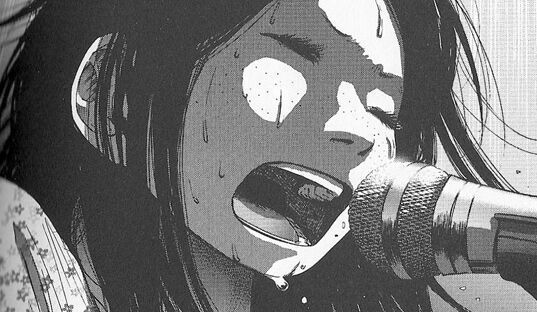
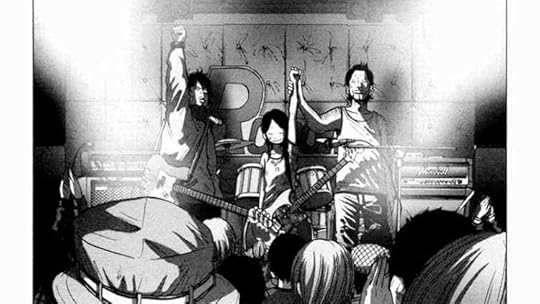
Desde que vi anunciado que habría un capítulo epílogo nuevo, diez años después, para Solanin, me surgió una pregunta. ¿Para qué? No parecía un pilladineros, mucho menos una promoción de la obra original. Sí, era un extra para una edición especial en formato grande que iba a salir en Japón, pero tampoco parecía una razón lo suficientemente válida como para continuar la obra. No es hasta ahora, una vez leído, que lo he comprendido.

Estos dos capítulos extra de Solanin son, como bien dice la compilación de esta edición en inglés, un epílogo al manga. Uno de ellos data de 2010 y parece más un afterthought que un aporte inteligente a la historia original; el otro, de 2017, es el que me suscita genuino interés.

Pero empecemos por el primero, “Awaiting Spring”. Considero que Asano se queda a medias con este capítulo. La pareja que lo protagoniza se encuentra en una situación similar a aquel discurso maravilloso de Meiko sobre Taneda: una sensación de desequilibrio de la que prefiere evadirse. Sin embargo, hasta que llegan esas últimas cinco páginas, se da vueltas sobre lo mismo: encontrar piso, charlar un rato y montarse teorías locas sobre los antiguos inquilinos del apartamento. En cierto modo, es una forma bonita de recordar Solanin, pero no creo que vaya más allá y el mensaje final, esa idea de mantener la esperanza de que llegue la siguiente primavera, tampoco resulta especialmente novedoso. Lo que sí demuestra este capítulo por lo demás bastante flojo es que Asano ha mejorado una barbaridad como dibujante. Es posible que no tenga esa alma juvenil de la obra original, pero es un estilo maduro que ya domina el paneling y podría cuadrar en cualquier exposición de arte. Los fondos son más hiperrealistas que nunca, los diseños están cuidados hasta el mínimo detalle y los ángulos de cada imagen van cargados de significado. Es, sin duda, lo mejor que puedo sacar de “Awaiting Spring”.

El segundo capítulo de esta compilación cumple con aquello que el otro no podía: ser un epílogo a la obra original que aporta una nueva visión sobre sus personajes sin olvidarse de dónde vienen. En mi reseña de Solanin hablaba de cómo veía a Asano reflejado en su obra: joven, inseguro, buscando su lugar en el mundo y con cierto aire de rebeldía. Once años después, vuelvo a sentir lo mismo, de una manera radicalmente opuesta. Este Asano es un hombre maduro, acomodado a una rutina y encajado en el engranaje de la sociedad. Sigue siendo él, por supuesto, y esa ligera desgana por la comodidad de la vida moderna está presente en todo el capítulo. Proyectado en el dibujo, veo a ese Asano ya acostumbrado a una fórmula visual que le funciona con unos diseños muy reminiscentes de Dededede; tanto que Billy parece un personaje completamente distinto, Kato cuesta diferenciarse de Hiroshi en Dededede y Meiko pasa de ese diseño tan potente de la obra original a un personaje del montón. En cierto modo, se adecúa a la aceptación de la nueva vida por parte de Meiko, insertada ya en la rutina social. Sin embargo, no puedo dejar de pensar que el dibujo, aunque asombroso, ha perdido parte de la identidad original.

En cierto modo, eso es lo que sucede con este capítulo: el espíritu rebelde de Solanin se ha convertido en la comodidad lógica y realista que confieren los años de madurez. Meiko es una mujer con familia, contenta, en cierto modo a su pesar, con el rumbo que ha tomado su vida. Billy y Kato apenas parecen haber cambiado y se muestra la solución de Meiko como la más adecuada: entrar en el engranaje social tanto como el Asano que habla en el revelador postscript. No deja de ser triste que los sueños de Solanin se hayan quedado en aquel glorioso concierto, pero resulta un final lógico dentro de la filosofía realista de Asano: así es la vida. Con sus altos, sus bajos y, cómo no, sus rutinas.

Resulta gracioso y algo irónico pensar que, en mi retrospectiva de Asano, estos dos capítulos no pintan nada tan pronto. A pesar de haberlos leído justo después de Solanin, su tono, ideología y dibujo representan a un Asano muy distinto que ya ha pasado por Buenas noches, Punpun. Era de esperar dadas las fechas de publicación, pero no he podido evitar pasar directamente al epílogo tras leer la obra original. Supongo que, cuando llegue a este año de publicación, retocaré un poco la reseña para que encaje dentro de la retrospectiva. De todos modos, esta lectura continuada me ha permitido ver la evolución de Asano de una manera tan brusca que casi ha aportado más que comprobar sus ligeros cambios ideológicos a lo largo de los años. Con la ventaja de haber leído la mayor parte de la obra de Asano con anterioridad, soy capaz de apreciar las diferencias entre el Asano de veintipocos años y el que ya supera la treintena. Prefiero, sin duda, ese espíritu rebelde de Solanin, no por ser lo correcto, sino por captar de manera tan descarnada ese paso de la adolescencia a la madurez que en este epílogo se consagra decididamente.
Profile Image for Derek Royal.
Author 16 books74 followers
June 11, 2018
A fine epilogue to a book that easily stands on its own. But it's nice that Asano felt the desire to briefly return to his earlier work. After all, Solanin is a work that many people know Asano by.

And thanks to my friend, Pascal Hamon, for getting me this TCAF Exclusive volume while he was at the Toronto convention. The paperback was only available there. (There is a Kindle version available.)
Profile Image for firewokwithmee.
96 reviews1 follower
December 28, 2022
ya know it really is nice to have an author revisit an old story and let you know how things have been since you last saw them in real time. i do love that this has a lot more to say without actually saying them? how we move on from loss or how we settle into our new lives is something we can rarely comment on in the present. seeing some characters still do the same ol same ol or see Meiko move on in the ways that she has, both paths are lovely tbh!
Profile Image for Sem.
609 reviews30 followers
September 22, 2020
I could write a whole essay on how the differences (thematic and stylistic) between this and the original work mean so much and say so much about Asano and how he experiences the world (also, that afterword!) but instead I'll just say it's a good epilogue to the manga.
Profile Image for Kulwinder Singh.
580 reviews101 followers
July 16, 2021
I don't think this epilogue was really necessary because it didn't add anything meaningful to the original story. It only threw some light on Meiko's life after ten years. What about the whole gang?
Profile Image for VM.
111 reviews6 followers
February 14, 2022
im sorry for adding this but i am so behind on my reading goal you guys.

in terms of the actual epilogue: lowkey annoyed with who she ended up with.
Profile Image for Jon Ureña.
Author 3 books121 followers
October 2, 2019
Three and a half stars.

When I visited my local comics shop hoping that they could locate the seventh volume of "Oyasumi Punpun" in Spanish (they could not; its publisher hasn't renewed its stock in quite a while, and I still don't have a copy), I found a tenth year edition of Asano's second best manga: "Solanin", an idealistic, generally optimistic story about a couple of young adults who decide to give their last shot at personal meaning before surrendering to the deadening routine of some nameless office. After I reread it I found out Asano added an epilogue produced about ten years later.

The first obvious thing is how the art style has changed. Asano uses his new comfortable style from "Dead Dead Demon's Dededede Destruction". In two pages of comments after the epilogue ends, Asano mentions that he was surprised by how poor his previous style was at times, particularly the composition of some shots. I prefer how he used to draw people's faces; Meiko's (the female protagonist from "Solanin") in particular seemed far more distinct before. Now, with Asano's current comfortable "cute" style, Meiko's features blend into something somewhat generic.

This epilogue was written around the time Asano was finishing "Reiraku", and shares plenty of the general vibe. The epilogue starts introducing a couple of young strangers, around the age Meiko and Taneda were when "Solanin" starts. She's looking to move into Meiko's previous apartment, that had remained unoccupied. I'm guessing the apartment held particular meaning for Asano given how during "Solanin" you can see actual photos of it. It wouldn't surprise me if it was the apartment that Asano lived at for a while. Also, the younger Meiko sort of resembled a past girlfriend that the author mentions in "Reiraku", so I wouldn't be surprised if he based Meiko's looks on that person as well. In any case, we learn that the new couple .

When we meet Meiko again we learn that in the world of the story .

Meiko gets together with her old friend Ai, whom we know from "Solanin". Ai has tickets for a concert of a band that features .

The saddest part happens when Meiko attends the concert. .

Meiko reminisces and compares her current self with her old one: .

We see Meiko for the last time as she, content with her day to day, vows to walk her current path no matter how hard it gets, to the end of the world if necessary.

This epilogue lacks the bite that "Solanin" itself had, but it was inevitable. The poisonous bite of something like "Oyasumi Punpun", and many other classics of fiction, couldn't have been faked: it came from an author that didn't know if he'd end up having to give up his dreams of supporting himself through his art, who had plenty of psychological issues to work through, who worried about the state of the world, who might have felt, somewhat recently abandoned, that his time was running out to find the love of his life, which we tend to believe for a couple of decades or so that it must be hiding somewhere. This epilogue, as well as the rest of Asano's latest stuff, is a product of someone who pays his bills comfortably, who has given up struggling against himself and against the world, and who, about to enter his forties, needs to start looking into growing old with as few troubles as possible. Good for him, as far as it pertains having to live a human life: if after "Oyasumi Punpun" he had still needed to struggle as furiously, raking his psychological state, who knows what hole he would have ended up in.


Profile Image for Nelson.
369 reviews18 followers
July 12, 2018
This tiny book contains the epilogue chapter #29 as well as the one-shot "Awaiting Spring" previously collected in Ctrl+T.

Awaiting Spring:
The first time I read Awaiting Spring online, I had it sitting at a 6 because the fan translation was just so poor that I didn't even understand certain plot points, but upon reading the official translation, I loved it. The official translation gets the poetic phrasing of Asano's writing perfectly. The story in itself is fairly simple, but it gets an 8 because it does exactly what it was intended to do: show that life goes on, other people are living their lives independent of you, and that the things you leave behind will be picked up by someone else.

Epilogue, Chapter 29:
As for chapter #29, I thought it was great. Much like Awaiting Spring, it achieves exactly what it means to achieve, and that is that time goes on, things change, and we must move forward. It is set about 10 years after the events of Solanin and mostly focuses on Meiko's life, but also shows where all the supporting characters have ended up. It continues the themes of the main story and puts a nice bow on the whole thing, all without invalidating or somehow souring the closure of the original ending. The most interesting thing about this chapter is seeing not only the characters' growth, but also Asano's growth as an artist. His art looks exponentially better here than it did in Solanin, with more realistic characters, better shading, and the use of his signature background technique. I thought it was clever to include this together with the one-shot which was done 5 years after Solanin and 5 years before the Epilogue, essentially showing the evolution of Asano's skill and techniques. One of my favorite things about this little book was the afterword, where Asano explains some of his reasoning behind the pivotal turning point in Solanin and reflects on his journey since then. It's hard to score one-shots, but this is easily a 10.

As a package, this little book couldn't be a more perfect cherry on top of an already delicious cake.
Profile Image for Ryan Caulfield.
3 reviews
July 20, 2018
Perfect. Dreams die, then different dreams grow back to replace the old ones, like a tree. “How are you feeling these days?” - Inio Asano
Profile Image for Jase.
58 reviews155 followers
November 13, 2021
This is what the title says implies, a short return by Inio Asano more than 10 years to to a year long slice of a life/coming of age series that ended in 2006.

I'm going to give this 5 stars but really only as a cap to entire series. Let me be clear in saying that this would be a completely useless read for anyone who hasn't read Solanin.

For people who have read Solanin it perhaps a perfectly imperfect and admirable afterword for at least one of the main characters and more than anything is a reminder of a great experience in reading of the past and elicits both the happiness of seeing old friends and the emotional shattering that Asano is well known for.

The release of this epilogue seemed fanciful when announced and upon reading it you are immediately put back into the reality of a character who has aged in real time since the last we saw them over a decade ago.

To date I think Asano has three perfect comics, all 3 different genres, to his name and it was a delight returning to one of them.
Profile Image for Maggie Gordon.
1,914 reviews162 followers
June 30, 2018
I will admit that I did not love Solanin, or even like it that much. But I have no idea that this Epilogue actually added. Not as bad as the Harry Potter epilogue, but non-offensive doesn't make it good.
Profile Image for Zian B..
2,320 reviews34 followers
February 15, 2020
This didn’t add too much to the original manga and left me confused as to who exactly was Meiko’s new lover is. There also wasn’t much insight as to what happened to the other characters that were featured, aka Meiko and Taneda’s friend group.
Profile Image for Persy.
1,079 reviews26 followers
April 3, 2024
“I can only express myself in words. So sometimes I tell myself silly lies.”

I’m just pure melancholy right now. Why do I keep reading such sad, yet strangely hopeful stories?
Profile Image for Michael Sorbello.
Author 1 book317 followers
December 10, 2020
Meiko has recently graduated from college and hates her new job as an office worker. Her boyfriend Taneda gets paid chump change for working long hours as an illustrator and hates his job as well. Both of them are unsatisfied with the way their lives turned out and struggle to find reasons to be happy. Tired of such a dull and depressing life, Meiko decides to quit her job on a whim and get in touch with some old friends from college who used to play in a band together with Taneda. After reuniting, everyone learns that none of their lives worked out the way they wanted and they grow closer as each of them struggle to find meaning and fulfillment in their mundane lives. They get the band back together and confront their insecurities.

Solanin is less of a story and more of a look into the day-to-day struggles of young college graduates transitioning into adulthood. It's an awkward time in your life when you struggle to let go of your dreams and desires in order to move on and take on the responsibility of a grownup. It's hard, it's confusing and it's depressing as hell. The story goes through all the stages of grief. Denial, anger, bargaining, depression and then finally acceptance.

I'm sure everyone has felt like they weren't ready for the real world at some point in their lives. Everyone has experienced the fear of never becoming a healthy member of society or being able to gain true acceptance and fulfillment in life. It's okay to not be okay and it's okay to make stupid mistakes, so long as you don't let them take control of your life and define your entire being. Life doesn't follow a script and neither should you.

Inio Asano never fails to hit really close to home and take you through a rollercoaster of negative emotions before paying you off with a realistically hopeful and uplifting finale. His stories are simple yet they represent real life in the modern world frighteningly well, sometimes making you recall all kinds of sad, dark and embarrassing memories. He explores the lives of normal people and make you feel as if you've been in their shoes many times before. Solanin is no exception.

***

My Social Media

My YouTube Channel: https://www.youtube.com/channel/UCPPs...

My Instagram Account: https://www.instagram.com/michael_sor...

My Wattpad Account: https://www.wattpad.com/user/Michael-...

My Twitter Account: https://twitter.com/SorbelloHorror

My Facebook Account: https://www.facebook.com/michael.sorb...
Profile Image for Maya (Sup3rN0va).
279 reviews23 followers
November 29, 2023
💫[instagram]💫[storygraph]💫[YouTube]💫[Patreon]💫[Get 60 Days Free of Scribd]💫
-------

Solanin: An Epilouge by Inio Asano is a slice of life sequel to Solanin by the same mangaka, it was really nice in terms of the art but the story itself was really lacking in terms of information about all the characters. The short story is about Meiko and how she's been after 10 years have passed. It doesn't really shed a light on the other band members, they only make an appearance at the end of the story.

I think it would have been more interesting to follow each band member to see where they've gotten to in life, instead we follow Meiko and all get is her talking about where her life is headed. The art was beautiful but the story was very boring.

I loved the art but I didn't see a reason for this publication, basically nothing happened. I'm giving this 2.5 stars out of 5
⭐️⭐️⭐️

I read this for free on Libby App
Profile Image for Joey Lee.
18 reviews7 followers
November 30, 2020
I reread it still good. It’s not really an epilogue I mean it is but it’s more like a post time skip you can read the first one and still be perfectly content with the ending if you want something a little extra that’s what this is. A time skip into the future to see where the story left off if time resumed.

Overall the characters felt mature and real and grounded in reality so that’s why I felt drawn to solanin to begin with because I literally lived thru some of those scenarios being in my early young 20’s and as I’m approaching my mid 20’s it gives me a glimpse or preview into what it means to develop and mature as not just an adult but also as a person.
This entire review has been hidden because of spoilers.
Profile Image for Xena Gabrielle.
119 reviews4 followers
January 16, 2026
i’ve been meaning to read this epilogue and was really happy to find it! i mostly forgot the details from Solanin but this refreshed some things a little… having read what happened to her after all those years, i find it bittersweet how she lived a normal, mundane life.

dreams really are brightest when you’re young. i guess that’s just the simple joys of life—being able to dream. before life hits you with reality.

i think people can view this ending in two different ways: a happy or a sad ending. but for someone like myself, who finds peace in the calm, quiet, normal life, then this is a good ending. and i think she deserves that. ♥
Profile Image for Olive.
3 reviews5 followers
April 16, 2019
Short and sweet

I loved Solanin when I read it years ago in college. I even wrote a literature paper on it focusing on its and my depression. I've reread it a couple times since then and gotten more out of it at different stages of my life.

This is a short and sweet epilogue showed me a bit more about the change in perspective of characters and myself as the years have passed. Asano's notes at the end also really bring out that introspection in me.

Thanks for all your work, Inio. Especially Solanin.
Profile Image for Luke.
432 reviews9 followers
May 2, 2025
Solanin was a manga that meant a hell of a lot to me when I read it, relating to the struggles of the main characters and being able to empathize with them a great deal. It was well written, well-paced, and really well storyboarded. This epilogue, however, added nothing new to the story, gave it a resolution that it didn’t need, and—at least for me—even detracted from the emotional weight of the original story.

I wish I had never learned about this epilogue.
Profile Image for Dylan Sayre.
10 reviews
April 22, 2020
Not really a book, very short. However, it is a great conclusion to Solanin. Written almost 11 years after Solanin originally came out, it is cool to see the author's thoughts going back to the series. It is sad to see Takeda almost completely forgotten, but that's life isn't it. Life goes on
Profile Image for Andrea.
169 reviews15 followers
January 1, 2023
So what are they doing now?

Good question... I'm sure that as we speak... they're both living their ordinary lives somewhere.


New people moving into an apartment/home that previously belonged to a story's main characters... gets me every time.
Profile Image for Wombo Combo.
579 reviews13 followers
November 28, 2018
This is just a short chapter that takes place years after the original chapters, but it changes the way I view the original. It deeply affected me and I'm not completely sure why.
306 reviews
July 5, 2021
Pretty good

I gained some closure over the fate of the characters in the original Solanin manga. Overall, a pretty good read.
Displaying 1 - 30 of 45 reviews

Can't find what you're looking for?

Get help and learn more about the design.