Jump to ratings and reviews
Rate this book

The Descent of Alette

Rate this book
In "The Descent of Alette," Alice Notley presents a feminist epic, a bold journey into the deeper realms. Alette, the narrator, finds herself underground, deep beneath the city, where spirits and people ride endlessly on subways, not allowed to live in the world above. Traveling deeper and deeper, she is on a journey of continual transformation, encountering a series of figures and undergoing fragmentations and metamorphoses as she seeks to confront the Tyrant and heal the world. Using a new measure, with rhythmic units indicated by quotation marks, Notley has created a "spoken" text, a rich and mesmerizing work of imagination, mystery, and power.

150 pages, Paperback

First published March 1, 1996

98 people are currently reading
3554 people want to read

About the author

Alice Notley

85 books223 followers
Alice Notley was an American poet. Notley came to prominence as a member of the second generation of the New York School of poetry—although she always denied being involved with the New York School or any specific movement in general. Notley's early work laid both formal and theoretical groundwork for several generations of poets; she was considered a pioneering voice on topics like motherhood and domestic life.
Notley's experimentation with poetic form, seen in her books 165 Meeting House Lane, When I Was Alive, The Descent of Alette, and Culture of One, ranges from a blurred line between genres, to a quotation-mark-driven interpretation of the variable foot, to a full reinvention of the purpose and potential of strict rhythm and meter. She also experimented with channeling spirits of deceased loved ones, primarily men gone from her life like her father and her husband, poet Ted Berrigan, and used these conversations as topics and form in her poetry. Her poems have also been compared to those of Gertrude Stein as well as her contemporary Bernadette Mayer. Mayer and Notley both used their experience as mothers and wives in their work.
In addition to poetry, Notley wrote a book of criticism (Coming After, University of Michigan, 2005), a play ("Anne's White Glove"—performed at the Eye & Ear Theater in 1985), a biography (Tell Me Again, Am Here, 1982), and she edited three publications, Chicago, Scarlet, and Gare du Nord, the latter two co-edited with Douglas Oliver. Notley's collage art appeared in Rudy Burckhardt's film "Wayward Glimpses" and her illustrations have appeared on the cover of numerous books, including a few of her own. As is often written in her biographical notes, "She has never tried to be anything other than a poet," and with over forty books and chapbooks and several major awards, she was one of the most prolific and lauded American poets. She was a recipient of the Ruth Lilly Poetry Prize.

Ratings & Reviews

What do you think?
Rate this book

Friends & Following

Create a free account to discover what your friends think of this book!

Community Reviews

5 stars
814 (54%)
4 stars
417 (28%)
3 stars
181 (12%)
2 stars
52 (3%)
1 star
24 (1%)
Displaying 1 - 30 of 144 reviews
Profile Image for C.A..
Author 45 books589 followers
May 8, 2008
I despise EVERYONE who has given this book LESS than 4 stars! WHAT'S THE MATTER WITH YOU!? Anyway, there is no sliding scale for suffering here, THIS BOOK will HAUNT you long after you've finished reading it, unlike ANY poetry! Alice Notley creates new archetypes, and gives new jobs to old ones. Don't allow anyone to ruin it for you, as most Notley fans can't help themselves but to blab about what and how this book unfolds. Tell them to please be QUIET! Tell them this book is for YOU, as much as anyone, and it's your experience for the reading.

For an interview with Notley: http://phillysound.blogspot.com/2007_...

CAConrad
Profile Image for Leslie.
106 reviews22 followers
Read
April 27, 2016
I played laser tag for the first time this week. I navigated the strobe lit rooms like a disoriented grandmother, spending half my time dazzled by the alien autopsy disco room and the other half crab walking down ramps to avoid slips and rug burns. This book was a lot like laser tag. The writing was awesome—as surreal / tinseled as the autopsy room. In poems I was inside a subway wending through snake innards. I met a hairy-chested mermaid. The speaker’s genitals detach, reattach and more! Could the animator of Fantastic Planet please rise from the dead and make this into a film?

I deduct a star for a critical plot point that I navigated as unwillingly as a carpeted ramp: the speaker is on a hunt for the Tyrant (aka the Patriarchy funneled into a single being) as well as The Mother from Whom All Women Originate. Anytime these figures surfaced I knew a Big Moral was around the bend; I felt forced into catechism. I spent my reading sleuthing what that moral might be and whether or not I could get behind it.

I deduct a second star for the Mother of all Mothers. The Mother says cringe-inducing things like: “Then something happened” “to the male” “perhaps because he” / “didn’t give birth” ”he lost his” “connection” “to the beginning” / Maybe I’m a misogynist, but she may as well describe a moon breast. I resent the implication that my worth might be based on some clump of entrails I don’t plan to use. I also fear that this underworld has a womyn-born-womyn only policy that I would strictly oppose.
Profile Image for Stephen M.
145 reviews645 followers
October 4, 2011
This is an admirable novel in lyric. It is endlessly creative, furiously constructed and showcases a mind, hard at work within the confines of the written word. Not to suggest that the written word is inherently limiting but more often than not, I stop myself and say “it is only words. How much can I expect from this?” This question was pushed and squeezed throughout my entire reading.

I came to conclude that writing is much more than just words, despite it only being comprised of only words. Instead, I began to think of words as ideas aided and abetted by images constructed of words. More often than not, I set this book aside to let the images stew in my mind. There are a total of 148 pages each with its own poem on it. It is a lot to take in, but I couldn’t help but admire the hard work put into this book.

This is all flattering Notley on the merits of her poetry. When I consider this book as a single work and a novel, I am left with mixed feelings. First off, I felt let down by the ending. This could be the nature of an epic tale. I consider the idea that the grandiosity of the epic makes for inevitable let downs. I consider the show Lost, which was massive in scope and characters that any ending (despite its uninspired finish) would feel anticlimactic. It would be inevitable that the weight of story-lines, motivations and ambitions would have to leave one restless in the end.

I’m not sure if this is the case with this book. The entirety of the book hinges on our protagonist, Alette, and her struggle against “the tyrant” (patriarchy personified). All threads lead to her inevitable showdown. When the showdown comes, there is little to throw a fuss about. It lasts only page or so and the nature of their struggle betrays the bombastic creativity that precedes it. As with any epic, especially those written in lyric, all things operate on two levels of meaning. The tyrant represents the all the sexist things in society. I was hoping that the showdown would also hold a symbolic unraveling of sexist notions. But the showdown seemed so dashed off, that any kinds of answers to societal problems was unclear and undercut. There’s a good chance that I didn’t fully grasp the meaning or that I misread it, but the fact remains that any of her own answers to the problems that she spends a great deal of time setting up, didn’t follow through for me.

Another issue I had was with the tip-toeing between prose and poetry and how it effected the exposition. When there is such an emphasis upon figurative meanings there can get to the point where even the basic actions of the main character need to have great significance. This got somewhat tedious. I didn’t like having to frequently jump back and forth between belief in an actual story, and metaphor that was conveying a more intellectual and emotionally complex argument. This is tenuously linked to how much I believed in, or didn’t believe in, the character and her motivations and desires. In keeping with the traditions of epics, there was not a lot of occupation with the main character’s inner psyche. I’ve always found this the most difficult part of these types of stories, I’m not sure whether or not there should or shouldn’t be tensions within the character. Or if the character herself should be taken seriously in a realistic sense. Even though Notley is using characters in her lyricism, maybe we shouldn’t be looking too much into them as characters, as we would in a novel, but be absorbing the brunt of the narrative through the function of just the language.

Either way, it didn’t quite sit with me right.

All these criticisms aside, I would highly recommend this reading just based upon Notley’s brilliant use of language. I especially recommend it to those interested in feminist literature. I would hope and could easily see this becoming a classic of literature as the progress for feminism moves forward.
Profile Image for Kate Savage.
758 reviews180 followers
November 3, 2019
Alice Notley: how did you know what was happening down in my subconscious/meditation/dream space? How did you dare write a book as unhinged and deep-down as this?

This is a book of poetry about killing the Tyrant. If you are a revolutionary, read this before Marx or Mao, because I think it takes the possibility of emancipation more seriously than they did. Also: it has beautiful snakes.
Profile Image for Gregory Duke.
960 reviews180 followers
July 5, 2024
Indescribably brilliant. Notley's work is a prime example of a poetics of experience. There's much to intellectualize and consider and break down considering gender, history, subjectivity, alterity, war trauma, American identity in a post-Vietnam War culture, indigineity, humanity's relationship to nature, yet the images burst and blast page by page into a phantasmagoric, unpindownable vision of love, destitution, and marginality via a subterrannean world of paternal owls, dissolved selves, side quests, ghosts(?), vaginal caverns(?), etc. I also chose to listen to Notley read most of the third and fourth sections of the poem, and she becomes viscerally emotional while reading certain sections, which, to say the least, heightens the drama (and comedy) of the text. Much love.
Profile Image for Caspar "moved to storygraph" Bryant.
874 reviews55 followers
Read
May 17, 2023
RIGHT this is WEIRD and delightful and something like a contemporary feminist epic , Alice Notley is super cool & is famous for being so she keeps going. maybe this could have been slightly fewer pages but who's complaining

anyway one of my favourite features of this is I think Alice , very like Sharon Olds, is using/has discovered a poetic technique that actually Works and MAKES SENSE Psychologically I think it seeps in convincingly it's "practical and delicious"
Profile Image for Jake Beka.
Author 3 books7 followers
August 20, 2025
definitely deserves a reread from me at some point. gotta give it some time though. some of this 'experimental' (air quotes because it's not highly experimental but just enough) feminist epic really worked and resonated for me, and other sections either did not work for me or I just read through it faster than I should have (should as in, Notle suggests what the reading pace should be in the introduction).
Profile Image for Hanna.
Author 6 books10 followers
July 29, 2016
The Descent of Alette is a contemporary feminist approach to the traditional monomyth (even following the 17 stages as per Joseph Campbell fairly closely). What makes this myth slightly different (and perhaps relevant) is the female as hero and the man as villain.

Alette is on a journey to defeat the tyrant, who represents the repression and submission of women and refers to himself as comprising all reality. The epic is dripping with metaphors, some more blatant than others, about the evils of patriarchy and the sin man has committed to nature (represented by a headless woman). She travels through levels which, in a way, resemble a video game: four books separated into subway stations, caves, forests/waters, and leading up to the ultimate face off with the tyrant (or boss, if you will), with the goal of reestablishing nature and the value of woman out of man’s destruction and oppressive patriarchy.

When reading this, one may get the notion that Notley really hates men. Women must be beasts in order to transcend man’s domain and even then they are still bound in one way or another within his imposed restrictions. Non-bestial women are rendered as faceless, objectified, static and helpless characters in the world man crafts. Notley’s women lose their sanity over this. They are trapped perpetually in an underground subway where identities are few and far between--trapped there by the man Alette must conquer.

Notley employs striking imagery and a language that absorbs the reader. The epic is rich, complex, and easy to get lost in. For metaphor junkies, it can provide hours of stimulating and thought provoking analysis. One such example, she uses the subway to illustrate how individuals can lose their individuality:

“[...]you” “see them” “perform actions” “without objects”
“As if in pantomime” “Without papers” “without machines” “Most of
these are women” “They wear dresses,” “pantyhose,” “grown-up shoes,”
.................................................
“Then a man” “in a suit” “enters” “&they hand him” “all their
invisible work” (19)

Most everyone is personality-less, often faceless, with actions predetermined by gender roles. In the subway we see the power dynamic between the men and women of everyday reality. The only people on the subway who are distinguished in any way are the “insane.” Alette proposes to the women that they could leave this realm of identitilessness and powerlessness if they grouped together, but she herself is reluctant to alone transcend the place that has become so familiar and safe.

The next realm she enters is that of the caves where issues of sex and gender are questioned. Here Alette loses her sex and subsequently her sense of identity. So ubiquitous is gender that it is a great task for one to have a sense of self beyond it. Throughout the poem Notley examines this in various ways, questioning the pervasiveness and necessity of gender.

In the forest-esque place Alette next enters she meets the headless women, representing at once Mother Nature and the objectification of the female form. In the previous book, gender was questioned, while here it seems to be proliferated as Alette learns the value of her sex. Though this is also where she learns the value and ability of her own bestiality--the ultimate boon. She becomes nature, free of man’s artificial intrusion. It is ultimately the natural which succeeds, which defeats the tyrant, and within nature is both a genderlessness and an equality of gender that speaks to the importance of the female as a separate entity as well as a ubiquitous force necessary for life.

Though this is a blatantly feminist epic, the language, imagery, allusions, metaphors, all help to make The Descent of Alette enjoyable to anyone who appreciates literature, regardless of individual ideology. It is rife with potential analysis and deconstruction, yet is also a story that can be enjoyed superficially--merely for what it is.
Profile Image for Lucas Vladimiroff.
37 reviews
April 4, 2022
This book is amazing. It is so original and creative in the way it’s written and it makes what is basically a dystopian story so much more interesting. The concept is incredible and all the symbolism adds so much to it. I especially liked all of the angles Notley addresses the patriarchy because it’s something that negatively affects everything from nature to women to even men themselves. The really amazing thing is how poetry can convey so much is so little. Each page is like a little poetic vignette of something Alette observes or experiences through her journey and the fact that in just a page of words in verse Notley can break down an entire subject like masculinity or sexuality and get the reader to think about it even past the context of the book blows my mind. Also side note the way that when Alette finally encounters the human embodiment of the patriarchy it all boils down to some good old fashioned gaslighting is clever I liked that

That being said, I obviously didn’t give this 5 stars. And the weird thing about that is my criteria for a book is if it changes the way I think or view the world or gets me to think beyond the context of the book and this certainly achieved that. So maybe it deserves 5 stars? My main issue with it is the plot which is frequently why I don’t like dystopian. I feel like dystopian authors tend to make their characters and plot unnecessarily underdeveloped in order to make it more applicable and it always frustrates me. That being said, the plot of this book definitely picked up towards the end which got me really invested. And Alette isn’t the most underdeveloped protagonist, but I guess what I missed from this book is the why. Why is she exceptional? Why is she the one that will kill the Tyrant? Why does she manage to do something to break out of this society when everyone else wishes to break out of it too? I just wish she had more to her because everything she observes and perceives is so interesting and the fact that this book is written in a way that it feels like an oral story adds even more to her character since it’s first person. Speaking of the way it’s written that is one thing I know other people hate about this book is the use of quotation marks but I don’t mind it at all it makes certain phrases stand out and that impacts me more.

Anyway guys read this book I’m serious it’s incredibly relevant and beautiful
Profile Image for Sophia Le Fraga.
Author 8 books19 followers
May 5, 2020
I took a day off from work to descend with Alette, and find myself thinking about this epic and some of its lines days later.

Like everything Alice Notley touches, The Descent of Alette is amazing. Notley writes, "On a leaf" // "or a petal" "a piece" "of black lettuce" "Like a temple" "tiny, & // nearly" "transparent" "My mind floats" "my mind floats but" // "ever downward" — resonant lines but especially so during COVID.

Elsewhere: "Thus," "there was a woman" "who kept trying".

The day I read Alette, I also tried to make a strawberry [g]Alette, my first. Coincidence? I think not!
77 reviews1 follower
February 9, 2016
I think she did herself and her readers a dis-service with the unnecessary misuse of quotation marks to "slow the reader down." A poet/writer has word choice, punctuation, sentence line break, stanza break, etc. to "slow the writer down". Also it seemed that many of the poems were the same poem rewritten. I am sure that is true of all writers, but she kept reusing the same images/metaphors; cave, tunnel, subway, train, naked, etc. The disservice was that there was some very good, insightful, original poetry buried in there.
Profile Image for James.
Author 1 book36 followers
March 29, 2020
"I found this" "epic" "rather affected" "stylistically"
"but also rather captivating" "in its chutzpah"
"and the way it elevates" "the lowly" ("subways,
protoplasm") "through the sheer depth" "of its descent"
Profile Image for Taylor.
22 reviews1 follower
November 23, 2018
I can’t look at quotation marks the same way
Profile Image for Zane.
71 reviews
June 9, 2024
very cool!for my speculative fiction class. comments on gender and animailty. i had to get used to the way its written but actually grew to really like it. i did cry
Profile Image for Mir.
4,974 reviews5,331 followers
Want to read
August 11, 2016
My reaction to reading the text:
“I walked into” “the forest;" “for the woods were lit” “by yellow
street lamps” “along various” “dirty pathways” “I paused a moment”
“to absorb” “the texture” “of bark & needles” “The wind carried”
“with a pine scent” “the river’s aura—" “delicious air” “Then a

figure” “appeared before me—" “a woman” “in a long dress” “standing
featureless” “in a dark space” " ‘Welcome,' she said," "& stepped into”
“the light” “She was dark-haired” “but very pale” “I stared hard at her,
realizing” “that her flesh was” “translucent," "& tremulous," “a

whitish gel” “She was protoplasmic-" “looking—" “But rather beautiful,"

Aww, hell no.
Profile Image for Mitch.
159 reviews29 followers
July 26, 2007
Visionary narrative. Nothing you ever read by any "post-modern" poet could ever prepare you for this one. Harrowing underworld narrative, filled with foreboding and darkly psychedelic wisdom. I heard Alice read from this before it was published, at the Ear Inn, and elsewhere...I found it utterly riveting. Then, when it came out in book form, I saw the confusing use of quotation marks in the text, and had to re-think how to read it. Not for everyone, probably, but definitely worth the read if you can handle it. Notley raised the ante with this one.
Profile Image for jude.
234 reviews23 followers
August 23, 2021
a hermetic dreamlike allegory in which the narrator descends ever deeper into the structures of reality to recover what has been lost, alice notley's the descent of alette offers a feminist re/deconstruction of epic poetry, for so long the domain of the individual rugged man par excellence—and in so doing attempts to reconnect us with hitherto ignored possibilities for life itself, for a culture beyond the deathly reach of war and ruination.
Profile Image for Jacob Wren.
Author 15 books419 followers
October 2, 2015
Alice Notley writes:

"Remember me here,"
"when you can, when" "you want to laugh" "Humor" "is closer" "to the
divine than" "you might think" "The trouble is" "when you're laughing"
"you don't always" "bother with" "anything" "else," "like thinking,"

"like helping"
Profile Image for Aumaine Rose.
90 reviews
March 18, 2023
Riveting expression of form and new myth, like a storybook tale of the collective psyche in which the individual can see herself in many places
Profile Image for Olga Tsygankova.
48 reviews8 followers
June 13, 2022
Highly original form and captivating imagery in the first three books, but flattens a little in the final chapter, focussing too much on the battle with the “tyrant.”
Profile Image for Laura Gooch.
19 reviews
February 23, 2024
“I am” “going to” “kill myself now” “in a” “cave”
Profile Image for D. Dorka.
617 reviews27 followers
November 12, 2020
---English below---

Iszonyúan lassan haladtam ezzel az egyébként nem túl hosszú kötettel, és minden egyes alkalommal küzdöttem magammal, hogy 1) leüljek olvasni, 2) ne hagyjam félbe. Én bárkinek elhiszem, hogy objektíven ez egy csodás kötet. De számomra leginkább szenvedés volt. Valahogy így képzelek egy fogalmam sincs milyen drogtól való tripet, csak ez még ahhoz is túl sokáig tartott.


Miután befejeztem, az első dolgom volt valamiféle kritikákat/ajánlókat olvasni róla, hogy némi értelmet tudjak adni ennek a számomra szinte teljesen értelmezhetetlen valaminek. Eleve nem vagyok jóban a misztikummal, itt viszont minden azzal van átitatva. Volt egy kis Isteni színjáték beütése is a föld alatt haladó Alette-nek, csak itt nem volt állandó kísérő. De a lényeg hasonló volt: megnéztük a csatornákat, amik mint utólag megtudtam, a New York-i hajléktalanokat hivatottak bemutatni a maguk módján. A cím maga, mint szintén utólagosan olvastam, egy sumér alkotás előtt tisztelgés, amelynek címe The Descent of Inanna, amelyben szintén egy női protagonista történetét követjük, akinek a neve csak a végén derül ki. Ami átjött az oldalakról, az nagyon sok sötétség (szó szerint, nem átvitten értelmi szintre hivatkozva) és sok düh/harag. Mindez elég furcsa képekben (misztikum, ugye.) És ahhoz sem tudtam hozzászokni, hogy ritmikai egységek voltak idézőjelek közé szorítva, képtelen voltam így olvasni és érteni is.


Kis túlzással az egyetlen örömöm, hogy a végére értem.


--- ---

This book was not for me. I hate mysticism and darkness. I couldn’t do anything with the format as well. Those " " marks just killed the whole reading experience for me (the little that could have remained). It took me ages to read this 160 pages and every time I struggled to sit down and not to DNF. Objectively I see it is powerful, thought-provoking etc. But is made me too uncomfortable.



Profile Image for Rachel Wilder.
17 reviews2 followers
February 7, 2022
YOOOOO SO EPIC (pun intended). wow alice. i, too, agree that capitalism is similar to riding on an endless subway underground, never allowed to see the light of day 💯. i feel like i didn't fully understand all of the metaphors and whatnot within this but like even if i didn't get what it "meant" i was still invested in alette's story. some of that shit was really fuckin scary too ????

not gonna lie, the quotation marks low key gave me a headache at first but i liked them once i got used to them.

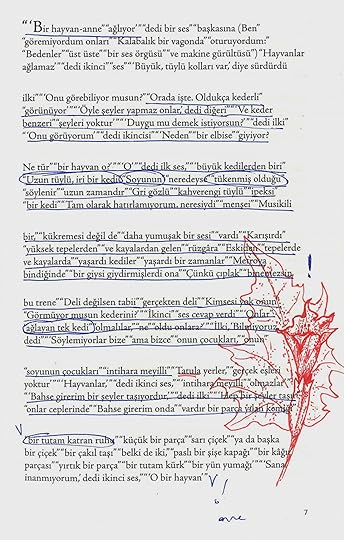
i got this used so i think it's funny because the previous owner probably had to read it for school so it had like annotations and stuff; but whoever owned it before me was definitely a "hate all men" feminist when i think this is so clearly a "capitalism is the biggest obstacle to liberation from the patriarchy" book. i need to reread this and make my own better annotations.

#go owls !

sorry i am gay so i don't know how to format poetry quotes good or like do italics or any formatting on goodreads? this really spoke to me. also scared the bejeezus out of me.

"I" "near the window," "when the man" "assumed a look of"
"calm alarm" "on his face" "& pointed to" "something" "be-
hind me" "I turned & saw a" "head" "upsidedown" "in the window"
Profile Image for Keith.
Author 10 books287 followers
January 23, 2012
There is a point on each readthrough of Descent of Alette that I have the urge to draw a map -- the kind of maps we used to draw to help us navigate the dense corridors of the point-and-click computer games we used to copy and recopy onto piles of floppy disks and then play through, as fast as we could, on our parents' monolithic desktop PCs, comparing notes over the phone each afternoon as to how far we'd gotten, just how deeply into the Fireberry Labyrinth we'd explored, how many gems we'd collected for the Golden Altar, or what color potions we needed to drink in order to to turn into a pegasus and fly across the sea.

Which is not to say that Descent.. deserves to be put into so pedantic a category as 80's roleplaying games--but that there is a framework here, a rule-set, that borrows not just from a library of older and simpler folktales that come before it, but from the surface tropes of those tales -- the need for the tactical symbology of precious stones that grant entrance to the villains' lair; to totemic animals that provide guidance and instruction; to a landscape of mysterious caves and forests. There is a sense here of playacting with mythology, of a wandering exploration of a surreal world that is at times dense with meaning, and at other times simply associative, experimental, and dreamlike. This is both the risk and the beauty of the book, which presents itself as a series of 146 half-page poems, lines of free verse further divided into sub-lines, short units of phrase cordoned off by quotation marks, so at first glance the narrator's voice seems like a chorus: "this subway" "i saw" "on the subway" "a world of souls."

By the author's own admission, this unusual technique is meant to force a certain pace and meter on the reader, and although the learning curve of processing Notley's verse is initially steep, it does in fact do what she set out to, making a first readthrough of the book a slow and measured affair, more like witnessing a performance of text than reading in one's own voice, in one's own head.

What is perhaps not accounted for, under such strict guidelines, is the reader's ability to process plot at the same time as language--story itself becomes almost obscured as words and phrases abstract into pure rhythm and sound. The separation of these elements -- narration from narrative -- becomes almost as afterthought as the book picks up speed; the reader becomes less and less aware of the extra work being done to understand the text, in much the same way the process of reading subtitles in a foreign film becomes more automatic the longer the film plays.

In this is raised the question of why the excessive metering is necessary -- but one might ask the same of why it's told as poetry, why it's not a play, why the interconnected scenes wouldn't be better suited as a series of paintings. The truth is that there may be an answer to the question, "Why does it need to be this way?", but what's truer is that it doesn't matter. Descent of Alette demands to be accepted for what it is, not for what it's not.

But navigating the structure of the text is paralleled -- even dwarfed -- by the navigation of the story, and of the story-world. Hence the demand on the reader to light the way, at least at first glance, with one's own framework. Hence the need for maps.

Chronologically, Descent follows its protagonist through a subway system that traps its riders and never opens to the world above, into a system of caves filled with otherworldly denizens, into a vast underworld, and finally to the home of the Tyrant -- a mysterious man who we know, from the first page, owns the souls of everyone in this strange universe. We are presented with endings before the middles that lead to them, as everything here is fated: we know the tyrant is evil before we quite understand why; we know the narrator must kill him before we understand why she has been chosen.

In this way, again, Descent seems to be playing with the tools of the fairytale. Like children chasing each other with capes and plastic swords, it doesn't matter why we must kill the ogre -- we know the nature of ogres, and that is enough.

It is the specific episodes of Alette's journey, and not the overarching narrative, that provide depth and color. Each car of the train and room of the cave holds strange vignettes -- a woman made of rocks, a man who suggests the walls should absorb his genitals. There are repeating patterns, but amid the strange cacophany of signs and portents it takes some time for what we're meant to focus on to rise to the surface.

Those things that do gain significance throughout the descent-- a giant snake (who is, we are told, emphatically ambiguous in gender), an owl (who is not), and a theater of characters concerned with the duality of their sex, indeed with the existential imbalance of gender itself --gradually instruct us as to what Descent of Alette is about, as if we should have known all along.

Alette's journey is rich, fulfilling, intoxicating. It truly feels like exploration -- a travelogue of the id so wild, naked and terrifying that the sandbox of the fairytale was required simply to allow the reader to understand it.

The conclusions that it draws, however, leave me on the outside, looking in. That the descent's ultimate focus is the imbalance of gender, and that imbalance has created a history of oppressive decisions made by men is something I already know. That the solution to this idea is the death of an abstracted man-god seems a neat and tidy way to wrap up something that's incredibly complicated; it's a crucial point at which the fairytale ending doesn't service the open-ended, soul-plumbing navigation of the abyss that's come before.

I have all these maps now, see. I need someplace to use them.
Profile Image for permanentsharpie.
52 reviews3 followers
May 19, 2025
I think I came into this expecting to find it much harder to parse and draw meaning from than it actually was - I was honestly shocked at times with how direct I found it to be in its commentary. It’s beautiful to read, and so visual when you’re able to get into the rhythm of it all. It may be silly to say but I kept on having the thought that someone could make an extraordinary walking-simulator type video game based on this work, it could be gorgeous and moving as the poetry is. Thank you Gregory for finding and giving me this copy, I really do love it.
Profile Image for phoenix kai.
14 reviews
June 29, 2023
This book was absolutely wild. It is so surreal and dreamlike, yet so concrete and vivid at the same time.

i see so much of its influence in other media or books i've read. It definitely took effort and attention to engage with this book, but it is so worth it. And by the end, i couldn't put it down.
Profile Image for Vehka Kurjenmiekka.
Author 12 books146 followers
September 16, 2024
I have zero idea of how to rate this. Some of the views regarding gender were a bit outdated (which is understandable, since this was published about 30 years ago), and sometimes trekking through this book felt like climbing in the middle of a landslide, but hey, I made it! And now I am part of the group of people who have read the whole poem. Achievement unlocked.
Profile Image for ben.
40 reviews
March 23, 2024
“I walked into” “the forest;” “for the woods were lit” “by yellow
street lamps” “along various” “dirty pathways” “I paused a moment”
“to absorb” “the texture” “of bark & needles” “The wind carried”
“with a pine scent” “the river’s aura—” “delicious air”

Omg yes mawmaw this book slays p*ssy
Displaying 1 - 30 of 144 reviews

Can't find what you're looking for?

Get help and learn more about the design.