

What do you think?

Apogee Books Space Series #12
The High Frontier: Human Colonies in Space
In 1969 America had proved its leadership in human spaceflight but among the nation's youth an anti-technology mindset was growing. Princeton physicist and professor Dr. Gerard K. O'Neill, inventor of the revolutionary colliding-beam storage ring technology that is now the basis of all high energy particle accelerators, asked his students if they could come up with a working space colony system to permanently and happily house tens of thousands of regular people. They dug into the challenge. Soon his small band of students grew to scores of researchers both young and old, all united in the big dream of letting real people have a real choice in their futures. In 1974, Dr. O'Neill put his three-pronged plan of space colonization, space solar power, and large scale space construction into easily accessible form with the release of the book The High Frontier. Fourteen years later, the Space Studies Institute, founded by O'Neill, re-released the original text, unchanged except for the doctor's addition of the Appendix "A View from 1988," and a new preface by astronaut Kathy Sullivan. This is one of the milestone and timeless classics of space habitation, alternative power, and human potential, all made possible with technology we already have. This expanded third edition features a new preface, introduction, and collection of essays by space researchers.
184 pages, Paperback
First published January 1, 1977
About the author
Gerard K. O'Neill
9 books27 followersGerard Kitchen O'Neill (February 6, 1927 – April 27, 1992) was an American physicist and space activist. As a faculty member of Princeton University, he invented a device called the particle storage ring for high-energy physics experiments. Later, he invented a magnetic launcher called the mass driver. In the 1970s, he developed a plan to build human settlements in outer space, including a space habitat design known as the O'Neill cylinder. He founded the Space Studies Institute, an organization devoted to funding research into space manufacturing and colonization. His award-winning book The High Frontier: Human Colonies in Space inspired a generation of space exploration advocates. (Wikipedia)
Ratings & Reviews
Friends & Following
Create a free account to discover what your friends think of this book!
Community Reviews
Displaying 1 - 30 of 72 reviews

December 6, 2016
if you like this review, i now have website: www.michaelkamakana.com
051216 from ??? childhood: this is the second review: can i truly say i have read this twice?- the first time was a paperback, with coloured illustrations, i must have been a teenager (under 17 my usual cutoff) so this was not first edition, which i see here was forty-two years ago! i had forgotten how much this book is dedicated to making the economic case, not relying on anything like the tech since common. in a way, this reminds me of verne, describing the fantastic according to his time, making it familiar, though O’Neill does seem aware of how contemporary and so limited he is making it, how conservative, only perhaps understating the tech if not the politics to reach high frontier orbit...
so sentiment plays a role in this rereading, as it reminds me of my youthful, my utopian, my Star Trek idea of our future. all those economic details will probably be as absurd as 19th century ideas of a few gentlemen somehow launching to the moon, not least because his economic arguments rely on expansive solar power satellites as response to looming energy crisis. the project of O’Neill’s devising will be a greater project than back to the moon, let alone to asteroids or any Mars shot- but the arguments for mankind to create and live in such habitats and expand through the solar system, to live free of any gravity well (planet), to go farther, to become as a species immortal, no longer constrained to any one world, all make sense...
eventually...
encouragement: after the rapturous box office success of 'the martian' i am moved to revisit this book, read o so many years ago. ok, another from my childhood... when the apollo program was over the only human space excitement was 'skylab', and then the disappointingly infrequent shuttles to low earth orbit, even as we got used to weather satellite views, we got used to images actually received from the surface of mars, in this time got used to gps, got used to the internet, got used to apocalyptic global climate-change... this was and is never enough for me: this book, this beautiful dream, maybe politically implausible but always perhaps technically possible, encouraged me to dream sf more of the triumphant world-creating sort, sf and technology and science as the way of saving the future. so the economics were off by a few magnitudes. so our tech was not there yet. but the idea science could save us? as son of a scientist, around scientists, reading my dad's old scientific americans, i wanted to believe in these utopian possibilities. well i was a kid at the time... but this dream never ends but just pauses (and by now maybe the tech is getting there?)...
221029: if there is comfort reading for me, this is it.in the years read I have more skepticism that tech will solve the world but it remains the dream. in memory, still five...
051216 from ??? childhood: this is the second review: can i truly say i have read this twice?- the first time was a paperback, with coloured illustrations, i must have been a teenager (under 17 my usual cutoff) so this was not first edition, which i see here was forty-two years ago! i had forgotten how much this book is dedicated to making the economic case, not relying on anything like the tech since common. in a way, this reminds me of verne, describing the fantastic according to his time, making it familiar, though O’Neill does seem aware of how contemporary and so limited he is making it, how conservative, only perhaps understating the tech if not the politics to reach high frontier orbit...
so sentiment plays a role in this rereading, as it reminds me of my youthful, my utopian, my Star Trek idea of our future. all those economic details will probably be as absurd as 19th century ideas of a few gentlemen somehow launching to the moon, not least because his economic arguments rely on expansive solar power satellites as response to looming energy crisis. the project of O’Neill’s devising will be a greater project than back to the moon, let alone to asteroids or any Mars shot- but the arguments for mankind to create and live in such habitats and expand through the solar system, to live free of any gravity well (planet), to go farther, to become as a species immortal, no longer constrained to any one world, all make sense...
eventually...
encouragement: after the rapturous box office success of 'the martian' i am moved to revisit this book, read o so many years ago. ok, another from my childhood... when the apollo program was over the only human space excitement was 'skylab', and then the disappointingly infrequent shuttles to low earth orbit, even as we got used to weather satellite views, we got used to images actually received from the surface of mars, in this time got used to gps, got used to the internet, got used to apocalyptic global climate-change... this was and is never enough for me: this book, this beautiful dream, maybe politically implausible but always perhaps technically possible, encouraged me to dream sf more of the triumphant world-creating sort, sf and technology and science as the way of saving the future. so the economics were off by a few magnitudes. so our tech was not there yet. but the idea science could save us? as son of a scientist, around scientists, reading my dad's old scientific americans, i wanted to believe in these utopian possibilities. well i was a kid at the time... but this dream never ends but just pauses (and by now maybe the tech is getting there?)...
221029: if there is comfort reading for me, this is it.in the years read I have more skepticism that tech will solve the world but it remains the dream. in memory, still five...

March 20, 2022
3.4⭐ Read when it was published in 1977, the book prostylitized a optimistic future for humanity in giant rotating cylinders, located at the solar systems Lagrange points. The bright eyed science fiction fan I was (am) lapped it up. I didn't always follow the science but O'Neill sounded like he knew what he was talking about (plus he had a cool Mr. Spock haircut).
The intervening decades made it clear the concept wasn't going to happen easily or quickly, but the new wave of private sector space exploitation has renewed interest in extraterrestrial habitats, so who knows? Maybe, as SunRa suggested, "Space is the place." But having said that I come down firmly of the side of Frances Frost, who said in her poem ' Valentine For Earth'; " Oh, I'm all for rockets/and worlds cold and hot/but I'm wild in love/ with the planet we've got. "
The intervening decades made it clear the concept wasn't going to happen easily or quickly, but the new wave of private sector space exploitation has renewed interest in extraterrestrial habitats, so who knows? Maybe, as SunRa suggested, "Space is the place." But having said that I come down firmly of the side of Frances Frost, who said in her poem ' Valentine For Earth'; " Oh, I'm all for rockets/and worlds cold and hot/but I'm wild in love/ with the planet we've got. "

July 8, 2011
I enjoyed this book more for what it represents than for the actual content. A shining dream that if not for the Challenger and Columbia disasters, and NASA's woeful management of the space program, might be partly realised today. This is the future I always wanted to live in growing up, the clean and white-plastic future of 1970s films and Vincent di Fate paintings. Something hopeful. May it yet come.
June 30, 2017
Straight from the good days of science fiction where there is hope and potential, compared to the bleak post-apocalyptic content we see these days.
Gerard K O'Neill may have had an idealistic vision of the future of the human race, but he backed it up with hard science and theory whilst still making it accessible to the average person.
He nicely balances the history of space exploration, theories from the science community in his time, and his own hypothesis and ideas in regards to road-mapping space colonies. Alongside fictional future families and the human aspect of living in his various space colonies.
Gerard K O'Neill may have had an idealistic vision of the future of the human race, but he backed it up with hard science and theory whilst still making it accessible to the average person.
He nicely balances the history of space exploration, theories from the science community in his time, and his own hypothesis and ideas in regards to road-mapping space colonies. Alongside fictional future families and the human aspect of living in his various space colonies.
July 13, 2014
I read this book as a teenager and ate it up. Rereading it in my early 30's I notice a few things I glossed over back then:
(1) a Malthusian view of the world, the errant view that people would outpace resources.
"the evils of environmental damage are minor compared to others that have appeared: sharp limits on food, energy, and materials confront us at a time when most of the human race is still poor, and when much of it is on the edge of starvation"
(2) Naïveté with respect to the promise of the Space Shuttle, both cost and availability.
"NASA is presently advertising a cost of about 20 million dollars for a shuttle launch, assuming complete recovery and reuse of all the hardware required. The SSME's would cost several million dollars each, so for economy they should be recovered from orbit."
(3) Naïveté with respect to society,
"Soon after the first Apollo landing ; in 1969, we passed through a period of profound distrust of anything technological, and we will probably never again welcome new technical options in the same unthinking manner that we did in the 1950s."
It's still a good book; the engineering feats proposed are feasible, but the cost numbers due to (2) are off by orders of magnitude. His false anchoring in a Malthusian worldview (1) negate his promise of less war and distress due to space colonization (the problems he proposes to solve aren't really problems)
The part I enjoyed as a teenager, and the hope I still have, is in the opening of a new frontier. Someday.
(1) a Malthusian view of the world, the errant view that people would outpace resources.
"the evils of environmental damage are minor compared to others that have appeared: sharp limits on food, energy, and materials confront us at a time when most of the human race is still poor, and when much of it is on the edge of starvation"
(2) Naïveté with respect to the promise of the Space Shuttle, both cost and availability.
"NASA is presently advertising a cost of about 20 million dollars for a shuttle launch, assuming complete recovery and reuse of all the hardware required. The SSME's would cost several million dollars each, so for economy they should be recovered from orbit."
(3) Naïveté with respect to society,
"Soon after the first Apollo landing ; in 1969, we passed through a period of profound distrust of anything technological, and we will probably never again welcome new technical options in the same unthinking manner that we did in the 1950s."
It's still a good book; the engineering feats proposed are feasible, but the cost numbers due to (2) are off by orders of magnitude. His false anchoring in a Malthusian worldview (1) negate his promise of less war and distress due to space colonization (the problems he proposes to solve aren't really problems)
The part I enjoyed as a teenager, and the hope I still have, is in the opening of a new frontier. Someday.

August 23, 2020
This is the most exciting and thought-provoking book I have read in some time. I heard recently that this book inspired Jeff Bezos's interest in space, which led him to form Blue Origin, with the aim of accomplishing exactly what The High Frontier envisions, millions of people living and working in space.
Bezos is the CEO and founder of Amazon.com. One of the Amazon TV series, The Expanse, also incorporates many of the concepts of this book, including mining of the asteroid belt, and people living and traveling in huge rotating cylinders which simulate gravity, as well as habitation of the minor planet Ceres.
This book is not science fiction. The technology needed to accomplish human habitation of space, including profitable manufacturing and energy production, existed when the book was first released in 1977.
The imperative of finding new living space for the growing population of Earth, as well as additional energy to keep up with the industrialization necessary to bring the third world a better standard of living, is still as real as it was in 1977, and in 1988 when the book was updated.
I highly recommend this. I could not put it down!
Bezos is the CEO and founder of Amazon.com. One of the Amazon TV series, The Expanse, also incorporates many of the concepts of this book, including mining of the asteroid belt, and people living and traveling in huge rotating cylinders which simulate gravity, as well as habitation of the minor planet Ceres.
This book is not science fiction. The technology needed to accomplish human habitation of space, including profitable manufacturing and energy production, existed when the book was first released in 1977.
The imperative of finding new living space for the growing population of Earth, as well as additional energy to keep up with the industrialization necessary to bring the third world a better standard of living, is still as real as it was in 1977, and in 1988 when the book was updated.
I highly recommend this. I could not put it down!
August 29, 2020
I first read The High Frontier in 1977 after running into Keith and Caroline Hensen at the World Science Fiction Convention in Boston. (Or was it Kansas City the year before?) They were just getting the L-5 Society going at the time and were hoping that someone would start forming local chapters. So I did: the Northwest L-5 Society was born with members from Washington, Idaho, British Columbia, and Oregon. Over next year I found myself doing 100 (exactly) public lectures about space colonies and industries in space.
So, yes, the book is that good. Later, politics and crackpot social engineering would make a mess of the L-5 Society and the National Space Society that took it over, but during the brief halcyon years it existed, it was a great source of hope and wonder.
For what it's worth, in addition to being a science fiction fan, I did time for 40 years as professional aerospace engineer, working on airplanes in Seattle and spacecraft in Houston (and even in Las Vegas!), and I endorse this book. :)
So, yes, the book is that good. Later, politics and crackpot social engineering would make a mess of the L-5 Society and the National Space Society that took it over, but during the brief halcyon years it existed, it was a great source of hope and wonder.
For what it's worth, in addition to being a science fiction fan, I did time for 40 years as professional aerospace engineer, working on airplanes in Seattle and spacecraft in Houston (and even in Las Vegas!), and I endorse this book. :)

July 20, 2020
Well written books but I am the only one who is NOT looking forward for space colonization. I mean, what makes human think that if he messed up life on Earth that was perfect to begin with, he won't mess it up on other planets.
So, please DO NOT colonize space until you sorted out your very sad situation on this planet.
So, please DO NOT colonize space until you sorted out your very sad situation on this planet.

September 19, 2010
A complaint I sometimes have about plans, ideas or programs put forth by space advocates (I consider myself to be one) is that they are often long on the what, but short on the why. O'Neill may be deficient in other areas of his proposals, but the "Why" is not one of them and I have to applaud him for that. His primary justification is the development of cheap energy for Earth. That would at least get venture capitalists to put down their coffee. And secondly he offers new Real Estate to provide growing room for Earth's burgeoning population.
Given O'Neill's academic background I am surprised at how wildly optimistic he was in the late 1970's that by now (2013) we would already have large-scale space-based industries in operation or at least well into development. Obviously, we are far, far away from that and the prospect of it is not even on the horizon. It is for this reason and the fact that in two or three instances he falls back on fictional vignettes to add reality and emotion to his proposals that I gave it three stars rather than four.
But my meaningless rating will have little effect on the long term life of this book. I believe that precisely because he was so optimistic, and proposed such fantastic rates of development for space colonies, that his book will be read for centuries and possibly even millenia. I think space historians will repeatedly refer back to his vision and compare them to their current reality, much as he referred to famous space dreamers Tsiolkovsky and Goddard. In short, I think his immortality, regardless of how lofty, is safe for a long time to come.
The sixty-four dollar question is: "When WILL O'Neills futuristic visions become commonplace reality?" I wish I could be around long enough to learn the answer, but I'm afraid at the rate we're going, no one alive today, let alone an old dude like me, will still be kickin' when that happens.
If you like to compare what futurists of yore predicted where we'd be now, with what has actually occurred, you'll enjoy this book.
Given O'Neill's academic background I am surprised at how wildly optimistic he was in the late 1970's that by now (2013) we would already have large-scale space-based industries in operation or at least well into development. Obviously, we are far, far away from that and the prospect of it is not even on the horizon. It is for this reason and the fact that in two or three instances he falls back on fictional vignettes to add reality and emotion to his proposals that I gave it three stars rather than four.
But my meaningless rating will have little effect on the long term life of this book. I believe that precisely because he was so optimistic, and proposed such fantastic rates of development for space colonies, that his book will be read for centuries and possibly even millenia. I think space historians will repeatedly refer back to his vision and compare them to their current reality, much as he referred to famous space dreamers Tsiolkovsky and Goddard. In short, I think his immortality, regardless of how lofty, is safe for a long time to come.
The sixty-four dollar question is: "When WILL O'Neills futuristic visions become commonplace reality?" I wish I could be around long enough to learn the answer, but I'm afraid at the rate we're going, no one alive today, let alone an old dude like me, will still be kickin' when that happens.
If you like to compare what futurists of yore predicted where we'd be now, with what has actually occurred, you'll enjoy this book.

July 12, 2015
Hard to tell if this is naïve or way ahead of its time. I mean, there's nothing that I know of that's strictly impossible in here, but it's almost forty years since publication and our one fully functional space station is nowhere near the Islands or Bernal Spheres that the author outlines. I think the big thing stopping us is the sheer cost of getting a payload out of our gravity well, something O'Neill doesn't really address and that a lot of people mistakenly thought would just get easier as time moves on. I think the shuttle program was probably a huge setback for the space program in this regard.
In the news today, a Canadian (!) firm announced they'd patented a mini-space elevator (space tower?) which could be the answer. Though a large amount of skepticism is necessary. It probably won't work. But wouldn't it be something to try?
In the news today, a Canadian (!) firm announced they'd patented a mini-space elevator (space tower?) which could be the answer. Though a large amount of skepticism is necessary. It probably won't work. But wouldn't it be something to try?

June 14, 2019
How humanity could have settled the solar system with 1970/80s technology. I can't recommend this book enough. Put down whatever you are reading and start this book, if you want to know what motivates Jeff Bezos in his Blue Origin rocket company. This book may give us a blueprint of what to expect in the relatively near future as humans finally start to get off this rock.

September 13, 2022
Somewhere between 3 and 4 stars. Some of O’Neill’s napkin-math is inspiring and hopeful while other calculations vastly understate the difficulty of supply chain and manufacturing. He also tends to project his immediate bubble of academia into the activities of the space colonies and interests of the majority of humans.
Where this book shines is showing how achievable the humanization of space is. O’Neill makes science fiction seem like a reality easily within reach. He outlines a roadmap that is optimistic on time scale but far from naive in terms of new technology needed to make space colonies (for the benefit of Earth and humanity) a reality.
Where this book shines is showing how achievable the humanization of space is. O’Neill makes science fiction seem like a reality easily within reach. He outlines a roadmap that is optimistic on time scale but far from naive in terms of new technology needed to make space colonies (for the benefit of Earth and humanity) a reality.

March 14, 2013
Politics and economics had much to do with the fate of this dream of the future from physicist Gerard K. O'Neill, first published in the mid-1970s. Since the 19th century at least, nations had been seeking a competitive advantage by pursuing high technology. Much that was achieved in unmanned and manned flight up to the landing of humans on the moon had brought payoffs not only in terms of national prestige but also in many military and civilian applications. What's more, these developments had generated optimism, excitement, a sense of wonder about what the years ahead would bring. That was the atmosphere in which O'Neill wrote this short book and the atmosphere in which I read it, not long after its publication. If men (and women, as the Soviet Union first showed) could venture into Earth orbit or beyond for short trips, why couldn't they live and work somewhere out there? O'Neill was one of many who believed that they could, and in this book he described a handful of the technical concepts that would make it possible. (The Wikipedia entry gives a bare-bones summary along with some of the still-intriguing illustrations from the book.)
Alas, the end of the 60s economic boom in the United States, fading interest from industry, and the lack of a clear advantage that any superpower could gain that would be worth the cost--not to mention public disaffection--meant that the colonization of near space lost its drive. Unlike such visions as energy from nuclear fusion, however, there are no obvious technical reasons to doubt that mankind could still achieve one of O'Neill's visions. And a new consideration has become apparent in recent decades: the possibility that our single habitat might fail us. Mass extinctions have occurred more than once in Earth's history; this was partly known when O'Neill wrote, but the most recent and familiar, the end of the dinosaurs, was much less well understood. Along with geologic and cosmic threats, there's also a human threat: we might poison our own home, or if nothing else crowd ourselves sick. Physicist Stephen Hawking tried to call attention to these risks a few years ago. He may be the most famous person yet to have proposed that humanity should prepare another place to live. (The failing home of his own mind gives a personal dimension to his warning.)
Unfortunately, though humanity as a whole, and presumably many other species, would benefit from the development of colonies elsewhere, it's not clear who should pay for it. But it may happen, possibly along the lines that O'Neill brought to vivid life in this book.
Alas, the end of the 60s economic boom in the United States, fading interest from industry, and the lack of a clear advantage that any superpower could gain that would be worth the cost--not to mention public disaffection--meant that the colonization of near space lost its drive. Unlike such visions as energy from nuclear fusion, however, there are no obvious technical reasons to doubt that mankind could still achieve one of O'Neill's visions. And a new consideration has become apparent in recent decades: the possibility that our single habitat might fail us. Mass extinctions have occurred more than once in Earth's history; this was partly known when O'Neill wrote, but the most recent and familiar, the end of the dinosaurs, was much less well understood. Along with geologic and cosmic threats, there's also a human threat: we might poison our own home, or if nothing else crowd ourselves sick. Physicist Stephen Hawking tried to call attention to these risks a few years ago. He may be the most famous person yet to have proposed that humanity should prepare another place to live. (The failing home of his own mind gives a personal dimension to his warning.)
Unfortunately, though humanity as a whole, and presumably many other species, would benefit from the development of colonies elsewhere, it's not clear who should pay for it. But it may happen, possibly along the lines that O'Neill brought to vivid life in this book.

January 20, 2023
Don’t expect one of those popular physicist books that dumb it down and pretty it up to avoid offending or intimidating anyone. No punches are pulled here. Expect to be both offended and intimidated, and maybe a little confused. You might even be personally and directly insulted, and, what makes it worse: you won’t be sure. You don’t have to love either physics or getting into space colonization thing as much as O'Neill in order to appreciate this book. But really: it doesn’t hurt.
The world needs more forward-thinking and opinionated physicists like O'Neill. Everyone thinks physicists are a soporific lot who bring to their work all the passion and spent most of their time in voluntary solitary confinement doing some kind of test. But no! There are people out there who like physics and genuinely trying to solve real-world problems, even the problem so far ahead in a distant future where earth is no longer habitable.
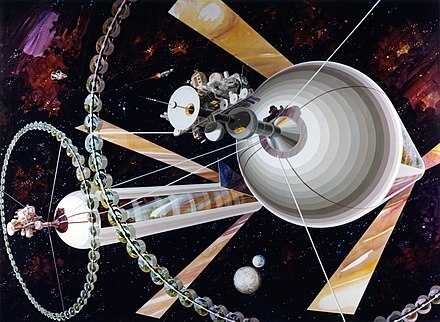
There's this concept that fascinate me, an artificial home in outer space; O’Neill’s based his idea on using ‘islands’ in the migration of humans, the concept later to be known as O'Neill cylinders and it would consist of two cylinders rotating on an opposite directions to cancel any gyroscopic effects. In other words, to maintain a steady direction of its axis of rotation so it wouldn't go astray. The island would generate an artificial gravity due its spinning nature and using the solar power for electricity.
Some of the concepts presented went sailing right over my head. You are almost certainly not going to understand all the details, but this doesn’t matter much. You’ll pick up the gist of it, and what a fascinating gist it is. This book provides a decent mechanism on how human colony in outer-space looks like. 50 years after it was first published, the book was and is still relevant.
The world needs more forward-thinking and opinionated physicists like O'Neill. Everyone thinks physicists are a soporific lot who bring to their work all the passion and spent most of their time in voluntary solitary confinement doing some kind of test. But no! There are people out there who like physics and genuinely trying to solve real-world problems, even the problem so far ahead in a distant future where earth is no longer habitable.
There's this concept that fascinate me, an artificial home in outer space; O’Neill’s based his idea on using ‘islands’ in the migration of humans, the concept later to be known as O'Neill cylinders and it would consist of two cylinders rotating on an opposite directions to cancel any gyroscopic effects. In other words, to maintain a steady direction of its axis of rotation so it wouldn't go astray. The island would generate an artificial gravity due its spinning nature and using the solar power for electricity.
Some of the concepts presented went sailing right over my head. You are almost certainly not going to understand all the details, but this doesn’t matter much. You’ll pick up the gist of it, and what a fascinating gist it is. This book provides a decent mechanism on how human colony in outer-space looks like. 50 years after it was first published, the book was and is still relevant.

March 16, 2017
In the wake of the Apollo program, humanity was in a mindset we truly can be proud of: "What's next? The universe is the limit!"
Unfortunately, we then dragged ourselves through half a century of close-mindedness, petty politics, and unpardonable lack of vision. We've fallen embarrassingly short of Gerard's beautiful and practical visions. This is no fault of his own. So long, beautiful dreamer. Thank you for sharing your glimpse of what we truly could have used these past decades for.
#misanthropy
Unfortunately, we then dragged ourselves through half a century of close-mindedness, petty politics, and unpardonable lack of vision. We've fallen embarrassingly short of Gerard's beautiful and practical visions. This is no fault of his own. So long, beautiful dreamer. Thank you for sharing your glimpse of what we truly could have used these past decades for.
#misanthropy

November 14, 2015
In this rather optimistic, tecnologically plausible book the profesor ONeill develops space colonies or islands of great size, populated by humans exploiting resources of other astronomic bodies tan Earth in orthe to solve the population and finite resources of Earth problem;the book is full of illustrations and sketches of the space islands .It is a interesting book with historical value;i think the movie Elysium is influenced by this book

June 1, 2008
With Apollo-era can-do spirit, O'Neill convincingly shows how we can mine oxygen on the moon, beam solar power back to earth, build colonies in high earth orbit, and homestead the asteroids, all using 1970s era technology.
He promises we'll be living in Island One at L5 orbit by 2005, at the latest.
A fun book for space nerds. The definitive book on giant space colony design.
He promises we'll be living in Island One at L5 orbit by 2005, at the latest.
A fun book for space nerds. The definitive book on giant space colony design.

March 14, 2021
The bare outlines of the history of space exploration are known by almost all Americans, or were until recently. The Soviets put a satellite into orbit, kicking off both the Cold War and the Space Race. A short time later America placed a man on the Moon. People looked forward to humanity expanding into the farthest reaches of space. We would have colonies on Mars and low Earth orbit flights would become as inexpensive as red eye flights between cities.
It didn't quite turn out that way, and in the intervening years the United States ceded its leadership position first to other nations and then to private space exploration firms. These have promised reasonably priced, single-stage flights to outer space and even long-term habitation among the stars. That they've already managed to save billions of dollars that were squandered during the government-sponsored heyday of space exploration shows that they deserve to be taken seriously.
One very rich individual who has invested in space exploration, Jeff Bezos, was greatly influenced by "The High Frontier." It would behoove anyone currently living on Earth (and I guess that includes us all) to read this book in order to understand the foundational ideas of post-NASA space exploration presented in its pages.
"The High Frontier" explains in fairly clear language how overpopulation on Earth will soon tax resources to a point that space flight will become a necessity if the species hopes to survive. It describes ways to economize so that launch vehicles can also serve as initial habitats, and how everything from recreation to government might play out once we have slipped the bonds of Earth's gravity once and for all.
Black and white illustrations appear throughout the text, recalling retro-futurist pastiches of colonies with their interstellar greenhouses and town squares beneath glass-skinned enclosures. It reminded this reader of Golden Age SF and its enthusiasm for the human destiny among the stars, and added a charm to the sometimes technical prose.
Whether the current crop of billionaire mavericks like Bezos (or Elon Musk) will ultimately achieve their visions is still unknown. The idea of human habitation of space, free from material want and energy scarcity, is a beautiful dream. But dreams, alas, can curdle into nightmares, which is why the subject deserves such careful study by everyone who hopes to have any kind of stake in the future (on Earth or among the stars). Here, then, is one of the foundational texts on how to get it right. Reading it and applying its ideas (and its warnings) is no guarantee against failure, but it couldn't hurt. Recommended.
It didn't quite turn out that way, and in the intervening years the United States ceded its leadership position first to other nations and then to private space exploration firms. These have promised reasonably priced, single-stage flights to outer space and even long-term habitation among the stars. That they've already managed to save billions of dollars that were squandered during the government-sponsored heyday of space exploration shows that they deserve to be taken seriously.
One very rich individual who has invested in space exploration, Jeff Bezos, was greatly influenced by "The High Frontier." It would behoove anyone currently living on Earth (and I guess that includes us all) to read this book in order to understand the foundational ideas of post-NASA space exploration presented in its pages.
"The High Frontier" explains in fairly clear language how overpopulation on Earth will soon tax resources to a point that space flight will become a necessity if the species hopes to survive. It describes ways to economize so that launch vehicles can also serve as initial habitats, and how everything from recreation to government might play out once we have slipped the bonds of Earth's gravity once and for all.
Black and white illustrations appear throughout the text, recalling retro-futurist pastiches of colonies with their interstellar greenhouses and town squares beneath glass-skinned enclosures. It reminded this reader of Golden Age SF and its enthusiasm for the human destiny among the stars, and added a charm to the sometimes technical prose.
Whether the current crop of billionaire mavericks like Bezos (or Elon Musk) will ultimately achieve their visions is still unknown. The idea of human habitation of space, free from material want and energy scarcity, is a beautiful dream. But dreams, alas, can curdle into nightmares, which is why the subject deserves such careful study by everyone who hopes to have any kind of stake in the future (on Earth or among the stars). Here, then, is one of the foundational texts on how to get it right. Reading it and applying its ideas (and its warnings) is no guarantee against failure, but it couldn't hurt. Recommended.
March 26, 2021
For a book with a reputation of being a classic, influential, and uplifting...I found reading it to be quite a slog. I had to start skimming.
On the plus side, I think this is an important work. Further, it has made me rethink my preference for planetary settlements. While I always took for granted that large habitats in free space is the ultimate goal, I had previously assumed that we must establish footholds on planetary bodies first—that free-space habitats would be too difficult without knowledge gained from planetary settlement. No. Now I think it’s plausible that free space habitats may be easier. Perhaps we should skip the Moon and Mars and just start building our free space habitats.
On the negative side, his economics are just total wishful thinking. His only firm idea for money making is space based solar power. Unfortunately, the idea didn’t make sense then and it doesn’t make sense now. Per capita energy usage is falling, terrestrial solar panels are dirt cheap, power storage technologies are maturing, yada yada. In most situations, space solar power doesn’t outcompete alternatives when you boil it down to the price per kilowatt-hour.
His other ideas relating to the economics are basically self-licking ice cream cones. For instance, most people in the habitats will be employed...building more habitats. More people move there to get these awesome jobs...just building more habitats. Okay. But so what if people don’t want to move there in droves of 1000 per day? Then there’s less demand for more habitats and the jobs of the people in space evaporate and then they need to leave to find paying work and then....well, the tongue falls off the self-licking device.
I found that too much of the book was devoted to utopian (he repeatedly swears it’s not a utopia, but let’s call a fig a fig) descriptions about how lovely life is in the habitats. Patterned after cozy European villas, flowers are everywhere because everybody loves to garden, and everyone gets along, and there’s no fighting, no joblessness, food and energy are abundant and basically free, even the old and infirm can still have great mobility in the reduced gravity portions of the habitat, and everything is beautiful and nothing hurts. I just summarized about 30% of the book for you in one run-on sentence.
Overall it’s worth reading if you’re a space settlement fanatic, but i hesitate to recommend it to anyone else. Unfortunately, I don’t yet have an alternative to suggest in its place.
On the plus side, I think this is an important work. Further, it has made me rethink my preference for planetary settlements. While I always took for granted that large habitats in free space is the ultimate goal, I had previously assumed that we must establish footholds on planetary bodies first—that free-space habitats would be too difficult without knowledge gained from planetary settlement. No. Now I think it’s plausible that free space habitats may be easier. Perhaps we should skip the Moon and Mars and just start building our free space habitats.
On the negative side, his economics are just total wishful thinking. His only firm idea for money making is space based solar power. Unfortunately, the idea didn’t make sense then and it doesn’t make sense now. Per capita energy usage is falling, terrestrial solar panels are dirt cheap, power storage technologies are maturing, yada yada. In most situations, space solar power doesn’t outcompete alternatives when you boil it down to the price per kilowatt-hour.
His other ideas relating to the economics are basically self-licking ice cream cones. For instance, most people in the habitats will be employed...building more habitats. More people move there to get these awesome jobs...just building more habitats. Okay. But so what if people don’t want to move there in droves of 1000 per day? Then there’s less demand for more habitats and the jobs of the people in space evaporate and then they need to leave to find paying work and then....well, the tongue falls off the self-licking device.
I found that too much of the book was devoted to utopian (he repeatedly swears it’s not a utopia, but let’s call a fig a fig) descriptions about how lovely life is in the habitats. Patterned after cozy European villas, flowers are everywhere because everybody loves to garden, and everyone gets along, and there’s no fighting, no joblessness, food and energy are abundant and basically free, even the old and infirm can still have great mobility in the reduced gravity portions of the habitat, and everything is beautiful and nothing hurts. I just summarized about 30% of the book for you in one run-on sentence.
Overall it’s worth reading if you’re a space settlement fanatic, but i hesitate to recommend it to anyone else. Unfortunately, I don’t yet have an alternative to suggest in its place.

April 6, 2022
One of the most important types of science fictional cities is the space station or habitat. Gerard K. O’Neill worked out the physics, engineering, economics and a lot more of a real space colony in his The High Frontier of 1979. Working with technologies and materials that were available in the 1970s, O’Neill spelled out in remarkable detail how a complex habitat of multiple rotating rings and cylinders could be constructed at L5 (a LaGrange point where it can maintain a stable position in relation to Earth while both orbit the sun).
Though it would start with a core construction crew of only a few thousand living in spartan conditions, he imagined facilities that could support millions. And their habitats would have beautiful landscapes of valleys, hills, lakes and multiple villages and cities supporting a diverse population. He also gave a lot of thought to the economics of the enterprise, seeing the necessity for the colony to turn a profit through trade with Earth. Its principle export would be energy generated in great solar arrays and beaming electricity to Earth by microwave.
If you want to know the origin of fictional spaces stations like Babylon 5 and Deep Space 9 and many others, this is it. O’Neill was convinced that part of Earth’s population would be forced to relocate to space because of overpopulation (that was the driving concern at that time instead of climate change), and so he worked out what seemed to him a practical way to support people in a habitat of abundance and even luxury. This book lays out the practical plans for opening the world of space settlement. While there have been multiple advances in our understanding of colonizing space, especially the impacts on the human body, The High Frontier is still essential reading, especially for those of us with a science fictional perspective. I doubt anyone (with the possible exception of Michael T. Savage) has envisioned a space habitat in such detail and scientific accuracy.
Read the full post at SciFi Mind.
Though it would start with a core construction crew of only a few thousand living in spartan conditions, he imagined facilities that could support millions. And their habitats would have beautiful landscapes of valleys, hills, lakes and multiple villages and cities supporting a diverse population. He also gave a lot of thought to the economics of the enterprise, seeing the necessity for the colony to turn a profit through trade with Earth. Its principle export would be energy generated in great solar arrays and beaming electricity to Earth by microwave.
If you want to know the origin of fictional spaces stations like Babylon 5 and Deep Space 9 and many others, this is it. O’Neill was convinced that part of Earth’s population would be forced to relocate to space because of overpopulation (that was the driving concern at that time instead of climate change), and so he worked out what seemed to him a practical way to support people in a habitat of abundance and even luxury. This book lays out the practical plans for opening the world of space settlement. While there have been multiple advances in our understanding of colonizing space, especially the impacts on the human body, The High Frontier is still essential reading, especially for those of us with a science fictional perspective. I doubt anyone (with the possible exception of Michael T. Savage) has envisioned a space habitat in such detail and scientific accuracy.
Read the full post at SciFi Mind.
August 27, 2026
This is an excellent and fairly short book and is well worth your time. While the technical details have not aged perfectly, O'Neill's plan is remarkably close to what present day space advocates and institutions suggest. That is, the plan to build a lunar mass driver and lunar industry to process material, then send mass to orbit and the Earth-Moon Lagrange points, in order to build increasingly large solar arrays and rotating space habitats. He gets quite into the details of what life in such a habitat might look like. Some of those details would be written differently today, such as accounting for modern day LED lighting, not to mention the somewhat dated cultural references, but generally speaking his vision is maintained today.
That vision is the primary basis on which I'm rating this as five stars. This book came out a few years after the peak energy of the space race and in a period of rapidly decreasing enthusiasm for space programs, preceding the decades-long stagnation we saw until recently. He was writing at a point when the conventional wisdom and statistical predictions looked towards overpopulation and mass starvation in much of the world. A very different context for space colonization than today, with below-replacement fertility and comparatively to the 1970s) high living standards in most countries.
While I'm glad we avoided the Malthusian outcome he feared, one cannot help but feel disappointing that so little of his vision for human progress in space came to fruition. Hopefully that will change in the near future.
The High Frontier belongs in the foundational canon of modern space advocacy and is highly encouraged reading for anyone who sees our future among the stars.
That vision is the primary basis on which I'm rating this as five stars. This book came out a few years after the peak energy of the space race and in a period of rapidly decreasing enthusiasm for space programs, preceding the decades-long stagnation we saw until recently. He was writing at a point when the conventional wisdom and statistical predictions looked towards overpopulation and mass starvation in much of the world. A very different context for space colonization than today, with below-replacement fertility and comparatively to the 1970s) high living standards in most countries.
While I'm glad we avoided the Malthusian outcome he feared, one cannot help but feel disappointing that so little of his vision for human progress in space came to fruition. Hopefully that will change in the near future.
The High Frontier belongs in the foundational canon of modern space advocacy and is highly encouraged reading for anyone who sees our future among the stars.

May 27, 2023
The High Frontier
Book 23/2023.
I like O’Neill’s late Cold War techno-optimism. The biggest question you’re left with after reading him is “where did we go wrong?” Certainly, the “Peace Dividend” really was a retirement from American ambition, and he saw it coming. On top of that, I think the focus on short term, low-impact technology development (ahem, social media) has really cost us. Here he lays out the building blocks for building a sustainable human presence in outer space.
O’Neill takes the then-emerging environmental bad news as a reason one to act. We can’t go back, so we must press forward. He also asserts clearly a preference for smaller industry and technological inclusionism that is missing from today’s tech industry. One thing I’ve always appreciated about his work: he ties the move to advance technology to the benefit of all his mankind, rather than deepening social and economic divides. In fact, he presages American decline and asks whether bequeathing a better world should be the final act of a superpower. He also misses a few tricks, particularly related to the development of automation, which could make his project more feasible and commercially viable.
At its core, the book is a dream. We need the dreamers to tell us what we could do. We need to be inspired, and frankly we’ve lost a lot of that inspiration in the West today. But one missing part of this dream is the use of greater automation to reduce work in general and to build what others call “Fully Automated Luxury Communism.” O’Neill (maybe as a result of his political historical moment) couldn’t separate his vision from capitalist and industrialist modalities.
Book 23/2023.
I like O’Neill’s late Cold War techno-optimism. The biggest question you’re left with after reading him is “where did we go wrong?” Certainly, the “Peace Dividend” really was a retirement from American ambition, and he saw it coming. On top of that, I think the focus on short term, low-impact technology development (ahem, social media) has really cost us. Here he lays out the building blocks for building a sustainable human presence in outer space.
O’Neill takes the then-emerging environmental bad news as a reason one to act. We can’t go back, so we must press forward. He also asserts clearly a preference for smaller industry and technological inclusionism that is missing from today’s tech industry. One thing I’ve always appreciated about his work: he ties the move to advance technology to the benefit of all his mankind, rather than deepening social and economic divides. In fact, he presages American decline and asks whether bequeathing a better world should be the final act of a superpower. He also misses a few tricks, particularly related to the development of automation, which could make his project more feasible and commercially viable.
At its core, the book is a dream. We need the dreamers to tell us what we could do. We need to be inspired, and frankly we’ve lost a lot of that inspiration in the West today. But one missing part of this dream is the use of greater automation to reduce work in general and to build what others call “Fully Automated Luxury Communism.” O’Neill (maybe as a result of his political historical moment) couldn’t separate his vision from capitalist and industrialist modalities.
May 19, 2026
Finally got around to reading this, after learning much of O'Neill's ideas through osmosis. The instigator for me was hearing Elon Musk fans claiming that he had now embraced this vision for spaceflight because he wants to build a satellite linear accelerator on the moon. And
1) These people have clearly not read the book because there's very little about Musk's "plans" that come anywhere close to this and
2) This might have seemed like a possibility for the future in the 70s but if you think this is going to happen I have a bridge to sell you... or SpaceX stock... hear the IPO's coming soon.
No, but seriously, fairly interesting book. O'Neill has obviously done his work, and there's a good reason why these ideas have stayed in the sci-fi consciousness for so long. It's such an appealing idea of what we can do as the human race, even if it is ultimately rather farfetched. Compared to your sort of manifest-destiny-race-to-the-stars thinking these concepts come across as quite egalitarian, coming from one big (and still unresolved question): how to we allow developing countries to develop without straining our resources. O'Neill's answer: go to space! That answer just happened to involve hundreds of Shuttle launches a year, and... well... reality always has a way of interfering.
1) These people have clearly not read the book because there's very little about Musk's "plans" that come anywhere close to this and
2) This might have seemed like a possibility for the future in the 70s but if you think this is going to happen I have a bridge to sell you... or SpaceX stock... hear the IPO's coming soon.
No, but seriously, fairly interesting book. O'Neill has obviously done his work, and there's a good reason why these ideas have stayed in the sci-fi consciousness for so long. It's such an appealing idea of what we can do as the human race, even if it is ultimately rather farfetched. Compared to your sort of manifest-destiny-race-to-the-stars thinking these concepts come across as quite egalitarian, coming from one big (and still unresolved question): how to we allow developing countries to develop without straining our resources. O'Neill's answer: go to space! That answer just happened to involve hundreds of Shuttle launches a year, and... well... reality always has a way of interfering.

February 3, 2020
This book covers physicist Gerard K. O'Niell's wildly over-optimistic studies, ideas and speculations (along with similar overlapping NASA studies) developed in the 1970's on the construction and deployment of huge space colonies / habitats -- basically giant space stations (along with the accompanying infrastructure like mass drivers and manufacturing facilities in space) mostly located between the Earth and the Moon that would house tens of thousands or even hundreds of thousands of people. The giant habitats would be mostly constructed from raw materials obtained from the moon and asteroids. One of the purposes of building these habitats would be to alleviate overpopulation and environmental degradation problems on Earth , as well as dealing with energy shortage issues (which could be addressed by the construction and utilization of solar satellite power stations).

September 18, 2023
4.5 out of 5
This book posits what it would take to humanize space. It focuses on the economic and practical application of creating cities in space.
What I liked:
Incredibly thorough. I picked up this book to augment my knowledge of space communities for novels I am writing. It confirmed a lot of what I already knew and had me considering aspects that I had not anticipated. This book was originally published in 1977. There is an addendum dated 1988 that was interesting. It gave a snapshot of what has changed since the original publication which I found interesting.
What I didn't like:
The hypothetical letters from future residents were a bit meh. I skimmed through those because it doesn't really reflect current values.
Overall:
I think it is a good reference book for anyone wanting to have a practical blueprint for space communities.
This book posits what it would take to humanize space. It focuses on the economic and practical application of creating cities in space.
What I liked:
Incredibly thorough. I picked up this book to augment my knowledge of space communities for novels I am writing. It confirmed a lot of what I already knew and had me considering aspects that I had not anticipated. This book was originally published in 1977. There is an addendum dated 1988 that was interesting. It gave a snapshot of what has changed since the original publication which I found interesting.
What I didn't like:
The hypothetical letters from future residents were a bit meh. I skimmed through those because it doesn't really reflect current values.
Overall:
I think it is a good reference book for anyone wanting to have a practical blueprint for space communities.

November 6, 2023
The most disappointing aspect of this book is that, even after 50 years since its publication, we have not made any significant progress towards turning its ideas into a reality. I loved the concept, and it was the first time I realized that expanding our civilization into space might, in some ways, be more feasible than colonizing other planets. The technical explanations and the science behind space colonies were perfect. On the other side, I felt that the social descriptions of societies in space were a bit too idealistic and naive.

December 15, 2024
(I read the second edition from Bantam, not the third from Apogee)
This was an enjoyable read. What's aged well and lasted is the idea that these habitats can be nice places to live, and that the use of space resources can generate much cheaper costs for settling in space. I loved the drawings. A lot of the justifications center on 70s ideas of overpopulation and resource shortage that we know were wrong. The idea of space solar power remains pretty dubious in my opinion. Likewise, O'Neill's concept of using mass drivers for propulsion is batshit crazy from an original debris standpoint.
This was an enjoyable read. What's aged well and lasted is the idea that these habitats can be nice places to live, and that the use of space resources can generate much cheaper costs for settling in space. I loved the drawings. A lot of the justifications center on 70s ideas of overpopulation and resource shortage that we know were wrong. The idea of space solar power remains pretty dubious in my opinion. Likewise, O'Neill's concept of using mass drivers for propulsion is batshit crazy from an original debris standpoint.

June 9, 2025
Very interesting scientific concepts based on what was possible with the know-how of the 1970s. I find the parts of the book which explore what actually living on these habitats would mean for human activities super. The book was quite long and at times a bit too dense in physics for me, but that's more so my problem than the book's! My main takeaway was regret, about how poorly we managed the opportunities for prosperity, failing to develop a flourishing space industry last century, despite the realistic optimism outlined in O'Neill's vision here.
December 1, 2019
I read this book as an civil engineering undergraduate, forty years ago, and never forgot the straightforward discussions on how to colonize space using existing technologies. Seems very relevant to today, when space exploration is going to likely eclipse all earth activities and we need to have the believing forethought to make it a reality, a memorable reality where all can participate and benefit.

August 4, 2021
Something Jeff Bezos needs to re-read
Well worth reading: Space tourism will not support the exploration of space or the diaspora of the human race into space in order to be invulnerable to catastrophes which might end the reign of homo sapiens.
O’Neill shows how the production of inexhaustible, clean energy from orbit would lead to the colonization of space, individual freedoms, and wealth beyond imagination.
Well worth reading: Space tourism will not support the exploration of space or the diaspora of the human race into space in order to be invulnerable to catastrophes which might end the reign of homo sapiens.
O’Neill shows how the production of inexhaustible, clean energy from orbit would lead to the colonization of space, individual freedoms, and wealth beyond imagination.
Displaying 1 - 30 of 72 reviews