

What do you think?

Boys on the Run #1
ボーイズ・オン・ザ・ラン 1
痛みを知る、すべての男たちへ。あるいは、すべての痛い男たちへ。三十路目前、そろそろ選択しようじゃないか、我が人生! 超等身大ダメ男・田西敏行の遅咲き青春ブルース!!
妄想ばかりのダメ男に訪れた、一世一代の恋愛チャンス! 職場の飲み会で、憧れの後輩・植村ちはると初めて話せた田西。そこからメール交換も始まり、ふたりの仲は徐々に進展していくのだが…!?
妄想ばかりのダメ男に訪れた、一世一代の恋愛チャンス! 職場の飲み会で、憧れの後輩・植村ちはると初めて話せた田西。そこからメール交換も始まり、ふたりの仲は徐々に進展していくのだが…!?
- GenresMangaHumorSlice Of Life
204 pages, Paperback
First published November 30, 2005
About the author
Kengo Hanazawa
122 books142 followersKengo Hanazawa (花沢健吾 Hanazawa Kengo, born January 5, 1974) is a Japanese manga artist known for his seinen works. He won the Topic Award of the 2005 Sense of Gender Awards for Ressentiment and was nominated for the 3rd, 4th and 5th Manga Taisho for I Am a Hero.
Ratings & Reviews
Friends & Following
Create a free account to discover what your friends think of this book!
Community Reviews
Displaying 1 - 4 of 4 reviews
March 1, 2026
This main character made me cringe every 2 chapters I’ve never seen anything like it
December 11, 2024
[check out this review on my personal page, where it looks better]
Four-and-a-half stars. This is Hanazawa’s magnum opus.
When I read Hanazawa’s I Am a Hero quite a few years ago, I assumed it was his debut work. The first few chapters of that story were that kind of somewhat-inept awkward, as if coming from an author who hasn’t quite realized how to properly present his ideas. That changed as the very long series (about 260 chapters) progressed, so you forgive that kind of shit. Unless you didn’t get through those initial chapters, that is. But I’ve read so much manga that it seems I have run out of “serious” manga (no more Oyasumi Punpun out there), and I returned to Hanazawa to figure out if anything else of his was good. I read his actual debut, about an ugly bastard who falls in love with an AI in a virtual world (here’s the review for Ressentiment ). I liked it a lot. The drawings were the most amateurish part, but the plot was tight and well-woven. The single other work between Ressentiment and I Am a Hero is a long-running series named Boys on the Run, produced in the second half of the 2000s. I loved it. To my surprise, Hanazawa most famous I Am a Hero is a significant step down from his best work.
This series I’m reviewing follows a young man in his twenties named Tanishi. He’s kind of a loser: his looks are average, he is a virgin, he lives with his parents, he works as a salesman for one of those companies that produce toys for vending machines (even though he’s a terrible salesman), and the girl he likes, who is a coworker of his, considers him a stalker (or at least badmouths him as one). This is mainly a character study, a bildungsroman of sorts: we are to witness how a boy who has been dealt bad cards in life tries to become a respectable man.
Most of Hanazawa’s main characters are fuck-ups, including Tanishi. While they share that with most of Minoru Furuya’s protagonists (Furuya being my overall favorite mangaka), ultimately Furuya’s are good guys who are screwed up. I can’t say the same thing for Hanazawa’s. This story’s protagonist considers other people’s luck or accomplishments something of a personal affront, he’s morally weak, and has very little self-control, leading him to break promises and/or fuck himself over in a way that made it hard for me to sympathize with him at times. There were several points in which I wanted to yell, “What the fuck are you doing? Stop, and get out of there!” He’s the “act first and think of the consequences later” type.
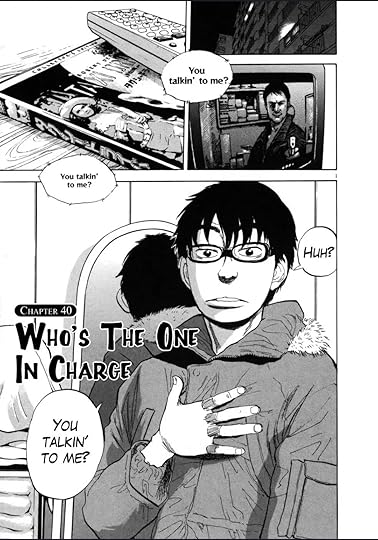
Do you know what a mid-way turning point is? Many books on writing consider it the most important piece of a story. That mid-way turning point is something like the main mast in a circus tent, ensuring the structure doesn’t collapse. It makes everything that happened before it a prequel to the true meat of the story, which will come afterwards. It sets a clear before-and-after deal, to the extent that the majority of the characters we grew familiar with in the first half no longer appear in the second. Such turning points tend to be spoilers. Some books on writing suggest that when trying to come up with a story, you shouldn’t start plotting properly until you have nailed down that turned point. I mention it because Boys on the Run has a perfect mid-way turning point that closes the curtain on most everything that came before. Without giving away spoilers, I’d say the first half of Boys on the Run is about winning over a girl (in truth, a sort of Japanese version of Taxi Driver), and the second is about boxing.
Anyway, let’s give a few concrete details about what one can expect from this tale. Tanishi is, as mentioned, working as a salesman for a struggling toy company. They are competing with a large toy company who is taking over most of the available spaces in restaurants and specialized stores for vending machines. So Tanishi is a loser working for losers. Tanishi is attracted to their toy designer, a cute girl and also the sole female worker. She’s nice to everyone. Most of the male coworkers, generally unused to interacting with women, treat her as their local princess.
Tanishi tries to get closer to her, but keeps fucking up. At one point he lent her his favorite porn video, of all things (I don’t recall the circumstances that made it seem okay), only to end up giving her a DVD of bestiality instead, one that belonged to the guy to whom he had lent the porn DVD. In retrospect, this whole porn video thing is likely a reference to Taxi Driver; there are far more overt references to that movie later.
[read the rest of this review on my site]
Four-and-a-half stars. This is Hanazawa’s magnum opus.
When I read Hanazawa’s I Am a Hero quite a few years ago, I assumed it was his debut work. The first few chapters of that story were that kind of somewhat-inept awkward, as if coming from an author who hasn’t quite realized how to properly present his ideas. That changed as the very long series (about 260 chapters) progressed, so you forgive that kind of shit. Unless you didn’t get through those initial chapters, that is. But I’ve read so much manga that it seems I have run out of “serious” manga (no more Oyasumi Punpun out there), and I returned to Hanazawa to figure out if anything else of his was good. I read his actual debut, about an ugly bastard who falls in love with an AI in a virtual world (here’s the review for Ressentiment ). I liked it a lot. The drawings were the most amateurish part, but the plot was tight and well-woven. The single other work between Ressentiment and I Am a Hero is a long-running series named Boys on the Run, produced in the second half of the 2000s. I loved it. To my surprise, Hanazawa most famous I Am a Hero is a significant step down from his best work.
This series I’m reviewing follows a young man in his twenties named Tanishi. He’s kind of a loser: his looks are average, he is a virgin, he lives with his parents, he works as a salesman for one of those companies that produce toys for vending machines (even though he’s a terrible salesman), and the girl he likes, who is a coworker of his, considers him a stalker (or at least badmouths him as one). This is mainly a character study, a bildungsroman of sorts: we are to witness how a boy who has been dealt bad cards in life tries to become a respectable man.
Most of Hanazawa’s main characters are fuck-ups, including Tanishi. While they share that with most of Minoru Furuya’s protagonists (Furuya being my overall favorite mangaka), ultimately Furuya’s are good guys who are screwed up. I can’t say the same thing for Hanazawa’s. This story’s protagonist considers other people’s luck or accomplishments something of a personal affront, he’s morally weak, and has very little self-control, leading him to break promises and/or fuck himself over in a way that made it hard for me to sympathize with him at times. There were several points in which I wanted to yell, “What the fuck are you doing? Stop, and get out of there!” He’s the “act first and think of the consequences later” type.
Do you know what a mid-way turning point is? Many books on writing consider it the most important piece of a story. That mid-way turning point is something like the main mast in a circus tent, ensuring the structure doesn’t collapse. It makes everything that happened before it a prequel to the true meat of the story, which will come afterwards. It sets a clear before-and-after deal, to the extent that the majority of the characters we grew familiar with in the first half no longer appear in the second. Such turning points tend to be spoilers. Some books on writing suggest that when trying to come up with a story, you shouldn’t start plotting properly until you have nailed down that turned point. I mention it because Boys on the Run has a perfect mid-way turning point that closes the curtain on most everything that came before. Without giving away spoilers, I’d say the first half of Boys on the Run is about winning over a girl (in truth, a sort of Japanese version of Taxi Driver), and the second is about boxing.
Anyway, let’s give a few concrete details about what one can expect from this tale. Tanishi is, as mentioned, working as a salesman for a struggling toy company. They are competing with a large toy company who is taking over most of the available spaces in restaurants and specialized stores for vending machines. So Tanishi is a loser working for losers. Tanishi is attracted to their toy designer, a cute girl and also the sole female worker. She’s nice to everyone. Most of the male coworkers, generally unused to interacting with women, treat her as their local princess.
Tanishi tries to get closer to her, but keeps fucking up. At one point he lent her his favorite porn video, of all things (I don’t recall the circumstances that made it seem okay), only to end up giving her a DVD of bestiality instead, one that belonged to the guy to whom he had lent the porn DVD. In retrospect, this whole porn video thing is likely a reference to Taxi Driver; there are far more overt references to that movie later.
[read the rest of this review on my site]

June 16, 2018
Pretty great series, nice art;Pretty good story

November 17, 2021
Well that was hilarious and awkward in equal measures.
Displaying 1 - 4 of 4 reviews