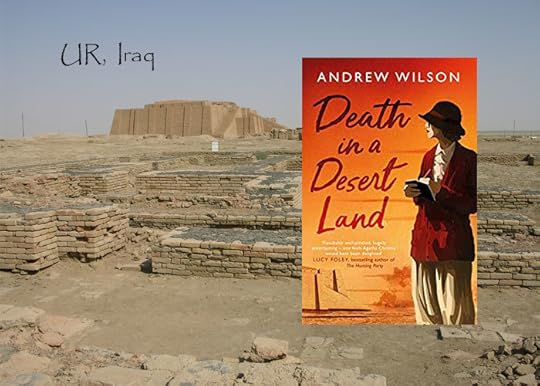
Queen of Crime Agatha Christie returns to star in another stylish mystery, as she travels to the excavation of the ancient city of Ur where she must solve a crime with motives that may be as old as civilization itself.
Fresh from solving the gruesome murder of a British agent in the Canary Islands, mystery writer Agatha Christie receives a letter from a family who believe their late daughter met with foul play. Before Gertrude Bell overdosed on sleeping medication, she was a prominent archaeologist, recovering ancient treasures in the Middle East. Found near her body was a letter claiming that Bell was being followed and to complicate things further, Bell was competing with another archeologist, Mrs. Woolley, for the rights to artifacts of immense value.
Christie travels to far-off Persia, where she meets the enigmatic Mrs. Woolley as she is working on a big and potentially valuable discovery. Temperamental but brilliant, Mrs. Woolley quickly charms Christie but when she does not hide her disdain for the recently deceased Miss Bell, Christie doesn’t know whether to trust her—or if Bell’s killer is just clever enough to hide in plain sight.
With Wilson’s signature “strong characters, shrewd plotting and a skillful blending of fact and fiction” (Shelf Awareness, starred review on A Talent for Murder), this is a thrilling adventure set amidst the cursed ruins of an ancient land.
"I'm a journalist and author. My work has appeared in the Guardian, the Washington Post, the Daily Telegraph, the Observer, the Sunday Times, the Independent on Sunday, the Daily Mail, the New Statesman and the Evening Standard magazine."
This is my first taste of Andrew Wilson's historical crime fiction series set in the 1920s featuring the Queen of Crime as a a undercover sleuth working for the British intelligence officer, Davison, after solving the murder of a British agent in Tenerife previously. This is a well told novel that shows detailed research of Agatha Christie's real life, people she really knew, with Wilson skilfully and seamlessly blending fact with fiction. Wilson's Christie is modest, shrewd, anxious and vulnerable, and still not quite over her first husband leaving her. She travels to Baghdad and the ancient city of Ur to look into the death of Gertrude Bell, the famous Arabist and adventurer, after unsent letters are uncovered which suggest she was murdered by someone working at the Ur archaeological site. Christie's visit was to be the source of the well known crime novel Murder in Mesopotamia, and in time was to culminate in her second marriage to the archaeologist, Max Mallowan, who gets a brief mention here.
At Ur, the dig is run by Leonard Woolley, a man who had a tense relationship with Bell, often disagreeing with her. He is married to the larger than life Katherine, an outspoken woman, whose first husband, a military man who worked for British intelligence, committed suicide. She has a reputation for not liking other woman on the site but has made an exception for Christie whose crime fiction she admires. Katharine is not a well liked woman, volatile, afflicted with fits of mania, loves a cat named Tom that is loathed by everyone else, and experiencing strange hallucinations. Others on the site include Lawrence McRae, and his troubled nephew, Cecil, whose parents are tragically dead, Father Burrows, and the site administrator, Cynthia Jones, an extremely capable and well organised woman. Present are the Americans, the charming dig photographer, Harry Miller, and the very wealthy Archer family, Hubert, his wife, Ruth and daughter, Sarah.
When a murder takes place, the chief and obvious suspect is Katherine, but is she guilty? Christie investigates, only to find nothing is as it seems. Wilson does not shy away from portraying the attitudes and norms of this period of history, the overt racism, a colonial power party to spiriting away ancient Middle Eastern treasures, the locals all looking alike and doing all the actual heavy work on the dig, whilst the British and Americans live in their own little exclusive bubble. All of this adds a sense of authenticity to the storytelling, not to mention the accurate portrayal of the real Christie's visits to the Middle East. This is an engaging mystery, one that I think many fans of Agatha Christie are likely to enjoy reading. Many thanks to Simon and Schuster for an ARC.
Aww, this series is so much fun! The main character is Agatha Christie! I have not read the previous two books, but I will spill the beans and tell you after this I definitely plan to! I also can easily let you know this one stands alone if you want to jump right in like I did.
A family has written to Agatha Christie asking for her help in solving the death of their daughter. Gertrude Bell was a famous archaeologist working in the Middle East. She was competing with another archaeologist, Mrs. Woolley, for some key artifacts worth a fortune.
Christie goes to Persia to meet with Mrs. Woolley. She is brilliant but pulls no punches letting Christie know exactly what she thought of Gertrude.
Wow. So a little side note as to why I connected so well to this story. One of my majors in undergrad was anthropology, and I heavily considered attending graduate school for archaeology. I love everything about archaeology from digging in the dirt, to discoveries, to analysis. It’s all fascinating, and this book being set amongst ancient ruins? Loved it.
More to love… The characters are so engaging. Agatha Christie is a force, and we all knew she would be. The plot never loses steam, and there’s great tension throughout. It also has an adventure feel, which made it even more exciting.
Overall, Death in a Desert Land is a solid, clever, original historical mystery, and I am ever so grateful it was put on my radar.
I received a complimentary copy. All opinions are my own.
Not having heard of the bestselling author Andrew Wilson before or reading any of his atmospheric murder mysteries featuring ‘Agatha Christie’, I was most intrigued to read his latest Agatha story “Death in a Desert Land”. In true Christie form, Wilson has written a first rate novel that you’d be hard pushed to realise hadn’t actually been written by the golden age, queen of detective fiction herself! For me, every character was excellently portrayed and had a typical persona of the 1920’s and each had a perfect role to play in the plot itself. I was interested to learn that a lot of the characters were based on real life people and actually did work as archaeologists, so seemlessly they were written into the story. Set in the Near East in the ancient Mesopotamian archaeological site of Ur, the atmosphere of the surrounding desert was so accurate, you could actually feel the intense heat and dry air and with the smells from the souks and alleyways, the novel really takes on its own ambience and pervading mood for the setting. The author had captured Agatha Christie so true to form this could literally have been a biography and murder that Agatha had found herself in, in real life. The research into her knowledge of poisons and her intriguing personal life blended real life and fiction superbly. Her classic ability to sniff out a criminal from ten paces made this a fabulously intriguing novel and the archetypical gathering at the denouement where the culprit was revealed was a joy to read. I was particularly stunned by the revelations of one of the character’s at the end and thought it a very clever addition to the storyline. I will definitely be going back to read the first two in this historical crime series, “A Talent for Murder” and “A Different Kind of Evil” and without doubt will be reading any future instalments featuring the fabulous sleuthing of Mrs Christie!
Wilson continues his fictionalized stories about Agatha Christie's life, positing her travels and adventures partly as undercover work for British Intelligence, as supporting her detecting aspirations, and as gathering material for her writing. An inspired idea, the reimagined life of Agatha! Agatha has been asked by her friend and Intelligence Officer Davison to go to Ur by way of Bagdad to investigate the death of a prominent archaeologist, writer and Intelligence Officer Gertrude Bell. (Bell also helped drafted the antiquities law in Iraq. Given the rape of antiquities from the Middle East and Egypt this was an important accomplishment for the times). Agatha is presented as a quiet force, still reeling with self doubts after her infamous disappearance, followed by her divorce from her husband Archie. To those she meets she is a crime writer with interests in archaelogy. The buildup of tension over time, the brutal death of a young heiress at the Dig near the Ur Ziggurat, the accusations and actions against the accused Mrs Woolley, are full of acrominy and hate, bordering on hysteria. Throw in others with secrets and there is a downward spiral towards chaos with too many clues. Agatha is dealing with a group of strangers throwing off the shackles of civilized behavior, and the real possibly of descent into anarchy. Agatha has her hands full as she searches for clues and brings together hunches and facts, and in consummate Hercule Poirot fashion unveils the murderer, and the hidden plot within a plot I commend the author's detailing of the facts behind this story at the end of the novel. In this section background information is given that is not only informative but attests to the quite rigorous research Wilson has engaged in, thus shaping this intriguing addition to the novels about Agatha Christie, the person. A solid historical crime/mystery read!
The combination of Agatha Christie, archaeology, ancient civilizations, and the Middle East is irresistable to me, so my perspective on this book may be skewed. But Death in a Desert Land was the perfect summer-afternoon read on my front terrace, and I recommend it for the following reasons.
First, Wilson gets the tone right; I felt as if I were reading a Christie novel. Second, he also gets the desert right; I'll be back again in the Middle East this fall and can't wait to be surrounded by sand, climbing in and out of archaeological sites. Lastly, the book reminds me of the Amelia Peabody series by Elizabeth Peters; I miss that (late) author a lot, and the dig superintendent in Death in a Desert Land could be a twin to the super in the Peabody mysteries.
My one complaint is that I suspected the villian at the 30-percent mark. But the read is pleasant and engaging enough to overlook that. I'll be buying the next book in this series.
There’s something really exciting about a novel which mixes fact and fiction. Taking a real life author, Agatha Christie and making her a character solving her own mysteries is genius. Taking her on a case which then will lead her to write A Murder in Mespotamia…..now that gave me a little frisson right there!
I’ve enjoyed this series from the start and it’s getting better. All these adventures lead to plots in her real life novels. That’s something that will never get old for me and it’s always exciting to see what she is going to get up to next.
This, set in Iraq is a classic. The prelude to A Murder in Mesopotamia is a feast for bookworms everywhere and a really good mystery into the bargain. I really got to know Agatha in this novel and her emotional side, her inquisitive mind and her character in general.
But that setting! The dig at Ur and the subsequent finds. I was there, in the dust, sand and hot Iraq sun. What a treat that was! So evocatively drawn and imagined. Historical figures wander on and off the pages. Leonard and Katherine Wooley were the ones who headed the excavations in real life and it’s a very unique feeling to have so many names and events wrapped up in one story.
You don’t have to know much about the Christie novel or Christie herself to enjoy this book. It’s a treat for the eyes and the imagination. Arm chair detectives will love it!
So sad this is the last book available from this series. It was wonderful, so suspenseful, had a fascinating and rich historical and geographical background - everything a girl can want from a historical mystery novel and more. Agatha Christie's character is still well done, and the rest of the characters here, many of which also historical figures, also come to life convincingly. When is the next one coming out?
I would venture to say that most people have heard of the great mystery writer Agatha Christie. She’s written so many classic mysteries and I would be hard pressed to meet someone who hasn’t heard of at least one of her books in one way or another.
Because she is so recognizable and such a classic mystery writer, I was thrilled to see that someone had turned her into her own fictional sleuth. My first thought when I saw that someone had done this, was that it sounded hokey. Agatha Christie is such an icon and to mess with that and turn her into a fictionalized detective sounded trite…..but at the same time, I was also here for it.
Especially when I read the description. It sounded like Agatha Christie was going to be kind of a female Indiana Jones—at least in this book—who solves crime. And to be honest, I didn’t care how hokey this book could potentially be, I just knew that I needed to read it!
My first thought when I finished this book was ‘where have you been hiding?!’. This series is a new to me series, as is the author and as soon as I finished I went and brought the other two books in the series because I loved this one and needed more!
This book had such great tone and presence about it and I loved that the author stayed true to Christie as a person, as well as the time period. This author has written a lot of non-fiction/biographies from what I understand, and this series is his first fictional writing. I think being a non-fiction writer helped him stay true to the period as well as Christie herself. I was glad he didn’t make her into a caricature of herself, he kept her smart, a little romantic and introspective. I think fans of Christie’s novels will find a lot to love with this series.
Other things that went through my mind while reading this one were how much I love exotic settings for murder mysteries! I adored the Amelia Peabody series and often try to find another series that might fill that void and this particular book at least, reminded me of all the things that I love about the Amelia Peabody books—intelligence, interesting mystery, exotic location, archeology, and some cheek.
This book is the third in a series so naturally I was worried about picking this book up late in the game, but I didn’t feel lost in the slightest. The author does a great job keeping the reader up to speed on previous plot points but overall this book focuses on the mystery and for that, there isn’t much back story needed.
On the whole, I loved this book and truly enjoyed picking it up each night! I can’t wait to read the other books in the series as well, what an interesting heroine! Also, the cover alone makes me want to read this book. It screams adventure and archeology and I would easily have grabbed it off the shelf at any bookstore!
A clever plot, with Agatha herself as the crime-solving protagonist. A very respectable number of red herrings, I eventually guessed the culprit but not the motive. And some good, evocative descriptions of Baghdad, the desert and the archaeological site at Ur.
Also, I didn’t know much about Leonard and Katherine Woolley, so I was surprised to learn some of the historical facts around which this story was constructed. Quite an enjoyable read.
I feel like I've read a similar book, but still a great addition to this series with Agatha Christie as the main character. I'll be waiting impatiently for book #4
"Fresh from solving the gruesome murder of a British agent in the Canary Islands, mystery writer Agatha Christie receives a letter from a family who believe their late daughter met with foul play. Before Gertrude Bell overdosed on sleeping medication, she was a prominent archaeologist, recovering ancient treasures in the Middle East. Found near her body was a letter claiming that Bell was being followed and to complicate things further, Bell was competing with another archeologist, Mrs. Woolley, for the rights to artifacts of immense value. Christie travels to far-off Persia, where she meets the enigmatic Mrs. Woolley as she is working on a big and potentially valuable discovery. Temperamental but brilliant, Mrs. Woolley quickly charms Christie but when she does not hide her disdain for the recently deceased Miss Bell, Christie doesn’t know whether to trust her—or if Bell’s killer is just clever enough to hide in plain sight."
I really loved discovering how much of this story was based on real people and situations and what Wilson did with those things. The mystery is multi-layered and really good.
I appreciated that there wasn't a whole lot of foul language, but there were a few scattered words. I also appreciated how well Wilson handled a very sensitive subject.
What a great read! I have always loved Agatha Christie’s work and this storyline was marvelous. Murder, intrigue and deception in a desert setting! With Agatha as the detective. And some of the characters are based on real people. I read it in one day and will read the other two books in this series
Struggled to finish this book, mainly because of its slow pace but my stumbling block was Agatha Christie written like a man, and a journalistic type at that. I doubt the real woman would have been as questioning as this version, undercover or otherwise. At one point, she does get her comeuppance and mellows somewhat. Unfortunately I don't think the sense of place is particularly strong. Christie inwardly questions the desecration and blatant plundering of grave sites, which didn't seem to bother anyone back then, but we got a millennium flutter of guilt for appearance sake.
The social hierarchy and limitations on women are fittingly pompous although not entirely accurate. Heat, sand and traditional drinks abounded and deeds are dastardly enough yet I found it hard to immerse myself. I don't enjoy author reiteration, e.g. writing a sentence then explaining it. Also Wilson has a tendency to write "I knew that appearances counted for nothing" several different ways. Regardless of avid fictioneers, I have always questioned the use of turning a famous person into a fabricated character in their own genre. A step too far?
In summary, it's a good attempt and I am sure fans will enjoy it but I think rather a lot of light-weight nonsense surrounds Gertrude Bell, Mrs Woolley, and this excursion into Christie's world of crime. To quote from the book "How extraordinary," said Miller, as we stepped into the courtyard. "It seems too unbelievable for words."
It's a piquant idea--a mystery with a real life Agatha Christie as detective. And I did like it, though it was slow going, but maybe not enough to go back and read the earlier volumes in this series. In the period after her divorce, but before she met her second husband, Agatha is asked by an agency of the British government to go to the new country of Iraq and investigate the death of Gertrude Bell, long believed to be an accident or suicide. A newly-found letter indicates Bell's belief that she was being threatened by someone at the excavation of Ur by noted archaeologist Dr. Woolley. When she gets to Ur, a murder, a sandstorm, and lots of suspicious characters make Agatha's job harder, but she is able to use her skills to unmask a murderer. Some of the same characters appear, disguised, in Christie's Murder in Mesopotamia, begging the question: Why not read that instead?
A divine treat for Christie fans! An intriguing, exotic puzzler for mystery fans! I'm enthralled by Wilson's series of inspired mysteries solved on the spot by the well-imagined character of Agatha Christie, with these experiences ultimately providing the plotting of her subsequent famous books. The reader is dazzled by the brilliant play of real and imagined scenes, as well as a sensitive depiction of Christie's personality - introspective, imaginative, self-deprecating, and a bit romantic.
This story is set at the famous archaeological dig at Ur and uses real life characters Leonard and Katherine Wooley, who headed those excavations. Christie fans who know her mystery Murder in Mesopotamia, will thoroughly enjoy Wilson's plotting and characterization of the same situation here in this story. Whether you know this Christie story or not, readers will find a skillful, stylish, exciting mystery to devour. Well done! This becoming my favorite series!
I've read "A talent for murder" and didn't like it very much but I've was interested to give Andrew Wilson another try and I'm glad I did. This was a very enjoyable mystery that held my interest it was equal amount of cozy and exciting to read. Will definitely read other books in the series.
More of an AG feel to it, perhaps due to the setting in Ur. Although I wasn’t sure about the reveals at the end, they made sense after reading the about the facts. Those always provide a better appreciation for the story.
After her adventures in Tenerife, Agatha Christie travels to Baghdad after being recruited to try and find out whether the death of adventuress Gertrude Bell was truly an accident/suicide or was in fact a murder, as the woman herself was concerned about in newly discovered letters.
When she reaches the dig site of Ur, she finds herself embroiled in a completely different mystery - the murder of American heiress Sarah Archer, and the strange behavior of Mrs. Woolley, wife to Leonard Woolley, who is running the dig site.
How easy it was for someone you loved to turn against you; a face that you had once gazed upon with adoration become possessed by something else entirely, something unfamiliar and strange.
As I felt with the last book, Wilson writes a great mystery. This one seems to depend on a few more real people than the last book did, but it's still a fascinating and compelling story. It's definitely not one that I had figured out, just like the last book.
I preferred this book to the last one because there were fewer unnecessary plot points, and I was less concerned about the length. I still thought that it was a tad bit too long, and cutting it down by 15-20% would have benefitted the story as a whole by tightening it up. That said, the mystery was fascinating and I ended up reading the story in a couple of hours because I couldn't put it down, which says everything that needs to be said, I guess!
I watched the ever-shifting sands turn from purple to violet and rose to yellow ocher, and finally something that approached a delicate shade of apricot.
I don't usually like reading series out of order, but this book happened to catch my attention at the library and the setting and premise sounded intriguing enough to make me pick it up anyway. Started out engaging enough, but ultimately the overabundance of people acting rather unhinged and contrived plot didn't impress me much. Also, it just has to be said: Dear authors - kill as many people as you like in your books, but leave the pets alone. There's little that'll put me off a book faster.
3.5 stars...Perhaps not as good as the first installment in this series, but certainly better than the last. I love that it was set in a location that is vastly underused (the Iraqi desert) and lightly explores the history of one of the earliest civilizations in the world. The mystery itself didn't 'wow' me..it really was all rather 'meh'. Let's hope the next installment is worthy of the lead character, Dame Agatha herself.
I really enjoyed this book which cleverly uses facts about Agatha Christie's life and other key characters to create a tense work of fiction. Set in the 1920s in what is now Iraq, it features old-style sleuthing and plenty of twists and turns with Agatha Christie as the central character. I'm definitely going to read the other books in this series.
Though I enjoy this series and the mysteries are very good, I felt this one dragged because of all the redundant info. I absolutely love the true facts at the end. I read them first.
As soon as I found out Andrew Wilson has yet another Agatha Christie mystery out, I added it to my preorder list on Amazon. Must read this masterpiece as soon as it comes out! And boy, I was not disappointed. In the third installment of the historical series reimagining events from Agatha Christie’s life, the author travels to Iran to investigate a suspected suicide of Getrude Bell, a famous adventurer and traveler (and a real-life person. Thanks, Mr Wilson for introducing me to this fabulous and strong woman!). To proceed with her investigations, she must go from Baghdad to an archeology dig in Ur, where we are introduced to a classic English country house mystery, even though the small cast of characters is in the middle of a desert. Nevertheless, it is the tried and true formula that makes it so appealing. When you have barely 10 characters plus Agatha Christie in a small house with an approaching sand storm, and bodies start dropping from the sky (or the zikkurat), you are in for a treat. Agatha (and Mr Wilson) does not disappoint and draws from her real-life experience as a murder mystery writer, nurse and poison connoisseur and neatly solves the mystery before it’s too late. I must admit, once I start reading it, I was hoping it would be nothing like Murder in Mesopotamia, which Dame Agatha wrote herself after the same trip. Please, no second husbands who are in fact masked first husbands, I was thinking. No open windows, no masks, no stones, since Mr Wilson’s book featured a lot of similarities with Murder in Mesopotamia. But fortunately, that was not the case. Oh, and we also got to meet Mr. Max Mallowan, who would later become Agatha Christie’s second husband. Their meeting in this book (and in real life) was delayed due to his appendicitis, so hopefully, in the next book or so we can see their introduction. Maybe they can have an adventure together on their honeymoon in Italy, Yugoslavia and Greece?
I was overjoyed to receive an early copy from NetGalley as I found the previous books in this series to be tremendous. This 3rd instalment didn’t disappoint. The writing was engaging & dramatic with nods to Christie’s novels & real life delightfully sprinkled through the mystery. The relationship that is evolving between Davison and Christie is compelling and I hope their friendship continues to be developed.
I really liked the mystery, but was not as enchanted with the writing or some of the characters. Both seemed artificial and stilted to me, and I thought Agatha was slow in figuring out who the murderer was. (Although in the final summing up she said she had pretended to believe in the innocence of certain parties.)
This book blew my mind! Historical mystery that kept you guessing until the very end. I loved books where you suspect everyone and don't know who to trust. Wilson. Top notch book!
I havent read the first 2 in the series but this didnt matter. I enjoyed this crime novel, with Agatha Christie as the main character solving the crime. Will look for others.
Agatha Christie travels to the ancient city of Ur in Death in a Desert Land, latest in Andrew Wilson’s fictional accounting of her exploits as a “secret operative” and all-around detective.
The dead individual is known from the very page -- Gertrude Bell. Who is not a fictional character, but was indeed a real historical personage, famous for her archeological exploits and influence on British Middle East policy in the early 20th century. Is this an anti-climactic let down, then? Well, we know who, but not why. We know how quite quickly. (There is indeed a mystery behind Gertrude Bell’s death, which is explained in the extensive Author’s Note at the end of the book which gives more information about the real historical figures that appear in this book. Don’t read it too early!)
Letters are found from Miss Bell, in which she writes she is afraid for her life. Well, how can a famous mystery writer overlook something like this? She can’t and neither could Andrew Wilson, and so off Mrs. Christie goes, first to Baghdad. Here, she meets the photographer for the dug – was this a chance meeting? Mr. Harry Miller – what is his story? Can he be trusted? Probably not. This is a mystery book, after all.
Possibly involved in the case is Katharine Woolley, wife of Leonard Woolley, the archeologist in charge of the dug at Ur. Mrs. Woolley did not like Gertrude Bell, not many people did, apparently. She was too brash, too opinionated, and looked down her nose at too many people. Not very feminine, either. There’s also a mystery behind the death of Katharine Woolley’s first husband. Is there a link to Gertrude Bell somehow?
There’s an animal’s death in this book – that should be mentioned.
A young woman is killed -- and Mrs. Woolley is discovered standing over her. She doesn’t remember a thing. Open and shut case, it seems. But Mrs. C doesn’t think so. Our Mrs. Christie begins to think there’s something else at play here. Poor Miss Bell is beginning to take a back seat. And all the while Mrs. Christie must fight off feelings of attraction to one of the men on the site. A tangled web, indeed. He could be the murderer.
The author has the fictional Agatha Christie think back to the plots of “her” books – luckily enough two of the most famous ones had already been published – to use as ideas as to what is going on; bluffs; a setup; or what? The books furnish her with the ability to carry on with investigating “real life” as she did in the writing. Fiction within fiction!
Davison (friend to Agatha, prominent in earlier books in the series), from the beginning of the book arrives, with a “policeman” in tow. The three of them concoct a ploy, a drawing room scene(!) where everyone’s assembled, during a sandstorm. Then of course it’s time to set the trap. The author certainly does know how to use every single character to tell a story. There is terror and fear here, too, both within (waiting for a murderer to strike again) and without (the sandstorm). And definitely the characters are diverse, just as in a real Agatha Christie novel.
I figured out who the killer was almost from the beginning, and was not disappointed. I just felt that some of what was done was silly (when you find out who the murderer is, think back to one early scene with the eventual killer and perhaps you’ll understand what I mean). I had to mark the story down for doing that.
In the end, both cases are solved, according to Mrs. Christie. And what has happened is that Mr. Wilson has put an amazing twist on it – he solved one case of murder while pretty much ignoring the one he started with – because it usually is isn’t possible to solve a “real” historical mystery – insert name of Jack the Ripper here. And in the course of doing that has given us some astounding facts about some really interesting (real) people. Read Death in a Desert Land and see if you don’t agree with me.
Thanks to the publisher and to Net Galley for a copy of this book, in exchange for this review.
This is the third in Andrew Wilson's Agatha Christie's mystery series. Death in a Desert Land has Christie traveling to the city of Ur in Iraq to investigate if famed explorer Gertrude Bell's death was indeed a suicide after a pair of letters found in Bell's handwriting warning of someone trying to kill her.
Christie meets the cast of characters where Bell was last seen alive: Dr. Leonard Woolley, a meek archeologist, Mrs. Katharine Woolley, his mercurial, erratic wife, Cynthia Jones, a plain spinster, Father Burrows, Lawrence McRae and his nephew Cecil, American photographer Harry Miller, and Hubert and Ruth Archer and their daughter Sarah.
As she is there, Katharine begins to act increasingly off-kilter: she hears voices and sees impossible faces, her beloved cat is found dead on her bed while she has claw marks on her arms and more importantly, she is seen with her hands covered in blood when Sarah Archer is killed. Everybody in the camp, except Leonard and Christie, believe Katharine is an unstable murderer and lock her up in a shed.
Christie needs to work fast on who really killed Sarah because she believes that there are more nefarious forces at work; forces that want Katharine Woolley dead.
I enjoyed Death in a Desert Land more than I did with Wilson's last entry, A Different Kind of Evil. I liked the locked room situation the characters found themselves in one the sandstorm came about. I felt that the tension was lacking. Many exciting events were happening but I just didn't feel it. The murderer and their motive, while specifically cliché, had a bit of depth that was interesting.
What originally got my attention with this series is how Wilson uses real life events in Agatha Christie's life to create a new mysterious narrative. I highly enjoyed it in his first book, A Talent For Murder. In the second title, there were barely any historical facts. In this one, it was great how he used Christie's real trip to Ur in 1928 to be the backdrop of the mystery.
Also, it was very cool that Dr. Leonard Woolley and Katharine Woolley were real people. A lot of their personal life that Wilson had in this book actually happened. As was Katharine's secret, which proved to be the catalyst for many of the book's events. I have never said this before, at least, I don't believe I have, I am very much a fan of the cover art. It's beautiful.
Though Death in a Desert Land wasn't my favorite of the series, I still can't wait for the next one.