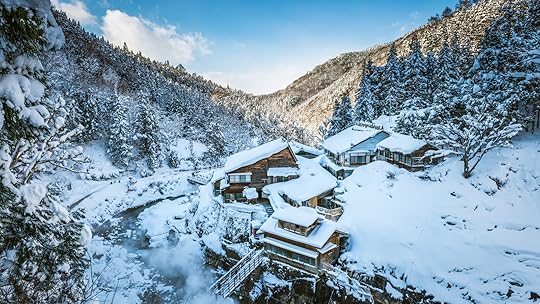
Kobayashi Issa was a Japanese poet known for his haiku poems and journals. He is regarded as one of the four haiku masters in Japan, along with Bashō, Buson and Shiki. Reflecting the popularity and interest in Issa as man and poet, Japanese books on Issa outnumber those on Buson, and almost equal those on Bashō.
Although better known by his pen name Issa, he was born Kobayashi Yataro in 1763 on a farm in central Japan.
Haiku by Kobayashi Issa (1763-1827), in his own hand
No lightsome thing it is To have been born a man Now autumn closes! (*)
The quintessentially Japanese poetic form haiku, consisting of a mere three lines of five, seven and five syllables, is a strange and wondrous beast. Originally called hokku because it was the initial verse in a long renga, or linked verse poem, the form could emancipate itself from its original context, I believe, due to the Japanese taste for the slight and evanescent. The primary impetus for this emancipation was Matsuo Basho (1644 – 1694), who demonstrated what a master could do with this little poetic form. Just as one has seen in the reception of haiku in the West, it seemed so easy to write that poetasters of every description threw themselves upon the form and merrily generated millions upon millions of quintessentially ephemeral texts.
But there is gold amidst all that dross, particularly in the work of the widely recognized Three Pillars of Haiku: Basho, Yosa Buson (1716-1783) and Kobayashi Issa,(**) though Westerners accustomed to longer forms must adjust their expectations to be able to appreciate poetry that necessarily suggests more than it can say.
During the Tokugawa period (1603-1868) the leisure classes consisted of the samurai and the rapidly rising mercantile class, so, unsurprisingly, it was from their ranks that the overwhelming majority of haiku poets stepped. A striking exception was Issa, born to very modest farmers in a tiny village perched on the northern edge of what is often called the Japanese Alps (at least by Westerners), a mountain range bisecting the main island Honshu, where only a short time separates the release of winter's bite and the start of autumn's chill.
In the Japanese Alps
The snow thaws - And suddenly the whole village Is full of children! (*)
In such a poor region there was little opportunity for education and, what is more, when he left the village to make a living somehow in Tokyo (then called Edo) he was only fourteen. Records of Issa's first years in Tokyo are rare, but at some point he became the handyman/apprentice of a haiku master and began a long and never prosperous climb to recognition as a master in his own right, scraping together a living by accepting fees from students and the hospitality of admirers.
Issa's peasant class origin was in many respects a great drawback, but it also enabled some of his striking originality of topic and expression. Where, for instance, Basho attempted to lose his self in nature, to disappear into a mystic communion with nonhuman reality, Issa tried to humanize nature, to personify even the lowliest creatures. Spare the Fly! Wringing his hands, wringing his feet, He implores your mercy! (*)
And he opened the form up to practical concerns and a very wry humor: spring is here - also here, right before my eyes, cracks in the wall (***)
Wry and generally self-deprecating humor: is it hard to crawl on my wrinkled palm first firefly of the year? (***)
Following Basho's lead, Issa also wrote in the haibun form, which mixes linked prose and poetry to sometimes wonderful effect. Basho perfected the form in his travelogues and in his famous piece on his last abode, named Genjuan no Fu (evocatively translated by Donald Keene as "unreal dwelling"). One of Issa's finest haibun - Oraga Haru - is introduced, commented and translated by Yuasa Nobuyuki in The Year of My Life (1960/72). Instead of a trip through space, Issa's is a trip through time: from New Year to New Year Oraga Haru is an account of what he did, felt and heard during the year of 1819, a year that proved to be tragic for the poet and his wife.
An unusual feature of Yuasa's translation is to present haiku in the form of (unrhymed) quatrains instead of the standard three lines. Nonetheless, one immediately recognizes Issa's voice: When I sat down To pray to Buddha, Mosquitoes came buzzing Out of his shadow.
Haibun are not normally narrative, but rather episodic and impressionistic. Events are suggested, but moods and moments dominate.
The overwhelming event of 1819 for Issa was the sudden death of his beloved daughter Sato from smallpox in her second year of life. Due to financial constraints, Issa married very, very late, and his first child died after only a month or so of life. He and his wife were overjoyed and heartened that the second child made it safely out of the first year; that joy colors the first three quarters of the text.(4*) But the joy was not to last. The chapter describing the child's taking ill and passing is wrenching. Issa's commemorative poem: The world of dew Is the world of dew, And yet . . . And yet . . .
(*) Translated by Lewis MacKenzie in The Autumn Wind (1957). This is not the poem in the introductory image.
(**) The person responsible for the Meiji era revitalization of the form, Masaoka Shiki (1867-1902), is considered to be the fourth Pillar by many.
(***) Translated by Ueda Makoto in Dew on the Grass: The Life and Poetry of Kobayashi Issa (2004).
(4*) Actually, Issa's first three children died before they reached their second birthday; his wife passed soon after the death of the third. After an unsuitable remarriage that lasted four months, Issa married a third time more appropriately, but died before he could see the birth of his fourth child, the only one to live into adulthood.
Five stars, of course five stars, what do you expect?
Not "A Year of My Life," but "THE Year of My Life." Issa makes one year emblematic of his entire life with a mix of prose and haiku that examines the intellectual, emotional, spiritual value of the events that make up a life - birth, death, travel and its unfolding landscape, work.
We've seen a lot of the haiku as stand alone pieces, but putting them into context raises their impact in unexpected ways. The well known haiku:
The world of dew Is the world of dew and yet and yet...
is a powerful piece, when it's preceded by Issa's musings on his young daughter's death it becomes closer to devastating.
A worthwhile introduction by the translator Nobuyuki Yuasa contextualizes Issa in relation to the other famous masters of Haiku, and explains the basic principles of Haiku, Renga, Waka, and Haibun. The intro. also includes some wise quotes from Bashô on the art of Haiku, including:
"What is important is to keep your mind high in the world of true understanding and yet not forget the value of that which is low. Seek always the truth of beauty, but always return to the world of common experience."
"You can learn about the pine only from the pine,...When you see an object, you must leave your subjective preoccupation with yourself; otherwise you impose yourself on the object, and do not learn...if your feeling is not natural--if the object and yourself are seperate--then your poetry is not true poetry but merely your subjective counterfeit."
I do not like most modern poetry because it is autobiographical. I like this book because it is autobiographical. The difference is that modern poets do little, if anything, to help readers understand the context for the events that brought on the feelings they write about, so the reasons for the feelings expressed in their poems are not clear. Issa write prose telling you exactly what occasioned a poem then presents the poem. This is elegant and obvious, and it escapes the obscurity that makes so much modern poetry inaccessible. Yuasa’s translation teats the Issa’s haikus as four-line poems, so it was easy to lose the fact that I was reading haiku, but most of this work is still lovely and made more so because I understand why Issa wrote these poems.
Issa is one of my favorite haiku poets, so I was excited to crack into this. That being said, the translations haven't aged well and are likely on the literal side. I can't be certain—I don't speak Japanese—but these translations seem overwritten.
The good:
- It preserves the context of Issa's work, many of which we would call "Haibun"—haiku poems bringing a paragraph or two of prose to conclusion, much like the flower that blooms from a tangle of bushes.
- Many haiku by writers Issa admired are included, and these are generally included to show us the emotional landscape Issa traverses as he wanders through life, day after day. I enjoy reading being brought into commune with his poetic tradition.
- Issa is a genuinely sweet and compassionate guy who has seen some hardship. Themes of his childhood neglect and abuse are a dark cloth against which the love—and loss—of his own children, or his humane reverence for all sentient life stand out in brilliant contrast.
- the second edition, which I was given as a gift, is a beautiful little book which I'll certainly keep as a reminder of the person who gave it to me, and also out of reverence for this excellent poet
The bad:
- I don't usually feel strongly about how haiku are structurally arranged, although that they should be between one to four lines is a given. with that in mind, the choice to universally translate these in four lines was a mistake. They don't have the beauty or the brevity of haiku.
- There's a lot of adjective/adverb piling. I suspect the four-line format didn't provide enough tension to hone the choice of words.
- The introduction provides a decent overview of Haiku and is best for illuminating the context of Issa's life and writing, but I didn't find it particularly enlightening in terms of haiku theory. It is still better than the proscriptive and confused demands on haiku made by Blyth (my arch-nemesis)
- the introduction also kind-of spoils the "climax" of the book—right after showing an earlier version of the poem I actually felt was better. That the author disagrees which the good one is tells me we have much different taste.
In resume:
This is an old-school translation of Haiku. The poems in translation don't really shine. They do manage to give you an emotional bridge to Issa, but I will look for another translation of this work now that I have finished it.
At the end of the day, any Issa is better than no Issa. I thank Yuasa for leaving us with this translation, which no doubt paved the way for future translators.
Ehhhhh, I prefer Hamill's translation. Also it had been two decades since I first read Year of My Life, I was definitely less impressed this time; so many weak poems, and the editing is a mess. It did become clearer to me, though, that his daughter's death is the real thematic core of the work (she's mentioned obliquely throughout).
It's hard to rate a collection like this because some poems really speak to you and are five star poems while others don't do anything for you. I did like how Issa had little stories in every chapter rather than just a collection of poems.