Jump to ratings and reviews
Rate this book

The World Goes On

Rate this book
Shortlisted for The Man Booker International Prize 2018

A Hungarian interpreter obsessed with waterfalls, at the edge of the abyss in his own mind, wanders the chaotic streets of Shanghai. A traveller, reeling from the sights and sounds of Varanasi, encounters a giant of a man on the banks of the Ganges ranting on the nature of a single drop of water. A child labourer in a Portuguese marble quarry wanders off from work one day into a surreal realm utterly alien from his daily toils.

In The World Goes On, a narrator first speaks directly, tells twenty-one unforgettable stories, then bids farewell ('for here I would leave this earth and these stars, because I would take nothing with me'). As László Krasznahorkai himself explains: 'Each text is about drawing our attention away from this world, speeding our body toward annihilation, and immersing ourselves in a current of thought or a narrative...'

The World Goes On is another masterpiece by the winner of the 2015 Man Booker International Prize. 'The excitement of his writing,' Adam Thirlwell proclaimed in the New York Review of Books, 'is that he has come up with his own original forms-there is nothing else like it in contemporary literature.'

320 pages, Paperback

First published March 1, 2013

333 people are currently reading
4322 people want to read

About the author

László Krasznahorkai

43 books2,867 followers
László Krasznahorkai is a Hungarian novelist and screenwriter who is known for critically difficult and demanding novels, often labelled as postmodern, with dystopian and bleak melancholic themes. He was awarded the Nobel Prize in Literature in 2025.

He is probably best known through the oeuvre of the director Béla Tarr, who has collaborated with him on several movies.

Apart from the Nobel Prize, Krasznahorkai has also been honored with numerous literary prizes, among them the highest award of the Hungarian state, the Kossuth Prize, and the 2015 Man Booker International Prize for his English-translated oeuvre.

Ratings & Reviews

What do you think?
Rate this book

Friends & Following

Create a free account to discover what your friends think of this book!

Community Reviews

5 stars
306 (28%)
4 stars
381 (35%)
3 stars
256 (24%)
2 stars
93 (8%)
1 star
27 (2%)
Displaying 1 - 30 of 166 reviews
Profile Image for Seemita.
196 reviews1,775 followers
May 18, 2018
[A near 4 stars]

My first acquaintance with László Krasznahorkai was through the dark and hypnotic Satantango . Into the swooping belly of a dancing and delirious night, a bunch of villagers had fallen prey to a fictitious dawn, egged by a manipulative and mysterious stranger. They were led to their ultimate doom not as much by the towering outsider as by their own failures to spot the cracks. An apocalyptic blanket had rendered the book both bleak and brazen, showcasing Krasznahorkai’s enviable skills of sealing a haunting painting with some unusual colors. The World Goes On follows almost the same trajectory, with the near same aplomb.

The book opens with a narrator who speaks, narrates and bids farewell, and under each of these three sessions, ends up sharing 21 stories of myriad backgrounds. The stories hop and leap across Italy and India, US and Germany, and are nestled amidst the gardens and stations, ghats and highways - a frail woman fidgets at a post-office while filling a telegram form and eventually leaves without scribbling the address, a curious man doesn’t stop obsessing over the scientific marvel of a water drop to the quandary of a fugitive foreigner, a panting policeman comes to an inexplicable halt with inches separating him from the peeing scoundrel, a man receives an offer to co-direct a film only to find his host dead after making a similar offer to numerous others. These slices of life open up at different times with different characters but they all have a thing in common – the recurrence of mundane and hanging ends that strangles the meaningful pulse of quotidian life. And hence, the peppering of philosophy from the stables of Nietzsche, Heraclitus and Beckett is no surprise.

For those uninitiated into the Krasznahorkai-world, the narrative can appear a disjointed and convoluted maze of plain, vanilla threads that bear no promise of perking up for chapters on end and are dyed in pitch-dark realities of the human mind.
...a world where even a bouquet of violets carries the definite odor of money. This was the place I had fallen back into with a crash.
His penchant for lengthy sentences, frequent repetition, sparse punctuation and cryptic monologues add an additional layer of intricacy in reaching the essence of his words, which are unambiguously inclined towards disintegration and annihilation. But for this reader, his prose displayed the tenacity of a sleuth, waiting for the right moment to deliver a fatal blow and do so in such smooth and unhealthily subtle manner that the occurrence of the high-point may even escape the reader’s detection.
I no longer recall how long this lasted, possibly days, even weeks, until one morning I was sitting by the window, looking out at the un-consoling light, and outside, below the kitchen window, a band of sparrows burst upward from the dry twigs of an unclipped hedge only to almost instantly swoop back down again.
This collection is a nasty reminder of what is dead in us. It is a reminder of our mask of indifference that keeps the pungent but urgent smoke of action from entering our innards. Krasznahorkai is unapologetic in depicting the deranged and portentous side of us that belies the febrile temperament deep-seated in our conscience. And despite our protests in establishing truth otherwise, there shall be no benevolence because the world will go on, giving two hoots to our duplicities.

Profile Image for Josh.
375 reviews253 followers
May 17, 2018
It's hard to rate a book with a style that you can't quite put a finger on. At times, it made me feel claustrophobic, anxious or otherwise panicked. I felt like I couldn't take my eyes off of the page because if I looked one way or the other, I'd be back in my own world. I felt locked in: sedated, yet alert.

At other times, I needed a break. A few day's break. It was exhausting.

It's rare that I have been so back and forth on a book and finished it, especially with it being short stories or whatever the hell that was. Yet, I must also say that this was the first book in memory that I contemplated re-reading from the beginning as soon as I finished it.

I haven't felt this way while reading a book before.

The melancholy and death wish of most of the characters can be overwhelming at times, especially emotionally. It may make you feel a mixture of feelings, as listed above.

I don't think this was a good starting point for Krasznahorkai's literature, but I will read more. I must read more.

If a work of fiction doesn't make you feel anything, then you're wasting your time.
Profile Image for Paul Fulcher.
Author 2 books1,941 followers
October 9, 2025
From the winner of the 2025 Nobel Prize in Literature

On the Man Booker International Shortlist. Krasznahorkai is one of the world's finest writers, but this is neither his best work (War on War followed by Seiobo and Satantango) nor the easiest introduction (Herman and the Last Wolf). Don't start here, as one for Krasznahorkai completists only, but then everyone should be a Krasznahorkai completist!

It didn’t matter if it was fifteen miles from Los Angeles, eighteen miles from Kyoto, or twenty miles to the north of Budapest, it simply sat there, looking sad, watching over its companion, waiting for someone to come along to whom it might explain what had really happened or just sitting and waiting for the other to get up at last and make some movement so that the pair of them might vanish from this incomprehensible place.

The World Goes On is the translation by a combination of John Batki, Ottilie Mulzet and George Szirtes of László Krasznahorkai's Megy a világ.

This collection of pieces was published in this form in 2013 in the original Hungarian, although some of them were published separately earlier, notably A Théseus-általános (Universal Thesis), the longest piece, a 70 page novella, published in 1993.

This was perhaps the highlight of the collection, a series of three lectures given by an invited guest to a rather mysterious audience, which opens

I do not know who you are, gentleman.
I couldn't quite make out the name of your organisation.
And frankly, I must confess I am not entirely clear about what kind of lecture you expect me to give here
[...]
You are not saying anything.
Fine it's all the same to me.
Mr President, gentlemen - I shall speak about melancholy.
And I will begin by going way back.


He then relates a tale of a large ghostly tractor-trailer that arrived in a small Hungarian town in the 1960s, 'deep in the deepest hellhole of that decade.' Krasznahorkai fans will immediately know, before he tells us, what the trailer contains - the body of a huge whale - as this is of course a re-telling of the events of The Melancholy of Resistance. Although in the lecturer, the speaker scorns the book that claims to explain the events that followed:

I myself can now announce that to claim there is a book that knows, that promises to reveal and narrate to us and only us all that breaks loose in the wake of one of these gigantic whales, is either an insidious effrontery or the vilest drivel, in a word, lies, of course, for nobody knows what really is unleashed at these times, no one, and no book knows that, because that certain something lies completely covered up by the whale.
Mr. Chief Constable, esteemed gentlemen!


As the series of lectures proceeds, he gains no better knowledge of his listeners, but increasingly realises that he is not so much invited as trapped - the 2nd lecture is given, to his distress, with the lecture theatre locked, and between the 2nd and 3rd he is not allowed to return home but held, admittedly in comfort, in a basement.

This story is one of a number of echoes of his other works:

The short piece At the Latest on Turin, written in the early 90s, was to be essentially reproduced later in the script of the 2011 film A torinói ló (The Turin Horse), made with his long-term collaborator Béla Tarr;

The Bill: For Palma Vecchio, at Venice has already been published in English as a Sylph Editions monograph, together with reproductions of the paintings of Palma Vecchio;

and then there is the short piece Not on the Heraclitean Path, which I reproduce below in full (given it has been widely quoted in full in press reviews):

Memory is the art of forgetting.

It doesn’t deal with reality, reality is not what engages it, it has no substantial relation whatsoever to that inexpressible, infinite complexity that is reality itself, in the same way and to the same extent that we ourselves are unable to reach the point where we can catch even a glimpse of this indescribable, infinite complexity (for reality and glimpsing it are one and the same); so the rememberer covers the same distance to the past about to be evoked as that covered when this past had been present, thereby revealing that there had never been a connection to reality, and this connection had never been desired, since regardless of the horror or beauty that the memory evokes, the rememberer always works starting from the essence of the image about to be evoked, an essence that has no reality, and not even starting from a mistake, for he fails to recall reality not by making a mistake, but because he handles what is complex in the loosest and most arbitrary manner, by infinitely simplifying the infinitely complex to arrive at something relative to which he has a certain distance, and this is how memory is sweet, this is how memory is dazzling, and this is how memory comes to be heartrending and enchanting, for here you stand, in the midst of an in nite and inconceivable complexity, you stand here utterly dumbfounded, helpless, clueless, and lost, holding the infinite simplicity of the memory in your hand—plus of course the devastating tenderness of melancholy, for you sense, as you hold this memory, that its reality lies somewhere in the heartless, sober, ice-cold distance.


The link here is in the title and to the stunning piece "Kamo-Hunter", describing a snow-white heron by the Kamo River in Kyoto, which opens Seiobo There Below:
Everything around it moves, as if just this one time and one time only, as if the message of Heraclitus has arrived here through some deep current, from the distance of an entire universe, in spite of all the senseless obstacles, because the water moves, it flows, it arrives, and cascades...
The World Goes On is a mixture of philosophical pieces like this and short stories.
One theme common to a number is people trapped by noise and chaos and needing to escape - a worker in a marble mine, a traveller in Varanasi on the bank of the Ganges:

..the hubbub of the street resumes its rule over the city, and this hubbub flares up again like a flame, and indeed it is just like a malignant conflagration that nothing can put out, nothing can abate, alongside speeding vehicles, street philisophers, handbill distributors, and humming thickets of cables crisscrossing the air, the great stars of Bollywood pop music are blaring from radios, TVs, even from loudspeakers rigged on tuktuk cars, they blare 'I burn on the pyre of eternal love for you', and in this wildfire of noises he comes to the decision he must leave, because he is in mortal danger here...

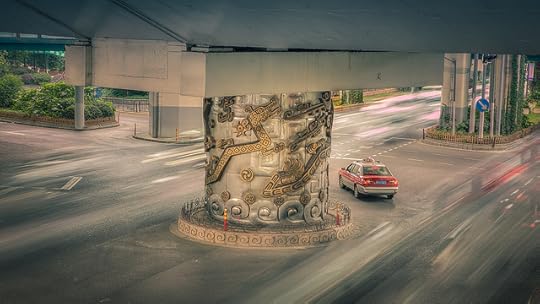
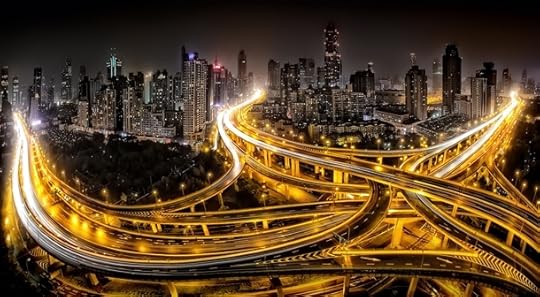
and a man in Shanghai who makes the mistake of trying to walk off a hangover in a city not suited to pedestrians, and finds himself trapped in the middle of Shanghai's rather more spectacular version of Spaghetti Junction, the Nine Dragon Crossing:

description

description

In other stories the oppression comes from tedium - an artist visiting an old friend in Kiev, expecting to visit various cultural sights only to find himself trapped in a car with a friend-of-his-friend with an interminable story about the goings-on in the internal audit department of the bank at which he works, or the traveller in Varanasi who, when he almost reaches the banks of the river, is accosted by a prophet-like figure who hails him with the enticing sounding promise that he will explain how each drop of water from the Ganges contains a temple, but then launches into a lecture on the molecular properties of H2O and the science of surface tension.

The collection ends with an eloquent tribute to the wonderful things of this word, but a promise to leave them behind, a view of the future which could be taken as highly optimistic, or highly pessimistic:

I would leave everything here: the valleys, the hills, the paths, and the jaybirds from the gardens, I would leave here the peacocks and the priests, heaven and earth, spring and fall
[..]
I would leave here incantation, enigma, distances, the intoxication of the inexhaustible eternities; for here I would leave this earth and these stars, because I would take nothing with me, because I've looked into what's coming and I don't need anything from here.


Overall, not Kraszhanorkai's strongest - although pulled together in the form of a coherent WORK some of the pieces weren't originally written for that purpose, and at times it shows. And I would recommend to the beginner to his work instead starting with the novels (e.g. War & War or Satantango) and for his more recent essayistic works Seiobo There Below. But even below par Kraszhanorkai is world class and he is a vital author to read, particularly in these times.

Reviews which better express aspects of this book than I can:

Thanks to Birne for pointing me to this one - in Music & Literature (which once dedicated a whole edition to the author Music & Literature: Issue 2) - which explains beautifully how this work fits in with Krasznahorkai's wider literary project:

http://www.musicandliterature.org/rev...

also:

https://brooklynrail.org/2018/02/book...

https://lareviewofbooks.org/article/l...

http://www.oxonianreview.org/wp/the-s...

https://www.theatlantic.com/magazine/...
Profile Image for Alan.
718 reviews288 followers
January 18, 2025
For a few days, I have struggled to settle on a star rating for this book. I have finally settled on a 5, because it provided far too many moments of losing myself in the realm of the sublime. The hesitation came from the presence of the stories that did not do so, and this is the constant danger of short story collections (although calling some of the pieces in this book “short stories” is far-fetched).

I suppose it’s always nicer to have monumental ideas about life and the futility of emotion wrapped up in a story that begins and ends in definitive narrative space. Beginning, middle, end, with characters that change according to conventional wisdom and a nice nugget to take away as a moral. This is not the style of Krasznahorkai. You may get a 60-page series of lectures by a political prisoner that’s not named and whose audience you know very little about. You may not be so lucky. Perhaps you get a paragraph. Or you might even get 17 pages of blank space (which are qualified and “explained” by fictitious endnotes which all refer to real books or peer-reviewed journal articles).

I’ll be coming back to this very soon, as it’s thoroughly annotated. A powerful paragraph:

“By now we are gliding among the buoys that mark the harbor, navigating somewhat blindly, for the lighthouse keepers are asleep and cannot guide our maneuvers—and so we drop our anchor into a murk that instantly swallows up our question about whether this greater whole reflects the higher meaning of the law. And so here we wait, knowing nothing, and we merely look on while, from a thousand directions, our fellow humans are slowly nearing us; we send no messages, only look on, and maintain a silence full of compassion. We believe that this compassion inside us is appropriate as such, and that it would be appropriate, too, in those who are approaching, even if it is not so today, it will be so tomorrow… or in ten… or in thirty years.”
Profile Image for Lee.
381 reviews7 followers
December 24, 2017
Krasznahorkai can do no wrong for me, and my rating might well be meaningless as I'm completely biased. I love what he's doing, and urge everyone who hasn't to read him immediately. I'm not sure how to describe his style - part Bernhard, part Broch, part Young - but I'm addicted to it.
Profile Image for Jim Elkins.
361 reviews451 followers
Read
October 6, 2019
What's Wrong with Krasznahorkai

I seem to be one of a very few people who do not value Krasznahorkai's fiction. His work is a lesson in how treacherous it is to keep Kafka too much in mind while you're writing. He often substitutes atmosphere for both ideas and structure, and he apparently feels that lugubrious, dark, "intolerable, cold, sad, bleak, and deadly" landscapes he conjures are both naturally and sufficiently expressive of his often vague but persistent ideas about melancholy and memory, which are themselves derivative of prewar European fiction.

Here I complain briefly about a half-dozen stories in the collection, and then, under number (2), quote one of the essays in its entirety and complain about it at length.

1.

The first piece, "Wandering-Standing," is a pastiche of one of Kafka's parables or Beckett's scenes, with too many ideas, each one a cliche. (The man torn in two directions, holding a heavy suitcase in each hand.)

The second, "On Velocity," is about a man who tries to walk faster than the Earth spins, in order to escape from thought itself, "because the Earth is thought." First he walks West, which is wrong, because he's just subtracting a little from Earth's rotation; then East, which works; and finally he walks, because he realizes it doesn't matter if he runs or not. The problem is that these three decisions are very simple. I was ahead of him on each one, reading fast to see how long it would take Krasznahorkai's narrator to get to the inevitable conclusion. It's not good to have the reader's thoughts ahead of the narrator's when the theme of the piece is moving thought faster than the Earth. (Note this is not an intended irony.)

The third, "He Wants to Forget," toys weakly with existentialism: "weakly" because it glances off ideas better developed in existentialist literature.

The fourth, "How Lovely," is feeble-minded, in the sense that he doesn't think through his own premise, which is a conference on the idea of area, which is in turn predicated on the non-existence and yet pervasive necessity of area (space). This could be developed (I think of Cesar Aira here, who could have made it into another literary conference), but here it isn't.

Fifth: "At the Latest, in Turin": this is a simple answer to Thomas Mann's reading of the story of Nietzsche's collapse (that the philosopher of the amoral succumbed to moral feeling). It's nearly a three-page philosophy essay, but it's bogged down by irrelevant literary metaphors ("by now we are gliding among the buoys that mark the harbor..." etc.).

Seventh is "Universal Theseus," which is cast as a lecture series. The first one recapitulates the story of the arrival of a sinister caravan, told in "The Melancholy of Resistance." The moral here is necessarily simpler than in that book: Krasznahorkai actually draws a conclusion ("melancholy is the most enigmatic of attractions") and proposes three sources of melancholy (pp. 39-40), which are not problematic in the context of a ten-page essay. This ruins part of "The Melancholy of Resistance" in retrospect, because it reveals a simple idea underneath the long novel.

2.

Reviewers have singled out a one-page essay called "Not on the Heraclitean Path" for special praise. It is just two sentences in John Bakti's translation:

"NOT ON THE HERACLEITEAN PATH

"Memory is the art of forgetting.
"It doesn’t deal with reality, reality is not what engages it, it has no substantial relation whatsoever to that inexpressible, infinite complexity that is reality itself, in the same way and to the same extent that we ourselves are unable to reach the point where we can catch even a glimpse of this indescribable, infinite complexity (for reality and glimpsing it are one and the same); so the rememberer covers the same distance to the past about to be evoked as that covered when this past had been present, thereby revealing that there had never been a connection to reality, and this connection had never been desired, since regardless of the horror or beauty that the memory evokes, the rememberer always works starting from the essence of the image about to be evoked, an essence that has no reality, and not even starting from a mistake, for he fails to recall reality not by making a mistake, but because he handles what is complex in the loosest and most arbitrary manner, by infinitely simplifying the infinitely complex to arrive at something relative to which he has a certain distance, and this is how memory is sweet, this is how memory is dazzling, and this is how memory comes to be heartrending and enchanting, for here you stand, in the midst of an in nite and inconceivable complexity, you stand here utterly dumbfounded, helpless, clueless, and lost, holding the infinite simplicity of the memory in your hand—plus of course the devastating tenderness of melancholy, for you sense, as you hold this memory, that its reality lies somewhere in the heartless, sober, ice-cold distance." (p. 95)

For examples of reviewers' praise of this see Joslyn Allen in Chronic Bibliophilia or Nicky Loomis in the Los Angeles Review of Books; both also quote the essay in its entirety. Loomis's praise is typical in the way she sets Krasznahorkai against the Attention Deficit Disorder of contemporary screen addiction: "So here goes 'Not on the Heraclitean Path' in its entirety," she writes. "I encourage you to read Krasznahorkai with no distraction. If you are on a train, do not look out the window mid-sentence. If you are on your computer, do not check your email. Do not take a bite of a sandwich. Ignore loved ones. And for god’s sake, turn off the news."

It is a beautifully paced sentence in English. But surely it isn't churlish to note that in crucial ways it doesn't make sense. The opening short sentence, for example, is not argued in the second long sentence: forgetting is not what is at stake, according to that longer sentence. The title, too, doesn't apply because the second sentence is about arriving at "a certain distance" from life, not re-arriving at the same destinations, as in Heraclitus's fragment.

Krasznahorkai says "the rememberer covers the same distance to the past about to be evoked as that covered when this past had been present." It's a clear trope, but it doesn't make sense in the logic of the essay itself. Why should the distance be the same? If "there had never been a connection to reality" in the initial experience, how could there have been a sense of traveling toward an essence that was in anyway comparable to what Proust would have called "voluntary memory"? As Nabokov's Van Veen would have said in "Ada, Or Ardor," the texture of time has been advanced over the mechanics of memory.

Even if we accept this, as the ongoing motion of the sentence requires, it doesn't make sense to then assert that "this connection had never been desired." It had, by the logic of the remaining half of the sentence.

I really don't want to sound like one of those carping ultra-rationalists who populate the TLS Letters to the Editor: I only want to say that the two sentences themselves ask to be read as a series of reasoned ideas. They're structured that way. Nothing in the text itself suggests that the text is only, or even largely, a formal gesture or an attempt to evoke ideas by assembling evocative non-logical parts. "Not on the Heraclitean Path" is a schematic philosophy, like most of the essays in this collection, like most of Krasznahorkai I've read, and as such it needs to stop relying on its prosody for free passes into a realm of supposed poetry.
Profile Image for Sidharth Vardhan.
Author 23 books770 followers
August 10, 2018
A sort of lite Beckett with international settings

In his lecture on Joyce's Ulysses, Nabhokov pointed out that the famous last chapter of the novel (comprising of 8 ridiculously large sentences) would have read just as beautifully if Joyce's editor had decided to introduce punctuation marks. But Joyce was followed by Faulkner (who holds the world record of largest single sentence in his Absolam! Absolam!), Beckett (a 100 page long paragraph) and LK (there is no way I am going to spell that big name!) seems to be on same train. And, IMO, they all would have been as awesome if they used punctuation marks. LK's writings become readable when you observe that he uses comas where full stops and sometimes semi-colans instead of paragraph breaks. It might be a question of personal aesthetic but, to me personally, it is just annoyance. LK also has Beckett's habit of artibitary using nouns instead of pronouns like 'they' or 'these' - this prolonging a sentence which seems to be favourite thing among modernists .... Or Post modernists, I mean what is difference?

This is more of a collection of writeups instead of a novel - and the word is writeups because they aren't exactly stories or most of them. Writeups set in different locations - Bulgaria, India, China, Bulgaria etc. A few of those write-ups worked for me but the ones that did work warranted the 4 star rating. There are couple of tricks (other than those with punctuation marks) LK does with style - especially the second last chapter one which is basically full of footnotes to a book which hasb280 blank pages. But once again, style doesn't enhance the beauty of content.
Profile Image for Calzean.
2,769 reviews1 follower
August 3, 2018
A lot of long winding sentences narrated by a series of depressing males in a series of depressing stories. Not sure what to make of this. Is it philosophy? A sign that Hungary, Germany and the world is in deep despair? It certainly is different. Did I enjoy it? No.
Profile Image for Anna.
379 reviews55 followers
October 14, 2025
Now worthy winner of the Nobel Prize in Literature 2025

Krasznahorkai’s Secret Optimism
for surely that is the main thing, tranquility, this is what this person seeks in the desired distance, some tranquility from the unspeakably oppressive, painful, insane disquiet that seizes him whenever he happens to think of his current situation, when he happens to think of his starting point, that infinitely foreign land where he is now

Formally this volume is a parallel of his Seiobo There Below, where he probed into how metaphysics was reflected and conveyed by art. The stories here, although some were published independently, are connected by their metaphysical substance which climaxes in the cathartic final passage.

An outstanding section in the first group entitled (He) Speaks and a key to the volume as a whole is the Universal Theseus story. Just like the volume itself, it consist of three speeches, in the last of which the narrator bids farewell, saying he is ready to leave, after having held his lectures to a mysterious audience on melancholy, revolt, and possession.

These texts are markedly philosophical explorations of the essential human experience: a sense of longing, the distance between here and there; the inner conflict caused by the longing to be there while being here; the tension between the urge to speak and the impossibility to express; life as the apocalyptic experience of our mortality and our rebellious if vague awareness of our eternity. Conflicts between the ‘here’ and ‘there’ of existence are even more intense and more obvious than in his major novels. The ‘now’ is the foreign land; the distant place is where one can hope to find a home. Life as melancholy.

The second set of stories entitled Narrates gives more tangible accounts of all the above. These narratives are fixated on professions (interpreter, marble cutter, film director, bankers, astronaut), showing how changes of mind and path are possible in individual, specific lives. Life as conscious or unconscious revolt against the melancholy.

The penultimate story in this second group tells about the bishop's reversal of liturgy, a renunciation on God’s mercy, a breaking down of the altar, triggered by the realization that we have not grabbed this grace. But this realization itself is a form of repentance, isn’t it? Despite the shattering sadness, Krasznahorkai simply cannot let go of hope, of the longing for transcendence.

The conclusion of this narrative part two is a story of seventy-nine empty paragraphs. It is the disintegration of the text, an echo of the dissolution of the world as he has just described it. The Word that called the world into existence has to dissolve, too, melancholy demands.

Except that it cannot because the Logos is everlasting. Krasznahorkai, a secret and strange optimist, cheats on his own pseudo-pessimism, and adds endnotes to those empty paragraphs. The endnotes ‘reference’ phrases from the invisible body text. He cannot let go of the word. These endnotes often cite scientific papers on memory, dissociative amnesia and criminal liability. A plea of insanity on behalf of humanity, as a response to the charges brought by the bishop.

And then comes that unforgettable, exhilarating passage that forms part three, where he Bids Farewell. With unbearable echoes from War & War, such as the nights in the kitchen and the notorious Way Out, the very farewell passage is proof that there is more to come after the seeming disintegration of world and word into the whiteness of oblivion:
because I would take nothing with me, because I’ve looked into what’s coming, and I don’t need anything from here

After this, who needs possession?
Profile Image for Richard Newton.
Author 27 books595 followers
August 10, 2018
This book grew on me. To begin with I found the style - pages and pages of fairly repetitive thinking without break or full stops - rather dull and irritating. It felt like listening to one of those dull friends who cannot ever get to the point, whose conversation drones on, meandering around, and which you cannot exactly follow. But somehow I got into the swing of it and started to enjoy it.

Krasznahorkai's style is not going to suit everyone, perhaps not even many. It certainly would not fit into the category of easy reads! It is difficult to describe and probably needs to be experienced to really get a sense of - but think in terms of a stream of consciousness style of writing.

This book contains 21 short stories varying in length from a page to about 30 pages. But "story" is almost the wrong word. They are fiction, sometimes quite surreal, but at the same time they are like philosophical essays. It is not always clear what Krasznahorkai is on about as little is said directly, but occasionally there are really profound moments.

Certainly an original voice and someone I will read a little more of. If you like to try something a bit different, I'd say give it a go. I can't promise that you will like it, but perhaps it will be something wonderful for you.
Profile Image for Robert Wechsler.
Author 9 books144 followers
December 23, 2017
Mixed reaction (as with just about any story collection). The volume starts off with some short, lightweight pieces and nearly ends with the only long story that didn’t work for me, “That Gagarin” (neither did the short pieces following it). In between, I found the medium and long stories anywhere from interesting to amazing. Not a must read, but Krasnahorkai is a remarkable writer.
Profile Image for Liviu.
34 reviews61 followers
May 6, 2023
I guess this is a book to consider to take with me on a deserted island, not for the easy reasons to make you feel happier but to facilitate a kind of extraction from the captivity of the physical space. If achieving a kind of human fulfillment (happiness?) is maybe an inner aspiration of each individual, one can also look in other directions to find a solution for their life where the happiness is not even on the horizon. And the solution seems to be to look from the inside to the possibility of some kind of extraction from this world, to a kind of levitation above the island, to a kind of annihilation of the self that could result in the end in a peace of thougths, to a calm of the mind that keep us prisoners each day to our own being. Indeed, there is some Kafka influence in some of the stories (Universal Theseus, just to mention one), spread into the Krasznahorkai long - some infinitely long - sentences, but they are anyway pretty innovative and enough through themself to constitute an authentic and valuable stories collection that fit really well in this contemporary world, not only because they require more time and involvement (they are no facile in any way) and definitely some rereading. Human condition in its aspirational form, stories about attempts to overcome it, to escape, to go through, to find portals, to beg for portals, for the understanding of the world. Overall, there are stories that don’t make you feel good, but if anything, better. Worth to reread in the future.
Profile Image for Huy.
960 reviews
August 9, 2020
Thế giới vẫn cứ tiếp diễn theo cái vũ điệu điên rồ của nó, trái đất vẫn quay, đêm rồi lại ngày, và nó sẽ vẫn tiếp tục như thế đến ngày cuối cùng, và dù chúng ta có làm gì đi chăng nữa thì cũng chẳng thể dừng được cái sự vận động của thế giới này. László Krasznahorkai hiểu được điều đó hơn ai hết với tập truyện ngắn (?) với những câu văn dài liên tu bất tận như một đặc trưng của ông (và cũng là điều khiến tôi yêu thích cách viết của ông) mà trong đó những nhân vật của ông bị mắc kẹt bởi sự tầm thường, hoặc sự vĩ đại mà không ai thấu hiểu, cảm giác muốn thoát ly mà chẳng biết bắt đầu từ đâu, mãi mãi lang thang trong thế giới vô định mà không có cảm giác mình thuộc về bất kỳ đâu. Mà chương cuối cùng, nhân vật trong đó đã quyết định từ bỏ tất cả và tuyên bố mình không cần bất kỳ điều gì ở thế giới này và lên đường ra đi, nhưng đi đâu, đó là câu hỏi mà khi khép cuốn sách lại (hay thậm chí khi khép lại cái cuộc đời buồn bã này), László Krasznahorkai chẳng đưa ra cho tôi câu trả lời.
Profile Image for Fede La Lettrice.
828 reviews86 followers
November 26, 2024
• Raccolta di racconti che riflette il talento di un autore che riesce a costruire un universo letterario denso, spesso cupo e intriso di inquietudine.

• La scrittura di Krasznahorkai richiama grandi voci letterarie come Kafka, Bernhard e Beckett, per il modo in cui esplora il caos e la tensione dell’esistenza umana. Ma anche Sartre con la sua Nausea e se stesso.

• Lo stile è puro Krasznahorkai: ipnotico, caratterizzato da lunghe frasi incatenate che danno un ritmo unico alla narrazione, come un respiro trattenuto e poi rilasciato con lentezza. Questo stile conferisce quasi una fisicità ai racconti, una sensazione di fatica e di lotta che coinvolgere il lettore nella claustrofobia dei personaggi. Le frasi prolungate e l’uso della subordinazione richiamano, in particolare, Bernhard, anche per il senso di soffocamento e ripetitività dell’esperienza, che evidenzia l’ossessione e la rassegnazione. C'è, inoltre, una frammentazione che richiama Kafka, un'ossessiva esplorazione della crisi dell'individuo di fronte a un mondo impersonale e assurdo, quasi dominato da forze invisibili.

• I temi sono una varietà, dalla precarietà dell’uomo moderno alla desolazione interiore, dalla critica sociale al nichilismo, fino a un profondo senso di fatalità e decadenza. Krasznahorkai non risparmia nulla: i suoi personaggi sono spesso figure ai margini, che si muovono in paesaggi desolati, una rappresentazione fisica del loro stato interiore. Ciò che rende "Avanti va il mondo" tanto potente è questa rappresentazione spietata della vulnerabilità umana e la continua ricerca di senso, nonostante il senso sembri sempre sfuggente e la realtà frammentaria.
L'uomo è sottomesso da forze più grandi, imperscrutabili eppure non c’è soluzione o consolazione ma una implacabile oscurità.

• Emerge una sorta di sensibilità "ungherese", un profondo legame con la storia e il destino dell’Europa centrale, impregnata di una malinconia che deriva da secoli di conflitti e di instabilità. Qui il rimando a Bernhard appare evidente: Bernhard rappresenta l’Austria come emblema della degenerazione morale ed esistenziale, Krasznahorkai trasmette un senso di fatalismo che caratterizza il destino della sua patria, trasfigurata in metafora esistenziale.

• Il ritratto lucido delle nevrosi collettive e della frammentazione dell’identità nazionale è evidente.
Lo stile unico, riconoscibilissimo, è capace di evocare un senso di realtà sospesa e di tensione costante.

• Emerge chiaramente, dell'autore, la sensibilità visiva e la cura per i dettagli che caratterizzano anche il suo lavoro di sceneggiatore e regista. I suoi racconti non solo descrivono, ma costruiscono scene in cui ogni elemento sembra posizionato con precisione cinematografica, dando al lettore la sensazione di assistere a una sequenza visiva. Questo effetto viene amplificato dal suo stile narrativo avvolgente, che crea un flusso quasi ipnotico, simile a una lunga inquadratura in movimento, portando il lettore dentro le immagini e i dettagli senza soluzione di continuità.

• Posso dirlo? Azzardo? Il più grande autore contemporaneo.
Profile Image for Neil.
1,007 reviews756 followers
April 7, 2018
This was my first experience of Krasznahorkai. And whilst I think I would like to read one of his novels at some point (this is a collection of shorter pieces of varying length), I am not sure I will be in a hurry to do that. Having not read anything by him before, I decided I would briefly investigate Krasznahorkai on the internet before launching into the book. Two things quickly become apparent:

1. This was not going to be a cheerful read
2. There would be some very long (I mean pages long) sentences.

You get a sense of where things are heading from the opening lines:

"I have to leave this place, because this is not where anyone can be, or where it would be worthwhile to remain, because this is the place—with its intolerable, cold, sad, bleak, and deadly weight—from where I must escape…"

And this first story is called "Wandering-Standing" which describes a state in which many of the characters that we meet find themselves: they want to escape and imagine their escape or the futility of attempting an escape, but they go nowhere. Time and time again, leaving (and compass points) are significant to the stories. The overall sense of foreboding through the book is encapsulated by the closing words of the title story:

"I sat there staring at the outside and as complete darkness filled the room only one thing was completely certain: it had broken loose, it was closing in, it was already here."

I know Krasznahorkai has a lot of devoted followers and I sort of get where they are coming from. He writes like no one else, he refuses to provide details that would ground stories in the reader’s imagination (making the reader work harder), and he often has moments of humour and self-mockery. One of his characters says

"I will not continue, not wishing to overdo things and let a tormenting stylistic inanity heighten the tension to the breaking point."

I think it is this individualistic, self-deprecating obscurity that attracts me to think I will try a novel of his at some point. But I will not hurry to do this. I’m not 100% sure I get the long sentence thing (the story "A Drop of Water" is a single sentence 29 pages long and seems a serious case case of "Why use one word when a paragraph will do?"): as a reader, I simply found myself inserting full stops as I read, which is probably a failure in me as a reader and means I am missing out on some of the author’s glory. But, in the midst of all this, there are moments of pure poetry and imaginative vision: "Nine Dragon Crossing" is both funny and, when a waterfall suddenly appears on a hotel TV screen, sublimely uncanny.

So a mixed bag and I am left with mixed feelings after my introduction to Krasznahorkai.
Profile Image for Sean.
57 reviews212 followers
December 5, 2017
Where Seiobo There Below locates a sort of divine transcendence in aesthetic experience, The World Goes On obversely finds a debasement of the sublime within a wholly terrestrial world and a failure of perception and language to attend to "that inexpressible, infinite complexity that is reality itself." Taken together, these two volumes affirm Krasznahorkai's status as one of the essential voices in literature today.
Profile Image for Chris.
384 reviews30 followers
February 3, 2018
The sensation of discovering a favorite author is not gradual. It is a thunderbolt, a swift jab to the heart. I do not read two, three books and have a lightbulb go off. I read a single chapter, even a single paragraph and know. Franz Kafka, David Foster Wallace, Joan Didion, Raymond Carver. It did not take long. Literary love at first read.

You can see where this is going. László Krasznahorkai. Add ‘em to the list.

He’s the type of writer who makes waiting in line at the post office gripping, even dreadful. Literally. There is a story about waiting in line at the post office and it is fantastic. Or in my second favorite story, which takes place largely in the back of a car while our timid protagonist is stuck listening to the driver’s vain and voluble friend blather on about his banking career, even the inane babble about middle-management corporate drama is engrossing, and you feel let down when the bored protagonist finally tunes him out.

Krasznahorkai has been a sensation for a while now — his first big success was published the same year as my birth. He won the international Man Booker in 2015. Yet, being a writer allergic to both paragraph breaks and commas, I’m not certain if he is all that widely read. I’ll avoid literary posturing entirely and tell you how I found him: I really liked the cover. And the title.

Thematically, these short stories can broken down to: Mundane life is terrifying. Humanity is a tiny piece of the universe and we may not exist, surely we do not truly understand causality in any meaningful way. Nor history. Most of the main characters are dissociating, locked up in asylums or wasting away their late middle-age in self-inflicted limbo.

“You shrink back slightly from the TV screen. You are incapable of reconciling all that you feel with all that you know.”


What elevates this beyond a (well-written) gallivant through misanthropy is that clearly Krasznahorkai, via his heroes, is desperately seeking some beauty in all this. Whether this be an early story about a guy trying to run faster than the earth, or my favorite piece: Gagarin. As in, Yuri Alekseyevich Gagarin, the first human in space. Like many pieces, the story is filtered through another character. In this case, a once-renowned lecturer, now living in an asylum, obsessively details his theories on the life of Gagarin: How could the first man in space die year later in a routine training incident? He invents clever solutions, backed up mostly by his own imagination.

I finished this book two weeks ago and I’m thinking about it still. Along with what Krasznahorkai novel I will read next.

This was originally published at The Scrying Orb.
Profile Image for Jim.
2,407 reviews795 followers
May 18, 2022
When you consider current Hungarian literature, the name of László Krasznahorkai is at or near the top. His The World Goes On is so far the best of the three novels of his that I have read. This is not an easy book to summarize in a phrase, so I won't even try. Like all his books, it demands close attention and comes close to profundity without wallowing in it. The most interesting of the three sections is the second, which consists of a series of "narrations" by various people in various places. (The best of them is about Russian Cosmonaut Yuri Gagarin and the author's speculation of how he came to die seven years after his journey into space.) Here is the third section in its entirety:
I would leave everything here: the valleys, the hills, the paths, and the jaybirds from the gardens, I would leave here the peacocks and the priests, heaven and earth, spring and fall, I would leave here the exit routes the evenings in the kitchen, the last amorous gaze, and all of the city-bound directions that make you shudder: I would leave here the thick twilight falling upon the land, gravity, hope, enchantment, and tranquility; I would leave here those beloved and those close to me, everything that touched me, everything that shocked me, everything that fascinated and uplifted me, I would leave here the noble, the benevolent, the pleasant, and the demoniacally beautiful, I would leave here the budding sprout, every birth and existence, I would leave here incantation, enigma, distances, the intoxication of inexhaustible eternities; for here I would leave this earth and these stars, because I would take nothing with me, because I've looked into what's coming, and I don't need anything from here.
Profile Image for Sini.
597 reviews160 followers
November 15, 2025
Van Laszlo Krasznahorkai – Nobelprijswinnaar 2025- las ik ergens in 2013 "Satanstango", en in 2016 het volkomen verpletterende "De melancholie van het verzet". Na die twee boeken wist ik dat ik verslaafd was. Dus las ik ook het waanzinnig prachtige "Oorlog en oorlog" en het van ondraaglijk pijnlijke schoonheid doordesemde "Seiobo there below". Al die boeken staan vol met ondoorgrondelijk proza, dat veel mensen zal afstoten door zijn complexiteit, maar dat mij helemaal meesleept omdat ik niet geloof en niet begrijp wat ik zie. Krasznahorkai is echt een van mijn topfavorieten, van wie ik alles wil lezen. Dus las ik ook zijn nooit in het Nederlands vertaalde verhalenbundel "The world goes on".

Hoewel, verhalenbundel? Geen van de teksten is een verhaal met kop en staart. Sommige teksten lijken eerder prozagedichten, of delirerende filosofische erupties. De verschillende teksten resoneren bovendien met elkaar, omdat cryptische motieven of gedachten uit de ene tekst op geheel andere maar even cryptische wijze hernomen worden in andere teksten. De ‘verhalenbundel’ is daardoor een wel heel obscuur en fragmentarisch ‘geheel’. En dat raakt aan een van de grondthema’s van het boek: het thema dat we het bestaan nooit als geheel overzien, dat we voortdurend alleen maar stukken en brokken en fragmenten ervaren en nooit een zinvolle totaliteit, dat het zijn ons door zijn chaotische veelvormigheid voortdurend overweldigt en nooit de gedaante aanneemt van een zinvol geheel.

Krasznahorkai varieert vorm en stijl van deze teksten meer dan hij in zijn in het Nederlands vertaalde werken doet. Heel korte prozateksten worden afgewisseld met heel lange. Ademloos delirerend proza wordt afgewisseld met verstild en aforistisch proza vol stukken wit. Afgrondig diepzinnige filosofische beschouwingen worden afgewisseld met bezeten monologen. Maar ook in dit boek excelleert Krasznahorkai weer met zijn handelsmerk: de ellenlange, soms wel tientallen pagina's doordenderende zinnen. Soms bestaat een verhaal van enkele tientallen pagina's uit één zo'n zin, vol komma's, puntkomma's, interjecties tussen haakjes of gedachtestreepjes. En vooral vol meanderende kronkelingen, onnavolgbare zijwegen, ritmische herhalingen die het proza soms iets bezwerends geven en soms juist iets koortsachtigs.

Volkomen ademloos proza dus, als van iemand die door pure verbijstering over wat hij vertelt niet in staat is om pauzes aan te brengen in zijn betoog. En bewust anti-conventioneel proza, dat weigert om de complexe inhoud waarover verteld wordt te ordenen in een normale tekst met zinnen van normale lengte die in overzichtelijke alinea's zijn geordend.

Om een indruk te geven ga ik nu één van die korte teksten in zijn geheel citeren. Een verhaal dat de aandacht trekt met zijn raadselachtige titel, dat vervolgens wordt ingeleid met een aforistische raadselachtige uitspraak, en dat dan bestaat uit een meanderende en volkomen ongrijpbare Krasznahorkai- zin over de ongrijpbare complexiteit van alles.

“Not on the Heraclitean Path

Memory is the art of forgetting.

It does not deal with reality, reality is not what engages it, it has no substantial relation whatsoever to that inexpressible, infinite complexity that is reality itself, in the same way and to the same extent that we ourselves are unable to reach the point where we can catch even a glimpse of this indescribable, infinite complexity (for reality and glimpsing it are one and the same); so the rememberer covers the same distance to the past about to be evoked as that covered when this past had been the present, thereby revealing that there had never been a connection to reality, and this connection had never been desired, since regardless of the horror or beauty that the memory evokes, the rememberer always works starting from the essence of the image about to be evoked, an essence that has no reality, and not even starting from a mistake, for he fails to recall reality not by making a mistake, but because he handles what is complex in the loosest and most arbitrary manner, by infinitely simplifying the infinitely complex to arrive at something relative to which he has a certain distance, and this is how memory is sweet, this is how memory is dazzling, and this is how memory comes to be heartrending and enchanting, for here you stand, in the midst of an infinite and inconceivable complexity, you stand here utterly dumbfounded, helpless, clueless, and lost, holding the infinite simplicity of the memory in your hand — plus of course the devastating tenderness of melancholy, for you sense, as you hold this memory, that its reality lies somewhere in the heartless, sober, ice-cold distance."

Proza als dit bedwelmt mij volkomen, juist omdat ik niet kan parafraseren wat hier staat. Daarom sleept het mij mee in een ervaring van niet- begrijpen, niet- weten, volkomen paf staan. Heraclitus was volgens sommige interpretaties de man die zei dat alles stroomt, dat niemand ooit twee keer baadt in dezelfde rivier (want elke rivier is een voortdurend zichzelf veranderende stroom), en dat het hele Zijn net zo van toeval doortrokken is als het dobbelspel van een spelend kind. Misschien daardoor geïnspireerd geeft Krasznahorkai ons geen verhalende of analytische beschouwing over de "inexpressible, infinite complexity that is reality itself". Maar wel een talige eruptie die ons in die complexiteit onderdompelt. En die ons door zijn eigen complexiteit ervan doordringt dat we de complexiteit van het bestaan voor geen meter kunnen bevatten.

Bovendien, "reality and glimpsing it are one and the same.”. De realiteit zoals wij die ervaren is dus alleen een glimp van de oneindig complexe realiteit die er daadwerkelijk is. En die glimp is voor Krasznahorkai vooral de ervaring dat die realiteit gewoon te complex en grillig is om te overzien. Misschien was dat voor Heraclitus anders, omdat hij nog niet alle huidige Westerse logica kende en dus nog niet de ervaring had dat de zo complexe wereld voortdurend met die logica botst. En misschien is dat de reden dat dit verhaal "Not the Heraclitean Path" heet. Wij kunnen het zijn immers niet meer puur als stroom zien, zoals Heraclitus wellicht nog wel kon. Wij kunnen die stroom alleen indirect ervaren, namelijk alleen op de momenten dat ons ordenende verstand hapert. En de ontbrekende connectie tussen woorden en dingen voelbaar wordt.

Dat laatste gebeurt bij het lezen van Krasznahorkai voortdurend. Want hij laat ons ordenende verstand helemaal haperen. Door zijn tekst alle kanten op te laten bewegen. Door daarin onze normale begrippen volkomen te ondermijnen. En door vooral het niet- begrijpen te benoemen, de ontbrekende connectie tussen de dingen en ons begrip van die dingen. En alleen die hapering biedt ons een vage glimp op het zo complexe bestaan. Een glimp die we bovendien totaal niet kunnen bevatten. Maar wel een glimp die ons stevig kan raken, door zijn ongewoonheid en zijn ongewone schoonheid. Een effect dat misschien te vergelijken is met teksten uit de negatieve theologie. Want ook die duistere theologen bouwden hun betogen op als ketens van negaties en paradoxen, om zo al onze begrippenkaders te ondermijnen, en ons ontvankelijk te maken voor de absolute en ontzagwekkende onbegrijpelijkheid van God.

Iets na "Not the Heraclitean Path" staat bovendien een fraai verhaal over iemand die, in totale dronkenschap, volkomen overweldigd wordt door een kruispunt van 14 wegen op verschillende hoogten in Shanghai (de beroemde "Nine Dragons Crossing"). Meteen daarna, en met die hallucinante ervaring nog in zijn achterhoofd, hallucineert hij dat hij immense watervallen ziet. Dat overweldigt hem zelfs nog meer. Zeker als hij bedenkt dat al die watervallen uit oneindig veel druppels bestaan, terwijl het onmogelijk is om zich zelfs maar één van die druppels voor te stellen. Laat staan "het geheel" van die druppels: de kolkende en steeds veranderende waterval. Dat “geheel” is dus al helemáál ondoorgrondelijk. En zo komt hij tot overweldigende conclusies: "[…] that the Whole exists in its wholeness, the Parts in their own particularity, and the Whole and the Parts cannot be lumped together, they don’t follow from one another, since after all the waterfall for example is not composed of its individual drops, for single drops would never constitute a waterfall, but drops nonetheless do exist, and how heartrendingly beautiful they can be when they sparkle in the sunlight, indeed how long do they exist, a flash, and they are gone, but they still have time in this almost timeless flash to sparkle, and in addition there is also the Whole, and how lovely that is, how fantastically beautiful, that this Whole, the waterfall as a Oneness can appear […]".

Een ervaring van overweldigd getroffen zijn, kortom. Van enorm geraakt worden door iets wat te groot is om te bevatten. En wat juist daardoor van overweldigende schoonheid is. Ook dat is een confrontatie met de "infinite complexity that is reality itself", net als in “Not the Heraclitean Path”. Met eveneens als boodschap dat "reality and glimpsing it are one and the same" . En die boodschap doordesemt ook andere verhalen in deze fraaie bundel.

Ook dit Krasznahorkai-boek is weer erg rijk. Hallucinant zelfs. En dat versimpel ik in deze recensie natuurlijk enorm. Maar de citaten hierboven geven misschien toch voldoende beeld. Voel je fascinatie bij die lange zinnen? Probeer dan dit boek, en anders bijvoorbeeld "Satanstango", "Oorlog en oorlog", "Seiobo there below", of "De melancholie van het verzet". Voel je tegenzin of onbegrip? Lees dan andere schrijvers. Zelf blijf ik deze ondoorgrondelijke Hongaar trouw volgen. En sommige van zijn boeken lees ik over een aantal jaren vast opnieuw
Profile Image for Justin Evans.
1,716 reviews1,125 followers
January 19, 2018
I was disappointed by Krasznahorkai's Seiobo, and a little concerned that my disappointment was actually exhaustion, either my own with him, or him with his style. But The World was far more enjoyable--perhaps not as 'great,' but much better. For a start, many of the pieces avoid the unnecessary single-sentenceness that marred Seibo; in that book, the sentences were less intriguing and fascinating than mildly dull. The same goes here for the stories that feature it, but as with any literary style, it reads better when surrounded by different styles. The same goes for the form of the pieces; there's much more variation here, with some pensees, some very short fictions, some longer stories (as in the previous volume), some shorter. And there's a very good Elizabeth Costello meets something much better than Elizabeth Costello piece, in which Krasznahorkai thinks over his previous work, and wonders if it was all that good. It was, but he's not satisfied. This is as it should be.

Another reviewer, who has my utmost respect, expressed his dislike of 'That Gagarin.' I actually thought it was very interesting: an interpretation of a photograph of Gagarin. That's a literary form I'd like to see more of, whether in Krasznahorkai or others.

Otherwise, it has the intelligence and dark irony you expect. I grew frustrated by the footloose globe-trotting (stories are narrated in Shanghai, Portugal, Ukraine, India, Italy, Russia, and Turkey); on the other hand, if I was Krasznahorkai, I'd be pretty happy to spend as much time outside Hungary as I could right now.
Profile Image for Freca - Narrazioni da Divano.
390 reviews23 followers
September 7, 2025
Un mio limite è non poter scendere sotto i 5 girasoli con Krasznahorkai, eppure non sapere come parlarne.
Teoricamente una raccolta di racconti, nel pratico un insieme di pensieri, discorsi, pagine di quello che potrebbe essere un alter ego dell'autore, che ci parla in prima persona direttamente ma anche a un pubblico altro ma anche semplicemente a sé stesso e al contempo al mondo. Estremamente esistenzialista, l'assurdo diventa protagonista.

Un'immersione continua, nella profondità e poi quando si ritorna a prendere respiro si vede che intorno, fuori, non c'è nulla di che, il mondo è sommerso.

Ho trovato geniale la parte su Kavifis, non dicendo nulla dice tutto.

Ha tanti livelli di lettura, il che lo rende un libro immediato e al contempo non facile: sicuramente a ogni rilettura ci si innamora di più. Ci rivediamo fra qualche anno.
Tra l'altro il richiamo alla balena di melanconia della resistenza mi ha fatto tornare in mente il primo amore
Profile Image for Adam Ferris.
324 reviews71 followers
June 24, 2024
"We are in the midst of a cynical self-reckoning as the not-too-illustrious children of a not-too-illustrious epoch that will consider itself truly fulfilled only when every individual writhing in it-after languishing in one of the deepest shadows of human history-will finally attain the sad and temporarily self-evident goal: oblivion. This age wants to forget it has gambled away everything on its own, without outside help, and that it can't blame alien powers, or fate, or some remote baleful influence; we did this ourselves: we have made away with gods and with ideals. We want to forget, for we cannot even muster the dignity to accept our bitter defeat: for infernal smoke and infernal alcohol have gnawed away whatever character we had, in fact smoke and cheap spirits are all that remains of the erstwhile metaphysical traveler's yearning for angelic realms-the noxious smoke left by long- ing, and the nauseating spirits left over from the maddening potion of fanatical obsession."

Like anything Krasznahorkai writes, it goes beyond the norms of popular contemporary literature which is one of several reasons this collection worked for me. These stories often seemed like philosophical and allegorical vehicles to display Krasznahorkai's prose exploring his obsession with the minutiae of our being and existence. Whether contemplating the merits of revolt and melancholy, or the meaning of life and water found through the filth and pollution of the Ganges, I was enraptured by his writing and found myself fully immersed in each chapter.

The standout stories for me included That Gagarin, Universal Theseus, One Hundred People All Told, Nine Dragon Crossing A Drop of Water. Each tale explores man's plight to find truth and meaning by letting go or stepping back from trying too hard to understand and accept the essence. I am a huge fan of his elaborate and entertaining prose even though non-Krasznahorkai fans may find this all tedious, repetitive or derivative. The challenge of reading Krasznahorkai is well paid off when you find yourself pausing after reading one of the many awesome passages just to breathe and capture a bit of that essence we are all seeking.

"Memory is the art of forgetting."

"The whole thing was really too vast. Why had no one ever spoken about this?"
Profile Image for Michael.
852 reviews636 followers
April 19, 2018
I normally struggle to review short story collections, do I go through every story and share my opinions? Reading The World Goes On, all I could think is ‘I have no clue how to analyse and review this’. Rather than a review, I am going to just share my thoughts on this book, and hopefully it will eventually resemble a review.

The World Goes On is actually my second László Krasznahorkai, having read The Last Wolf / Herman earlier this year. I was struck with the thought that this might be the first Krasznahorkai that people might read. László Krasznahorkai won the Man Booker International Prize in 2015, before it was repackaged and combined with the Independent Foreign Fiction Prize (IFFP). However the publicsity around that award is nothing like it is today. This could be a combination of the older prize awarding an author for their contribution to fiction rather than a specific book and the rise of social media. Which brings me back to my original point, The World Goes On has been longlisted for the prize but it is not a good place to start for this Hungarian author. This feels like fragments of stories and ideas rather than an actual piece of fiction.

I think the judges for the 2018 Man Booker International Prize has gone out of their way to pick a longlist that showcases interesting narrative structures. While I appreciate the surprising entries on the list, it does make it less accessible. Having said that, I would be so mad if the Man Booker International Prize followed the trend of the Man Booker Prize and Women’s Prize for Fiction and just picked the most popular books. I want to see a balance between discovery and introducing new people to books in translation. I would hate to think how many people will not read more László Krasznahorkai because of The World Goes On.

László Krasznahorkai is a very talented writer; he has a post-modernist style, and it feels like he gets so bored, he has to set limitations on his own writing. In The World Goes On, you will find plenty of examples of him writing a one sentence story. I have to admit after reading this book and The Last Wolf, I wonder what Krasznahorkai has against the full stop. Like I said before, this feels more like a collection of ideas rather than short stories.

While I enjoy László Krasznahorkai as a writer, even I think I was not ready for The World Goes On. I am not giving up on this author, this is a book for the fans. Read The Last Wolf / Herman first, discover some of his novels and if you like his style and his view on the world, then read The World Goes On. I do not think this should have been on the longlist, and I hope it does not stop many people from enjoying László Krasznahorkai in the future.

This review originally appeared on my blog; http://www.knowledgelost.org/book-rev...
Profile Image for Zeynep Şen.
Author 5 books12 followers
October 26, 2017
Simple fact: Krasznahorakai is not for everyone. In fact his books are among the most difficult works I've ever read, topped only by Joyce (thus far). This "collection of stories" if it can be called that is no exception Luckily, I enjoy difficulty and working to overcome it. If you're looking for a traditional narrative, this is not for you. If you want to feel as though you are lost in a maze, want to have reality, sanity, madness, history and memory questioned before your very eyes but without you realising until after you've finished a chapter, definitely go for this book. Your brain might shortcircur afterwards but trust me, it will be worth it, so long as you go with the existential flow.
Profile Image for Old Man JP.
1,183 reviews76 followers
October 7, 2022
This is my first attempt at Krasznahorkai and I'm not sure exactly how I feel about him. This is a collection of short stories that are all over the board in terms of subject matter as well as readability. Some of the stories were almost impossible to make sense of while others were perfectly understandable. His writing is quite unique and hard to define but, if pressed, I would describe it as strange. Some of the more notable stories were a collection of three stories under one title, Universal Theseus, that featured three lectures that were quite humorous, other notable stories were The World Goes On about the collapse of the twin towers, Downhill On a Forest Road that was about an accident and all of the little incidences that occur leading up to it that could have prevented it and A Drop of Water that was a thirty page story told in one very long and confusing sentence that began with a man standing on one hand and meandering off from there. It was an interesting read and, although I'm not totally sold on Krasznahorkai, was good enough to make me want to read another by him.
Profile Image for Magdelanye.
2,008 reviews246 followers
November 11, 2021
A decisive turnaround has taken place....We even kept saying...that there was no way to hold it back, everything was being swept irrevocably toward the brink....we didn't realize the change had already occurred. p82

Awareness/ lack of awareness: the extremes of these states preoccupy the characters caught in the world of Laszlo Krasznahorkai. Strip your mind of preconceptions. To read this hybrid fiction is to be caught between compulsions; to wallow in the melancholy or to pounce on the bits that indicate redemption. Either way, following along the winding trail of run on sentences and dubious grammatical choices will undoubtedly forge some new neural pathways to allow the hard working reader some kind of comprehension and the distinct thrill of mind-boggling discovery.

How can anyone leave in two opposite directions at once, that is the question. p7
One may try to put this in simpler terms, but the thing that needs to be said does not thereby become any simpler. p38
Profile Image for Luis Borjas.
38 reviews
April 1, 2018
László Krasznahorkai has said in interviews that a lot of his writing is picking up a thread of a constant chatter in his mind and following it with patience, focus and delicacy as not to break it. The collection of texts in this volume cover a wide range of topics and some aren't even structured in the gargantuan sentences he's infamous for, but they share the depth of pursuing an idea far deeper than other authors and the unsettling feeling of even then not really facing some existential horror head on, but only through circumambulating glimpses that get closer and closer, like a spiral, but never there--and this makes the discovery all the more satisfying, the naming of It without naming It.
87 reviews3 followers
February 7, 2018
Recommended if you enjoy:
-endless run-on sentences (seriously...there are entire chapters written as a single sentence)
-repetition, repetition, repetition
-boring windbag characters and little to no plot within each story
-bizarre wastes of paper (one chapter features 17 BLANK pages followed by some inexplicable footnotes)
-sad sack themes that are poorly developed

I will think twice before trusting the next book review I hear on NPR.

The most interesting quote in the book could also be the book's motto: "Every train of thought has its own tempo, including my own, and I have to confess that at times I cannot even keep up with my own..."
Profile Image for Joey.
112 reviews3 followers
January 12, 2018
Building a sense of dread and depression, I thought this lacked the incision of his other works that I've read. Then, as always, the last few sections undertake to reinterpret and reinforce the entire preceding, bathing it in such a light as to reveal some beautiful truth in decay, and tell us that everything will be alright.

How is it that Krasznahorkai does this again and again, and it always works?
Profile Image for Lenon.
24 reviews2 followers
December 30, 2024
Som velmi rad, ze tato kniha vysla v slovenskom preklade. Kniha je velmi existencialistcka a filozoficka. Snazil som sa najst jednu spolocnu nit, ktora by spajala vsetky poviedky a je to asi len metapribeh rozpravaca ktory je za tym. Stale spracovavam dojmy z knihy.
Displaying 1 - 30 of 166 reviews

Can't find what you're looking for?

Get help and learn more about the design.