This edition is intended to help the advanced learner by providing English translations of most words found in the text. To find the definition of a word, just follow the link on it to its glossary entry. Reading the classics never was this easy! - The built-in glossary is compatible with all versions of Kindle, including Kindle apps and devices.
Henri René Albert Guy de Maupassant was a popular 19th-century French writer. He is one of the fathers of the modern short story. A protege of Flaubert, Maupassant's short stories are characterized by their economy of style and their efficient effortless dénouement. He also wrote six short novels. A number of his stories often denote the futility of war and the innocent civilians who get crushed in it - many are set during the Franco-Prussian War of the 1870s.
The wide hayfields waiting to be harvested were full of flowers. The sinking sun cast a mantle of russet light over all and in the gentle warmth of the day’s end the fragrance of the grass wafted in on them mingling with the damp smells of the river and filling the air with easy languor and an atmosphere of blessed well-being. He felt soft and unresistant, in communion with the calm splendour of the evening and with the vague, mysterious thrill of life itself. He felt in tune with the all-embracing poetry of the moment in which plants and all that surrounded him revealed themselves to his senses at this lovely restful and reflective time of day. He was sensitive to it all but she appeared totally unaffected. They were walking side by side when suddenly, bored by the silence, she began to sing.
As it has been ages I have been reading a story by Guy de Maupassant, a GR friend’s high praise of his short story ‘La femme de Paul’ stirred me to take de Maupassant’s collected works back from the shelf and plunge in straight away. ‘La femme de Paul’, known as ‘Femme fatale’ or ‘Paul’s Mistress’ in English, was published in 1881, in de Maupassant’s first volume of short stories, The House of Madame Tellier.
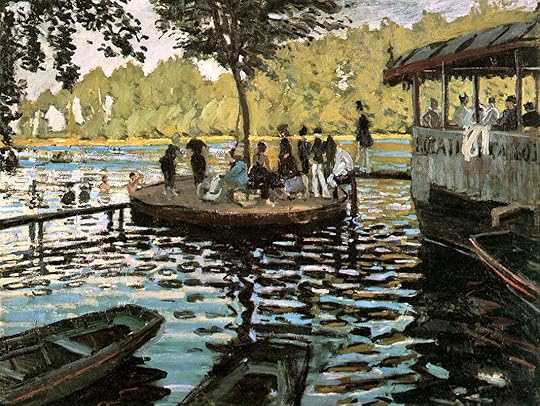
(Claude Monet, Bain à la Grenouillère, 1869)
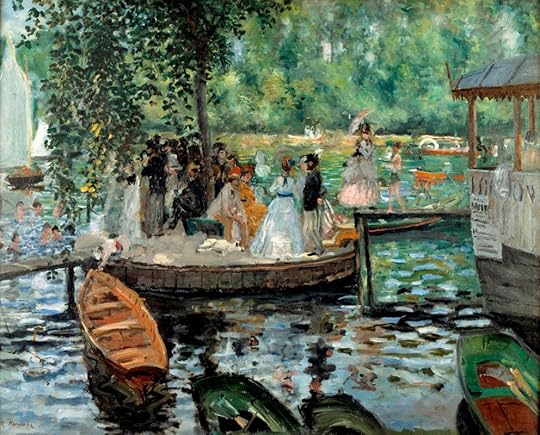
The story is set at La Grenouillère (‘The Frog Pond’), a pontoon boat on the edge of the island of Croissy-sur-Seine housing a huge ballroom and restaurant which was wildly popular during the Second Empire, its small beach, its canoes for daily hire and its famous weekly ball attracting Parisians coming by train. The place inspired a few famous Impressionist paintings and de Maupassant knew it very well, regularly frequenting it as he was a devoted boater and was living nearby for a few years, renting a small house on the banks of the Seine:
For ten years, the Seine was my only, my absorbing passion. Ah, that beautiful, calm, diversified and stinking river, full of mirage and filth. I think I loved it so much because it seemed to give me a sense of life.
According to Henry Troyat, de Maupassant considered it a good place to pick up women - not the sharpest crayons in the box, generous and eager - gratefully turning them into the heroines of his stories - just like Renoir did , finding quite a few of his models among the women hanging around at La Grenouillère.
With his unflinching pen de Maupassant depicts the spot as one that seems at first sight idyllic, but with a closer look reveals a cesspool, sketching its bawdy ambiance with verve:
Four couples were dancing a quadrille and watching them was a group of elegantly dressed young men whose respectable appearance was ruined by the hideous incongruity of the setting. The place reeked of vice and corruption and the dregs of Parisian society in all its rottenness gathered there: cheats, conmen and cheap hacks rubbed shoulder with under-age dandies, old roués and rogues, sleazy underworld types once notorious for things best forgotten mingled with other smalltime crooks and speculators, dabblers in dubious ventures, frauds, pimps and racketeers. Cheap sex, both male and female, was on offer in this tawdry meat-market of a place where petty rivalries were exploited, and quarrels picked over nothing in an atmosphere of fake gallantry where swords or pistols at dawn settled matters of highly questionable honour in the first place.
It is here that we meet the young couple Madeleine and Paul. Paul, a senator’s son, is too sensitive, refined and serious to fit into this rowdy environment, but he is very much in love with the shallow Madeleine, who flourishes in this biotope and is happier than a gopher in soft dirt, seeking pleasure where she can get it – to her, life’s a ball. A vicious power game unlashes between the two of them, showing a striking imbalance in love which reminded me of Charles Swann and Odette de Crécy.
The way in which de Maupassant depicts Madeleine’s abrasiveness is far from subtle; while dreamy Paul basks in the beauty of the nature of the rural surroundings, bubblehead Madeleine disturbs the peace and calm caterwauling, bawling some fashionable song in a squeaky, unmodulated voice, bored. Madeleine also fancies women, as Paul has to find out when a boat with four women arrives at the place.
(Pierre-Auguste Renoir, La Grenouillère, 1869)
Evidently things end bad in this intense drama thriving on jealousy, lust and cruelty. Drenched in a colour palette of which the final muddiness reminiscences of Emile Zola’s Thérèse Raquin, Paul and Madeleine learn that love is not an innocent or ludicrous game. How soon the ripples one leaves in the water and in another one’s life disappear.
Closing the story, Jacques Brel’s song Madeleine is playing in my head…
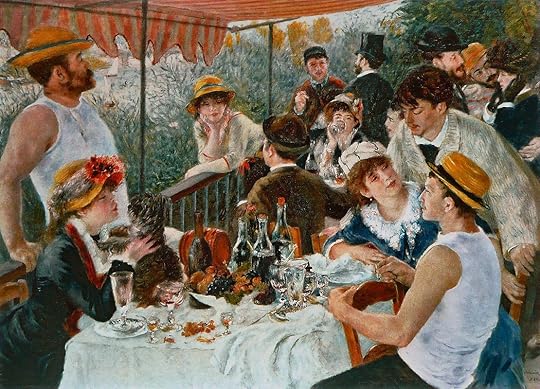
(Pierre-Auguste Renoir Le déjeuner des canotiers, 1881)
(This painting depicts the boaters with their straw hats and white boater’s shirts like de Maupassant describes them in his story)
Det här verkar vara en novell som uppfattats på mycket olika sätt. Av den anledningen tänker jag bemöda mig med att skriva något här trots att jag vanligen bara använder Goodreads för att logga lästa böcker och hålla reda på böcker som verkar intressanta att läsa framöver.
Jag fann ingen beskrivning av novellens handlingen på bibliotekets hemsida, så innan jag lånade den sökte jag på nätet och läste några olika texter bl.a. ett inlägg av en person som kallar sig "Jonathan" (https://marvellousmaupassant.wordpres...). När jag sedan läste novellen tyckte jag att nämnda inlägg var grymt orättvist och totalt okritiskt.
Novellen följer ett par som tillbringar en kväll vid La Grenouillère (grodträsket). De är väl kända bland övriga besökare och det verkar finnas en uppfattning att Paul är illa ute, dvs. känner starkare än han borde (underförstått "som varande vit heterosexuell man"). De hamnar i bråk om två lesbiska par som anländer vid kaféet. Paul ger uttryck för intolerans och raseri medan Madeleine anser att det inte är hans ensak. Hon känner en av kvinnorna och de bestämmer sig för att träffas senare under kvällen mot Pauls önskan. Paul och Madeleine försonas, men kvällen tar sedan en dramatisk vändning. Det är handlingen, men vad är det egentligen som pågår?
Paul är förälskad, och riktig förälskelse innebär i någon mån att förlora makt och kontroll. Det yttrar sig bl.a. i novellen som en önskan att förlåta sådant han annars inte skulle tolerera. Istället för att acceptera sina känslor och göra upp med upplevelsen av maktlöshet försöker han sträcka ut sin maktsfär till att inkludera även kvinnan han älskar, Madeleine. Om han kontrollerar henne så kan han acceptera sin förälskelse. Genom novellen försöker han kontrollera hennes åsikter, vad hon säger, vart hon går och vem hon träffar. Han verkar till och med gå så långt att sätt sig till doms över hennes tankar, eller snarare enligt honom, avsaknaden därav. Problemet är bara att hon vägrar låta sig kontrolleras av honom. Hon spelar det högsta kortet i leken - hon är villig att skiljas från honom. Nånstans är det på grund av att hon inte finner sig, att hon är villig att gå, som hon av läsaren ska uppfattas som lättsinnig. För mig rimmar det illa. Hon kan inte ändra honom, att möta honom på de villkor som han ställer upp vore slaveri, så vad har hon annars att sätta emot honom?
En annan fråga är hur seriös relationen är och om det förekommer otrohet? Under hela narrativet går han omkring och framhåller hur han lider, och trånar, hur djupt han känner. (Sådant mångfacetterat känslo- och tankeliv som hon inte är kapabel till, i hans bedömning. Han verkar tycka ett det är ett rimligt antagande att hon inte kan ha tankar eller känslor som han inte kan ana sig till.) Men det finns inga indikationer på att hon vilselett honom ifråga om sina känslor. Han har inte heller omsatt sina känslor i handling dvs. giftemål. Hon lever i en sexuell relation med en man, men utan att vara gift vid slutet av 1800-talet. Om hon blir gravid och han inte "gör det rätta" så riskerar hon att hamna på gatan. En lika välgrundad tolkning är alltså att han är den som inte tar relationen på allvar. Vad har egentligen lovats?
Det sorgliga är att det dramatiska slutet knappast är orealistiskt. Även idag, över hundra år senare, innebär mäns oförmåga att identifiera och hantera sina känslor på ett konstruktivt sätt ett stort lidande för de själva såväl som för andra. Som medmänniska vill jag inte gotta mig i Pauls öde, men som f.d. socialsekreterare kan jag bara tänka att vi med detta slut slapp ett antal potentiella framtida kvinnofridsbrott.
Väl skriven, underhållande och tankeväckande. Rekommenderas.
I could get all wrapped up in how much I like Guy de Maupassant's distasteful yet hilarious descriptions of the people and society he lived in, here combined with Hjalmar Söderberg's wits and skilled ability to describe human feelings. But I think I'll settle with:
This classic short story contains a love triangle, sports, booze, romance, heartbreak, love angst, descriptions of boobs and butts, comedy, tragedy and a spot of girl/girl action. Will this make do for a salespitch?
This entire review has been hidden because of spoilers.
Språket kändes lite gammaldags, men så var det ju också Söderberg som var översättare.
Det var en ganska tråkig berättelse. Trots att jag vet att den utspelar sig på 1800-talet så kändes den jobbig att läsa med tanke på stereotyperna av man och kvinna i en kärleksrelation.
Jag störde mig mycket på Pauls agerande i samband med de lesbiska kvinnorna.
Jag imponeras och fascineras av både författaren och Paris som är så progressiva år 1881! Slukade novellen men ville samtidigt läsa långsamt för att inte missa ett ord. Hjalmar Söderberg har översatt, bara det…
Renoir's "La Grenonillère" painting gives a small portrait of Guy de Maupassant's "Paul Mistress", revellers enjoying themselves, which is a truly depressing and sad story of passion.
Story in short- Paul who has it all that would seem but he desires something that is elusive but yet still he longs for it.
➖➖➖➖➖➖➖➖➖➖➖➖➖➖➖➖➖➖➖➖➖➖➖➖➖➖➖➖➖➖➖➖➖➖➖ Highlight (Yellow) | Location 33822 The Restaurant Grillon, a small commonwealth of boatmen, was slowly emptying. In front of the door all was a tumult of cries and calls, while the jolly dogs in white flannels gesticulated with oars on their shoulders. The ladies in bright spring toilets stepped aboard the skiffs with care, and seating themselves astern, arranged their dresses, while the landlord of the establishment, a mighty Highlight (Yellow) | Location 33825 individual with a red beard, of renowned strength, offered his hand to the pretty dears, with great self- possession, keeping the frail craft steady. The rowers, bare-armed, with bulging chests, took their places in their turn, posing for their gallery, as they did so, a gallery consisting of middle class people dressed in their Sunday clothes, of workmen and soldiers leaning upon their elbows on the parapet of the bridge, all taking a great interest in the sight. Highlight (Yellow) | Location 33829 The boats one by one cast off from the landing stage. The oarsmen bent themselves forward and then threw themselves backwards with an even swing, and under the impetus of the long curved oars, the swift skiffs glided along the river, got far away, grew smaller and finally disappeared under the other bridge, that of the railway, as they descended the stream towards La Grenouillère. One couple only remained behind. The young man, still almost beardless, slender, and of pale countenance, held his ❌❌❌❌❌❌❌❌❌❌❌❌❌❌❌❌❌❌❌❌❌❌❌❌❌❌❌❌❌❌❌❌❌❌❌❌❌❌❌spoiler alert
Maupassant truly likes to have tragic endings. I was upset when Paul committed suicide. Madeleine seemed to not really care for him and even after his death, she seemed easily consoled. Paul had an obsession for her and if it was purely lust or that and a romantic feeling? When they went to La Grenonillère, seeing her lesbian friends, Pauline especially, she looked to ditch Paul at some point. Why after seeing her girlfriend, she still went with Paul and was not upfront is just terrible. The laughing by the girls at this man being played a dupe is just plain mean. What is terrifying and confusing is when Paul saw Madeleine and Pauline by a mutilated corpse of a man in the woods, first why he did not report this and why he even wanted his lover anymore is beyond me. It seems that all in this story are deprived souls.
Highlight (Yellow) | Location 33832 mistress, a thin little brunette, with the gait of a grasshopper, by the waist; and occasionally they gazed into each others eyes. The landlord shouted: “Come, Mr. Paul, make haste,” and they drew near. Of all the guests of the house, Mr. Paul was the most liked and most respected. He paid well and punctually, while the others hung back for a long time, if indeed they did not vanish insolvent. Besides which he acted as a sort of walking advertisement for the establishment, Highlight (Yellow) | Location 33836 inasmuch as his father was a senator. And when a stranger would inquire: “Who on earth is that little chap who thinks so much of himself because of his girl?” some habituè would reply, half-aloud, with a mysterious and important air: “Don’t you know? That is Paul Baron, a senator’s son.” And invariably the other could not restrain himself from exclaiming: “Poor devil! He is not half mashed.” Highlight (Yellow) and Note | Location 33840 Mother Grillon, a worthy and good business woman, described the young man and his companion as “her two turtle-doves,” and appeared quite moved by this passion, profitable for her house. The couple advanced at a slow pace; the skiff, Madeleine, was ready, when at the moment of embarking therein they kissed each other, which caused the public collected on the bridge to laugh, and Mr. Paul taking the oars, they left also for La Grenonillère.
Highlight (Yellow) | Location 33843 When they arrived it was just upon three o’clock and the large floating café overflowed with people. The immense raft, sheltered by a tarpaulin roof, is attached to the charming island of Croissy by two narrow foot bridges, one of which leads into the center of this aquatic establishment, while the other unites its end with a tiny islet planted with a tree and surnamed “The Flower Pot,” and thence leads to land near the bath office. Highlight (Yellow) | Location 33847 Mr. Paul made fast his boat alongside the establishment, climbed over the railing of the café and then grasping his mistress’s hand assisted her out of the boat and they both seated themselves at the end of a table opposite each other. On the opposite side of the river along the market road, a long string of vehicles was drawn up. Fiacres alternated with the fine carriages of the swells; the first, clumsy, with enormous bodies crushing the springs, drawn by a broken down hack with hanging head and broken
Highlight (Yellow) | Location 33851 knees; the second, slightly built on light wheels, with horses slender and straight, their heads well up, their bits snowy with foam, while the coachman, solemn in his livery, his head erect in his high collar, waited bolt upright, his whip resting on his knee. The bank was covered with people who came off in families, or in gangs, or two by two, or alone. They plucked blades of grass, went down to the water, remounted the path, and all having attained the same spot, stood still awaiting the ferryman. The clumsy punt plied incessantly from bank to bank, discharging its passengers on to the island. The arm of the river (named the Dead Arm) upon which this refreshment wharf lay, appeared asleep, so feeble was the current. Fleets of yawls, of skiffs, of canoes, of podoscaphs (a light boat propelled by wheels set in motion by a treadle), of gigs, of craft of all forms and of all kinds, crept about upon the motionless stream, crossing each other, intermingling, running foul of one another, stopping abruptly under a jerk of the arms to shoot off afresh under a sudden strain of the muscles gliding swiftly along like great yellow or red fishes. Others arrived incessantly; some from Chaton up the stream; others from Bougival down it; laughter crossed the water from one boat to another, calls, admonitions or imprecations. The boatmen exposed the bronzed and knotted flesh of their biceps to the heat of the day; and similar to strange flowers, which floated, the silk parasols, red, green, blue, or yellow, of the ladies Highlight (Yellow) | Location 33861 seated near the helm, bloomed in the sterns of the boats. A July sun flamed high in the heavens; the atmosphere seemed full of burning merriment: not a breath of air stirred the leaves of the willows or poplars. Down there the inevitable Mont-Valerien erected its fortified ramparts, tier above tier, in the intense light; while on the right the divine slopes of Louveniennes following the bend of the river disposed themselves in a semi-circle, displaying in their order across the rich and Highlight (Yellow) | Location 33865 shady lawns, of large gardens, the white walls of country seats. Upon the outskirts of La Grenonillère a crowd of promenaders moved about beneath the giant trees which make this corner of the island the most delightful park in the world. Women and girls with breasts developed beyond all measurement, with exaggerated bustles, their complexions plastered with rouge, their eyes daubed with charcoal, their lips blood-red, laced up, rigged out in outrageous dresses — trailed Highlight (Yellow) | Location 33869 the crying bad taste of their toilets over the fresh green sward; while beside them young men postured in their fashion-plate accouterments with light gloves, varnished boots, canes, the size of a thread, and single eye-glasses punctuating the insipidity of their smiles. The island is narrow opposite La Grenonillère, and on its other side, where also a ferry-boat plies, bringing people unceasingly across from Croissy, the rapid branch of the river, full of whirlpools and eddies Highlight (Yellow) | Location 33873 and foam, rushes along with the strength of a torrent. A detachment of pontoon-soldiers, in the uniform of artillerymen, is encamped upon this bank, and the soldiers seated in a row on a long beam watched the water flowing. In the floating establishment there was a boisterous and uproarious crowd. The wooden tables upon which the spilt refreshments made little sticky streams, were covered with half empty glasses and surrounded by half tipsy individuals.
This little gem was unexpected, fun and gruesome. An evocative painted scene in which a man cannot stand for the percieved depravation and lets his love get the best of him. Made me want more of the same.
Roddare, vackra vyer, sommar, uteserveringar och grönområden. Paul, ung, välbeställd, roddare med sin båt och älskarinna som båda verkar heta Madeleine. Han är otroligt förälskad och åtrår henne hela tiden, hon verkar besvara känslorna. Människor runt omkring kan kommentera att han är en stackare som är så kär i den flickan. När en båt med kända flator kommer, ropar hela hopen och skränar, Madeleine visar sig känna en av kvinnorna och Paul förbjuder henne att prata med dem, men Madeleine gör det ändå. De blir osams men löser det. De promenerar i en vacker omgivning, Paul ser och känner naturromantiken i scenen men då börjar Madeleine sjunga nån enkel schlager och ganska falskt. Paul känner att hennes vackra panna är tom, hon är helt enkelt dum i huvet. Men han kan inte släppa henne ändå. När hon tvingar honom att gå på balen (muffbal!) så träffar hon de lesbiska kvinnorna igen och försvinner med en av dem, Paul upptäcker dem i deras kärleksakt och dränker sig i förtvivlan.
Men vad handlar den här novellen egentligen om? Att män och kvinnor upplever kärlek olika? Att män blir besatta och förledda av kvinnor? Vilket av könen är det starka? Den handlar om olycklig kärlek! Och nån irriterande tanke att en förälskad man har all rätt till kvinnan han är förälskad i och är en så dramaqueen att han kastar sig i vattnet och dör. Mes...
This entire review has been hidden because of spoilers.
First published in 1881 as La femme de Paul. Paul is a wealthy young man, son of a distinguished senator, who is regularly seen boating on the Seine at a popular a inn on Croissy Island near Paris with his mistress Madeleine, whom he is crazy about although she doesn’t have the same well-educated social middle class background. One day a boat arrives below the inn with four well-known young women of a particular Lesbian genre who provoke Pail’s indignation and catcalls of “Lesbos! Lesbos!” from the crowd on the shore. But Madeleine defends the ladies and their mores and is even friendly and soon passionately involved with one of them. Things go from bad to worse from then on, at least for Paul.
Tableau magnifique d’un espace sensible détaillé Je ne suis pas certain de saisir le propos ou même la visée de l’auteur à travers cette nouvelle, notamment avec cette pseudo-critique d’une supposée décadence Je me conforte dans mon ressenti et je reste sur le positif en soulignant l’importance des sentiments de Madeleine par la douceur et la tendresse des échanges, des dialogues, et par les sentiments qu’elle exprime jusqu’à la fin
intressant, depikterar 1800-talets Paris i olika ljus. Det var intressant att få se en så självständig kvinna ha ett fokus och en mentalitet som jag bara förr har associerat med dagens ungdomar. Och att få läsa om "lebbar" i en så gammal berättelse var minst sagt intressant. Novellen ställer frågor - vem har rätt i sin känsla, och enligt vilka villkor?
Den var helt ok. Jag hade ingen aning om vad den skulle handla om men blev positivt överraskad. Det var lite för mycket onödiga miljöbeskrivningar dock.
I've been putting it off for some time now, but it was actually a really good book, and it was nice to add a short story to my reading list instead of another novel. I got a really nice quote out of this book, the way the author uses alliterations makes it fun to read, without it feeling excessive.