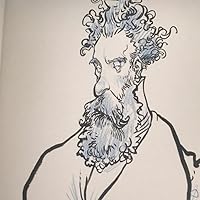
It’s hard to express how much a single account of a life can come to mean to you, particularly when you’ve spent the best part of a year reading it. This biography is a testament to the value of education, kindness and human connection: a life marked by tragedy, intrigue and inspiration.
I first heard about Jackson Knight following a lecture by Sharon Marshall at the University of Exeter. As an Exonian, I was immediately captivated by the idea that a scholar from the university could rise to such heights: producing the first Penguin Classics translation of the Aeneid, which, before David West’s version, became the definitive and most accessible way for so many readers to appreciate Vergil. I was equally astonished to discover that he had founded the Vergilian Society, whose members included T. S. Eliot. Indeed, Knight’s friendships and acquaintances were remarkably far-reaching, from E. V. Rieu to Cecil Day-Lewis, Poet Laureate and father of Daniel Day-Lewis. To me, these connections to something greater, more famous, more enduring, would have been achievement enough. They seemed proof that a country academic could reach extraordinary heights.
But Marshall’s lecture instilled something else in me. Learning of Knight’s connection to spiritualism, and how his alternative beliefs and practices, through a medium, became integral to his translation of the Aeneid, left me transfixed. Here was a man who, contrary to almost every Enlightenment principle, believed he could communicate with the spirit of Vergil, dead for more than two thousand years, to inform his academic work. And by God, did it work. His translation is incredible: electric, informed, nuanced and original, yet wholly capturing the essence of the Latin. We may call this luck, genius, or perhaps a legitimate connection with a long-deceased soul. Whatever the explanation, Knight’s methods speak for themselves. I can find no better summation than R. G. Austin’s review of his work:
“He loved Virgil, and he communicates his love even to those who cannot agree with his method; he must have done more than many greater scholars have done towards making Virgil’s poetry (and with it the Latin language) live and move for all kinds of readers. He seems, in his Virgilianism, always to have been stretching out his hands in longing for some further shore; he makes us conscious that such a shore exists, even though we may not travel in his company.”
And so, with all this already invested in Knight, it was perhaps inevitable that I should fall in love with his brother’s biography. It is a portrait filled with admiration, infectious warmth and endless intrigue. As one commentator observes, he was “as effervescent as a bottle of champagne”. Through a succession of wonderful vignettes, we develop a genuine sense of Knight: a figure larger than life, devoted to his work, to others and, above all, to teaching. In an age before the abundance of pedagogical resources we now take for granted, he seems to have placed active learning at the very heart of his educational philosophy. He was warm, jovial and funny, and yet his life was also marked by considerable tragedy.
His relationship with his overbearing mother, his unsuccessful love life, his academic shortcomings and his fastidious, almost obsessive-compulsive tendencies all emerge as traits that define, refine and ultimately humanise him. Yet the sadness of these experiences is underscored by such affection and reverence that one cannot help but fall all the more in love with him. Consider his advice to a first-year class studying epic: “Leave a couple of pages of your notebooks blank.” “Why?” asks a shy student. “Because,” replies Knight, “I hope one day you’ll write an epic about me!”
During the course of reading the biography, I was also fortunate enough to encounter Knight’s letters, lovingly preserved by the archivists at the University of Exeter. What met me there was an equally rich, equally lovable and equally effervescent presence. A man of extraordinary politeness, delightful quirks and considerable intellect. In those cold, quiet rooms, surrounded by letters written decades ago, I felt something reaching across time. The ink and handwriting seemed impossibly immediate, as though the words had been put to paper yesterday. For a moment, the distance between his world and mine seemed to collapse. It was almost as if a hand had been placed on my shoulder, bridging the gap between the living and the dead.