With Imperium Secundus a failed dream, the primarchs of the Triumvirate swear to reach Terra and defend the Imperium's heart. But danger awaits them, and their destinies are in their hands…
Imperium Secundus lies revealed as a heretical folly. Terra has not fallen, though it remains inaccessible. Sanguinius, Guilliman and the Lion El’Johnson, the primarchs of the Triumvirate, must reach Terra at all costs. They seek to defend the Emperor, and to atone for their sins. But the Ruinstorm, a galaxy-wide maelstrom of chaos, hides the Throneworld from the primarchs. Now the fleets of three Legions depart Macragge, and the primarchs will stop at nothing to overcome the Ruinstorm. Yet an insidious enemy watches their every move, and plots against the weaknesses of the errant sons of the Emperor. Each has his own inner storm, linkand each marches towards his own ruin.
46th Horus Heresy novel is a real good one with fate, doubt and atonement as its main themes, giving an end to the Imperium Secundus storyline started so long time ago in book 27 The Unremembered Empire and having lots of references to David Annandale's previous works: we have secondary characters Iron Hands and Salamanders previously appeared in The Noose, short story published in the Shattered Legions anthology (the end of the fight for X Legion captain Khalybus and his crew here was so epic that now I really want to read it again as soon as possible, but I'm afraid my "Books To Read" list is just too much long for that), great daemonic main villain Madail coming back from The Damnation of Pythos (that I loved and always thought of it like a self-contained story, but the author pleasantly surprised me here) and some Word Bearers who served under traitorous Dark Apostle Khurta Sedd in The Unburdened.
I just loved this storyline about three Primarchs struggling in their quest to return to Terra and atone for their sin of founding a second Imperium while thinking the Emperor was dead: it could have been named "Three primarchs (Not) in a Ruinstorm: and Most of the Time Without a Night Haunter" (good old Konrad Cruze has his screen time here too) or "The Last Temptation of Sanguinius" because I not remember the IX Legion Primarch being so much Christian Messianic as in this tale, and the coming back to planet Davin where Horus fell at the dawn of the Heresy, now surrounded by a gigantic shell made of the bones of trillions dubbed the Necrosphere, was one of the most epic moments in the whole long spawned series.
Sadly this novel has the same problem of Graham McNeill's Vengeful Spirit: so many characters, events and storylines that the tale almost crumbles under their weight and some events like Meros' sacrifice in the end and the initial triple attack by Word Bearers, Night Lords and World Eaters against the Primarchs fleet, really needed lots of pages more to be fully depicted for good. Furthermore, the author likes to put Sanguinius, Guilliman an The Lion in lots of situations where they risk their lives, but if you have a minimal knowledge of the W40K setting you already know who, where and when is going to die (Sanguinius is going to remind you about his final fate something like a thousand times in this book) and who is still alive and well (Guilliman is practically the new Emperor in the current Age of Dark Imperium period of Imperial history started with the release of Warhammer 40000 8th edition rulebook), pulling away almost all tension and thrill from it.
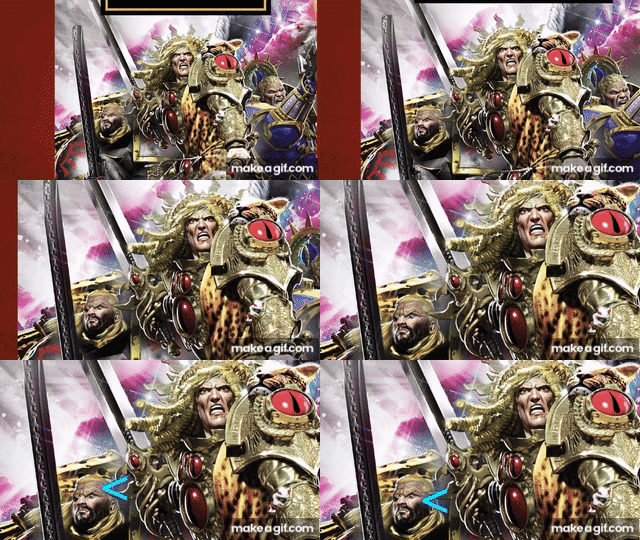
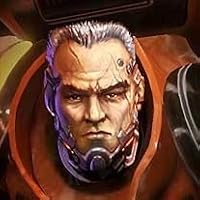
And while Horus Heresy covers are usually state of art ones, the Sanguinius with goldielocks and The Lion seeming like Paul Michael Levesque, better known by his wrestling ring name Triple H, was a real letdown for me.
Such a shame, because I loved Annandale's The Damnation of Pythos and really wanted giving to this one too 5 stars, but in the end you really feel the end of this awesome series is near and it is going to be a magnificent one.
Ruinstorm is a complicated book, but by no means a bad one. Nevertheless, it strains under its own weight which leads to a sagging middle- bowed by its ambition and the stresses of combining the real and the unreal.
David Annandale has a reputation for understanding the true cosmic horror nature of Chaos. Not the near-comical portrayal as we've seen in, say, "Fear To Tread", but Chaos as moral and existential threat. The best examples I can think of would be "The Carrion Anthem", "Damnation of Pythos", "The Traveller" and "Warden of the Blade." With Ruinstorm, however, this gift is compromised by the demands of the narrative. At some places the story has a perfect flow and rhythm, buffeting us in the storm; while at others, it feels as though battle has been inserted for the sake of it. It is this sag that sadly blights the middle of the book, and is compounded by the next few trials and travails being easily overcome.
Where it excels, however, is in the mad spectacle of the Ruinstorm and the effect it has on the three main primarch characters. Sanguinius especially is put through the emotional and spiritual ringer; facing down the spectre of his own forewarned death and the bloody echoes of Signus Prime. His desire to find a way through the maelstrom is intensified by the guilt he feels over Imperium Secundus.
This guilt also defines Guilliman's arc, while he second-guesses everything he has done since Calth. The spectre of corruption and taint haunt him, as he considers the means and method of the enemy.
While the Lion also has his doubts, he isn't as troubled by guilt. More he is motivated by the pragmatic desire to find the quickest and most direct way through. Aided by the warp-entity Tuchulcha, he has the most ease in jumping but is stymied at every turn. He has also taken over responsibility for keeping Curze contained. Curze introduces an interesting narrative wrinkle, as his foresight and ignorance mirror Sanguinius' own.
With pay-offs from a number of previous sources (including Damnation of Pythos and "The Noose"), the novel spirals into plots both old and new; including a return to at least one unexpected set-piece. The novel succeeds most in its atmosphere of unremitting tension and palpable unease; especially where human characters are concerned. The prologue in particular is a wonderfully crafted piece of text which calls to mind the best of the poison prayers which he festooned "Sermon of Exodus" with.
Ultimately, the weight of the plot and its requirements help to hamstring the novel. There is, perhaps, too much going on. At the beginning of the novel, the narrative jumps almost irregularly between the three main strands and breaks us from the story at the wrong moments. When the story finally focuses, it then briefly slumps, before regaining its puff. By the end, we see a number of interesting confrontations and decisions, which give new light to the Heresy as it draws to its close, a new perspective (if a particularly mundane one) on how the Legion dispositions of the Siege came to be how they were.
Despite all this, the book was never boring. If anything I think it simply had to commit harder to one course; to lean into the insane symbolism and imagery of the end of all things. Its a novel begging to be a "battle at the centre of the mind"; I'd almost have liked it to take place more entirely in their heads- as though they were just setting off, the events pass, and then it turns out they're much less far in than they first thought.
Because ultimately, this isn't about the journey to Terra. It's about the journey to know whether or not you're worthy to; it's about facing down doubts and spitting in the eyes of fate. On both sides.
This is the 46th book in the Horus Heresy series. It tells the tale of the Triumvirate, the triple Primarchs making up the leadership of the Imperium Secundus. WHen the Word Bearers, Night Lords and World Eaters unleashed the Ruinstorm agains the thousand worlds of Ultramar, no one could get out. The largest legion, walled in and impotent. With the Ultramarines, the Blood Angels and the Dark Angels are rendered in a war within and the tales told of the death of the Emperor and the fall of Terra. Order had to be re-eastablished. The Imperium had to live on. Sanguinius was installed as the Emperor and Guilliman and the Lion were his advisors and left and right hand. Konrad Curze, who lead the Night Lords was captured and imprisoned after a failed attempt on Sanguinius' life. After the threat within was eradicated the three loyal sons of the Emperor decided to turn their efforts to breaching the Ruinstorm, the chaos field brought into being to keep them from Terra, while Horus waged his wars and devoted more of Imperium space to his cause. The voyage was fraught with danger and the initial threat was the fleets from the Word Bearers, Night Lords and World Eaters allied against them. These fleets were used to dealing with the ships of the loyalists, but the warships of the Primarchs of three Legions were more than a match for them. Add to this the Lion having a questionable Navigator who lead them to specific places and jump points to speed their efforts, and soon the loyalists were pointed to where the Heresy began. The planet where Horus fell to the forces who warped his courage and loyalty to his father..... Davin. What follows after in the third act of the book is the struggle against Chaos Undivided, in the form of a prophet that kept a conduit from the warp open to fuel Horus' war. The three loyalists emply Curze to guide them and they quicly find out this is folly. They uncover the Undivided and fall upon it with all weapons at their disposal. The ensuing battle was as epic as the Dropsite Massacre, but the ending was a triumph and soon the way to Terra was finally made open. There were difficulties though. In the end their paths were clear. Sanguinius knew he was to fight at the side of his father and directly oppose Horus. He could not get there through the blockades and the fleets arrayed against him. The Lion chooses to take his fleet and wage guerilla warfare at the planets used by the Traitors, unleashing planet killing munitions on them to declare them rid of Horus' influence. Guilliman decides to take the battle to the blockades, as he has the largest fleet by far, attacking and harrying the traitor fleets to slow down the inevitable tide of Horus' ships and troops. Lastly Sanguinius would burn at best speed to Terra, to reunite with his father. But what of the Night Haunter, Konrad Curze? His fate is as declared and known as Sanguinius's. The lord of the Blood Angels seals Curze in a savior pod coffin and releases his frozen form into the void. His fate was revealed to Sanguinius and he chose to just put him out of the fight, to be dealt with as fate has written, in the future. Overall this book was amazing and still the hits just keep on coming in this series. The gears are turning now and the final battle between Horus and the Emperor can't be far away. I know that there are at least two more books in this series adveritsed, and one is another set of short stories. The end will come but I will be sad at the lack of all this filler from the Horus Heresy. There is an end though and I am sure it will be magnificent!
I'm going to start off that writing this book would've been difficult to write from the start. A book that features four Primarchs quite heavily should be awesome but the major theme that the author pursued is fate. More specifically that the four main characters are fated to survive, at the very least, the contents of the book. We all knew that anyway going in as what happens to these four characters isn't exactly a secret. But the author kept throwing them in situations where their lives are completely at risk yet we know there isn't a chance of one of them dying. There's no sense of drama at all except if you are one of the seemingly endless supply of Space Marines under their command. The author dabbles with the possibility of changing fate but far too late in the game for any suspense to build. And his hands are tied by the overarching and established narrative anyway. The stakes just weren't set high enough for any emotional commitment from myself.
I'll also be frank on this - I do not like Annandale's writing style at all. He spends a lot of text describing things without actually describing anything at all. It all seems a little flamboyant for flamboyancy's sake and I found myself looking up quite often and just thinking "Really?" I do not want to remove myself from being ensconced in a story because of awkward similes. He also tries to generate the illusion of pace by devolving into the use of sentence fragments but couple this with the above mentioned lack of danger and the general absurdity of some of the story events it started to get painful to read.
The book is what it is; it's a filler to not leave too much of a lull while the main events in the series ramp up. The series itself would not be affected in the slightest had this book not been written.
Cuarto libro que leo de este autor y, definitivamente, no coincidimos en gustos a la hora de disfrutar una historia.
Tormenta de Ruina tenía todos los ingredientes para ser una de las novelas clave dentro de la Herejía de Horus, una de esas que te enganchan a la saga a pesar de sus altibajos de calidad. Pero ha resultado ser justo lo contrario: una piedra en el camino que hay que rodear para llegar al objetivo final.
Es una pena, porque había potencial. Teníamos a tres primarcas con protagonismo en la historia (aunque, en mi opinión, alguna de esas legiones no son precisamente las más interesantes) y una trama que parecía girar en torno a la gran tormenta que bloquea el acceso a Terra.
Sin embargo, el resultado es una historia carente de ritmo que, pese a sus 300 páginas, se hace pesada. La trama principal es insulsa y los primarcas, que deberían haber sido el gran atractivo, resultan planos y sin impacto real en la historia. Para eso, casi habría sido mejor darle el protagonismo a algún legionario anónimo, que al menos podría haber despertado cierto interés con su trasfondo.
Seguiré con la saga porque, a estas alturas, ya queda poco para llegar a Terra. Pero lo cierto es que este libro me ha quitado las ganas de leer sobre la Herejía por unas semanas.
As a firstborn, I don't think the 2nd half of this book was good for my health. Unfortunately for my mother, my father raised me not to be afraid of anything, least of all men. Guess who's been in a club fightttt?? I grew up scraping with my brothers; I know how to cause pain for and to them. So when Sanguinius...!!! I got triggered.
I can't expound further because of spoilers, but at some point, I was asking for our coach, El Johnson, to put me in! Imagine having to square up with your siblings at their big age because they're actually foolish. How inconvenient, what a waste of time, I can't believe you're making me do this...
Can't believe I care about these fictional men to the point I want to beat them for their own safety.
This book was a wild ride, party after party. The hype for the Siege of Terra is starting!!!
Like the idea of cheating destiny; having a character like Curze involved whose whole belief is built on predetermined fate, and the Primarchs all teaming up as the books progress makes for a fun read - maybe a bit caught up in its own ambition, you can see why the Primarchs themselves have rarely been the main characters, especially more than one in the early stages of the Horus Heresy and I do think the series was at its best when it was focused on the regular Space Marines caught up with dividing loyalties around people like Horus etc. The spectacle of the Ruinstorm and the sheer chaos replicates some of the sheer devastation of Doctor Who's Time War, and you can see the character growth that Annadale uses to bring to the table in its characters.
There's maybe one too many plot thread for one novel, but what a novel it is.
My only problem with this book is how the lion has blonde hair and black beard, and sanguineous has cornrolls I mean, look at that cover art. I things its particularly hideous
Ruinstorm is written by the very same David Annandale who penned the (I'll be polite) very polarising Horus Heresy novel, The Damnation of Pythos. Personally, I found that to be the most uninteresting and unrelatable novel in the series so far. With this in mind, I picked up Ruinstorm with zero expectations, and as a result I was quite pleasantly surprised with how much I enjoyed it.
Ruinstorm is the conclusion of the Imperium Secundus story arc, (see also Unremembered Empire etc.) which saw the Primarchs Sanguinius, Roboute Guilliman and Lion El'Jonson form a new Imperium at the other side of the galaxy, believing Terra and the Emperor to have been compromised by Horus and the forces of Chaos. This book chronicles the beginning of the journey back to Terra, for the inevitable showdown that we have known has been coming for years and years.
Those who enjoyed Annandale's The Damnation of Pythos always cite his narration of Chaos in the Warhammer 40,000 universe as a highlight, as well as some of the horror elements he was able to weave into his prose. The same could be said for this book; all the chapters featuring Chaos, Daemons and Traitor Primarchs are very strong. Perhaps the main plotline in Ruinstorm is the path of Blood Angels Primarch Sanguinius, and how he deals with his premonitions of the battle to come. Along the way, he and his brothers have to deal with the forces of Chaos, both physical and ethereal. The spotlight is firmly on Sanguinius, but the others have their own paths and journeys which I felt interested in and compelled to keep reading.
My biggest criticism of this book is perhaps the same as lots of other books in the series. There are always secondary characters introduced who are either bland, unimportant or both. We have to sit through chapters following these "B" level characters who only partially influence the main plot at best, and yet they're the featured character in up to a third of the chapters in these books. Obviously some authors introduce and develop these characters better than others, but outside of the Primarchs and their established Space Marine officer characters, the rest of the cast were largely forgettable.
Towards the end of the book, you really feel that the series is starting to draw to a conclusion, and real progression has occured in this book. The Horus Heresy series has a very average middle where at least a dozen novels do very little to advance the storyline. Despite it's flaws, Ruinstorm was an enjoyable read and is definitely one of the more important entries in the series.
April 2024 Read using the Horus Heresy Omnibus Project Reading Order Omnibus XVI Imperium Secondus II Fate's Ashes (https://www.heresyomnibus.com/omnibus...) as part of my Oath of Moment to complete the Horus Heresy series and extras.
I haven't forgotten about this and I've been thinking about it a lot and I know that I can't fairly review this after where my head was at when I was reading this, so I will read it again before this storyline picks up again. I have a bunch of Primarchs and Character books to catch up with and I'm still working in the eNovellas from the end of this omnibus, so I look forward to coming back somewhen between finishing those and before Omnibus XVIII.
***
A funny thing happened on the way to the Throneworld.
I need some time to process this before more of a write up, but this is astounding and so very different, so exquisitely, excruciatingly Annandale, and I'm sure that has violently divided people.
I was sitting on a tentative four that I firmly believed a re-read while less assailed by the blackest of C-PTSD depression and nebulas ADHD distraction would be an unassailable five, but then the perfectly bleak with golden cruelty epilogue came into the picture and now I know I don't need to wait.
Through using the Horus Heresy Omnibus Project (www.heresyomnibus.com) and my own choices, I have currently read 31 Horus Heresy novels, 16 novellas (including 2 repeats), 103 short stories/ audio dramas (including 6 repeats), as well as the Macragge's Honour graphic novel, 15 Primarchs novels, 4 Primarchs short stories/ audio dramas, and 2 Warhammer 40K further reading novels and a short story...this run. I can't say enough good about the way the Horus Heresy Omnibus Project suggestions. I'm loving it! Especially after originally reading to the releases and being so frustrated at having to wait so long for a narrative to continue.
Okay, okay, I get it, Sanguinius is 40k Jesus. This book could have been renamed "The Last Temptation of Sanguinius". It was really heavy-handed. That aside, we are finally within sight of Terra and stuff is getting real.
The trio of demigods leading the Imperium Secundus have come to realise the error of their ways. Terra still stands, and with this news Guilliman has made his decision to risk everything in order to support their father. Amassing a gigantic armada of their remaining vessels, they seek to brave the Ruinstorm which has seemingly cut them off from the rest of the galaxy. Yet, nothing is ever simple when it comes to the forces of Chaos. Even as the traitors find themselves beset on all sides by mortal and daemonic foes alike seeking to bar their passage, other plans are at work. Something hungers to claim the primarchs and turn them to the Ruinous Powers' service, and the renegade Konrad Curze still has a part to play in this saga...
The Good
If you were ever to stop and look at David Annandale's interests, you'll notice three major reccuring factors. He's a fan of most classic horror genres, from the Hammer era through to the slasher films of the 80s. He loves big, bold events and explosive pieces with weight to them. Plus, he has a love of the kaiju genre, with the likes of Godzilla and co. Why does this matter? Because he tends to be at this best when two or more of these elements cross over, allowing him to sink his teeth into something familiar, and pull off stunts most authors would struggle with. It's akin to how Ben Counter's tales can verge upon being outright camp at points, but still have enough earnest intent and substance to pull through.
Ruinstorm, in particular, fits Annandale's skills exceptionally well because of these factors. It's a titanic Chaos storm which has been raging for months about the galaxy, warping all about it. This leaves room for horror stories of haunted ships, dead worlds discarded by their Dark Gods, places so twisted that they push the boundaries of what can be believed. While this isn't apparent at first, the opening stages of the book lull you into a false sense of security, offering up some of the more mundane and tangible threats you would expect of Chaos. Just when you think that this might be sticking purely to the tabletop models, the narrative starts throwing threats the Legions' way which are pure Chaos. Less the discount Lovecraft you might expect and more sort of undefined monstrosity Bronze Age Comics were noted for. It's insane and exaggerated, but they are presented so well and on such a scale that it is difficult not to become hooked as a result.
The story also moves at a brisk pace and delves back and forth between certain locations. It visits multiple planets, faces varying threats and even bumps into some surprising foes no one fully expected to appear. As soon as it seems to finish up with one problem, another almost immediately emerges. This creates a sense of relentless havoc and pressing danger which perfectly fits a journey on this scale, and emphasises the true power of Chaos. When a God or something capable of twisting reality itself to its will decides to make you its plaything, you're hardly going to overcome it without suffering some serious scars as a result. Even if you are among the best soldiers the galaxy has ever known, you're still going to be cannon fodder before some of their best servants. By adding in these elements and juggling between more substantial offerings, it avoids at least a few of the more disliked elements found in Battle for the Abyss. Furthermore, it grants more substantial moments for character building.
The story does repeatedly emphasise a massive scale and weight to the beings involved. However, before it becomes truly unmanageable, the story is always scaled back. There's always some excuse to narrow down the focus naturally or concentrate upon one or two figures, while cutting back and forth between the larger military effort and an individual duel or act. This especially benefits the Lion early on due to his personal secrecy and Sanguinius for the bulk of the story. Both of who have enough insight, impact and commentary to prevent some of the immense nature of what is going on from completely overwhelming the narrative. Guilliman himself also has a few decent moments, and the story does a good job of presenting flaws within the characters without letting them overwhelm all else. Rather than the laser pointer focus upon Angron's failings which made many fans regard the World Eaters as "the joke legion" (and no, I'm not going to let that drop anytime soon) it brings them up, but offsets them against obvious moments of competence. Even when a character is performing an act which is seemingly stupid, the drama or even subject of fate itself is used to almost excuse it. There's a certain internal logic to the overall setting which carries them through. That might sound odd, but it's the same sort of one which allows people to accept elite special forces to exist alongside knights errant and space elves.
When the narrative does make call-backs to previous books, they are extremely deftly handled. This creates a sense of tangible continuity with prior events, and while many are obvious there is a number which prove to be subtle. At least subtle enough to be lost in the moment of the action itself. Take this one scene for example, where the Ultramarines opt to get some revenge on the Word Bearers via a captured vessel:
"In the midst of the Word Bearers formation, the Annunciation turned against the flow of the retreat. It accelerated as if it sought to escape from the cluster of ships. It had ceased to respond to hails shortly before the arrival of the Ultramarines fleet. The Cavascor pulled away from it, and the Annunciation drove straight for the Orfeo’s Lament. The light cruiser was still turning when the larger ship closed in on it. It abandoned its manoeuvre and tried to accelerate on a tangent. The Annunciation struck it just forwards of the stern. It broke the Lament in half. It barrelled through the hull in a storm of explosions. Statuary from both ships, colossal embodiments of metaphor and the lessons of the dark, flew off from the collision in a swarm of tumbling fragments. The Orfeo’s Lament howled its last, and the plasma cry swept over the Annunciation. The strike cruiser’s bow was a ruin after the collision, twisted and fused. Tremors swept the hull, damage feeding damage until the ship was a bomb awaiting the signal for detonation. The signal came from the Cavascor, when Hierax remotely triggered melta charges he and his Destroyers had left behind. The raging holocaust grasped at the retreating squadron, scraping the void shields, striking at the vessels with a foretaste of the XIII Legion’s anger.”
Explosive, awesome and utterly over the top, isn't it. Well, in admiring that, you might have missed one thing: This is karmic retribution. It's the Ultramarines performing the exact same action as the opening strike against Calth, the one used to kill hundreds of thousands in the opening attack and destroy much of their fleet. The way it is presented and added in does grant some value to re-reading the work, and that might even be true of later stories as well.
Finally, and most pressingly, Sanguinius is probably one of the story's strongest points. While James Swallow is the best-known Blood Angels author - and I will personally defend all but one book from his series as being entertainingly crafted - people have noted that he tends to focus upon a few key elements above all others. In particular, their Curse went from a notable pillar of their character to overwhelming all else, hardly helped by an atrocious codex which enhanced this mistake tenfold. So, when it came to writing about the Heresy, rather than getting insight into the legion as it was, the same focus yet again was purely on the Black Rage and Red Thirst. Annandale does acknowledge it here, but he isn't beholden to it. Instead, his commentary upon Sangiuinus reflects more of the upstanding qualities of the character and a surprising level of both pessimism and optimism. Much of it ties into choice, fate and the actions made in the time characters have, along with a few definite links to the future. It's a more engaging take on him than what we have previously seen outside of Pharos, and it's enough to make me personally hope Annandale gets another shot at writing him before this is all over.
Yet, while there is a lot of good there's also a great deal of bad, unfortunately. Often, this tends to go hand in hand with its best qualities.
The Bad
What will certainly rob many people the wrong way to star with is Annandale's prose. While personally, I have grown to like it, his short and choppy sentences can be grating outside of some of the faster-paced action scenes. Equally, as charming as it is in adding a level of detail writers often ignore, there's no denying that his stories can delve into purple prose at times. This often works well when it comes to Chaos itself, or even the more pseudo-ancient qualities of the Imperial forces, but in others it can be unnecessary. It creates a sense of the work being overengineered, and it's easy to see a new reader finding it off-putting. Even the best of authors have this happen at times, after all, just look at Prospero Burns.
Another definite issue with the core narrative is how certain elements tend to loop themselves or even add in utterly superfluous elements to them. This is especially evident with Konrad Curze partway through the story, as his conversations with the Lion seem to exist largely to fill time and drive a wedge between the Lion and Sangiunius. Even his eventual fate, while poetically told and with a few nice touches, nevertheless still suffers from a few logical holes which holds it back. This is true of many scenes intended to drive a few major players onward, as they work thematically and have a fantastic atmosphere, but occasionally certain necessary ones will push that suspension of disbelief a bit too far.
In fact, the book tends to be at its worst primarily when details tend to get a bit out of Annandale's own hands. The sheer scale of what he presents and many of the fantastical elements can push things to the very brink of people questioning them or taking them out of the story. Yet, there are a few key moments when he underplays equally massive events or skims over them, making them seem irritatingly small in the grand scheme of things. This is true of supposedly one of the greatest single naval actions of Imperial history. When there is atmosphere, detail, and weight to the events they work extremely well. When it's too overstuffed, rushed or even lacking in a few key elements, the immensity works against it until its simply destructive "noise" overwhelming the narrative.
It has to also be said that a number of notable characters simply lacked any serious impact upon the tale. The Iron Hands in particular retain a number of key scenes to help give them some meaning - and even one of the few scenes to actually get their "flesh is weak" mentality right in recent years - but they tend to be lost in the story. With so much going on, it's easy to quickly lose track of them, and a few notable deaths seem too much like C-list fodder as a result. This might have been fine if it ended there, but others suffer as well. Several major Blood Angels players, particularly Amit, feel as if they are so far into the background that they might as well not be there. While this could be understandable due to the strong focus upon the relationship between the primarchs - a major plus of the book - it's neverthelss quite disappointing to see.
Even if you can get used to the above points, what works against the story the most is how it lacks a definitive ending and beginning. If you attempt to go right from the very end of Angels of Caliban to this, there's a distinct jump from one to the next. While the story might serve to tie up the Imperium Secundus plot, very little is actually done within the Imperium Secundus itself. When you start reading, the attempts to escape are already underway, and the book simply skims over the dismantling or nitty gritty of their mass exodus from Guilliman's personal empire. More than a few other readers have questioned if there was supposed to be another four chapters at the start, or even a full novella, to get around this. Without them, the tale suffers from a notably awkward start to series familiars.
Then we have the conclusion, which is definitely rushed. It's not bad,and the epilogue itself is certainly very satisfying for all involved. It justifies why the other primarchs cannot make it to Terra in time, does away with Curze and even offers a new spin on Sanguinius' fate. With that said though, so much of the previous chapters emphasised action that it seems more like a concession over an essential story element. If it had included more of what was seen in the epilogue then this would be a far better tale, but without it the character-driven edge is unfortunately just that bit too blunt for it to stand among the greats.
The Verdict
This is certainly going to be a very divisive book among fans. There's no denying its strengths, but the shortcomings certainly make it very flawed indeed. It seems as if for every major step forward the story makes, it falls short in another area. Not so spectacularly it is unreadable by any means, but simply to the point where it can be seen as quite disappointing. Even with that said however, Ruinstorm is still a tale worth reading for Horus Heresy fans. It offers up plenty of good moments and, even with its own problems, corrects a few old issues or proves certain story concepts right. Some great moments will definitely stick in your head - especially one particularly mind-bending daemonic fortress - but the overall tale won't hit as hard as other works. Overall, most will likely read this once, feel satisfied, and then move onto the next book.
For every 40k fan who ever wondered how it would be like to travel the Warp first hand. Plus, you get four Primarchs in one storyline. A worthy end for the "Unremembered Empire" series.
Jau Imperium Secundus izveidošanas brīdī katram no trim primarkiem bija savas šaubas, vai tik savās bažās par Zemes jeb Terras likteni un Imperatora potenciālu krišanu no nodevēja Horusa un tā līdzskrējēju leģionu rokas, paši nepasāk līdzvērtīgi ķecerīgu un nodevīgu projektu. Tomēr stāsta ‘’tagadnes’’ momentā zinot labāk primarku triumvirāts steidz, ko spēj, lai laikus un ne par vēlu atgrieztos un vēl paspētu palīdzēt. Tik vien tāds šķērslis, ka to ceļā joprojām stāv Word Bearers(WB) nodevības uzbrukumā izveidotajai warp Ruinstorm vētrai, kura bloķējusi UM teritoriju visus šos garos gadus kopš Horusa nodevības no jebkādas informācijas no pārējā Visuma, kas kalpojis par pamatiemeslu, kāpēc vispār Imperium Secundus izveidota.
Although I thoroughtly enjoyed David Annadale's novels so far, Ruinstorm is probably the weakest novel from him.
My main issues with are: - The depiction of the Primarchs is rather dull most of the time and there is to much 'tell' instead of 'show'. Both Gulliman and the Lion are considered top tier strategists, but both just charge into situations without coherence or structure. Sanguinius is meant to be 'angelic', but besides his wings, he shows no signs of particular nobility. Big decisions are felled impulsively and although the book spends quite some time with the thoughts of the three Primarchs, they still lack identity. Considering three Primarchs are the protagonists of this novel, this is a huge disappointment and a wasted opportunity.
- The Battle scenes are seriously boring. And I'm absolutely not against Bolter Porn, but David Annandale somehow manged to make me want to skip the fight scenes. The Primarchs fight generic in a way, that make them fluctuate between normal Space Marines and Dragon Ball characters. There is no pattern, no comparability and especially no suspension. Non of the three Primarchs fight in a way that would be recognizable even compared to their depiction from other Novels. That's especially sad because although everyone is on board that Sanguinius is probably the strongest Melee Fighter of all, it is not shown in any believable way. He just flies around and bests situations deus ex machina style.
The the Legions suffer the same fight. They act and fight exactly the same way and seem to be just generic and exchangeable.
- The Dialogues are really weak and definitely a wasted opportunity to pitch different ideas against each other. The Dialogues between the characters seem to be entirely plot driven and tells the reader what is going to happen next and what to expect, instead of giving characters and their relationships any depths. There is absolutely no development in the relationships between the Primarchs, which leads to the final decision seem very arbitrary to me and therefor not plausible at all.
What redeems this book is actually David Annandale's incredible good depiction of Corruption and temptation. Especially his depiction of Gulliman's doubts about the Anathemas was a great read and believable even if Gulliman would have fallen to Chaos. Also Sanguinius temptation story arc is also very very strong and in a way heartbreaking, which make me wish David Annandale would have written how Horus have been turned.
All in all it is a mediocre read and I'm disappointed with the author, because he has already shown, that he can do much better.
What an absolutely fantastic book. THIS is the book I've been waiting for to move the Chaos gods into the fray, truly challenge the Primarchs and their understanding of the world and what their place is in this war.
That's all I can really post, everything else would be a spoiler, but this is one of my absolute favorites now.
3.5 Star of TerraNot enough to beat Sly Marbo sigh
Ruinstorm is basically a 40k..no 3ok book about three guys who regret something really really bad and end up on a very dangerous road trip with matching family drama, david cronenberg reference and some entire chapters of novelization of 40k Gothic Armada game.
Also a cameo from the chaos unit guy with robot spider legs like that Will Smith movie. Sorry I have few knowledge on their miniatures
The book is the attempt to tie up the Imperium Secundus from Unremembered Empire plot for good, moving the story toward Terra(and we know whats gonna happen there), until one of the three(YES 3-Three. I'll explain everything later) woke up from a 10.000 years coma and start pushing the story forward.
OK lets have a short review
The book is about doubt. Their doubt of the decision they made in the past. The doubt of every decision they take in the present may damage everything in the future not just personal but all around them. The doubt of the decision of your comrade/siblings may cause you something dire. Also facing something that you know eventually end up on a bad course.
That's basically the story of this book(and the gothic armada thing I said early) its a good book. Not as good as some WH novels I read in the past but still..
Now to other news:
GW's cocktease engine starts cranking up to 11 since the release of Gathering Storm: Papa Smurf's return. and their biggest news is Sanguinius return. Now my question is..
Should Sanguinius return?
His already dead and bringing him back will cheapen his sacrifice in my opinion. But I have fate on Games Workshop whatever their decisions are.
So If ever they bring Sanguinius back. How should they bring him back and what is his role in the grand story?
Business standpoint:
Option A: He comes back so GW can sell sanguinius models. But they can do that on 30k Forge world. It maybe cool but, 60£ for a toy-- sorry I mean miniatures...MINIATURES would give a poor fan like me a heartattack and cry while staring at my empty pocket and pocketses. Option B: Do the Gathering storm thing again. That way the to--miniatures will not be that expensive. But how do you make a story out of it.
Lore standpoint:
Option A: The emperor is poking his nose on Eldar technology again and make his own version of spiritstone and give it to Sanguinius. They can then use the eldar teamup their doing in the GT to bring him back. Option B: He comes back because he is space Jesus. He had long hair and died so humanity didn't have to.
Now this book really pushed things along. Sanguinus is soooooo cool, shame he dies. Much like the other black library books, the writing perfectly captures the grim dark universe in a way that I can see how much I know and how much I still need to find out. I’m excited to see what happens to roubute, the lion and sanguinius. I also spent way too much money on actually warhammer figures so I guess I’m doing this even though I said I wasn’t.
Another example of a pretty good book which I wish were better but contains important information for the whole series so I kinda felt obligated to read it. However, there is one small caveat here. This book did cement Sanguinius as my favorite character in the series. Close contenders are John Grammaticus and Mortarion
This was the first book I’ve read in this series that I think really does justice to the horrific magnitude and scale of Chaos. I really enjoyed this one. Annandale is a great storyteller here.
It was alright, it's always good to see 3 of the big boys come together in an action packed adventure but Sanguinius having to overcome the same mental issue 3 times in the same story was a bit boring.
Well, to be honest I was a bit sceptical about this book after reading The Damnation of Pythos (which is the worst Horus Heresy novel ever, check the rating). However, I have to admit that in this case Mr. Annandale surprised me. This isn't just a good book - it's a very good book, believe me. And by the way, its a very important book in the Horus Heresy series, answering some very interesting questions. I'm pretty sure the true fans wouldn't be disappointed.
Boring and unnecessary. I finished this book two weeks ago, but I find it hard to recall most of the plot. I am usually fan of daemons, but this book took it way too far. Like the thing with the wall going accross the galaxy? That's just stupid and takes me out of the story.
Luckily this book doesn't provide anything important for the main plot, so you can skip this.
My least favorite storyline. Recognizing these story lines usually come in books of 3 I still wanted to see this through even if the first 2 were just got awful, I felt like the events were probably not skippable.
This continued to be a bad storyline however sometimes made up for it by the fantastic visuals and battle scenes.
I overall did not enjoy myself and found this more tedious then enjoyable but the action packed adrenaline rush was momentarily entertaining. Just wish it was in smaller doses as I felt the plot and characters just get drowned out.
I did enjoy seeing the scale of the true threat going on with the warp and getting just how big things can get and problematic it could be. With how massive the scale of things would zoom out to fairly consistently though the plot armor and the way it would keep getting handled felt nearly everything come off as not really that significant. I really got tired of unimaginably terrible things get brushed off, the like 10th time it happens you get kinda numb to it.
It really sucks how this universe handles grim dark stuff sometimes or at least in this latest booj. These scenes of death, destruction and things just going bad for humans or servitors just never feel like it has lasting effects. It comes off as background noise. Like a scene where sound is described as shattering a crew, while the description of the scene is gruesome and nice.... But like.... Ok now what? Nothing that's what.... The scene just continues and nothing else but this hollow description is given to you that has the feeling of meaning nothing else other then this artifical feeling of grim dark. Where are the consequences? I just dont understand. So much death and destruction to crew and things just truck along like normal with barely any attention to detail on what the ship without a crew is supposed to do. If so much graphic attention is going to be given on so much death I sorta expect things to change.
It feels like as long as the main character are alive that absolutely everything else in inconsequential because magically things will just work out somehow without the need to explain how. It's odd and sucks the feeling of awe dry when you know oh most always that the result is nothing of consequence.
This book also sometimes is just silly. A galaxy sized structure big enough to make gravity create a event horizon and somehow you just like think you can poke a hole into a door. Gosh my head hurts with trying to wrap my head around how stupid this was sometimes and how somehow it still just worked out despite just how unfathomable more advance things are in comparison.
This trilogy also continues on with all the weirdly stupid choices characters like Guilliaman make. Like for characters so advanced, tactical and more intelligent, it doesn't at all come off that way with all the poor choices that are made for the sake of dragging out the book.
The visuals were creative and cool but overall this Imperial Secundus stuff is just badly written garbage that I feel was committed to and couldn't be backed out of so this whole part of the series was done to try to make it work when it was better off just not even attempted.
I really hope the next story line in this universe goes way better.
Ruinstorm covers a very interesting time- the period right after the Istvaan Dropsite massacre. Horus' Heresy is in full effect. Chaos storms have grown into a monster storm known as the Ruinstorm. It has cut off access to the Warp throughout the Imperium, cutting it in twain.
This story focuses on the struggles of three Primarchs- Gulliman of the Ultramarines; Sanguinius of the Blood Angels and The Lion of the Dark Angels. As Sanguinius fights in a warp realm to try to throw off the nefarious effects of the Ruinstorm, Gulliman and The Lion try to unravel the mystery of the "Pilgrim" and why it has been causing entire worlds to go dark. More than that I will not say.
This was a good tale, though lacking in the quality of some of the other tales. It does provide some interesting information about the thoughts of the Emperor. I have always wondered why the Emperor never warned or spoke of the Warp and the powers of Chaos. The explanation that humanities knowledge of these creatures helps them to grow stronger and the concept of a "psychic shieldwall" to trap the Warp also makes sense. In many ways it is the genesis of the Astronomicon of the 40K times.
An entertaining and interesting read and it did have some valuable information about certain epochal events of the Heresy. Still this was not as exciting or as tightly written as most of the other Heresy novels which tend to stand above the other 40K storylines. But if you are a fan, like me, you will not dislike this book and may find out some pressing answers to old questions.
It’s almost impressive how Annandale has made a book including 4 of the most interesting Primarchs in the series so unbearably dull.
For me, the HH series at its best shines when we get to see the relationships between the demi-gods of las that are the primarchs. It’s rare to get two or more interacting in depth and here we have three going to war against chaos and deliberating on how to best reach terra and save the imperium, and it’s just so mundane and uninspired. There is nothing subtle or novel about the characterisation of the Primarchs, and none of them interact as brothers or even people who have met Before!
Ok maybe I’m being a bit harsh, some of RG’s doubts following imperium secundas and sanguinus temptation was...ok...and that’s why I have two and not one star, but such a wasted opportunity.
I’m currently reading wolfsbane as I write this and the contrast couldn’t be starker, when the Primarchs in that book talk together it’s real and interesting, Annandale cannot do real, all the characters in this book are cardboard cut outs and I didn’t care about a single one. I also found his handling of the surreal ie chaos, was equally boring and forgettable
How is this guy still getting work at BL? If you look the average ratings of his books they are universally terrible.
I read the HH to gain greater insight into the big players and events than I was originally given 20 years ago and this book fails in that, having read the book all I know is that three legions wanted to go to earth but only one did, which I already knew