

What do you think?

Big Ideas Simply Explained
O Livro das Religiões
Através de uma equipe multidisciplinar de autores, que incluiu especialistas em filosofia, mitologia, folclore, estudos bíblicos e religiões abraâmicas, O livro das religiões trata desde as crenças primitivas surgidas na Pré-História até as religiões modernas que se disseminaram a partir do século XV – passando pela descrição minuciosa das crenças milenares e clássicas, do hinduísmo, do budismo, do judaísmo, do cristianismo e do islamismo.
Hardcover
First published July 15, 2013
Ratings & Reviews
Friends & Following
Create a free account to discover what your friends think of this book!
Community Reviews
Displaying 1 - 30 of 135 reviews

December 4, 2017
Priceless book! - ¡Libro invaluable!
This review is bilingual. You will find first the review in English and after that, you will find the review in Spanish.
Esta crítica es bilingüe. Usted encontrará primero la crítica en Inglés y luego de esta, usted encontrará la crítica en Español.
RELIGIOUS(LY) READING
The first thing that comes to mind is a quote from the novel Virgin by Mary Elizabeth Murphy (aka F. Paul Wilson): God created Faith to unite us, but Man created Religion to separate us.
Because even within several of the most popular religions that worship the same God, there are several subgroups that generate separations within the same religion.
I was looking for this book for a while and I am very happy to have finally found it, since the book is as good (if not better) as I imagined it. And at an affordable price, thanks to the fact that it is published by DK, which is usually a suitable combination of hardcover, prestige paper in full color, but at a reasonable price.
The Book of Religions, as the title indicates, is a book where you can find the origin and the most punctual elements, such as sacred texts, founders and relevant preachers, central ideas, evolution and ramification, key chronology, highlighting geography, average census of adepts, significant divisions, etc... of the majority of the most popular religions in history, such as Christianity, Judaism, Islam, Buddhism, Hinduism, but also primitive beliefs, as well as modern religions.
By having all those beliefs and religions in the same book, it is very practical to see certain similarities between them, and to note relevant coincidences such as the 6th Century B.C., it was a key moment in history where most religions consolidated to start creating their own impacts around the world.
This is an essential book for all those interested in knowing about the other religions that exist and/or existed, but also to learn a little more about their own religion, whatever it may be. Definitely it is a lot of overwhelming information to be able to fully understand it in the first read, so I have no doubt that I will be returning to this book many times to read it again.
And do not forget that in the end, the most important thing is to have faith in God (no matter what you call the Higher Power in which you believe) and seek to live in peace with your peers.
LECTURA RELIGIOSA(MENTE)
Lo primero que se me viene a la mente esa una frase de la novela Virgin por Mary Elizabeth Murphy (aka F. Paul Wilson): Dios creó la Fé para unirnos, pero el Hombre creó la Religión para separarnos. .
Ya que inclusive dentro de varias de las religiones más populares que adoran al mismo Dios, existen varios sub-grupos que generan separaciones dentro de una misma religión.
Anduve detrás de este libro y me alegra mucho haberlo encontrado finalmente, ya que el libro es tan bueno (sino es que mejor) como me lo imaginaba. Y además a un precio accesible, gracias a que es publicado por DK, que usualmente es una combinación idónea de pasta dura, papel prestige a todo color, pero a un precio razonable.
El Libro de las Religiones como el título lo indica, es un libro donde puedes encontrar el origen y los elementos más puntuales, tales como textos sagrados, fundadores y predicadores relevantes, ideas centrales, evolución y ramificación, cronología clave, geografía resaltante, censo promedio de adeptos, divisiones significantes, etc… de la mayoría de las religiones más populares en la historia, tales como Cristianismo, Judaísmo, Islamismo, Budismo, Hinduismo, pero también creencias primitivas, así como religiones modernas.
Al tener todas esas creencias y religiones en el mismo libro, es muy práctico ver ciertas similitudes entre ellas, y notar coincidencias relevantes como que el Siglo VI A.C. fue un momento clave en la historia donde la mayoría de las religiones se consolidaron para empezar a crear sus propios impactos alrededor del mundo.
Este es un libro esencial para todos aquellos interesados en conocer sobre las otras religiones que existen y/o existieron, pero también aprender un poco más de su propia religión sea cual sea. Definitivamente es una cantidad de información abrumante como para poder entenderla totalmente en la primera leída, por lo que no dudo que estaré regresando a este libro muchas veces para volver a leerlo.
Y no olviden que al final, lo más importante es tener fé en Dios (no importa cómo le llamen al Poder Superior en el cual crean) y busquen vivir en paz con sus semejantes.
This review is bilingual. You will find first the review in English and after that, you will find the review in Spanish.
Esta crítica es bilingüe. Usted encontrará primero la crítica en Inglés y luego de esta, usted encontrará la crítica en Español.
RELIGIOUS(LY) READING
The first thing that comes to mind is a quote from the novel Virgin by Mary Elizabeth Murphy (aka F. Paul Wilson): God created Faith to unite us, but Man created Religion to separate us.
Because even within several of the most popular religions that worship the same God, there are several subgroups that generate separations within the same religion.
I was looking for this book for a while and I am very happy to have finally found it, since the book is as good (if not better) as I imagined it. And at an affordable price, thanks to the fact that it is published by DK, which is usually a suitable combination of hardcover, prestige paper in full color, but at a reasonable price.
The Book of Religions, as the title indicates, is a book where you can find the origin and the most punctual elements, such as sacred texts, founders and relevant preachers, central ideas, evolution and ramification, key chronology, highlighting geography, average census of adepts, significant divisions, etc... of the majority of the most popular religions in history, such as Christianity, Judaism, Islam, Buddhism, Hinduism, but also primitive beliefs, as well as modern religions.
By having all those beliefs and religions in the same book, it is very practical to see certain similarities between them, and to note relevant coincidences such as the 6th Century B.C., it was a key moment in history where most religions consolidated to start creating their own impacts around the world.
This is an essential book for all those interested in knowing about the other religions that exist and/or existed, but also to learn a little more about their own religion, whatever it may be. Definitely it is a lot of overwhelming information to be able to fully understand it in the first read, so I have no doubt that I will be returning to this book many times to read it again.
And do not forget that in the end, the most important thing is to have faith in God (no matter what you call the Higher Power in which you believe) and seek to live in peace with your peers.
LECTURA RELIGIOSA(MENTE)
Lo primero que se me viene a la mente esa una frase de la novela Virgin por Mary Elizabeth Murphy (aka F. Paul Wilson): Dios creó la Fé para unirnos, pero el Hombre creó la Religión para separarnos. .
Ya que inclusive dentro de varias de las religiones más populares que adoran al mismo Dios, existen varios sub-grupos que generan separaciones dentro de una misma religión.
Anduve detrás de este libro y me alegra mucho haberlo encontrado finalmente, ya que el libro es tan bueno (sino es que mejor) como me lo imaginaba. Y además a un precio accesible, gracias a que es publicado por DK, que usualmente es una combinación idónea de pasta dura, papel prestige a todo color, pero a un precio razonable.
El Libro de las Religiones como el título lo indica, es un libro donde puedes encontrar el origen y los elementos más puntuales, tales como textos sagrados, fundadores y predicadores relevantes, ideas centrales, evolución y ramificación, cronología clave, geografía resaltante, censo promedio de adeptos, divisiones significantes, etc… de la mayoría de las religiones más populares en la historia, tales como Cristianismo, Judaísmo, Islamismo, Budismo, Hinduismo, pero también creencias primitivas, así como religiones modernas.
Al tener todas esas creencias y religiones en el mismo libro, es muy práctico ver ciertas similitudes entre ellas, y notar coincidencias relevantes como que el Siglo VI A.C. fue un momento clave en la historia donde la mayoría de las religiones se consolidaron para empezar a crear sus propios impactos alrededor del mundo.
Este es un libro esencial para todos aquellos interesados en conocer sobre las otras religiones que existen y/o existieron, pero también aprender un poco más de su propia religión sea cual sea. Definitivamente es una cantidad de información abrumante como para poder entenderla totalmente en la primera leída, por lo que no dudo que estaré regresando a este libro muchas veces para volver a leerlo.
Y no olviden que al final, lo más importante es tener fé en Dios (no importa cómo le llamen al Poder Superior en el cual crean) y busquen vivir en paz con sus semejantes.

February 4, 2018
When some nomads started staying put and growing some taters & turnips around 10,000 BCE they became acutely aware of the weather and they needed to contact whoever was in charge of rain and sunshine and get a little co-operation going. They figured just because you can’t see something doesn’t mean it’s not there. So, for instance, the wind. These invisible things – let’s call them spirits – were just everywhere, and they were running wild. But some people could talk to them, and make deals. You do this for us, we’ll do that for you. So that was the concept of sacrifice. Here’s a goat, now give me a wife. Alright, two goats. Arm-twister! Hey, don’t snow all over my cabbage patch, here’s a donkey.
Some of it wasn’t no donkeys neither. It turns out that the grisly heads rolling down the ziggurat scenes in Mel Gibson’s Apocalypto movie were factually correct. Ugh!
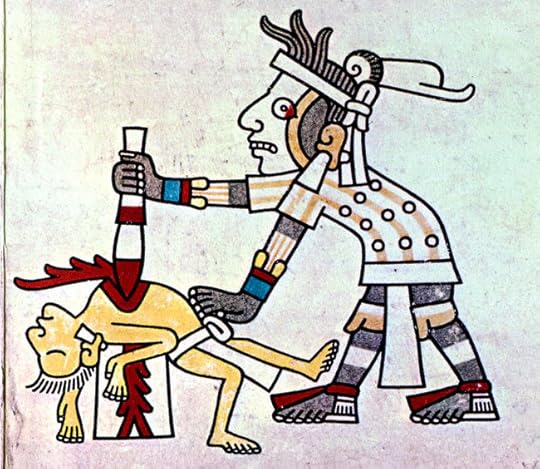
Some bold types called shamen took strong medicine and went across to the spirit world and returned with very specific knowledge (the necklace you lost is behind front door of your neighbour’s hut – not saying how it could possibly have got there).
Oh, humans have spirits too, and the good news is, they’re immortal. Actually, the land and the spirits and the creatures and the humans are all part of each other, it’s like that crazy novel The City and the City by China Mieville, these different worlds all co-terminous in the same place and interweaving and all.
Well, several thousand years passed and spirits in some places became gods and got specific powers and tights and capes to wear too, and city states grew up all over, their kings were divine or divinely chosen, and the people believed that tosh because the priests told them it was true. That happened in the USSR under Stalin too, so it’s an idea which took a long time to die out.

This excellent book then moves on to the oldest living religion, Hinduism, followed by Buddhism (which might not be a religion, it’s much more a philosophy), Judaism, Christianity and Islam, the three great monotheisms. Finally we get a miscellaneous section which tears through Sikhs, Santeria, Mormons, Baha’I, Tenrikyo, Cargo Cults (which have now disappeared), Jehovah’s Witnesses, Rastafari, Cai Dai, Scientology, Unification Church, Wicca, TM, UUA, Krishna Consciousness and Falun Dafa. They all go by so rapidly that I’m not sure the subtleties of each faith are adequately explained - the Unification Church appears just to believe that everyone should get married, for instance. I think there must be more to it than that.
But mainly the nine authors of this classy compendium can cheerfully collect compliments and congratulations for their collectively crisp, cool, calm compression of these copious complex, confusing and contrary concepts.
Some of it wasn’t no donkeys neither. It turns out that the grisly heads rolling down the ziggurat scenes in Mel Gibson’s Apocalypto movie were factually correct. Ugh!
Some bold types called shamen took strong medicine and went across to the spirit world and returned with very specific knowledge (the necklace you lost is behind front door of your neighbour’s hut – not saying how it could possibly have got there).
Oh, humans have spirits too, and the good news is, they’re immortal. Actually, the land and the spirits and the creatures and the humans are all part of each other, it’s like that crazy novel The City and the City by China Mieville, these different worlds all co-terminous in the same place and interweaving and all.
Well, several thousand years passed and spirits in some places became gods and got specific powers and tights and capes to wear too, and city states grew up all over, their kings were divine or divinely chosen, and the people believed that tosh because the priests told them it was true. That happened in the USSR under Stalin too, so it’s an idea which took a long time to die out.
This excellent book then moves on to the oldest living religion, Hinduism, followed by Buddhism (which might not be a religion, it’s much more a philosophy), Judaism, Christianity and Islam, the three great monotheisms. Finally we get a miscellaneous section which tears through Sikhs, Santeria, Mormons, Baha’I, Tenrikyo, Cargo Cults (which have now disappeared), Jehovah’s Witnesses, Rastafari, Cai Dai, Scientology, Unification Church, Wicca, TM, UUA, Krishna Consciousness and Falun Dafa. They all go by so rapidly that I’m not sure the subtleties of each faith are adequately explained - the Unification Church appears just to believe that everyone should get married, for instance. I think there must be more to it than that.
But mainly the nine authors of this classy compendium can cheerfully collect compliments and congratulations for their collectively crisp, cool, calm compression of these copious complex, confusing and contrary concepts.

July 5, 2023
This book provides a fantastic overview of the world’s religions in a format that is very easy to grasp. I love the layout of these books, as someone who is dyslexic and very much a virtual learner, the style used (flow charts, diagrams quotes, etc) makes it much easier to understand. The only downside to this book is that it is very much an overview so if you are looking for a more in-depth analysis/guide of, for example Christianity, then I would reach for The Bible Book by the same author. This one was extremely useful to read first though before getting into the details of each book of the bible.

August 25, 2022
Excellent introduction to the history of religions covering all eras. All the main historic events, actors, concepts, beliefs are well explained in a direct compact style. The work seems to me te be quite objective. I wanted to get an overview of the evolution of religions and I was not disapppointed. My interest is more of a desire to acquire additional knowledge as I am not a religious person and I am not a member of any religious organization.
Having been raised in the Catholic Church in Canada and having been witness as a child of many types of abuses carried out by priests (as finally admitted by the Pope) that may explain why I could never again trust any religious organization after such traumatic experiences. The dark side of the force: religion can unfortunately be used as a weapon. I like the philosophy of the Dalai Lama who openly states that practicing a religion is not the defining behavior of a person: attendance to religious activity is less important than acts of love, generosity and compassion towards others. Piety, stated values and beliefs are worthless if they are not sincerely applied in one's life in a way that is not detrimental to others.
Having been raised in the Catholic Church in Canada and having been witness as a child of many types of abuses carried out by priests (as finally admitted by the Pope) that may explain why I could never again trust any religious organization after such traumatic experiences. The dark side of the force: religion can unfortunately be used as a weapon. I like the philosophy of the Dalai Lama who openly states that practicing a religion is not the defining behavior of a person: attendance to religious activity is less important than acts of love, generosity and compassion towards others. Piety, stated values and beliefs are worthless if they are not sincerely applied in one's life in a way that is not detrimental to others.
June 28, 2015
This was an interesting book. Sort of an encyclopedia of religion, the book presents basic religious ideas, from many different traditions, in easily digestible articles. There are major sections on the five major religions of humanity (Hinduism, Buddhism, Judaism, Christianity, and Islam) and several section with articles based on beliefs of other religious traditions. Based on my seminary background, I was surprised at the breadth and depth of coverage of Christianity from both a doctrinal and historical perspective. I can only assume the coverage of the other religions is similar. I was amused when about Moses Maimonides' position that God has no attributes (essentially that God is incomprehensible) kept referring to God as "he". Wouldn't that imply that God has gender, which would be an attribute? In any case, this book is a decent source of information on many religious traditions and beliefs. Not an in depth treatment of any, but a good overview/survey source.

May 22, 2024
জন্মদিনের আগাম উপহার স্বরূপ পতিদেব হইতে প্রাপ্ত (পড়ুন বাগানো!) উপহার।
সেই প্রাচীন আমল থেকে আধুনিক যুগের ছোট বড় নানা ধর্মের সারকথা নিয়ে লেখা অদ্ভুত সুন্দর বইটা। কোনো ক্রিটিসিজম নাই বললেই চলে। যে ধর্মের যা মত, যা মানে, যা বিশ্বাস তাই ই বলা শুধুমাত্র। ধারণা বা বেসিক নলেজ অর্জনের জন্য বেস্ট তবে বেশি গভীরে যাবার মত তথ্য নেই।
পাতায় পাতায় ছবি সহ রঙিন বইটা এক টানে উল্টে পাল্টে পড়ে ফেলতে ইচ্ছা করে। কিন্তু তাই ইচ্ছা করলেও দেখবেন পড়ার সময় রেখে রেখে রয়ে সয়ে পড়ছেন। যেন শেষ না হয়ে যায়!❤️
সেই প্রাচীন আমল থেকে আধুনিক যুগের ছোট বড় নানা ধর্মের সারকথা নিয়ে লেখা অদ্ভুত সুন্দর বইটা। কোনো ক্রিটিসিজম নাই বললেই চলে। যে ধর্মের যা মত, যা মানে, যা বিশ্বাস তাই ই বলা শুধুমাত্র। ধারণা বা বেসিক নলেজ অর্জনের জন্য বেস্ট তবে বেশি গভীরে যাবার মত তথ্য নেই।
পাতায় পাতায় ছবি সহ রঙিন বইটা এক টানে উল্টে পাল্টে পড়ে ফেলতে ইচ্ছা করে। কিন্তু তাই ইচ্ছা করলেও দেখবেন পড়ার সময় রেখে রেখে রয়ে সয়ে পড়ছেন। যেন শেষ না হয়ে যায়!❤️

March 10, 2024
هذه الموسوعة المصغرة اختيار جيد لمن يحب الاطلاع على نشأة الأديان وتطورها عبر العصور، كما تقدم معلومات مفصلة عن الأديان ومذاهبها كالبوذية والهندوسية والسيخ والزرداشتية وكذلك اليهودية والمسيحية والإسلام. وكذلك يشرح الكتاب الظروف الاجتماعية والسياسية المؤثرة في تشعب الأديان إلى فرق وطوائف وأبرز الشخصيات المؤثرة في هذا المجال.

September 8, 2017
3.5 stars
Informative book about different major religions.
This book was hard for me to get through for a few reasons. I'm not really interested in the very specific details of religion, so the textbook-style type paragraphs were boring and hard to finish. I have also mentioned this in my reviews of the other books in this series, but I'm not a fan of the format; it's not organized enough for me (yes, I'm that Type A).
For some topics the format works very well (e.g. for the Politics one) but for religion it seemed choppy and lacking of important aspects of the religions. The main 2 sections are Christianity and Islam, which have short 'chapters'/articles titled with things like "God Guides Us with Shari'a"--if you don't know what Shari'a is, those types of titles are unhelpful and you can't find what you're looking for.
I also wish the book clearly looked at different religions' stances on social issues like women's rights (e.g. abortion, divorces, etc.), LGTBQ rights, etc. and compared them.
I also was unhappy with the book's minimization of certain requirements of faiths.
Example (this is the only one I remember, but there were others too):
"Jihad is Our Religious Duty
...He argued that in the first stage, jihad towards others should be peaceful and passive. In the second stage, Islam should be defended with peaceful argument. The third stage allowed for followers to defend the Muslim community against injustice. In the fourth stage, Muslims are called on to engage in armed conflict, within specific legal guidelines and Qu'ranic guidelines, when the Islamic faith is under threat." (Ambalu, 278).
In other books, this would have been written like "To defend Islam, Muslims are encouraged to engage in violence."
Overall if you're interested in religion and interested in an introduction this is a decent book to start with.
Informative book about different major religions.
This book was hard for me to get through for a few reasons. I'm not really interested in the very specific details of religion, so the textbook-style type paragraphs were boring and hard to finish. I have also mentioned this in my reviews of the other books in this series, but I'm not a fan of the format; it's not organized enough for me (yes, I'm that Type A).
For some topics the format works very well (e.g. for the Politics one) but for religion it seemed choppy and lacking of important aspects of the religions. The main 2 sections are Christianity and Islam, which have short 'chapters'/articles titled with things like "God Guides Us with Shari'a"--if you don't know what Shari'a is, those types of titles are unhelpful and you can't find what you're looking for.
I also wish the book clearly looked at different religions' stances on social issues like women's rights (e.g. abortion, divorces, etc.), LGTBQ rights, etc. and compared them.
I also was unhappy with the book's minimization of certain requirements of faiths.
Example (this is the only one I remember, but there were others too):
"Jihad is Our Religious Duty
...He argued that in the first stage, jihad towards others should be peaceful and passive. In the second stage, Islam should be defended with peaceful argument. The third stage allowed for followers to defend the Muslim community against injustice. In the fourth stage, Muslims are called on to engage in armed conflict, within specific legal guidelines and Qu'ranic guidelines, when the Islamic faith is under threat." (Ambalu, 278).
In other books, this would have been written like "To defend Islam, Muslims are encouraged to engage in violence."
Overall if you're interested in religion and interested in an introduction this is a decent book to start with.
April 27, 2023
Прочетох я
Реално я изслушах.
Това беше не просто книга, а пътуване, за това ми отне и толкова време. Не, че самата книга ме промени свръх много, по-скоро беше беше спътник на пътя.
Когато започнах да слушам аудиокнигата (гласът е топ), бях агностик.
В края не заради книгата, а просто до там ме доведе пътя станах ученик на Христос (ученик на Истината) сиреч християнин.
Книгата ми помогна да открия поне 2 големи неща, които не бях преди:
1. Зороастризма
2. Почти няма други религии освен християнството...
3. Буда е бил боклук (това дори не го научих от тази книга, която удобно го бе пропуснала и за това и давам и 4 звезди) - Буда е изоставил царството, жена си И НОВОРОДЕНОТО СИ ДЕТЕНЦЕ (син, който кръстил Перчо - като малко перце) избягал, за да търси "просвещение" - егоцентрик, егоист и безотговорник.
Между другото това което ми прави впечатление е че специално в християнството около Исус най-вероятно няма да се появи в бъдеще нещо ново и разтърсващо откритие за което да не е било чувано за 2 хиляди години, да не е имало множество секти базирани на него, и да не е било отхвърляно множество пъти
ова което ми прави повече впечатление е че по-стари пророци, като Заратустра от Персия се игнорират. Вместо книгата Авеста (библията на персийските зороастрийци) да се интегрира в стария завет.
И да не се разширява християнстовто с нещо по-ново, а с нещо по-старо, но забравено.
Историята на Заратустра е мн интересна.
Той говори за дявола и битката му с Бог много преди евреите да дефинират Сатана, духовните бунтове и тн. А реално Исус супер много набляга точно на това. На злото, на демони, дявол и т.н.
Че битката му е със злото, и че злото е реално съществуващо нещо и дори личност. И че злото се побеждава, чрез говорене и вършене на истина, съвестност и любов между хората.
Зороастрийзма е единствената друга религия която толкова ясно казва. Тя дори е още по-проста в учението си.
Добри мисли, добри думи, добри дела.
А от всеки мъж се очаква да говори истината, да изпълнява думата си, и да стреля правилно.
Всички останали религии които съм изучавал е пълно мазало, и изобщо няма морал, изобщо не се говори за истина, или за поемане на отговорност. Или за вършене на нещо в името на некой друг.
Говори се основно или за самоосъвършенстеане и лично просвещение - както е при будизма - да медитираш и ти самия да достигнеш до просвещение. И да зарежеш семейство, жена, деца, работа, и да караш на просия и медитация .. (което е и доста гностическо)
Или повечето други религии са мазнене на боговете, който бог ти трябва на него се кланяш и мазниш. Което погледнато от християнски план си е абсолютно вещество, идолопоклонничество и кланяме на демони.
Християнството дори признава, че това работи, или че тия други богове съществуват, но са демони, и ще ти вземат повече отколкото ще ти дадат..
А след Христос, всички други религии и секти, които се появяват, които гравитират около Христос се вижда, че всячески се опитват да размият Божествеността му.
Че не бил Бог-слово дошъл в плът, а че бил просто син. Че бил обладан от светия дух, че бил нещо си друго. Че бил просто пророк като Мойсей (при исляма) и пр.
Което е много показателно за тенденция. Никоя нова религия не тръгва да отрича Мойсей, или някой друг пророк, всички целят да отрекат Исус. Щото разказите му предадени от учениците му до днес са ТОП. И самите те са доста скандални.
Буквално вчера дослушах енциклопедията за религиите и това ми направи впечатление за пореден път.
Както биха казали някои, тези тенденции са доста... Лукави
А иначе, ако прочетеш червения текст в библия - реалните уроци на Исус - ще видиш, че буквално няма какво да се махне или добави. Абсолютно класически са, универсални, балансирани, и истина
Истината е някъде посредата и виждаш, как квото е учил Исус абсолютно е истина.
И е било радикално както за тогава, така и е радикално за сега междудругото.
Щото например принципа е да не мразиш хората. Дори да не мразиш някой, който е убил твой близък примерно. А да осъзнаваш, че този човек е под влияние на злото, и един вид също е жертва, и ако не се спаси, това му състояние ще продължи цяла вечност.
Исус учи да МРАЗИМ, и супер много говори за ОМРАЗА и МРАЗЕНЕ, но не към хора, а към зли дела, зли учения, лъжи, [идеологии напр.] и кат цяло
Мрази комунизМА
Обичай комунисТА
А тва все повече виждам колко е трудно за хората да го разберат. Те искат да мразят хората, а не виждат, че хората са просто излъгани жертви на различни влияния в повечето случаи.
Злото не е в хората, но злото може да действа в този свят само, чрез хората.
Злото действа, чрез мисли, идеи, предложения и пр. в умовете на хората.
Човек който е обладан от някаква идеология, която ще доведе до смъртта и мизерията на милиони функционално си е обладан от зло човек.
Тия дет бяха ковид ваксърите, дето на всяка цена лъжеха, мамиха, изтерясваха само и само да ваксинират всички против ковид, и жени и деца защото така трябва... Тва за мене си бяха функционално обладани от злото хора
....
Накратко, като четох книгата очаквах да видя 200 различни религии, които са сходни на християнството, говорят за зло и добро, за Бог създател, който го наричат по различни начини и общо взето очаквах да описват еднакви неща от различна гледна точка...
Както хората, които не са изучавали религиите изобщо биха казали - ем те всички религии говорят едни и същи неща.
Аз очаквах да е така, и да видя къде са сбъркали и което е до бро, инетересно и истина да го взема, а което е глупост да го скипна.
Всъщност се оказа, че 90% от написаното в книгата е глупосост.
практически няма религии.. Или ок религии - т.е. ритуали има, но история на битието и адекватно описание на това ЧЕ ЗЛОТО СЪЩЕСТВУВА и че е в битка в бунт срещу доброто, го има само в Зороастризма, в Юдаизма, в Християнството и в Исляма. Може би малко и в египетската религия, но там поне за сега четеейки една друга книга българска за религията им не съм много впечатлен, общо взето базови неща изпускат.
В началото на тази книга смятах, че хората сме лоши. Така и отхвърлих зороастризма описан там. В последствие вече не мисля, че хората сме лоши, но че сме слаби и злото може да действа през нас лесно.
Почнах да чета тази книга, тъй като осъзнах, че наистина съм агностик, и дори да не вярвам, аз не знаям в какво не вярвам. Нямам представа какво е буда например, или харе кришна.
СЛед тази дълга енциклопедия, и няколко години изучаване, мога да кажа, че повечето "религии" са кланяне на демонични същества - богове с малко б-ъ. Повечето такива култове отричат злото, че съществува, и така му помагат, тъй като злото действа много по-добре, когато хората не знаят, че съществува.
Това се вижда и по начинът по който живеят хората кланящи се на идолите.
За китай не мога да кажа, че ми е ясно, там имам дупки. В индия положението е яко зле.
Единствено зороастризма, който чувам, че го има жив там може да е някакъв път ала ранно старозаветно християнство, защото спорд мен пророк зороастър е бил в контакт с Бог отец.
Останалите култове... по плодовете ще ги познаете.
Интересното е че само в изброените религии злото се споменава. Ниво в будизма, нито в инцийските гупости, злото е споменато.
Дори в стария завет постепенно се появява..
Аз съм шокиран как може Пророк зороастър и ученията му да не са включени в библията, поне на християни...
Мога още да пиша, но имам работа в момента.
Най-важното е че никой не стига до Бог освен, чрез Христос.
Дори Зороастър да е бил в контакт с Бога творец, той пак е под Христос.
След време бих изучавал исляма, макар, че там плодовете му ме притесняват.
Истината се познава по плодовете.
Реално я изслушах.
Това беше не просто книга, а пътуване, за това ми отне и толкова време. Не, че самата книга ме промени свръх много, по-скоро беше беше спътник на пътя.
Когато започнах да слушам аудиокнигата (гласът е топ), бях агностик.
В края не заради книгата, а просто до там ме доведе пътя станах ученик на Христос (ученик на Истината) сиреч християнин.
Книгата ми помогна да открия поне 2 големи неща, които не бях преди:
1. Зороастризма
2. Почти няма други религии освен християнството...
3. Буда е бил боклук (това дори не го научих от тази книга, която удобно го бе пропуснала и за това и давам и 4 звезди) - Буда е изоставил царството, жена си И НОВОРОДЕНОТО СИ ДЕТЕНЦЕ (син, който кръстил Перчо - като малко перце) избягал, за да търси "просвещение" - егоцентрик, егоист и безотговорник.
Между другото това което ми прави впечатление е че специално в християнството около Исус най-вероятно няма да се появи в бъдеще нещо ново и разтърсващо откритие за което да не е било чувано за 2 хиляди години, да не е имало множество секти базирани на него, и да не е било отхвърляно множество пъти
ова което ми прави повече впечатление е че по-стари пророци, като Заратустра от Персия се игнорират. Вместо книгата Авеста (библията на персийските зороастрийци) да се интегрира в стария завет.
И да не се разширява християнстовто с нещо по-ново, а с нещо по-старо, но забравено.
Историята на Заратустра е мн интересна.
Той говори за дявола и битката му с Бог много преди евреите да дефинират Сатана, духовните бунтове и тн. А реално Исус супер много набляга точно на това. На злото, на демони, дявол и т.н.
Че битката му е със злото, и че злото е реално съществуващо нещо и дори личност. И че злото се побеждава, чрез говорене и вършене на истина, съвестност и любов между хората.
Зороастрийзма е единствената друга религия която толкова ясно казва. Тя дори е още по-проста в учението си.
Добри мисли, добри думи, добри дела.
А от всеки мъж се очаква да говори истината, да изпълнява думата си, и да стреля правилно.
Всички останали религии които съм изучавал е пълно мазало, и изобщо няма морал, изобщо не се говори за истина, или за поемане на отговорност. Или за вършене на нещо в името на некой друг.
Говори се основно или за самоосъвършенстеане и лично просвещение - както е при будизма - да медитираш и ти самия да достигнеш до просвещение. И да зарежеш семейство, жена, деца, работа, и да караш на просия и медитация .. (което е и доста гностическо)
Или повечето други религии са мазнене на боговете, който бог ти трябва на него се кланяш и мазниш. Което погледнато от християнски план си е абсолютно вещество, идолопоклонничество и кланяме на демони.
Християнството дори признава, че това работи, или че тия други богове съществуват, но са демони, и ще ти вземат повече отколкото ще ти дадат..
А след Христос, всички други религии и секти, които се появяват, които гравитират около Христос се вижда, че всячески се опитват да размият Божествеността му.
Че не бил Бог-слово дошъл в плът, а че бил просто син. Че бил обладан от светия дух, че бил нещо си друго. Че бил просто пророк като Мойсей (при исляма) и пр.
Което е много показателно за тенденция. Никоя нова религия не тръгва да отрича Мойсей, или някой друг пророк, всички целят да отрекат Исус. Щото разказите му предадени от учениците му до днес са ТОП. И самите те са доста скандални.
Буквално вчера дослушах енциклопедията за религиите и това ми направи впечатление за пореден път.
Както биха казали някои, тези тенденции са доста... Лукави
А иначе, ако прочетеш червения текст в библия - реалните уроци на Исус - ще видиш, че буквално няма какво да се махне или добави. Абсолютно класически са, универсални, балансирани, и истина
Истината е някъде посредата и виждаш, как квото е учил Исус абсолютно е истина.
И е било радикално както за тогава, така и е радикално за сега междудругото.
Щото например принципа е да не мразиш хората. Дори да не мразиш някой, който е убил твой близък примерно. А да осъзнаваш, че този човек е под влияние на злото, и един вид също е жертва, и ако не се спаси, това му състояние ще продължи цяла вечност.
Исус учи да МРАЗИМ, и супер много говори за ОМРАЗА и МРАЗЕНЕ, но не към хора, а към зли дела, зли учения, лъжи, [идеологии напр.] и кат цяло
Мрази комунизМА
Обичай комунисТА
А тва все повече виждам колко е трудно за хората да го разберат. Те искат да мразят хората, а не виждат, че хората са просто излъгани жертви на различни влияния в повечето случаи.
Злото не е в хората, но злото може да действа в този свят само, чрез хората.
Злото действа, чрез мисли, идеи, предложения и пр. в умовете на хората.
Човек който е обладан от някаква идеология, която ще доведе до смъртта и мизерията на милиони функционално си е обладан от зло човек.
Тия дет бяха ковид ваксърите, дето на всяка цена лъжеха, мамиха, изтерясваха само и само да ваксинират всички против ковид, и жени и деца защото така трябва... Тва за мене си бяха функционално обладани от злото хора
....
Накратко, като четох книгата очаквах да видя 200 различни религии, които са сходни на християнството, говорят за зло и добро, за Бог създател, който го наричат по различни начини и общо взето очаквах да описват еднакви неща от различна гледна точка...
Както хората, които не са изучавали религиите изобщо биха казали - ем те всички религии говорят едни и същи неща.
Аз очаквах да е така, и да видя къде са сбъркали и което е до бро, инетересно и истина да го взема, а което е глупост да го скипна.
Всъщност се оказа, че 90% от написаното в книгата е глупосост.
практически няма религии.. Или ок религии - т.е. ритуали има, но история на битието и адекватно описание на това ЧЕ ЗЛОТО СЪЩЕСТВУВА и че е в битка в бунт срещу доброто, го има само в Зороастризма, в Юдаизма, в Християнството и в Исляма. Може би малко и в египетската религия, но там поне за сега четеейки една друга книга българска за религията им не съм много впечатлен, общо взето базови неща изпускат.
В началото на тази книга смятах, че хората сме лоши. Така и отхвърлих зороастризма описан там. В последствие вече не мисля, че хората сме лоши, но че сме слаби и злото може да действа през нас лесно.
Почнах да чета тази книга, тъй като осъзнах, че наистина съм агностик, и дори да не вярвам, аз не знаям в какво не вярвам. Нямам представа какво е буда например, или харе кришна.
СЛед тази дълга енциклопедия, и няколко години изучаване, мога да кажа, че повечето "религии" са кланяне на демонични същества - богове с малко б-ъ. Повечето такива култове отричат злото, че съществува, и така му помагат, тъй като злото действа много по-добре, когато хората не знаят, че съществува.
Това се вижда и по начинът по който живеят хората кланящи се на идолите.
За китай не мога да кажа, че ми е ясно, там имам дупки. В индия положението е яко зле.
Единствено зороастризма, който чувам, че го има жив там може да е някакъв път ала ранно старозаветно християнство, защото спорд мен пророк зороастър е бил в контакт с Бог отец.
Останалите култове... по плодовете ще ги познаете.
Интересното е че само в изброените религии злото се споменава. Ниво в будизма, нито в инцийските гупости, злото е споменато.
Дори в стария завет постепенно се появява..
Аз съм шокиран как може Пророк зороастър и ученията му да не са включени в библията, поне на християни...
Мога още да пиша, но имам работа в момента.
Най-важното е че никой не стига до Бог освен, чрез Христос.
Дори Зороастър да е бил в контакт с Бога творец, той пак е под Христос.
След време бих изучавал исляма, макар, че там плодовете му ме притесняват.
Истината се познава по плодовете.

September 8, 2013
A very good introduction to religion. What's special about it is that it focuses on certain themes of each religion, while giving a general summary of its history at the beginning of each religion. I think the book accomplishes it's goal by picking out the distinct characteristics of these religions- while occasionally illuminating the similarities they share. Does not serve as a complete source of information, but due to its recency and enjoyable format, this book does serve as a excellent entrance into the fascinating study of religion.

November 2, 2020
I received criticisms, remarks from a friend on this topic. He is friendly, often writes in newspapers on this topic. As he is writing for general public; I expect him to bring more content.
I wanted this person to give a more serious, thoughtful understanding of religion. Apparently, he gave usual popular internet arguments or opinions on Religion.
I mean, I wanted him to put more effort in educating himself, having a thoughtful response. He's on his way to get a PhD.
It would be beneficial for a discussion, rather than saying,
"Religion is a tool, used to control people."
This does not discredit the idea of God (genetic fallacy). I shared this book, so he can go through different religions and be more informed.
Hinduism was most interesting to me. I wish more people would talk about religion openly, rather than cower.
The Book is a survey of religious ideas.
I think, this would be have much better if Religious ideas were more systematized or hierarchical.
I was thinking, a lot of religious groups treat each other with disdain. Wish, there was a book that would give how each religion view each other throughout centuries.
I would recommend this to anyone, who wants to go through a concise description of religions of humanity
Deus Vult,
Gottfried
I wanted this person to give a more serious, thoughtful understanding of religion. Apparently, he gave usual popular internet arguments or opinions on Religion.
I mean, I wanted him to put more effort in educating himself, having a thoughtful response. He's on his way to get a PhD.
It would be beneficial for a discussion, rather than saying,
"Religion is a tool, used to control people."
This does not discredit the idea of God (genetic fallacy). I shared this book, so he can go through different religions and be more informed.
Hinduism was most interesting to me. I wish more people would talk about religion openly, rather than cower.
The Book is a survey of religious ideas.
I think, this would be have much better if Religious ideas were more systematized or hierarchical.
I was thinking, a lot of religious groups treat each other with disdain. Wish, there was a book that would give how each religion view each other throughout centuries.
I would recommend this to anyone, who wants to go through a concise description of religions of humanity
Deus Vult,
Gottfried

December 22, 2021
A mini-encyclopedia of religions written by various scholars, containing a lot of information about many religions, explaining their evolutions, spirituality, history, and denominations. The narration is very entertaining, objective, and accurate, you won't get bored at all! Worth reading.

December 29, 2020
This book provided a fantastic synopsis of the world’s religions. It was well-written, expansive, and informative, taking one on a trip from the ancient to the modern religions of the world. Each religion was presented tastefully and respectfully. I wanted a book to help me understand where my own religious history (Mormonism) fit in with the development of religious thought. This was the only book on world religions I found that even included a section on the topic.
What I learned was how many similarities in theology and origin there are amongst the various religions. I came away with a strong feeling that any religion claiming exclusive monopoly to absolute truth is a dangerous endeavor. I found comfort in the teachings of Sri Ramakrishna, that all faith essentially comes from the same source and all paths eventually lead back to that source. My next religious undertaking will be to read a book examining the historical Jesus versus the Christ of the New Testament.
You can tell each section was written by various different contributors, based on the number of typographical errors present. Some sections had quite a few, while others included none that I noticed.
What I learned was how many similarities in theology and origin there are amongst the various religions. I came away with a strong feeling that any religion claiming exclusive monopoly to absolute truth is a dangerous endeavor. I found comfort in the teachings of Sri Ramakrishna, that all faith essentially comes from the same source and all paths eventually lead back to that source. My next religious undertaking will be to read a book examining the historical Jesus versus the Christ of the New Testament.
You can tell each section was written by various different contributors, based on the number of typographical errors present. Some sections had quite a few, while others included none that I noticed.

February 7, 2016
I've been looking for a book like this for a long time and I'm glad I found this book.
This book cover a major sections and introduced me to a new beliefs and myths and its easy to read with nice diagrams and illustration.
This book cover a major sections and introduced me to a new beliefs and myths and its easy to read with nice diagrams and illustration.

December 11, 2020
I’ve felt cheated out of my religious education for years when my old and weird eccentric religious education teacher was never never there for lectures and when he was he smelt of mothballs, cigarette smoke and he believed putting on the Simpsons was justified as education failed me in my GCSE. It was a true shame because actually my best friend and I were the rarity of the class and we did enjoy learning. Surprise surprise when we and the rest of our class failed our exam.
Everything I know about religion before reading this book has been either biased or going off other people’s experiences of religion and history.
And I felt it was time to do my own research. I can say that after reading this book I am certainly more aware of the worlds religions, their history’s and their influences. But in actual terms of how detailed religion influences people’s lives day to day, not so much. I get the overall gist of it but a bit more information in that aspect would have been nice.
Information wise it can be a lot to handle and read therefore it’s taken me about four months to complete because reading it in big sections is a no go. Small sections are definitely doable.
Everything I know about religion before reading this book has been either biased or going off other people’s experiences of religion and history.
And I felt it was time to do my own research. I can say that after reading this book I am certainly more aware of the worlds religions, their history’s and their influences. But in actual terms of how detailed religion influences people’s lives day to day, not so much. I get the overall gist of it but a bit more information in that aspect would have been nice.
Information wise it can be a lot to handle and read therefore it’s taken me about four months to complete because reading it in big sections is a no go. Small sections are definitely doable.

January 21, 2024
Ein sehr interessantes Buch über die Entwicklung von Glaube und Religion im Verlauf der Menschheitsgeschichte.
Das Buch ist in verschiedene Abschnitte eingeteilt. Angefangen bei verschiedenen Stammesreligionen wie dem Schamanismus, weiter über die Religionen in der Antike wie die Antiken Griechen. Im Anschluss werden die großen Weltreligionen Hinduismus, Buddhismus, Judentum, Christentum und Islam. Abschließen tut das Buch mit einem Blick auf modernere Religionen.
Zu jedem Kapitel wird etwas zu den Hintergründen, Praktiken und den praktizierenden Völkern geschrieben. Alles sehr oberflächlich, aber trotzdem informativ, neutral und Wertungsfrei.
Einen Punkt abzug gibt es für mich vor allem für zwei Sachen. Teilweise war das seehr trocken und zäh, aber gut es ist ein Sachbuch. Die andere Sache ist das Layout, es ist teilweise sehr durcheinander und macht ein strukturiertes Lesen schwer.
Das Buch ist in verschiedene Abschnitte eingeteilt. Angefangen bei verschiedenen Stammesreligionen wie dem Schamanismus, weiter über die Religionen in der Antike wie die Antiken Griechen. Im Anschluss werden die großen Weltreligionen Hinduismus, Buddhismus, Judentum, Christentum und Islam. Abschließen tut das Buch mit einem Blick auf modernere Religionen.
Zu jedem Kapitel wird etwas zu den Hintergründen, Praktiken und den praktizierenden Völkern geschrieben. Alles sehr oberflächlich, aber trotzdem informativ, neutral und Wertungsfrei.
Einen Punkt abzug gibt es für mich vor allem für zwei Sachen. Teilweise war das seehr trocken und zäh, aber gut es ist ein Sachbuch. Die andere Sache ist das Layout, es ist teilweise sehr durcheinander und macht ein strukturiertes Lesen schwer.

February 16, 2025
'The Religions Book’ is a great introduction to world religions. It features in-depth sections on Hinduism, Buddhism, Judaism, Christianity and Islam, as well as featuring broader sections on primal beliefs, ancient and classical beliefs, and modern religions.
The text is easy to follow, making it accessible to a wide range of readers, including those completely new to the subject, and it uses helpful graphics to summarise and clarify key concepts. Colourful illustrations help to break up the text, preventing any of the chapters from feeling too dense.
I would recommend this book to anyone who is new to the subject or who is looking to refresh their knowledge. It will act as a solid jumping off point for further learning and will remain a useful reference text.
The text is easy to follow, making it accessible to a wide range of readers, including those completely new to the subject, and it uses helpful graphics to summarise and clarify key concepts. Colourful illustrations help to break up the text, preventing any of the chapters from feeling too dense.
I would recommend this book to anyone who is new to the subject or who is looking to refresh their knowledge. It will act as a solid jumping off point for further learning and will remain a useful reference text.

November 24, 2025
The final book in a trilogy of books I've read about the major religions in our world throughout history up through today. So much of what happens in our world is impacted by the religious beliefs and practices of those in power and the people they lead. Beliefs about God, from ancient times up through today, have had a profound impact on all of us whether we understand that or not. Our ideas about morality, death, the afterlife, conflicts over faith, rituals, prayer, and changes in beliefs over time impact all of us in ways we may or may not be aware of.
March 11, 2022
An excellent first introduction to religions of the world.
Two things:
(1) too many gods with too many laws with too many versions with too many terminologies to keep track of.
(2) I have a confession - I couldn't conquer the temptation to laugh while reading about the cargo cults.
Two things:
(1) too many gods with too many laws with too many versions with too many terminologies to keep track of.
(2) I have a confession - I couldn't conquer the temptation to laugh while reading about the cargo cults.

February 15, 2022
Useful overview.

October 5, 2022
Foarte bine explicata, pe întelesul tuturor, cu toate informațiile necesare pe acest subiect. As trece-o la “ cărți de citit intr-o viața”.

June 12, 2024
I took forever to finish this, but it was still good! The book was Both informational and aesthetic, and I enjoyed learning about the different religions — even the smaller ones. Religion is such an interesting quirk (for a lack of better word) of humanity and it’s kinda funny reading about all of these different stories we create to comfort ourselves regarding the unknown and inexplicable.


September 15, 2025
Very informative about several different religions, I enjoyed learned all that I did

April 20, 2020
"Fui para o Ocidente e vi islamismo, mas não vi muçulmanos. Voltei para o Oriente e vi muçulmanos, mas não vi islamismo." (Muhammad 'Abduh)

September 5, 2022
Informative, non judgemental to some extent and good as a quick read on world religions

May 28, 2020
I want to start off this review by saying that I did not finish this book!
There are a lot of subjects that I don't know about that I want to know more about. Top among those subjects is religion. I've never been a religious person. Spiritual, perhaps, but never overly religious. My parents never forced me to go to church, they never really forced their religion upon me, and I've always been free to explore that area if I wanted to so I could ensure that my beliefs are what I want or envision them to be. I never really wanted to go exploring in that direction until recently, but I didn't want to go take a class at the local college because that's a chunk of change to spend with a chance that I'll still walk away potentially confused. Instead, I scoured the internet for books that may be of assistance to me. When I came upon this book, I thought it seemed like it would be a good fit.
It's not!
The book is beautifully laid out but, to my brain, it just adds to my confusion as I was trying to learn and absorb the material. The charts and pictures really don't add anything for me, they weren't helpful. The actual text itself? It was very, very repetitive and that's not how I learn. You can tell me something over and over again and I might never get it even after the fifteenth time! I was expecting a far more in depth look at each religion, prepared to be exposed to the beauty of each of them, and get sucked into the material in some sort of cohesive way. This was just repetitive and felt, to me, like it was all over the place. I'm not saying that this book would be bad for all individuals! No, it's just not how I learn.
I would recommend this if a wall of text is far too much (and it can be, absolutely!) for you and you need to have the visuals and the repetitiveness to absorb the material. My brain just wasn't equipped for this particular style.
There are a lot of subjects that I don't know about that I want to know more about. Top among those subjects is religion. I've never been a religious person. Spiritual, perhaps, but never overly religious. My parents never forced me to go to church, they never really forced their religion upon me, and I've always been free to explore that area if I wanted to so I could ensure that my beliefs are what I want or envision them to be. I never really wanted to go exploring in that direction until recently, but I didn't want to go take a class at the local college because that's a chunk of change to spend with a chance that I'll still walk away potentially confused. Instead, I scoured the internet for books that may be of assistance to me. When I came upon this book, I thought it seemed like it would be a good fit.
It's not!
The book is beautifully laid out but, to my brain, it just adds to my confusion as I was trying to learn and absorb the material. The charts and pictures really don't add anything for me, they weren't helpful. The actual text itself? It was very, very repetitive and that's not how I learn. You can tell me something over and over again and I might never get it even after the fifteenth time! I was expecting a far more in depth look at each religion, prepared to be exposed to the beauty of each of them, and get sucked into the material in some sort of cohesive way. This was just repetitive and felt, to me, like it was all over the place. I'm not saying that this book would be bad for all individuals! No, it's just not how I learn.
I would recommend this if a wall of text is far too much (and it can be, absolutely!) for you and you need to have the visuals and the repetitiveness to absorb the material. My brain just wasn't equipped for this particular style.
April 1, 2021
I picked up this book to gain an introduction into the origins of religion and was pleasantly surprised.
I found an incredibly compact and informative book which explains the origins, development and history of the major and minor religions. What I love most is you aren't bombarded with superficial information (I. E. Going too deep into detail about religious practices and rituals) but gives you enough information to do your own research. The foundation offered by this book is aided by the directory, a bitesized version of each mentioned religion - I'd argue to read the directory and use it to guide your own study!
I appreciated how the branches of particular religions were given sufficient detail as to why they occurred. However, some of these sections were long winded and could have been included in the directory instead for cohesion. I found these sections, while informative, were short and disrupted an otherwise progressive flow detailing each religion. Again, if you're looking for a book to introduce you into the origin of religions around the world then I strongly recommend this book.
May you enjoy your time reading!
I found an incredibly compact and informative book which explains the origins, development and history of the major and minor religions. What I love most is you aren't bombarded with superficial information (I. E. Going too deep into detail about religious practices and rituals) but gives you enough information to do your own research. The foundation offered by this book is aided by the directory, a bitesized version of each mentioned religion - I'd argue to read the directory and use it to guide your own study!
I appreciated how the branches of particular religions were given sufficient detail as to why they occurred. However, some of these sections were long winded and could have been included in the directory instead for cohesion. I found these sections, while informative, were short and disrupted an otherwise progressive flow detailing each religion. Again, if you're looking for a book to introduce you into the origin of religions around the world then I strongly recommend this book.
May you enjoy your time reading!
April 29, 2015
This book is really useful as a research tool. It covers religions from prehistory through to the modern day. Each religion is in a separate section that is clearly demarcated and often colour coded so that you can see a change from one to the other. There are pictures, diagrams and even time lines to help in understanding the basics of the religion in question. The text is broken into easily digestible chunks to help comprehension. Over all, this is a great starting point for anyone who wants to know more about religion and has been useful in my own research.
July 31, 2022
Gives a rough overview of world religions, but hardly a thorough or balanced one. It also seems to treat religions uneven ones, with certain ones spending less time exploring the beliefs than the history with a bias towards the more progressive denominations and ignoring other historical issues; it can't seem to balance the theological and historical aspects that shape them over time.
Displaying 1 - 30 of 135 reviews