

What do you think?

Alpha: Abidjan to Paris
Alpha Coulibaly is emblematic of the refugee crisis today - just one of millions on the move, at the mercy of people traffickers, endlessly frustrated, endangered and exploited as he attempts to rejoin his family, already in Europe. With a visa, Alpha's journey would take a matter of hours; without one he is adrift for eighteen months. Along the way he meets an unforgettable cast of characters, each one giving another human face to the crisis.
The book is presented in graphic novel format, with artwork created in cheap felt-tip pen and wash, materials Alpha himself might be able to access. Bringing together prize-winning novelist Bessora and award-winning artist Barroux, this is a timely and important account of one man's desperate journey and comes to the UK market with a foreword by Michael Morpurgo. Supported by Amnesty International and English PEN Association.
The book is presented in graphic novel format, with artwork created in cheap felt-tip pen and wash, materials Alpha himself might be able to access. Bringing together prize-winning novelist Bessora and award-winning artist Barroux, this is a timely and important account of one man's desperate journey and comes to the UK market with a foreword by Michael Morpurgo. Supported by Amnesty International and English PEN Association.
128 pages, Hardcover
First published September 1, 2014
About the author
Bessora
22 books10 followersBessora is an award-winning author of Swiss, German, French, Polish, and Gabonese heritage, whose work has been anthologized in Best European Fiction and has received the Fénéon Prize and Grand Prix Littéraire d’Afrique Noire. Raised in Europe, America, and Africa, she has traveled extensively and her fiction is underpinned by extensive research and her training as an anthropologist. Alpha is her first graphic novel. She lives in Paris.
Ratings & Reviews
Friends & Following
Create a free account to discover what your friends think of this book!
Community Reviews
Displaying 1 - 30 of 109 reviews

December 9, 2019
Heartbreaking look at one man trying to find his wife and son; the abuse and advantage that these migrants face at the hand of human trafficking gangs is horrifying - what use is the UN if they can't even agree to bring these criminals to justice? It seems to me that there should be a way for all countries to agree to stop human trafficking.

Read
July 12, 2017I learned about this remarkable book from the Guardian newspaper, and immediately ordered it from the UK. This is a book that describes the desperation and the despair of young men in West Africa. We see stories of the thousands who are stranded in Morocco and Algeria, trying to cross over to Spain and make their way into Europe. Alpha leaves Abidjan, the capital of the Ivory Coast, to search for his wife and son who went to Paris. He has not heard anything from them, and leaves to find his wife's sister in Paris.
This novel conveys the tragedy of this migration, and is a basic introduction to the experience through the eyes of a sympathetic migrant. Highly recommended for any interested in migrants/immigrants, refugees, Africa and more.
This novel conveys the tragedy of this migration, and is a basic introduction to the experience through the eyes of a sympathetic migrant. Highly recommended for any interested in migrants/immigrants, refugees, Africa and more.

January 26, 2018
There's nobody to explain what's going on. And nobody who dares ask - animals prefer not to know when they're being led to the slaughter. It's always like this. And no, you don't get used to it. You just resign yourself to it. That's all.
This graphic novel tells the story of Alpha, who makes the perilous journey from Cote d'Ivoire in the hope of arriving at his sister in law's salon near the Gare du Nord in Paris, having sent his wife and child ahead sometime before (but he has not heard from them). The journey is fraught with danger and there are losses along the way.
The illustrations are done in felt tip pen, mostly blacks and greys with a very little colour in each frame, and are very effective.
I found this book absolutely devastating and heart wrenching, but these stories need to be told and we in the West need to read them.
This was a chance find at my local library, and I am glad I found it. It will stay with me for a long time.
This graphic novel tells the story of Alpha, who makes the perilous journey from Cote d'Ivoire in the hope of arriving at his sister in law's salon near the Gare du Nord in Paris, having sent his wife and child ahead sometime before (but he has not heard from them). The journey is fraught with danger and there are losses along the way.
The illustrations are done in felt tip pen, mostly blacks and greys with a very little colour in each frame, and are very effective.
I found this book absolutely devastating and heart wrenching, but these stories need to be told and we in the West need to read them.
This was a chance find at my local library, and I am glad I found it. It will stay with me for a long time.

November 3, 2016
Quite honestly I spent days trying to figure out how to write a review for Alpha and I still don’t know. Emotionally it’s a story that had left me raw, especially the epilogue which just felt like being punched again.
I really want people to read Alpha but I can’t write that it’s beautiful or inspiring. The art is a reflection of the story, it’s grey and bleak. As reader you want there to be hope, something to make all the things Alpha goes through to be worth it. It’s what keeps Alpha and the reader going.
This is a story that I feel people should/need to read. It won’t make you feel happy. It’ll probably make you feel uncomfortable. But that’s a good thing.
I really want people to read Alpha but I can’t write that it’s beautiful or inspiring. The art is a reflection of the story, it’s grey and bleak. As reader you want there to be hope, something to make all the things Alpha goes through to be worth it. It’s what keeps Alpha and the reader going.
This is a story that I feel people should/need to read. It won’t make you feel happy. It’ll probably make you feel uncomfortable. But that’s a good thing.

October 14, 2023
A raw, powerful graphic novel that takes us on a heartbreaking journey beginning in the Ivory Coast as Alpha leaves to find his wife and son who have traveled ahead of him to Paris to be with her sister. He has not heard from them, so he doesn’t know if they are alive. His love and dedication as he pursues them as an “illegal” migrant is inspiring and devastating.
The book highlights the broken systems and societies that people try to survive in spite of as they flee as “illegal” immigrants. It begins with Alpha attempting the impossible task of getting legal permission to travel and moving to illegal means out of desperation. He gathers a memorable group of migrants as he perseveres through tremendous hardships.
The writing is simple but searing, and this book can be read quickly. The art is powerful- the people appear almost disfigured at times and less than human.
This graphic novel is award-winning and supported by Amnesty International.
The book highlights the broken systems and societies that people try to survive in spite of as they flee as “illegal” immigrants. It begins with Alpha attempting the impossible task of getting legal permission to travel and moving to illegal means out of desperation. He gathers a memorable group of migrants as he perseveres through tremendous hardships.
The writing is simple but searing, and this book can be read quickly. The art is powerful- the people appear almost disfigured at times and less than human.
This graphic novel is award-winning and supported by Amnesty International.

August 8, 2018
For the second time this week, I find myself feeling bad about not really liking a graphic novel centered on a very timely and important subject. Last time it was the Syrian Civil War in Freedom Hospital: A Syrian Story, this time it is the African refugee crisis.
This book does have a harrowing tale to tell of how Alpha makes his way from Cote d'Ivoire across the Sahara Desert to the coast of Morocco where he hopes to cross the sea to Spain and eventually Paris. The whole way he searches for traces of his wife and child who made the same journey a short while before him. He makes allies among his fellow refugees, trying to build a group of people he can trust in a world populated by those who would take advantage or endanger him or, worst of all, send him back to the land he fled.
Unfortunately, I had major problems with the execution of this graphic novel. Starting with the fact, that it is not so much a graphic novel as an illustrated story or a slight variation on a children's picture book. Most pages consist of two rectangular panels, each with a large block of text below.
The pictures are a pretty ugly mix of what looks like magic markers and watercolors. The color palette mostly ranges from black to gray, with occasional pops of color on people's clothes. Noses tend to be black blobs in the centers of faces that are either white or washed in gray, which sort of gives a lot of the characters the appearance of rather creepy circus clowns.
And the narrator speaks in a really awkward way throughout the book with lots of sentence fragments or short simplistic sentences. I cannot tell if this technique is supposed to represent a lack of intellect/education, a struggle to speak in a language that is not native to him, or a really bad job on the part of the translator.
Finally, the story seems to arbitrarily stop in the middle of the quest (short of Paris, despite the subtitle), with a single page of "epilogue" serving as a hasty outline of the rest of the story that the creators seemed too lazy or pressed for time to tell in full.
Oh, and to be really petty, a helpful map of the area in question was buried at the back of the book instead of being placed at the front where it would have been more useful.
I admire the aim of this book, but the end product was a chore to finish and left me feeling cheated or tricked.
This book does have a harrowing tale to tell of how Alpha makes his way from Cote d'Ivoire across the Sahara Desert to the coast of Morocco where he hopes to cross the sea to Spain and eventually Paris. The whole way he searches for traces of his wife and child who made the same journey a short while before him. He makes allies among his fellow refugees, trying to build a group of people he can trust in a world populated by those who would take advantage or endanger him or, worst of all, send him back to the land he fled.
Unfortunately, I had major problems with the execution of this graphic novel. Starting with the fact, that it is not so much a graphic novel as an illustrated story or a slight variation on a children's picture book. Most pages consist of two rectangular panels, each with a large block of text below.
The pictures are a pretty ugly mix of what looks like magic markers and watercolors. The color palette mostly ranges from black to gray, with occasional pops of color on people's clothes. Noses tend to be black blobs in the centers of faces that are either white or washed in gray, which sort of gives a lot of the characters the appearance of rather creepy circus clowns.
And the narrator speaks in a really awkward way throughout the book with lots of sentence fragments or short simplistic sentences. I cannot tell if this technique is supposed to represent a lack of intellect/education, a struggle to speak in a language that is not native to him, or a really bad job on the part of the translator.
Finally, the story seems to arbitrarily stop in the middle of the quest (short of Paris, despite the subtitle), with a single page of "epilogue" serving as a hasty outline of the rest of the story that the creators seemed too lazy or pressed for time to tell in full.
Oh, and to be really petty, a helpful map of the area in question was buried at the back of the book instead of being placed at the front where it would have been more useful.
I admire the aim of this book, but the end product was a chore to finish and left me feeling cheated or tricked.

February 6, 2017
The heart breaking story of an Ivorian man trying to make his way to the Gare du Nord to reunite with his family, of whom he has had no news since they left to make the same journey. A graphic novel but laid out more like a collection of photographs with captions underneath. Mostly there are two to a page, sometimes one larger one. The illustrations are impressionistic but vivid, people's faces sketched out and staring - sometimes at the floor, sometimes searching the horizon, sometimes directly out at the reader.
I overheard a student this morning saying that the wall would make America "safer and more free". He was being provocative - riling up his peers on purpose - and, like Trump, I don't even know if he believed what he was saying -but I hope that with this book in his hands he might begin to think again.
I think it's important that the main character is a migrant, not a refugee. It challenges us to empathise with someone the press and politicians have told us is lazy, free-loading, a "benefits tourist", not worthy of our hospitality. This book challenges these assumptions: for example the page that shows an American tourist in Mali, skin pink and peeling. The caption says: "You see tourists in Abidjan, Bamako and Gao. Americans, French, happy people touring around Africa on bicycles. And what have we asked of them? Us, plenty is asked of us. They put up barriers, bang, bang, bang, barbed wire, bang, bang, bang, sniffer dogs trained to find illegal migrants, sniff, sniff, sniff, and watchtowers. We can't just go touring when we want."
It shows us that the world is impossibly weighted in favour of a very few privileged people, people who then despise others for not having the same advantages as them, for daring to dream, for daring to want something more, for daring to want to live. Borders are inhumane. Walls are inhumane. Why are we still building them?
I overheard a student this morning saying that the wall would make America "safer and more free". He was being provocative - riling up his peers on purpose - and, like Trump, I don't even know if he believed what he was saying -but I hope that with this book in his hands he might begin to think again.
I think it's important that the main character is a migrant, not a refugee. It challenges us to empathise with someone the press and politicians have told us is lazy, free-loading, a "benefits tourist", not worthy of our hospitality. This book challenges these assumptions: for example the page that shows an American tourist in Mali, skin pink and peeling. The caption says: "You see tourists in Abidjan, Bamako and Gao. Americans, French, happy people touring around Africa on bicycles. And what have we asked of them? Us, plenty is asked of us. They put up barriers, bang, bang, bang, barbed wire, bang, bang, bang, sniffer dogs trained to find illegal migrants, sniff, sniff, sniff, and watchtowers. We can't just go touring when we want."
It shows us that the world is impossibly weighted in favour of a very few privileged people, people who then despise others for not having the same advantages as them, for daring to dream, for daring to want something more, for daring to want to live. Borders are inhumane. Walls are inhumane. Why are we still building them?

November 11, 2018
We follow Alpha, a cabinet maker from Cote d'Ivoire, on his journey north in hopes of reuniting with his wife and young son in Paris. This story of migration and human suffering was a bitter and strong pill, but one that is important to read and learn in light of the present crisis.

October 22, 2021
I devoured this in 1 day. The writing was very simplistic (perhaps intended for a younger audience) but nevertheless the artwork and the story were very powerful.
October 7, 2018
The tragedy of our time must be the millions of people so tormented by economic or political repression--very often, both--that they decide, or are forced, to leave their homes and try to find peace or sustenance for themselves and their families. In the United States, we pay the most attention to Mexicans and Central Americans who come through the southern border, although I have also met people from Eastern Europe, the Caucasus, and, particularly, African and Chinese, who use that route. Once in a while, the news filters through about Africans drowning in the Mediterranean or Syrians blockaded from Hungary. (Although Nadia Murad just shared the Nobel Peace Prize!). The graphic novel "Alpha: Abidjan to Paris" gives this overwhelming tragedy a face--a man from Cote d'Ivoire trying and mostly failing to get across the Sahara and utterly failing to find his wife and child. This is not the vicarious danger we find in mysteries or thrillers; it is not the surrogate heartache and joy that we seek in romances. This is what we--mostly--turn away from as too serious and too sorrowful, and those acts of intentional neglect, in part define us.
I cannot say it with more eloquence than the preface, by the great Michael Morpurgo: This book "is not a comfortable read for us in the comparative comfort of Western society... Read it and weep because we know how fortunate we are, because we do so little to reach out and help those who need us most. So often we pass by on the other side. So often we look away. Once you read this deeply troubling book, passing by, looking away, is not longer an option."
I cannot say it with more eloquence than the preface, by the great Michael Morpurgo: This book "is not a comfortable read for us in the comparative comfort of Western society... Read it and weep because we know how fortunate we are, because we do so little to reach out and help those who need us most. So often we pass by on the other side. So often we look away. Once you read this deeply troubling book, passing by, looking away, is not longer an option."

March 8, 2019
Stark fictional narrative of a man trying to immigrate from Cote D'Ivoire to France and the people and problems he encounters on the way. It's a bleak picture and I definitely felt the guilt of the expat and tourist who's seemingly oblivious to the struggles of these "adventurers" as he calls himself. The gloomy muddled style of the illustrations adds gravity to the tone of this short graphic novel.

December 31, 2018
This is one of those books that you know is going to stay with you. The graphic novel format made the words even more difficult to hear.

January 28, 2018
It's difficult to know how to classify this raw and brilliant book, so perhaps I shall classify it as a story about people and leave it at that. I was lucky enough to interview Bessora, and her translator Sarah Ardizzone here and I'd urge you to check out their thoughts about Alpha. There is a lot of depth here and care, and it shines through to the final product; a graphic novel of unsparing, simple truth.
Alpha is trying to get from the Ivory Coast to the Gare Du Nord in Paris. His wife and child have made the journey before him, though he does not know whether they were successful. He does not know if they are even alive. Life isn't easy like that. This book doesn't give you the simple Hollywood narrative, it gives you something rawer than that. It gives you a burnt, bitter truth and makes the faceless known.
I heard Bessora speak about this book (a quote I include here in this article about children's books featuring refugees) and her comment that “We are all somebodies, not nobodies” has stuck with me for months now. She is a precise and beautiful writer, and when her language works with Barroux's simple and blunt artwork, Alpha comes to possess a fierce and unflinching beauty of its own. This is a powerful book. It might be too true for some.
Alpha is trying to get from the Ivory Coast to the Gare Du Nord in Paris. His wife and child have made the journey before him, though he does not know whether they were successful. He does not know if they are even alive. Life isn't easy like that. This book doesn't give you the simple Hollywood narrative, it gives you something rawer than that. It gives you a burnt, bitter truth and makes the faceless known.
I heard Bessora speak about this book (a quote I include here in this article about children's books featuring refugees) and her comment that “We are all somebodies, not nobodies” has stuck with me for months now. She is a precise and beautiful writer, and when her language works with Barroux's simple and blunt artwork, Alpha comes to possess a fierce and unflinching beauty of its own. This is a powerful book. It might be too true for some.

September 26, 2017
If you've ever wondered about the lives of refugees on the road then get hold of this powerful graphic novel. It is the story of Alpha whose wife and son have already set out to try to get to Paris, he hasn't heard from them since they left and now he is on the road too. He sets out, having sold all his meager possessions in the hope he will find his family and that he will be able to start a new life. Along the way he experiences people traffickers whom he pays hopefully, knowing that they may not deliver but hoping that he might be lucky. He journeys by boat, on foot and in rickety busses trying to avoid border guards and security people. He adopts a small girl who is very ill and looks after her on his journey. Alpha's story is sad and beautifully told. I loved the blurry art which was totally right for the story. Highly recommended for all secondary schools.

May 28, 2018
Alpha, a cabinet maker from Abidjan, on the Ivory Coast, is forced to leave his country. He sent his wife and son north, a few months earlier, to try a new life, in Paris, France.
Alpha begins to make his way north, using the dangerous services of traffickers, drug-dealers and other criminals, to cross border after African border, sometimes stopping for months, to earn enough money, to resume his trek to Morocco and beyond.
This is another strong, immigrant/migrant story, done in illustrated form, showing the hardships and hazards of making these perilous journeys, hoping for a brighter future, in a different locale. The artwork is simple, but perfectly executed.
**A perfect companion piece to The Girl Who Smiled Beads.
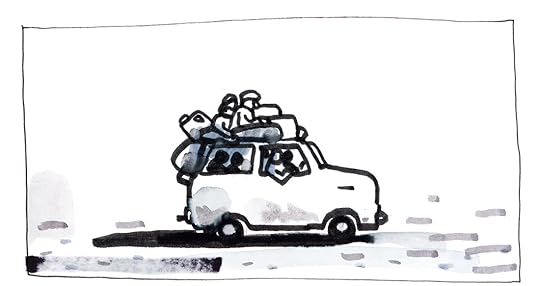
Alpha begins to make his way north, using the dangerous services of traffickers, drug-dealers and other criminals, to cross border after African border, sometimes stopping for months, to earn enough money, to resume his trek to Morocco and beyond.
This is another strong, immigrant/migrant story, done in illustrated form, showing the hardships and hazards of making these perilous journeys, hoping for a brighter future, in a different locale. The artwork is simple, but perfectly executed.
**A perfect companion piece to The Girl Who Smiled Beads.

October 8, 2017
SUCH. AN. IMPORTANT. BOOK.
The story follows Alpha from the Ivory Coast who is travelling to meet his family (who left before him) at Gare du Nord to begin his new life. This graphic novel covers human trafficking, inhumane refugee camps and the real struggle that many people are facing the world over. The illustrations are unique, and are drawn in such a way that they help to give a human face to the suffering that is happening all over the world. I think this book would work really well in the older years, and might be a nice book to put in the hands of some children to read alone. They will have thousands of questions about it, I'm sure, but I honestly think you can't underestimate the importance of giving children information about what is happening in the world.
The story follows Alpha from the Ivory Coast who is travelling to meet his family (who left before him) at Gare du Nord to begin his new life. This graphic novel covers human trafficking, inhumane refugee camps and the real struggle that many people are facing the world over. The illustrations are unique, and are drawn in such a way that they help to give a human face to the suffering that is happening all over the world. I think this book would work really well in the older years, and might be a nice book to put in the hands of some children to read alone. They will have thousands of questions about it, I'm sure, but I honestly think you can't underestimate the importance of giving children information about what is happening in the world.

January 4, 2019
This very personal tale of a man trying to leave Cote de'Ivorie is painful and, touching.
Can you even imagine not being able to leave your country ? Alpha can't get a Visa and leave to find his family in France mostly because he isn't white. He has to explore alternative (dangerous) means to travel. The illustrations are muted greys and browns with occasional splashes of bright color and fitting for the bleak scenes described. The marker like (or ink outlining gives drawings a bold and direct look. We meet fellow travelers - adventurers...though they are all fleeing a corrupt country. They include a woman who suggests she knows where Alpha's wife and child are, a man who wants to play professional soccer, and a lone child. The writer and illustrator make them quite real.
Can you even imagine not being able to leave your country ? Alpha can't get a Visa and leave to find his family in France mostly because he isn't white. He has to explore alternative (dangerous) means to travel. The illustrations are muted greys and browns with occasional splashes of bright color and fitting for the bleak scenes described. The marker like (or ink outlining gives drawings a bold and direct look. We meet fellow travelers - adventurers...though they are all fleeing a corrupt country. They include a woman who suggests she knows where Alpha's wife and child are, a man who wants to play professional soccer, and a lone child. The writer and illustrator make them quite real.

January 11, 2017
This is a beautiful if stark volume - the story it tells, the style of Bessora's writing and especially Barroux's illustrations.
Alpha Coulibaly has sent his wife and child on ahead from Cote d'Ivoire to his sister-in-law near the Gare du Nord in Paris, and now he decides to join them, to become as he calls himself an 'adventurer. The various gruelling experiences of migrants like Alpha are by now sadly familiar to us, but that does not make the story less compelling or heart breaking. The combination of restlessness and extreme patience is astonishing.
Particularly telling is the brief account of what happens 'next'.
Alpha Coulibaly has sent his wife and child on ahead from Cote d'Ivoire to his sister-in-law near the Gare du Nord in Paris, and now he decides to join them, to become as he calls himself an 'adventurer. The various gruelling experiences of migrants like Alpha are by now sadly familiar to us, but that does not make the story less compelling or heart breaking. The combination of restlessness and extreme patience is astonishing.
Particularly telling is the brief account of what happens 'next'.
August 25, 2019
This book changed how I see some things. I honestly thought all the post apocalyptic books describing bands of people coming together were fanciful. That in apocalyptic chaos, it's every mans for himself. But I think I was wrong. I think sometimes we are up and sometimes we are down. Sometimes we have the necessary skill and sometimes we don’t. And forging bonds with others evens those things out. This book showed me how the prostitute with nothing to offer, is the only one capable of making money on a later leg of the journey.
This book also left me weeping, stunned by it's harsh and believable depiction of immigration.

September 3, 2018
I liked the idea of it but the art was terrible and the message of "open borders" was rather condescending. My friends on the left don't have any answers for the migrant crisis. They lecture us that we should open all the borders and welcome everyone with open arms. But how are we going to integrate millions of people? Where are those jobs going to magically come from? The solution is to go to the source and fix the failed states that are producing refugees. But then folks on the left whine about colonialism and imperialist aggression.

November 3, 2018
This is one of the most depressing books I have ever read. It follows the true story of migrants travelling to Europe, hoping for a better life. It is a shame that many African countries are so corrupt and many people so poorly educated that they choose to abandon everything and risk their lives. However, I liked the illustrations, whose style complemented the brutal, chaotic story itself.

February 14, 2019
A remarkable book. 18 months to traverse from Abidjan to Paris, a desperate journey full of people traffickers, refugee camps & overcrowded boats & cars that have seen better days. Loss & Hope & Hopelessness. A searing tale ..... Highly recommended as an education regards the life of a refugee
May 2, 2019
Oh my heart.

January 17, 2020
Graphic novel depicting sub-Saharan immigration to Europe as seen through the eyes of the titular Alpha. His family has connections to France; family fought for France in the world wars, relatives run a salon near the Gare Du Nord in Paris, and his wife and child have already set out. He doesn't know their fate & searches for them along his own journey up and down northern Africa. He ends up joining with a few folks for most of the way, but their fates vary from his own. If you've never read up on this, or experienced something similar, I'm sure this is a good eye-opener about the horrible conditions & the perseverance it takes to take any of the steps, let alone successfully reach a destination. If you need a lighter introduction to the topic, the illustrations and story describe things well enough without lingering on any given upsetting scenario. Very good real-life take on current events and the type of complex story behind all the headlines.

September 20, 2020
Alpha is a tale of several refugees from sub-Saharan Africa who are trying to cross into Europe. Alpha's wife and son have gone ahead of him, and as he travels, he searches for any sign of them. It's a bleak story, well-written and moving--but then for some reason, just as it's getting to an important moment, the illustrated first-person narrative portion of the book is over, and instead we get an epilogue that's a few third-person paragraphs. It read like an outline for what the rest of the story would have been if they'd bothered to write and illustrate it. Why did we only get 3/4 of a book? What happened?
I also didn't really care for a lot of the artwork. I went back and forth on this, because there were some places where the style really fit the overall story. But why was everyone's nose a featureless void? I don't know, but it was distracting. There were just a lot of strange choices made when it came to the execution of this book.
I also didn't really care for a lot of the artwork. I went back and forth on this, because there were some places where the style really fit the overall story. But why was everyone's nose a featureless void? I don't know, but it was distracting. There were just a lot of strange choices made when it came to the execution of this book.

January 14, 2023
Wow. So I had a few experiences last year that echoed in minor ways the kind of journey illustrated in this remarkable account of migrating from Africa to Europe. But for me it wasn’t nearly as difficult, and the stakes were considerably lower. So I can only imagine, and that’s what’s so valuable about this book, that it explains in simple terms just how harrowing it really is. A real eye opener.

May 12, 2021
Oof. Excellent way to bring awareness to something we don't think often enough about/know more about/turn a blind eye to. Targeted at young adults, but an important read for adults too.

October 22, 2021
It's hard to think of this story as fiction, it feels so real, yet I'm sure it's still sanitized for a western audience. Although I'm sure much research and interviewing went into this making this fiction as representative as possible while not scaring readers away. A trip that could take a day legally takes years illegally and the travelers never know whether they'll survive the day.
November 6, 2018
“I imagine Europe is beautiful, but very cold too. There isn’t dust like there is in Africa. The roads are in good condition. I’m sure it’s cleaner than where I come from. I think Europe is a good place to live.”
Originally published in French in 2014 “Alpha Abidjan - Gare du Nord” is the story of Alpha, a young man setting off from poverty ridden Cote d’Ivoire, to try and track down his wife and child, who left the country before him. He sets off in an overloaded Lada, with only one functioning headlight, and later in an old Volkswagen van with a broken ignition and this is just during the early stages of what turns out to be a long, drawn out saga for him.
“New arrivals every day, from Guinea, Nigeria, Cameroon…From all sorts of places-Africa is so huge. They need protection, and promises.”
Trapped between the stubborn walls of illegal extortionists and government bureaucracy, and that’s just in his own country, even when Alpha flees his own country, he still must avoid countless gun toting border guards and people smugglers. This is a bleak and torrid journey with elements of prostitution, betrayal, death and disappointment woven throughout.
“And the Europeans think they’re taking on all the misery in the world. If Patience’s sister wasn’t close to the Gare du Nord, I’d have preferred Australia. The thing is, we don’t choose where we’re born, or where we migrate to. We make do, we go where we can.”
The desperation and the bullet proof optimism of some of the people is quite something, like in the case of Antoine from Cameroon, whose family, pooled together all their money, in the belief that he could make it to Spain and play for Barcelona and then be able to help them escape too.
On one hand the art work seems to be done almost entirely in black felt tip, with the occasional, lighter colouring added here and there. What initially appears to be the work of a bored, juvenile scrawl, is actually a deceptively clever and powerful piece of art work. It is highly effective and it really does seem to work along the ‘less is more’ school of thought. I’ve read a number of graphic novels covering this subject and this is as potent and enjoyable as any of them. The choice of drawing style gives this a cold, stark and at times brutal feel and this is a really fine piece of work.
Originally published in French in 2014 “Alpha Abidjan - Gare du Nord” is the story of Alpha, a young man setting off from poverty ridden Cote d’Ivoire, to try and track down his wife and child, who left the country before him. He sets off in an overloaded Lada, with only one functioning headlight, and later in an old Volkswagen van with a broken ignition and this is just during the early stages of what turns out to be a long, drawn out saga for him.
“New arrivals every day, from Guinea, Nigeria, Cameroon…From all sorts of places-Africa is so huge. They need protection, and promises.”
Trapped between the stubborn walls of illegal extortionists and government bureaucracy, and that’s just in his own country, even when Alpha flees his own country, he still must avoid countless gun toting border guards and people smugglers. This is a bleak and torrid journey with elements of prostitution, betrayal, death and disappointment woven throughout.
“And the Europeans think they’re taking on all the misery in the world. If Patience’s sister wasn’t close to the Gare du Nord, I’d have preferred Australia. The thing is, we don’t choose where we’re born, or where we migrate to. We make do, we go where we can.”
The desperation and the bullet proof optimism of some of the people is quite something, like in the case of Antoine from Cameroon, whose family, pooled together all their money, in the belief that he could make it to Spain and play for Barcelona and then be able to help them escape too.
On one hand the art work seems to be done almost entirely in black felt tip, with the occasional, lighter colouring added here and there. What initially appears to be the work of a bored, juvenile scrawl, is actually a deceptively clever and powerful piece of art work. It is highly effective and it really does seem to work along the ‘less is more’ school of thought. I’ve read a number of graphic novels covering this subject and this is as potent and enjoyable as any of them. The choice of drawing style gives this a cold, stark and at times brutal feel and this is a really fine piece of work.
Displaying 1 - 30 of 109 reviews