A dizzying tale of lust, mystery, and murder—from a beloved Japanese crime fiction author and LGBT iconThe Lady Killer leads a double life in Tokyo's shadowy underworld. By day, he is a devoted husband and hard worker; by night, he cruises cabaret bars and nightclubs in search of lonely single women to seduce.But now the hunter is being hunted, and in his wake lies a trail of gruesome murders. Who is the culprit? The answer lies tangled in a web of clues—and to find it, he must accept that nothing is what it seems. The Lady Killer pulls from author Masako Togawa’s vibrant personal life as a cabaret performer for Tokyo’s gay nightclub scene during the ‘50s and ‘60s. Throughout her writing career, Togawa continued to champion the LGBT community as a queer woman—sealing her reputation as one of Japan’s most prominent crime fiction authors and LGBT heroines.
Masako Togawa (戸川昌子) was a Japanese novelist, Chanson singer-songwriter, actress, feminist, LGBTQ+ activist, former night club owner, metropolitan city planning panelist and music educator. She was born in Tokyo, in 1933.
Masako Towaga began writing in 1961, backstage, between her stage appearances, and her first work The Master Key was published a year later, in 1962, for which she was awarded the prestigious Edogawa Rampo Prize. The story is set in the same apartment she grew up in with her mother. Her second novel, The Lady Killer, followed in 1963, becoming a bestseller. It was adapted for both TV and film, and nominated for the Naoki Prize.
She wrote more than thirty novels and was one of the most popular mystery writers in Japan, with many of her stories based on her own life experience.
A good story, almost pulp fiction, when you consider it was originally published in 1963. A married man works out-of-town and only comes home on weekends. He has little interest in his wife and family. Instead he lives for his weekly pick-up at the out-of-town bar. Suddenly all the women he has recently had sex with are being murdered and he’s being hunted by the police as the perpetrator. Of course he’s being framed. And of course, the person framing him is not the person that all the evidence points to.
I’ve read enough Japanese mystery novels to see a pattern. Whomever the evidence points to is definitely NOT the killer. And, you never get lost in the plot! These novelists love to give great detail about the where and when and what happened next and, just in case you missed something, the status of the plot so far is reviewed frequently. Ring by Koji Suzuki and Kiss of Fire, also by Togawa, a female novelist, are examples.
A fun, quick read with a lot of local color of urban Japan in the 1960’s.
I really enjoyed this, which is an odd thing to say about a Murder-mystery, which follows the deaths of several young women; and certainly I would not have read this book if it had been written by a man, but Masako Togawa is a woman. She was born in Tokyo in 1931 and died in 2016. The Lady Killer, her second novel, was published in 1963.
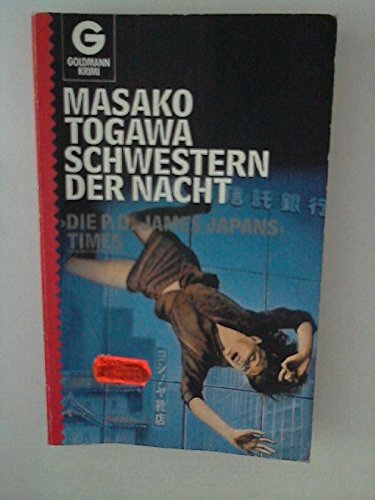
"Sisters of the Night" - a German publication of The Lady Killer.
The short biography on the back-flap of my copy reads:
Masako Togawa was born in Tokyo in 1933. After leaving high school, she worked as a typist, then made her professional debut as a nightclub singer at the age of twenty-three. Between acts, she started to write backstage, and at the age of twenty-four published The Master Key, which was awarded the prestigious Edogawa Ranpo Prize. Her next novel, The Lady Killer, was a best seller, and established her as one of the most popular novelists in Japan. Critics have compared her to both Muriel Spark and P.D. James.
On beginning the story, I noticed that Togawa uses a format which I had just encountered in Donna Tartt's The Secret History - Prologue, Part one, Part two and Epilogue, but Togawa uses this structure to much better effect in her story.
Togawa's novel opens with a young woman, driven to suicide some six-months after a one-night seduction. The Prologue also includes a flash-back of her meeting in a bar. The young woman, hears a man singing in a deep voice, one of the songs from Schumann's Zigeunerliedchen and she joins in. She is lonely, and depressed, and the song feels like a moment of heaven in her dreary life.
Togawa moves swiftly to Part One, 'The Hunter', which follows a woman who is looking for the man who sang in Bar Boi. We understand very quickly that this woman is on a mission, and we conclude that she is out to avenge her sister's death - and so like Tartt's novel we know who is dead and when the bodies start to turn up, we also have a fairly accurate idea of who has killed and why - and yet Togawa's novel has quite a different level of suspense.
As we proceed through Part One, we are switched into the perspective of Ichiro Honda, the man who likes to hunt down women for sex, but we are also filled in on his backstory. His wife lives apart from him in Osaka with her wealthy father and he only sees her at the weekends, flying to and from Tokyo. When he is not working as a financial consultant, he has his evenings free, to pursue women in the hidden alleys and secret dens of the city; we have a glimpse into the night-life, the bars and cafes and cheap restaurants of Tokyo.
Each of the three sections in Part one is labelled with the title of the three murders and eventually Ichiro Honda, through the papers learns that the murdered women are the same women he has previously courted and slept with. By the end of Part One, we have a mystery. Honda begins to believe that he must in someway be responsible for their deaths, and yet he has no actual recall of harming any of them, and in addition, on the date of each death, he is already with another woman, having spent the evening and night with her. As the reader, we put the clues together and have a good inkling of what is happening.
We continue with Part two, which switches to the perspective of Honda's appeal lawyer, because Honda has been arrested and accused of the murders. Takanato, however, is an astute old lawyer and uses logic to pick holes in the case put together by the police. Takanato with the help of Shinji, a younger lawyer, in the practice carries out detailed interviews and uses a detective agency to collect information.
As I read through this section, I started to feel restless and I kept thinking - 'it's obvious, so obvious, they need to go to the police station where the first victim was investigated, etc . . . ' And then right at the end of part two, almost at the close of the whole book, there is a twist that took me by complete surprise. And that is why Togawa's book is a 5 star read.
The Epilogue confirms the conclusions reached by the old lawyer, but it is also the most eerie and distressing part of the whole.
As I read, I kept asking myself, why would a woman chose this subject of a man preying upon women? Part One could be read as the author exacting her revenge on the promiscuity of a man. But in Part Two the narration switches so that our author appears to be in sympathy with Honda - his clever lawyers pulling out all the stops to prove his innocence? And then finally, I thought: 'this isn't about Honda at all'. This story is really about all those lonely women, in dead-end jobs who don't have a future, unless they are rescued by a man; but it is also about a wealthy woman who is also dependent on a man for her happiness. It's not possible for her either to imagine or try to find an alternative life.
Ichiro Honda, like many people, keeps a journal. Like many of those people, he would be quite embarrassed if anyone actually read his journal. Unlike some people though, his “Hunter’s Journal” is really just a list of sexual conquests. You see he lives in Tokyo, flying to Osaka only on the weekends to visit his wife. Every night in Tokyo he reinvents himself; he becomes a reporter, or someone who works in film, or a foreigner who barely speaks Japanese, whatever will get him close enough to his new target. He is the lady killer of the title.
Or is he? As one night after his latest victory, he hears that the previous girl has been found murdered. Then it happens again, and again. It seems like far worse things could come from his journal being found…
This was a solid little noir. I can’t say that is was great, but it was an enjoyable enough read. I never felt like putting it down at any point. It shines best in my opinion when it deals with the nature of guilt, and I don’t mean a guilty conscience. It discusses the nature of guilt in terms of a court of law and guilt of morals... and how one’s perspective of the second can influence the first.
My main complains against the book mostly come in during the second half, as we get a drastic shift in the focus of the story. The second half is far more investigation, which while interesting, follows a very repetitive pattern, that I felt wore out its welcome after a bit. Again, not enough to ever really make me want to quit, but enough that I wished we would move on a bit.
I must also say that honestly this is a very “modern” feeling book, with its frank depictions of sexuality (in multiple fashions) and the way it flows. If it wasn’t for the lack of smart phones and various other gadgets, one might be quite surprised to hear that it’s over 50 years old.
In closing: I feel like this is way too short of a review, but I honestly just don’t have much to say. The book is entertaining, but not really that noteworthy in my mind. It succeeded in what it sets out to do, but it feels like there was more potential to it that it never quite reaches. 3/5 stars and a recommendation to fans of Japanese pulp just looking for a fun time killer.
An extraordinarily chilly tale, set in Japan in the 1960s. Honda is a married man who makes a hobby out of seducing women. He's very much a predator--gets them drunk, lies about his identity, insistent advances--and he really sucks as a human being. However, when someone takes exception to his behaviour and decides to do something about it, the course they choose is to murder three of his conquests and frame him for the killings. Mate.
It's all about the raging miserable misogyny of the time and place, the sexual double standards, the misery caused in multiple directions by rigid cultural expectations and gender roles. (I have often considered how many mystery novels would have gone unwritten if everywhere had easy divorce.) There's an interesting trip to a Tokyo gay bar/brothel, although with pretty homophobic language at least as translated. (NB that the author was both a woman and a gay icon in Japan.) Everyone is awful and everything is grey. It's bleak, basically, though good.
Δεν κυκλοφορούν και πολλά αστυνομικά μυθιστορήματα Ιαπώνων συγγραφέων στα ελληνικά, πόσο μάλλον αστυνομικά νουάρ της δεκαετίας του '60. Αυτό παίζει να είναι και το μοναδικό! Αφού το είχα στο "περίμενε" για πάνω από επτά χρόνια (αγορασμένο με δυο ευρώ από κάποιο παλαιοβιβλιοπωλείο!), είπα να το διαβάσω τώρα που είχα όρεξη για ένα παλπ θριλεράκι που να μην είναι γραμμένο από Αγγλόφωνο συγγραφέα. Λοιπόν, πρόκειται για ένα πολύ καλογραμμένο και γεμάτο στιλ αστυνομικό θρίλερ, με μυστήριο και φόνους σεξουαλικής φύσεως, η ατμόσφαιρα του οποίου δεν έχει να ζηλέψει και πολλά από τα Αμερικάνικα ή τα Ευρωπαϊκά νουάρ της δεκαετίας του '60. Η εξέλιξη της πλοκής είναι αρκετά στρωτή και έως έναν βαθμό αναμενόμενη, όμως για έναν περίεργο λόγο κατάφερε να με κρατήσει στην τσίτα από την πρώτη κιόλας σελίδα, με το τέλος να κρύβει μια αρκετά ενδιαφέρουσα έκπληξη. Η γραφή της Τογκάουα είναι πολύ καλή, με τις περιγραφές της να δημιουργούν μια κάπως σκοτεινή ατμόσφαιρα και να καταφέρνουν με χαρακτηριστική άνεση να με μεταφέρουν στο Τόκιο της δεκαετίας του '60, δίνοντας μου την ευκαιρία να πάρω μια εικόνα από την Ιαπωνική αστική ζωή εκείνης της εποχής. Μπορεί σαν αστυνομικό μυθιστόρημα (ή, τέλος πάντων, σαν μυθιστόρημα μυστηρίου) να μην είναι κάτι το φοβερό και το τρομερό, όμως αν μη τι άλλο είναι αρκούντως ενδιαφέρον και ψυχαγωγικό, με εξαιρετική ατμόσφαιρα.
The Lady Killer finds and seduces women in bars and nightclubs. His targets are usually beautiful .. and lonely. For the most part, these women are one night stands. He is a master at disguise. He is also married to a woman he can no longer bear to look at. His forays into the nightlife of Tokyo is what he lives for.
When a woman he 'dated' jumps to her death it makes the news. He barely remembers her name. What the news didn't report was that she was 6 months pregnant. When investigated, they put manner of death as a suicide. But was it?
There are more women he has been with ... One by one they are murdered .. strangled and left to be easily found.
Did he black out and kill them? All the evidence points directly to him ....
This is a well written and translated crime fiction. The Lady Killer is a stand out character. The story line is a good one and easy to follow as the reader is privy to the Killer's thoughts and actions. There are twists and turns and an ending that was not only explosive, but a huge surprise.
THE LADY KILLER was first published in Japanese in 1963. The first English translation was published in 1986. Masako Togawa (1931-2016) was born in Tokyo. She died in 2016 at the age of 83.
Many thanks to Pushkin Vertigo / Netgalley / Edelweiss for the digital copy of this crime fiction. Opinions expressed here are unbiased and entirely my own.
Atmospheric tale that never really quite got going for me. My immediate reaction was style over substance but to be fair it was damn fine style. I finished it mostly because of the sense of place and character the author brought to it rather than any real desire to know the outcome. A good book for sure but not quite my thing in the end.
A married man was on a ‘hunt’ for lonely women in the nights of Tokyo, he slept with them and then put them down on his ‘Hunter’s Log’ like trophies, but then the women of these encounters started dying left and right.
My thoughts:
(1) So the man is basically getting the women very drunk and then taking them somewhere else to have sex. Man, that is pretty immoral although he seemingly isn’t breaking any laws. *sighs*
(2) A 19 years old young woman committed suicide six months after she spent the night with the man, is her sister seeking revenge?
(3) It is a pages-turner and it’s easy to read. The novel was first published in the 1960s and the story seriously didn’t age very well, the technology that was used to ‘catch’ the killer looks really outdated although it honestly is not the author’s fault and I am not holding it against her.
(4) However, I guessed who the killer really is in the middle of the story so this murder mystery isn’t so difficult for me, plus I feel all the characters, aside from the titled ‘Lady Killer' guy himself, are pretty lacking in depth and personality even for a crime and mystery novel. So 3.5 stars only.
(5) Still, I like how the author explained how the killer manipulated people to do their bidding that part is really nice!
El joven ingeniero Ichiro Honda se considera así mismo un “cazador”, y es que dedica su tiempo libre a cazar mujeres, a conquistarlas, a seducirlas, con el único objetivo de satisfacer sus impulsos sexuales. Ichiro vive una doble vida, ya que mientras que en Tokio deja salir a la bestia, en Osaka está casado y disfruta de una acomodada vida familiar. Sin embargo, un día, una de esas mujeres a las que sedujo aparece muerta, y este suceso será el principio de su tormento. Parece que alguien sigue sus pasos muy de cerca, alguien que acecha en las sombras esperando el momento oportuno para dar el golpe definitivo.
“Lady Killer” es un thriller de venganza que me ha gustado muchísimo. Me ha parecido adictivo de principio a fin, he devorado cada página, cada capítulo, siempre deseoso de saber que pasaría después. Pese a que no aporta elementos especialmente novedosos (aunque pudiera resultarlo en su época), sí que consigue no resultar típica, ni refrito de otras cosas. Es de esas historias donde es más interesante el cómo y el porqué, que el quién, algo que encuentro mucho en los thrillers japoneses, y me resulta muy interesante.
La novela es del 63, y fue un éxito de ventas en su día, cosa que me ha sorprendido bastante ya que trata temas como la sexualidad, desde el punto de vista perverso, pero también desde el placer, y no solo la sexualidad masculina, sino también la femenina. Y todo esto lo hace sin tabués, sin que aparezcan comentarios reprobatorios y castos que criminalicen esto. Incluso aparecen personajes homosexuales que no reciben un rechazo normalizado, algo no tan habitual en la literatura asiática, y menos en obras publicadas hace sesenta años.
La autora tiene un rollo muy oscuro, muy perverso, que me ha conquistado desde las primeras páginas. Ese retrato que hace de los más bajos instintos del ser humano, como el trauma o la represión hacen capaz al ser humano de las mayores atrocidades. Masako es una autora que consigue crear muy bien a este tipo de personajes y dotarlos de autenticidad, por lo tanto crea un extraño magnetismo en el lector que por un lado desea saber más de esos personajes y por otro se siente espantado por lo que le transmiten.
La única pega que le pongo, por lo cual no se lleva las cinco estrellas, es que el final me ha dejado un regusto agridulce, de esos finales de los que no termino de saber que pensar. Por una parte me ha gustado, por otra no. No consigo decidir si me pesa más lo que sí, o lo que no, o sí quizás necesito reflexionar un poco más al respecto. No lo sé, pero en cualquier caso, no ha deslucido mi impresión sobre este thriller que da mucho que pensar, y sobre una autora de la que ya quiero leer todo lo que pueda.
Me resulta increíble que la autora no sea más conocida y solo se tradujeran tres de sus muchas novelas al español, actualmente descatalogadas, eso sí. “Lady Killer” me recordó al “La chica de Kyushu” de Seicho Matsumoto por su tono y por su forma a la hora de desarrollar la trama, aunque Masako Togawa me parece mucho más rompedora que Matsumoto, debo añadir. El tiene ahora mismo cuatro novelas publicadas y disponibles en español, a ver si conseguimos lo mismo con ella. Si la encontráis de segunda mano, no lo dudéis y dadle una oportunidad, tiene mucho que aportar.
Originally published in 1963 in Japan, The Lady Killer is an intriguing pulp mystery that is heavy on its dark foreboding atmosphere. It's the early swinging sixties in Tokyo and one man is determined to have it all, the Don Juan of Tokyo's nightclubs who assumes a different character each night, sweeping single women off their feet. Of course, that's during the work week, not when he flies home and to Osaka to be with his wife for whom he has lost all attraction. When he's in Tokyo, he thinks about being the hunter and hunting his prey. That all changed when his prey start dying, falling from buildings, being strangled, and more, and, of course, all the evidence including blood and semen point to our Don Juan. Is he Jack the Ripper too? Or is someone setting him up? Part one is his point of view. Part two is the legal investigation.
Thanks to Pushkin Vertigo for providing a copy for review.
You wouldn't really know this was published in 1963 but for the lack of smart phones and the reliance of characters on reading the afternoon editions of newspapers... what I mean is this is a thoroughly modern whodunnit set in Tokyo. I'm quite in awe of what Togawa was able to do with this psychological thriller/whodunnit, in some ways even better than her debut The Master Key (my review here: https://www.goodreads.com/review/show...). Sure, there is a puzzle element to the plot, but she was able to pull off a decent twist while still allowing the reader to enter into the minds of the believable characters, including our philandering anti-hero. Great stuff.
Download my starter library for free here - http://eepurl.com/bFkt0X - and receive my monthly newsletter with book recommendations galore for the Japanophile, crime-fiction-lover in all of us.
My copy of this book was published by Pushkin Press, which was founded in 1997 and "publishes novels, essays, memoirs...everything from timeless classics to the urgent and contemporary," choosing books from around the world. Pushkin Vertigo is the division that specializes in suspense and thrillers. This particular book published by Pushkin Vertigo was written in 1963 and takes place at that period in time. It is, mind you, the time before DNA testing so forensics was more rudimentary, a point that becomes pivotal in the resolution of this case.
And what is the case? Well, the main character is Ichiro Honda, a husband and gainfully-employed professional who has a secret life. His wife is tucked away in Osaka and he lives in Tokyo, with weekend visits to see her. During the week, however, he is the Hunter, who goes out looking for vulnerable women to seduce. He's successful at this and even keeps a journal of his conquests.
However, when three of the women he has seduced end up murdered, we have the question of who did it. Is Ichiro a murderer in addition to being a callous Don Juan? There's a lot of evidence to incriminate him, in particular his very rare blood type, AB negative.
The 222-page mystery is divided into two parts: The Hunter and Collecting the Evidence. In the first part we see things mainly from Ichiro Honda's POV. In the second part, after Honda has been arrested for the murders, lawyer Hajime Shinji takes over the story, as he, believing Honda to be innocent, investigates the crimes and tries to find mitigating circumstances for the the incriminating evidence against him.
I found this to be a compelling read. Until the last chapters, I was convinced of the whodunit, only to find the story supplying an interesting twist. This book is 55 years old but, except for the lack of DNA to help with investigations, does not feel too old-fashioned. The author, Masako Togawa (1931-2016), was a popular mystery writer of the time and appears to have been a very interesting woman. She is described as "a singer, actress, feminist, nightclub owner and gay icon."
Bellissimo! Un giallo strutturato benissimo con personaggi ben definiti, un movente credibile ed una costruzione perfetta. La prima parte è molto descrittiva e consegna a chi legge tutti gli elementi e gli indizi per capire, nella seconda parte le ipotesi e la soluzione spingono ad un ritmo frenetico portando ad una soluzione inizialmente ovvia fino a rimescolare le carte con un finale sconvolgente. Assolutamente consigliatissimo.
Very good. Another fine Japanese crime novelist to come back into vogue — and one with quite a story of her own! I would, however, have preferred a different type of ending. Hence the lost star.
Our titular lady killer (figuratively speaking of course) is a particularly unsavory character. Now, I've got nothing against your garden variety lovers and lotharios - I even find them fascinating. But if your target are the dejected, the sad, and the lonely, then it's only a matter of time before you corner a prey whose perfunctory rejection would lead them to suicide.
He's a full-fledged narcissist - he sees women as nothing more than objects for a night (or at most two) of his pleasure and doen't care one whit about their feelings as soon as he's done with them. There's no tenderness or even empathy here - he listens to their woes but only so he'd be able to devise the right words to say to lure them to bed. He only ever regards them as a score, a mere entry in his "hunter's journal" which he can read anytime he needs an ego massage. This is wham-bam-thank you-ma'am in its coldest, most predatory sense.
If it was only a matter of lechery then maybe it would have been excusable. But he doesn't even care to use adequate protection - in one year he's sired at least two illegitimate kids of which he knew nothing until the mother of one of them offs herself. When he learns this by chance, he expresses nothing but the shallowest regret, certainly not enough to at the very least change his ways. He doesn't care about the consequences of his actions - why should he? - so when the full brunt of his iniquities came down to bear upon him, he was caught by surprise. Because of his hubris, he never stood a chance.
Thing is, while one would love to savor his eventual comeuppance, this is not the ideal way to get this, not by a long stretch. For one, I don't think anyone can abet the murder of innocent women just to frame the bastard. Two, capital punishment is a legal penalty in Japan and no matter how despicable he is, his sins still don't warrant his death.
Now it's all up to his legal defense team to find a way to extricate him from the real killer's web. And oh what a fine little spider we have here. I shan't say what kind though or I'll give the game away.
"At the very least my husband deserves to die for the murder of that innocent woman. For husband and wife are one, are they not? So it really doesn’t matter if he, my better half, goes to the gallows in my place." kinda giggled when i read this. (3.5)
Die Übersetzung aus dem Englischen statt dem Japanischen ist nicht so gut geglückt wie bei "Der Hauptschlüssel", und es gibt einen großen Zufall, der eine wichtige Rolle spielt. Abgesehen davon ein hervorragender Kriminalroman, bei dem kaum zu begreifen ist, dass er über 60 Jahre alt ist.
3.75 ⭐️ Not your conventional crime thriller. And you kind of know who it is all along the way. The book is more like a contemporary fiction, than of the crime genre.
An artful, old fashioned murder mystery which merrily leads its investigators (and the reader) along a convoluted pathway scattered with clues. Even the title is a masterful play on words, open to several interpretations… more than one of which may be correct.
The Lady Killer isn’t as outright bizarre as more modern Japanese crime fiction, but is still imbued with cultural idiosyncrasies and social conventions which make it a distinctly different reading experience to the average mainstream thriller.
The story is told almost exclusively from a male perspective, initially from that of the womaniser who escapes his unhappy marriage by hunting female ‘prey’ in the big city. When his lovers are found strangled, the rest of the investigation is unveiled by his lawyer’s assistant who’s been tasked with proving the client’s innocence. That might be tricky because the evidence against him is compelling…
The predatory adulterer who stalks, seduces and discards vulnerable women makes for an uncomfortable protagonist – but does being a despicable sexual slimeball automatically condemn him as a cold-blooded murderer?
The Lady Killer was also ahead of its time in terms of forensic police investigation, and incorporates early insights into the identification of a suspect from blood and other samples, long before DNA typing became commonplace.
Presented in fairly plain language, this story is deceptively straightforward – until the moment that it obviously isn’t and you realise just how cleverly you’ve been misled. 8/10
I have remarked in other reviews when a book has happened at just the right time. Unfortunately, this wasn't one of them. I struggled with the first 30 pages or so, taking what seemed like forever to plow through them. So why didn't I set it aside? Because I've read this author before and expected something greater than this very pedestrian opening.
I won't pretend this is a book for everyone. The book opens with a lonely young woman in a Tokyo bar being drawn to a man who sings beautifully. They sing a duet. Too much alcohol follows and the expected happens. Six months later the woman, now six months pregnant, throws herself out of a 7th story window. The newspaper accounts leave out that she was pregnant, but the police tell her older sister.
What follows is a trail of murder of women who have been seduced by the same man. Everything seems obvious, does it not? As in the case with other mysteries that seem obvious, it would do well to be skeptical. I was not. I should have reminded myself that a writer at the top of her form would try to pull the wool over my eyes.
I would happily read this author again. Despite the slow start and my remarks about about it, Togawa pulls off a very good psychological novel. I'll find the 4th star, but perhaps a tad reluctantly.
Masako Togawa is known as the PD James of Japan. Her novel The Lady Killer could have just as easily been written today with the isolation, uncertainty, and its dark twists. It opens with the one night stand of a 19-year old woman and a wealthy musician that she meets in a bar. After the young woman falls from a building 6 months later, we learn about her life and the family that she leaves behind.
As we read about the man that she met and his proclivities - he keeps a journal of his sexual escapades - we also find that he is being followed by bad luck. The women that he meets begin to die and he is taken into police custody, but it takes some time before we learn who has been killing and why.
Masako Togawa delivers an engrossing detective mystery set in Tokyo.
I kind of regret wasting my time to read this. This was actually pretty good but I've grown to be familiarized with the plot structure and the execution of the narrative. To be fair, this novel is definitely older as opposed to other prominent Japanese crime fiction and the idea might be fresh at the time. However, I just didn't feel particularly taken by the characters, the writing, and the story.
The read is a bit dry as in black and white scenarios as opposed to colorful dialogues and descriptions. For that alone I would have rated it 3 stars, but when it all comes out in the wash at the end, I have to bump it up a star for pure ingeniousness. Especially considering that it was written and published in the 1960's, it must have been quite unique for its time. I still think it holds up as I would have never guessed the ending and when it comes to mysteries, I admire all that surprise me in the end!
I was sure I'd figured out the perp, but I should have known! This mystery first published in 1962 offers glimpses of now-vanished Tokyo scenes its era: a coffee shop in the evening, filled with men dressed in geta (wooden "clogs") and summer cotton kimono, all on their way home from the public baths; wandering violinists playing music on request at bars; a woman who earns her livelihood as a keypunch operator, and so on. A delightful read.
Giving this an average 3.5 stars. I like the concept, the deviousness and the reveal of the plan meticulously showed the nature of the crime yet it felt dragged for a bit
Un libro che è stata una piacevole scoperta! Prima opera che leggo di questa autrice e ho apprezzato il suo stile di scrittura, veramente scorrevole! La trama poi si è rivelata intrigante e io sono cascato in pieno nel tranello messo in atto da Togawa Masako! Certo, alcune cose sono un po' tirate per esigenze di trama, ma nulla sopra a cui non si possa soprassedere! Libro davvero consigliato, una lettura coinvolgente che tratta temi importanti (soprattutto per l'epoca). Non fatevelo scappare