Jump to ratings and reviews
Rate this book

Venture to the Interior

Rate this book
Combines a spiritual odyssey with the author's account of his dangerous journey--part of a British fact-finding mission--through two little-known regions of British Central Africa in 1949

253 pages, Paperback

First published January 1, 1952

12 people are currently reading
293 people want to read

About the author

Laurens van der Post

78 books165 followers
Sir Laurens Jan van der Post was a 20th Century South African Afrikaner author of many books, farmer, war hero, political adviser to British heads of government, close friend of Prince Charles, godfather of Prince William, educator, journalist, humanitarian, philosopher, explorer, and conservationist.

Ratings & Reviews

What do you think?
Rate this book

Friends & Following

Create a free account to discover what your friends think of this book!

Community Reviews

5 stars
92 (29%)
4 stars
104 (33%)
3 stars
86 (27%)
2 stars
24 (7%)
1 star
6 (1%)
Displaying 1 - 30 of 43 reviews
Profile Image for Daren.
1,576 reviews4,575 followers
May 31, 2022
This is one of van der Post's earliest books, and to me it felt like he was scared of leaving something out.
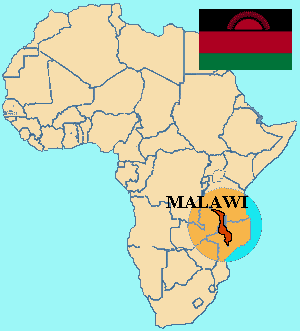
It is the story of his travelling to Nyasaland (now Malawi) to investigate two tracts of land -
One was a huge, rugged mountain mass in he extreme south of the Protectorate; the other a large plateau abruptly and precipitously set from eight to nine thousand feet above the lakes and planes of the extreme north of the territory.
However, in reading the first hundred pages of this book, you would more think this is a collection of every internal thought the man had between accepting the task, and setting foot on the mountain. First we are told he will not burden us with a family history, then sets about to provide 17 pages of his family history, pausing in the middle to confirm he is sharing only the bare essentials necessary to understand his attachment to Africa. Then he describes not only his series of flights from London to Blantyre, but describes each conversation or interaction, and shares snippets of memories and past experiences of the places they stop in transit or even fly over. The vast majority of this is inane and lacked relevance to me, and I was pretty close to marking this off a a DNF. For a journey of 72 hours, LvdP was almost bang on a page an hour.

However, after around 100 pages, after his arrival in Nyasaland the story starts to take some form. He makes his introductions to all the administrators and the like; makes his plans for the first of his investigative journeys, and finally sets off.

Mlanje or the Mulanje Massif as it is now known, is worth a google to see what LvdP was in for. Accompanied by Quillan and Vance, forestry officers familiar with the area, but who have never circumambulated the mountain. They are also accompanied, of course by 20 bearers and some personal assistants. The journey itself is interesting enough, but unfortunately LvdP begins this section of the book by preempting an unfortunate accident at the end. He shares with the reader some sort of premonition, then for every major decision made on the journey he makes some form of statement to disclaim himself from it - this may be fair enough to point out but he hardly endears him to the reader, who knows full well the author can frame the story any way he feels leaves him in the best light.
The balance of this section of the book deals with the aftermath of the tragic accident.

The second tract of land is referred to in the book as Nyika, or the Nyika Plateau (now a National Park). After organising his trip from the south to the north, LvdP again plans his expedition, this time accompanied by Michael Dowler, the Government Veterinary Officer. Michael's assistants and 40 bearers form the balance of the party. This journey takes something a little less than a month, and covers a large area of the plateau. Much of the expedition narrative is broken up by a POW story (unclear what relevance, other than LvdP woke up in a depressed mood, and didn't know why, and later realised it was an anniversary of a relevant date of his internment under the Japanese in Indonesia); a chapter long discourse about the psychology of African drumming; and a dream LvdP has. Strangely in the last chapter, the story just peters out:
With this dream, my journey in Africa really ends. It is true I spent another three weeks on that lovely plateau, but there is nothing new to say of it.
He wraps up the end of the journey quickly, and offers not further mention of his report or closure of his investigation.

I found this a very unusual and disjointed book - one I would struggle really to recommend. Perhaps just those interested in LvdP's writing in general, although he is considered an unreliable source by some, accused of embellishing his war record and many of his expeditions.

2.5 stars, which I can't justify rounding up to 3. I have read five other LvdP books, all three or four stars. This one - by some distance is the one I least enjoyed.

2 stars.
Profile Image for Diane in Australia.
739 reviews16 followers
June 23, 2019
Okay, my very first Laurens van der Post book, and I found it to be just 'okay'. This was first published in 1952 and, therefore, is dated, but I'm fine with that. I read a lot of older books. I just didn't find it to be a real page-turner, and his philosophising wasn't all that interesting to me. It was nice to read about the beauty of an unspoiled, uninhabited section of Africa. The rest of it, not so much.

3 Stars = It was 'okay'.
144 reviews2 followers
February 1, 2015
I was not far into the first part of this book when I started to feel suspicious. Laurens provides some context for his adventure in the form of family history, and what do you know? It's exciting on both sides. Maybe it's just the jealousy of someone whose pedigree can best be described as "peasants on both sides, all the way back" but this struck me as...possibly exaggerated. So I turned to trusty Google.

Perhaps it's ignorance, but I'd never heard of Laurens van der Post before picking up this book. And as it turns out, the controversy surrounding this man is almost more interesting than the book itself. It's possible that he lied about or exaggerated many of his experiences. His account of his family history on his father's side is one of the areas in which he may not have been entirely truthful.

Aside from his questionable honesty, it's not disputed that he treated women awfully. He had multiple affairs, abandoned his first wife and children, and took advantage of a 14 year old girl who was entrusted to his care, fathering a child with her and ruining her budding career as a dancer. Far from the wise and good man he portrays himself as in his writing.

After the questionable family history, almost 100 pages of the book are occupied by his travel by aeroplane from England to Nyasaland (modern day Malawi). More specifically, they are occupied by his crotchety-old-man-complaining about this newfangled means of travel. It's a common problem in books from this era, air travel being so new that the author must spend many pages in excited wonderment or grouchy longing for the good old days of slow travel, each of which tend to confound the modern reader to whom it's simply a normal part of travel.

If you can make your way through the tiresome air travel section, the narrative picks up from there and the book will become much more pleasant to read. Laurens, along with two white companions and an excessive amount of native bearers, explores mountain of Mlanje with its unique ecosystem and unpredictable weather. Here the tell-tale signs of untruth once again rear their head - Laurens in his great wisdom is able to pre-cognitively predict disaster and like Cassandra warns his companions against all mistakes, but alas! They don't listen. Disaster strikes but it is definitely super in no way saintly Laurens's fault!

After Mlanje, Laurens moves on to the Nyika plateau in the north of Nyasaland. Some of his descriptions of the scenery and wildlife are very beautiful and evocative.

The philosophical aspect which is supposed to be a big part of this book fell a bit flat with me. A lot of the philosophical asides seemed frankly nonsensical to me - they sounded deep on the surface but on examination it was impossible to figure out what Laurens was trying to say. One part that was clear, was that Laurens calls for peace and understanding between races, while in the same breath sexualising black people and romanticising their primitive, dark natures. Since the last book I read by a South African from this era was much more virulently racist, I guess Laurens gets a teensy tiny point for being a slightly less ridiculously racist?

To conclude, the latter 200 pages of this book are entertaining, if perhaps not strictly factual. The main value I got from this book was a little more understanding of the history and geography of Africa.
Profile Image for Katja Willemsen.
Author 5 books16 followers
August 29, 2012
Colonial and written in a clunky style of the times, I nevertheless loved this book. Van der Post has been accused of elaborating/ expanding/ inventing (depends on the critic) his memories, but I didn't care. He was an adventurer, fascinated by cultural differences, and even if his attitude is occasionally superior, the stories he tells are rich, and deeply personal.
Profile Image for Nicoletta.
12 reviews1 follower
July 27, 2020
CAPTIVATING HEARTFELT HONESTY & COURAGE!

Van Der Post ventures into unknown territory in Africa on multiple long and difficult journey’s.
I felt a part of his thoughts and heart every step of the way and his reflections are so heartfelt and emotional, his work takes the readers on a roller coaster of emotions.

His passion and love for Africa are conveyed so deeply and thoughtfully in his words and ideas in his books, and I genuinely feel lucky to feel like I am on his journeys and experience the wonder yet struggles of his adventures. He always finds ways to overcome the hardships and manages to see the light in every dark situation.

I really do recommend reading this book and any of his incredible stories whether they are fiction or his own experiences they are all equally unique and beautiful to read!
Profile Image for Cathy.
27 reviews
February 18, 2011
Another one the my stupid grammar school gave us to read and study. I was about 14 and understood nothing. It did me no good at all at the time.
I remember my headmaster suggesting that I read The Cruel Sea by Nicholas Monsarrat, or The Kontiki Expedition by Thor Heyerdahl.

I began reading these in my mid-twenties and found Kontiki brilliant. I could never have read it earlier. I believe there's a right time to read a book, and don't buy the kids something that's far too old for them. You'll ruin it for them.

Another lecture - but hopefully useful.
Profile Image for Susan Armstrong.
8 reviews1 follower
April 14, 2016
This remains one of my favourite books by one of my favourite authors. On the surface this book is about a true, post WWII adventure and exploration -- philosopher Sir Laurens van der Post's incredible and dramatic journey into the interior of Africa to survey certain areas for the colonial British government. However as always with van der Post's writing his meaning is deeper and is woven so beautifuly throughout the text. As the title eludes, this is a bold and grand venture into the interior of our human selves.

In the Preface he sets up this venture when he refers to 'an unresolved conflict between two fundamental elements in my make-up; conscious and unconscious, male and female, masculine and feminine...On one side, under the heading "Africa", I would group unconscious, female, feminine, mother; and under "Europe" on the other: conscious, male, masculine, father'. And further in the text he states for example: 'For this unreality starts in an incomplete awareness of ourselves... out of this dark gorge... between the two halves of ourselves, out of this division between the Europe and the Africa in us, unreality rises up to overwhelm us... The human being... is strangled in his own lack of self-awareness.' And again, ''The problem is ours; it is in us, in our split and divided hearts... We hate the native in ourselves; we scorn and despise the night in which we have our being ...before we can close our split natures we must forgive ourselves. We must, we must forgive our European selves for what we have done to the Africa within us.'

This is a highly-recommended prophetic book prompting much-needed reflection on our human condition; that we do indeed all suffer from this split personality and that a deeper awareness of it is critical to our future. In terms of a solution, van der Post laments in the book '...could there be... some magic somewhere, some medicine that could redeem all?' In other words can our split natures be reconciled?? Is there something out there that can reconcile these depressingly dividied 'African' and 'European' selves? Unbelievably, there is. An Australian biologist -- who himself frequently draws upon the work of Sir Laurens van der Post, including 'Venture To the Interior' -- Jeremy Griffith has produced a biological explanation of the human condition that does just that. Our human condition is logically explained in first principle terms and the outcome is truly wonderous and transforming for the entire human race. A breakthrough of monumental significance.
Profile Image for Bettie.
9,976 reviews5 followers
March 6, 2014


Dedication:
To Ingaret Giffard
in order to defeat the latest
of many separations.


Part I THE JOURNEY IN TIME starts off by a snippet from Sir Thomas Browne:

"We carry with us the wonders
we seek without us: there is all
Africa and her prodigies in us"


Opening: Africa is my Mother's country.


Read more on Malawi here: http://fhsbandawe.org.uk/travel-log-b...

From wiki_ The Nyika Plateau lies in northern Malawi, with a small portion in north eastern Zambia. Most of it lies at elevations of 2100 to 2200 m, the highest point being 2605m at Nganda Peak. It is roughly a diamond in shape, with a long north-south axis of about 90 km, and an east-west axis of about 50 km. It towers above Lake Malawi (elevation 475 m), and the towns of Livingstonia and Chilumba. Its well-defined north-west escarpment rises about 700 m above the north-eastern extremity of the Luangwa Valley, and its similarly prominent south-east escarpment rises about 1000 m above the South Rukuru River valley.

It is known for its wildlife, including Burchell's Zebra, many birds and endemic butterflies, chameleons, frogs and toads, and also for its orchids. All of the plateau is protected, by Malawi's large Nyika National Park and the much smaller Nyika National Park, Zambia. The only settlement on the plateau is Chelinda, the headquarters and accommodation site for the Malawian park.
Profile Image for Stephen Hayes.
Author 6 books135 followers
June 6, 2016
It is 50 years since I read this book, so I am reliant on my diary for what I thought. It was quite a thought-provoking book. When I read it, I had been in Britain for four months, I was living in digs in Streatham in South London, and driving buses for London Transport, and feeling homesick for South Africa, and rather alienated in Britain. That was why i bought the book and read it, and that coloured my attitude to the book.

It provoked two thoughts in me: first, that Laurens van der Post, though born in Africa, wrote about Africa like a European. That annoyed me, particularly because of my own circumstances at the time. Secondly, he wrote about forgiveness in a way that may have been reflected in the Truth and Reconciliation Commission in South Africa thirty years later.

So this is what I wrote in my diary on 6 June 1966:

I read more of Venture to the interior and came to the conclusion that van der Post is above all things a European. He may have been born in Africa, but to him Europe is home. He writes about and sees Africa through European eyes. Alan Paton is one South African writer I know who writes as an African, as a non-European. There may be others, but I haven't read them. Much of what van der Post says is true, though, particularly about air travel. There is something about an international airport that is unlocated, almost like the in-between land of pools in The magician's nephew. It is neither here nor there. It is not a part of the world at all. A strange unreality pervades it, and an atmosphere that both attracts and repels. One is no longer located in time and space. One is not anywhere, but everywhere is a possibility. The possibilities are exciting. It is a sort of cocoon transitional stage, only here, you feel, can you make the choice. I am nowhere - where shall I be? London? Nairobi? New York? Karachi? Paris? Entebbe? Johannesburg? Rome? Salisbury? All are possibilities.

It bugs me, this European outlook, the assumption of European superiority. Even he, born in Africa, writes in terms of England as if England is the almighty bloody absolute from which everything
else in the world is to be judged. It is understandable in an Englishman, who must describe new things in terms of what he already knows, but not in someone brought up on a Free State farm.

He writes very well at times, but I can't help feeling that he is a traitor to the land of his birth. He has become an Englishman. And what is this England, this soft land, where the corners of everything are rubbed off? Where so many things are blurred and ill-defined? The climate and geography are strange to me.

I have just been through an English spring, but it is completely different to spring back home. England in spring is like a great fat lazy cow chewing over the cud. It is not, as in South Africa, a sudden awakening. A fanfare of wattle blossoms to announce its arrival in August. Then silence.

Then spring, when in a few weeks of September everything turns green. The azaleas and bougainvillias flower. The winter brown turns to summer green, and again there is silence for a space, and then a fanfare of jacarandas to announce that the process is completed -- summer is here.

Not so in England. There is a blurring of the edges, a shading over from winter to summer. No
grand dramatic displays and flourishes, but a little bit here, a little bit there. First this turns green, then that. One plant flowers, then another. Bushes blossom while the trees are still all dead. It is a much slower process, an unfolding, like a movie lap dissolve done very slowly, the new picture slowly emerging out of the old. In South Africa it is like a changing of lantern slides -- one disappears and the other takes its place. Both are beautiful, but I think I still prefer ours.

6 Jun 1966 - Van der Post on forgiveness

One thing that struck me in the first couple of chapters was his father's forgiving the British after the Boer War.

It has always been one of the more frightening ironies of Afrikaner life that people like my father, who with Smuts and Botha had fought and actually suffered in the war, could forgive and begin anew, whereas others, alive today, who were never in the heart of the conflict, can still find it so hard to forgive an injury that was not even done to them, and how can there be any real beginning without forgiveness?

I noticed something similar in my experience with war crimes officers, who had neither suffered internment under the Japanese, nor even fought against them. They were more revengeful and bitter about our sufferings and our treatment than we were ourselves. I have so often noticed that the suffering which is most difficult, if not impossible to forgive, is unreal, imagined suffering. There is no power on earth like imagination, and the worst, most obstinate grievances are imagined ones.

This seems to touch on the core of a rather big question of human behaviour, One is that we so often find it easier to forgive those who injure us than those who injure others; and this imagination business. Reading about life in Nazi Germany conjures up all sorts of horrors, but they are imaginary horrors, I have never experienced them. In South Africa there are probably the same horrors, but one gets used to them. This is why so many people emphatically deny that South Africa is a police state, because it does not fit their mental image of a police state. But Germans probably felt the same 30 years ago.

I seem to recollect Trevor Huddleston in his book Naught for your
comfort
saying how much harder it was to forgive things done to other people, because one can only imagine how they feel. And ]those who questioned] the value of Liberal Party rural meetings, because you know that you go to encourage them in the face of SB intimidation, but by going you only encourage the SB to step up their campaign of intimidation. But it is a selfish martyrdom attitude -- a sort of "I alone can bear the suffering" kick. But they too must bear their share of suffering -- we are not the ones to deny it to them. It is their privilege as members of God's kingdom.


Profile Image for Nicholas Beck.
377 reviews12 followers
November 2, 2021
Laurens wanders around Africa, more specifically Nyasaland (modern day Malawi) for no particular purpose it seems other than the British Government has sent him to reconnoitre the areas. Well he crafted a book out of it which is a fascinating window into the colonial mentality of the 50's.

We are only a few years after WW2 really and Laurens philosophy as regards black Africans veers from extremely progressive to standard colonial racist attitudes and points in between. His descriptions of the African countryside are magnificent, perhaps the strongest part of this travelogue even as he positions himself as an ersatz Livingstone striding across unexplored mountain ranges (with plenty of locals helping carry supplies of course) and a dollop of Jungian philosophising about the duality of life. (Biographically Laurens van der Post lived this duality to the full. For the sordid details read his biography).

I read this before I read his biography. This is also gives an excellent insight into Laurens van der Post, the man and the myth. https://www.jstor.org/stable/3557423
Profile Image for Jason Prodoehl.
242 reviews5 followers
April 10, 2022
Another thoughtful, beautiful book by Laurens van der Post. There is a great deal of detail in this book (a full page on what he purchased to prepare for his expedition to Mlanje, Nyika plateau in Nyasaland in Eastern Africa. All I can say is, his detail and thoughtfulness are all a part of this introspective, and beautiful work. If you have patience in reading him, you are rewarded with some gems in his philosophy and beautiful soul. I'm going to share a particularly moving passage for me in the book.
(from page 160 in the edition I read): "The world to my mind has never been fuller of finer thinking than it is today. I never pick up a paper, magazine, or book, be they in Japanese, French, Javanese, Russian, English, or Twi, and fail to be struck by the fine thoughts, the idealistic feelings, the noble sentiments they express. Yet, though all the contributing writers appear to be merchants of man's finest feelings, has there ever been an age that, considering its lights, has done worse things than this one, with its class hatreds, race hatreds, colour prejudices, world wars, and concentration camps? Has there been another age that, knowing so clearly the right things to do, has so consistently done the wrong ones?"
Though this book was published in 1952, it seems just as relevant today.


Another passage that touched me:
"...we have come dangerously late to this new awareness. We do not understand that we cannot do to others what we do not do to ourselves...But before we can close our split natures we must forgive ourselves.... All begins with forgiveness. Even the spring is a re-beginning because it is sheer, utter forgiveness and redemption of the winter and its murder of leaves.”
Profile Image for Adrian Fingleton.
428 reviews10 followers
February 5, 2019
I know this book is extremely dated, and some of the views are mired in a time when racial equality was not a widespread concept. However it's written from the heart by an interesting man, and some of his philosophising is quite ahead of it's time, with a strong ecological theme running through it. Effectively the book boils down to two journeys into uncharted Nyasaland (later to become Malawi I think) and the author keeps the reader engaged all the way. He paints a picture of unspoiled lands, rich with game, and with an air of mystery due to the fact that he's effectively 'off the map'. I enjoyed the book - albeit the long, long air trip from London to his destination goes on way too long. Apart from that, very enjoyable.
1,149 reviews
December 31, 2021
I picked this off our bookshelf and wondered, “What country was Nyasaland?” Today it is Malawi. In 1952 Van der Post was sent there to survey lands for the British colonial government. To me, the book was more about Van der Post than it was about his trip there, with much too much philosophizing and of very little interest.
Profile Image for Sue Williams.
43 reviews3 followers
November 18, 2020
I enjoyed this book as both an adventure and as a glimpse into a certain period of history. It's well written, and it's important to remember it's a memoir - it's his account of his time in the area, his thoughts, and his philosophies on life and the world. I enjoyed this look into the past.
Profile Image for Samuel.
124 reviews
Read
June 7, 2024
An empathetic and philosophical account, without really any of the gung-ho travel adventurism. Certainly the phrasing is of its time, but the sentiment is far more open-minded than might be expected twenty years before.
Profile Image for Caroline.
Author 3 books11 followers
Read
April 24, 2011
The most boring and soporific of the textbooks I had to read for the GCE -- a view shared by almost everyone in my class.
Profile Image for Peer.
305 reviews1 follower
February 12, 2017
Read half of it. Couldn't get over the complacent writing style. The story is too much focused on the writer himself. Maybe nice for his family. But I'm no family...
164 reviews
August 11, 2021
Is it possible to form an accurate impression of this book without having at least some idea of the author’s backstory?

He is variously described as a fantasist and a war hero, a womanizer and a gentleman. An early environmentalist and a political supporter of big business establishment.

There is no doubt that his service in WW2 and time in Japanese POW camps, form a genuine foundation for his reputation.

His commitment to environmental causes later in life led to a great many positive outcomes, and he was genuinely on the right side of history in terms of apartheid.

On the other hand, he clearly behaved disgracefully in his dealings with a 14 year old girl in his care.

It is difficult to resist the comparison between Van Der Post’s life and that of a modern social media influencer. There are clear similarities in the carefully curated image, the questionable connection to reality, the slavish attempts to cling to higher level celebrities.

So - an autobiographical account of a voyage to the dark heart of Africa written by a social media influencer? Buckle up!

I found Venture to the Interior to be like the curate’s egg - good in parts. The descriptions of life in colonial Africa are beautifully done, and the authors knowledge of and love for the countryside are obvious.

There is at times a somewhat mawkish expression of sympathy for the African ‘bearers’, no doubt a function of the times, and forgivable to an extent given our knowledge of the author’s subsequent work in the field of racial equality, particularly with respect to the people of the Kalahari.

At the same time there is an unquestioned acceptance of the dominance and superiority of the European settlers and the social structures that keep them separate from and above the local people. There is also a degree of what feels like forced naïveté about the behavior of several of the European remittance men that he encounters - one of these characters goes on to be prosecuted for child abuse in later life back in the UK.

The high points of the story for me are the descriptions of African landscape and the Jungian self-explorations of the subconscious of the author and his motivations. He was clearly troubled by his experiences during the war, and approaches his ‘ventures’ more as ways of dealing with these issues more than actual physical undertakings. Many of his insights during these internal ventures are profound, insightful and painfully relevant to the modern reader.

Well worth the time, with sentiments that haven’t dated and historical insights that are illuminating as they are painful.


Profile Image for David Burns.
446 reviews5 followers
May 18, 2023
"HE was a spellbinding storyteller, a figure of mesmerizing charm. The South African-born writer Sir Laurens van der Post, who died in 1996 at 90, sold millions of copies of his novels and nonfiction books, including ''The Lost World of the Kalahari,'' about the plight of the South African Bushmen, which became a popular BBC television series.

Van der Post was a Jungian mystic and a spiritual adviser to Prince Charles; according to British newspapers, he taught the prince to talk to his plants. In 1982 Charles made him godfather to his heir, Prince William. Van der Post was also a close friend of Prime Minister Margaret Thatcher, exerting an influence on her policy in South Africa.

He had a following in the United States as well. For several years, he gave the Advent sermon at the Cathedral of St. John the Divine in New York. The year he died, he attended a celebration of his work in Boulder, Colo., and 4,000 people came.

But according to a new biography, Teller of Many Tales: The Lives of Laurens van der Post by the British journalist J. D. F. Jones, published here last month by Carroll & Graf, van der Post was a fraud who deceived people about everything from the amount of time he actually spent with the Bushmen to his military record during World War II. His claim that he had brokered the settlement in the Rhodesian civil war was a lie as was his insistence that he was a close friend of Jung's, Mr. Jones says."

https://www.nytimes.com/2002/08/03/bo...

Venture to the Interior ** Read in Blantyre, Malawi (before and after hiking Mulanje mountain - the setting of this book) ** (April 2023)

Read more about the controversial writer who lived a colorful, and many say partly fabricated, life of adventure:

https://www.theguardian.com/world/200...
Profile Image for Joshua Green.
148 reviews2 followers
August 31, 2020
The first thing I've read by van der Post. I really enjoy his style of mixing travelogue with just enough philosophizing. He pauses regularly, but not for too long, to reflect on various things along the way, and points in his own life, often breaking chronology for the sake of making points or drawing connections.

The book follows his journey to and through Malawi (then the British protectorate of Nyasaland) on a surveying mission. The author is so mum on the point or details of his mission, though, they the reader barely knows why he is traveling, but that isn't a criticism as this isn't the point of the book.

Van der Post makes some insightful observations on his own wartime / prisoner-of-war PTSD (although, of course, he doesn't call it that) throughout, and there are some engaging character sketches and evocative descriptions of the vanished time and distant places he moves through. I enjoyed the book until the end, but couldn't help but think the author's writing skills were going somewhat to waste on this relatively minor journey. What I mean is, the author makes many allusions to other events in his life throughout which suggest to me that the period documented in this book is one of the least interesting portions of his life (his early life growing up in Africa, and particularly his WW2 military service and imprisonment all sound far more interesting). So, I hope that his more deliberately autobiographical 'Yet Being Someone Other' or 'Walk with a White Bushman' might see him using his talented memoir style to its fullest effect. Nice workmanlike edition by The Hogarth Press.
Profile Image for Erik Empson.
506 reviews13 followers
October 3, 2025
I do like the fluidity of this author's style. This book is about two expeditions in Malawi, both involving some serious trekking up mountains. Mlanje and the Nyika plateau.
Quite slow to get going and pretty self-involved. Clearly Venture to the Interior refers as much to author's exploration of self as to his journey into the heart of Africa.
The mindset is very much a colonial one, although there is considerably complexity to his view, and there is considerable othering going on. Van der Post's claim is in that in Africa we have the potential to encounter the "dark" "native" brooding inner self that has been suppressed in the West. It is quite poetic and at times touching. He dwells a fair amount on a terrible incident that saw the death of a companion during a storm, and there is a feeling of a need to absolve himself of guilt in his role in the events that led up to it.
Really a 3.5 stars as this is really readable but not a 4 because it idles some.
Profile Image for John Ellis.
18 reviews1 follower
April 21, 2021
The years have not been kind to the memory of Laurens van der Post. He was decidedly not the man he told us he was. “Venture to the Interior”, the book that made him, has not aged well. It’s the product of the kind of Empire man who is hopefully long since passed: deeply racist, condescending and colonial in all the worst ways. I was promised the story of a man whose outward adventure leads to some inner discovery, but all that really happens is: white man does a bit of low-energy exploiting, makes the Africans carry all his luggage, and goes home to make up tall tales about it. Van Der Post may have ventured ‘to’ the interior, but he never truly went ‘in’. In the 21st century, “Venture to the Interior” is an ugly relic of a decidedly ugly chapter in Africa’s tragic history.
Profile Image for Mark Thuell.
110 reviews5 followers
July 24, 2023
I enjoyed this book despite its slight oddness. Wonderful descriptions of the land and it’s peoples, an interesting story of discovery and hardship.
The author spends too much time in his own head philosophising about I don’t know what. Racism I think which is a bit rich since he was sent by the imperial government to see if the land could be further exploited.
His love of Africa certainly came across though.
Profile Image for Liz Wager.
232 reviews8 followers
June 14, 2017
I read this on a trip to Malawi but I'm afraid it only served to remind me that van der Post is not my favourite travel writer. I enjoy his descriptions (and it was interesting to read about Blantyre in the 1940s when I was there) but I can't take his pompous philosophising ...
Profile Image for Geir Ertzgaard.
284 reviews15 followers
March 2, 2020
Dyp respekt og en underliggende rasisme i en magisk og merkelig bok med en magnetisk tiltrekningskraft og framføringsevne. En bok som må leses som et tidsvitne fra et 50-tall som enda ikke har klart å distansere seg fra kolonitiden. Kryptisk, som min egen anmeldelse.
648 reviews2 followers
January 13, 2021
van der Post is not a congenial guide to Africa. His at times striking descriptions are frequently marred by dull philosophising and mythologising. Crushing lack of humour.
107 reviews2 followers
July 22, 2023
Good writing and easy read but the last few chapters a bit airy, but alright.
Displaying 1 - 30 of 43 reviews

Can't find what you're looking for?

Get help and learn more about the design.