“Weinbaum, Bir Mars Destanı'yla birlikte sempatik uzaylıyı icat etti. Bilimkurgu onunla birlikte bağnazlıktan uzaklaştı.” –Ursula K. Le Guin
“Bilimkurgu alanında klişelerden kurtulup özgün hikâyeler üretebilen tek yazar. Büyük bir hayranıyım.” –H. P. Lovecraft
“Weinbaum, var olmak için kendi sebeplerine sahip dünyadışılar yaratan ilk yazar.” –Isaac Asimov
“Stanley G. Weinbaum, kısacık kariyerinde bilimkurguda bir devrim gerçekleştirdi. Biz de hâlâ onun bize kazandırdığı temaları keşfediyoruz.” –Poul Anderson
“Stanley G. Weinbaum, modern bilimkurgunun kurucularından biri olarak Wells ve Heinlein'la anılmayı hak ediyor.” –Frederik Pohl
Asimov'un deyişiyle bilimkurgunun üç büyük novasından biri olan Stanley G. Weinbaum, bir buçuk yıllık yazarlık kariyerine ve trajik ölümüne rağmen erken dönem Altın Çağ'ın en başarılı yazarlarından biri. Hem ilk hem de en önemli öyküsü “Bir Mars Destanı” da bilimkurguyu kökten değiştiren ve uzaylı algısında devrim yapan gerçek bir klasik.
Yakın gelecekte insanlık Mars'a sefere çıkar ve mürettebatın asi üyesi Dick Jarvis'in başından beklenmedik bir olay geçer: Mars'ta yepyeni bir ırkla tanışır; devekuşu benzeri Tviil'le. Ancak Mars'taki tek hayat formu Tviil değildir. Onun yardımıyla Jarvis, “Bir Mars Destanı” ve devam öyküsü “Hayaller Vadisi”nde Mars'ın diğer mucizeleriyle de karşılaşacaktır.
Bu iki klasik öyküye ek olarak Weinbaum'un yarattığı bir diğer çarpıcı karakter olan Profesör Manderpootz'un yer aldığı “Eğer Dünyaları” ve “İdeal”in yanı sıra ters giden bir bilimsel deneyi anlatan “Uyumun Doruğu”, uzaylı ekolojilerine yoğunlaşan saykedelik öykü “Üşütük Ay” ve sanal gerçekliği işleyen ilk öykülerden “Pygmalion'un Gözlüğü” de bu derlemede kendine yer buluyor.
Bir Mars Destanı, modern bilimkurgunun ilk adımları.
"In his short career, Stanley G. Weinbaum revolutionized science fiction. We are still exploring the themes he gave us." —Poul Anderson
"Stanley G. Weinbaum's name deserves to rank with those of Wells and Heinlein—and no more than a handful of others—as among the great shapers of modern science fiction." —Frederik Pohl
As a short story, the narrative is weak: one man’s trek across part of Mars, but because you know from the start that he’s telling it when reunited with his crewmates, you know he survives (and even that comes about by deus ex machina). So I adjusted my expectations to an exotic travelogue, without any major surprises. I was wrong.
There’s little science or tech. Instead, it’s primarily about the variety of Martian life he encounters. And what variety! That’s what makes this special.
It was published in 1934, and widely praised by Isaac Asimov and others. Apparently, before this, aliens were not portrayed in such detail and variety, let alone non-carbon-based lifeforms with lives, inner lives, and culture of their own.
Look, don’t touch?
After Jarvis’ rocket crashed, he walked across a desert towards the base. He crossed a dried-up canal, and ploughed through walking grass. “Up to that time, you know, I hadn't seen anything worth worrying about on this half-dead world - nothing dangerous, that is.” And then he noticed an ostrich-like creature being attacked by a tentacled one. He wasn’t going to intervene - until he spotted that the victim had some sort of manufactured bag hanging from its neck. Ergo, it was intelligent.
Image: Jarvis and Tweel, surrounded by bubbles (Source)
Buddy road trip
They make presumed friendly gestures, try to communicate (like Robinson Crusoe and Man Friday?), and travel on. “Tweel” is the nearest approximation of the being’s name that Jarvis can pronounce.
“We could exchange ideas up to a certain point, and then blooey! Something in us was different, unrelated; I don't doubt that Tweel thought me just as screwy as I thought him. Our minds simply looked at the world from different viewpoints, and perhaps his viewpoint is as true as ours.”
Language continues to be a challenge: “He seemed terrifically amused that the same word meant the same thing twice in succession, or that the same word could apply to two different objects.” So they switch to simple arithmetic.
Wonders
“But suddenly things came drifting along from the Xanthus cliffs - small, transparent spheres, for all the world like glass tennis balls! But light - they were almost light enough to float even in this thin air - empty, too; at least, I cracked open a couple and nothing came out but a bad smell.”
They encounter strangeness (to Jarvis), beauty, and peril. The eventual connections between some of the very different life forms are interesting. The pyramids and their creators are especially notable.
“There was a line of little pyramids - tiny ones, not more than six inches high, stretching across Xanthus as far as I could see! Little buildings made of pygmy bricks, they were, hollow inside and truncated, or at least broken at the top and empty… Man, we trailed that line for hours! After a while, I noticed another queer thing: they were getting larger. Same number of bricks in each one, but the bricks were larger.”
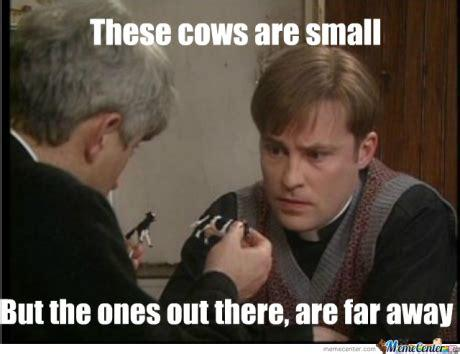
I thought of Father Ted: Image: “These [model] cows are small but the ones out there are far away.” Father Ted explaining perspective to Father Dougal (Source) But the Martian pyramids really were getting larger.
What qualifies as “life”?
This is a story of exploration and possible colonisation. Questions about what constitutes life, especially intelligent life, run through it. Consciousness, of course. But is it essential that they breathe (and if so, what?) and reproduce (does parthenogenesis count?)? Can there be life from what we think of as inert substances?
See also
• Weinbaum’s imagination is impressive, and coupled with the general compassion of his protagonist and the multinational crew, I expect it’s a partial inspiration for Becky Chambers’ To Be Taught, If Fortunate, which I reviewed HERE.
• The journey may have inspired that of Mark Watney in Andy Weir’s The Martian, which I reviewed HERE.
• For a linguistic slant on trying to communicate with aliens, see Ted Chiang’s The Story of your Life (filmed as “Arrival”), which I reviewed HERE.
• The comedy sit-com, Red Dwarf, is a personal favourite. There’s a precursor of Polymorph in this story.
Stanley Grauman Weinbaum is a well-known sci-fi writer who died too young, too soon for us to know if he would have been one of the "greats". He was born on April 4, 1902 and died on December 14, 1935. A MARTIAN ODYSSEY was his first published story, appearing in the July 1934 edition of Wonder magazine. It was well received by readers and critics. Earlier, John W. Campbell had issued a challenge to writers: "Write me a creature who thinks as well as a man, or better than a man, but not like a man ." Many feel that Weinbaum met that challenge in A MARTIAN ODYSSEY. He.wrote more short stories and a few novels, but died from lung cancer less than a year and a half after this story was published.
This story was written when the possibility of intelligent life on Mars was still seriously considered. Weinbaum wrote within the scope of the science of his day. Many of the odd things which the explorers encounter on Mars were at least prototyped in other serious sci-fi. And those things are decidedly odd. Some would not be out of place in ALICE IN WONDERLAND.
Some will see traces of the thinking of colonialism in this story. Maybe so, but I look at it as the ages old thinking of the conqueror: You've got it, we want it, we can take it, so we will. This has been and still is the way of most of the world. You shouldn't let it or the Mars setting prevent you from enjoying A MARTIAN ODYSSEY.
An astronaut on Mars got separated from his crew members after he wrecked his rocket and has to take a long and perilous walk back to safety and his mother-ship.
If this sounds familiar and reminds you of The Martian, you’re not mistaken. There are indeed quite a few similarities between the two stories, and I wonder if Andy Weir took some inspiration from Weinbaum’s work.
Stanley G. Weinbaum’s short story first got published in 1934 in a science fiction magazine called Wonder Stories. Although it has some pulpish elements to it I have to say that I was pleasently suprised by the depth of the characters. There are five of them (four humans, one alien) and each develops his own traits on the rather limited space of only thirty pages. The most interesting one, apart from the main protagonist Jarvis (the “Mark Watney” of the story), was the alien named Tweel. You have to imagine him as some sort of intelligent ostrich. Opinions differ on how intelligent he actually is. He only learned six or seven words of human language, but can express a great deal with this limited vocabulary. Jarvis and Tweel soon become sort of friends: “[…] it was just that we were somehow mysteriously different—our minds were alien to each other. And yet—we liked each other!"
But there are also some odd creatures, the antagonists if you will, whose mantra, “We are v-r-r-riends!”, is better not believed. Considerung the year of publication, it seems quite obvious to me that with these so-called mud-creatures the bad Germans, the Nazis, are characterized. Interestingly enough there is also a good German among the ship’s crew, the engineer Putz, who is talking in the typical German accent.
Weinbaum’s writing is very efficient and I would like to read more of his stories. Too bad he died so young (one and a half years after this story was published; at the age of 33). At least there is a sequel to this one, called Valley of Dreams which I’m now eager to read it.
Wonderful to read an 84-year-old SFnal representation of *truly* alien consciousnesses, explicitly made to be so by the author. It was hokey to have a Mars setting, but 84 years ago not quite as hokey as it would be today.
Tweel's character is a hoot. I would love to meet this boop-snoot! And there's a twist at the end of the story that sums up humanity and colonialism right tidily. *sigh*
I loved this book! It may be in part due to the fact that the last two titles I finished kind of blew. Or maybe because I read it in a waiting room and it managed to make me laugh out loud. Not LOL, but for real, with sound, laughing out loud, in public, in an otherwise quiet place.
I made the mistake of reading a few bad reviews. This little tome was written in 1934 and when you keep that in mind as you read, it is so much more entertaining that it would be if written now. Our narrator is a pretty full of himself astronaut that has encountered other life on Mars. His telling of his adventures is just too funny. He explains the attempts at communication and empathy and actually makes a friend of sorts.
What's so funny is just how conceited and holier than thou our narrator and his listeners are. I could just hear Patrick Warburton as the astronaut. Actually, this would make a genius SNL skit!
Oh, my God. This story was disgusting. And I don't mean gross. I mean an abomination of a tale. I know, I know...it was written in the 1930s. But I don't feel inclined to give Weinbaum any slack for that. This story wasn't only poorly written, cocky, highly- and offensively-racist, it was an imperial and colonial orgasm in the worst pornographic way. The main character might as well have been Zapp Brannigan from Futurama, and his exploits with Martian aliens would have made early British colonials 'taming' the Congo look like present day UN model diplomats. This story has zero appeal for today's audiences, and is as dated as the abacus.
Yedi öyküden altısı çok güzeldi zevk alarak okudum sadece 'üşütük ay' öyküsünü sevemedim,bir mantığa oturtamadım. Özellikle 'eğer dünyaları' ve 'ideal' öykülerini çok sevdim çılgın bir ikiliydiler ama ikisininde finali beni birazcık üzdü :(
In general I do not mind "classic" SF. Although the current times may have overtaken their technology dreams, some of the concepts and questions are still valid (see Asimov's laws of robotic). This short story is addressing the different nature of alien life. Other than e.g. in Stanislaw Lem's Solaris it is done in a wild west like style, and the main character is of course American. He tells about his encounters with different lifeforms on Mars in a colloquial language, which is not appropriate to scientists in an international team. I had the same problem already with Andy Meir's "The Martian".
There are also some factual mistakes. While Weinbaum may not have known that the atmosphere of Mars in not breathable, he should be aware, though that the Earth seen from Mars (as in inner planet) can never be seen in the zenith.
The story is an easy, rather entertaining and short lecture. So I still gave it 2 stars. But I will not spend the effort to read (Valley Of Dreams), which apparently is a sequel to this story.
-Una buena ocasión para demostrar que las perspectivas cambian con el tiempo.-
Género. Relatos.
Lo que nos cuenta. Seis relatos del prematuramente malogrado y no demasiado conocido autor, mayoritariamente de Ciencia-Ficción y que tocan, entre otros temas, el extraño y peligroso ecosistema venusiano, las matemáticas para escapar de un loco homicida, una isla con criaturas extrañas, la exploración de Marte y una mujer con capacidades metahumanas. Relatos escritos entre 1934 y 1936, varios publicados de manera póstuma, y editados en diferentes antologías y recopilaciones a lo largo de los años.
¿Quiere saber más de este libro, sin spoilers? Visite:
The 5 stories here don't at first seem all that astonishing in the genre of Science Fiction: Trips to Mars & Venus, mad scientists creating mutants are staples of the genre and yet.... These were written between 1934-6. While they obviously spring-board from Homer, Wells and Burroughs, they are far more modern and grounded in reality, more in keeping with the likes of Bradbury. At the time these would have been truly groundbreaking.
The science is based in fact, and feels plausible. The aliens are neither humanoid nor tentacle monsters intent on conquest of Earth or mating with its women. The parade of creatures here are truly alien and given psychology and philosophy as our heroes try and understand and communicate with them.
I was also impressed with the strong role of women - In the Adaptive Ultimate (Filmed 4 times - She Devil, The Miraculous Serum, Kyra Zelas and Beyond Return) - Two scientists inject a woman with fruit-fly DNA and create a totally amoral 'goddess' who adapts to every situation like a chameleon. For a more positive role there's Pat the better half of the husband and wife team in The Lotus Eaters. She's strong, qualified and daring.
Considering these were written in the mid 1930's they are radical indeed and changed the face of science fiction into what we know it as today.
Bir Mars Destanı bir süredir kitaplığımda okunmayı bekliyordu. Normalde bilimkurgu klasiklerini çok bekletmeden okurum ama nedense bunu elime almam uzun sürdü. İçerisinde 7 bilimkurgu öyküsü bulunuyor. Bunların içerisinde birkaçı birbiriyle karakter ve olaylar açısından bağlantılı. H. G. Wells’i anımsatan bir kalemi var yazarın. Kurgusunda ufak da olsa bilimsel bağlantılar kurmaya ve mantıksal açıklamalar yapmaya çalışmış. Neredeyse bütün hikayeleri beğendim. İçlerinde 4 tanesi ön plana çıktı. Adını kitaba veren Bir Mars Destanı; Kurtuluş Projesini çok ufaktan hatırlatan hoş bir öyküydü. Uyumun Doruğu; hastalığa çare aramak derken üstün bir insan oluşturmanın sonuçlarını anlatıyordu. Pygmalion’un Gözlüğü; mitolojiye yaptığı atıflarla ve sanal gerçeklik benzeri bir icadı anlatmasıyla okuması keyifli bir hikayeydi. Eğer Dünyaları; çoklu evlenler düşüncesine farklı bir bakış içeriyordu. Çoğu hikayenin eğlenceli bir dili vardı. Ne yazık ki yazarlık kariyeri uzun sürmemiş. Asimov’un, Weinbaum hakkındaki yazısının önsöz olarak koyulması yazarın önemini gösteriyor. Bilimkurgunun altın çağının öncülerinden kabul ediliyormuş. Kitapta Mars’ta bir kratere yazarın adının verildiği de belirtilmiş. Kısacası benim okumaktan keyif aldığım bir kitap oldu.
ENGLISH: An interesting story about the first exploration of Mars. The explorers find many varied life forms, some completely incomprehensible to us, others partially understandable. This story demonstrates great imagination, although the description of Mars doesn't correspond to what we know about that planet today. But that wasn't known in 1934.
ESPAÑOL: Interesante cuento sobre la primera exploración de Marte. Los exploradores encuentran numerosas y variadas formas de vida, algunas de ellas totalmente incomprensibles para nosotros, otras parcialmente comprensibles. Este cuento demuestra gran imaginación, aunque la descripción de Marte no corresponde en absoluto a lo que hoy sabemos de ese planeta. Pero eso en 1934 no se sabía.
-Una buena ocasión para demostrar que las perspectivas cambian con el tiempo.-
Género. Relatos.
Lo que nos cuenta. Seis relatos del prematuramente malogrado y no demasiado conocido autor, mayoritariamente de Ciencia-Ficción y que tocan, entre otros temas, el extraño y peligroso ecosistema venusiano, las matemáticas para escapar de un loco homicida, una isla con criaturas extrañas, la exploración de Marte y una mujer con capacidades metahumanas. Relatos escritos entre 1934 y 1936, varios publicados de manera póstuma, y editados en diferentes antologías y recopilaciones a lo largo de los años.
¿Quiere saber más de este libro, sin spoilers? Visite:
gerçekten genç yaşta seni kaybettiğimiz için çok üzüldüm Stanley! keşke uzun ömürler yaşayıp bize bu öykülerin gibi mükemmel eserler okutma fırsatı sunsaydın. sen harika bir yazarsın! ve harika bir meslektaşsın ve bunun izlerini her bir satırda hissettirdiğin için mesleğime bir kez daha mutlulukla bağlandım.
8/10. Leído en 2006 Recopilación de los supuestos mejores cuentos de Weinbaum…y para mí la mayoría son MUY buenos, y mira que yo no soy nada forofo de los cuentos.
Think not what you can do for Mars, think only what Mars can do for you. (Sigh!) Yes, this is colonialist, imperialist and racist in equal measure, yet it's probably not fair to condemn it for that since it was Written in 1934 and is of its time. It would be cruel to review it through the lens of 2014 because it simply doesn't stand up.
A expedition to Mars which Weinbaum imagines as a dry desert with thin but breathable air and low gravity. It has plants and creatures consistent with the world and Weinbaum's imagination is not lacking. One of the expedition members is separated from the others and this is his recounted story about his (first contact) meeting with a sentient alien, an ostrich-like being, Tweel, who manages to learn half a dozen words of English and communicate quite complex concepts, but at the end of the encounter human and Martian are no closer to understanding each other than they were at the beginning. This is what lifts it to two stars in my opinion, because the rest of it, (the journey across Mars) is largely first-they-did-this and then-they-did-that. The interest lies in Jarvis and Tweel's attempts at communication.
Sadly there is no attempt to understand a third race which is quite benign until Jarvis steals the egg-like-thing which seems to be the focal point of their civilisation. Why? Because he can and because he believes it may be a powerful healing device. There's no concept of leaving well alone. No theft-is-wrong. No Prime Directive. Mars is there to pillage for whatever the humans can appropriate.
This is interesting only from a historical perspective. Available free from Project Gutenberg.
Stanley G. Weinbaum'u uzun zamandır merak ediyordum. Kendisi bilim kurgu dünyasına yön veren, kalıplaşmış uzaylı algısını bile değiştirmiş bir yazar. Yazarlık kariyeri de geç başlamış, kısa sürmüş. Ona rağmen ölümünden uzun zaman sonra bile ismini hala bilim kurgu alemlerinde duyabilmemiz mümkün.
"Bir Mars Destanı" kısa öykülerden oluşan bir bilim kurgu kitabı. Kitaba adını veren hikayemiz ise birbirine bağlı 2 hikayeden oluşuyor. Mars'ta geçen bu hikayede Weinbaum bize hayal gücünün aslında ne anlama geldiğini, bir sınırının olmadığını bize gösteriyor. Gerçekten okuması ve olayları kafada canlandırması oldukça keyifli bir şeyler ortaya çıkmış. Diğer hikayelerini de es geçmemek lazım. Çok farklı dallarda çağının ötesinde düşünceleri baz alarak çok güzel hikayeler yazmış Weinbaum. Özellikle sanal gerçeklik temalı öyküsü gerçekten beni çok şaşırttı.
-From The Science Fiction Hall of Fame, Volume One-
Wow! Not bad for a story written in the 1930s! A bit racist and has a scene that reminds me of Indiana Jones that propagates colonialism but that's okay!! He'd be so disappointed to know that his Mars was 1000x more interesting than the real one! And boy did he like exclamation points; I've never seen so many in one place!! The alien lifeforms were unique and inventive, particularly Twee who was similar to not annoying and actually funny Jar Jar Binks! The story is worth it for Twee alone!!
Surprisingly charming, with an unexpectedly funny main cast. Jarvis ragebaiting Harrison was prime comedy. The worldbuilding was quite impressive, and boasted a good range of different, very unique creatures
Don't trust the people who decry this story as "racist" or "imperialist". They either have not read the story and are just jumping on some kind of dumb bandwagon, or they have some sort of mental disorder that prevents reading comprehension.
I absolutely love this short story (and its sequel).
Yes, the science is woefully outdated, but that's not the point. It's still a fantastic, fanciful, journey across the Red Planet.
Where the story really shines is the interaction between the protagonist, Jarvis, and his Martian sidekick, and Weinbaum succeeds at making the alien a believable "alien mind", someone who is clearly intelligent, but who has trouble communicating with the human because of a lack of common cultural reference points. And yet, they manage to get along, even becoming friends. (See how dumb the "racism" claim is?)
I also liked the snarky interaction between Jarvis and the rest of the crew. There's not much of it, but I thought it worked really well.
This is, to me, an absolute must-read. It's an absolute shame Weinbaum died so young; I have no doubt he would have become one of the great names in SF otherwise.
Honestly, I am speechless as to how much I loved this book. Stanley Weinbaum has a fantastic imagination and my type of quirky since of humor. I laughed through the whole book! There were parts I literally had tears dripping off my face because I could not for the life of me stop laughing. The characters he told about were fascinating, and their inner workings so detailed that they seemed real. It's amazing how his words can paint such a beautifully detailed, incredibly funny, and exciting story. To me, this story was brilliant and inspiring.
Czy przeczytałem tę książkę głównie ze względu na to, że jest krótka, aby nadrobić Goodreads 2022 reading challenge? Być może, ale i tak była na mojej to-read liście. Sama książka - podobnie jak książki choćby H. G. Wellsa - ciekawa głównie dlatego, że pozwala nam dowiedzieć się jak ludzie z przeszłości myśleli o przyszłości. Poza tym nic specjalnego.
This was a short fun read – the story is of how two new friends, one human and one of Mars, address communication challenges as they try and get out of a tricky spot. It’s not until the end that we learn what put them in danger, and throughout the story makes subtle remarks on being human.