
What do you think?
Rate this book


Few creatures of horror have seized readers' imaginations and held them for so long as the anguished monster of Mary Shelley's Frankenstein. The story of Victor Frankenstein's terrible creation and the havoc it caused has enthralled generations of readers and inspired countless writers of horror and suspense. Considering the novel's enduring success, it is remarkable that it began merely as a whim of Lord Byron's.
About the Author:
Mary Wollstonecraft Godwin (1797–1851), daughter of political radical William Godwin and feminist writer Mary Wollstonecraft, grew up among the leading voices of the Romantic movement. She met and wed poet Percy Bysshe Shelley in 1816. When the Shelleys spent that summer on Lake Geneva with friends—among them, Lord Byron—Byron challenged the writers to a ghost-story contest. Mary Shelley’s sketch inspired her novel Frankenstein (1818), influenced by her loss of her infant daughter in 1815. Four years after Frankenstein’s publication, her husband drowned. The tragedy haunted Shelley for the rest of her life, which she dedicated to annotating her husband’s writing, publishing her own novels, and revising Frankenstein for republication.
246 pages, Kindle Edition
First published January 1, 1818


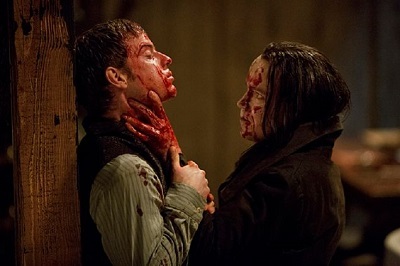

No one can conceive the variety of feelings which bore me onwards, like a hurricane, in the first enthusiasm of success. Life and death appeared to me ideal bounds, which I should first break through, and pour a torrent of light into our dark world. A new species would bless me as its creator and source; many happy and excellent natures would owe their being to me. No father could claim the gratitude of his child so completely as I should deserve theirs. Pursuing these reflections, I thought that if I could bestow animation upon lifeless matter, I might in process of time (although I now found it impossible) renew life where death had apparently devoted the body to corruption.As gorgeous as the prose is, I thought it a crime not to include at least one quote.




“I have love in me the likes of which you can scarcely imagine and rage the likes of which you would not believe. If I cannot satisfy the one, I will indulge the other.”
-From the 1994 movie
“...once I falsely hoped to meet the beings who, pardoning my outward form, would love me for the excellent qualities which I was capable of unfolding.”
‘I was dependent on none and related to none. The path of my departure was free, and there was none to lament my annihilation. My person was hideous and my stature gigantic. What did this mean? Who was I? What was I? Whence did I come? What was my destination? These questions continually recurred, but I was unable to solve them.’
‘I am thy creature: I ought to be thy Adam; but I am rather the fallen angel, whom thou drivest from joy for no misdeed. Everywhere I see bliss, from which I alone am irrevocably excluded. I was benevolent and good; misery made me a fiend. Make me happy, and I shall again be virtuous.’


We are as clouds that veil the midnight moon;
How restlessly they speed, and gleam, and quiver,
Streaking the darkness radiantly!—yet soon
Night closes round, and they are lost forever…


I collected bones from charnel-houses; and disturbed, with profane fingers, the tremendous secrets of the human frame. In a solitary chamber, or rather cell, at the top of the house, and separated from all the other apartments by a gallery and staircase, I kept my workshop of filthy creation: my eye-balls were starting from their sockets in attending to the details of my employment. The dissecting room and the slaughterhouse furnished many of my materials; and often did my human nature turn with loathing from my occupation, whilst, still urged on by an eagerness which perpetually increased, I brought my work near to a conclusion.


![Profile Image for s.penkevich [hiatus-will return-miss you all].](/_next/image?url=https%3A%2F%2Fi.gr-assets.com%2Fimages%2FS%2Fcompressed.photo.goodreads.com%2Fusers%2F1735525095i%2F6431467._UX200_CR0%2C11%2C200%2C200_.jpg&w=128&q=75)


