

What do you think?

The Complete Poems of Sappho
Whether a scholar of the classics or an admirer of fine poetry, this is the only Kindle version of Sappho's work that presents each fragment in the original Greek alongside a concise brand new English translation. A brief biography is also included, as well as an Ancient Greek pronunciation section, allowing you to read aloud and experience the true beauty of Sappho's original text.
* new translation of the surviving fragments
* includes the recent 2005 discovery of a near complete poem by Sappho.
* table of contents to navigate between poems
* brief biography to Sappho and her work
* UPDATED with two other translations of Sappho's poems
Introduction
2011 DUAL TEXT TRANSLATION by Peter Russell
1907 TRANSLATION by Bliss Carman
1910 TRANSLATION by John Myers O’hara
Please visit www.delphiclassics.com for more information on our other titles.
* new translation of the surviving fragments
* includes the recent 2005 discovery of a near complete poem by Sappho.
* table of contents to navigate between poems
* brief biography to Sappho and her work
* UPDATED with two other translations of Sappho's poems
Introduction
2011 DUAL TEXT TRANSLATION by Peter Russell
1907 TRANSLATION by Bliss Carman
1910 TRANSLATION by John Myers O’hara
Please visit www.delphiclassics.com for more information on our other titles.
206 pages, Paperback
First published January 1, 2009
About the author
Sappho
318 books2,100 followersWork of Greek lyric poet Sappho, noted for its passionate and erotic celebration of the beauty of young women and men, after flourit circa 600 BC and survives only in fragments.
Ancient history poetry texts associate Sappho (Σαπφώ or Ψάπφω) sometimes with the city of Mytilene or suppose her birth in Eresos, another city, sometime between 630 BC and 612 BC. She died around 570 BC. People throughout antiquity well knew and greatly admired the bulk, now lost, but her immense reputation endured.
https://en.wikipedia.org/wiki/Sappho
Ancient history poetry texts associate Sappho (Σαπφώ or Ψάπφω) sometimes with the city of Mytilene or suppose her birth in Eresos, another city, sometime between 630 BC and 612 BC. She died around 570 BC. People throughout antiquity well knew and greatly admired the bulk, now lost, but her immense reputation endured.
https://en.wikipedia.org/wiki/Sappho
Ratings & Reviews
Friends & Following
Create a free account to discover what your friends think of this book!
Community Reviews
Displaying 1 - 30 of 97 reviews

May 5, 2019
To me he seems equal to gods,
the man who sits facing you
and hears you near as you speak
softly and laugh
in a sweet echo that jolts
the heart in my ribs. Now
when I look at you a moment
my voice is empty
and can say nothing as my tongue
cracks and slender fire races
under my skin. My eyes are dead
to light, my ears
pound, and sweat pours over me.
I convulse, greener than grass
and feel my mind slip as I go
close to death.
Sappho’s Fragment 31.
According to the book it is one of the most famous fragments of poetry we have from Sappho, about her feelings for a woman when she sees her talking with a man.
Curious, I looked for other translations and eventually spent the better part of my Sunday morning only to realize what I suspected. Translations vary widely.
Like this one, a translation from A.S. Kline hidden among a small treasure of classical poetry I discovered in his website:
He’s equal with the Gods, that man
Who sits across from you
Face to face, close enough, to sip
Your voice’s sweetness,
And what excites my mind,
Your laughter, glittering. So,
When I see you, for a moment,
My voice goes,
My tongue freezes. Fire,
Delicate fire, in the flesh.
Blind, stunned, the sound
Of thunder in my ears.
Shivering with sweat, cold
Tremors over the skin,
I turn the colour of dead grass,
And I’m an inch from dying.
:-O
How good is that?
And how much more striking and dramatic than the first one. But in the end, was this what Sappho really wrote? Which version is closer to her writing?
There was only one way to find out.
Armed with a dictionary and the remnants of my Ancient Greek knowledge I gave it a shot. I tried to stick to the original as much as possible, tried to retain the verses, the syntax, even the punctuation and order of words as they appear. Here’s what and how I produced it.
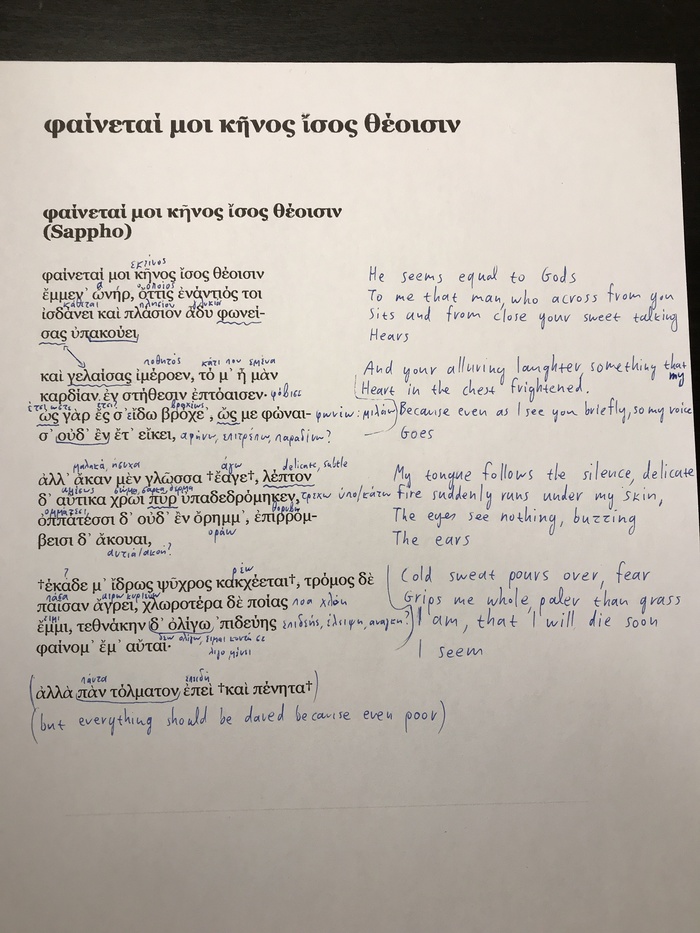
He seems equal to Gods
To me that man, who across from you
Sits and from close your sweet talking
Hears
And your alluring laughter, something that my
Heart in the chest frightened.
Because even as I see you briefly, so my voice
Goes
My tongue follows the silence, delicate
Fire suddenly runs under my skin,
The eyes see nothing, buzzing
The ears
Cold sweat pours over, fear
Grips me whole, paler than grass
I am, that I will die soon
I seem.
Now I am not an expert in Ancient Greek nor a translator, so if someone is and happens to stumble across this I welcome any suggestions. That said, judging from this poem and its translation I don’t think I can recommend this book.
And that’s because it seems that the translator tried to keep close to the original, but quite a few things bothered me.
Firstly, the arbitrary use of punctuation:
For example, in the first line the translator puts a comma in ...equal to gods, the man... placing a comma where it was originally not and choosing to separate a sentence in a way that Sappho chose not to. Why? A transliteration of that sentence from Ancient Greek to English goes like this: Seems me he(/him/that) equal to gods to me man, who across you sits... which could easily and appropriately be translated as: He seems equal to gods to me that man, who across from you sits... It’s just straightforward this way, no need to insert a comma in a different place.
Another example, the translator put a full stop after ...pours over me. There is no full stop in the original, there is a comma instead, which probably means that Sappho preferred to describe the situation in just one sentence and not two.
And secondly some poetic freedoms I didn’t like:
...in a sweet echo? There’s absolutely no reference of echo in the poem. Wouldn’t...voice be a better word choice? It is in the original too!
...my tongue cracks? I don’t like the metaphor per se, let alone that the original reads: ...soft/quiet my tongue follows... crack seems just too strong and odd here trying to convey the meaning of that particular line.
In my opinion the book’s translation is neither poetic and memorable (like A.S. Kline’s) nor as accurate as I would like it. 2,5 stars then, rounded off to 3.
the man who sits facing you
and hears you near as you speak
softly and laugh
in a sweet echo that jolts
the heart in my ribs. Now
when I look at you a moment
my voice is empty
and can say nothing as my tongue
cracks and slender fire races
under my skin. My eyes are dead
to light, my ears
pound, and sweat pours over me.
I convulse, greener than grass
and feel my mind slip as I go
close to death.
Sappho’s Fragment 31.
According to the book it is one of the most famous fragments of poetry we have from Sappho, about her feelings for a woman when she sees her talking with a man.
Curious, I looked for other translations and eventually spent the better part of my Sunday morning only to realize what I suspected. Translations vary widely.
Like this one, a translation from A.S. Kline hidden among a small treasure of classical poetry I discovered in his website:
He’s equal with the Gods, that man
Who sits across from you
Face to face, close enough, to sip
Your voice’s sweetness,
And what excites my mind,
Your laughter, glittering. So,
When I see you, for a moment,
My voice goes,
My tongue freezes. Fire,
Delicate fire, in the flesh.
Blind, stunned, the sound
Of thunder in my ears.
Shivering with sweat, cold
Tremors over the skin,
I turn the colour of dead grass,
And I’m an inch from dying.
:-O
How good is that?
And how much more striking and dramatic than the first one. But in the end, was this what Sappho really wrote? Which version is closer to her writing?
There was only one way to find out.
Armed with a dictionary and the remnants of my Ancient Greek knowledge I gave it a shot. I tried to stick to the original as much as possible, tried to retain the verses, the syntax, even the punctuation and order of words as they appear. Here’s what and how I produced it.
He seems equal to Gods
To me that man, who across from you
Sits and from close your sweet talking
Hears
And your alluring laughter, something that my
Heart in the chest frightened.
Because even as I see you briefly, so my voice
Goes
My tongue follows the silence, delicate
Fire suddenly runs under my skin,
The eyes see nothing, buzzing
The ears
Cold sweat pours over, fear
Grips me whole, paler than grass
I am, that I will die soon
I seem.
Now I am not an expert in Ancient Greek nor a translator, so if someone is and happens to stumble across this I welcome any suggestions. That said, judging from this poem and its translation I don’t think I can recommend this book.
And that’s because it seems that the translator tried to keep close to the original, but quite a few things bothered me.
Firstly, the arbitrary use of punctuation:
For example, in the first line the translator puts a comma in ...equal to gods, the man... placing a comma where it was originally not and choosing to separate a sentence in a way that Sappho chose not to. Why? A transliteration of that sentence from Ancient Greek to English goes like this: Seems me he(/him/that) equal to gods to me man, who across you sits... which could easily and appropriately be translated as: He seems equal to gods to me that man, who across from you sits... It’s just straightforward this way, no need to insert a comma in a different place.
Another example, the translator put a full stop after ...pours over me. There is no full stop in the original, there is a comma instead, which probably means that Sappho preferred to describe the situation in just one sentence and not two.
And secondly some poetic freedoms I didn’t like:
...in a sweet echo? There’s absolutely no reference of echo in the poem. Wouldn’t...voice be a better word choice? It is in the original too!
...my tongue cracks? I don’t like the metaphor per se, let alone that the original reads: ...soft/quiet my tongue follows... crack seems just too strong and odd here trying to convey the meaning of that particular line.
In my opinion the book’s translation is neither poetic and memorable (like A.S. Kline’s) nor as accurate as I would like it. 2,5 stars then, rounded off to 3.
August 15, 2021
i normally wouldn’t include something as short as this as a book i’ve read but i’m genuinely DISTRAUGHT at the amount of lost literature that we’ve lost from sappho. yes, it’s amazing that this much has even survived with the attempted erasure of her literature, but we have been ROBBED.
god i love this so much
god i love this so much

February 9, 2019
I have heard of the miracle of Sappho's poetry (how incredibly modern she sounds), but never fully grasped it until I actually got to read her myself. I found her poems so easy to understand and to feel in yourself, it's really amazing.
Ok, some of them, yes, are admirable in a cold and external way, like the historical artifact they are (the ones alluding to gods and mythical figures from Greek lore, or the ones from which only fragments survived). But many of them are so alive that you could believe they were written today by a bard close to your heart.
---------------------------------------------------
Here's my favorite (one of her best-preserved ones, Prayer to Aphroditi):
On your dappled throne, Aphrodite,
sly eternal daughter of Zeus,
I beg you: do not crush me with grief,
but come to me now—as once
you heard my far cry, and yielded,
slipping from your father's house
to yoke the birds to your gold
chariot, and came. Handsome swallows
brought you swiftly to the dark earth,
their wings whipping the middle sky.
Happy, with deathless lips, you smiled:
"What is wrong, why have you called me?
What does your mad heart desire?
Whom shall I make love you, Sappho,
who is turning her back on you?
Let her run away, soon she'll chase you;
refuse your gifts, soon she'll give them.
She will love you, though unwillingly."
Then come to me now and free me
from fearful agony. Labor
for my mad heart, and be my ally.
Ok, some of them, yes, are admirable in a cold and external way, like the historical artifact they are (the ones alluding to gods and mythical figures from Greek lore, or the ones from which only fragments survived). But many of them are so alive that you could believe they were written today by a bard close to your heart.
---------------------------------------------------
Here's my favorite (one of her best-preserved ones, Prayer to Aphroditi):
On your dappled throne, Aphrodite,
sly eternal daughter of Zeus,
I beg you: do not crush me with grief,
but come to me now—as once
you heard my far cry, and yielded,
slipping from your father's house
to yoke the birds to your gold
chariot, and came. Handsome swallows
brought you swiftly to the dark earth,
their wings whipping the middle sky.
Happy, with deathless lips, you smiled:
"What is wrong, why have you called me?
What does your mad heart desire?
Whom shall I make love you, Sappho,
who is turning her back on you?
Let her run away, soon she'll chase you;
refuse your gifts, soon she'll give them.
She will love you, though unwillingly."
Then come to me now and free me
from fearful agony. Labor
for my mad heart, and be my ally.

January 23, 2025
“Some say cavalry and others claim
infantry or a fleet of long oars
is the supreme sight on the black earth.
I say it is
the one you love. And easily proved.”
“You came and I went mad about you.
You cooled my mind burning with longing.”
“I shall love
as long as there is breath in me
and care [...]"
“May you sleep
on your tender girlfriend’s breasts."
“Someone, I tell you, in another time,
will remember us."
This was a beautiful compilation of all of Sappho's poetry. I was particularly fond of the "Testimonia and Ecomia" section—dedicated to how Sappho was perceived. Learning that she was chastised for her appearance, only for Socrates to don her with the title "the beautiful Sappho" was deeply touching. A very interesting and insightful read.
“In appearance she seems to have been contemptible and ugly. [Socrates called her “the beautiful Sappho.”] She had a dark complexion and was very short."
“The beautiful Sappho. Socrates liked to call her this because of the beauty of her song, although she was small and dark.”
“What else could one call the Lesbian’s love but that which Socrates practiced. Both seem to me to have practiced love in their own way, she of women, he of men, and both said that they could fall in love many times and all beautiful people attracted them."
“Some say there are nine Muses. Count again.
Behold the tenth: Sappho of Lesbos.”
infantry or a fleet of long oars
is the supreme sight on the black earth.
I say it is
the one you love. And easily proved.”
“You came and I went mad about you.
You cooled my mind burning with longing.”
“I shall love
as long as there is breath in me
and care [...]"
“May you sleep
on your tender girlfriend’s breasts."
“Someone, I tell you, in another time,
will remember us."
This was a beautiful compilation of all of Sappho's poetry. I was particularly fond of the "Testimonia and Ecomia" section—dedicated to how Sappho was perceived. Learning that she was chastised for her appearance, only for Socrates to don her with the title "the beautiful Sappho" was deeply touching. A very interesting and insightful read.
“In appearance she seems to have been contemptible and ugly. [Socrates called her “the beautiful Sappho.”] She had a dark complexion and was very short."
“The beautiful Sappho. Socrates liked to call her this because of the beauty of her song, although she was small and dark.”
“What else could one call the Lesbian’s love but that which Socrates practiced. Both seem to me to have practiced love in their own way, she of women, he of men, and both said that they could fall in love many times and all beautiful people attracted them."
“Some say there are nine Muses. Count again.
Behold the tenth: Sappho of Lesbos.”

November 30, 2021
Wow, I started this earlier than I remembered - read the introductory section & first translation (1907, Bliss Carman) in August 2017, then read the first half of the second translation (1910, John Myers O'Hara) around October - 3 years later, in 2020. Then I finished it off November 2021. There's some kind of Eminem off-rhyme to this reason, I'm sure.
I have the probably unfortunate habit of typically needing to read a book of poems from cover to cover before unlocking "arcade mode", where I can idle through & pick & study & compare as I like (a curse thankfully broken with most poets' mammoth "complete works" books, though Sappho's remaining oeuvre is sadly brief enough for me to not feel it this time). Now that I've done so with this book, I look forward to being able to dip into Sappho whenever. Due to the immense breaks between reading, I cannot compare the two translations, though I plan to as I reread (seems inevitable). The second one, fresh in my memory, certainly seemed fine & left me with a decent enough taste in my mouth.
I'm tempted to next read Sappho's complete works over a day or weekend & seek out a respected modern translation (preferably by a woman), just to see how it feels - there's not much likelihood of it being able to be corrupted into anything unenjoyable anyway, & I'd really like a woman's POV with the translation. Oh, & since I haven't said so directly yet - I fkn loved these poems. They can be very flowery, which is usually the opposite of what I'd enjoy, but it all (mostly) seemed to hold a certain gravitas & sheer beauty which I found inescapable.
But no one maid, I think, beneath the skies,
At any time shall live and be as wise,
In sooth, as I am; for the Muses Nine
Have made me honored and their gifts are mine;
And men, I think, will never quite forget
My songs or me; so long as stars shall set
Or sun shall rise, or hearts feel love’s desire,
My voice shall cross their dreams, a sigh of fire.
I have the probably unfortunate habit of typically needing to read a book of poems from cover to cover before unlocking "arcade mode", where I can idle through & pick & study & compare as I like (a curse thankfully broken with most poets' mammoth "complete works" books, though Sappho's remaining oeuvre is sadly brief enough for me to not feel it this time). Now that I've done so with this book, I look forward to being able to dip into Sappho whenever. Due to the immense breaks between reading, I cannot compare the two translations, though I plan to as I reread (seems inevitable). The second one, fresh in my memory, certainly seemed fine & left me with a decent enough taste in my mouth.
I'm tempted to next read Sappho's complete works over a day or weekend & seek out a respected modern translation (preferably by a woman), just to see how it feels - there's not much likelihood of it being able to be corrupted into anything unenjoyable anyway, & I'd really like a woman's POV with the translation. Oh, & since I haven't said so directly yet - I fkn loved these poems. They can be very flowery, which is usually the opposite of what I'd enjoy, but it all (mostly) seemed to hold a certain gravitas & sheer beauty which I found inescapable.
But no one maid, I think, beneath the skies,
At any time shall live and be as wise,
In sooth, as I am; for the Muses Nine
Have made me honored and their gifts are mine;
And men, I think, will never quite forget
My songs or me; so long as stars shall set
Or sun shall rise, or hearts feel love’s desire,
My voice shall cross their dreams, a sigh of fire.

June 23, 2019
extremely gay and i loved every word. but all that's survived is fragments. fragments i adored, of course, but a sentence out of context can never match one from a text that is whole.

February 9, 2025
2,5 *
thoughts:
I fear I may forever hold a weak spot for Sappho. She has my heart in a firm grasp with her immaculate and true descriptions of love.
But... I wasn't all too impressed with this translation. Though some are wonderfully rendered, other poems feel emptied of emotion. This disappointed me at times.
thoughts:
I fear I may forever hold a weak spot for Sappho. She has my heart in a firm grasp with her immaculate and true descriptions of love.
But... I wasn't all too impressed with this translation. Though some are wonderfully rendered, other poems feel emptied of emotion. This disappointed me at times.

April 25, 2023
the poems were so pretty, and had a really distinctive tone and style. absolutely stunning imagery :’)
some personal favourites:
- the virgin
- as long as there is breath
- to a friend gone, remember
i wish i could give this a higher rating :’) i suspect that reading other translations would offer a fuller perspective. it’s really very unfortunate that what we have left is so fragmented - sometimes the meaning was unclear because the poems were so short.
some personal favourites:
- the virgin
- as long as there is breath
- to a friend gone, remember
i wish i could give this a higher rating :’) i suspect that reading other translations would offer a fuller perspective. it’s really very unfortunate that what we have left is so fragmented - sometimes the meaning was unclear because the poems were so short.

June 14, 2019
2019 Pride month read #14
If Not, Winter is a classic, but I enjoyed this translation as well.
If Not, Winter is a classic, but I enjoyed this translation as well.

March 15, 2020
I have come across references to Sappho many times in my recent reading. So I finally decided to read her works to fill this gap in my reading, knowing it would not take long because so little survives.
The Delphi Classics Edition contains a 2011 Greek / English dual text translation, by Peter Russell, of all her surviving work, about 650 lines total (out of an estimated 10,000 lines she may have produced over her lifetime). That took only about an hour to read.
A couple of odes survive, some shorter pieces which may or may not be complete, and over a hundred fragments of a few words to several lines. Russell's direct translation seems closest to Sappho's voice. And, a remarkable voice it is. Ancient commentators who had access to more of her work raved.
Some fragments remind me of haiku or Ezra Pound's famous little poem about the Paris Metro.
"The stars around the wide moon lose all their shining beauty, as she illuminates the whole earth with silver."
There are two other "translations" in the volume:
A 1907 "translation" by Bliss Carman
A 1911 "translation" by John Myers O'hara
There is the following note about the Carman "translation":
"Perhaps the most perilous and the most alluring venture in the whole field of poetry is that which Mr. Carman has undertaken in attempting to give us in English verse those lost poems of Sappho of which fragments have survived. The task is obviously not one of translation or of paraphrasing, but of imaginative and, at the same time, interpretive construction. ... "
I class these "translations" more as poetic fan fiction mostly built on fragments of her original poems.
I rate Carman's work much superior to O'hara's. Carman seems closer to the original voice of Sappho shown in Russell's more direct translation. O'hara's verse is more stilted to my ear, redolent of Edwardian poetic pretense, obfuscation, and stereotypes.
This volume could really use a short scholarly article about Sappho explaining more of what we know about her, legends about her, her work, what we know about how her work was lost, her critical assessment in antiquity, and her importance in culture. Lacking that, I suggest you at least read the Wikipedia article on Sappho to fill in that lacuna.
The Delphi Classics Edition contains a 2011 Greek / English dual text translation, by Peter Russell, of all her surviving work, about 650 lines total (out of an estimated 10,000 lines she may have produced over her lifetime). That took only about an hour to read.
A couple of odes survive, some shorter pieces which may or may not be complete, and over a hundred fragments of a few words to several lines. Russell's direct translation seems closest to Sappho's voice. And, a remarkable voice it is. Ancient commentators who had access to more of her work raved.
Some fragments remind me of haiku or Ezra Pound's famous little poem about the Paris Metro.
"The stars around the wide moon lose all their shining beauty, as she illuminates the whole earth with silver."
There are two other "translations" in the volume:
A 1907 "translation" by Bliss Carman
A 1911 "translation" by John Myers O'hara
There is the following note about the Carman "translation":
"Perhaps the most perilous and the most alluring venture in the whole field of poetry is that which Mr. Carman has undertaken in attempting to give us in English verse those lost poems of Sappho of which fragments have survived. The task is obviously not one of translation or of paraphrasing, but of imaginative and, at the same time, interpretive construction. ... "
I class these "translations" more as poetic fan fiction mostly built on fragments of her original poems.
I rate Carman's work much superior to O'hara's. Carman seems closer to the original voice of Sappho shown in Russell's more direct translation. O'hara's verse is more stilted to my ear, redolent of Edwardian poetic pretense, obfuscation, and stereotypes.
This volume could really use a short scholarly article about Sappho explaining more of what we know about her, legends about her, her work, what we know about how her work was lost, her critical assessment in antiquity, and her importance in culture. Lacking that, I suggest you at least read the Wikipedia article on Sappho to fill in that lacuna.

July 16, 2021
Mostly fragments that say little. One of the contributors described reading Sappho as trying to see the entirety of a statue of which one possesses only an elbow and one finger. Those are my words, not hers.
Sappho seems to be more of a muse than a writer. Her fragmentary work has inspired other writers to great, and sometimes feverish, length.
I liked the Delphi version because it gave the Greek and the English translation. I like to sound out the words that I recognize, proper nouns mostly, and try to pronounce the Greek.
I can sometimes be found trying to read Greek and Latin poetry in parks out loud. People think I'm a raving nutter. Who am I to argue?
Sappho seems to be more of a muse than a writer. Her fragmentary work has inspired other writers to great, and sometimes feverish, length.
I liked the Delphi version because it gave the Greek and the English translation. I like to sound out the words that I recognize, proper nouns mostly, and try to pronounce the Greek.
I can sometimes be found trying to read Greek and Latin poetry in parks out loud. People think I'm a raving nutter. Who am I to argue?

June 10, 2021
3.5*
still not a fan of how this is collected but i like the translation much more than If Not, Winter: Fragments of Sappho
still not a fan of how this is collected but i like the translation much more than If Not, Winter: Fragments of Sappho
August 12, 2022
3 ⭐️for the translation which I found hmm,okay..
Sappho’s poetry is remarkable. I have already read it in its original language so it’s inevitable to compare.
The long introduction of the book is pretty good.
Sappho’s poetry is remarkable. I have already read it in its original language so it’s inevitable to compare.
The long introduction of the book is pretty good.

June 8, 2020
While Sappho's poems are absolutely gorgeous, this translation didn't really do justice to the beauty of her verse. I will definitely find a different translation to try.

October 29, 2022
i love sappho’s poems and the glossary + mentions at the end - defo gonna read more of them
[idk how to rate this because it’s a set of poems?😭]
[idk how to rate this because it’s a set of poems?😭]
Read
May 29, 2026I’m not a poetry girlie, but I’ve been wanting to read Sappho’s work for ages.
It was interesting to have a historical perspective and a quick overview of what we know of her and how her work was treated over the centuries. For example, I didn’t know that copies of her work were torn to use for mummification. I also enjoyed learning about the different approaches to translating her work.
Even though they are mostly fragments, I found what I could understand from them to be gorgeously written and evocative. It’s definitely something I will reread. I want to try a different translation for comparison and different editions, since this one doesn’t seem to carry certain poems.
My favorites include Moon, Hektor, To a Friend Gone, Remember, and Supreme Sight on the Black Earth.
It was interesting to have a historical perspective and a quick overview of what we know of her and how her work was treated over the centuries. For example, I didn’t know that copies of her work were torn to use for mummification. I also enjoyed learning about the different approaches to translating her work.
Even though they are mostly fragments, I found what I could understand from them to be gorgeously written and evocative. It’s definitely something I will reread. I want to try a different translation for comparison and different editions, since this one doesn’t seem to carry certain poems.
My favorites include Moon, Hektor, To a Friend Gone, Remember, and Supreme Sight on the Black Earth.

February 26, 2024
i said, "go, and be happy
but remember (you know
well) whom you leave shackled by love"
but remember (you know
well) whom you leave shackled by love"
Read
June 15, 2026maailman eka taylor swift
November 29, 2025
Someone, I tell you, in another time,
will remember us.
Sappho again breaks my heart. It makes me see everything in violet-colours. She wrote prayers to Aphrodite, we shall pray to Sappho herself 💔
will remember us.
Sappho again breaks my heart. It makes me see everything in violet-colours. She wrote prayers to Aphrodite, we shall pray to Sappho herself 💔

April 6, 2015
For my money, the most heartbreaking ending in literature is The Name of the Rose. Not to be too spoilery, but it involves a hidden library of countless classical texts (imagine Aristotle's Comedy, the lost plays of Sophocles, the collected correspondence of Alexander the Great, etc.) going up in flames. That the writings that form the cornerstone of Western civilization are often just the remnants that survived by fluke chance reinforces the all-encompassing impermanence of the human condition. I judge Jeopardy contestants when they can't properly name Motown backing bands. History has a way of making important things trivial and then forgotten.
Anyways, if there was a winner in this fictional fire it was Sappho. Sappho was widely acknowledged as one of the preeminent Hellenistic poets of the Classical Era. She was the rare woman who achieved predominance in their field in antiquarian times. And she achieved a level of predominance that is pretty staggering for anybody. For many classical Hellenes it was Homer then Sappho then everybody else. There are even sources found from hundred of years after her death basically saying that her stuff was going to be around forever. Now, all that's left is over a hundred fragments. Probably none represent a complete poem. Only a few (around a half dozen) even resemble a full poem. The vast majority are random excerpts, (often quotations from a second source) of a few lines are less. Many are just a line or a segment of a line.
However, this has paradoxically made Sappho the perfect poet for an ADD generation. I can appreciate it, but man reading Wordsworth go on for pages rhapsodizing about some meadow can be a bit of a drag. It's there to be found, but it takes a certain amount of elbow grease and sustained concentration to extract resonance out of a lot of poetry. Compare that to something like "Fragment 105:"
That's it. That's the poem. And it's not just great because it's short. Read the whole surrounding circumstances into those words. Those words are trace survivors of a body of work that was first widely acknowledged as sublime, then slowly forgotten about. Yet somehow, these words lingered on, and survived until Renaissance Europe rediscovered her work, around 2200 years after her death. These words have meant something to people throughout the ages. We can't precisely say what they meant to a Classical Greek, but the trace elements leave a kind of common empathy. Isn't that, for lack of a better word, poetic?
Anyways, if there was a winner in this fictional fire it was Sappho. Sappho was widely acknowledged as one of the preeminent Hellenistic poets of the Classical Era. She was the rare woman who achieved predominance in their field in antiquarian times. And she achieved a level of predominance that is pretty staggering for anybody. For many classical Hellenes it was Homer then Sappho then everybody else. There are even sources found from hundred of years after her death basically saying that her stuff was going to be around forever. Now, all that's left is over a hundred fragments. Probably none represent a complete poem. Only a few (around a half dozen) even resemble a full poem. The vast majority are random excerpts, (often quotations from a second source) of a few lines are less. Many are just a line or a segment of a line.
However, this has paradoxically made Sappho the perfect poet for an ADD generation. I can appreciate it, but man reading Wordsworth go on for pages rhapsodizing about some meadow can be a bit of a drag. It's there to be found, but it takes a certain amount of elbow grease and sustained concentration to extract resonance out of a lot of poetry. Compare that to something like "Fragment 105:"
To himself he appears...
That's it. That's the poem. And it's not just great because it's short. Read the whole surrounding circumstances into those words. Those words are trace survivors of a body of work that was first widely acknowledged as sublime, then slowly forgotten about. Yet somehow, these words lingered on, and survived until Renaissance Europe rediscovered her work, around 2200 years after her death. These words have meant something to people throughout the ages. We can't precisely say what they meant to a Classical Greek, but the trace elements leave a kind of common empathy. Isn't that, for lack of a better word, poetic?

July 13, 2018
This is wonderful. Great intro. I especially enjoyed the discussion of the mystical aspects of love as a transcendental experience, in the context of Sappho’s poem “Seizure,” as it is translated here. I read the poems partially in that light. Tender and sensitive, the smallest fragments are frequently overpowering—sensual dynamite. Highly recommended.

March 29, 2020
one star for the translation, five stars always for sappho’s poetry always
“...sleek afroditi broke me with longing for a boy.” ???
I’ve read this line 100s of times, and this is the first time I’ve read it with reference to a boy
I almost threw my kobo across the room
“...sleek afroditi broke me with longing for a boy.” ???
I’ve read this line 100s of times, and this is the first time I’ve read it with reference to a boy
I almost threw my kobo across the room

October 8, 2020
Simply and completely amazing. The bits of poetry that have survived only offer a small piece of the lost treasure of literature.
May 2, 2022
interesting. i’d like to read a different translation

September 29, 2020
Even the fragments we have of Sappho's poetry are incredibly beautiful. She was considered the 10th Muse in the ancient world, and even studied and learned for hundreds of years after her death.
This book offers the "complete poems" as far as evidence at the time is available. Hopefully someday this book with be outdated with more discoveries being made at Oxyrhynchus in Egypt.
Still, if you enjoy poetry, classical studies, or ancient Greece, this volume will delight you. I found it useful to divide the book into three parts. The poetry, the sources/notes/commentary; and the Glossary. I book marked those three sections, so I could look up the sources and glossary for each entry I was reading.
One other part of this book that was interesting to read: there was a section of references of Sappho in Greek and Latin antiquity. Writers who wrote about Sappho. All in all, I enjoyed this volume, and hope to read it again.
This book offers the "complete poems" as far as evidence at the time is available. Hopefully someday this book with be outdated with more discoveries being made at Oxyrhynchus in Egypt.
Still, if you enjoy poetry, classical studies, or ancient Greece, this volume will delight you. I found it useful to divide the book into three parts. The poetry, the sources/notes/commentary; and the Glossary. I book marked those three sections, so I could look up the sources and glossary for each entry I was reading.
One other part of this book that was interesting to read: there was a section of references of Sappho in Greek and Latin antiquity. Writers who wrote about Sappho. All in all, I enjoyed this volume, and hope to read it again.
October 12, 2022
Saphho's complete works are a joy to read. It just feels a lot more relatable and modern compared to for example Ovid or Pindaros. Not to mention how much more relatable Sappho is compared to the Song of Songs in the old testament. In other words, when it comes to lyrics about passion - there really isn't anyone else coming close to Sappho in ancient times.
Unfortunatly, not a lot of her works survives to this day so reading her complete works is a rather short read.
It really is a wonderful read. The poems are short and concise, and there is none of the fluff that some other greek authors fill out their poems with. I love it.
I give Sappho 5/5
Unfortunatly, not a lot of her works survives to this day so reading her complete works is a rather short read.
It really is a wonderful read. The poems are short and concise, and there is none of the fluff that some other greek authors fill out their poems with. I love it.
I give Sappho 5/5

March 26, 2026
enjoyed this more than i thought! the translations are done quite well; i felt like i could still sort of hear sappho’s “voice” despite it not being the original language and a lot of it being pieced together. can’t remember where i picked this book up but it was totally an impulse secondhand buy - i know nothing about sappho and didn’t even realize she was a real (?) person but regardless this was cool and i learned new things!
4th poetry book this yr :)
4th poetry book this yr :)
February 8, 2026
i’m not usually a big history person but there is something so moving about being able to connect to someone so intimately from thousands of years ago through shared feelings and experiences
and now i can finally call myself a real sapphic! 👩❤️💋👩
and now i can finally call myself a real sapphic! 👩❤️💋👩

July 4, 2024
lets be realistic was i ever gonna rate sappho lower than 5....

September 16, 2024
"I do not know what to do: I have two minds."
Displaying 1 - 30 of 97 reviews