

What do you think?

En soledad
En soledad, de Chabouté, es la historia del habitante aislado de un faro, oculto desde la infancia por su deformidad física, y totalmente solo desde la muerte de sus padres. Únicamente un pequeño barco pesquero le deja semanalmente unos alimentos, hasta que su nuevo marinero tiene la inquietud de conocerle. A partir de aquí un cómic encantador, poético, sugerente, nostálgico, con pocas palabras y muchas imágenes entrañables, que nos hace evocar la soledad, la esperanza, la vida de los otros...
376 pages, Hardcover
First published January 1, 2008
About the author
Christophe Chabouté
40 books263 followersChristophe Chabouté is a French author and illustrator.
D’origine alsacienne, il suit les cours des Beaux-Arts d’Angoulême, puis de Strasbourg. Vents d'Ouest publie ses premières planches en 1993 dans Les Récits, un album collectif sur Arthur Rimbaud. Mais il se fait surtout connaître en 1998 en publiant Sorcières aux éditions du Téméraire (primé au Festival d’Illzach) puis Quelques jours d’été aux éditions Paquet (Alph’Art Coup de Cœur au Festival d'Angoulême). Il a également illustré des romans pour la jeunesse.
D’origine alsacienne, il suit les cours des Beaux-Arts d’Angoulême, puis de Strasbourg. Vents d'Ouest publie ses premières planches en 1993 dans Les Récits, un album collectif sur Arthur Rimbaud. Mais il se fait surtout connaître en 1998 en publiant Sorcières aux éditions du Téméraire (primé au Festival d’Illzach) puis Quelques jours d’été aux éditions Paquet (Alph’Art Coup de Cœur au Festival d'Angoulême). Il a également illustré des romans pour la jeunesse.
Ratings & Reviews
Friends & Following
Create a free account to discover what your friends think of this book!
Community Reviews
Displaying 1 - 30 of 614 reviews

August 5, 2017
An entire life spent alone on a rock. What's he do all day?
This graphic novel is stunning.
First published in France in 2008, Alone was just translated into English this year, and I'm grateful I had the chance to read this beautiful book. It's about a disfigured man who lives alone in a lighthouse, and he's never been been off the island. He passes the time by reading the dictionary and using his imagination to dream up stories. Once a week, a local fisherman drops off food supplies for him, but the man never comes out to talk. The novel takes a turn when another fisherman hears about the lighthouse keeper and decides to intervene.
The story is told in black and white drawings and with very few words. It's one of the most captivating and haunting graphic novels I've read — right up there with Nat Turner by Kyle Baker and The Arrival by Shaun Tan. I read Alone in one sitting during a rainstorm, and when I turned the last page, I sat silently for several minutes, still absorbed in the book, listening to the raindrops on the roof.
This graphic novel is stunning.
First published in France in 2008, Alone was just translated into English this year, and I'm grateful I had the chance to read this beautiful book. It's about a disfigured man who lives alone in a lighthouse, and he's never been been off the island. He passes the time by reading the dictionary and using his imagination to dream up stories. Once a week, a local fisherman drops off food supplies for him, but the man never comes out to talk. The novel takes a turn when another fisherman hears about the lighthouse keeper and decides to intervene.
The story is told in black and white drawings and with very few words. It's one of the most captivating and haunting graphic novels I've read — right up there with Nat Turner by Kyle Baker and The Arrival by Shaun Tan. I read Alone in one sitting during a rainstorm, and when I turned the last page, I sat silently for several minutes, still absorbed in the book, listening to the raindrops on the roof.

September 8, 2017
Okay Sandi, you were right, I was wrong. After my friend Sandi posted a glowing review of this graphic novel, I told her I love her review but that graphic novels were not my thing. I had only read one previous to this, and tried a few more, but those little boxes and bubbles of speeches, just irritated me. She told me she thought I would love this one, that in very few words, but with some wonderful pictures the story was one I should read.
So I did, and it was an amazing story, gorgeous black and white drawings. paint a heartfelt and lonely picture of a disfigured man living in a lighthouse. With only a fish in a bowl for a friend,and an encyclopedia his only book, he uses his imagination to travel where he cannot. A boat drops off supplies for him, an arrangement his father had made before his death. Well, the less said the better, just savor the experience, a picture indeed can tell a thousand words.
So I did, and it was an amazing story, gorgeous black and white drawings. paint a heartfelt and lonely picture of a disfigured man living in a lighthouse. With only a fish in a bowl for a friend,and an encyclopedia his only book, he uses his imagination to travel where he cannot. A boat drops off supplies for him, an arrangement his father had made before his death. Well, the less said the better, just savor the experience, a picture indeed can tell a thousand words.

July 20, 2017
A compendium of imaginative isolation in its most mythic and romantic representation.
Linger on and bask in each scrupulous panel, becoming intimately familiar as with a brick at eye level in front of your work desk. Each crack, crevice, and granule becoming a friend you see every day, contributing to memories of which these features will remind you on account of the vagaries conceived while staring at it in fits of creative agony or ecstasy.
To be alone is to be in innumerable worlds simultaneously, exploring unadulterated and uninterrupted expressiveness within oneself, playing with words as pictures in pure and personal perfection.
Linger on and bask in each scrupulous panel, becoming intimately familiar as with a brick at eye level in front of your work desk. Each crack, crevice, and granule becoming a friend you see every day, contributing to memories of which these features will remind you on account of the vagaries conceived while staring at it in fits of creative agony or ecstasy.
To be alone is to be in innumerable worlds simultaneously, exploring unadulterated and uninterrupted expressiveness within oneself, playing with words as pictures in pure and personal perfection.

September 9, 2017
“Bless you prison, bless you for being in my life. For there, lying upon the rotting prison straw, I came to realize that the object of life is not prosperity as we are made to believe, but the maturity of the human soul.” ― Aleksandr Solzhenitsyn, The Gulag Archipelago 1918-1956
Alone, finally translated this year (2017) in English from the French, is Chaboute’s masterpiece. Early on he did graphic interpretations of the work of Rimbaud, and more recently, an interpretation of the story of Moby Dick, but this more than 400 page novel is Chaboute’s story, in black and white, mostly wordless, and an amazing artistic accomplishment about the nature of words and the imagination.
The story is rather simple; a man with some physical deformities—one is reminded of the Hunchback of Notre Dame in the bell tower—is born in a lighthouse and never leaves this tiny island for more than fifty years, fifteen of them after his parents are dead. Regularly a fisherman, according to arrangements made by our hermit’s father, leaves him food and supplies.
What does the man do most of the day? He picks out words in a dictionary and uses these words as a trigger to his imagination, to create stories that he sometimes enacts for himself and a goldfish. Words free the man for several decades from his prison, but one day a man newly hired by the fisherman leaves him a note with the supplies and everything changes. In a sense, this simple nearly wordless story is an allegory about language and creativity, but the turn to human connection moves it in yet another important direction. A literary masterpiece in comics!
Alone, finally translated this year (2017) in English from the French, is Chaboute’s masterpiece. Early on he did graphic interpretations of the work of Rimbaud, and more recently, an interpretation of the story of Moby Dick, but this more than 400 page novel is Chaboute’s story, in black and white, mostly wordless, and an amazing artistic accomplishment about the nature of words and the imagination.
The story is rather simple; a man with some physical deformities—one is reminded of the Hunchback of Notre Dame in the bell tower—is born in a lighthouse and never leaves this tiny island for more than fifty years, fifteen of them after his parents are dead. Regularly a fisherman, according to arrangements made by our hermit’s father, leaves him food and supplies.
What does the man do most of the day? He picks out words in a dictionary and uses these words as a trigger to his imagination, to create stories that he sometimes enacts for himself and a goldfish. Words free the man for several decades from his prison, but one day a man newly hired by the fisherman leaves him a note with the supplies and everything changes. In a sense, this simple nearly wordless story is an allegory about language and creativity, but the turn to human connection moves it in yet another important direction. A literary masterpiece in comics!

October 29, 2018
Christophe Chaboute’s Alone is kind of a modern-day fairytale where a deformed man with the unlikely name of Alone lives - yes, alone! - in a lighthouse - and he’s lonely cos he’s alone…
… am I missing something here - is that it? Yes it is. Wow. It looks like an imposing book but it’s mostly silent so you can breeze through it in no time. The art is very accomplished and some of the visuals are amusing. He spends his days reading random dictionary entries then tries visualising them and they’re odd-looking as he has no experience of the outside world.
I wish there was more substance here though - “having an imagination is good” is not enough for an entire book! Barely anything happens and then it’s over. Alone left almost no impression on me. I has more substance on the underside of my gross bin’s lid!
… am I missing something here - is that it? Yes it is. Wow. It looks like an imposing book but it’s mostly silent so you can breeze through it in no time. The art is very accomplished and some of the visuals are amusing. He spends his days reading random dictionary entries then tries visualising them and they’re odd-looking as he has no experience of the outside world.
I wish there was more substance here though - “having an imagination is good” is not enough for an entire book! Barely anything happens and then it’s over. Alone left almost no impression on me. I has more substance on the underside of my gross bin’s lid!

June 10, 2022
Superb. An achingly sad yet beautiful story.
I'm thankful I'm not among those who are alone today, alone tomorrow.
Also, on this day, I need to repeat what I wrote below:
"Many thanks to the Goodreads members I follow. Without them, I might never have known about this book, a fine example of the art of the graphic novel, and a gifted artist’s ode to the imagination."
Read June 2022/Edited July & Nov. 2022 (added images and so forth)
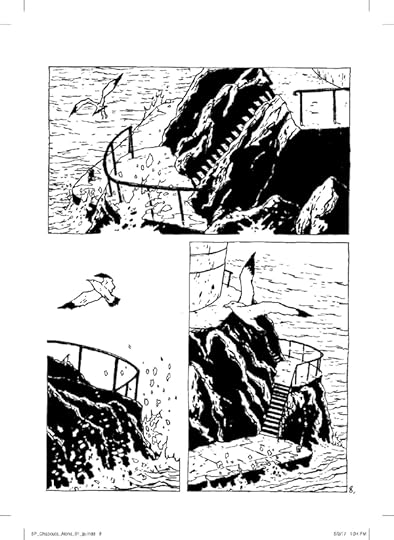
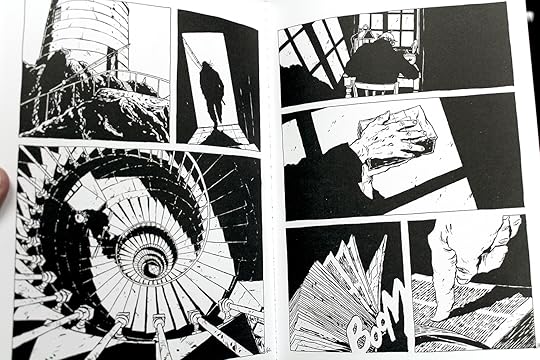
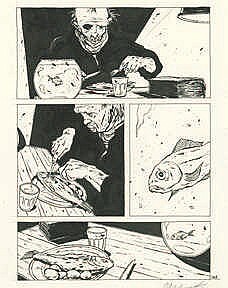
Alone, the beautiful and moving graphic novel by the French author and illustrator, Christophe Chabouté, is a stunning achievement both visually and story-wise. Black and white and nearly wordless, it almost suggests a silent film, but set in the present. Cinematically, it incorporates montage and liberal use of point of view “shots” that echo the moves of a camera. The opening is as if samples of frames were clipped from a reel, closing in and zooming out on a seagull and on the lighthouse which leans in expressionistic angles against the world and the sea, as though in combat with all that is outside. Inside the lighthouse, we climb the spiral stairs and move through the rooms, noting its contents—a fish in a bowl, trapped much as he is; toy medieval soldiers on horseback (or chess pieces?) and a bit of tree branch, which evoke battle scenes and imagined forests in the mind of the protagonist, who we don’t actually see until the book is one-third or so gone.
The story:
A middle-aged man has lived his entire life in a lighthouse, never interacting with even one soul, living off the fish he catches and supplies dropped off by a pair of fishermen, who explain,
“Why has he never set foot on land?”
“Because of his parents! He was born deformed … a monster …They kept him hidden in the lighthouse—they were ashamed of him.”
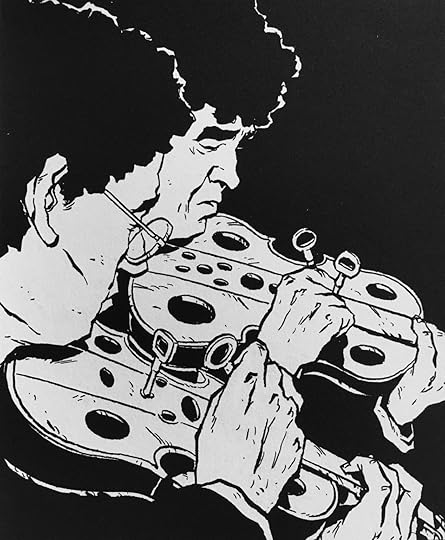
A monster? Huge exaggeration. Yes, he is homely; one of his eyes and the eyebrow is smaller than the other, he has oversize teeth, hair clinging in patches to a misshapen head. True, he is even more imperfect than the rest of us, but … a monster? Of course he isn’t, but that’s how his parents and others in the outside world perceive him. And most sad of all, that’s how he perceives himself. A monster, who must be kept in isolation, with nothing to keep him company but a fish in a bowl, and his imagination: sparked by things from the outside world that have drifted to the lighthouse, and by random glances at his dictionary. His imagination creates surreal versions of everyday items he's never seen, and has only the dictionary descriptions to guide him. Here for example, violins:
Alone is an almost unbearably sad tale, but lightened with generous doses of humor, and uplifted with a humanist message, and it nearly, almost, drew a tear from me. Many thanks to the Goodreads members I follow. Without them, I might never have known about this book, a fine example of the art of the graphic novel, and a gifted artist’s ode to the imagination.
I'm thankful I'm not among those who are alone today, alone tomorrow.
Also, on this day, I need to repeat what I wrote below:
"Many thanks to the Goodreads members I follow. Without them, I might never have known about this book, a fine example of the art of the graphic novel, and a gifted artist’s ode to the imagination."
Read June 2022/Edited July & Nov. 2022 (added images and so forth)
Alone, the beautiful and moving graphic novel by the French author and illustrator, Christophe Chabouté, is a stunning achievement both visually and story-wise. Black and white and nearly wordless, it almost suggests a silent film, but set in the present. Cinematically, it incorporates montage and liberal use of point of view “shots” that echo the moves of a camera. The opening is as if samples of frames were clipped from a reel, closing in and zooming out on a seagull and on the lighthouse which leans in expressionistic angles against the world and the sea, as though in combat with all that is outside. Inside the lighthouse, we climb the spiral stairs and move through the rooms, noting its contents—a fish in a bowl, trapped much as he is; toy medieval soldiers on horseback (or chess pieces?) and a bit of tree branch, which evoke battle scenes and imagined forests in the mind of the protagonist, who we don’t actually see until the book is one-third or so gone.
The story:
A middle-aged man has lived his entire life in a lighthouse, never interacting with even one soul, living off the fish he catches and supplies dropped off by a pair of fishermen, who explain,
“Why has he never set foot on land?”
“Because of his parents! He was born deformed … a monster …They kept him hidden in the lighthouse—they were ashamed of him.”
A monster? Huge exaggeration. Yes, he is homely; one of his eyes and the eyebrow is smaller than the other, he has oversize teeth, hair clinging in patches to a misshapen head. True, he is even more imperfect than the rest of us, but … a monster? Of course he isn’t, but that’s how his parents and others in the outside world perceive him. And most sad of all, that’s how he perceives himself. A monster, who must be kept in isolation, with nothing to keep him company but a fish in a bowl, and his imagination: sparked by things from the outside world that have drifted to the lighthouse, and by random glances at his dictionary. His imagination creates surreal versions of everyday items he's never seen, and has only the dictionary descriptions to guide him. Here for example, violins:
Alone is an almost unbearably sad tale, but lightened with generous doses of humor, and uplifted with a humanist message, and it nearly, almost, drew a tear from me. Many thanks to the Goodreads members I follow. Without them, I might never have known about this book, a fine example of the art of the graphic novel, and a gifted artist’s ode to the imagination.
January 2, 2026
What a delightful start to 2026 (thanks Sandi). Christophe Chabouté’s graphic novel Alone is about solitude and reclusiveness and the power of imagination.
Alone is the name given to a hermit living on a lighthouse. A dictionary and a goldfish are his only company, leaving his imagination as his only form of entertainment.
Until a single act of kindness from a fisherman changes everything.
It’s a wonderful story, underpinned by beautiful illustrations.
Alone is the name given to a hermit living on a lighthouse. A dictionary and a goldfish are his only company, leaving his imagination as his only form of entertainment.
Until a single act of kindness from a fisherman changes everything.
It’s a wonderful story, underpinned by beautiful illustrations.

August 30, 2017
5 stars
What a great book. This is a graphic novel - a novel that a lot of work went into. It is all in black and white. It has very few words, but tells a sad, sad story, ultimately ending well. This is translated from French and regarded as Chaboute's masterpiece.
The story tells of a man - a hermit, that no one has ever seen - who lives in a lighthouse way out to sea, on just an outcropping of rock. He was born in that lighthouse. Now 50 years later he has been the sole inhabitant for the last 15 years, since losing his parents. He gets supplies delivered weekly, however he hides while that boat is there. Once that boat takes on an ex-convict as the crew things begin to change.
This is 368 pages of very little words and a story well told in pictures. The pictures speak to you and you feel his isolation and his fears. This is an author that I definitely will read again.
What a great book. This is a graphic novel - a novel that a lot of work went into. It is all in black and white. It has very few words, but tells a sad, sad story, ultimately ending well. This is translated from French and regarded as Chaboute's masterpiece.
The story tells of a man - a hermit, that no one has ever seen - who lives in a lighthouse way out to sea, on just an outcropping of rock. He was born in that lighthouse. Now 50 years later he has been the sole inhabitant for the last 15 years, since losing his parents. He gets supplies delivered weekly, however he hides while that boat is there. Once that boat takes on an ex-convict as the crew things begin to change.
This is 368 pages of very little words and a story well told in pictures. The pictures speak to you and you feel his isolation and his fears. This is an author that I definitely will read again.

September 10, 2025
“Solitário” é possivelmente a obra mais amada de Chabouté e agora compreendo porquê. Como não adorar a história de um homem deformado que vive há 50 anos desamparado no sítio mais isolado que pode existir? Nesta GN quase silenciosa consagrada ao poder da imaginação, há um pescador que cumpre a promessa de entregar provisões a um homem que nunca ninguém viu, num farol onde o único som que se ouve é “boom, boom”. É descoraçoante perceber o que o produz e como se processa este jogo solitário de uma pessoa sem qualquer tipo de estímulo ou de contacto humano, que tem como única companhia um peixinho num aquário.
Um navio de pedra imóvel, um barco de granito que não balança, ele não nos leva a lado nenhum, ele não acosta.
Basta uma frase tão simples como “há algo que você gostaria?”, escrita por um homem que também sabe o que é estar só, para desencadear uma reacção no protagonista que pode significar a vida ou a morte.
Um navio de pedra imóvel, um barco de granito que não balança, ele não nos leva a lado nenhum, ele não acosta.
Basta uma frase tão simples como “há algo que você gostaria?”, escrita por um homem que também sabe o que é estar só, para desencadear uma reacção no protagonista que pode significar a vida ou a morte.

December 3, 2017
His name is Alone. Well...that’s what we call him anyway.
It begins with a captain of a small boat and his assistant delivering two boxes to an automated lighthouse in the middle of nowhere. The assistant is new and thinks the captain must be part of a smuggling ring and isn’t shy about showing his disapproval. But the captain soon sets him straight, telling him he’s only delivering supplies to the man who lives in the lighthouse. The man was born there 50 years ago and has never once set foot on land. He then tells his assistant why that is, but he isn’t satisfied and starts peppering the captain with questions the captain doesn’t care to think about such as what does the man do all day and isn't he unhappy living under those circumstances?
Did I hire a sailor or a social worker?
The captain hired an assistant with a past as mysterious as the man in the lighthouse, and the assistant unknowingly sets off a chain of events by leaving a note for the lighthouse inhabitant whom no one living has ever seen.
I picked up this graphic novel because I was intrigued by the beautiful cover and the description of the story which on the surface is a simple one. But there are depths to it like the ocean surrounding the lighthouse, with ripples that reach out to the reader, especially anyone seemingly stuck where they are in life. The text is minimal, which works to the story’s advantage in making it a universal one. The black and white graphics are bold and sometimes bleak, adding atmosphere and dimension to the story which had me tensing toward the end. Written and illustrated by a renowned French artist, this graphic novel kept me riveted and left an impression. Following is a link for a short video clip of this book that’s very cool, but it contains major spoilers, so be warned if you plan to read this book.
http://www.simonandschuster.com/books...
It begins with a captain of a small boat and his assistant delivering two boxes to an automated lighthouse in the middle of nowhere. The assistant is new and thinks the captain must be part of a smuggling ring and isn’t shy about showing his disapproval. But the captain soon sets him straight, telling him he’s only delivering supplies to the man who lives in the lighthouse. The man was born there 50 years ago and has never once set foot on land. He then tells his assistant why that is, but he isn’t satisfied and starts peppering the captain with questions the captain doesn’t care to think about such as what does the man do all day and isn't he unhappy living under those circumstances?
Did I hire a sailor or a social worker?
The captain hired an assistant with a past as mysterious as the man in the lighthouse, and the assistant unknowingly sets off a chain of events by leaving a note for the lighthouse inhabitant whom no one living has ever seen.
I picked up this graphic novel because I was intrigued by the beautiful cover and the description of the story which on the surface is a simple one. But there are depths to it like the ocean surrounding the lighthouse, with ripples that reach out to the reader, especially anyone seemingly stuck where they are in life. The text is minimal, which works to the story’s advantage in making it a universal one. The black and white graphics are bold and sometimes bleak, adding atmosphere and dimension to the story which had me tensing toward the end. Written and illustrated by a renowned French artist, this graphic novel kept me riveted and left an impression. Following is a link for a short video clip of this book that’s very cool, but it contains major spoilers, so be warned if you plan to read this book.
http://www.simonandschuster.com/books...

July 19, 2022
I love walking. When it’s warm out, I go for a walk. I usually stick to the same 3-4 routes that I have done for years, and sometimes I explore. Until last year, I would do this with one of my close friends. They lived within a 10-minute walking distance, so we’d make something happen. That changed. Within a summer, everyone was gone. What now? The same routes, the same distances, the same activity – but alone.
What’s been the result? I can still text my friends and set something up, but it’s different now. Waiting 2-3 days to be able to schedule something is not off the table, and I know this will start to pile on as the years go on. Nowadays, quite often, there is no recipient in the immediate vicinity for my stupid jokes, otherwise I would be laughing a lot more (often at my own jokes). But there has been a surge in imaginative creativity. At the risk of missing scenery (who cares, I have seen it hundreds of times anyway), I dig into an idea, exploring and coming up with alternative solutions to problems. Sometimes I am so into what I’m thinking about that I miss acquaintances on the street. This happened earlier today – I walked past someone I knew, ghosted her, and felt a tap on my shoulder. I get lost, I’m telling ya.
These are the images that came to me when I read Alone, poetry in graphic motion. Who is that man, solo, in a room, tossing the dictionary like dice, putting his finger on a random word and then going to town? I don’t know, but he’s sure as hell got a wild imagination.
What’s been the result? I can still text my friends and set something up, but it’s different now. Waiting 2-3 days to be able to schedule something is not off the table, and I know this will start to pile on as the years go on. Nowadays, quite often, there is no recipient in the immediate vicinity for my stupid jokes, otherwise I would be laughing a lot more (often at my own jokes). But there has been a surge in imaginative creativity. At the risk of missing scenery (who cares, I have seen it hundreds of times anyway), I dig into an idea, exploring and coming up with alternative solutions to problems. Sometimes I am so into what I’m thinking about that I miss acquaintances on the street. This happened earlier today – I walked past someone I knew, ghosted her, and felt a tap on my shoulder. I get lost, I’m telling ya.
These are the images that came to me when I read Alone, poetry in graphic motion. Who is that man, solo, in a room, tossing the dictionary like dice, putting his finger on a random word and then going to town? I don’t know, but he’s sure as hell got a wild imagination.

July 2, 2017
I don't read graphic novels too often, so when this one showed up on my doorstep courtesy of the publisher (not sponsored, not obligated to review) I was intrigued. I was even more intrigued when I found out it was translated from French, and told almost entirely in illustrations. There is a bit of dialogue, but not much; so little, in fact, that you can probably read this nearly 400-page book in less than an hour.
I thought the drawings were evocative and showcased the characters' feelings really well. I was a bit unsure about the representation in this book, mainly of the character with a physical disfigurement. It is an empowering and hopeful story, but mainly read to me as a bit dated and old hat.
If you're looking for something new to try, I'd recommend checking this out for a quick read.
I thought the drawings were evocative and showcased the characters' feelings really well. I was a bit unsure about the representation in this book, mainly of the character with a physical disfigurement. It is an empowering and hopeful story, but mainly read to me as a bit dated and old hat.
If you're looking for something new to try, I'd recommend checking this out for a quick read.

January 12, 2023
PT O poder do silêncio num mundo dominado pelo ruído.
A capacidade de Chabouté contar uma história apenas através da arte é extraordinária — verdadeiramente única.
Estas páginas transmitem uma profunda sensação de conforto e serenidade.
Quanto à história em si, cabe a cada um de nós tirar as suas próprias conclusões, mas há, sem dúvida, uma mensagem profunda no seu núcleo.
Uma mensagem de solidão.
--
EN The power of silence in a world overwhelmed by noise.
Chabouté’s ability to tell a story purely through art is extraordinary—truly one of a kind.
These pages radiate a deep sense of comfort and serenity.
As for the story itself, it’s left to each of us to draw our own conclusions, but there is undoubtedly a profound message at its core.
A message of solitude.
A capacidade de Chabouté contar uma história apenas através da arte é extraordinária — verdadeiramente única.
Estas páginas transmitem uma profunda sensação de conforto e serenidade.
Quanto à história em si, cabe a cada um de nós tirar as suas próprias conclusões, mas há, sem dúvida, uma mensagem profunda no seu núcleo.
Uma mensagem de solidão.
--
EN The power of silence in a world overwhelmed by noise.
Chabouté’s ability to tell a story purely through art is extraordinary—truly one of a kind.
These pages radiate a deep sense of comfort and serenity.
As for the story itself, it’s left to each of us to draw our own conclusions, but there is undoubtedly a profound message at its core.
A message of solitude.

October 21, 2017
At first this book reminded me of Samuel Beckett's Company, Ill Seen Ill Said, Worstward Ho and The Lost Ones: individuals placed into a contextually indifferent existence that defines them through their lack of connectedness to anything. But this story soon takes a positive turn as the hermit in the lighthouse (fantastic metaphor!) finds that random words found by throwing up a dictionary and reading the definitions can never help him find the Platonic forms he is trying so hard to envision; it takes a former prisoner on the boat that delivers supplies to him (another fantastic metaphor!) to understand the world through a kindred spirit. Wonderful to discover such a talent - Christophe Chabouté is now on my 'reading radar'!

September 29, 2017
Breathtaking
Black and white aloneness
A story in pictures
Slices of feeling
Picture: ocean rocking
Picture: wind roaring
Picture: taste of solitude—Tout Seul; the French title says it better.
A quiet, gut-wrenching masterpiece
Black and white aloneness
A story in pictures
Slices of feeling
Picture: ocean rocking
Picture: wind roaring
Picture: taste of solitude—Tout Seul; the French title says it better.
A quiet, gut-wrenching masterpiece

July 22, 2018
This graphic novel is simply remarkable. There is almost no text, but the story is so powerful, that it speaks for itself.

March 13, 2024
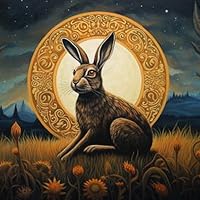
Onboard this lighthouse, we’ll never get ashore ...
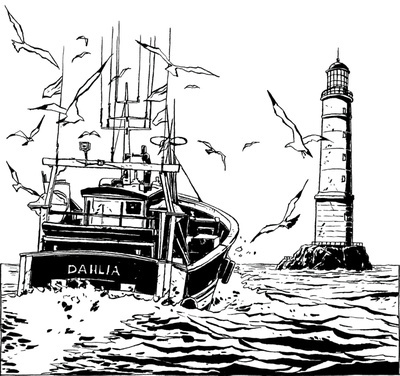
Associating lighthouse with loneliness is one of the most abused metaphors in literature. Yet Christophe Chaboute manages to create something that feels fresh and poignant out of the premise.
Unlike Park Bench , this album makes use of words and dialogue and concentrates on one character, but the artwork is clearly coming from the same hand that likes to draw simple, clear black and white line drawings arranged in cinematic progression, reminding me of childhood flipbooks. His delicate touch on human emotions is well served by these stark graphic images
The main character is a recluse, a middle aged man who takes care of an offshore lighthouse. The only regular visitor to the rocky outcrop is a supply boat that was instructed to respect the resident’s privacy, leaving his packages on the pier at the base of the tower.
Before we are introduced to the main character, we witness the speculation of the two sailors manning the boat about who the man is, why he hides from the world, what does he do all alone in the middle of nowhere?
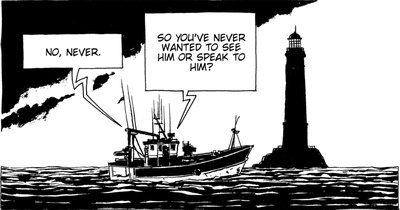
I believe the clue to this enigma can be found in the epigraph from the first blank page of the album:
Imagination : the ability to form a mental image of fictional or perceived objects or concepts not actually present to the senses. The ability to invent, create, or concoct.
When the focus of the story moves from the supply ship to the room where the keeper lives, we learn that he occupies his time fishing, taking care of his pet fish in a bowl and playing a game with a fat dictionary, riffling the pages and pointing his index finger at a random line.
He then proceeds to imagine what the word he picked really means. In the absence of any significant contact with the outside world, the keeper lets his imagination take over, with some oddball results.
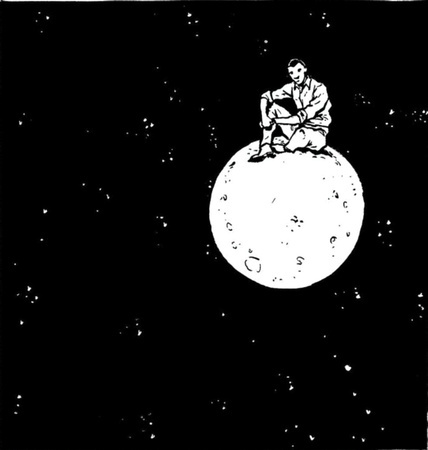
Among the words randomly chosen from the dictionary are the astronaut Neill Armstrong, centaur, cello, battle, solitude, routine, prison, etc.
Chaboute is actually carefully choosing these words in order to underline the quest of the keeper to escape from his marooned stone ship and to find a way to experience the real world directly, through his own senses.
The argument here is that the keeper needs to use his imagination in order to create a different future than the dreary repeat of his solitary habits.
I am planning to check out what else this talented artist has published.

September 14, 2019
The story of a deformed man who lives alone on a lighthouse. He spends his day randomly selecting words from an tattered dictionary, imagining their definitions. That is almost the entirety of the book over and over. It quickly lost my attention. The book also followed seagulls around for the first 50 pages. The book appears daunting at over 400 pages, but is almost wordless. I flipped through it in about 30 minutes. The art is quite good, but the author needs to learn how to edit.

January 27, 2020
Son zamanlarda okuduğum en güzel grafik eser.
Bu anlatının filmi de çekilebilir, kitabı da yazılabilir. Ama en güzel sanatsal formu grafik roman olmalı. Rutinin hem içinde hem de oldukça dışında ruha dokunan muhteşem detaylar, okuyucuyu/izleyiciyi alıp başka bir gerçekliğe götüren çizgiler ve de içimizdeki münzeviye ayna tutan minimalist bir hikaye. Kesinlikle tavsiyedir.
Bu anlatının filmi de çekilebilir, kitabı da yazılabilir. Ama en güzel sanatsal formu grafik roman olmalı. Rutinin hem içinde hem de oldukça dışında ruha dokunan muhteşem detaylar, okuyucuyu/izleyiciyi alıp başka bir gerçekliğe götüren çizgiler ve de içimizdeki münzeviye ayna tutan minimalist bir hikaye. Kesinlikle tavsiyedir.

September 11, 2017
There's some dialogue in this story, but very little. Mostly, it's pictorial tale, illustrated simply, strongly, beautifully.
There's an automated lighthouse out in the ocean but every week, a guy drops off two boxes of supplies down at the lighthouse dock. When his employee, a new hire, asks why, the captain of the boat explains that a man lives in that lighthouse, all alone in the 15 years since his father died. The new sailor asks why the alone man doesn't just leave and the captain then explains that the guy is horribly disfigured and the parents had never let him set foot on land so he's spent his entire life in the lighthouse and on the surrounding rock. It's been 50-some years.
The rest of the story shows/tells what this solitary man does with his life, day in and day out. He's clever, coming up with ways to entertain and stimulate his mind.
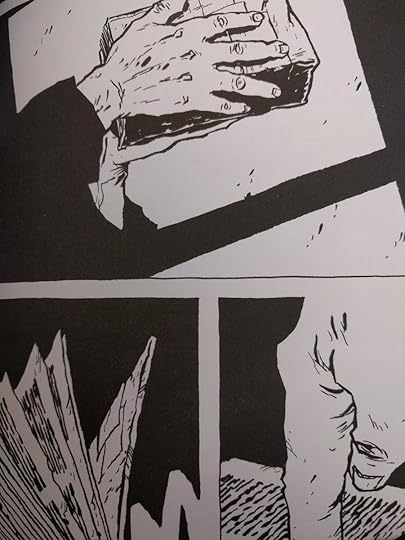
He has a collection of treasures washed up from the sea and they're enough to give him opening into the larger world, but not an opening large enough that he feels he can enter that world.
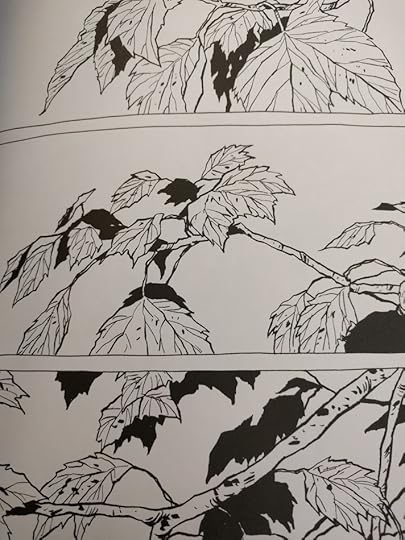
It takes a question from a stranger and a gossip magazine to make him realize there's so much more beyond his island and the treasure-bringing sea.
I loved all the emotions I got reading this story. The lighthouse dweller, isolated his entire life, is childlike in his awareness of the world. He imagines a podiatrist measuring human feet, the feet of tables and chairs, the bases of lamps because his lack of experience creates a lack of context. He has created a tidy existence for himself and his one friend, another gift from the water. Perhaps not knowing what he's missing - I'd say freedom but it's not so much that he's not free, more that he isn't aware of the possibility of stepping beyond his environment - makes him not bitter, not aggrieved, not yearn for everything beyond his doorstep. Because all that lies beyond his doorstep is saltwater and, once a week, a boat from which he hides. But no one can live without connection and he makes do until he can't anymore.
It's a sad story, sort of, but also graceful and uplifting.
I really liked it.
There's an automated lighthouse out in the ocean but every week, a guy drops off two boxes of supplies down at the lighthouse dock. When his employee, a new hire, asks why, the captain of the boat explains that a man lives in that lighthouse, all alone in the 15 years since his father died. The new sailor asks why the alone man doesn't just leave and the captain then explains that the guy is horribly disfigured and the parents had never let him set foot on land so he's spent his entire life in the lighthouse and on the surrounding rock. It's been 50-some years.
The rest of the story shows/tells what this solitary man does with his life, day in and day out. He's clever, coming up with ways to entertain and stimulate his mind.
He has a collection of treasures washed up from the sea and they're enough to give him opening into the larger world, but not an opening large enough that he feels he can enter that world.
It takes a question from a stranger and a gossip magazine to make him realize there's so much more beyond his island and the treasure-bringing sea.
I loved all the emotions I got reading this story. The lighthouse dweller, isolated his entire life, is childlike in his awareness of the world. He imagines a podiatrist measuring human feet, the feet of tables and chairs, the bases of lamps because his lack of experience creates a lack of context. He has created a tidy existence for himself and his one friend, another gift from the water. Perhaps not knowing what he's missing - I'd say freedom but it's not so much that he's not free, more that he isn't aware of the possibility of stepping beyond his environment - makes him not bitter, not aggrieved, not yearn for everything beyond his doorstep. Because all that lies beyond his doorstep is saltwater and, once a week, a boat from which he hides. But no one can live without connection and he makes do until he can't anymore.
It's a sad story, sort of, but also graceful and uplifting.
I really liked it.

September 1, 2017
Although this book is huge, it reads quickly. The majority of the panels are wordless. A ship makes a delivery to a lighthouse on an island just barely large enough to hold it. The captain tells his shipmate that, even though the lighthouse is automated. The son of the former caretakers lives there. Born deformed, he shuns human company, and hasn't been seen in years. We, the readers, do get to see the island's sole inhabitant and how he spends his days ...
The cover makes this seem like a more grim and bleak tale than it turns out to be. Alone is warm, whimsical, and human. Chabouté's approach is cinematic. Many of the panels feature moment to moment transitions which give the effect of slow pans and zooms. The pacing is leisurely, but never lethargic.
This whole book feels like some forgotten classic of French cinema, perhaps something from the 70's or 80's. It's not strongly set in any particular era. It made me smile and warmed my heart, which is no mean feat for a graphic novel. Recommended!
The cover makes this seem like a more grim and bleak tale than it turns out to be. Alone is warm, whimsical, and human. Chabouté's approach is cinematic. Many of the panels feature moment to moment transitions which give the effect of slow pans and zooms. The pacing is leisurely, but never lethargic.
This whole book feels like some forgotten classic of French cinema, perhaps something from the 70's or 80's. It's not strongly set in any particular era. It made me smile and warmed my heart, which is no mean feat for a graphic novel. Recommended!
September 12, 2025
Solitário é uma obra-prima em novela gráfica que combina sensibilidade visual e narrativa minimalista para explorar os temas da solidão, do isolamento e da descoberta do mundo. A história acompanha um homem que passou toda a sua vida, ou seja, 50 anos, confinado a um farol, sem nunca ter contacto humano directo, vivendo sob a proteção e controle de seus pais até estes falecerem. O protagonista possui uma deformação física que sempre foi mantida escondida, conhecida por todos, mas nunca vista, aumentando o sentimento de alienação e diferença.
O pai, o último a falecer, deixou instruções e dinheiro confiados a um pescador para garantir que o filho tivesse alimento. O pescador mais velho apenas entregava as caixas de mantimentos, cumprindo mecanicamente a função, sem jamais interagir ou despertar curiosidade no protagonista. Essa rotina reforça o isolamento total: ele conhecia apenas o farol, o mar, o peixe que tinha no aquário e o dicionário que lia aleatoriamente e que gerava nele criatividade, sem nunca imaginar um mundo além daquele espaço.
Um momento significativo ocorre quando, ao folhear o dicionário, encontra a palavra “monstro” e decide ver-se ao espelho. É o primeiro instante em que se confronta com sua própria imagem e com a deformidade que o isolou socialmente. Esse episódio revela o peso emocional do confinamento e da percepção de si mesmo em relação ao mundo exterior, ainda que invisível.
O verdadeiro ponto de viragem na história surge com a acção muito humana do pescador mais jovem. Diferente do mais velho, ele faz uma pergunta simples mas transformadora através de um bilhete: “Há algo que você gostaria?”. Esse gesto aparentemente banal desperta no protagonista curiosidade, fazendo-o refletir sobre sua própria vida, sobre liberdade e sobre tudo aquilo que nunca conheceu. É um exemplo claro de como uma acção pequena, humana e empática, pode provocar uma revolução interna, quebrando anos de isolamento e rotina.
Chabouté usa elementos visuais para reforçar o tema da liberdade e do autoconhecimento. Há vários que contrastam com a prisão do farol, como por exemplo gaivotas a voar, cavalo a correr, o mar, sugerindo possibilidades infinitas e instigando o leitor a refletir sobre limites e oportunidades.
A narrativa de Solitário é quase sem palavras, transmitida principalmente através de ilustrações a preto e branco. A economia de palavras aumenta a intensidade das imagens e faz o leitor mergulhar na experiência de solidão e descobrimento do protagonista.
Solitário é uma história sobre solidão, coragem, descoberta e liberdade, mostrando que mesmo gestos simples ou palavras aparentemente banais podem ter impactos transformadores. Chabouté constrói uma narrativa sensível, visualmente rica e profundamente humana, lembrando-nos que o mundo é maior do que os nossos limites autoimpostos e que a liberdade muitas vezes exige coragem para deixar para trás aquilo que nos protege, mas que também nos aprisiona.
O pai, o último a falecer, deixou instruções e dinheiro confiados a um pescador para garantir que o filho tivesse alimento. O pescador mais velho apenas entregava as caixas de mantimentos, cumprindo mecanicamente a função, sem jamais interagir ou despertar curiosidade no protagonista. Essa rotina reforça o isolamento total: ele conhecia apenas o farol, o mar, o peixe que tinha no aquário e o dicionário que lia aleatoriamente e que gerava nele criatividade, sem nunca imaginar um mundo além daquele espaço.
Um momento significativo ocorre quando, ao folhear o dicionário, encontra a palavra “monstro” e decide ver-se ao espelho. É o primeiro instante em que se confronta com sua própria imagem e com a deformidade que o isolou socialmente. Esse episódio revela o peso emocional do confinamento e da percepção de si mesmo em relação ao mundo exterior, ainda que invisível.
O verdadeiro ponto de viragem na história surge com a acção muito humana do pescador mais jovem. Diferente do mais velho, ele faz uma pergunta simples mas transformadora através de um bilhete: “Há algo que você gostaria?”. Esse gesto aparentemente banal desperta no protagonista curiosidade, fazendo-o refletir sobre sua própria vida, sobre liberdade e sobre tudo aquilo que nunca conheceu. É um exemplo claro de como uma acção pequena, humana e empática, pode provocar uma revolução interna, quebrando anos de isolamento e rotina.
Chabouté usa elementos visuais para reforçar o tema da liberdade e do autoconhecimento. Há vários que contrastam com a prisão do farol, como por exemplo gaivotas a voar, cavalo a correr, o mar, sugerindo possibilidades infinitas e instigando o leitor a refletir sobre limites e oportunidades.
A narrativa de Solitário é quase sem palavras, transmitida principalmente através de ilustrações a preto e branco. A economia de palavras aumenta a intensidade das imagens e faz o leitor mergulhar na experiência de solidão e descobrimento do protagonista.
Solitário é uma história sobre solidão, coragem, descoberta e liberdade, mostrando que mesmo gestos simples ou palavras aparentemente banais podem ter impactos transformadores. Chabouté constrói uma narrativa sensível, visualmente rica e profundamente humana, lembrando-nos que o mundo é maior do que os nossos limites autoimpostos e que a liberdade muitas vezes exige coragem para deixar para trás aquilo que nos protege, mas que também nos aprisiona.

November 23, 2016
Ako ovo nije najtuznija prica ikad nacrtana, onda je barem u samom vrhu. Kadrovi su predivni i isto toliko usamljeni i tuzni.
Jedna stolica, jedna casa, jedan tanjur, jedna vilica, jedan tragican lik, na prozoru naslagane stvarcice koje pripadaju nekim drugim zivotima, a koje su slucajno doplutale... Jedna ribica, jedan rjecnik i nevjerojatna snaga maste. Jedan krevet i rutina...
Jedan slucajni, empaticni prolaznik i jedna mozda mala nada.
Slomio me sa svim svojim detaljima. Pretuzno.
Jedna stolica, jedna casa, jedan tanjur, jedna vilica, jedan tragican lik, na prozoru naslagane stvarcice koje pripadaju nekim drugim zivotima, a koje su slucajno doplutale... Jedna ribica, jedan rjecnik i nevjerojatna snaga maste. Jedan krevet i rutina...
Jedan slucajni, empaticni prolaznik i jedna mozda mala nada.
Slomio me sa svim svojim detaljima. Pretuzno.
This entire review has been hidden because of spoilers.
December 7, 2021
Başından sonuna hüzün dolu, etkileyici. Anlatmak istediğini sessizlik içinde anlatıyor. Dingin ve sakin. Çizimler de buna paralel çok detaylı değil ve sade. Dolayısı ile kalın olmasına rağmen çok çabuk okunuyor (izleniyor). Daha uzun olabilirdi diye düşünmeden edemedim açıkçası bitirince. Bir iki şey eksik kaldı gibi hissettim; tekne misal.

June 11, 2018
A door stopper that I could have read in an hour or less. The dialogue was minimal even for a graphic novel. The story may seem simple, but it’s really not. Would recommend.

July 9, 2021
Emocionado demais com essa obra! Uma mensagem pra vida.

June 7, 2021
Yüksek fiyatına karşın hafif içeriği ve hızlı okunması nedeniyle üniversite yıllarımdan sonra çok uzun bi süre çizgiromandan uzak kalmıştım. Ancak yıllar sonra Sualtı Kaynakçısı, Portekiz, Jeff Lemire'in Essex County üçlemesi gibi harika çizgi romanlar beni tekrar bu yola soktu.
Yapayalnız da anafikir ve işleniş olarak güzeldi. BOOM sesinin nereden kaynaklandığı merak uyandırdı ve sonundaki plot twist de beni mutlu etti. Ancak yine de hikaye bir bütün olarak tatmin etmedi. Çizgiler sadeydi ve pek fazla detay barındırmıyordu. Bununla birlikte bir martı uçuşuna 4 sayfa ayırınca yer yer sayfaları oldukça hızlı çevirirken buldum kendimi. Öyle ki sayfaları yanyana değil de arka arkaya koyup bassalar ve çocukluğumuzdaki gibi sayfaları hızlıca parmağımızın ucuyla serbest bıraksak muhtemelen çizgi film gibi hareketli bir görüntü elde ederdik muhtemelen.
Dolayısıyla belki 40 dakikada bitirdiğim 376 sayfanın ardından ödediğim 41.25 TL'ye değdi mi? Bence değmedi.
Herkese keyifli okumalar
Yapayalnız da anafikir ve işleniş olarak güzeldi. BOOM sesinin nereden kaynaklandığı merak uyandırdı ve sonundaki plot twist de beni mutlu etti. Ancak yine de hikaye bir bütün olarak tatmin etmedi. Çizgiler sadeydi ve pek fazla detay barındırmıyordu. Bununla birlikte bir martı uçuşuna 4 sayfa ayırınca yer yer sayfaları oldukça hızlı çevirirken buldum kendimi. Öyle ki sayfaları yanyana değil de arka arkaya koyup bassalar ve çocukluğumuzdaki gibi sayfaları hızlıca parmağımızın ucuyla serbest bıraksak muhtemelen çizgi film gibi hareketli bir görüntü elde ederdik muhtemelen.
Dolayısıyla belki 40 dakikada bitirdiğim 376 sayfanın ardından ödediğim 41.25 TL'ye değdi mi? Bence değmedi.
Herkese keyifli okumalar

October 4, 2020
Bir deniz fenerinde toplumun normlarına aykırı bir görünüşe sahip olduğu için kapalı kalan bir adam Yapayalnız. Bir tek sözlüğü ve bir de akvaryum içinde balığı var. Sözlükten rastgele kelimeler seçip onların anlamını hayal gücüne göre şekillendirerek o deniz fenerindeki sonsuz zamanı tüketmeye çalışıyor. Ta ki ona haftalık erzakını bırakan tekneye çalışmaya herkesten farklı biri gelene kadar. Çizimler benim tarzım değildi ancak hikayeyi sevdim.

November 29, 2016
Just...beautiful.

October 19, 2019
Hiç bir şey söylemeden de bir çok şey söylenebiliyormuş.
Displaying 1 - 30 of 614 reviews