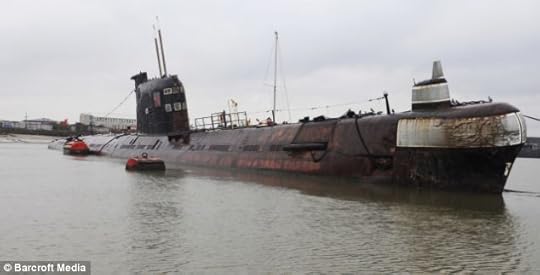
How close did we come to nuclear war? Within a word, but most people don't know the story.
Based on the true story...suffering PTSD and radiation poisoning from the K-19 disaster, Vasili Arkhipov rides the B-59 submarine carrying a nuclear torpedo into the Cuban Missile Crisis that thrusts him between Captain Savitsky and apocalyptic disaster. The Last Saturday of October is the real-life hero’s saga of the Russian sailor who saved the US from a nuclear firestorm on the most dangerous day in human history. It bears witness to the little-known B-59 incident in a scorching portrayal of the military standoff on Black Saturday 1962. It is a submarine thriller, delivered with the intensity of Red October and Das Boot, so detailed and gripping that it's hard to remember that the wild tale is true. The declassified story of Vasili Arkhipov, the Soviet naval officer who preempted a nuclear strike on America, is told from the claustrophobic confines of the Soviet submarine, B-59 beneath the sweltering sea. It reconstructs the submarine’s journey from Murmansk to the Cuban Missile Crisis in meticulous detail and recounts known events from inside the hull, shedding new light on accepted historical “truths.” The world watched in horror, never knowing that their only hope for survival was a sailor submerged beneath the Sargasso Sea. Declassified documents, US and Soviet, furnish evidentiary artifacts of the B-59’s voyage and provide the factual foundation for the story that reminds us of our tenuous existence in a nuclear world, and how we nearly lost it.
This book is based on a true story and is set during the Cuban crisis of 1962. Prior to reading this book, I was familiar with world events during the Cold War but not all of the detail. The story is told from a Russian perspective and, to me, it highlighted the anxiety for the Russian military leaders working in a regime full of spies, half-truths and entirely lacking in trust. It made me reflect on how difficult it must be, for the men on the ground, to conduct a mission under such difficult circumstances.
This book is incredibly detailed about the life of military personnel on a submarine during this period. It was easy to imagine the cramped space, limited and unexciting food choices, long work hours and, further into the book, the adverse weather conditions and terrible heat. I found some of the descriptions a be overly lengthily and technical for my personal taste. The book was slow moving for the first half, the bulk of the writing being devoted to technical descriptions and scene setting. The action picks up significantly during the last 40% of the book and the story becomes very thrilling and past paced.
The characters were interesting, especially Starpom and the old man (captain). The author captured their thoughts, emotions and aptly described the heavy burden of responsibility each man carried on this dangerous mission. It is spine-chilling to think that but for the actions of one man, we could be living (or not living) in a post-apocalyptic world.
I would recommend this book for people who are interested in military history and stories about survival under difficult circumstances.
About the author: According to the information in the book, the author graduated from the US Naval Academy and served as a naval officer aboard the patrol gunboat, USS Douglas, and on the fleet ballistic submarine, USS Will Rogers. He qualified as a surface warfare officer and as a submariner. He attended Yale University on a sonar scholarship and received. He studied writing and Russian history at Winthrop University.
Structure of the book: The book is divided into 17 chapters, to which there are added several parts such as preface, introduction, appendixes, bibliography and notes.
Overview: We all heard about Attila, Caesar, Constantine, Napoleon, Alexander the Great or Kennedy. These were great leaders which are not going to be forgotten very soon, if ever. But behind great leaders there have always been groups of great minds: counselors, generals, servants, wives or even mistresses. Although they are condemned to anonymity, these too contributed significantly to great victories or to harsh defeats, these too took important and crucial decisions, and these too often risked their lives, only for the leaders to take all the credit for their work. This book is about one of these great anonymous persons that did more than avoid a war, he prevented the end of the human race. Nobody heard about Vasili Arkhipov, and yet he had the fate of mankind in his palm. In the 1960s, during the tensions of the Cold War and the Cuban Missile Crisis, the difference between life and death, nuclear winter and clear sky, stood in a decision taken in seconds by one person, while bombs were being dropped upon his submarine. Based on historical documents, with a large expertise in the military field (especially submarines) and driven by sheer passion, the author managed to put together a story that accurately reproduces one of the decisive, and yet unknown, moments for mankind. One word, one switch of a button, one drop of sweat and we could have been history; all of us. The story is an eye-opener and makes the reader aware of the dangers of our time. Our lives, our children’s lives and our future depend on the experience, sanity, inner humanity and goodness not only of our leaders, but also of the anonymous men standing behind our leaders. If only one of these many men makes a mistake consequences can be unimaginable.
Quote: Submarines do not fail safely … They fail catastrophically. Like a helicopter, a submarine is a flying rock, and when things go wrong it will drop like a stone unless the humans onboard take immediate actions to regain control of the craft.
Strong points: I think the idea of putting together historical documents and, based on them, making a story for the general public is a brilliant idea and a strong point in itself. The details and the way the author presents the life on a submarine are amazing; as a reader, you can clearly notice the expertise of the author in this field. Moreover, the author managed to precisely reproduce the Russian mindset, especially in relation with the Americans.
Weak points: In the first edition of the book, which I read and reviewed, there are some problems that prevent me from giving it five stars. A couple of paragraphs have not been well formatted. The pictures inserted are welcome, but they could have been better displayed. In a couple of places the story is hard to follow because it is filled with technical details or Russian expressions. Russian words meddled with English words is not a good idea because it is often confusing. There are a couple of links in the text toward Wikipedia; looks as if the author slipped them there. And least but not last, the parts after Chapter 16 seems to be useless (at 61% in the book). This is where the book should have ended in my opinion; or at least I felt that that was the natural end of it. I skipped most of the appendixes because they are filled with technical details that probably make much more sense only to a reader that has military/navy knowledge.
Who are your heroes? Churchill? Gandhi? Luther-King? However long your list is, it is very likely, like mine, not to include Vasili Arkhipov, a Russian submariner who, if you were born before October 1962 almost certainly saved your life, and if you were born after October 1962, almost certainly made your life possible. The Last Saturday of October is the fact based story of probably the most important, unsung superhero and saver of humanity there has ever been. It is narrated in beautifully intricate detail, from the point of view of one inside the B-59 submarine through its terrible voyage during the Cuban Missile Crisis - and Douglas Gilbert knows from personal experience, what life inside a submarine is like, which comes across with a chilling reality that no writer, however talented could conjure up simply from imagination. Researched to the standards of a university text book, but told to the standards of a great novel, I am simply in awe. If you read no other modern history this year, read this book.
“The Last Saturday of October” by Douglas Gilbert, is a recounting of the Cuban Missile Crisis of 1962 from the perspective of Soviet submariners who were dispatched to the region by the leaders of the Soviet military.
The story is told by the men who served the Soviet Union in submarines. They sailed from the arctic port of Polyarny in Russia’s waters, extending through Kola Bay, past the Norwegian Sea and into the North Atlantic: destination Mariel Bay, Cuba. Gilbert’s harrowing descriptions of life on a diesel-powered submarine illuminates the terrible conditions thrust on the sailors who manned these less than perfect vessels. Their Soviet leaders showed little regard for their lives while at sea and even worse when they returned.
Gilbert conveys an impressive understanding of nautical terms and the operation of a diesel submarine, so much so that it suggests to this reader, that he may have served on such a ship.
Gilbert’s primary protagonist is Captain Second Rank, Vasili Arkhipov, who prior to his appointment on the submarine was an officer on a doomed Soviet nuclear submarine that had seen the horrific deaths of many sailors due to the malfunction of its reactor.
Relegated to a supporting post, Vasili is appointed the ship’s Chief of Staff and Executive Officer, known as Starpom. While passed over as the overall commander, Starpom’s duties prove critically important during the crisis. He’s haunted by the images in his mind of courageous sailors who lost their lives in their effort to restore his previously doomed vessel. By keeping his personal demons in check, he keeps his head while others lose theirs.
All the submarines in the fleet from Polyarny have been outfitted with tactical nuclear weapons in the form of torpedo warheads. Once the secret of the special weapons is revealed, the commanding officers contemplate their power and possible use. In particular, Captain Second Rank, Valentin Savitsky, the commander of Vasili’s submarine, is fully aware of their power and resigned to using his weapon if he finds himself in a fight with the Americans.
The Soviet fleet of submarines sails into the Sargasso Sea and is buffeted by a hurricane. None of the men from the frozen north has ever been in the tropics, and they suffer greatly, both in oxygen deprivation and lack of ability to abate the oppressive temperatures and humidity found below deck, not to mention the appalling personal hygiene options.
While I found the author’s initial references to Arkhipov as “the Legend,” in the early part of the novel, a bit distracting, I relaxed once he began calling him Starpom, his appointed position and continued to refer to him as such through the balance of the book.
The book is really a tribute to Vasili Arkhipov and his part in averting a nuclear war between the United States and the Soviet Union. Gilbert makes it more than clear that this was his intention. While I would have preferred to see the action carried out with more specific and less general narrative description, it’s undeniable that the actions of Vasili’s Starpom helped stave off nuclear annihilation to much of the world. For that, I have to salute Douglas Gilbert’s heartfelt tribute to the legend, Vasili Arkhipov.
This is an incredibly well-researched book. The last 50 pages or so detail his sources in fleshing out the story. He could have used footnotes but thankfully didn’t, as they would have been a distraction to this reader.
Anyone who’s interested in this period in recent history would be well served to consider reading “The Last Saturday of October” to learn about Vasili Arkhipov’s contribution to the preservation of civilization.
I grew up during the cold war era, so I looked forward to reading this book. I am just a bit too young to actually remember the Cuban Missile Crisis. After all, I was two-years-old at the time. However, the story was pretty well-known and often a topic of conversation by people around me during my younger years. Despite that, reading this book was quite a shock. What really floored me while reading The Last Saturday of October, was how much we did not know.
This story is a thriller and a historical bombshell. Written from the point of view of the Russians, the story is meticulously researched with much of the information only declassified in recent years. The characters are real and so well developed that you actually become part of the conversation and part of the story. You have the very real feeling that you too are on the submarine, and experiencing the same wet, cold, fear, discomfort, and uncertainty that the crew of submarine B-59 was dealing with.
What is truly extraordinary is the fact that, if not for the last minute moral decisions of a few Russian men, and especially Vasili Arkhipov, the world today would be very different. Many do not know just how dangerously close we came to nuclear war. It was a unique moment when that realization dawned on me.
Douglas C Gilbert (no relation) clearly knows his subject matter and probably has first-hand naval training or experience. I would certainly not be at all surprised to learn the author served a few years in the U.S. Navy. The dialogue and terminology ring very true throughout the story. The research and documentation are very impressive.
The Last Day of October is a must read for history buffs, military history enthusiasts, and anyone who enjoys well-written historical fiction. I give this book 5 out of 5 Stars and highly recommend it!
The Last Saturday of October is the true story of an intriguing and extremely dangerous episode in history – October 1962, when the world was tottering on the edge of nuclear destruction. Gilbert has obviously mastered huge amounts of research and experience in submarine warfare and tells the dramatic story of Russian submarine B-59 very clearly. The tale is told exclusively from a Russian perspective and in many ways, is concerned with the struggles of the submariners themselves, as they face Atlantic storms, then subtropical heat and US navy patrols to get to their allotted target area off Cuba, carrying their nuclear warhead. We are shown the heat, dehydration, low oxygen and rising tension in a submarine that is not equipped for its role and is cut off from communication with the world outside. It is easy for the reader to understand just how fragile and dangerous life in a submarine could be - from the moment the submarine dives for the first time and there is something wrong with the dive mechanism, almost plunging uncontrollably to fatal depths. As one of the main characters says: “Submarines do not fail safely. They fail catastrophically”.
The story culminates in the world threatening drama in the control room of B59 when the captain orders a last-ditch strike against an American aircraft carrier using a nuclear war-head torpedo. The only man who can prevent the triggering of world Armageddon is the submarine’s executive officer. The torpedo is made ready, the aiming systems are deployed and a single order is required. But at this last second for the safety of humanity, the executive officer manages to persuade the captain that there is another solution. He is maybe the only man in history who can truly claim to have saved the world from extinction.
Initially, some of the technical details – both of the mechanics and the organizational aspects of the Russian navy- can feel overwhelming (which is the main reason for dropping a star) but eventually, the book comes to exert an increasing fascination as the reader is immersed in the bizarre and claustrophobic world of early 1960s submariner.
"The Last Saturday of October" eBook was published in 2018 and was written by Douglas Gilbert. This is Mr. Gilbert's first publication.
I received a copy of this novel from the author in return for a fair and honest review. I categorize this novel as ‘G’. The story is dramatized non-fiction.
This is an inside look at how close the US and Russia came to nuclear war during the Cuban Missle Crisis. In 1962 the US had discovered Soviet nuclear missile sites in Cuba. The US set a fleet to stop shipping headed into Cuba that might be carrying nuclear weapons.
Captain Vasili Arkhipov is given the mission to take his submarine brigade to Cuba. They are carrying nuclear-tipped torpedoes. He had already survived a nuclear disaster at sea on another submarine and was suffering from what we now know as PTSD. His vessel and crew were being chased by a large antisubmarine force of the US. He was being pushed ever closer to having to use his nuclear weapons.
I enjoyed the 6 hours I spent reading this 238-page non-fiction book that reads like a thriller. I think that Gilbert did a good job of taking history and making it readable and exciting. I like the chosen cover art. I give this book a 4 out of 5.
I am alive today because of the actions of a Russian submarine officer. This is one of the scariest books I’ve ever read. It’s also one of the most authentic. About one third of the volume of the book is footnotes, excerpts, links, and other resources, much of it primary resource material (I found the footnotes to be just as fascinating as the story). The first part of the book is a novelized version of real events. Not fictionalized. Novelized—that is, told from inside the heads of the main characters. The reader is privy to thoughts as well as actions. It starts out like Das Boot. Part competence porn, part Band of Brothers, a varied group of men stuck together in a cramped, crowded, smelly submerged tank have to deal with adversity and each other. Then the sub reaches its destination and…choices have to be made. Well, thank goodness for Vasili Arkhipov. This isn’t just a good book—it’s an important one. Read it. Read it even if you have no interest in submarines, warfare, or near death experiences.
It gives you the feeling that you are in the boat. You can feel what they are going through and what they must have been thinking. Love the use of some terms only a submariner would know.
The word “thriller” hardly seems adequate to describe a barely fictionalized account of an event that actually occurred at the height of the Cuban Missile Crisis in 1962. Not only is this a pulse-pounding tale of a potentially-catastrophic incident that occurred between two super-powers, it is written from the Russian point of view, something we Americans rarely get to read.
The story follows a brigade of nuclear-armed submarines ordered to Cuba by the Soviet government as part of its nuclear weaponization program. We follow one of these subs, commanded by Valentine Savitsky and captain Vasili Arkipov, from the Russian Arctic south across the Atlantic. Almost immediately the sub runs into trouble at its first dive. Nothing gets any easier after that. The sub and its crew experience North Sea storms and an Atlantic hurricane that nearly does them in. Finally, they arrive in the tropical Sargasso Sea where they are essentially abandoned by Moscow, sent virtually no information, and left to fend for themselves. Their last order is to wait until given the order to proceed to Cuba. After the battering of the hurricane, they are left to languish in the tropics – a hot and humid climate that they and their ship are not prepared to survive, especially when forced to stay deeply submerged for long periods to avoid detection. The suffering of the sailors increases. Lack of oxygen and lack of water lead to various serious ailments – among them dysentery and painful skin diseases as well as extreme exhaustion. Death seems imminent.
Meanwhile, U.S. Navy has set up a blockade to prevent Soviet ships from entering and arming Cuba. A cat-and-mouse game follows between the sub and U.S. Navy ships determined to find it. This is where the drama comes in. The Soviet commander lacks orders from Moscow but is willing to use his nuclear-armed torpedo if war has broken out. He’s a warrior, and he wants to go down fighting. But has war broken out? Captain Arkipov convinces the commander that there is no sure sign of war, that the Americans appear only to be using sonobuoys for detection, not destruction, and a single ping from the sub might bring about an American stand down. That’s what the Russians do in the end. It works. In short, Arkipov manages to prevent the outbreak of World War III. Eventually the Soviet sub is detected and forced to surface. One of the lighter moments was learning that when the sub came up for air and to charge batteries, the Russian crew found itself surrounded by U.S. Navy destroyers shining bright lights on their sub and blasting out Dixieland jazz music in their direction. As they were in international waters and no conflict was imminent, the Americans let the Soviet sub go back out to sea.
My only critique of The Last Saturday of October is that it needed the thoughtful touch of a skilled editor. The book sometimes falls into deep weeds with its detailed descriptions of submarine construction, technology and culture that could cause crossed-eyes in the general reader. Also an editor would have caught and revised some inauthentic dialog and phrases that were nonsensical. Also problematic is the appearance of undefined naval and submarine terms that are unfamiliar to the general reader. An example is “piss cutter.” Look in your UrbanDictionary.com for that one.
After graduating from the U.S. Naval Academy and serving as a naval officer, author Douglas Gilbert spent his subsequent career in electrical engineering working on sonar detection systems in submarines and surface ships. He is imminently well-qualified to present this very well-researched account of a not well-known historical event. The book has photos, a detailed annotated bibliography, and glossaries. Word of advice to author: Find an agent who can sell this to Hollywood before some far-less qualified screen writer discovers the story. Last Saturday will make a great film.
This book was entered in The Wishing Shelf Book Awards. This is what our readers thought: Title: The Last Saturday of October: The Declassified Secrets of Black Saturday Author: Douglas Gilbert
Star Rating: 4 Stars Number of Readers: 16 Stats Editing: 9/10 Writing Style: 8/10 Content: 7/10 Cover: 5/10 Of the 16 readers: 11 would read another book by this author. 7 thought the cover was good or excellent. 15 felt it was easy to follow. 11 would recommend this story to another reader to try. Of all the readers, 7 felt the author’s strongest skill was ‘writing style’. Of all the readers, 9 felt the author’s strongest skill was ‘subject knowledge’. 12 felt the pacing was good or excellent. 11 thought the author understood the readership and what they wanted.
Readers’ Comments ‘I did enjoy this thriller although I suspect, despite the insistence of the author, most of it is fictional. But it was a gripping read with plenty happening to keep me interested. Also, any new angle on the Cuban Missile Crisis is always interesting.’ Male reader, aged 43 ‘For me the most interesting aspect of this book was the way the author showed what life is/was like on a submarine. The author obviously has a lot of experience in this, and this shows in the excellent handling of the setting.’ Male reader, aged 65 ‘Readers into military history might find this fascinating. Of course, the ‘thriller’ elements of the story are fictional but I think this is a clever way of putting across history. It’s considerably more accessible than simply a dry, historical text. The author did a fab job. Sadly, he did a terrible job on the cover.’ Female reader, aged 48 ‘Fascinating and scary how close it got to nuclear war. This book will make you think.’ Male reader, aged 28 ‘Intense, often gripping, like the ticking clock of a bomb. A tiny bit slow in parts when the author gets lost in technical info but, all in all, a very satisfying read.’ Female reader, aged 39
To Sum It Up: ‘A fascinating look at the intensity of submarine life and how close we were to all out nuclear war.’ The Wishing Shelf Book Awards
Who would have thought that the world nearly came to an end at the start of the swinging sixties? The story that Douglas Gilbert tells in this fascinating novel is full of underwater drama that impacts personally upon all the submariners aboard the B-59 submarine, as well as focussing upon the factually true, potentially nuclear, incident that took place in the water off Cuba in 1962. The clear narrative used by the author somehow conveys to the reader a taste of the repetitive monotony of the necessary duties regularly required from the crew, with an incredible amount of technical detail; while at the same time allowing an uncomfortable, sweaty, even claustrophobically candid, glimpse at the conditions experienced by the Russian sailors. Violent Atlantic storms and interpersonal disputes and differences of opinion among officers all add to the tension aboard the sub at different times. You are meant to recall that these events were very likely to have occurred during the Cuban Missile Crisis and, regardless of what generation the reader is, there is a certain amount of spine-tingling horror, of what might have been, that lingers in the memory after completing the book.
Gilbert uses his own knowledge and training as a submariner, and much historical detail with great skill. The characterisation and dialogue are clear and credible throughout the novel. When a touch of cynical, personal opinion creeps in about politicians, of whatever persuasion, together with their decisions and their foibles, it comes across as understandable and no surprise. This is an amazing story told with amazing clarity and verve. My only criticism would be that earlier, when there was such a lot of specialist navy detail to take in, long passages of technical description slowed down the story and delayed the tension still to come. This could be true for those readers with no military experience or without a particular interest in them. Nevertheless highly recommended.
I enjoyed the tension created by the writer of this book which is a historical fiction. Although this element is acknowledged by the author he publishes an impressive list of factual references. With his own knowledge based on life long work under the seas I found it very believable and It made me nostalgic for the tv series “voyage to the bottom of the sea” I watched in my youth. It’s a thinking persons read and some of the wording is impressive and always appropriate. It’s interesting to hear it from the soviet point of view too although there could have been more balance introduced by adding some dialogue from the US. side . Not my usual choice but if you like edge of your seat stuff that makes you think about how the fates could have ended everything read it. There’s a thread running through the book which readers will discover for themselves. The author states it himself . However horrible the thought “the threat of mutual annihilation” has prevented a global conflict for 75 years. As as those who wage war are affected by it‘a terrible consequences.
Gilbert weaves together a history of the Cuban Missile Crisis from the Soviet side. His knowledge of submarines, the men who served on them, and the Soviet Navy shine through the story to build a historical account that is validated by extensive documentation in the footnotes and bibliography. His knowledge of the day in October of 1962 when the world shuddered from fright is unparalleled. Other authors who were there on-board US ships and witnessed the events of the day do not compare to Gilbert's rendition . You will not find a more thorough examination of the crew of the B-59 on that fateful day.