This review was first published in my TRIAPA zine, The Watcher 3.8 (October 2025).
This is an excellent and peculiar novel: strange, atmospheric, and distinctly not a conventional fantasy. If anything, it is a kind of postmodern gothic masquerading as a tie-in, an eccentric experiment that uses the trappings of sword-and-sorcery to meditate on art, memory, and the metaphysics of evil.
The opening 10–15% reads like a baroque dungeon crawl: a company of adventurers brought together to confront a terrible sorcerer. This section is vivid, operatic, and tragic, with each hero meeting an ornate doom. Then the novel leaps forward decades into a new register. A playwright, Detlef Sierck, has been commissioned to dramatize the defeat of the dark enchanter Constant Drachenfels. The surviving heroes are summoned as consultants; the play is to be staged at the very site of the battle, the sinister fortress itself. This theatrical conceit, i.e. art performed within the haunted locus of its own subject, gives the novel a self-reflexive depth.
Among the characters, Genevieve, the centuries-old vampire, is especially compelling: a quiet, ironic observer who seems to carry history’s melancholy within her immortal frame. Oswald, the prince and ostensible slayer of Drachenfels, grows increasingly ambiguous as the story unfolds, while Detlef, the playwright, emerges as the novel’s true center: a man obsessed with turning horror into art, and art into truth.
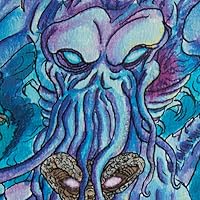
But what most haunts Drachenfels is its meditation on the ontology of evil. Constant Drachenfels, the titular sorcerer, ceases to feel like a mere villain in a story. His presence--a mask, half-symbol, half-entity--seems to assert itself through multiple narrative strata: Drachenfels the historical figure, Drachenfels the legend retold, Drachenfels the character in Detlef’s play, Drachenfels the force that perhaps transcends fiction altogether. The novel seems to whisper that evil itself may have ontological autonomy and that narrative and imagination are merely its disguises.
If we read this Platonically, we might say that Yeovil (perhaps unwittingly) dramatizes the Form of Evil, the abstract Idea that shadows all its particular instances. Plato conceived the Form of the Good as the highest reality, the sun from which intelligibility radiates; by inversion, Drachenfels suggests an anti-Form, a negative absolute. After all, if Goodness is Being (as in Plato and later in Augustine), then radical evil is a kind of parasitic existence, a privation that nonetheless exerts real influence. Simone Weil once wrote that "evil is the form which God’s mercy takes when we refuse it," and this is a paradox that fits Drachenfels, whose malign vitality endures because humanity continues to summon it in art, in ambition, in cruelty.
When the novel peels back its layers--the play within the story, the actor playing the villain, the author writing the actor playing the villain--we begin to suspect, like Boethius in The Consolation of Philosophy, that evil cannot be confined to persons or epochs; it is a metaphysical principle endlessly incarnated. The horror here is not only what Drachenfels did but that he is, and that his being can recur in new forms, again, and again, and again.
Thus, by the novel’s end, when evil resurfaces (I’ll leave the details unsaid), the reader feels less the shock of plot than the dread of metaphysics. The realization dawns that evil, like an archetype, subsists beyond time. It finds new vessels: in art, in memory, in pride, in the will to mastery. As we close the book, we recall that the same essence animates our own world’s atrocities: an abuser’s cruelty, a bureaucrat’s indifference, a tyrant’s delight in domination. Yeovil’s fantasy, then, becomes a parable about the persistence of evil’s form beneath history’s surface.
For a Warhammer novel to make us meditate on the Platonic Form of Evil is no small achievement. Drachenfels is a strange and understated triumph: a gothic mirror held up to the idea that stories, like rituals, can both contain and conjure the things they describe.