Jump to ratings and reviews
Rate this book

Born to Be Posthumous: The Eccentric Life and Mysterious Genius of Edward Gorey

Rate this book
From The Gashlycrumb Tinies to The Doubtful Guest, Edward Gorey's wickedly funny and deliciously sinister little books have influenced our culture in innumerable ways, from the works of Tim Burton and Neil Gaiman to Lemony Snicket. Some even call him the Grandfather of Goth.

But who was this man, who lived with over twenty thousand books and six cats, who roomed with Frank O'Hara at Harvard, and was known--in the late 1940s, no less--to traipse around in full-length fur coats, clanking bracelets, and an Edwardian beard? An eccentric, a gregarious recluse, an enigmatic auteur of whimsically morbid masterpieces, yes but who was the real Edward Gorey behind the Oscar Wildean pose?

He published over a hundred books and illustrated works by Samuel Beckett, T.S. Eliot, Edward Lear, John Updike, Charles Dickens, Hilaire Belloc, Muriel Spark, Bram Stoker, Gilbert & Sullivan, and others. At the same time, he was a deeply complicated and conflicted individual, a man whose art reflected his obsessions with the disquieting and the darkly hilarious.

Based on newly uncovered correspondence and interviews with personalities as diverse as John Ashbery, Donald Hall, Lemony Snicket, Neil Gaiman, and Anna Sui, Born to be Posthumous draws back the curtain on the eccentric genius and mysterious life of Edward Gorey.

513 pages, Kindle Edition

First published November 6, 2018

330 people are currently reading
5744 people want to read

About the author

Mark Dery

24 books97 followers
From http://markdery.com/?page_id=130

Mark Dery is a cultural critic, essayist, and book author who has taught at NYU and Yale. He coined the term “Afrofuturism,” popularized the concept of “culture jamming,” and has published widely on American mythologies and pathologies. His books include Flame Wars (1994), a seminal anthology of writings on digital culture; Escape Velocity: Cyberculture at the End of the Century (1996), which has been translated into eight languages; The Pyrotechnic Insanitarium: American Culture on the Brink (1999), a study of cultural chaos in millennial America; and the essay collection, I Must Not Think Bad Thoughts: Drive-by Essays on American Dread, American Dreams (2012). His is the author, most recently, of a biography, Born to Be Posthumous: The Eccentric Life and Mysterious Genius of Edward Gorey, published by Little, Brown in 2018.

Ratings & Reviews

What do you think?
Rate this book

Friends & Following

Create a free account to discover what your friends think of this book!

Community Reviews

5 stars
343 (25%)
4 stars
512 (37%)
3 stars
366 (27%)
2 stars
99 (7%)
1 star
34 (2%)
Displaying 1 - 30 of 334 reviews
Profile Image for Miranda Reads.
1,745 reviews165k followers
October 28, 2025
3.5 stars
description

But did anyone really know him? Did he even want to be known.
Edward Gorey is famously infamous.
Being nil, Gorey decided, was the safest policy.
His work provided the scaffolding and inspiration for Neil Gaiman's Coraline, for Tim Burton's creeptacular movies, for Lemony Snicket's Series of Unfortunate Events and so much more.

And yet, surprisingly little is known about him.

He wrote many delightfully macabre books, which alternately impressed and horrified publishers.
"There's so little heartless work around," said Gorey. "So I feel I am filling a small but necessary gap."
His books could never fit into one category, which often resulted in his work being shuffled off to the side.
Publishers were reluctant to market them to children, fearing their morbid subject matter and gleeful amorality were inappropriate...
But Gorey never let that stop him - he quietly puttered around with his odd little books and while he has faded from pop culture, his immortal influence lives on.

What a cool biography! (And you don't see me saying that very often!)

I never knew much about Gorey but I was definitely aware of Gaiman, Snicket and Burton - so I had a lot of fun getting to know the man behind the murders.

I love how Gorey kept making his horrendously amoral books solely because he felt like it.

I now have this huge itch to pick up everything Gorey has ever written and just read it - cover to cover - especially his murderous ABC books.

The book really emphasizes Gorey's commitment to his incredibly fine line art drawings - which have an etching-like feel - and I totally agree.

I loved all of the illustrations that the author included. They were so intricate and detailed - truly amazing that those were hand-drawn.

I honestly regretted that there were not more shown in this biography. Dery described the images so well that I kept wishing that he included more!

I really appreciated how much time and effort the author spent researching this novel (the sources section alone took up nearly sixty pages!) but, and this is more of a personal preference, but this book felt too detailed.

There were a few times where it really felt like we were circling back over and over to rehash the same topic.

For example, one thing the author never tired of discussing was Gorey's sexuality. The author states several times that:
Gorey's own preference, of course, was that he be seen not as a type - a gay artist or even an artist - but as an individual.
And yet, every few chapters, we would spend pages analyzing minute crumbs of Gorey's sex life (or lack thereof):
Everyone who encountered him assumed he was gay, yet he maintained, to his dying day, that he was a neutral.
It just became a bit wearisome the fourth time we went around the whole was-Gorey-gay-or-asexual shtick...

Overall - I really enjoyed my foray into Goreyland and I am absolutely excited to pick up a few of his novels!
Life, in Goreyland, is a random walk, full of mystery and melancholy, punctuated by the unpredictable and inexplicable.


All quotes are from an uncorrected proof and are subject to change upon publication

YouTube | Blog | Instagram | Twitter | Facebook | Snapchat @miranda_reads
Profile Image for Jeffrey Keeten.
Author 5 books252k followers
March 7, 2019
”Only now are art critics, scholars of children’s literature, historians of book-cover design and commercial illustration, and chroniclers of the gay experience in postwar America waking up to the fact that Gorey is a critically neglected genius. His consummately original vision--expressed in virtuosic illustrations and poetic texts but articulated with equal verve in book-jacket design, verse plays, puppet shows, and costumes and sets for ballets and Broadway productions--has earned him a place in the history of American art and letters.”

 photo Gorey20Mystery_zpsojw3x0xp.jpg

I first experienced Edward Gorey without even knowing I was in his world. The introduction to PBS’s long running series MYSTERY! was where I first brushed up against the uniqueness of Gorey’s imagination. I was in 8th grade. I can remember sitting there completely taken aback, unsure of what I’d just seen, but I knew I’d never seen anything like it before. Every week I watched the opening very carefully looking for anything that I missed the week before. It never occured to me to find out who the creator was of this wonderful opening or pursue other work by him. I wasn’t a fully developed researcher and collector of those things that pleased me...yet.

So when Little, Brown contacted me to see if I was interested in reviewing a biography of Edward Gorey, I felt a whole host of emotions. A) Even though I had occasionally browsed his books, I had never really allowed myself to be seduced by his work. B) I’d been in a Victorian phase for many years now and still had never delved into the carefully cross-hatched Victorian figures that Gorey created. C) This book could be the impetus to encourage me to finally launch a full out investigation of all things Gorey. D) I was thrilled with the opportunity to maybe finally close a circle begun when I was 13 years old.

 photo Gorey20Theater20Goers_zpsfx3g0que.jpg

Gorey was all that I hoped he would be. He was a voracious reader. He took a book with him everywhere so that any time he found himself waiting in line or stuck in a boring situation he could pull out his book and take himself elsewhere. He had over 21,000 books in his library at his death. He watched over 1,000 movies a year. Think that is impossible? Not if you don’t sleep. He was a huge fan of Buffy the Vampire Slayer, cats, and, most of all, Balanchine's ballet performances. To list all the things he enjoyed would maybe be contained in a scroll ten feet long if one wrote them in small, spidery script.

Gorey considered himself asexual. ”Thomas Garvey coins the useful term glass closet to describe ’that strange cultural zone’ inhabited by people in the public eye who ‘simultaneously operate as both gay and straight. Gorey kept perfectly mum about his true nature to the press; he only spoke about it in his art.’” I think that Gorey did not want to be pigeonholed as anything really. He was fussy about just being considered an artist when he really saw himself as a writer first. He was flamboyant in his appearance with wearing floor length fur coats year round and sporting rings on every finger. Supposedly, there was a lot of gay coding into his artwork for book covers that he designed for writers such as Herman Melville for Anchor Books. Looking at any form of art with an eye for overt or hidden symbols always makes me a bit nervous. Sometimes you find what you are looking for because that is what you want to find.

That all said, every crush that Gorey had throughout his life was some form of unrequited love for a member of the same sex. I wonder when we will reach a time when we are not categorized by our sexual preferences. Gay musicians/artists/politicians, etc. are still pressured by interest groups to declare their sexual preference, but by doing so they are generally suddenly defined first by their sexual preference, and everything else they do almost becomes a footnote to that revelation.

 photo Gorey20Children_zpsevulalv0.jpg
The melancholy deaths of Gorey’s children.

His books were dominated by infanticides. They caused parents to be uneasy and made it hard for booksellers to categorize his work. The awkward size of his books was also difficult and forced many publisher’s to design counter displays for his books at the register. Kids, in general, I have found, love his books. The creative deaths of the children in his books could be scary, but we do like to be frightened, especially when Gorey leads us onward to an ending that leaves us smiling.

He didn’t mind confusing us either. ”N is for Neville who died of ennui.” Or how about this one: ”Still later Gerald did a terrible thing to Elsie with a saucepan.” What terrible thing could anyone do to another person with a saucepan? The mind of the reader was forced to ponder and ponder some more. Usually, I ended up laughing at the scattershot directions that my mind went, trying to pluck the right thread that would lead me to where Gorey intended me to go. Or maybe he wanted the readers to lead himself to his own meaning.

 photo Gorey20Earbrass_zps67zui6tl.jpg
Clavius Frederick Earbrass

One of my favorite stories of his was ”The Unstrung Harp”, which was about a writer named (C)lavius (F)rederick Earbrass. ”’The best novel ever written about a novelist,’ Graham Greene called it in all apparent seriousness.” The book covered all the hazards of a writer’s life: ”disappointing sales, inadequate publicity, worse than inadequate royalties, idiotic or criminal reviews, terrors of the deadline and the blank page.”

 photo Gorey20Dracula_zpspwhxd7dc.jpg

The idea to have Gorey design the sets for the Broadway production of Dracula was simply a moment of brilliance. He threw himself completely into the project with “every leather-bound volume lovingly rendered of the books in Dr. Deward’s sanatorium library”. The bats, skeletons, death’s-head pansies, coffins, mummified corpses, Dracula’s watch chain strung with teeth, the drapes, and the exquisite wallpaper were all drawn with delicate care. This showed the world that Gorey was much more than just a cartoonist or “children’s” book author or really categorized any which way except that he was capable of showing exceptional talent in whatever medium he chose to express it. The show ran for 925 performances over three years and made Gorey a wealthy man.

 photo Gorey20Photo_zps4zg2cjfi.jpg

I was constantly, gleefully googling arcane references while reading this book. Gorey’s interests were wide and varied. By reading about his interests, I expanded my own passions, and really anyone who cares about the creative process should read this book. He was a Renaissance man, not only in talent but also in the way he found the world so fascinating. People might have been disappointing, but then he could always create more acceptable characters with the nib of pen. I will certainly be pursuing many more lines of inquiry inspired by this book. Mark Dery will take you on a journey into the development of a creative mind and introduce you to a man who figured out a way to live his life the way he wanted to. So few of us get that opportunity.

My thanks to Little, Brown who supplied me with a free copy in exchange for an honest review.

If you wish to see more of my most recent book and movie reviews, visit http://www.jeffreykeeten.com
I also have a Facebook blogger page at:https://www.facebook.com/JeffreyKeeten
Profile Image for Beverly.
950 reviews467 followers
September 25, 2022
I stopped reading this at one point, because it was a bit tedious, but I'm glad I thought to give it another go. The author started talking about Gorey's books and his illustrations in order of their publication and that's when I started enjoying this biography of the late, great Edward Gorey. When I read about an artist, that's where my interest lies is in their art. The discussion of the artist's influences and inspiration is what engaged me.

I learned other things too. I never knew that Gorey used pseudonyms. He would sign his books and art with a name made up out of the letters of his true name. These are fun and inventive and dour, just like his art. Not much is known about him personally. He was an only child in a family that wasn't very close. He adored animals, especially cats and always had a few about. Gorey liked collecting odds and ends and was a bit of a hoarder. He loved the ballet too and movies and television later in life.

Other reviews of this book have taken issue with how much of it has to do with the biographer's interest in figuring out if Gorey was gay. I think he was, but it doesn't really matter. His wonderful, weird and engaging art is what he should be and is remembered for.
Profile Image for Samantha.
63 reviews8 followers
January 23, 2022
So, are we just all gonna ignore the fact that Dery is being acephobic? He clearly has an agenda.

Page 136: "If such articles are to be believed, then 'Gorey wasn't necessarily gay, even though he was a lifelong bachelor who dressed in necklaces and furs....he was just asexual, a kind of lovable eunich.'"

Page 138: "Gorey kept perfectly mum about his true nature to the press; he only spoke about it in his art. And in a way, to be honest, the glass closet was appropriate to his artistic persona, which was neither here nor there, but locked in a kind of alienated stasis."

Page 139: "In New York, Gorey came closer to self-identifying as gay--IF ONLY IN HIS MIND AND TO A FEW CLOSE FRIENDS (emphasis mine)--than any other time in his life."

Page 174: "Gorey, of course, would've let out a theatrical groan at the suggestion that he was some sort of agent provocateur for the incipient counter culture." (Oh, cool, Dery admits even Gorey wouldn't have been on board with all this.)

Gorey himself has, fairly famously, publicly stated that he was generally sexless and asexual. From Ascending Peculiarity: "I'm neither one thing nor the other particularly. I am fortunate in that I am apparently reasonably undersexed or something ... I've never said that I was gay and I've never said that I wasn't ... what I'm trying to say is that I am a person before I am anything else ... "

Yeah, yeah, if it walks like a duck and talks like a duck, it might be a duck, but isn't that up to the maybe-duck to decide? Gorey might have been gay. Or not. Either way, it wouldn't have mattered, because it was up to him to decide how public he wanted to be with something as private as his sexuality. Dery very clearly overstepped a boundary. Dick move, man. You don't out another person, ever.

Dery spends nearly the entire book pushing an agenda that purports Gorey is an underappreciated gay icon, which he might be...if he ever self-identified as gay. WHICH HE NEVER DID. First of all, asexual is a valid identity, and to steamroll over Gorey's declaration as such does a disservice and is incredibly disrespectful to those who also identify as asexual--an identity wholly misunderstood and underrepresented. Secondly, BIOGRAPHIES SHOULDN'T HAVE AGENDAS. Biographies are based in fact. A good biographer tells the story of a person's life, all based in truths. Wanna start espousing *theories* about a subject? Write a theoretical art history book. Write cultural criticism. You could literally take this exact book and just change the title to not imply this was a biography. But none of that happened. Dery took information, developed a loose theory his subject was conveniently too dead to refute, and ran with it. That is not a biography. This should never have been called a biography. And frankly, I couldn't get past Dery so blatantly pushing an incorrect agenda--I after the first hundred pages, I hate-read the rest of this book, because I love Edward Gorey so damn much, and you, Mark Dery, RUINED IT. Who cares if Gorey was gay?! For a writer like Gorey, his sexuality, or lack thereof if you follow his own comments rather than Dery's, is wholly irrelevant to the collected body of work. Honestly, based on Gorey's childhood and his comments about children, I'd say looking at his views on family in relation to his work would be way more interesting, and *relevant*. Gorey clearly wanted to keep his sexuality private, for whatever reason, and that was his prerogative. For someone who claims to admire Gorey as much as he does, Mark Dery sure was disrespectful of him.

A book about a great subject does not make that book great.

As much as I want to give this book one star, I can't. It's still relatively well-written and well-researched, even if it completely disregards what a biography should be by bastardizing facts to support a personal narrative. The second star is also to maybe give Dery the benefit of the doubt and hope that maybe, just maybe, he wasn't the one who picked that title. His back-flap bio indicates he has a history of cultural criticism--which would make a Gorey-as-gay-icon treatise make a lot more sense. Just as photographers sometimes get blamed for retouching gaffes they didn't make (spoiler alert: most of the time, the magazines do their own retouching, and it has nothing to do with the photographer), maybe Dery is the victim of a bad title someone else picked? In any case, Dery massaged the truth to support a personal agenda, and that's inexcusable.
Profile Image for thefourthvine.
770 reviews243 followers
September 27, 2019
DNF. Dery spends a good chunk of the introduction (and as much of the book as I could bear to read) insisting that Gorey was gay, when his own statements on that matter were that he wasn’t much interested in sex and, when asked if he was gay, that he wasn’t one thing or the other. That seems pretty clear to me, but Dery goes the “ignoring everything he actually said in favor of tired stereotypes” route, insisting that Gorey was gay because everyone knew he was (uh, Gorey doesn’t seem to have?), because he wore fancy coats and loved ballet and had “bitchy wit” (seriously). It’s infuriating.

I honestly don’t know why Dery did this. He was really determined to interpret Gorey’s work through a queer theory lens, but he could as easily have done that while acknowledging that Gorery’s queerness was, apparently, asexuality. And it’s possible that he, as a queer writer himself, just wanted Gorey to be like him. Which, dude, I get it; I myself was pretty excited when I realized Gorey was queer. We’re always hoping our heroes will turn out to be like us. But — that doesn’t make it okay to overrule what Gorey himself said about his sexuality. It still just a gross, violating thing to do, to Gorey and to every asexual reader out there.

The rest of the book wasn’t worth enough to outweigh the damage done in stereotyping and erasing Gorey himself. This one gets a yikes from me.
Profile Image for Richard Derus.
4,178 reviews2,264 followers
June 15, 2022
I CHECKED THIS BOOK OUT OF THE LIBRARY. SIX TIMES. ULTIMATELY A LIBRARIAN BOUGHT ME A SALE KINDLEBOOK. (True story!)

My Review
: There are few things my elder sister and I agree on. One of them is that Edward Gorey's a bloody genius, and about as hilarious as it's possible to be. (We also both love Jo Walton, so it's not as though she's a waste of space. Entirely, anyway.)

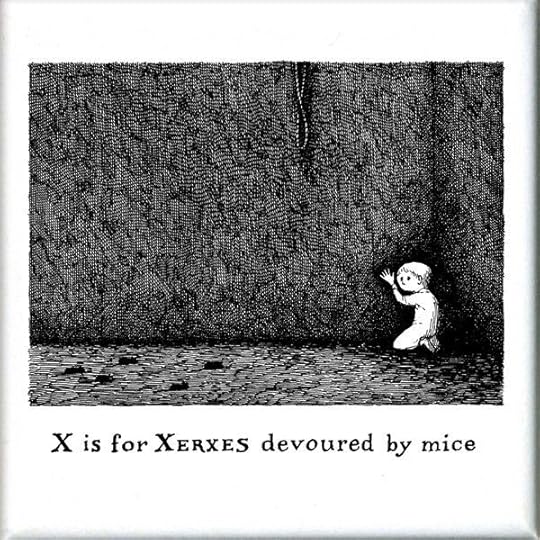
That's what Edward Gorey's superpower is, though. He speaks to a certain inner weirdo in some people, a rebellious streak that demands the sheer nonsensical pointlessness of Life be acknowledged and celebrated. Poor Xerxes...a Gashlycrumb Tiny I truly felt for.

Now that Gorey's safely dead, what's the skinny on his narrow gay ass? Welllll...not that fascinating, if I'm honest. He was exactly as you'd expect someone who could think up a child called "Xerxes" would be. Strange, a misfit, completely and utterly himself because he *designed* himself with great care. His artwork was justly celebrated for its technical merit...by three or four people. Weirdness exacts costs from the weirdo. Gorey was famous...if you know who he is. I'm never sad or sorry that I know who he is, unlike many famous people. But Gorey's talent as an artist was never the subject of major retrospectives at the Museum of Snooty Stuff or the Obscene Wealth Collection.

Unlike most of the art you'll see in those cultural institutions, you've seen a Gorey image. (If you're reading this blog, you have.) The Mystery! series opening sequence? Gorey. The 1950s Anchor Books images? Gorey. Over 100 of his own books, popular culture objects. He was a niche force, but a force nonetheless.

However, Dery's exhaustively researched biography goes into some detail about the skinny on Gorey's sexual nature. I think, like Greta Garbo, he wanted to be left alone. He never, ever once said he was gay. He lived through Stonewall...long after it was entirely okay with most people to come out as gay, he didn't.

Because he wasn't.

He said, in an interview collected in Ascending Peculiarity, "I'm neither one thing nor the other particularly. I am fortunate in that I am apparently reasonably undersexed or something ... I've never said that I was gay and I've never said that I wasn't ... what I'm trying to say is that I am a person before I am anything else ... " That, mes amis, is a clear statement of being. He was what we, in 2022, call "asexual." That doesn't prevent him from presenting himself in a striking and deeply queer-coded manner. But if the twenty-first century has taught me anything, it's that people are who and what they say they are. Gorey? Asexual, and presenting himself as a strange misfit. And that is all there is to it.

I wasn't pleased by Author Dery's claiming of him for the gay men of the world solely because we have his own words on the subject and they are not, despite the fact they could easily and safely have been, "I am gay." So. He wasn't. Yes, let's claim him as an ikon of the QUILTBAG spectrum! Yes, let's celebrate his Otherness, his determined design of his Otherness, and the glorious art that came out of it..."There's so little heartless work around," said Gorey. "So I feel I am filling a small but necessary gap."

But let's not posthumously (!) reassign his stripe on the flag for our own need to possess him. Let's celebrate the way he said he was with the gratitude and laughter and little frisson of unnerved nerves that he designed it to evoke in his viewers.
Profile Image for Montzalee Wittmann.
5,212 reviews2,339 followers
November 17, 2018
Born to Be Posthumous: The Eccentric Life and Mysterious Genius of Edward Gorey by Mark Deryis a book I requested and the review is voluntary.
I didn't even know who Edward Gorey was when I started this book, is that bad? Well I sure do now!
I love how this book is written. It is full of character and is very colorful just like the subject! Each chapter heading is unique, and the interviews, the subjects, the content, and the personal details are totally remarkably!
I started out knowing nothing about this man and ended up knowing more than I ever expected to! Brilliantly written about quite an interesting person.
I thank Little, Brown and Company for letting me learn so much from this talented author!
Profile Image for H (trying to keep up with GR friends) Balikov.
2,125 reviews819 followers
February 1, 2020
First, you must decide if you like the work of Edward Gorey
Next, you must decide if you want to know more about him than what you can see in his art and illustrations
Next, you must decide if you want to read almost 500 pages about him
Next, you must decide if Mark Dery is a reliable person to provide that information to you
Finally, you must decide if the price (list $35 US, $44.50 CAN) is worth it.
(And I guess, you must decide if you want to read any further in this review.)

This book is intended to “…get to the bottom of a man whose mind was intricate as Chinese boxes…”

Dery vows to “…use the tools of psychobiography to make sense of Gorey’s relationships with his absent father and smothering mother and of the lifelong effects of growing up an only child with a prodigious intellect (as measured by the numerous IQ tests he endured). Gay history, queer theory, and critical analyses of Wildean aestheticism and the sensibility of camp will be indispensable, too, in unraveling his tangled feelings about his sexuality, his stance vis-à-vis gay culture, and the “queerness” (or not) of his work. A familiarity with the ideas underpinning surrealism will help us unpack his art, and a close study of nonsense (as a literary genre) will shed light on his writing. An understanding of Balanchine, Borges, and Beckett will come in handy, as will an appreciation of Asian art and philosophy (especially Taoism), the visual eloquence of silent film, the mind-set of the Anglophile, and the psychology of the obsessive collector (not just of objects but of ideas and images, too).”

Gorey lists George Balanchine as “…the great, important figure in my life…sort of like God.” Though, Gorey worked with Balanchine, the best that Dery can suggest of a relationship between the work of these men is that “Gorey’s characters often strike balletic poses and tend to stand with their feet turned out in ballet positions.”

Yet, he goes on to note: “…his carefully staged tableaux seem about as dynamic as daguerreotypes next to the action-packed drawings of illustrators like Ralph Steadman and cartoonists like Jack Kirby, whose characters explode out of the picture plane.”

I loved the chapter on Masterpiece Mystery and Gorey’s contributions…but much of the book was a lot of work, and speculation.

I appreciated this Dery insight: “…his clarity and concision---the witty brevity of his writing, the economy of his line, his eloquent use of negative space, his beautifully balanced compositions---harmonize with the Balanchine aesthetic.” With this I would agree but I had consumed over three hundred pages of less than sparkling prose before finding this acorn.
Profile Image for Jason Das.
Author 9 books14 followers
May 21, 2019
Sigh ... what a squandered opportunity. Well-researched, dully conceived, poorly written.

I learned a lot about Edward Gorey (for which I am quite grateful) and I experienced a lot of how limited and tiresome Mark Dery is (for which I am quite annoyed).

An abridged version of this book (just the history and contemporaneous criticism, please!) would be a joy. Instead it’s a slog, mired in Dery’s overbearing neediness to act as the readers’ guide, interpreter, and self-conciously witty friend. On top of that, Dery is driven to categorize, define, look for hidden meaning, connect dots, Freudian-analyze, speak authoratively about specialized topics he doesn’t really understand, etc. (and show off his legwork for all of the above). If only he’d just get out of the way of the story—it’s a consistantly interesting one.

I like that images are distributed where they ought to occur in the text (rather than clumped in glossy inserts) but there should be many, many more. Time and again, Dery will spend a paragraph describing an illustration or object in superficial detail when we would be much better off just seeing the thing. (I’m sure the rights are expensive, but so is gumming up the book with all these extra words; maybe just tell us where to find the pictures in other books.) That said, I did appreciate the descriptions of things we can’t see as easily, such as theatrical works.

For all the minutiae in some areas, I miss it in others. Who paid for his theater company? How did he travel between NYC and Cape Cod? Why did Gorey think Philadelphia was closer to Pittsburgh than to NYC? Who took care of his cats in New York when he went to Cape Cod? Where did his cats come from? What were their names? Did he take them to the vet? (We do get a tiny bit of info about his cats, mostly those who survived him, but info on them seems like the most obvious hole in the book; they seem to have been much more important to Gorey than they are to Dery.)

Some of the endnotes are good and important (on such topics as David Bowie, the whiteness of Gorey’s world and art, the origin of the Black Doll), so take some time to scan for the long ones.

I recommend Joan Acocella’s review in The New Yorker and Robert Gottlieb’s review in the New York Times Book Review, both of which I read in the middle of slogging through this book. They are both enjoyable reads featuring valuable infomation and insight about both Gorey’s greatness and this book’s shortcomings.
Profile Image for John.
377 reviews14 followers
December 20, 2018
I'm less than thrilled with the idea of readers receiving a book from a publisher in exchange for a review. I'm unsure why that is permitted at all, but at least it is noted when it occurs.

I found this book neither good nor bad. Does it capture Gorey's unique genius? No. Does it focus too much on his sexuality? Yes.

Meh. Stick to Gorey himself.
Profile Image for Michael Martin.
275 reviews17 followers
June 18, 2019
Mark Dery’s 500-page biography of Edward Gorey takes on an influential and immensely talented illustrator and concentrates the bulk of its pages on endless and needless speculation about the artist’s sexuality.

Gorey is such a talented, colorful personality with nearly five decades of work that he deserved a far better author and presentation than this.

We learn precious little about how Gorey worked (other than quick references to Dover costume books and pen nibs) but we sit through chapter after chapter after chapter of Dery speculating on his sexuality.

Most infuriating are some of the rambling footnotes. In two cases he speculates that Gorey and Warhol must have met, even though a close associate tells him “No, they never did.” Dery insists they must have... because in one case they were featured in the same magazine.

Another footnote speculates, with absolutely NO evidence to confirm the statement, that Gorey might have been sexually abused by a member of the Catholic clergy. This is in a bio? With no evidence anywhere?

There is yet another troubling footnote taking on Gorey for racism, because most of his Edwardian/Victorian costumed characters were white.

All in all, I don’t regret reading the book. If nothing else, it made me pull my Edward Gorey collections off my bookshelf and reread and enjoy THEM. I suggest you do the same.
Profile Image for Betsy Decillis.
89 reviews2 followers
January 12, 2019
This is a book that reveals more about the author than it does the subject matter.

Based on the cover and the description, I expected to be swept up into an incredible journey about an incredible man. That did not happen.

Whenever I did lock into the book and writing, that would be about when the author's extreme interest in whether Gorey was homosexual or asexual would rear its ugly head. It became uncomfortable and downright disrespectful to the man he was writing about.

In the end, the author would do well to learn a few lessons from Gorey: Just be and be comfortable with the empty spaces.
Profile Image for Jim Coughenour.
Author 4 books227 followers
February 16, 2019
I first stumbled on Amphigorey in the summer of 1980 in a bookstore off Harvard Square – the moment of that discovery is cross-hatched in memory. (Up to that collection, according to Mark Dery, Gorey had been known only to the lucky few, particularly patrons of the Gotham Book Mart.) Later in the 1980s, at Booksellers Row in Chicago, I found 20 or more of the actual oblong books, seemingly moments after some ex-collector had dropped them off – and on Goreyesque winter evenings I lost myself among their pages. I can still recite some inspired passages by heart, which is nothing unusual among enthusiasts.

Mark Dery has done an exhausting job documenting the solitary cartoonish man behind the books. He's also taken something of a beating, in the reviews I've read – especially the one by Robert Gottleib – for making too much of the non-mystery of Gorey's sexuality. (Was there ever any doubt?) Hardly the most interesting thing about him (especially as he seems to have had almost no sex with anyone), but in the way of things his work would not have been what it was without it. Let's just say that when I first read The Gashlycrumb Tinies there wasn't any doubt in my mind that the wicked dark humor behind it was gay at its core – and that knowledge isn't something easy to explain.

Set that sterile debate aside. Dery's book is a gift to those of us who love Edward Gorey's work, who still marvel at his weird intelligence and splintered humor every time we look at it. Dery leads us through the work book by book, into the opacity of Gorey's eccentric and artful life. Many nights, reading it before sleep, I found myself laughing out loud at an aperçu Dery had rescued from oblivion, or getting out of bed to find one of the books in the tumble of my shelves and marvel again.
Profile Image for Kaethe.
6,567 reviews536 followers
March 9, 2019
Proceeding slowly as well, but that's because I keep following tangents down rabbit holes. I can't hardly go a page without wanting to Google something or add another book to the eternal list.

***
I did rather take my time, which only seems fair since Dery apparently spent something like 7 years writing it. He managed to amass not only facts and details, but also a meaningful context.

Biographies aren't usually my thing. There's the ever-present danger of learning something about the subject that will put you write off them forever, or there's too much about their romantic lives, or you just watch someone fade away into poverty and despair. Happily, none of that is the case here. Gorey didn't really have much of a romantic life, but his eccentricities were charming, and it doesn't all end sadly, and along the way we learn a great deal about his process and the ramifications of his creations.

And of course what I really like is realizing that even though I have nothing else in common with him we did share two things: a fondness for cats and reading. His Victorian through Jazz Age settings are just exactly what you get from reading tons of old novels. His Mortshire is modern enough to have plumbing and well-off enough to have servants, but it is devoid of so much of the irritating minutiae of real life and no one ever does anything much. Like murder-mysteries of the 20s and 30s one isn't met to feel a strong connection with the victims, and despite all the murdering, there aren't ever any stakes to speak of. It's all so refreshingly unemotional.

Library copy

Profile Image for Katy.
233 reviews2 followers
did-not-finish
February 7, 2019
Read the introduction, and was put off by the tone/approach/bias of the author, and abandoned this in the to-read pile for long enough to make it obvious that I won't be reading this one right now.

I mean, in the intro, the author quotes Gorey saying "I don't think I'm much one thing or the other", and then goes on and on about how he must be in denial -- he wore fur coats! He went to the ballet all the time! Obviously gay! Meanwhile, I was hoping for discussion of art, and process, and inspiration.

I might try reading it again another time when I don't feel so irritated about it.
Profile Image for Ariel.
1,912 reviews42 followers
February 8, 2019
I love everything every done by Edward Gorey so I just had to read this book. And I enjoyed the biographical bits of it, the parts about his life, how at one stage he went to NYCB every single night of ballet season for about 20 years and wore rings and a long fur coat and sneakers and a big Santa beard, but then moved to Cape Cod where he collected cats and crystal doorknobs and potato mashers and other peculiar objects (I once visited the house, which is now a museum, and greatly admired the doorknobs).

What I didn't like was the vast quantities of critical analysis of Gorey's oeuvre which is, at heart, specifically not meant to be analyzed. It's supposed to be silly and mysterious and a little creepy all at the same time. I especially did not enjoy the attempt to fit Gorey's persona and oeuvre into queer theory and the apogee of camp, and the author's endless speculations on whether Gorey ever consummated his gay crushes or was, as Gorey himself suggested pretty openly, asexual. It seemed somewhat beside the point to me, like my grandmother proudly claiming famous people as Jews, culminating in the announcement that Modigliani's mistress had been half-Jewish. (True story.) Yes, there's something campy and queer about Gorey's aesthetic. But that's not WHY he's great. It's just HOW he's great. Or part of it, anyway.

I must admit I rather skimmed toward the end, which ended with a perfect Gorey touch of him leaving most of his money to benefit animals, including "the Elephant Sanctuary in Hohenwald, Tennessee; the Xerces Society in Portland, Oregon, dedicated to invertebrate conservation, and Bat Conservation International in Austin, Texas."
Profile Image for Laura Floyd.
1,151 reviews49 followers
gave-up
December 4, 2019
Edward Gorey's art is fascinating, so he must be a fascinating man, right?

I think the answer to that is, "right!" but, unfortunately, I could not read this book. I made it through chapter one, which was as far as I had to go to become convinced that the author has an agenda. This book is not a biography so much as it seems to be an attempt to posthumously prove that Edward Gorey was gay, and therefore worthy of being a gay icon.

IF the man was gay, that's cool. If he'd wanted to be an icon of any kind, cool. But Gorey was (as was made very clear, even through only chapter one) famously averse to discussing his sexuality, claiming directly in one interview to be asexual.

BUT! exclaims Dery triumphantly. BUT! He was flamboyant and didn't date women. GOTCHA!

Okay, so by the end of chapter one we hadn't gotten around to any gotcha-ing, but that did feel like the conclusion we were likely heading inevitably toward.

Let the man keep his own council on who he did or did not want to have sex with - even in death! He didn't want that to be a topic of conversation, so why are you making it one? Why CAN'T he be both flamboyant and asexual?

Blah. Sorry for the rant. Instead of reading this, I'm going to go find some of Gorey's books that I haven't read before which is, honestly, all of them. Everything I know about him I've learned from posters and illustrations without written context.
Profile Image for  Bon.
1,349 reviews198 followers
February 9, 2022
Yeah, no, we're not here for an acephobic agenda. I started this book and was like "hoo boy this author sure is obsessed with labeling Gorey's sexualit- oh THERE HE GOES AGAIN." So I read a few reviews and apparently this continues through the whole book. Nope.
Profile Image for Jenny.
32 reviews2 followers
February 1, 2019
I know it's already enormous but this book desperately needed more illustrations, if not colour plates.

Also, RELENTLESSLY and NON-IRONICALLY Freudian. My God.
Profile Image for Rose.
201 reviews7 followers
December 16, 2019
I loved Edward Gorey's work ever since I first saw the Mystery! intro as a kid. It's one of those pieces that really stuck with me for a long time. It wasn't until the internet took off and I was older that I was able to find it again and learn of Edward Gorey.

Luckily, I waited for the internet because if I had waited for this book instead, I would have been sorely mislead.

This book is offensive to every asexual person out there with the typical dismissal of asexuality with the "repressed gay" trope. It is evident that though the author was well-researched on Edward Gorey, using many primary sources, he forgot to look up what asexuality was, what it means, and only looked through a queer lens. He wanted Gorey to be something even Gorey said he wasn't.

I would have waved it aside if there wasn't (at what felt to be the end of every paragraph) a rhetorical question, "He claimed he wasn't gay... or wAs hE?!?!" Everything about his art and his friends' art is somehow homoerotically repressed. It gets irritating...

First thing's first, for those who may not be aware of asexual theory, slang, etc.: a crash course. Asexuality is the absence of sexual attraction to anyone and everything. Instead, the asexual community (sometimes shortened to "aces") recognize different types of attraction: aesthetic (anything to do with the senses), romantic (wanting to be in a close relationship), and sexual. Asexuals do not feel the latter. Aromantics (often overlap with asexuals, but not necessarily) do not feel romantic attraction (though this doesn't mean they can't love). In some ways, it's similar to how ancient Greeks viewed love (agápe, éros, philía, philautia, storgē, and xenia).

Sexual people (allosexuals) typically experience all three and usually experience them at once. This is why a lot of allos cannot distinguish the difference between finding someone "hot" and wanting to bone them or think sex = love. Part of this may be limited to English, which combines all of these into the same word, indistinguishably.

Sex repulsed is another term used in the ace community with its meaning being self evident. Not all aces identify as sex repulsed, some are neutral and a few enjoy sex. Ace/allo relationships happen, but with some agreement in place, especially if the ace person is sex repulsed.

Note that though the DSM recognizes sexual disinterest as a mental illness (Hypoactive Sexual Desire Disorder), diagnosis of HSDD is ONLY IF IT CAUSES UNDO STRESS and was meant for people dealing with sexual performance issues, not attraction ones.

Now...

I get how people may mistake Gorey for being gay. He was flamboyant, he liked ballet, he read gay authors... I mean, it would be prejudice to assume so, but I can see how one can jump to conclusions. Based on what I said about asexuality above, Gorey probably wanted to convey he was a "sex repulsed homoromantic asexual," meaning he was romantically attracted to other men, but asexual. These words weren't invented until later (maybe the 2000's).

From the biography itself:
"Gorey's own sexuality was famously inscrutable. He showed little interest in the question, claiming... to be asexual, by which he meant 'reasonably undersexed or something,' a state of affairs he deemed 'fortunate.'"

"Entering the hormone-addled years of adolescence, he showed no sign that his thoughts were turning to romance. As always, the objects of his affection were cats."
(wow, I'm feeling a bit called out by this description, haha *closes Youtube cat video*)

"Life... is a foot-draggingly gloomy procession of 'frustrated desires' and 'sex entanglements from what they tell me--I wouldn't know...' (Interesting to note that at eighteen--an age when most young men are feeling their oats--he's already holding the subject of 'sex entanglement' at arm's length."

Lurie, a co-worker and friend of Gorey's says, "Not everybody wants to wake up in the morning and there's somebody in the bed with them, you know? Some people value their solitude, and I think Ted was like that. He wanted to live alone; he wasn't looking for somebody to be with for the rest of his life. He would have romantic feelings about people, but he wouldn't really have wanted it to turn into a full-blown relationship, and that's why he never did." (pg 108)

Quoting a late friend's wife on Gorey, "'Most of the other servicemen thought they were both gay,' says Jan, 'but Gorey never put his foot under the bathroom partition,' so to speak."

"Did Gorey want to be wanted? Or did he really require nothing more than books, Balanchine, cats, and his work?" (I'm seriously being called out now, hahaha) "He confides [in a letter] that he feels... that, while he doesn't envy his friends the turbulence of their love lives, he does think he 'ought to be having a few direct emotional experiences, however small.'"

I had more tagged but my post-its fell out.... so...

I don't care if he was dubbed the Queen of Queers and sailed around on a flying unicorn for Pride Month. I don't even care if he dated people or had sex with people, he's the only one who can comment on what sort of attraction he felt. Otherwise, we could go around assuming all gay people forced into straight marriages are bi. "What? You say you're gay? But you're married to a woman. Clearly, actions speak louder than words."

You know who else is asexual and largely thought to be gay, Tim Gunn. The "make it work" guy from Project Runway. So there you go.

Go look up some pictures of cats.
Profile Image for Esther.
351 reviews19 followers
September 23, 2019
This one was a doozy! I think biographies can generally be hard for me to get through, but I quite liked this one! I think it lagged in the middle third, but I loved especially the chapters on the end of his life
Profile Image for Jim Dooley.
914 reviews68 followers
May 6, 2019
There just isn’t any way to sugar-coat this. For the first two-thirds of the book, there were several times when I wanted to throw the book through the window. (All right, I’d actually donate it to the public library.) The final third interested me much more and I looked forward to my reading sessions ... and I can even say that I was sorry to have the book end. (It will still be donated to the public library, though.)

My consternation wasn’t with the style of writing, or the fact that there weren’t all that many definitive conclusions shared with the Reader. No, after 7-years of writing this tome, Mark Dery found it necessary to pose the question over and over (and over) again, “Was Edward Gorey gay?” He then provides many examples to support that he was, but always comes back to not being certain ... and asking again. It is even mentioned at the end of the book, for cryin’ out loud!

Now, I’m not so naïve as to suggest that sexuality has nothing to do with an artist’s creativity. Of course, it does! But, in many instances, it isn’t the over-riding influence. If Gorey was gay, not EVERYTHING that he created or that held his interest was gay lifestyle-driven. However, from the number of times that the issue is brought to the forefront in this book, the Reader would soon surmise that understanding a person’s sexuality is always the key to understanding that person’s life. If that was the writer’s intent, I think there is a flaw in the logic.

Although I was aware of fellow artist, Charles Addams, much more through the television series, “The Addams Family,” and the publication of his drawings, Edward Gorey first took hold of my attention when his drawings were animated as the “intro and outro” for the PBS television series, “Mystery.” It reached the point that even if I wasn’t particularly interested in the story that week, I would tune-in to see the Gorey introduction.

In later years, I discovered that he had created the sets for the Frank Langella DRACULA play on Broadway. I would also run across some of his drawn images from time to time in magazines ... not always understanding them, but still fascinated by them. My culmination came a year ago when I purchased a 1000-piece Gorey jigsaw puzzle from the Columbus Museum Of Art, and it became a focal point for visitors who would tackle putting together a portion of the picture.

Now, there were aspects of the book that I really enjoyed:

* Although not pointed out as a theme, there were many examples of Gorey having an abundance of curiosity. Whereas most of us are curious for a moment and then let the thought go as we hurry on to the next aspect of our busy lives, he would explore it, turning it over in his mind until he found “a way in” to appreciating it. Being aware of the present moment was certainly a factor;

* He did not explain his Art, an aspect that frustrates followers of David Lynch. Gorey would set up a situation, but he left plenty of gaps ... often literally ... inviting his audience to participate with their own mind’s image or interpretation. This was undoubtedly why I didn’t always feel as if I understood his work, and yet I was still fascinated by it;

* There were many book, Art, music, and ballet references that were new to me, several of which I have already started tracking down;

* Gorey didn’t take himself or the opinions that others had of him too seriously. This led to him enjoying so much of what he did, and putting himself in the enviable position (as Dick Cavett noted) of living the life that he wanted to live. Cool!

Before I even finished the book, I was ordering Gorey books on Amazon, and I’m very much looking forward to enjoying them soon. So, I certainly can thank the writer for stirring me to do some further investigation, including more self-analysis of how I perceive my own life.

All of this is a long way of saying that your enjoyment of BORN TO BE POSTHUMOUS: THE ECCENTRIC LIFE AND MYSTERIOUS GENIUS OF EDWARD GOREY will depend greatly on your mood when you start it ... and if you can absorb without annoyance the continual sexuality questions.
Profile Image for Beth Adams.
33 reviews
March 2, 2019
oh C'mon, you know? I don't think Edward Gorey was "born to be posthumous" so it's a ridiculous title. I didn't think the Author was up to the task of this bio. Edward Gorey's work was larger then life in a way but also nonchalant. I didn't like the authors tone. I got this as a Christmas gift, read like the first chapter then felt ill and had to put it down. Corey was a genius. "The Elephant House" about his home and work habits, eccentricities, just weird tidbits about his life is a way better book and has lots of photos of his house which he called this, because if I remember correctly of a toilet that looked like a elephant's trunk or something. I've visited his house, (it is a museum of sorts) and that was really interesting. He collected strange things, he had an amazing eye, of course. Go out and find "The Elephant House" much better then this.
Profile Image for Amanda .
929 reviews13 followers
February 23, 2020
The only thing I knew about Edward Gorey before reading this book was that he wrote and illustrated The Gashlycrumb Tinies, a book I had spotted years before at a tiny shop. I loved the dark sense of humor and his tiny, detailed drawings. Fast forward many years later and after seeing this title, I purchased it without even reading the synopsis.

Gory was part of an influx of designers who transformed cover art and pushed the boundaries. Yet as much as he was known as an artist, I was surprised to discover that he would always think of himself as "first a writer, then an artist."

Dery paints a picture of Gorey as an intellectual savant, someone who seemed to know about everything and be inspired by everything he consumed. His books, like himself, are uncategorizable. He too, went on to inspire famous men such as Neil Gaiman, Tim Burton, and Lemony Snickett.

Gorey was a study in opposites, someone who actively worked not to become famous while also achieving a cult status amongst followers. He kept his friends and acquaintances at arm's length, keeping them in boxes so that different groups didn't overlap with others. Yet he craved companionship and closeness with others, while eventually pushing people who got too close to him away. People in his life only got to see the parts of him that he chose to share.

Unlike the last "biography" I tried to read by DNF'd (Ahem Truman Capote: In Which Various Friends, Enemies, Acquaintances, and Detractors Recall His Turbulent Career), this book wasn't just an amalgamation of reminiscences from former acquaintances and friends. This book was thoroughly researched and provides readers with a fascinating glimpse into the life of a notoriously private man. It was well researched and well written.

My only qualm about the book is that Dery continually implied throughout the book that Gorey was gay, despite the fact that Gorey publicly identified as asexual, when pressed. Dery's agenda to out Gorey as gay flies in the face of the assumption of the impartial biographer. Had Gorey been alive to read this book, I think he would not be accepting of Dery's attempts to out him, which could be interpreted as character maligning.

Despite this limitation, I thoroughly enjoyed the book and would recommend this to anyone who values dark humor and art.
Profile Image for Lolly K Dandeneau.
1,933 reviews252 followers
November 5, 2018
via my blog: https://bookstalkerblog.wordpress.com/
'Things impermanent, incomplete: these were the sorts of things Gorey loved best.'

I was excited to learn months ago that there would be a book coming out about Edward Gorey, the man whose genius inspired the likes of Tim Burton and Daniel Handler (Lemony Snicket), among others including Anna Sui. Ahead of his time, the ‘too strange and eccentric nature’ of his creations later found a wider audience, certainly with my generation and those born after. Gorey is the father of it all, a man who found beauty in ‘things withered’ as he took ‘pleasure in that which is old, faded and lonely.’ As to his sexuality, admittedly I am not interested in the speculation so much but can understand his hesitance during his time to claim homosexuality. During his youth, it certainly wasn’t a time embracing any peculiarities of arts nor any deviate from the so-called ‘norms.’ He was flamboyant in his dress, certainly it all seemed to be theater but reading about the way he kept his home, when he finally allowed someone deeper access into it, not everything was about ‘show’, with his home ever changing almost as if a stage for his entertainmen, a show for one. He seemed a man unto himself, someone who lived for his pleasures without the need to explain himself. I always find it interesting when we try to explore the sexuality of others, that it still makes people uncomfortable if someone doesn’t chose a label. Maybe it’s because I have family members who are attracted to people but aren’t (or weren’t for those now deceased) much interested in the complications of relationships, who chose to live their lives freely, to come and go as they pleased and put their time and attention into their passions, be it art, study work, travel. As well as others who once were married and when it ended invested in themselves, didn’t chose to have more relationships later in life. In fact, I see it all the time in neighbors, friends. Not everyone wants someone in their life, at their side all the time and would rather visit with friends and then go home to the quiet of their beloved solitude. Don’t confuse being sometimes alone with chosing to live as a recluse. Why is that so hard to accept? There are people who don’t really feel invested in their sexuality at all, who find their passions in other things beyond the body. Certainly the gay imagery in some of Gorey’s work fuels the whisperings that he was homosexual, as well as his own comments in interviews. There was also the earlier crush. In fact, Maurice Sendak (himself gay) met Edward Gorey and understood him, the need to hide his sexuality, as well as the struggle as an artist to be taken seriously, to become successful. Whatever his sexual preference was, Gorey was a wildly creative, fascinating, private man. Before he went to Harvard, his education was delayed by serving in the Army. It’s hard to associate the Edward we all know and love with the clean-cut military picture of one Private Gorey, circa 1943.

His childhood certainly doesn’t seem as ordinary as he led people to believe as you will read about in the chapter entitled “A Suspiciously Normal Childhood”. As the author asks, is it normal to be ‘cutting your eyeteeth on Victorian Novels’, learning to read at three? What about a grandmother’s madness? Seems he had plenty of gothic drama to fuel his future work, within his own upbringing. As this is a review, I won’t go into more, it’s in Mark Derry’s book, read it! It seems current times would have been perfect for Gorey’s talents, but maybe for someone enamored of his privacy fame would have been too itchy a coat for the man. Certainly I can imagine the shallow narcissism of our times would have been fodder for his work, even his later plays that seemed to become a bigger passion than releasing books for his fans. We can all learn so much from the pleasure Edward Gorey revelled in while creating something for the sake of doing it simply because you enjoy it and not worrying so much about the reception. In time, those naysayers will come around, which he learned years before with a certain magazine cover he landed after prior rejection. There was a lot I didn’t know about Gorey, and this book isn’t so much about revealing deep dark secrets as it’s a peek into the life of one heck of a peculiar artist, one whose macabre style was rich in texture, his shading with only a pen is incredible, his meticulousness evident with crosshatching. He had a signature style, creepy little stories that an untold number of artists have mimicked, but will we ever know the man fully? A man of biting wit, melodramatic about the smallest events and yet seemingly indifferent about the big stuff, lover of cats who he allowed free reign, even if it meant messing up work he spent hours on, contrary to his core, highly intelligent, a lover of the ballet, avid collector, a lover of things old, faded and lonely. Can we ever know even ourselves? For fans and people new to Edward Gorey, this is a wonderful read.

Available Tomorrow November 6, 2018

Little, Brown and Company
Profile Image for Lael Braday.
Author 9 books14 followers
January 3, 2019
The heartbreak of a good biography is finding out that the artist whose work sings to you is not the person of your imagination. It’s almost like a friendship breaking up over irreconcilable differences. The joy of a great biography is reveling in all the nooks and crannies of the artist whose work speaks to you. Mark Dery’s representation of Edward Gorey’s life is well-researched—including interviews with friends, family, and colleagues—and often feels too intimate, probing as deeply as possible into an ultra private man whose public persona was a purposeful put-on. The brilliant title and chapter headings are Gorey-esque: A Suspiciously Normal Childhood, Sacred Monsters, Epater le Bourgeois, Nursery Crimes, etc. Dery has sectioned Gorey’s life into childhood, education, career moves, and his various obsessions, the main ones being literature high and low, silent movies, and the ballet choreography of George Balanchine, with their corresponding closely-knit fan groups. Any Gorey fan can learn something new in this biography, for the man was quite complex, and he apparently needed little sleep, working on something every moment possible, from his little books sold successfully at Gotham Book Mart, through his book cover art and collaborations, to his work in theater and television. Though far from an open book, Gorey’s career flowed easily through profound and lasting friendships, Dery presenting the development and arc of such friendships with a light touch. Themes running throughout the biography are Gorey’s complex parental relationships, his tendency to keep himself to himself while handing out sardonic opinions like candy, and speculation upon his sexual orientation. Though he’d answered the question of his sexual orientation, speculation continued, with “evidence” pointed out in his work and life. Though Dery may reference the evidence and speculation a bit much, he offers a comprehensive gathering of Gorey’s work and a well-thought-out timeline of his life, with a wonderful takeaway that Gorey made his art to please himself. It’s a must-read biography of a man as interesting and mysterious as his little books of Victorian / Edwardian children suffering unusual demises. Little, Brown & Company graciously sent me an ARC of this fantabulous biography for an honest review.
Profile Image for Michael.
650 reviews134 followers
February 27, 2019
Having gathered slightly less than a handful of Gorey's books, and having been delighted and frustrated by them in equal measure, the publication of Dery's biography was a timely one for me. Perhaps now I would be provided with a key to understanding what on earth Gorey was on about!

Well, mission accomplished! Somewhat...

Dery explains for the uninitiated that the point of most of Gorey's work is that there is no specific point. Gorey's interest is in atmosphere, feeling, the unsaid, and in leaving room for the reader (observer?) of his books to find such meaning as they may. What a relief! Released from the agony of interpretation I find myself more able to connect with the books and enjoy them for what they are, rather than what I'm trying to make them be.

That service provided, as a biography, Dery’s book is (so far as I can tell) detailed, sympathetic and insightful. Gorey is presented as somebody it would have been difficult, and interesting, and pleasant, and stimulating, and frustrating to know.

Placing Gorey within the stream of LGBTQI+ culture, counter-culture and mainstream culture seemed a worthwhile exercise to me, however I think that a little too much time is spent by Dery discussing Gorey’s sexuality. From the quotes Dery gives by Gorey on the subject, he addressed the topic adequately and the “long stare” seems somewhat intrusive when cast upon a person who protected their privacy so carefully.

The foregoing point aside, this is a fantastic work of biography which I thoroughly enjoyed.
Profile Image for V. Briceland.
Author 5 books80 followers
April 28, 2019
Mark Dery pulls off some kind of sleight of hand by claiming, in his introduction to Born to Be Posthumous, that there's not much to say about illustrator, author, and notoriously private Edward Gorey . . . and then proceeding to write one of the year's most engaging (and hefty) biographies.

Dery charts Gorey's life through an improbable stint in the military, followed by years designing book covers for classics, before stumbling into unexpected fame as his pen-and-ink illustrations gained appreciation. At the height of his mainstream success and fame, he retired, by all accounts, to potter around his Cape Cod home with his cats and engage in amateur avant-garde theatrics. Throughout the biography, he manages solidly to position Gorey's output in the context of a larger creative movement of post-war, post-McCarthy disengagement with intellectualism—and how Gorey's sexuality (which appears to have been un-acted upon, despite his many same-sex infatuations with younger men) informs his work through sometimes subtle, and sometimes barely-veiled, camp.

Lively, informative, and always interesting, Born to Be Posthumous is a must-read for any fan of Edward Gorey, Dogear Wryde, D. Awdrey-Gore, or any of the artist's many pseudonyms.
Profile Image for Leigh.
293 reviews12 followers
July 14, 2019
I have never been so upset about a book as I have been about this one. It’s not a biography - it’s Dery’s attempt to legitimize his ideas about Gorey’s sexuality. Edward Gorey was a homo-romantic asexual, something he freely admitted in interviews and was very open about in various letters to people throughout his life. So where is the debate? Why write a book loosely based on this man’s genius, and then keep bringing it back to his ‘mysterious’ sexuality? It is very clear that Dery (a straight man), knows absolutely nothing about this complex orientation - he continually implies that Gorey experienced something traumatic in his childhood (no proof), and that he was just ashamed of being gay (again, no proof). What. The. Fuck. Shame on you Mark Dery - you had the opportunity to explore Gorey’s fascinating life and his beautiful creations… and instead you wasted it on a 500 page slap in the face toward the man you’re now making money off of. This brick gets 1 star, and that’s only because the writing itself isn’t garbage.
Profile Image for Alice.
90 reviews5 followers
April 30, 2019
At times this is an engaging look at a brilliant author/artist. However, whenever things really start to become interesting, the author meanders back into the subject of Gorey’s sexuality. It seems to me a chapter devoted to this topic would be fitting, but he discusses almost no aspect of Gorey’s childhood, adult life, friendships, or work of any kind without bringing it up again and again. Considering it was a subject Gorey himself chose not to discuss and considered relatively boring/unimportant, it’s a jarring choice.
Displaying 1 - 30 of 334 reviews

Can't find what you're looking for?

Get help and learn more about the design.