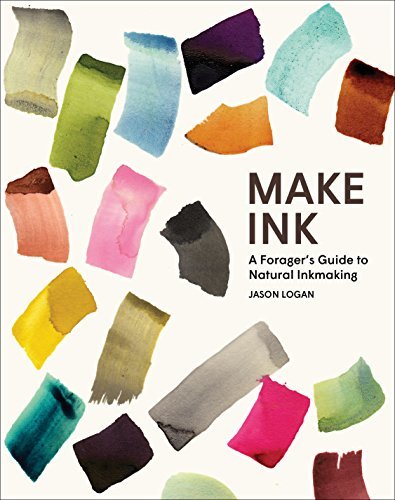
"The pigments he concocts from these humble beginnings are as fun to make as they are eye-opening to work with . . . the world never quite looks the same." —MarthaStewart.com A 2018 Best Book of the Year—The Guardian The Toronto Ink Company was founded in 2014 by designer and artist Jason Logan as a citizen science experiment to make eco-friendly, urban ink from street-harvested pigments. In Make Ink, Logan delves into the history of inkmaking and the science of distilling pigment from the natural world. Readers will learn how to forage for materials such as soot, rust, cigarette butts, peach pits, and black walnut, then how to mix, test, and transform these ingredients into rich, vibrant inks that are sensitive to both place and environment. Organized by color, and featuring lovely minimalist photography throughout, Make Ink combines science, art, and craft to instill the basics of ink making and demonstrate the beauty and necessity of engaging with one of mankind's oldest tools of communication. "Logan demystifies the process, encouraging experimentation and taking a fresh look at urban environments." —NPR "The book is full of inspiration and takes a lot of the mystery out of ink making, at least at its simplest level. And it also reminds me why I love ink—any ink or liquid color as much as I do." —The Well-Appointed Desk "Quite a few recipes . . . that use color from the carrots, black beans, blueberries, turmeric, and onion skins all make beautiful ink colors." —Design Observer "Make Ink opens up about methods, providing an open source guide to DIY ink." —CityLab
This is a beautiful, thoughtful book, but it does have its flaws. The recipes are interesting and for the most part usable, though I can't imagine that too many people would want to devote an entire teaspoon of saffron threads to making ink. The photographs are gorgeous - - enough so that I plan to look for the printed version the next time I'm in a bookstore. My chief disappointment, and the reason I didn't give it five stars, is that there's precious little information about preserving these inks. The author recommends a whole clove per bottle of ink or "a few drops" of wintergreen oil. I can tell you that the recurring mold on my walnut hull ink scoffs at cloves in the bottle. I'd have appreciated more attention to the issue of mold appearing in these inks made from botanical materials.
Logan moves on foot around New York City, foraging everything from rusty nails to wild berries and taking them home to make ink.
This is beautifully photographed, beautifully written, and kind of strange. I don't get the impression that it's aimed at crafters who really want information about inkmaking -- it's more like a "Holy shit, Doris, look at this. Did you know you could make ink out of bits of concrete?"
I enjoyed about the first third of the book and then bogged down and never went back.
It’s pretty but has like a dozen ink recipes in two hundred pages. I get his approach is: try stuff! But if you want to make ink as opposed to read about it and see pictures of it, not the best book.
the most inspiring art book i’ve read in some time. i now have an eye on some wild grapes growing up the side of my house. everyone i know will get purple birthday cards next year!
So I had a delightful hyperfixation with this book, or tbh just full on fell in love with it. Was reading a copy of a friend's while staying for a week and then just had to buy it for myself once I got home. A visual masterpiece, even the thought of reading it got me excited. It's been the biggest colour inspiration I've had in a while, which was perfect timing for current studies. You can really feel Logan's passion for what he does filter into every aspect of this book - the layout and photography is just damn delicious, his rigorous commitment to experimentation, the poetic colour introductions, playful stories and an overall reassuring, joyful tone that beckons you to experiment too. Even though it's highly unlikely I have the executive function to follow through on such a long term project as making my own ink, it was still very fun to think about and open my mind to the possibility of its existence. Very helpful instructions and guiding comments though so I'm not completely vetoing the idea. This was exactly the comfort book I didn't realise I needed. Also colour foraging is such a beautiful term. Gahh I just loved this so much!
Gorgeous photography and well laid out, but not *quite* approachable enough.
What I liked:
The book was more or less broken up into colours, with a recipe for each one. The author makes sure to explain in detail where the materials are sourced from, how to work with them, and then takes you step by step through how to make a certain colour of ink.
The photography was just really nice. A whole section was dedicated to examples of different pairings of inks or just how ink behaves on paper in general and I think it was one of the best parts of the book.
What I didn't like:
Although the recipes were gone through in quite a bit of detail, it's not going to be as easy everywhere in the world to get certain supplies. Now, each colour did have a spot at the end titled "other sources of X" but it was not clear at all how much of any one substitute one might use, and I certainly don't believe that it's always just a 1:1 switch. Experimentation is of course possible, but unless you follow a recipe from the book basically exactly (often depending on whether you can forage for the ingredients where you live), there's no guarantee this book can teach you how to make a successful ink.
I think for someone who just needs an overview of the basic idea of ink making but wants to put the time and effort into several experiments themselves, this is a great book. For myself, if there's anything this book has convinced me of it is that I just don't have the time and energy I'd need to dedicate to creating an ink I'd be satisfied with.
I placed this book on hold at the library after discovering its existence via Instagram where I follow Jason Logan's (no relations) account Toronto Ink Company. The book arrived on Wednesday and since that time I have already foraged oak gall from local bur oaks in anticipation of concocting some oak gall ink. Plus, I finished reading, then rereading the book because it was such a pleasure to read and immerse myself in!
I absolutely cannot wait to start ink alchemy with my own foraged finds and this book will have been the catalyst. Now, who wants to make ink with me?
Absolutely fantastic. I’ve already tried out making some ink, and am looking forward to creating some local colours once spring arrives in a few months.
An absolutely fabulous and thorough book on how to create ink! I was looking for a How To on making Black Walnut ink for a project, but this book made me fall in love with ink. From the healing process of foraging for ingredients, growing my knowledge by studying the unlimited processes of creating different colors, to the art of using the inks in infinite ways. The author has a voice for connecting with the reader, and I felt like he was taking me on his foraging walks and then into his kitchen, where I sat on the counter and learned my own process of creating living ink. Now, I need to go get my avocado skins and pits out of the compost to make pink…
Really pretty book with a different angle on natural dyes that opens them up to non-fiber people. Design of the book is particularly great, and the projects seem pretty approachable for anybody with a beat-up old pot and an eye for foraging.
Beautifully illustrated. Instructions are clear but often lack details and references. The recipes are not plentiful and I cannot forgive the author for misspelling Anong Migwans Beam's name in the acknowledgements.
I've got a bunch of inky caps mushrooms deliquesing in a jar. And a new to me mushroom that's all over our yard makes a great yellow stain. I've been boiling it on a fire out side. So I bought Make Ink the book by Jason Logan that I was resisting buying because I couldn't find a second hand copy. Omg I love this book. I want to mary this book. It's about foraging for color in the city. Its beautiful and printed on lovely paper and the descriptions and stories and histories are dreamy. The book keeps repeating that there are no rules! Try everything!
Although I was hoping for a more of a reference book than a guide book I found this book inspiring - I have done natural dying and foraging but this is an exciting idea - especially with my current love of fountain pens.
I write with fountain pen and ink so I was immediately drawn this beautiful book with gorgeous photos. But it’s in font 6 or something stupid, so it’s quite hard to read for any length of time. Parts of it are almost a meditation on art but it’s actually quite short on ink ‘recipes’
It's a beautiful book, but not what I expected. I had hoped to see photos or drawings of the leaves, acorns, etc., whatever is foraged so I don't need to get another book
Small print and huge margins--not so good for my eyes, but it could become a journal.
Heavy on the whimsical contemplative artsy stuff - which, don't get me wrong, I also love in moderation - but almost no information on the science behind the inkmaking. In fact, in most of the places where the author tries to say something scientific it's painfully wrong. The worst section is Water. Why only discuss water when some of the recipes involve alcohol? "Additives" are all lumped together in one category that includes things like metal salts, acids and bases but there's little guidance on what to use where, and the recipes do not really elaborate. WHY do clove or wintergreen prevent mold growth? This seems suspiciously too easy and makes no sense to add to a water based ink. Will it not float on the top?? Ugh.
As someone who has done a lot of work with natural dyes over the years and also has a graduate degree in biochemistry, I am continually disappointed at how little interest the natural color communities have when it comes to the science of how these things work, as it could really open up more opportunities for discovery.
"Pigment" has a very different definition in the science world than in the art world and can encompass a wide variety of organic and inorganic molecules that all have wildly different pH, solubility, and stability requirements from one another when it comes to how they interact with cellulose and other substrates. I was hoping to get information on how to make ink that I can use for fine art that is light-fast, stable, will not corrode nibs and paper, or is potentially waterproof. You will not find any information on these things in this book, not any of the science behind these properties. You just have to waste your time blindly experimenting until you get something you like, I suppose.
I will say it made me very excited to go out and forage stuff and experiment, but it seems I'll have to do my own learning when it comes to which pigments need which treatments.
The cherry on top is that he has the line "You are a scientist" when discussing experimenting with the inks. No Jason, no you're not. Science and art both involve creative experimentation, you can take a methodical approach to your art practice, but that doesn't make them the same thing. When you're not using any science to inform your experiments, you're just being a disciplined artist and craftsman, and that's ok.
The author sorely missed an opportunity to collaborate with a real color chemist (they exist!) to create a truly beautiful AND comprehensive book. It definitely involves the spirit of adventure and discovery for the foraging parts, but as it is it's very rudimentary and uninformative if you're serious about actually using the inks you make.
I thought this book flowed really naturally. I myself found it quite instructional as to how one can explain their artistic process. I've made a lot of ink according to the recipes and advice that were given in the book. My only complaint is that I wish it were published with a companion ink journal and/or had a section in the book dedicated to guiding the reader on documenting their personal experiments. What I mean is that templates would have been helpful. If you can't really remember how you ended up modifying a recipe, you can't replicate it and I think it'd be really nice if this book figured out a way it could be more interactive. That could even just be in the form of including pages for reader's notes following each recipe. A big part of why I enjoyed this book so much was the fact that it wasn't treated like a compilation of blog posts nor a food cookbook. Instead, it did exactly what it said it intended to do which was to guide readers through their own ink-making process. I think the book really encouraged the reader to experiment themselves and gave reasonable advice as to have you could replicate the recipe processes to suit your own resource availibility according to potential surroundings. The testing section to me was what was especially unique about this book and stood out.
Logan’s MAKE INK was an impulse Kindle buy, and boy was I happy to get it once I opened it up. It is a gorgeous primer on the creation of inks, the history of it and how to forage for materials, and the various ways good inks can be used in a variety of ways from simple natural materials one can find not only in nature, but in the city, or wherever you find yourself. I really enjoyd the illustrations, swatches, applications, and the descriptions of what happens with the materials over time and how that can be a benefit. While I am primarily a writer, I do like to dabble in fountain and dip pens (of course I do), and occasionally make very, very bad artwork. This will be instrumental in my applications and I will enjoy making some of these in my home with my kids as just a fun activity – but knowing what you need to do it seriously, and how to apply the various formulations to get different desired (or unexpected) results makes this book a great addition to my collection of things that would be cool to add to things I leave behind in my work.
A heartfelt treatise to the wonderful world that is colors and hidden colors in all kinds of nature, including the manmade. Logan is an artist but also a poet, with words and imagery that help your eyes glide easily through his prose, like the juicy wash of a brush saturated with beautiful ink. As a watercolor and ink illustrator, I'd lately been interested in getting to know the origins of my art supplies and how to make watercolor, particularly that using materials gathered myself from the environment around me. I feel more inspired than ever to keep my eyes open and my bag ready for my harvesting. Already, my eyes notice more color and textures as I walk the streets of New York where I live. Yesterday, I went out and collected several bottles full of still-red rose hips, acorn caps, and rusted paint off the wall of one of Long Island City's old warehouses, all so I can try out some of Logan's recipes myself post haste.
i read this book aloud to my husband over a few weekends while he made breakfast. i found out about the book from an interview that was republished in the latest issue of Brick Magazine. i'm not going to be making ink anytime soon, but i found the writer's descriptions and ink samples fascinating and beautiful. the book inspired me to look around and consider the wonder of the world around me. Logan makes ink from both natural and human-made things, including rust and the contents of someone's tea saucers. it's all quite whimsical. you can learn about the history of ink going back to ancient Chinese ink making until the present day. and he explains how to make various inks in ways that are easy to understand and quite doable. i highly recommend this book, whether you want to make ink or not. i would include this book as an essential book for those interested in wonder, colour, paper and ink, whether you are an urban or rural person...
This is a great introduction to the concept of ink making— an empowering and beautiful read. I do think it just skims the surface of what is possible. It is not by any means a complete, educational text. If you are someone already in the world of pigment making, it’s probably one to skip. As a newbie though, it was a very approachable introduction that has me very excited to continue learning. He does include a small list of useful books at the back of the text— I will check those out next.
I would have given it 4 stars for being a slimmed down book on the subject— not something I am usually a fan of. But I would have been lying if I hadn’t said I’ve gotten 5 stars worth of time and enjoyment out of it.
So glad I came across this book! Found this title by chance while scrolling for art books. Experimental, thoughtful, fun, and really encouraging to try. I’ve already been doing some painting with coffee, and I think I’ll give Sumac and wild berries, especially non-edible ones a try. Never thought that even industrial rust and hard seeds can be boiled and used.
Like other readers here, I think the guide was great for making art and projects with others and also learning about the properties of our surroundings, but I’d want more tips on preventing molds and preserving the paint made, especially for the purpose of sharing them with others.
Photographs are excellent and I loved the illustration and the writing voice.
I do not have the space to use this book the way I want to, but someday I hope to follow his glorious teachings. This book is gorgeous. The photos, the teachings, Michael Ondaatje. Gorgeous.
I am often asked what exactly ink is. It's not paint which is a liquid color use mainly for creating images or covering surfaces. What distinguishes ink from other art supplies is its use as a tool for communication. People have been leaving marks with berries, burnt sticks, or colored rocks since the dawn of humanity but the use of ink as a transmitter of language can be traced back to the first evidence of civilization in China and Mesopotamia: most often on shards of pottery, featuring markings that historians say were at first mostly accounting ledgers."