This was a struggle between what I wanted to feel and what I felt.
I’m not going to lay false claim to being an early convert to George R.R. Martin’s A Song of Ice and Fire cycle. To the contrary, up until April 17, 2011, I spent a great deal of time passively ignoring fantasy in general, and Martin in particular. (By passively ignoring, I mean I lived my daily life without ever thinking about the topic). However, on that date, HBO premiered Game of Thrones. Within three minutes, people were being decapitated, and my interest was piqued.
I bought the first book, A Game of Thrones, finished it, and waited a couple days before ordering the second, A Clash of Kings. In the interim, I stopped eating, threw other, lesser novels in the trash, and started sporting a hobo’s beard. When the second book arrived, I tore into it. By the time I reached the last fifty pages, I belatedly realized I needed to order the next installment, A Storm of Swords. (At this point I still thought I could kick the habit, and go back to a world where books that didn't feature castles, swords with names, and endless wine flagons could hold my interest).
There was a daylong lag between finishing Kings and receiving Swords. During that 24 hour period, I experienced intense symptoms of anxiety, agitation, and sleeplessness. In other words, I went through the same withdrawal as your garden-variety crystal meth user. By the time I started Swords, the fourth book, A Feast for Crows, was already in the mail. Thus, I had a smooth transition between book three and four, which is to say that I stopped muttering I don’t want to read other books ever again every time I looked at my bookshelf.
Due partially to good timing, and partially to luck, I completed Crows shortly before the release of Martin’s long-awaited fifth book, A Dance With Dragons. I went to work on the release date, signed out sick at lunch, drove to Barnes & Noble, and spent the rest of the day in Westeros.
All this is to say that I was excited for the release of Dragons. Indeed, when I woke up the morning of the release date, I was in a state bordering on giddy; it may be worth adding that giddiness is not a state I visit often.
Of course, my excitement doesn’t hold a candle to the fervor of the true fans, the ones who’ve been reading Martin since he first created A Song of Ice and Fire.
The first three novels came out two years apart, starting in 1996. Following Swords, in 2000, however, the gestational phase for Martin’s writing turned glacial. Crows did not come out for five years, and when it did, it landed with a thud. It had grown so large that Martin split the story in half; instead of dividing things chronologically, though, he did so by character. This meant that many fan favorites – Tyrion, Jon, and Daenerys – did not appear in Crows. Even worse, Martin stated in an afterward that the next volume – Dragons – would be arriving the next year.
Six years later, that was true.
So it’s been six years since Brienne was left hanging by the neck at the end of Crows. And it’s been more than a decade since we’ve spent any appreciable time with the main triumvirate of Tyrion, Jon, and Daenerys. That’s a lot of years for readers thirsting to know what happens next. Though I hadn’t been there from the start, I counted myself among the insatiable.
I counted down the days, checked Martin’s blog, and when they started coming out, I read every early review, spoilers be damned. To a one, they were positive: Glowing. Effusive. Filled with praise. Yet almost all of them also had a but. “It’s a great book, but…” “Fans should be totally satisfied, but…”
When I finally started reading, the buts were the farthest thing from my mind. I’m not what you’d call an overly optimistic person; still, Martin had done enough to earn my trust. It took me till page 500 before a bit of doubt crept in; I did my best to suppress that. By page 700, the doubts had turned to a dull roar.
On page 913, it hit me: nothing was going to save this experience. Dragons is a disappointment. More than that, it’s a Star Wars Episode I: The Phantom Menace-like disappointment. This is a book you want to like. No, that’s wrong. This is a book you want to love. I’m sure plenty of readers will love it. Or they’ll say they did. I’m just unsure how real that love is. The alternative is bleak: a six year wait only to discover that Martin blew it; that his story has spun out of control; that despite nearly 1,000 pages, the plot doesn’t move an inch. I see now why the word but kept creeping into those reviews.
The plot for Dragons picks up where Swords ended and runs concurrent (at least for the first half) with Crows (in an early scene, between Samwell and Jon, we are treated to a conversation held in Crows, though this time it is told from Jon’s point of view, rather than Sam).
As with all the other books in this series, Dragons is told from the third-person limited point of view, through the eyes of select “viewpoint characters” that alternate with each chapter. Back in Thrones, there were only eight viewpoint characters, which gave you depth without scope. That is, the limited points of view allowed you to become intensely connected to the featured characters; however, many of these characters were in the same geographical area, which meant that a lot of action took place offstage, and was related through exposition. At times, it was like looking at Westeros through a keyhole.
In Dragons, there are a whopping sixteen viewpoint characters. This means you get great coverage of Martin’s world. He has now put boots on the ground in every corner of the Seven Kingdoms and beyond. On the other hand, there’s very little chance to grow connected to some of these newer additions. For instance, characters such as Areo Hotah, Victarion Greyjoy, and Quentyn Martell flit past so quickly, they barely register an impression.
Right off the bat, Martin addresses the main criticism of Crows by treating us to successive chapters on Jon, Tyrion, and Daenerys. Indeed, these three comprise the bulk of Dragons chapters and length. Unfortunately, their mere inclusion is not enough to save the day.
Of these three, only Tyrion is still mobile. Long regarded as Martin’s greatest creation, Tyrion retains that distinction, if only because there are no other viable contenders. Tyrion, the Imp, is the dwarf son of a rich and powerful father, whom Tyrion killed in Swords. As always, Tyrion makes his way with a slashing wit, boundless confidence, and an unflagging desire for whores and booze. Part of Tyrion’s appeal – which is testament to Martin’s plotting – is that Tyrion is always dynamic. In Thrones, we underestimated Tyrion, who seemed a smart-assed, half-crippled bundle of hedonistic principles. In Kings, Tyrion was given a position of power, and used it wisely, displaying martial ingenuity along with flashes of humanity. By Swords, Tyrion’s power had been stripped, and he was engaged in battle of wits with his sister and father. The result is that Tyrion’s character has never settled; Martin has kept him on his toes, thereby engaging our interest.
That holds true in Dragons. Following his escape from King’s Landing, Tyrion embarks on a journey across the Narrow Sea, to find Daenerys Targaryen. I won’t get into detail about his trek, as it contains plot spoilers. Suffice it to say, beyond the surprises and reveals, there are many nice moments to Tyrion’s story, including a haunting boat ride past old Volantis, and a touching companionship with Penny, a fellow dwarf. Tyrion is still brash and funny and the bearer of a slightly-skewed moral compass. That I’m beginning to tire of him probably has more to do with the fact that he’s an old friend, and I’m overly familiar with all his tricks and quirks. (Alas, Martin’s attempt to frame Tyrion’s quest as a way to find his place in the world is cringingly pat).
Unlike Tyrion, Jon and Daenerys are rooted in place.
Jon is on the Wall, where he remains throughout the entirety of Dragons. His conflict has to do with wannabe-king Stannis Baratheon, the red priestess Melisandre, and the hordes of wildlings that Jon has to resettle south of the Wall. The problem with Jon is that he’s become a dull, stuffy hypocrite, in thrall to his own perceived rectitude. Despite spending much of Storms as a traitor, riding, eating, and sleeping with the wildlings (and by sleeping with, I mean boinking), Jon is still convinced of his own rightness. Throughout Dragons, his modus operandi as Lord Commander of the Night’s Watch is to stiffly inform Stannis that he is not allowed to help him; then he helps Stannis; and later, he rationalizes those actions to himself. This is repeated on a loop until the book ends.
Meanwhile, Daenerys is stuck in Meereen with her army. The invasion that began with such promise in Storms has become a quagmire. While this may be a trenchant commentary on America’s current military adventures in the Middle East, it creates a resounding narrative lull (about the only action in Meereen comes from the dragons, one of which gets loose and begins poaching children).
Daenerys has chosen to stay in Meereen, despite all strategic advice to the contrary, because she wants to care for her people (whom she describes as “children” with queenly condescension). At a gut level, I disliked her for this stance. From the beginning of A Song of Ice and Fire, Martin has expounded on the theme of power and politics. Time and again, Martin has rewarded the purveyors of Kissingerian Realpolitik (such as Tywin Lannister) to the detriment of Stevensonian idealists (such as the late Eddard and Robb Stark). I spent much of Dragons annoyed with Daenerys for not making the tough, brutal, pragmatic choices that would allow her to win. Having given the notion a bit more thought, I realize that Daenerys actually deserves a bit of credit for having the most finely tuned moral sense of any other character. She is, after all, trying to help the poor, close the fighting pits, and free the slaves (even though Martin’s other characters make such a persuasive case for slavery I got a little uncomfortable). Still, Daenerys’ goodness is not a substitute for plot. As with Jon at the Wall, Daenerys’ chapters are eye-glazingly cyclical: in each one, she is badgered to do something by an advisor or courtier; she gives a little ground while still holding to her principles; later, she is proven wrong; and the whole charade begins again.
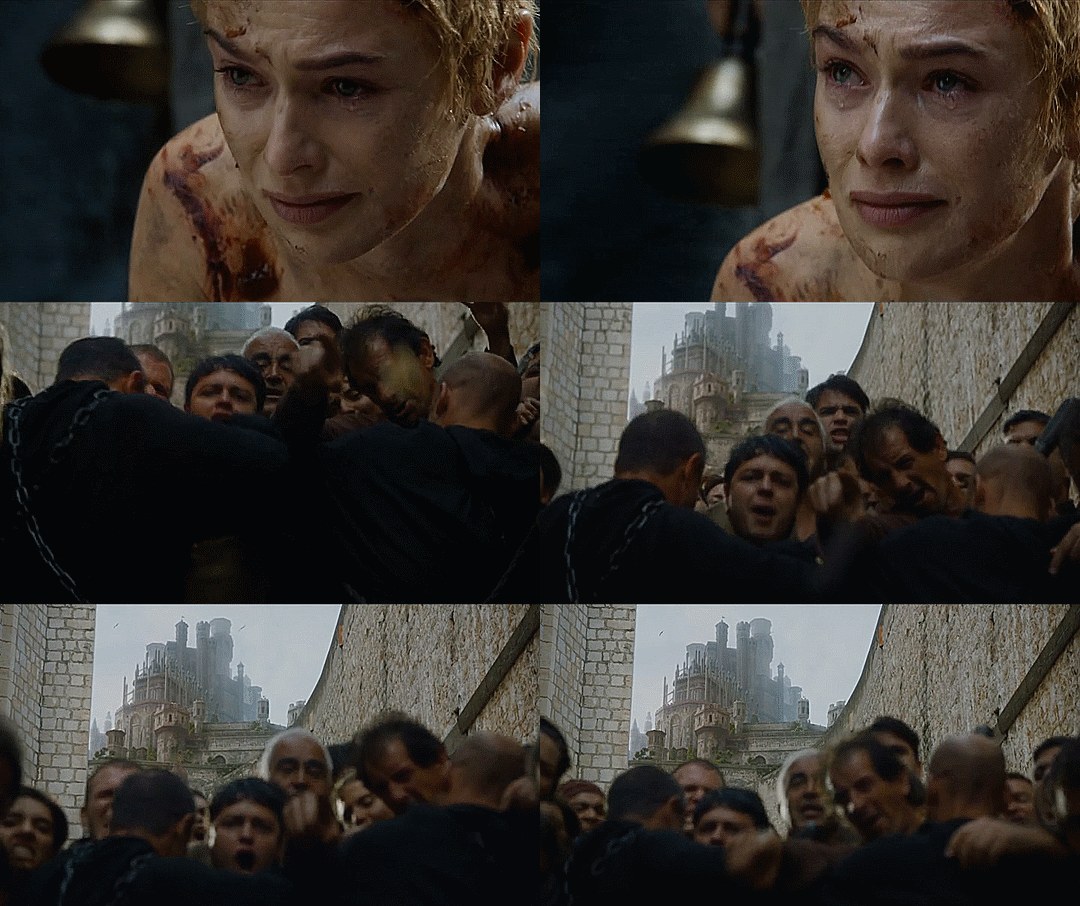
The other viewpoint characters are a mixed batch. The connecting theme with most of them is a desire to reach Daenerys in Meereen. The highlights include Bran, growing into his shape-shifting abilities; Arya training with the Faceless Men (and moving farther from the light); Ser Barristan Selmy at the twilight of his career, filled with regret yet still capable of kicking ass; and Cersei Lannister, who is forced to undergo an excruciatingly riveting trial by shame, which duly whet my appetite for her eventual vengeance.
On the other hand, I don’t care for the Greyjoys or the Martells. They were introduced too late into the series for me to have any profound connection. Moreover, their arcs and characterizations are uninspired. (There are two viewpoint characters for whom discussion would involve potential spoilers. Suffice it to say, one of these characters represents some of Martin’s best work; the other embodies just the opposite).
If it’s not clear, my main criticism in Dragons is that nothing much happens. There is no action. It’s a lot of people walking and talking and drinking and eating skewered meat. In other words, it’s like a Renaissance Faire. But at least a Ren Faire has a joust. Here, in the midst of all that walking (and riding and boating) and talking, there are precious few battles, swordfights, fisticuffs or gratuitous sex scenes. I almost longed for a scene of depressingly low taste, such as the incestuous flirtation between Asha and Theon in Kings.
To make matters worse, Martin (formerly a writer for The Twilight Zone) employs a cheap serial style that only serves to emphasize how little is happening. Each individual chapter follows the same general outline, just like a serialized drama. The viewpoint character is introduced; the character has a flashback that explains what he or she has been doing lately; the current narrative thread is joined; and finally, a conflict will arise. Just as something is about to happen, Martin will end the chapter with a cliffhanger. (One chapter ends with a character drawing his sword, just as a fight is about to start). This style is a huge miscalculation. After awhile, I became resigned to the fact that nothing would ever happen until the last page. Instead of action, I’d be forever plunging forward, looking for a resolution that never came (or if it came, it’d be so far forward in the book that I couldn’t remember the cliffhanger to begin with).
To be sure, Dragons is better than Crows. The writing is more sure-handed, unlike Crows which seemed carved out by an editor. Yet there is a distinct drop-off fromSwords. The descriptions aren’t as fresh; the dialogue isn’t as sharp; the plotting isn’t as intricate. Maybe this is a function of the series’ length, but cracks are beginning to show. I started to notice the clichés, the lazy phrases, the writerly tics. For instance, in the span of two pages, Martin twice describes a character saying words that left “a bitter taste” in her mouth (in all my life, I’ve never tasted a single word; apparently, this character feasts upon them). The dialogue, which once had a pulpy, almost Mamet-like pungency to it, has become pretty lousy. There are still some decent monologues, but the exchanges have devolved from evocative to exclamatory (and sometimes just lame; two different characters declaim that such and such a person is “as useless as nipples on a breastplate”). The leitmotifs, which used to be as simple and as elegant as “winter is coming,” are now heavy-handed (“words are wind”) or crude (“where do whores go”). Even the names have gotten worse. We used to have good, solid, muscular names, such as Bran or Ned or Robert or even the androgynous-yet-uncomplicated Jaime. Now, the reader is forced to make sense of unpronounceable collections of consonants and increasingly ridiculous aptronyms (Bloodbeard? Really?).
(Anyone who doubts my qualitative critique of Martin’s writing should find someone to read aloud to them from a Daenerys chapter. After a few sentences of stumbling over names and reciting exclamation-point-dotted sentences will prove my point).
I don’t think I’m giving anything away by telling you there is a cliffhanger at the end of Dragons. By the time I got there, I didn't care at all.
See, in Dragons, as in Martin’s other books, major characters die. Or at least they appear to die. Back in Swords, Martin brutally killed off Catelyn and Robb Stark at the Red Wedding (and had Robb’s decapitated body decorated by Robb’s wolf’s head). Since then, Martin has shown a preference for fake-killing his characters, tricking his readers into believing someone is dead before having that character reappear at a convenient moment. By this point, Martin has resurrected more people than Jesus. When people died in Dragons, I just shook my head and made my wagers as to when that person would show up.
The biggest problem with Dragons is that it didn't fulfill what I needed it to fulfill. In other words, I set for Dragons an impossible task, and reacted with surprise when it could not complete it. Yet my expectations – and the expectations of millions of others – are part and parcel of Martin’s grand enterprise. He set the bar very high for himself. It is becoming increasingly clear that he is wilting from that pressure. Instead of narrowing his story and focusing on its fundamentals, he has let the narrative explode. Instead of fine tuning plot points, he keeps throwing more plotlines into the mix. He’s like some juggler who keeps adding pins to distract you from the fact that he’s not wearing pants.
The most damning indictment I can give Dragons is that I finished it a week after it came out, but didn't get around to the review until now. In those weeks, I have not missed it. Furthermore, I have not once thought about how long I’ll have to wait until the next one. With his exceedingly long turnout time, Martin has set me up to stop caring.
I don’t know where I’ll be in five or six or seven years (it is a terrifying prospect to behold); still, I’m pretty certain that A Song of Ice and Fire won’t have a special place in my heart. Too many things will have happened. By that time, Dragons will be a distant memory: a book read by a different person in a different world. If the next book gets written, I may pick it up (or have it uploaded directly into my brain, if that’s how things are done in the future), but it won’t be the same experience. For me, the vibrancy is gone. If I move forward with the series, it will probably be out of a sense of nostalgia.