"Henryk IV" z 1596 roku to jedna z najpopularniejszych kronik historycznych Williama Szekspira. Następca angielskiego tronu, książę Walii, pragnie rozzłościć ojca, króla Henryka IV. Spędza mnóstwo czasu w tawernach, obcując z plebsem i pijakami, a przede wszystkim z kompanią sir Johna Falstaffa, z którego nagminnie stroi sobie żarty. W tym samym czasie Hotspur, który chowa do władcy urazę i pragnie przejąć koronę, planuje bunt. W działaniach wspiera go ojciec, hrabia Northumberland i wuj, hrabia Worcester. Wobec zagrożenia król prosi swego syna o pomoc. W połowie 1403 roku pod Shrewsbury dochodzi do decydującej bitwy...
William Shakespeare was an English playwright, poet, and actor. He is widely regarded as the greatest writer in the English language and the world's pre-eminent dramatist. He is often called England's national poet and the "Bard of Avon" (or simply "the Bard"). His extant works, including collaborations, consist of some 39 plays, 154 sonnets, three long narrative poems, and a few other verses, some of uncertain authorship. His plays have been translated into every major living language and are performed more often than those of any other playwright. Shakespeare remains arguably the most influential writer in the English language, and his works continue to be studied and reinterpreted. Shakespeare was born and raised in Stratford-upon-Avon, Warwickshire. At the age of 18, he married Anne Hathaway, with whom he had three children: Susanna, and twins Hamnet and Judith. Sometime between 1585 and 1592, he began a successful career in London as an actor, writer, and part-owner ("sharer") of a playing company called the Lord Chamberlain's Men, later known as the King's Men after the ascension of King James VI and I of Scotland to the English throne. At age 49 (around 1613), he appears to have retired to Stratford, where he died three years later. Few records of Shakespeare's private life survive; this has stimulated considerable speculation about such matters as his physical appearance, his sexuality, his religious beliefs, and even certain fringe theories as to whether the works attributed to him were written by others. Shakespeare produced most of his known works between 1589 and 1613. His early plays were primarily comedies and histories and are regarded as some of the best works produced in these genres. He then wrote mainly tragedies until 1608, among them Hamlet, Romeo and Juliet, Othello, King Lear, and Macbeth, all considered to be among the finest works in the English language. In the last phase of his life, he wrote tragicomedies (also known as romances) and collaborated with other playwrights. Many of Shakespeare's plays were published in editions of varying quality and accuracy during his lifetime. However, in 1623, John Heminge and Henry Condell, two fellow actors and friends of Shakespeare's, published a more definitive text known as the First Folio, a posthumous collected edition of Shakespeare's dramatic works that includes 36 of his plays. Its Preface was a prescient poem by Ben Jonson, a former rival of Shakespeare, that hailed Shakespeare with the now famous epithet: "not of an age, but for all time".
I read this book in the winter semester of my sophomore year, in 1965. I loved it. After Hamlet in my senior year, it will always rank as close to my personal favourite in those formative years. Guess why?
I saw myself as a junior Prince Hal. Guess a lot of us kids do, if we read it as teens. I had opted out of maths and sciences at that point, seeing my future in the humanities, and my dad, the scientist, was disappointed.
I wanted to get back into his good graces.
And Prince Hal does exactly that in his dad's - the King's - eyes, by single-handedly defeating his dad's prime rival, Hotspur, the warrior his dad compares him to (and in whose courage he finds young Hal sadly lacking). Until the day Hal kills Hotspur on the field of battle. Then, finally, Hal's star rises.
It took me a long time to realize I could never be an Alpha Male like my Dad - or like the King and his son, Hal. I always fell flat. But in the end, I would learn to keep my nose at the daily grindstone: tedious work in this world, and long, long after the age Hal became King of England.
Sic transit gloria!
Or does glory pass so easily?
It did for me at first. In my early years after the diaspora of my high school buddies to bigger and better worlds, I frequented the home town company - as an aging Prince Hal - of my own kinda Falstaffs and Bardolphs, alas.
Thankfully, meeting my wife soon after sounded their death knell in my life - as Hal (now in glory in Part II of King Henry IV) ditched poor, ludicrous Falstaff? But Hal's glory I was fated not to share.
That's where the tedium of the grindstone - still my chosen metier today - comes in.
Hard work can pay off, as my time in the office has done, and - in these older days - as Goodreads had lent dignity to my retirement!
And it's no good hoping for deliverance from our toils, my friends - not in this world! You will find your emoluments, but not your glory here.
Shakespeare, die-hard Renaissance Romantic that he always was, saw his only glory to be here on earth, alas.
But I still hope for the crown of Peace in the hereafter.
And, like T.S. Eliot, I for one am content that my:
Temporal reversion (has) nourished The life of significant soil -
And has done that primarily for the Greater Glory of God.
I have read this play many times, and--although Shakespeare always shows me something new--this reading gave me little insight and few surprises. I was struck with two parallels, however--one within the play itself, and one within Shakespeare's body of work.
First of all, I appreciated the subtle parallels between the Hotspur-Glendower and the Hal-Falstaff scenes. Each young man spends much of his time needling a self-important, older man who is such a windbag that the audience is almost automatically on the young man's side. Hotspur, whom we are inclined to respect because of his high spirits and his achievements as a warrior, is so easily irritated, and carries his own self-regard so close to the surface, that his needling of Glendower--although deserved--seem pointless, rash and injudicious. (It may, in fact, prove fatal, since Glendower fails to come to Hotspur's aid when most needed--a dereliction perhaps precipitated by the younger man's abrasive heckling.) Consequently, although we like Hotspur at the end of the scene as much as we liked him at the beginning, we respect him a good deal less.
Contrast with this the Hal-Falstaff exchanges. Hal, already characterized as a wastrel, punctures Falstaff's pomposity with such a controlled attack of pointed wit that we begin to admire him for his discipline (at least in conversation), and sense that there may be more to him than appears on the surface. In addition, Falstaff--unlike the humorless Glendower--is a worthy opponent, filled with wit and self-awareness, and the fact that Hal can more than hold his own--and keep his temper too--suggests a self-awareness, a deliberately cultivated distance from his degraded surroundings, that prepares us for his eventual transformation just as much as his soliloquy about the sun.
The other parallel--between plays--is closer, but certainly less important. Lady Percy, in her attempts to gain information about the coming rebellion, delivers a speech that is very much like Portia's speech to Brutus in similar circumstances. Their conduct afterwards, though, is different. Portia--the stoic Roman--cuts herself in the thigh to prove her ability to keep a secret, but Lady Percy--a hardy warrior's bride--tries to break her husband's little finger and force him to talk. (Like I said, this isn't that important, but it is interesting how a great dramatist can use similar materials in support of very different effects.)
Speaking overall, I am once again astonished by the great command of voices that Shakespeare demonstrates in this play. Hotspur, Falstaff, Glendower, Hal and Mistress Quickly all use language in very distinctive ways, and even the casual conversation of the servants in the stable yard is vivid and characteristic. I am also impressed with the expert and seamless blending of poetry with prose, history with comedy, rhetoric with wit.
By the time he wrote Henry IV, Shakespeare could not only do it all, but he knew exactly how--and when--to mix it up. This is indisputably the work of a master.
After Richard II, this is the second episode of Shakespeare’s major Histories (the events that will lead up to the Wars of the Roses). This play is not so much about Bolingbroke/Henry IV, as it is the first of a vast trilogy on Prince Hal/Henry V — from Eastcheap to Azincourt. The first part of Henry IV tells the events of the rebellion of the barons, following the lead of young Harry Percy, against the king they initially placed on the throne of England. Simultaneously, it is also a captivating and cheeky chiaroscuro on the low-ranking people, the nobodies, living in a dodgy tavern, at the same time as the king and nobility. It is, to my knowledge, the first time Shakespeare includes the commoners to such a large extent, into one of his history plays, and it is brilliant.
It is probably the endearing relationship between Prince Hal and John Falstaff, at the start, that makes this one of my favourite plays of William Shakespeare. It is difficult to explain in rational terms what makes this odd friendship and, especially, Falstaff — a chronic liar, drunkard and thief —, one of the sweetest, most memorable, most human, most touching characters of all literature. Only a couple other friendships between two men come to mind as energetically and emotionally as these two: Don Quijote and Sancho Panza, and maybe Tintin and Capitaine Haddock. (I even suspect that Falstaff directly inspired Haddock, both divine drunkards and hilarious insults mongers.) The end of Act V, when Harry pays homage to his foe Hotspur, and wrongly believes his gargantuan friend dead on the battlefield — which was probably intended as a comical scene — always makes my eyes water.
However, things take a very different turn after the battle of Shrewsbury. Stay tuned, review to be continued in Henry IV, Part 2…
How hard it must be to fight an enemy you admire; how hard it must be to realise your enemy is a stronger, and perhaps more worthy, man than your son, and how great it must be to realise that you are such a hypocritical fool, and that your son is more than you ever dreamed. But first, you must lament your heir to your advisors, clearly a great move:
Yea, there thou mak’st me sad and mak’st me sin In envy that my Lord Northumberland Should be the father to so blest a son— A son who is the theme of honour’s tongue, Amongst a grove the very straightest plant, Who is sweet Fortune’s minion and her pride— Whilst I, by looking on the praise of him See riot and dishonor stain the brow Of my young Harry. O, that it could be proved That some night-tripping fairy had exchanged In cradle clothes our children where they lay, And called mine Percy, his Plantagenet!
Henry Bolingbroke is a man with daemons. He won his crown on the back of a rebellion, and here he is many years later crushing a rebellion himself. There’s some irony in here. Shakespeare does love to point out a good hypocrite. In the rebellious Hotspur King Henry clearly sees part of himself, and in his son he sees a foe he vanquished many years before. The ineffectual Richard II has come to haunt he him; he doesn’t want to see England fall under such negligent rule ever again. So he is a man most divided. The choice he makes is the only one he could make. He puts his faith in his son and because of this the young Henry meets the challenge with vigour and character I’d argue he didn’t even know he possessed.
The young Henry, Hal to his friends, doesn’t take life too seriously. He spends his days drinking, pranking and bantering with an old knight named Sir John Fallstaff, and this lead to some of the best moments of the play. The two in a metatheatrical moment, a mini play within a play, act out a scene of King and Prince. Fallstaff rather hilariously, whilst pretending to be Henry IV, gives young Hal some advice about his drunken friend:
No, my good lord, banish Peto, banish Bardolph, banish Poins, but for sweet Jack Falstaff, kind Jack Falstaff, true Jack Falstaff, valiant Jack Falstaff, and therefore more valiant being, as he is, old Jack Falstaff, Banish not him thy Harry’s company, Banish not him thy Harry’s company. Banish plump Jack, and banish all the world.
Thus history becomes part comedy, and Shakespeare as always demonstrates how versatile a dramatist he was. Language becomes a clear distinction between the high born characters and the low. This is no Richard II where commoners are spouting out verse. In here there is a clear distinction between who is educated and who isn’t. The commoners speak in prose. The lord’s in verse. Young Hal can do a little bit of both. He has the ability to bond with the lowborn and the high born because of this, which is just a slight foreshadowing of the loyalty he will command one day. A good King knows how to communicate with his subjects not just the other rulers of the land, just a bit of subtlety from the bard.
Honour as well becomes a subject of much contention. What is honour? Is it personal integrity or is it loyalty to your King, and perhaps those you love. Indeed, honour becomes a subjective principle, one that means different things to each individual. For the King it is his need to protect his realm, for Hotspur it is personal integrity, and for Hal it is duty. Fallstaff’s honour, which is something easily debatable, is his love for his prince. His dialogue speaks otherwise, but his actions, though a little bit stupid, felt rather devoted at points even if they were also self-serving.
As with all of Shakespeare’s plays, watching a good version really helps. I like to read the play once, go watch an adaption, and then read the play again. It just adds another level to it. I did quite like this play, but I much preferred Richard II. The language in that play was pure poetry, and I much prefer tragedy to comedy.
There are two very deep, dark wormholes I’ve disappeared into recently, one involves my hapless efforts to master the perfect (or even, remotely edible) sourdough loaf, the second is William Shakespeare and his historical plays. Regarding the first, I have nurtured and even named my starter (he’s Frank), I feed him daily, and so far he has failed me. Frank is not long for this world. The latest instalment of the latter is Henry IV, part 1 – by William Shakespeare.
Billy the Bard is from Stratford, not far from where I was born in the UK – so we’re practically related.
Henry IV, part 1 is the historical sequel to Richard II – a work I read, reviewed and enjoyed recently. I must say, I enjoyed Henry IV more. Now, I’m not sure it’s because I have my eye-in regarding the language or because it’s written in a different style. I think it’s a bit of both.
Henry IV, is much older in this play, compared to Richard II. He’s been large and in charge for a while and is tired, a bit knackered. In this play the King is confronted by two issues. Firstly, he has a fractious relationship with his party going, reprobate of a son, Prince Harry (Hal), who seems to enjoy drinking at a local tavern with his mates more than attend to affairs of state and his responsibilities as Prince of Wales. Secondly, Henry IV needs to deal with a very significant rebellion/civil war, and various conspiracies. Nobility from the North and Wales and Henry Percy (Hotspur) were forming a massive force to take the throne. The Percy family in fact helped Henry IV usurp Richard II, but they ended up questioning his legitimacy.
Heady days.
These two narratives are nicely developed as seemingly separate stories, until they converge into a brilliant piece whereby Prince Henry reconciles with his father (there’s a remarkable scene in the palace whereby King Henry IV is giving young, and probably hungover, son Henry, the world’s biggest bollocking – only for The young Prince to finally see the error of his ways and swear total allegiance to his Daddy and help him defend the Crown. This exchange is so well written. They then come together to fight Hotspur and his co-conspirators in what is known as the Battle of Shrewsbury.
I found this play lively. Particularly, the scenes in the tavern with Hal and his mates, the speech was entirely different to that of the nobility. Slang, the vernacular of the common punters – lots of bawdy humour, mickey taking and practical jokes.
My favourite Shakespeare character so far, Sir John Falstaff was a highlight. This guy is a bloated, cheating, deceitful, funny and sketchy fellow and his relationship with Hal is both warm and antagonistic. He is VERY funny. Then there’s the deadly serious political shennaningans of Henry Percy – the long diatribes by the extremely opinionated, arrogant, angry and let’s be honest – brave Hotspur. He just seems so antagonistic to everyone, and particularly to the King and his son. Hotspur is a character you wouldn’t like to bang your supermarket trolley into on a lazy Saturday afternoon, he’d chuck you from the fruit and veg section to the canned vegetable aisle in a moment. Falstaff and Hotspur are my favourite characters but there are many, many other interesting players from nobility to the poorest of the poor involved in this story.
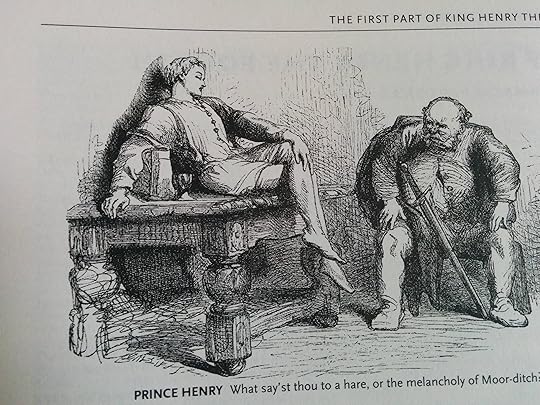
But, between Hotspur and Falstaff, the latter is the star. Much is made of the fact he is fat, and I’ve recently looked up a lecture on this fact. His fatness is mentioned (and other related cognomens) over twenty times! In fact, scholars ponder the question – why is Falstaff fat? Shakespeare doesn’t usually emphasise physical attributes. If you want to learn more – look it up, there’s plenty of opinion on this man’s corpulence and the significance of it.
I’ll no be no longer guilty of this sin; this sanguine coward, this bed-presser, this horseback-breaker, this huge hill of flesh
So this is a heavy political/historical play and also a comedy and it’s just brilliant. I can now say I am a fan of Shakespeare. Maybe even a Groupie! Time to buy a T-shirt, hey – maybe a Tattoo??
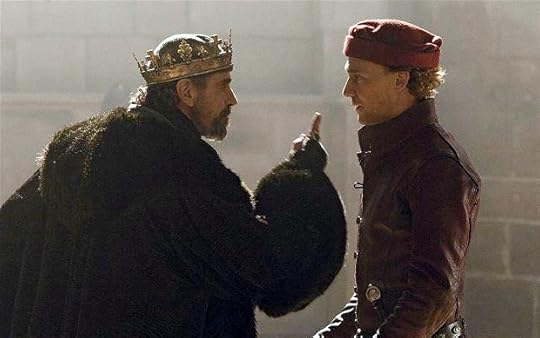
As is my habit, concurrently I gorged myself on the BBC’s Hollow Crown version of Henry IV, with a stellar cast. Such as the massively and handsome (let’s not deny it) Tom Hiddleston as Hal – he’s all bright, shiny, cheeky and perky. Jeremy Irons is great as Henry IV, he’s tried and cranky and gets a bit shouty. But I think the best performances are delivered by Joe Armstrong as Hotspur – angry, violent, strong and even more shouty and the hilariously corrupt and chubby, Falstaff - played by Paul Ritter. This is not a cheap production, the sets and scenes are realistic and the battle scenes are violently eye-opening. Thank heavens for publicly funded television. I truly love my (Australian) ABC and the BBC.
I am so happy I read and watched this and even more happy I understood it.
While William Shakespeare’s Henry IV, Part 1 is a different experience than Richard II, it is a fantastic play! The action picks up shortly after the conclusion of Richard II (after Bolingbroke has deposed the now dead Richard and become King Henry). It still has a serious side, but this play subverts the legitimacy of the monarchy by the ways it uses language. It does this most effectively by its depiction of the heir to the throne, Prince Henry (known as Hal) and his debased and disgraced compatriot, Sir John Falstaff and the juxtaposition of their comic mocking with the serious business of state.
Throughout the play, honor is associated with the morality of leadership. On that score, rather than a drunk or vagabond, Falstaff asserts his honor, “There lives not three good men unhanged in England, and one of them is fat and grows old” (Falstaff, Act 2 Scene 4). Hal answers (playacting as his father) with little sentimentality or seeming affection, “That trunk of humours, that bolting-hutch of beastliness, that swollen parcel of dropsies, that huge bombard of sack, that stuffed cloak-bag of guts, that roasted Manningtree ox with the pudding in his belly, that reverend Vice, that grey Iniquity, that father Ruffian, that Vanity in years?” (Prince Henry, Act 2 Scene 4). Hal’s association with Falstaff and his rag-tag crew belies his own moral authority. When Hal suggests banishing Falstaff, Falstaff answers that this would be harmful to the prince, “No, my good lord, banish Peto, banish Bardolph, banish Poins, but for sweet Jack Falstaff, kind Jack Falstaff, true Jack Falstaff, valiant Jack Falstaff, and therefore more valiant, being as he is, old Jack Falstaff, banish not him thy Harry's company, banish not him thy Harry's company. Banish plump Jack, and banish all the world.” (Falstaff, Act 2, Scene 4).
Falstaff is a teacher or mentor of sorts, but he also represents the recklessness of Hal’s youth. Prince Hal is capable of holding court over the debauched in the seedier sides of London, but is he capable of assuming his rightful place as the king of England? This is one of Shakespeare’s great plays!
The introduction of the old, lecherous Oldcastle (later renamed Falstaff due to complaints from the real Oldcastle family) was a real pleasure here. He offered a comedic respite to the bloodshed and politic intrigues which the Bard was describing from the later years of Henry IV's reign after his coup d’etat of Richard II.
One of the interesting aspects was the conflict between Henry IV and his son Hal, the future Henry V. At one point the father wishes that Hotspur, of the rival camp, was actually his son. Meanwhile, Hal loves to mess around with Falstaff: The thieves have bound the true men. Now could thou and I rob the thieves and go merrily to London, it would be argument for a week, laughter for a month, and a good jest forever. Henry IV Part 1, Act 2 scene ii
However, near the end Hal saves his father's life (on his road to redemption which completes in Henry IV Part 2) and they are reconciled: Stay and breathe awhile. Thou hast redeemed thy lost opinion And showed thou mak'st some tender of my life In this fair rescue thou hast brought to me Henry IV Part 1, Act 5, scene iv
Overall, the speeches were for me a bit less memorable than those in Shakespeare's play of Richard II, and yet the piece is full of action. Thoroughly enjoyable, but go I now onwards hence Henry IV Part II my ignoble soul awaits.
Highly recommended: The Hollow Crown, S01E02 with Tom Hiddleston as Hal and Joe Anderson as Hotspur was really good. The battle of Shrewsbury was well-shot. The Falstaff/Oldstone plot provides comic relief as Simon Russell Beale's protrayal is both pathetic and moving at times. I never had all that much affinity for the old lecher, but it sets up the drama in Henry IV Part 2 to see Hal and Falstaff imitating Henry IV and the Hal in the barroom scene.
“O, while you live, tell truth, and shame the Devil!” ― William Shakespeare, King Henry IV, Part 1
Falstaff!
Yes, I knew who he was. But until this year my exposure to Falstaff was mainly second-hand, through books that spoke of him. I hadn't touched any of Shakespeare's histories (I'm not counting Julius Caesar, etc., as a history) and so was surprised at just how much I liked this character. There are plays where the character and the play are equally matched (Othello, Hamlet, etc), but there are those plays where the character seems to float beyond the play. Henry IV, Part I seems like one of those. The play was great. I enjoyed it. But every time Falstaff arrived it seemed to jump up a level. It was certainly not a play where Falstaff played a central role. Obviously, Henry, Prince of Wales plays that part (and he is fascinating himself) but Falstaff just dervishes around the play making everything better. Breathing color and dynamics into every scene he is a part of. And he doesn't do it through and other-worldliness. He does it through his humanity, his base motives, and his complicated affections. There is no doubt that Henry loves Falstaff and that Falstaff loves Henry, but it is also clear that they are both using each other and KNOW the other is using them. It is perfect.
And the lines! Some of Shakespeare's great lines and great musings jump energetically from Falstaff's lips:
"Well, ’tis no matter; honour pricks me on. Yea, but how if honour prick me off when I come on? How then? Can honour set-to a leg? No. Or an arm? No. Or take away the grief of a wound? No. Honour hath no skill in surgery, then? No. What is honour? A word. What is in that word “honour”? What is that “honour”? Air. A trim reckoning! Who hath it? He that died o’ Wednesday. Doth he feel it? No. Doth he hear it? No. ’Tis insensible then? Yea, to the dead. But will it not live with the living? No. Why? Detraction will not suffer it. Therefore I’ll none of it. Honour is a mere scutcheon. And so ends my catechism."
Still one of my most favorite histories, or at least part one of perhaps three. ;)
Our favorite wastrel, Prince Henry, Hal to his friends, a drunkard, a thief, the bosom buddy of dear fat old Falstaff, hides his bright sun behind vile clouds so as to shine all the brighter when his day finally arrives.
In here, of course, we establish the lout with a sharp mind and careful cunning, dissembling for all to see but careful of the long game. When his his father sore needs his son's aid, Hal comes to the rescue, throwing off all such base clouds, or as little as need be, to ensure both his father and the close court of his worthiness, and he does so with flying colors, killing the most worthy night in England, the poor Percy of the Hot Blood, and so restoring both his honor and his valor in both word and deed.
This, of course, is just the prelude. The foreshadowing. The stage upon such things as the Ides of March are set.
Ever since I first read this, I've always called such low tides in men "The Hal Effect".
"Let no one expect shit of thee, and when the time draws neigh, toot your horn and shock the living hell out of them."
;)
Seriously, Shakespeare? Who knew that when Will Shook his Spear, he'd ever have so much to say? ;)
Food for powder, food for powder. They’ll fill a pit as well as better.
This is undoubtedly one of Shakespeare’s strongest plays. In tone and atmosphere it is far more varied and naturalistic than its predecessor, Richard II. The scenes with Hal amid the low-life of London are fetching, and do much to alleviate the stiff and stuffy courtly atmosphere of some of Shakespeare’s histories. The comedy also helps; and this play contains some of Shakespeare’s highest and lowest comedy, both of which are embodied in the corpulent Falstaff.
Most readers will, I suspect, concur with Harold Bloom in deeming Falstaff one of the bard’s great creations—though we may not go so far as to put him on a level with Hamlet. Bloom is correct, however, in seeing one’s opinion of Falstaff as a defining fact in one’s interpretation of the play. There are those who see in Falstaff the spirit of carnival—the ecstatic embrace of all the pleasures of life and the total rejection of all the hypocrisies of society. Others see Falstaff as a corrupter and a lout—a lazy and selfish fool.
For my part I vacillate between these two attitudes. There is no denying Falstaff’s wit; and his soliloquy on the futility of honor is wonderfully refreshing, puncturing through all of the political nonsense that motivates the bloody clashes. Still, I cannot help thinking that, if the Falstaffian attitude were embraced too widely, society itself would be impossible. Some social restraint on our pleasure-loving instincts is necessary if we are not to end up fat drunken thieves. On the other hand, a generous dose of the Falstaffian attitude can be a great antidote to the self-righteous nonsense that leads us into war.
In any case, Falstaff is not the only great character in this play. Hotspur is a mass of furious energy, an electrifying presence every time he is on stage. Prince Hal, though less charismatic, is more complex. From the start, he already has an ambivalent relationship with Falstaff, a kind of icy affection or warm disregard. Indeed, Hal holds everyone at a distance, and one senses a skeptical intelligence that is wary of committing until the circumstances are just right. It is hard to read his character’s evolution as that of a wayward youth who learns to embrace his identity. His actions seem far too deliberate, his timing too perfect. Was he hoping to learn something by keeping company with Falstaff and his lot?
I really do not like Shakespeare. I find him rather vulgar and his humor is not the kind that good jokes should be made of. John Falstaff, in this play, was a fun and ridiculous character. He was, perhaps, meant to portray all the people who make themselves seem better than they really are, which I think Shakespeare did cleverly.
So I guess if you like Shakespeare, you might as well check this one out. It's a quick read with funny characters.
YouTube kanalımda Shakespeare'in hayatı, mutlaka okunması gereken kitapları ve kronolojik okuma sırası hakkında bilgi edinebilirsiniz: https://youtu.be/rGxh2RVjmNU
Çelimsiz, iğrenç sefil, domuz artığı, yılan derisi, öküzdili kurusu, kurutulmuş boğa penisi, çiroz, kılıç sıskası, ifrazat dolu adam, vücudu hastalıklı salgınlarla şişmiş kişi, koca şarap tulumu, içi işkembe dolu valiz, içi doldurulmuş öküz, kocamış kötülük, ak saçlı ahlaksızlık, ihtiyar şeytan, onun bunun çocuğu, alçak şişko gibi kelimelerle ve isim tamlamalarıyla Shakespeare'in argo kelime haznemi büyük ölçüde geliştirdiği eser olmasıyla birlikte daha Darwin'in doğmasına yaklaşık 200 yıl olmasına rağmen insanlar arasında süregelen iktidar elde etme ve doğal seçilim süreçlerini erken dönem ve olgunluk dönemi eserleri arasında bir köprü görevi görmesiyle anlatır.
I don’t really have much to say about this play. I thought it was meh. It didn’t grip me, or entertain me, or make me feel anything for most of it. I didn’t care about the characters, plot or the comedy. Having said that though, the ending was quite suspenseful. A good war scene unfolded and there were plenty of exciting sword fights. The writing wasn’t as beautiful as Shakespeare’s usual writing that I love, but there were some good lines scattered here and there. But nothing overly special.
Second read after also watching an adaption: I absolutely love this play now. Falstaff is hilarious as he is terrible. I love seeing Hal and his relationship. I also really enjoyed seeing Hal and his dual personality depending on who he is with, and trying to delay taking up his responsibilities for as long as possible. The ending had the drama that I liked. I think what made me really enjoy this play was watching the friendships come to life on stage, and seeing the humour that I didn’t really catch while reading the play the first time. A good reminder to watch an adaption of and then reread the Shakespeare plays I find mediocre or dislike to see if seeing them on stage can change my mind!
I feel kinda lazy today so you won't get a detailed review/analysis from me. I also don't have it in me to go full snark on you, so let me just sum up this wonderful mess of a play: I never thought I would enjoy (like... really enjoy) one of Shakespeare's histories, I'm glad I was wrong because now I feel like nothing will stop me from seeking out his entire work and actually having fun whilst doing that. Henry IV, Part 1 is super accessible even for someone who has absolutely no fucking clue about England during the 16th/17th century and all of those weird ass houses: York? Lancaster? Tudor? ...I only know Targaryen. ;) The reason for that is its comedic nature, Henry IV, Part 1 reads like one of the Bard's comedies, as if you had mixed The Merry Wives of Windsor with Much Ado About Nothing.
So much roasting, so many witty one-liners, all of the likeable characters who make stupid ass choices but you wouldn't expect anything less because it's fucking Shakespeare. Honestly, the biggest mood in this entire ass play is Prince Hal being a huge disappointment to his father on purpose. His reasoning behind his lowly ways literally is the fact that he thinks that he can impress his father better if the latter has the worst opinion of his character... I mean, he isn't wrong... I still don't know if Hal really had to go all out hanging around with thieves and whores but go off, I guess, we all had some rough days in our teenage years. ;) At one point, Hal actually decides to rob his friend Falstaff just to prove a point. We all know, Roman culture is stabbing yourself just to prove a point, so I think Hal's take on life is actually quite reasonable.
Additionally, Henry IV, Part 1 is also quite the predictable play and not just because it's followed up by Henry V so you already know Hal's dad will bite the dust at some point, but because Shakespeare sets his character archetypes and plot points up in very obvious ways: the father who is disappointed in his son and heir and wishes another were in his stead; the son who deep down wants to make his father proud; the roguish friend who's mainly there for comic relief but who you'll take straight to the heart (but since I already knew Falstaff from The Merry Wives of Windsor that didn’t quite work for me, I just wanted to see him choke tbh). It helped me a lot in my comprehension that this play was so foreseeable as I had enough on my hands with keeping all of those names apart (why is literally every male named Henry or Richard??? I could cry).
I didn’t even mind the endless battles and fighting scenes that much as Falstaff kept me entertained throughout, so I’ll give him that. The way he tried to bullshit himself through this war (by basically dropping dead every five seconds without fighting at all, and then later claiming all the biggest wins for himself) was so fucking relatable, my most used annotation was: #ME. :D And the showdown between Prince Hal and Hotspur (=young Harry Percy, the boy who turned rebel with whom the King was so enamoured with in the beginning) was just fucking epic. I was rooting so much for Hal to finally prove his father wrong and make him proud in the end, whilst also feeling for Harry and his struggles to make a name for himself. Shakespeare really did an amazing job at fleshing out all of these characters in a very short amount of time. Chapeau!
Henry IV, Part 1 is definitely a play to remember and I cannot wait to finally finish its second part.
It may not be immediately obvious to people, when reading something like Drug Gang, but William Shakespeare has been a major and important influence on my writing. As an author, I have taken on board a lot of lessons from Shakespeare in terms of structure, story and character arcs.
Henry IV, Part 1 has always been my favourite work of Shakespeare. Primarily, this is because of the gradual transformation that Prince Hal goes through. Also, Falstaff is an amazing character, providing plenty of comic relief. The play manages to perfectly combine comedic elements, drama and an amazing story of a personal journey from wild and chaotic tearaway to triumphant hero.
The second play about The Wars of the Roses and so massive in history, good ol' Will had to make two parts about this particular king!
Henry IV was Henry Bolingbroke, the one who deposed the old king, Richard II. Since then, he has not had a quiet reign. There are still those who want Richard back (funny, considering how many supported Henry because they were unsatisfied with Richard's way of doing things). How did kings usually solve such a problem? Right, with a crusade, what else?! But he faces such problems with Wales and Scotland that he can't go on the merry road-and-killing-trip. There is lots of intrigue from influential families such as the Percys and Henry's own son is giving him a headache or two as well (since scandalous behaviour makes people question the worthiness to the throne). The most charismatic person here definitely is Falstaff - as fat and drunk and corrupt as the old bloke may have been. That charisma is not just thrown at the audience but also at Henry's son. But soon, there is an outlet for all the pressure boiling up because the intrigues against King Henry IV result in a battle at Shrewsbury. Opposite the king's forces is one of the Percys, called "Hotspur" of all things (one has to love the nicknames of the time). Funnily enough (literally because they are comic relief in my opinion), completing the trio is King Henry's son and his friends (yes, including the fat and drunk Falstaff who is no longer charismatic in my opinion, but acts most shamefully).
I must say, I didn't like Hal (Henry's son) very much. He was vile, thought himself oh-so-much-better, and made fun of his companions (especially Falstaff) in the worst ways. However, he himself informs the audience that this time will be over soon and that he will proof himself worthy. Had I not known what king he was to become, I would have considered this announcement the greatest joke in the play. Nevertheless, the aforementioned battle at Shrewsbury gives Hal his chance (after he somehow gets his father to give him command) and he does proof himself worthy indeed. There is the inevitable climax in form of single combat between Hal and Hotspur and it was thrilling. In the end, even the dishonourable Falstaff wants to make amends for his behaviour and vows to change his ways.
Thus, it can be said that apart from the overall theme of the Wars of the Roses, this play is also about sinful youths growing up to become men of honour. It definitely is the groundwork not only for part 2 but also for the next play about Henry V.
I liked this play much better than the one about Richard II. Maybe I, too, fell for the comic relief and was blinded by fools becoming heroes. ;)
Taught this play many times in the 60's and 70's, when it was often the one Shakespeare play in a college Intro to Lit class: great play, but heavily male. After my study with two prominent women Shakespeareans (separate post-docs at Harvard and Breadloaf) I moved, for the sake of my largely female community college students, to stronger women characters in the comedies and, say, Measure for Measure. But I still offhandedly quote from 1H4, say "If reasons were as plentiful as blackberries…"Falstaff to Hal who's caught him running away. (Just posted, 4 July 18, our blackberries on my FB "Parodies Lost" with Falstaff's note.) I emphasized students aloudread for Tone of Voice, essential for lit, and especially for drama. This play teaches tone really well: Falstaff insults the Hostess, by calling her "You woman!" and she takes great offense, "I was never called so in my life" Why? Because of Falstaff's tone. (Forgive I quote from memory here, last taught it two decades ago.) Shakespeare shows his invention (what we now call creativity, a different concept) every time Falstaff speaks. For instance, Hal insults Fallstaff's overweight with common criticism more useful to oversized Americans now--"this bed-presser, this huge hill of flesh"--while Falstaff thinks up great anti-jogger insults, "you starveling, you eelskin, you dried neat's tongue, you bull's pizzle…you sheath, you bow case, you vile standing tuck….Oh, for breath to utter what is like thee! "(4.4.270ff). Next Falstaff play-acts "in King Cambyses vein" playing Hal's father the King, saying about the Hostess, "For tears do stop the floodgates of her eyes.." Then Falstaff satirizes the King's doubt about his paternity of Hal, and also Hal and his father's facial appearance, "That thou art my son, I have partly thy mother's word…but chiefly a foolish hanging of thy nether lip, that doth warrant me." All this is delicious, and with the robbery scene surrounds the very serious scene of Hotspur's reading the letter of and heading away without telling his wife where: "Thou will not utter what thou dost not know." By the way, would that candidate Trump ( rhymes with "rump"?) knew half so many military terms as Lady Percy--who overhears Hotspur in his sleep--"of trenches, tents..frontiers, parapets/ Of basilisks, of cannon, culverin/ Of prisoners ransom…all the currents of a heady fight…" At any rate, I have barely scratched the surface of a grand historo-comedy, to vary Polonius's list of dramatic genres.
An absolutely brilliant and breathtaking work that is the perfect marriage of poetry, history, and wisdom. Falstaff may be one of the greatest creations of all literature, he is an astounding mix of hilarious wit, well-timed self-deprecation (or should we instead say, full of valour in discretion?), fervent loyalty (I feel the love-me-love-me-love-me need of a Golden Retriever here), and to top that off he stands as the ironic paradigm for honor and knighthood. From what we really know about knights and nobles around this time, Falstaff was probably the perfect mirror image, whereas Hal’s newly found chivalry is instead the curvy circus mirror.
You cannot help but love the tavern scenes, where Hal lets forth one of the more poignant soliloquies about the sun and informs us that this is all part of his plan- a plan that will briefly allow him to breathe free away from court where he will be immured for the rest of his life, and will also let him come to know the true stock of his kingdom. Also, it doesn’t hurt that after being seen to be such as ass, he can only be seen as improving. Only one place to go and that’s up! There also seems to be a sort of parallel story between the in-fighting amongst the tavern slugs and what are basically “elevated” kingdom-wide tavern brawls of would-be kings and attempted usurpers. Oh sure, they’re the nobility, so instead of a tavern brawl it’s an attempt at the throne, but it really boils down to the same thing doesn’t it? Even the basest man clings to some sort of honor, and what does Falstaff say honor is? Nothing but air.
You know why I really like Hal? He is much like Hector of Troy, he is confined by his duty to his family and country, he craves freedom but does what he must, and Hotspur is much like Achilles…and really, Achilles is the arrogant ass that always deserved to die. So it’s somewhat cathartic to the viewer to watch the brash and noble, but insufferable hot-tempered Hotspur to die and realize that all he accomplished will be to Hal’s glory, and he will be forgotten.
I should note that I read along after I watched the Hollow Crown series. Marvellous acting, truly wonderful... following along was not entirely conducive however because they jump around significantly and leave large portions out (luckily none of the omitted portions were Jeremy Iron's (King Henry) talking to Hal upon his return to Court, because those are some of my favorites)
Thank God for Youtube. As I have said before reading a Shakespearian play that I have not seen on either stage or screen can be a difficult task at best. In fact reading any play that I have not seen on stage or screen can be difficult, since they are generally not meant to be read but performed. The printed plays seem to supplement the performances rather than to take their place, so when I came to read this play I searched Youtube and discovered that the BBC versions of the history plays are available for viewing, so once I finished this play I ended up watching it and I must say that it really added to my appreciation of the play.
Henry IV Part One comes immediately after Richard II and begins after a slip of the tongue in anger in which Henry Bollingbrook (now Henry IV) causes the death of the previous monarch Richard II. Remember, during this period of English history England was in the middle of the Hundred Years War with France, and historians consider Henry (and Richard) to be weak kings during their reigns the war in France was not persued. However, England controlled a lot of French land at this time and keeping the peace in this land was difficult at best. At the beginning of the play Henry calls off an pilgrimage to the Holy Land (a crusade) to deal with some rebellions in Scotland and Wales (and I suspect that he never got to go on that pilgrimage).
The problem wasn't that Henry had usurped the throne (though his own inner guilt did have something to say in regards to this) but that he had to deal with rebellions in Scotland and Wales. His first decision ends up alienating his former friends because he decides not to seek the release of another Englishman namely because he had formed a marriage pact with Owen Gwendoler (more on him in a bit). As such these former friends end up rebelling against his rule and going over to his enemies.
There are also family problems as well because his son, Henry (who is to become Henry V) has fallen in with the tavern crowd (the Boars Head Tavern at Eastcheap which, unfortunately, is no longer there, though I do plan on going to Eastcheap when I am in London). I am not sure where Henry's castle is supposed to be, but if we know London, we know that Eastcheap is quite close to the Tower of London (in those days it wasn't a prison). The tavern crowd is run by the infamous Falstaff, one of the characters that seems to have obtained a legendary status in English Literature. While the plays in which he appears are not remembered, the character is. Falstaff is the fat, loud, cowardly, oaf that forms the comic relief of many a book and film (as well as this play) however he has a very important role here. While Owen Glendower has taken Henry's lords from him, Falstaff has taken is son, therefore Henry faces problems both in his position as a king and a rule as a father.
The robbery scene is very important as, while it seems to be only a minor part at the beginning, it has a very significant impact. Robbery, particularly armed robbery, is a very serious offence, and while today you may only land up in gaol (though I would not call that a particularly light sentence, especially since it can stain your character for life) in those days you would be executed. Basically the only reason Henry gets away with it is because he is the Prince of Wales. Even then there is a very serious father and son talk when he admits to his participation in the robbery (and it also appears that he does not implicate Falstaff, who would have been executed for the deed).
Act II, Scene IV is probably the longest, and the best, scene in the play in that it is the turning point for Hal's (the Prince) life. It begins with riotous merry making with Falstaff as the central figure, and ends with the sheriff coming in asking questions about the robbery. While Hal manages to keep the Sheriff off of Falstaff's back (and while the pickpocketing incident leads to a rather interesting result, with Falstaff claiming that bonds were stolen, only to realise that everybody knows they were simply records of what he owes) Hal ends up confessing to his father, and his father's act of mercy has Hal turn around and become the Prince of Wales. In the end he is on the battlefield, rebuking Falstaff for his tomfoolery, and becoming the hero by slaying Hotspur in single combat.
Owen Glendower was a Welsh rebel who was at war with the English during this period. I actually saw a documentary on Glendower and their suggestion was that it was during this time that Wales was transformed from being a wild and savage place to becoming that quaint place that we all associate with Wales today. It is similar to Scotland, with the place going from the wild and savage land of Macbeth and the Highlander, to the bagpipe playing centre of learning that produced the likes of Adam Smith.
In the same way that Richard III is demonised by Shakespeare, Glendower is also receives the same treatment. He his made to appear as a sorcerer in league with demonic forces, and that his victories against the English are not due to his skill as an insurgent but due to his dabbling in the occult. He only appears in a couple of scenes in the play, yet he the focus the part of the play that is not dominated by Falstaff. Where Falstaff has stolen the King's son, Gwendower has stolen the King's knights. However, in the same way that Henry brings order back to his family, he brings order back into the kingdom during the Battle of Shrewsberry, after which the play suddenly ends (obviously in anticipation for part 2).
february 2023 review: i seriously have nothing smart to say about this play; i just fucking love it. i love it so much. i know nobody wants to read a shakespearean history play (with a part ONE in the title, no less), but i've read the entire canon and can assert with confidence that this is always in my top 5 favorites list and hal and hotspur are some of shakespeare's most compelling, fascinating, larger-than-life characters. ooougughghghh when the characters are foils. when the characters. are foils. this play's only flaw (beyond "needs more women," which with the histories is an unfortunate given) is that i can't stand falstaff and i need his speeches to be, like, half the length (though i will admit he is better on-screen than on-page). sorry to my shakespeare class who had to deal with me in the back of the classroom bursting a vein trying not to stim and/or yell out answers to the professor's questions
also this reread has cemented my opinion that hotspur is one of my favorite fictional characters of all time. he's got it all. autism swag. wife guy. loud. starts fights for no fucking reason. smart as hell. claims he hates poetry but talks solely in verse. battle machine of a human being. completely fucking insane. he is everything to me
This must be one of Shakespeare's best historical dramas, although there's a lot that's invented for dramatic effect; the Bard can never be taken as very historically correct, for he's first and foremost a playwright. The fairly simple plotline following the major points of the reign of the first Lancastrian king is enlivened by the inclusion of what should be Will's most comical character, Sir John Falstaff, bon vivant par excellence, who often steals stage from Prince Hal with his antics, rogue witticisms, and rascally way of life.
I also liked the "Harry to Harry" point-and-counterpoint type of parallel narration for Henry Percy ("Hotspur") and Henry of Monmouth ("Hal"), which allowed Shakespeare to offer a comparative storyline for two young men with so much talent for warfare and leading men who, nonetheless, are underestimated and often chided by their fathers, the Earl of Northumberland and Henry IV respectively, and other elders of varied competence and vanity for two large flaws that colour the public perception of them: Hotspur has the shortest ever fuse in England, and his hot-headedness lands him in serious trouble as well as makes him vulnerable to manipulation by cunning older relatives, which culminates in a disastrous rebellion; and Hal is a hopeless carouser, whoremonger and reveller that's adding more gray hairs to his father's head with his licentious lifestyle and the bad company he keeps. One of these young men will realise in time he needs to change course if he wants to walk far in life, but the other's path will end at a battlefield by Shrewsbury as a consequence. This would be the tragedy portion of the play, but even so it doesn't lack humour, with Falstaff's "cowardly lion" battle exploits that are worth a smile or two.
I would have objected to calling this Henry IV, though! The king barely appears in order to bemoan his inutile of a prince heir or bemoan that the Percys & Co. just Do Not Understand How Cool a King He Is and how merciful, etc. I'd suspect Shakespeare doesn't like Bolingbroke a great deal, because even in Richard II, where he ironically had a larger role than in this play named after him, he seemed to me slightly more sympathetic to the deposed king than to the then Duke of Lancaster. Likewise, in this play, he's more enamoured of Prince Harry (what's it with scandalous English princes called Harry?), and so this first play of two could with justice be called instead The Very Merry Youth of King Hal the Fifth.
Prendere in mano questo testo dopo la lettura del Riccardo II dà all'opera ancora più spessore e complessità. Nell'Enrico IV, in modo ancora più netto che nell'opera precedente, il vero protagonista non è il re che dà il nome al dramma ma i suoi potenziali successori, i due Harry, cioè il principe di Galles legittimo erede e Harry "Hotspur" che si ribella alla corona. Il cuore del testo sta proprio nella contrapposizione fra questi due personaggi. Da un lato abbiamo un erede al trono scapestrato, inaffidabile, che passa il tempo nelle locande, si dedica alle rapine e il cui unico scopo sembra essere l'invenzione di nuovi scherzi. Dall'altro vediamo un Hotspur impavido, sempre pronto a far valere le sue ragioni, alla testa di un esercito di ribelli, che chiede conto al re delle sue azioni. Enrico stesso lo ammira e lo preferirebbe come figlio invece che come rivale.
Ma ci sono diversi parallelismi tra fra l'Enrico IV e il testo precedente. Sarebbe difficile infatti non fare paragoni fra il vecchio re deposto per via delle sue cattive attitudini e l'attuale principe di Galles, cioè il futuro re. Entrambi appaiono completamente inadatti al ruolo. Lo stesso Enrico IV, per l'appunto, dice che Hotspur sarebbe un erede migliore del figlio e spererebbe che i due Harry fossero stati scambiati alla nascita.
Un aspetto importante del testo è anche che il dramma storico è perfettamente bilanciato alla più pura e spassosa commedia, in cui il protagonista indiscusso è l'irredimibile Falstaff. Tutta la leggerezza delle scene comiche finisce un po' per mascherare la drammaticità di un'opera che secondo me è molto audace in quanto sembra riflettere sul senso stesso della regalità.
Secondo Enrico IV la regalità è un gioco di apparenze. Bisogna mostrarsi poco al popolo, mantenere un alone di mistero intorno alla propria figura, in modo da incutere timore reverenziale e rispetto. Ma Enrico sa che la legittimità del suo trono non è scontata perché frutto della deposizione del re di diritto. Questa contrapposizione fra la legittimità del potere e la moralità di chi lo esercita era presente anche nel Riccardo II, ma qui mi sembra che ci sia una critica ancora più profonda in quanto la legittimità del trono sembra oramai di fatto legata più che altro alla capacità militare di mantenere la carica.
Tutto il testo ha un ritmo molto alto, è divertente e ricco di azione. Quest'opera sembra anche coperta da un velo di disincanto dove Enrico IV e suo figlio appaiono assolutamente privi di maestà. Enrico è pieno di incertezze e Harry è un commediante.
I reviewed Richard II in January and decided at the time I would review all of the four plays in the series. A mere six months later I’m up to the second play – how hopeless is that? I intend to get through the next couple in what will seem (in comparison at any rate) to be me zipping along at a rate of knots.
I had to read this in high school – so thought I would be more familiar with it than it turns out that I am. There were things I remember very well – Falstaff’s ‘honour’ speech and Hal’s soliloquy at the start where he compares himself to a piece of shining metal on the dull ground. But most of the play had faded to background noise and nothingness.
People often say that the great thing about Shakespeare is that none of his bad guys are ever just bad guys. They tend to be ‘rounded’ characters that we even feel a bit of sympathy for – well, except Iago, of course. What is particularly interesting in this play is how few of the characters are in the least bit likeable. Falstaff is sometimes funny, but generally not even that – a coward and a liar, a drunkard and a glutton, I felt I was meant to laugh at him, rather than with him, but could hardly manage that. His ultra ego – Sir Toby Belch from Twelfth Night – is much more likeable and much more funny, I think. The King is at best annoying, his son Hal is a pain in the bum, and Hotspur comes across as the kind of person who spent too long as a child pulling the wings of flies. To be honest, there isn’t a single character you would like to have over for dinner. The scene where son saves father’s life and father is surprised is the kind of scene where you just want to bang heads together.
If Richard II is about the divine right of kings coming to an end – this play is about the guilt that comes from bringing about that end. Henry IV is only an incidental character in this play, really, despite it being named after him. At the start he wants to go off to the Holy Land and kill some Arabs (it is remarkable how long this has been seen as a bit of a panacea in the West – done something wrong? Feel a bit bad about it? Having trouble at home? Why not head off to the Holy Land and kill some Muslim Infidels! All will be forgiven.), but there is trouble at home in Scotland and Wales that puts off his plans. He is also mistreating (from a sense of guilt) those who helped to bring him to power. This would be okay if he was doing so in a Machiavellian way (they made me do it and now I’m punishing them) – but he is doing it unthinkingly. Not a great idea alienating your supporters without a really good reason.
The problem is that the young Hotspur is not only making himself look good in various military campaigns, but in so doing is making Hal, the King’s son, look decidedly worse. Hal has taken to drinking in bars and chasing after loose women with a fat old guy called Falstaff. Hal has decided to do this because when he finally does come good the brightness of his good deed will shine so much brighter against the black background of his previous bad deeds. This is almost a return to the divine right in the previous play – God will provide an occasion when he will be able to shine – but this hardly seems a reasonable thing for him to actively hope for, in fact, rely upon. There is an arrogance to this sort of idea – the kind of stupidity young men are all too prone to – that rings very true, but is also incredibly irritating at the same time. The play is really about us moving towards Young Hal and Young Hotspur doing a ‘this kingdom isn’t big enough for the two of us’ scene towards the end. And so it proves. They almost use that very line.
I really wanted to like Hal more – but that was quite out of the question. I probably would have liked to have liked Hotspur more too, but how he treats his wife is anything but loveable and sealed his fate for me. As I said, Falstaff has some wonderful anti-war lines, but then he does take money from people so they can avoid fighting in the war and keeps the wages of others that he then ensures will die - ‘food for powder’ he calls them, or cannon fodder as we might. Like I said, it is hard to chuckle away with him in quite the way we can over Sir Toby’s torturing of Malvolio, at least up until the very end of Twelfth Night when even those chuckles become a little uncomfortable.
If Richard II is a tragedy dressed as a history, there is part of me that would like to say this is a comedy dressed as a history – that isn’t quite true, but it is close enough for me to nearly be able to get away with it.
As I finished this, my third time reading through Henry IV, Part 1, I considered it in contrast to my other favorite of Shakespeare’s history plays, Richard III. While both are brilliant plays, the contrast between them couldn’t be starker. In Richard III, Shakespeare created his greatest villain. In Henry IV, there are no villains, only morally ambiguous adversaries. Richard romps across his play utterly dominating it, stealing every scene. King Henry is a secondary character in the play that bears his name, his primary role being the disappointed dad to Prince Hal, the play’s principle protagonist. Richard is a clever schemer who is ultimately destroyed by his great ambition. Prince Hal is a clever wastrel who is saved by discovering his ambition.
In Henry IV, Part 1 Shakespeare presents a far more subtle story than he did in Richard III. Every character is morally ambiguous and flawed, while none of them engage our animosity — all are sympathetic. Hotspurs, the rash young warrior in rebellion against the king, is easily the most likable and noble character in the play. Even the play’s principle focus — the transformation of Prince Hal from a dissipated wastrel to a man meeting the crisis and accepting the responsibilities of power — doesn’t escape this ambiguity thanks to one of Shakespeare’s greatest creations. Falstaff. Sir John Falstaff may be the greatest manifestation of the Dionysian principle in all of literature. Drunkard, glutton, thief, and scoundrel, he yet posses so much wit, humor, and good cheer, and even a certain earthy wisdom, that he leaves us with genuine pangs of regret that Prince Hal escapes his influence and accepts his destiny.
Glendower:I can call the spirits from the vasty deep. Hotspur:Why, so can I, or so can any man; But will they come when you do call for them? -act 3, scene 1
Now this is why I read Shakespeare.
So far, working my way through Will's plays chronologically has been about as frustrating as it has been illuminating. A few early gems aside (Romeo and Juliet, A Midsummer Night's Dream, Richard III), most of the Bard's best and most celebrated work is packed into the second half of his bibliography. With 15 of 38 plays down, my average rating has hovered around three stars, and only the assurance of eventual greatness has carried me through a slew of notorious clunkers like King John, Titus Andronicus, and the Henry VI trilogy.
But all that only makes it more rewarding when I finally do catch a glimpse of real brilliance—and lucky for me, 1 Henry IV provides more than a mere glimpse. Truth be told, most of the history plays live up to their reputations as dull and tedious affairs, at least next to the much flashier comedies and tragedies; but with 1 Henry IV Shakespeare finally figures out the genre's true strength: its capacity to put aside the rigid tropes of both tragedy and comedy, and to find a satisfying—and arguably more lifelike—balance between the two. (This sort of genre-busting seems to have been an ongoing fascination for WS, if his problem plays are any indication.)
The play is split pretty much evenly between the low, dirty humor of John Falstaff and his tavern-going friends (their dialogue is rendered mostly in prose) and the more elevated, aristocratic drama which unfolds between the eponymous king and his new rival, Henry "Hotspur" Percy (they do all their talking in classic Shakespearean verse). The two sections are linked together by Hal, the clever but lazy prince who—understandably enough, I think—would rather spend his youth getting drunk and playing pranks on Falstaff than hanging out at the palace conducting himself as a king-in-training. For the first couple of acts these two tableaux might as well take place in separate worlds, but as Hotspur and King Henry gear up for civil war the comedy and tragedy start bleeding together, till finally even Hal and pals have little choice but to get their shit together.
The effect is a little like those times in real life when something big and momentous happens without warning—a death in the family or a natural disaster or a shocking election—and suddenly going about your business like you always have isn't an option; the actual genre of your life, so to speak, changes. It's not really surprising when people start dropping dead around, say, Othello, because that's just the universe Othello exists in; it's more startling—and in a way, more sobering—when it happens to the comic relief.
But all that high-minded stuff aside, this is also just a really good play. The characters and relationships are well-rendered, the dialogue is topnotch, the core conflict is compelling and resonant. Henry IV follows pretty much directly on Richard II, which means if you've already read that one you've got a lot of helpful context for the events here; and since there are still two more plays in the series after this, Will is under less pressure to cram the whole saga into just five acts. The thing breathes, is what I'm saying.
Still, if 1 Henry IV doesn't quite reach the heights of a Hamlet or a Macbeth, it's only because that's not where Shakespeare is aiming. It feels like he's letting himself have fun here—the absurdly disproportionate amount of stagetime he grants to Falstaff seems proof enough of that—and with a good writer a sense of fun is an infectious thing. When I finished this play I felt reinvigorated, with a renewed excitement for all the Shakespearean treasures still to come. That seems like a more-than-good-enough endorsement to me.
What else can you give Henry iv part 1 than 5 stars. My favourite Shakespeare containing my two favourite characters Falstaff and Prince Hal. Of course this only part of Henriad which are my favourite plays. Prince Hal’s and Falstaff relationship through these plays is witty, intelligent and human. In the end it’s heart breaking but we understand- that’s the glory of Shakespeare and the growth of Prince Hal. This character growth is amazing but of course there are three plays to do that over. Henry IV part 1 contains the most humour and Henry IV part 2 the most touching moments. It’s the humanity that I love. So yes 5 stars. And definitely one of my favourite Shakespeare plays.
I love this play, and this edition. It's captivating and insightful, and I'm reading right after finishing "The Plantagenets," which I also recommend, and which teed it up nicely. (That book ends with Henry IV deposing Richard II, leading directly to the situation this play depicts.)
One problem with reading the history of the English kings is their stories tend to blur together after while. I've always been able to keep Henry II straight, because I watched "The Lion in Winter" 20 years ago, and still picture Peter O'Toole as Henry, Katherine Hepburn as Eleanor of Aquitaine, etc. I think I have this set of Henry's etched in my brain for another 20, too.
I tried two other editions of Henry IV, before settling on this one (Arden):
- The Applause edition: I loved the thorough explanations and insights into how actors have played scenes over time FOR OTHER PLAYS (several of the well-known tragedies), so I was expecting the same. Nope. Nothing but lots of footnotes indicating technical decisions on which folio/quarto was used on a particular line.
- Oxford School Series. The explanatory notes were very helpful, and I would have been very happy with this edition. But I compared this with Arden (reviewed here) line by and Arden had far more historical information and insightful notes on the wordplay (eg, biblical sources he was playing off). Also, the Oxford actually overdid it explaining some phrases I found obvious.
I went to B&N and worked through more than a dozen versions of this play, and found this most superior, by far. (Also, get historical info on all the major characters.) This appears to be the best out there. It costs a bit more: about $8 more than the others, but I'll be spending 40-60 hours with it, so that's less than 20 cents per hour of my time for something much more effective. A bargain.
(If money is really tight, I highly recommend the "Oxford School Series," (and note that's different than just "Oxford," which is also out there.
UPDATE: I started act 5 today, and still loving it. Racing through it, on my scale. I could do without Falstaff, but loving Hal and Hotspur and the other rebels and even the king sometimes.
Having just watched The Hollow Crown, this play was much easier to listen to. The audio alone can be quite confusing, but a familiarity with the play helps. I love this whole cycle of plays. Shakespeare's ability to mix pathos and humor hits its stride in this cycle of plays.