

What do you think?
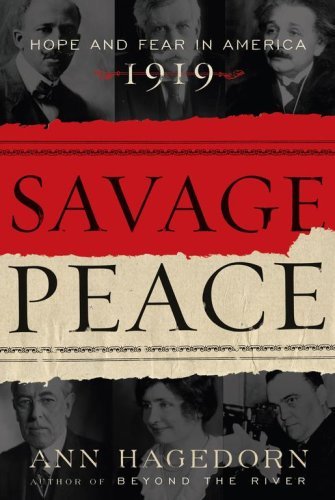
Savage Peace: Hope and Fear in America, 1919
Written with the sweep of an epic novel and grounded in extensive research into contemporary documents, "Savage Peace" is a striking portrait of American democracy under stress. It is the surprising story of America in the year 1919. In the aftermath of an unprecedented worldwide war and a flu pandemic, Americans began the year full of hope, expecting to reap the benefits of peace. But instead, the fear of terrorism filled their days. Bolshevism was the new menace, and the federal government, utilizing a vast network of domestic spies, began to watch anyone deemed suspicious. A young lawyer named J. Edgar Hoover headed a brand-new intelligence division of the Bureau of Investigation (later to become the FBI). Bombs exploded on the doorstep of the attorney general's home in Washington, D.C., and thirty-six parcels containing bombs were discovered at post offices across the country. Poet and journalist Carl Sandburg, recently returned from abroad with a trunk full of Bolshevik literature, was detained in New York, his trunk seized. A twenty-one-year-old Russian girl living in New York was sentenced to fifteen years in prison for protesting U.S. intervention in Arctic Russia, where thousands of American soldiers remained after the Armistice, ostensibly to guard supplies but in reality to join a British force meant to be a warning to the new Bolshevik government.
In 1919, wartime legislation intended to curb criticism of the government was extended and even strengthened. Labor strife was a daily occurrence. And decorated African-American soldiers, returning home to claim the democracy for which they had risked their lives, were badly disappointed. Lynchings continued, race riots would erupt in twenty-six cities before the year ended, and secret agents from the government's "Negro Subversion" unit routinely shadowed outspoken African-Americans.
Adding a vivid human drama to the greater historical narrative, "Savage Peace" brings 1919 alive through the people who played a major role in making the year so remarkable. Among them are William Monroe Trotter, who tried to put democracy for African-Americans on the agenda at the Paris peace talks; Supreme Court associate justice Oliver Wendell Holmes Jr., who struggled to find a balance between free speech and legitimate government restrictions for reasons of national security, producing a memorable decision for the future of free speech in America; and journalist Ray Stannard Baker, confidant of President Woodrow Wilson, who watched carefully as Wilson's idealism crumbled and wrote the best accounts we have of the president's frustration and disappointment.
Weaving together the stories of a panoramic cast of characters, from Albert Einstein to Helen Keller, Ann Hagedorn brilliantly illuminates America at a pivotal moment.
In 1919, wartime legislation intended to curb criticism of the government was extended and even strengthened. Labor strife was a daily occurrence. And decorated African-American soldiers, returning home to claim the democracy for which they had risked their lives, were badly disappointed. Lynchings continued, race riots would erupt in twenty-six cities before the year ended, and secret agents from the government's "Negro Subversion" unit routinely shadowed outspoken African-Americans.
Adding a vivid human drama to the greater historical narrative, "Savage Peace" brings 1919 alive through the people who played a major role in making the year so remarkable. Among them are William Monroe Trotter, who tried to put democracy for African-Americans on the agenda at the Paris peace talks; Supreme Court associate justice Oliver Wendell Holmes Jr., who struggled to find a balance between free speech and legitimate government restrictions for reasons of national security, producing a memorable decision for the future of free speech in America; and journalist Ray Stannard Baker, confidant of President Woodrow Wilson, who watched carefully as Wilson's idealism crumbled and wrote the best accounts we have of the president's frustration and disappointment.
Weaving together the stories of a panoramic cast of characters, from Albert Einstein to Helen Keller, Ann Hagedorn brilliantly illuminates America at a pivotal moment.
560 pages, Hardcover
First published March 27, 2007
About the author
Ann Hagedorn
6 books40 followersAnn Hagedorn is the author of five books, including the recently released The Invisible Soldiers: How America Outsourced Our Security. She was born in Dayton, Ohio and grew up in Dayton, Kansas City and Cleveland. Since college, she has lived in Chicago, Ann Arbor, MI, Lawrence, KS, San Francisco, and New York City. Hagedorn earned a B.A. in history from Denison University, an M.S. in information science from the University of Michigan, and an M.S. in journalism from Columbia University.
Her first professional job was on the library faculty at the University of Kansas where she worked as a research librarian and later directed a grant-funded project to compile a reference book on the history of economics. In pursuit of a writing career, she moved to New York City, where she found both a job and a place to live via New York University: a position on the library faculty writing speeches, brochures, and grant proposals, and an NYU apartment on Washington Square Park. Two years later, she began her master's work at Columbia. She also holds a German language proficiency degree from the Goethe-Institut in Prien-am-Chiemsee, Germany, and studied at Yale University under the tutelage of Arna Bontemps, esteemed participant in the Harlem Renaissance, for the purpose of writing her college senior thesis on the Harlem Renaissance writers.
Hagedorn took her first newspaper job at the San Jose Mercury News where she wrote about crime and covered trials in San Francisco's East Bay region. Her next job was writing for the Wall Street Journal in New York City where she reported on a broad range of subjects, writing front page stories on violent crime in shopping malls, the International Brotherhood of Teamsters, the longest criminal trial in U.S. history (the McMartin child molestation case), issues of geriatric convicts in federal prisons, securities fraud and penny stock fraud on Wall Street, the travails of takeover artist Paul Bilzerian, the rise and fall of Sasson jeans king Paul Guez, and litigation against dogs, especially in canine court in Los Angeles, among others. She also wrote about legal issues, bankruptcy cases and numerous federal trials.
In 1991, Hagedorn focused her knowledge of fraud and bankruptcy on probing the collapse of America's premier horseracing dynasty, Calumet Farm. The result was the highly acclaimed book Wild Ride: The Rise and Tragic Fall of Calumet Farm, Inc., a story of greed and intrigue in the 1980s that is now under option with Paramount Pictures.
The author left the WSJ in late 1993 to join the New York Daily News as Special Projects Editor. There, in addition to overseeing projects, she wrote multi-part series on geriatric inmates in New York prisons, New York lawyers who were laundering money for Colombian drug cartels, capital punishment, and a four-part series on George Steinbrenner and the bankruptcy of his shipbuilding empire ( which won an Associated Press award.) Next, she wrote a mini-sequel for the Wild Ride paperback edition and began researching and writing Ransom. After the release of Ransom, Hagedorn wrote a piece for The Washington Post and taught a narrative non-fiction writing course at Columbia University's Graduate School of Journalism, where she had been giving lectures in various classes for several years. During that time, she discovered a stunning story in the Ohio River Valley that resulted in her third book Beyond the River, now under option with Clear Pictures Inc. After writing Beyond the River, she taught a writing course at Northwestern University's Medill School of Journalism in Evanston, Illinois and while in Chicago began the research for Savage Peace.
She has given lectures on writing at Vassar College, Berea College, Denison University, Wilmington College, Ohio State University, the Antioch Writer's Workshop, and the Mercantile Library in Cincinnati, among other venues.
Her latest book, The Invisible Soldier
Her first professional job was on the library faculty at the University of Kansas where she worked as a research librarian and later directed a grant-funded project to compile a reference book on the history of economics. In pursuit of a writing career, she moved to New York City, where she found both a job and a place to live via New York University: a position on the library faculty writing speeches, brochures, and grant proposals, and an NYU apartment on Washington Square Park. Two years later, she began her master's work at Columbia. She also holds a German language proficiency degree from the Goethe-Institut in Prien-am-Chiemsee, Germany, and studied at Yale University under the tutelage of Arna Bontemps, esteemed participant in the Harlem Renaissance, for the purpose of writing her college senior thesis on the Harlem Renaissance writers.
Hagedorn took her first newspaper job at the San Jose Mercury News where she wrote about crime and covered trials in San Francisco's East Bay region. Her next job was writing for the Wall Street Journal in New York City where she reported on a broad range of subjects, writing front page stories on violent crime in shopping malls, the International Brotherhood of Teamsters, the longest criminal trial in U.S. history (the McMartin child molestation case), issues of geriatric convicts in federal prisons, securities fraud and penny stock fraud on Wall Street, the travails of takeover artist Paul Bilzerian, the rise and fall of Sasson jeans king Paul Guez, and litigation against dogs, especially in canine court in Los Angeles, among others. She also wrote about legal issues, bankruptcy cases and numerous federal trials.
In 1991, Hagedorn focused her knowledge of fraud and bankruptcy on probing the collapse of America's premier horseracing dynasty, Calumet Farm. The result was the highly acclaimed book Wild Ride: The Rise and Tragic Fall of Calumet Farm, Inc., a story of greed and intrigue in the 1980s that is now under option with Paramount Pictures.
The author left the WSJ in late 1993 to join the New York Daily News as Special Projects Editor. There, in addition to overseeing projects, she wrote multi-part series on geriatric inmates in New York prisons, New York lawyers who were laundering money for Colombian drug cartels, capital punishment, and a four-part series on George Steinbrenner and the bankruptcy of his shipbuilding empire ( which won an Associated Press award.) Next, she wrote a mini-sequel for the Wild Ride paperback edition and began researching and writing Ransom. After the release of Ransom, Hagedorn wrote a piece for The Washington Post and taught a narrative non-fiction writing course at Columbia University's Graduate School of Journalism, where she had been giving lectures in various classes for several years. During that time, she discovered a stunning story in the Ohio River Valley that resulted in her third book Beyond the River, now under option with Clear Pictures Inc. After writing Beyond the River, she taught a writing course at Northwestern University's Medill School of Journalism in Evanston, Illinois and while in Chicago began the research for Savage Peace.
She has given lectures on writing at Vassar College, Berea College, Denison University, Wilmington College, Ohio State University, the Antioch Writer's Workshop, and the Mercantile Library in Cincinnati, among other venues.
Her latest book, The Invisible Soldier
Ratings & Reviews
Friends & Following
Create a free account to discover what your friends think of this book!
Community Reviews
Displaying 1 - 30 of 40 reviews

June 27, 2008
I recall a college history professor, who constantly drew lessons from the period between the wars. As a young student, I initially found the era entirely uninteresting. I mean, there was World War One just a little earlier and World War Two just a little later. What possibly could have happened of interest in between events of that magnitude? Well, that college professor soon won me over. It turns out that a great deal happened "in between." The world in fact was shaped in those years. Politics, economics, law enforcement, race relations, gender relations, international relations and labor-capital relations all underwent major changes in those years.
Author Ann Hagedorn here fine tunes the argument of my old history professor, making a compelling argument for accepting 1919 - the very first year of that era - as the most important of the period between the wars and as the beginning of hope for those who previously had been abused or ignored.
From its title, "Savage Peace," to the end of its pages, this comprehensive and very well written volume considers the opposing forces busily at work in American Society in 1919 - the old establishment trying to hold on, to understand, to suppress and combat forces of change, and the growing, relentless wave of liberalism. The book provides a window into events as diverse as the Suffragette movement and the Black Sox baseball scandal. And it documents the heroic and often tragic struggles of the men and women who dedicated themselves to making the country and the world a better place for all.
Author Ann Hagedorn here fine tunes the argument of my old history professor, making a compelling argument for accepting 1919 - the very first year of that era - as the most important of the period between the wars and as the beginning of hope for those who previously had been abused or ignored.
From its title, "Savage Peace," to the end of its pages, this comprehensive and very well written volume considers the opposing forces busily at work in American Society in 1919 - the old establishment trying to hold on, to understand, to suppress and combat forces of change, and the growing, relentless wave of liberalism. The book provides a window into events as diverse as the Suffragette movement and the Black Sox baseball scandal. And it documents the heroic and often tragic struggles of the men and women who dedicated themselves to making the country and the world a better place for all.

October 16, 2008
Amazing how little I knew about 1919, somehow--even after the Lehane book, and Dos Passos, and William Leuchtenberg, and everything. Big surprise here, I suppose, is the spying (followed at a close second by all the lynchings): Hagedorn reveals how closely and obsessively the federal government was allied with, and even led by, private spy types, and by military intelligence, which went right on spying in some areas even when told not to. (And on people like CJ Walker as well as WEB DuBois and various lefties. The major assigned to "colored" issues, black himself, ended up concluding that Bolshevism had little to do with unrest, and that white prejudice accounted for the vast majority of problems.)
Secret hero: William Monroe Trotter, who got himself off to Paris to agitate for equal rights, got ignored by Wilson (one of history's great what-ifs: no Vietnam War, maybe, better Civil-Rights progress, less lynching...Should be a lefty alt-history novel, instead of all these warmongering History-Book-Club tomes where the Confederacy gets guns or whatever). Other one: Carl Sandburg, whose journalism from WWI Europe and in Chicago's black belt I now want to read.
Secret hero: William Monroe Trotter, who got himself off to Paris to agitate for equal rights, got ignored by Wilson (one of history's great what-ifs: no Vietnam War, maybe, better Civil-Rights progress, less lynching...Should be a lefty alt-history novel, instead of all these warmongering History-Book-Club tomes where the Confederacy gets guns or whatever). Other one: Carl Sandburg, whose journalism from WWI Europe and in Chicago's black belt I now want to read.

March 27, 2012
I have never really believed in the fallacy that the USA is the greatest democracy in the world. This book is one of a few that shows why.

September 19, 2013
This was an interesting book about a single year in America 1919. The war to end all wars was over and life should be getting back to normal but this was not the case. First of all was the problem of treaty to end the war. Wilson saw it as a crusade to get his 14 points included into the document. This would have included America's joining the League of Nations to attempt to avoid future wars. Opposition at home was strong and combined with Wilson's refusal to compromise led to the defeat of the treaty.
Another issue during the year was the sending of troops to Russia to intervene in the revolution. The unit sent was the 339th which was a black division. The African American also expected better conditions at home after fighting in the war and hearing Wilson' s declarations about freedom and self determination. Instead they found segregation alive and well and lynching on the rise. Efforts at passing legislation against lynching fell on deaf ears.
Labor strikes were also on the rise. Workers wanted better working conditions and pay. Also with veterans returning home jobs were scarce.
The last big issue of the period was the fear of radicals and boleshiviks who many thought were trying to destroy our form of government. This lead to what was called the red scare involving the mass arrest of so called radicals and subversives. This lead to controversies over our rights in particular the first amendment
This is a period often passed over as the war is over and the next great period is the Great Depression Worth the read.
Another issue during the year was the sending of troops to Russia to intervene in the revolution. The unit sent was the 339th which was a black division. The African American also expected better conditions at home after fighting in the war and hearing Wilson' s declarations about freedom and self determination. Instead they found segregation alive and well and lynching on the rise. Efforts at passing legislation against lynching fell on deaf ears.
Labor strikes were also on the rise. Workers wanted better working conditions and pay. Also with veterans returning home jobs were scarce.
The last big issue of the period was the fear of radicals and boleshiviks who many thought were trying to destroy our form of government. This lead to what was called the red scare involving the mass arrest of so called radicals and subversives. This lead to controversies over our rights in particular the first amendment
This is a period often passed over as the war is over and the next great period is the Great Depression Worth the read.
November 27, 2016
The spine of the plot -- America's crackdown on radical opinions in the wake of World War I -- is a great read that Hagedorn handles well. The problem is that she can't stop chasing rabbits, sticking in subplots that really don't add to our understanding of the main topic. There's a subplot about an attempted interracial marriage that does fit in with the overall thrust of the book; but what a British expedition to prove the theory of relativity says about "Hope and Fear in America" is unclear. (Hagedorn makes some attempts to tie all the subplots back to the main narrative, but they're weak.) The problem is that a book that has a riveting main plot gets bogged down in unnecessary diversions. The narrative picks up some steam -- and then we're off chasing one of Hagedorn's newest fascinations. They take a toll on the entertainment value of the book, and the story would no doubt be much stronger without them. But it's still a good enough book to warrant reading.

January 21, 2008
I didn't know a whole lot about US history between the two world wars...and this was an extremely well-written account of the years immediately following WWI. The author shares just about every viewpoint of that time--women and blacks fighting for equality, immigrants and workers trying to get labor unions started, President Wilson with his idealism trying to get the US to join his League of Nations, Hoover's start in government, even the scientists who at that time provided evidence for Einstein's theory of relativity. What a complicated time.
It was sad, though, to see just how much we haven't progressed as a nation. Change "Bolshevism" to "terrorism" in the text, and some of the chapters would sound just like something out of today's newspapers.
It was sad, though, to see just how much we haven't progressed as a nation. Change "Bolshevism" to "terrorism" in the text, and some of the chapters would sound just like something out of today's newspapers.

January 11, 2008
(As is often the case with me, I got sidetracked out of this terrific book. But I'll get back to it!)
Wow! We are often taught history as a series of wars, but that approach, of course, leaves out most of what we need to know. Savage Peace looks at post WWI America and the appalling civil rights violations justified by national security (such as infiltrating the NAACP and jailing labor activists), which brings to mind the current political climate. Packed with information, but written in an engaging manner that focuses on key personalities like Madame CJ Walker and Emma Goldman and many others - I'm loving this book.
Wow! We are often taught history as a series of wars, but that approach, of course, leaves out most of what we need to know. Savage Peace looks at post WWI America and the appalling civil rights violations justified by national security (such as infiltrating the NAACP and jailing labor activists), which brings to mind the current political climate. Packed with information, but written in an engaging manner that focuses on key personalities like Madame CJ Walker and Emma Goldman and many others - I'm loving this book.

June 8, 2015
History of America in 1919 focusing on the problems of racism, lynching, government oppression of free speech, the "Red scare", and labor unrest, strains too hard to parable-ize the story for post 9/11 America. Focus is on government failures and over zealousness, without a bigger-picture view of the real concerns that drove those mistakes.
Hagedorn's story is best when it focuses on the very real disconnect between sacrifices made by African-American in World War I and the racism and fear that awaited them back home.
Hagedorn's story is best when it focuses on the very real disconnect between sacrifices made by African-American in World War I and the racism and fear that awaited them back home.
March 26, 2009
This is a great book and very readable. I especially liked how the author used the backdrop of WWI to weave in the fears of American and the changing world. As it is the case, some Americans seem to have to create scapegoats to divert their own sense of inadequacies. The victims stories are clearly told in the pages of this work. What I learned is that the same old problems of race and fear of immigration, of communism, and of change has always been apart of our heritage and continue to be.
January 31, 2008
Did you know that we occupied a portion of, and fought Russia for a year after WWI ended? Between that, and the horrible things white people did to blacks in the south, this was a pretty fascinating book.
Want to Read
January 16, 2009Not only does this book interest me, but she graduated as a history major from Denison University - both my major and college. I'd like to read the work of a student that both my college and chosen department put out for the world.
June 7, 2013
Vidid depiction of the tyranny of Progressivism and the first real fascist government (by a progressive author, nonetheless). I'd recommend it to everyone, particularly is these times when our Constitution and rights are so very much in jeopardy.

July 4, 2015
Very educational. A lot of information about the period of time after World War One. Came away at the end of the book, much more knowledgeable about this time in history then I was before. Much thanks to Ann Hagedorn!

June 1, 2007
Excellent so far!

May 29, 2008
Hauntingly similar to the United States of today.

September 19, 2008
Interesting history of the year after WWI in the U.S. The land of the free wasn't all it was thought to be.
February 24, 2009
One of the best books I have ever read! Wonderful book about life in the U.S. during 1919. SO many parallels between 1919 and today that it's scary.

December 29, 2018
I've just gotta laugh and nod in agreement with some of the other reviewers on this page. I too have fallen into the trap of studying history as a series of wars and giving short shrift to the lessons to be drawn from the period between them. I'm glad I'm not alone in this.
I picked up this book to reinforce the knowledge I had already gleaned back in 2014 from America's Greatest Blunder: The Fateful Decision to Enter World War One by Burton Yale Pines. The biggest takeaway from that work was that America’s participation in World War I was a result of Woodrow Wilson’s delusional desire to remake the globe. I don't think any president since has quite matched Wilson’s extraordinary hubris, obnoxious sanctimony, and pretentious messianism.
So I plunged into Ann Hagedorn's book to review and perhaps to get a better feel for Wilson's antics at the Paris Peace Conference, but I found so much more than I was looking for. This is no mere rehash of Wilson’s failure at Versailles and the Republican opposition to his sovereignty-destroying effort to bring the U.S.into the League of Nations. This is a story of just about every facet of American life in 1919. Hagedorn spins an entertaining tale, filled with eccentric and intriguing personalities who are presented in a series of dramatic episodes. Current events in 1919, like today, were driven by a host of human characters whom it would be impossible to dream up.
There’s the sordid tale of A. Mitchell Palmer, who as the newly appointed Attorney General sought to use the "Red Scare" (Beware! They're planning an Independence Day coup!) to advance his presidential ambitions. There’s a young Justice Department lawyer, John Edgar Hoover, who used the fear of communism and anarchism to begin a steady rise to the top of American law enforcement.
Although the Armistice had ended the war for most American soldiers, thousands of American troops remained in Arctic Russia ostensibly to guard supplies but in reality to join a British force meant to help destroy the new Bolshevik government. They might have been stuck fighting an undeclared, purposeless, and nearly secret war against the Reds if not for Sen. Hiram Johnson, a California Republican, who pushed to end America’s intervention in the Russian civil war.
At the same time, a twenty-one-year-old Russian girl living in New York was sentenced to fifteen years in prison for protesting this intervention. Her name was Mollie Steimer. She slips in and out of view at several points within the main narrative along with a handful of fellow anarchists and leftists.
Steimer's case connects us to Supreme Court Justice Oliver Wendell Holmes, who in late 1919 rethought his prior support for draconian government free speech restrictions triggered by wartime security considerations. His dissent planted an important seed for the rebirth of American civil liberties.
Hagedorn devotes much attention to the hopeless efforts of black activists to hold America to the same standards that President Wilson was publicly advancing during the Versailles Treaty negotiations. So embarrassed was Wilson of the lynchings throughout the country and the "Jim Crow" South that the U.S. government denied passports to several leading black Americans who planned to travel to Paris to publicize their concerns. In response, William Monroe Trotter, a newspaper editor who also headed the National Equal Rights League, signed onto a small steamer as an assistant cook and jumped ship in France. In a series of escapades he humiliated President Wilson by pointing out how far America fell short of its professed ideals.
I've mentioned just a few fascinating people and their stories.There are so many more tales of individual triumph and tragedy. Together they contribute to an entertaining and informative read. This book provides a window into events as diverse as the Suffragette movement, the Black Sox baseball scandal and even 1919's biggest Christmas gift item - the Ouija board.
Moreover, as the reviewer jw so aptly puts it - this is a vivid depiction of the tyranny of Progressivism and the first real fascist government (by a progressive author, nonetheless). I'd recommend it to everyone, particularly is these times when our Constitution and rights are so very much in jeopardy.
I picked up this book to reinforce the knowledge I had already gleaned back in 2014 from America's Greatest Blunder: The Fateful Decision to Enter World War One by Burton Yale Pines. The biggest takeaway from that work was that America’s participation in World War I was a result of Woodrow Wilson’s delusional desire to remake the globe. I don't think any president since has quite matched Wilson’s extraordinary hubris, obnoxious sanctimony, and pretentious messianism.
So I plunged into Ann Hagedorn's book to review and perhaps to get a better feel for Wilson's antics at the Paris Peace Conference, but I found so much more than I was looking for. This is no mere rehash of Wilson’s failure at Versailles and the Republican opposition to his sovereignty-destroying effort to bring the U.S.into the League of Nations. This is a story of just about every facet of American life in 1919. Hagedorn spins an entertaining tale, filled with eccentric and intriguing personalities who are presented in a series of dramatic episodes. Current events in 1919, like today, were driven by a host of human characters whom it would be impossible to dream up.
There’s the sordid tale of A. Mitchell Palmer, who as the newly appointed Attorney General sought to use the "Red Scare" (Beware! They're planning an Independence Day coup!) to advance his presidential ambitions. There’s a young Justice Department lawyer, John Edgar Hoover, who used the fear of communism and anarchism to begin a steady rise to the top of American law enforcement.
Although the Armistice had ended the war for most American soldiers, thousands of American troops remained in Arctic Russia ostensibly to guard supplies but in reality to join a British force meant to help destroy the new Bolshevik government. They might have been stuck fighting an undeclared, purposeless, and nearly secret war against the Reds if not for Sen. Hiram Johnson, a California Republican, who pushed to end America’s intervention in the Russian civil war.
At the same time, a twenty-one-year-old Russian girl living in New York was sentenced to fifteen years in prison for protesting this intervention. Her name was Mollie Steimer. She slips in and out of view at several points within the main narrative along with a handful of fellow anarchists and leftists.
Steimer's case connects us to Supreme Court Justice Oliver Wendell Holmes, who in late 1919 rethought his prior support for draconian government free speech restrictions triggered by wartime security considerations. His dissent planted an important seed for the rebirth of American civil liberties.
Hagedorn devotes much attention to the hopeless efforts of black activists to hold America to the same standards that President Wilson was publicly advancing during the Versailles Treaty negotiations. So embarrassed was Wilson of the lynchings throughout the country and the "Jim Crow" South that the U.S. government denied passports to several leading black Americans who planned to travel to Paris to publicize their concerns. In response, William Monroe Trotter, a newspaper editor who also headed the National Equal Rights League, signed onto a small steamer as an assistant cook and jumped ship in France. In a series of escapades he humiliated President Wilson by pointing out how far America fell short of its professed ideals.
I've mentioned just a few fascinating people and their stories.There are so many more tales of individual triumph and tragedy. Together they contribute to an entertaining and informative read. This book provides a window into events as diverse as the Suffragette movement, the Black Sox baseball scandal and even 1919's biggest Christmas gift item - the Ouija board.
Moreover, as the reviewer jw so aptly puts it - this is a vivid depiction of the tyranny of Progressivism and the first real fascist government (by a progressive author, nonetheless). I'd recommend it to everyone, particularly is these times when our Constitution and rights are so very much in jeopardy.
January 12, 2019
1919 was "one of those years," like 1968, 1941, 1861, that was filled with so many world-changing events. Hagedorn covers it all, from race relations and lynching, baseball, the WWI armistice, Einstein, the League of Nations, Wilson, and the U.S. invasion of Russia. But the real story is the paranoic policies put forth by the Wilson Administration out of fear of; sedition, German spies, labor activists, Bolsheviks (anyone who wasn't white and pro-corporation), Socialists, Blacks, Suffragists, and anyone else who might question the war, the President, or his policies. A fantastic read which will send you spinning off looking for more reading regarding this period and the events which unfolded.
April 6, 2022
An amazing book that basically covers one year that rhymes with later years. It was a time of black Americans trying to exercise their rights and white supremacists trying to keep them down through lynching, terrorism and government action. It was a time when groups used fear mongering to gain power and keep others down. There was labor unrest as workers tried to gain a living wage and better working conditions while the rich keep increasing their profits and the government helped keep labor down. On the upside, it was the year that Einstein's theory was 'proved' and the first crossing of the Atlantic by airplane. Though a long book with chapters more chronological that topical it is one that all should read and think about to realize how far we haven't come.

January 20, 2022
The book does a good job of giving brief overviews of the myriad of threads: lynching's, labor unrest, peace talks, Bolshevism, etc., that plagued 1919 and resulted in it being called the "Red Summer." Other books have mined these different aspects of the year in more detail, but for a starting point this one is good.

December 15, 2017
I read this for an APUSH book report. I did not think I would like it as much as I did.

July 18, 2020
Review to follow.
April 19, 2025
Wow, 1919 was one memorable year. One of the craziest if not the craziest year in American history. Forget the sixties, the 1910s deserve more attention especially with the parallels to today.

February 15, 2021
Lessons from 1919 echo today
Over this last year (2020), we’ve heard the word “unprecedented” thrown around a lot. Reading Ann Hagedorn’s masterful work, it’s clear nothing we’ve been through lately is without precedent in the eventful year of 1919: global pandemic, racial strife, extremism, political turmoil—we have much to learn from SAVAGE PEACE. The book inspires with its stories of personal heroism, unsung bravery, and the very flawed humans who shaped the 20th century for the decades that followed. Highly recommended.
Over this last year (2020), we’ve heard the word “unprecedented” thrown around a lot. Reading Ann Hagedorn’s masterful work, it’s clear nothing we’ve been through lately is without precedent in the eventful year of 1919: global pandemic, racial strife, extremism, political turmoil—we have much to learn from SAVAGE PEACE. The book inspires with its stories of personal heroism, unsung bravery, and the very flawed humans who shaped the 20th century for the decades that followed. Highly recommended.
August 3, 2017
This book is unbelievable! I haven't had such a pleasure of reading for years. It presents year 1919 of the USA in a set of short stories covering all (well, all is impossible but it feels so) aspects of life. And all the stories presented as tense human dramas and are veeery well written.
I love history all my life but never felt that engaged... The United States' history now became an involving human drama for me and am going to read more, cannot wait, actually, to pick up a next book of the kind... Very happy.
I love history all my life but never felt that engaged... The United States' history now became an involving human drama for me and am going to read more, cannot wait, actually, to pick up a next book of the kind... Very happy.

August 26, 2013
Hagedorn's book, focusing on the "year destined to be a crucible of change" (50) focused on the fears and struggles as well as the advancements during the year 1919 America that would impact future generations. She focused on numerous subjects, including lynching, the Bolsheviks, Wilson's actions, women's suffrage, Einstein's discoveries, the first trans-Atlantic flights, etc. Her work was insightful, and will appeal to both the historian and casual reader.
She does make a couple of statements without lack of support, for example she states that 1919 laid the foundation for the Civil Rights movement (pg 440)... however, she did not provide sufficient evidence to support this. Previous historians have argued the foundations of the Civil Rights movement date back to the Underground Railroad, for example, and have provided a stronger argument to this statement. In addition, Hagedorn opens a few chapters with statements that seemed irrelevant to the topic and were distracting to the subject. For example, she opened her chapter "Out Like a Lion" talking about Japanese beetles in the first paragraph... for me, this was a distraction from her main topic.
Overall, a good book that gave me a better understanding of the year following WWI. I would recommend this book for anyone looking to learn more about this period!
She does make a couple of statements without lack of support, for example she states that 1919 laid the foundation for the Civil Rights movement (pg 440)... however, she did not provide sufficient evidence to support this. Previous historians have argued the foundations of the Civil Rights movement date back to the Underground Railroad, for example, and have provided a stronger argument to this statement. In addition, Hagedorn opens a few chapters with statements that seemed irrelevant to the topic and were distracting to the subject. For example, she opened her chapter "Out Like a Lion" talking about Japanese beetles in the first paragraph... for me, this was a distraction from her main topic.
Overall, a good book that gave me a better understanding of the year following WWI. I would recommend this book for anyone looking to learn more about this period!

August 3, 2011
Originally my exploration into Savage Peace was a simple way to meet a homework assignment in my Modern History class, but it soon became a piece worthy of compulsive and obsessive reading. Hagedorn explores aspects of history that little have been willing to do in the past and paints a grueling picture of post-WWI America. While describing the well known events and aspects of the time, she adds little known facts and stories that cannot be found elsewhere. This book reads like a book of serials with each chapter growing more intriguing than the next. She explores nearly anything that had an impact in 1919: the shadow war, the Red Scare, Bolshevism, anarchists, interracial relations, and so much more. The parallels to modern America that Hagedorn draws directly and the ones readers will find themselves are simply astonishing and, at times, terrifying. Hagedorn's non-fiction masterpiece should be read by all, compulsively, fearfully, and joyfully.

June 21, 2015
If one wants to read about all the warts and bad things that happened to America in 1919 and just a few of the positive things, this is the book. There is a few chapters scattered throughout about President Wilson's attempt at getting the US into the League of Nations, but this is mainly about the Red Scare, Union strikes, lynchings and more. Every now and then the writer spoke of a fun anecdote, such as the first Trans-Atlantic crossing by a plane, the first use of dial telephones and so forth. I cannot really recommend this book.

March 23, 2012
Interesting social history. Hagedorn finds people and events that have been overlooked in mainstream history and offers them up to the reader so as to broaden his/her understanding of the times. The frequency of lynching in this era is all but swept under the rug in mainstream history but she shines a bright light on one of the most shameful of our 'traditions' and helps the reader recognize the courage of those that worked to end it.
Displaying 1 - 30 of 40 reviews