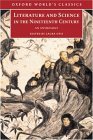
Although we are used to thinking of science and the humanities as separate disciplines, in the nineteenth century this division was not recognized. As the scientist John Tyndall pointed out, not only were science and literature both striving to better "man's estate", they shared a common language and cultural heritage. The quest for "origins", the nature of the relationship between society and the individual, and what it meant to be human were subjects that occupied both the writing of scientists and novelists.
This anthology brings together a generous selection of scientific and literary material to explore the exchanges and interactions between them. Fed by a common imagination, scientists and creative writers alike used stories, imagery, style, and structure to convey their meaning, and to produce works of enduring power. It includes writing by Charles Babbage, Charles Darwin, Sir Humphry Davy, Charles Dickens, George Eliot, Michael Faraday, Thomas Malthus, Louis Pasteur, Edgar Allan Poe, Mary Shelley, Mark Twain and many others. Also included are introductions and notes to guide the reader.
Trained as a neuroscientist and literary scholar, Laura Otis, Ph.D., studies the ways that literature and science intersect. In her interdisciplinary research, she compares scientific and literary writers' descriptions of memory, identity, emotion, and thought. Her research has been supported by MacArthur, Guggenheim, Fulbright, and Humboldt Fellowships. Otis earned her BS in Biochemistry at Yale University, her MA in Neuroscience from the University of California at San Francisco, her PhD in Comparative Literature from Cornell University, and her MFA in Fiction from Warren Wilson College. Since 2004 she has been a Professor of English at Emory University, where she teaches interdisciplinary courses on literature, neuroscience, cognitive science, and medicine. Otis is the author of Organic Memory (1994), Membranes (1999), Networking (2001), Müller’s Lab (2007), Rethinking Thought (2016), and Banned Emotions (2019). She has also translated neurobiologist Santiago Ramón y Cajal’s Vacation Stories (2001) into English and has edited Literature and Science in the Nineteenth Century: An Anthology (2002). A fiction-writer as well as a scholar, she is the author of the novels Clean, Refiner’s Fire, Lacking in Substance, The Tantalus Letters, and The Memory Hive. Her current project, The Neuroscience of Craft, examines what neuroscientists and creative writers can learn from each other about how sensations blend in people’s minds.
I found this anthology to be both amazing and helpful. I am not an expert on scientific history, but this book provides a wonderful gateway to excellent source material and reading that is just a lot of fun. If you are interested in anything from nineteenth-century science to Charles Dickens to Charles Darwin to steampunk...well, you would really like this book. Fascinating accounts of the usual subjects (evolution, biology, math, etc) are accompanied by writings about poverty and women and various other subjects. Enjoy!
I explored excerpts of this, during the final year of my university degree, but am not sure I ever read the entire contents. I am keen to return to this book and read it cover-to-cover as I can recall finding much to interest me on every page.
I never thought about it this way before this term, but one of the central contextual influences on 19th century literature were definitely scientific developments. Geological and evolutionary findings forever changed what human existence meant. God and humanocentrism were not the only things exorcised; economics, labour, romance, love, gender were all utterly reconfigured and re-envisioned. A novel like Tess of the D'Urbevilles can of course on the one hand be read as a tragic novel of love, class, morality, gender, but at the same time it is also about sexual selection, about descent, about a natural world free from humanocentrism. Add into the mix parasciences of race, sexuality, the Occult, medicine, and the mind, and suddenly underneath the texture of 19th century literature can be found bubbling, boiling scientific enterprises, discourses, 'creative misprisions' (as Gillian Beer puts it). Form was equally radically changed. The novel's capacity for evoking lineages and descent as well as narrating large tracts of time was used to express and explore Darwinian ideas; physics gave poetry new modes of sound, rhythm, and lineation. Edgar Allen Poe might have said, in 1829, that science has torn 'from me, | The summer dream beneath the tamarind tree' in 'Sonnet--To Science', but to me, and to those writing after Poe, science seemed to only have made that summer dream infinitely richer.
I always find anthologies hard to review because they do not represent the coherent work of a single author, which is how I evaluate most books. However, in the terms of the richness and intelligibility of the ideas chosen to be represented by the collection, this anthology was extremely well edited. The use of primary sources serves to weave several important ideas of nineteenth century scientific discovery and its impact in the intellectual world. To this goal, the different sections were clearly demarcated and the collection from scientific treatises to excerpts of novels was flawlessly chosen. All in all I would not hesitate to recommend this anthology to anyone who is curious to see the effect that science can have on the world of literature.
This is a monstrously huge anthology we read for my literature and science class. It is certainly a very handy resource for academics. Everybody from Huxley to Shelley to Darwin to Eliot to Lamarck is in here. Not exactly full of the most entertaining reads of all time but a great source for historical discussion of science.
An enjoyable anthology that will be a welcome resource in the future. In the introduction, Laura Otis writes that science and literature were much more intertwined in the 19th c. (p. xvii), something I think we've mostly lost. One had scientific papers with good writing that was accessible as well as a public dialogue between literature and science, with writers exploring the implications and ethics of the science. In addition to the brief introduction, each of the section introductions were amazing. One of the best was the introduction to "Sciences of the Body (pp. 130-5).
The text selections are broad and many, and some caught special attention from me. From the Science pieces, I enjoyed Proctor's "The Photographic Eyes of Science (1883) (p. 84). I was wowed reading an excerpt of Roentgen's original paper (1895) on the discovery of X-rays (p. 88). In our times of coronovirus, Oliver Wendell Holmes piece on "The Contagiousness of Puerperal Fever (1843) was quite good (pp. 177-181). There is a fascinating excerpt from Thomas de Quincey's Confessions of an English Opium-Eater (1822), especially useful during the present-day opiod crisis (pp. 331-4). An interesting piece on what I would call phantom limb syndrome was included from Mitchell's The Case of George Dedlow (1866) (p. 358-363). I can totally relate to Frances Power Cobbe's "Unconscious Cerebration: A Psychological Study" (1871) that suggests we can sometimes do our best work when we are asleep (pp. 424-7). Kekulé's "Address to the German Chemical Society" (1890) furthers this idea in that he explains how he came up with the structure of the benzene molecule: he had a dream about a snake swallowing its own tail (pp. 431-3)!
Of the Literature pieces, I liked Dickens's (1847-8) description of train travel from "Dombey and Son" (p. 116). I laughed out loud at George Eliot's Middlemarch (1871-2) excerpt: "A liberal education had of course left him free to read the indecent passages in the school classics" (p. 156)! Of course, I loved Poe's (1842) Mask of the Red Death (pp 171-7). I enjoyed H.G. Wells The Stolen Bacillus (1895), something I'd never read before (p. 197-203). May Kendall's poem "Lay of the Trilobite (1885) was really enjoyable (pp. 303-5). I liked the introduction from Jane Austen's Pride and Prejudice (1813) (pp 306-8), even though I usually prefer the Brontës. I was also taken with Thomas Hardy's (1891) "Tess of the D'Urbervilles" (pp. 318-324). I may even pick up a copy of Mary Elizabeth Braddon's Lady Audley's Secret (1862) after reading an excerpt (pp. 353-8). Finally, I enjoyed the excerpt from Oscar Wilde's The Picture of Dorian Gray (1890), so much so that I might have to revisit my copy of the novel (pp. 521-5).
An interesting collection of nineteenth-century literary and scientific texts. Anthologies are always tricky to review because they are meant to showcase a variety of material. This book certainly did that, but it felt very disjointed in parts. I struggled to see the connections between a lot of the texts beyond the glaringly obvious.
Clearly, the anthology covers a lot of ground. I think the editor, Laura Otis, does an excellent job of representing all decades of the era and structuring the texts into segments. Her introductions were good, although they did not do much more than summarise the upcoming texts. I am also inspired to pick up some of the featured material in this book in full as it intrigued me.
None of it really gripped me, however. Most were highly abstract and fragmented; it was hard to grasp the complete essence of the text. I am unsure what could fix this problem, but even the parts taken from complete novels I have read felt dull when condensed to a few pages. This point is even more apparent in the scientific texts, which we are plunged head-first into the jargon of and expected to make sense.
Overall I would recommend Literature and Science in the Nineteenth Century: An Anthology to anyone who is already interested and had a good grounding in the period. I would not consider this book to be general reading as most of the texts are more obscure. As it is a book dealing with all aspects of Victorian science, needless to say, some outdated views concerning race and sex and all the other prejudices do also crop up. These views are to be expected from the anthologies material, however, and Otis does tackle it in her introduction. Providing you do not mind this, it is worth trying the first segment and forming your own opinion.
An excellent introduction to scientific studies in the Victorian era, with some continuity from the late 18th Century. This book could be considered a series of short introductions to various fields of science, such as bacteriology, evolutionary studies and sociology - complete with the contemporary fiction that incorporated the new discoveries. The masterful balance of scientific and fictional excerpts keeps the book from feeling either too heavy and dry, or light and unmoored, allowing considerable reader stamina. Brilliant for those seeking to dive deeper into 19th Century scientific debates, or those who wish to better understand the origin of many of today’s sciences, and their initial impact on society. Though the book is long, it is neatly divided into manageable sections, each with an introduction.
Ich habe es nur auszugsweise in einem Seminar gelesen. Eine nette zusammenfassung verschiedenster Texte. Von wissenschaftlichen Papern von Faraday pber Kurzgeschichten zu Ausschnitten aus Romanen oder sozialwissenschaftlichen Werken von Engels ist alles dabei und einen groben Überblick über die wissenschaftliche Literatur dieser Zeit zu bekommen. In dieser gerafften Form sieht man sehr schön, wie sich der Stil weiterentwickelt hat und welche Stilformen verbreitet waren. Man sieht, wie sich das Bild der Wissenscahft und der Wissenschaftler verändert hat. Wie Darwins Ideen beeinflussten aber auch wovon Darwin beeinflusst wurde. Dieses Buch ist ein guter Einstieg, um anahand der Vorauswahl zu entscheiden, welche Romane oder Texte man nächer untersuchen will, wenn man denn gerade Anglistik studiert. Das ist definitiv keine Antologie, die mal man so zur Entspannung liest. Sie ist auch nicht sonderlich unterhaltsam, dazu sind die Themen einfach zu trocken. Das ist klassische Semesterliteratur, die man nicht unbedingt freiwillig liest.
TEST: This anthology offers a concise collection of texts both scientific and literary. Dealing with physical sciences, evolution, hygiene and germ theory it canvases the major scientific movements of the period.