

What do you think?
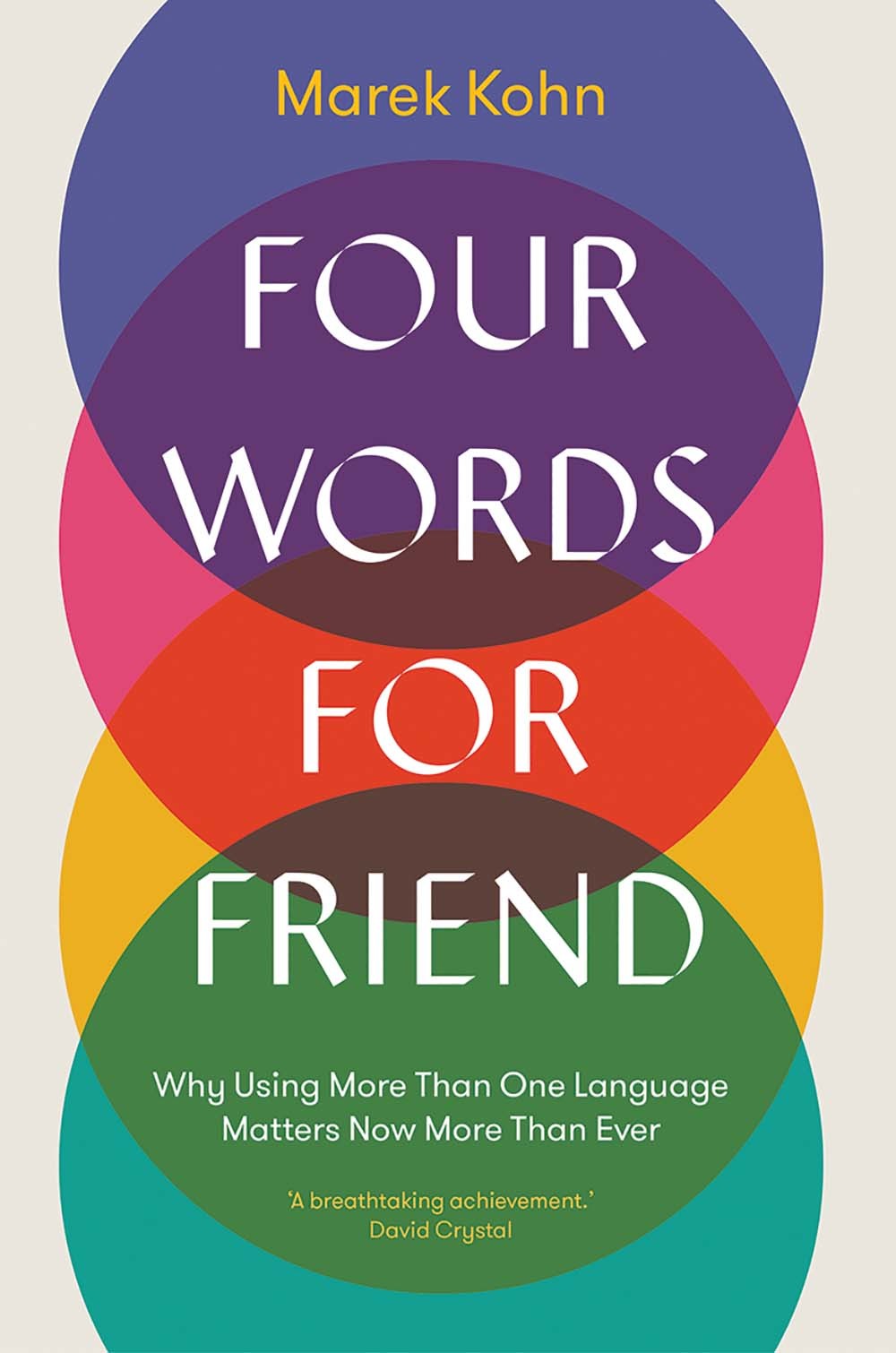
Four Words for Friend: Why Using More than One Language Matters Now More than Ever
A compelling argument about the importance of using more than one language in today’s world
In a world that has English as its global language and rapidly advancing translation technology, it’s easy to assume that the need to use more than one language will diminish—but Marek Kohn argues that plural language use is more important than ever. In a divided world, it helps us to understand ourselves and others better, to live together better, and to make the most of our various cultures.
Kohn, whom the Guardian has called “one of the best science writers we have,” brings together perspectives from psychology, evolutionary thought, politics, literature, and everyday experience. He explores how people acquire languages; how they lose them; how they can regain them; how different languages may affect people’s perceptions, their senses of self, and their relationships with each other; and how to resolve the fundamental contradiction of languages, that they exist as much to prevent communication as to make it happen.
In a world that has English as its global language and rapidly advancing translation technology, it’s easy to assume that the need to use more than one language will diminish—but Marek Kohn argues that plural language use is more important than ever. In a divided world, it helps us to understand ourselves and others better, to live together better, and to make the most of our various cultures.
Kohn, whom the Guardian has called “one of the best science writers we have,” brings together perspectives from psychology, evolutionary thought, politics, literature, and everyday experience. He explores how people acquire languages; how they lose them; how they can regain them; how different languages may affect people’s perceptions, their senses of self, and their relationships with each other; and how to resolve the fundamental contradiction of languages, that they exist as much to prevent communication as to make it happen.
264 pages, Hardcover
First published April 9, 2019
About the author
Marek Kohn
13 books17 followersMarek Kohn is a British science writer on evolution, biology and society.
Ratings & Reviews
Friends & Following
Create a free account to discover what your friends think of this book!
Community Reviews
Displaying 1 - 16 of 16 reviews

April 19, 2019
‘Among the many asymmetries that worked to Britain's disadvantage in its negotiations to leave the European Union,’ Marek Kohn notes, in one of the barbed asides that punctuate this book, ‘was the twenty-seven other nations' fluent grasp of the Daily Telegraph and the Daily Mail, unmatched by any corresponding British familiarity with the Frankfurter Allgemeine Zeitung or Bild.’
It's a point that seems especially clear from where I sit, as an Englishman living in German-speaking Central Europe, though I suppose it only takes you so far – one is loth, after all, to understress the drastic incompetence of the British politicians involved.
For a writer from the UK to be expatiating on the joys and benefits of multilingualism now, mid-Brexit, is not a timely coincidence – Kohn was inspired to the subject directly by seeing the nasty flare-up of xenophobia that followed the 2016 referendum. Kohn, whose family are from Poland, found himself responding not with a stronger desire to ‘identify as’ British, but, on the contrary, with a stronger desire to assert his Polish heritage and to properly learn the language which until then he had spoken only poorly and infrequently.
One of the themes of this book is the ways in which language is used both to bind people together and, conversely, to establish lines of difference between one community and another. ‘Pragmatic arguments – migrants should speak English to avoid misunderstandings in the workplace, or to make friends in the playground – shade into demands of a more dogmatic cast: this is the language of the country, so if you want to live here, you had better speak it.’ The end-point of this mindset can be lethal, as easily seen all over the world – Kohn retails several examples, including from the Middle East where not long ago, for instance,
Similar incidents were common during the Balkans conflicts too. (This was, remember, the original function of a shibboleth: ‘Then said they unto him, Say now Shibboleth: and he said Sibboleth: for he could not frame to pronounce it right. Then they took him, and slew him at the passages of Jordan.’)

New Orleans, 2017
Not all of the book, though, is on such a life-or-death level as this; a lot of it simply has to do with Kohn trying to get to grips with the latest research into bilingualism, what its beneficial effects are on the brain (if any), and how it might affect someone's view of society.
I really admired the ideas animating the book, but Kohn's layman viewpoint did occasionally give me pause. He doesn't write as a linguistic researcher, or even as an expert commentator on the field (his previous books have been on subjects as diverse as Darwinism and British drug culture); if anything, he is writing as an interested bilingual person, although given his confessedly rusty knowledge of Polish, even this is a bit of a stretch. Which makes his conclusions sometimes a little shaky.
A lot of his discussions of different languages have a decidedly neo-Whorfian tone which I think we should be cautious about; for instance, after considering languages with evidential grammar (like Turkish), he decides that ‘it is easy to infer that a population largely trusts its broadcasters if they accept that the default mode for news reports is the first-hand form’. This is quite a leap. Linguists tend to be suspicious of this kind of argument, not because it is totally without truth but rather because it so easily blends with arguments from pure stereotype (German is ordered and utilitarian, Italian baroque and expressive, etc etc).
He also sometimes displays a quasi-mystical, literalist view of languages' untranslatability, of the kind that is very rarely shared by people who actually translate professionally (or even regularly). When talking about how Spanish-speakers describe breaking a box, for example, he seems almost deliberately obtuse:
Huh? This example is especially weird because English actually has a very similar impersonal prepositional construction: ‘it broke on me’.
Being born in an English-speaking country used to be quite an advantage. Nowadays, it's almost a disadvantage, since everyone of basic education in the rest of the world speaks English anyway, and they speak a couple of other languages as well. And those who speak it as a second language may be getting extra benefits when it's used, since research suggests that using a non-native language helps you bypass emotional, knee-jerk reactions – something called the ‘foreign language effect’. Again, Kohn can't help seeing Brexit as a case in point:
Well, maybe. Certainly for those who do speak more than one language, or who want to speak more than one language, this book is full of fascinating anecdotes and studies to help consider what it means in a new light. And despite his flirtations with linguistic determinism, Kohn's conclusions on language are unimpeachable: ‘Its effects on thought are disputed. Its effects upon the relations between people are indisputable.’
It's a point that seems especially clear from where I sit, as an Englishman living in German-speaking Central Europe, though I suppose it only takes you so far – one is loth, after all, to understress the drastic incompetence of the British politicians involved.
For a writer from the UK to be expatiating on the joys and benefits of multilingualism now, mid-Brexit, is not a timely coincidence – Kohn was inspired to the subject directly by seeing the nasty flare-up of xenophobia that followed the 2016 referendum. Kohn, whose family are from Poland, found himself responding not with a stronger desire to ‘identify as’ British, but, on the contrary, with a stronger desire to assert his Polish heritage and to properly learn the language which until then he had spoken only poorly and infrequently.
One of the themes of this book is the ways in which language is used both to bind people together and, conversely, to establish lines of difference between one community and another. ‘Pragmatic arguments – migrants should speak English to avoid misunderstandings in the workplace, or to make friends in the playground – shade into demands of a more dogmatic cast: this is the language of the country, so if you want to live here, you had better speak it.’ The end-point of this mindset can be lethal, as easily seen all over the world – Kohn retails several examples, including from the Middle East where not long ago, for instance,
a bus was boarded by armed men, one of whom held a tomato and demanded each passenger tell him what it was: those who said it was a ‘banadura’, identifying themselves as Lebanese, were ordered off the bus; those who called it a ‘bandura’, revealing themselves to be Palestinians, remained on the bus and were slaughtered.
Similar incidents were common during the Balkans conflicts too. (This was, remember, the original function of a shibboleth: ‘Then said they unto him, Say now Shibboleth: and he said Sibboleth: for he could not frame to pronounce it right. Then they took him, and slew him at the passages of Jordan.’)
New Orleans, 2017
Not all of the book, though, is on such a life-or-death level as this; a lot of it simply has to do with Kohn trying to get to grips with the latest research into bilingualism, what its beneficial effects are on the brain (if any), and how it might affect someone's view of society.
I really admired the ideas animating the book, but Kohn's layman viewpoint did occasionally give me pause. He doesn't write as a linguistic researcher, or even as an expert commentator on the field (his previous books have been on subjects as diverse as Darwinism and British drug culture); if anything, he is writing as an interested bilingual person, although given his confessedly rusty knowledge of Polish, even this is a bit of a stretch. Which makes his conclusions sometimes a little shaky.
A lot of his discussions of different languages have a decidedly neo-Whorfian tone which I think we should be cautious about; for instance, after considering languages with evidential grammar (like Turkish), he decides that ‘it is easy to infer that a population largely trusts its broadcasters if they accept that the default mode for news reports is the first-hand form’. This is quite a leap. Linguists tend to be suspicious of this kind of argument, not because it is totally without truth but rather because it so easily blends with arguments from pure stereotype (German is ordered and utilitarian, Italian baroque and expressive, etc etc).
He also sometimes displays a quasi-mystical, literalist view of languages' untranslatability, of the kind that is very rarely shared by people who actually translate professionally (or even regularly). When talking about how Spanish-speakers describe breaking a box, for example, he seems almost deliberately obtuse:
They could say ‘se me rompió’, which can only be translated nonsensically or awkwardly in English: ‘it broke to me’, ‘to me it happened that it broke’.
Huh? This example is especially weird because English actually has a very similar impersonal prepositional construction: ‘it broke on me’.
Being born in an English-speaking country used to be quite an advantage. Nowadays, it's almost a disadvantage, since everyone of basic education in the rest of the world speaks English anyway, and they speak a couple of other languages as well. And those who speak it as a second language may be getting extra benefits when it's used, since research suggests that using a non-native language helps you bypass emotional, knee-jerk reactions – something called the ‘foreign language effect’. Again, Kohn can't help seeing Brexit as a case in point:
Britain, speaking English and only English, based its decisions on emotions and found itself in disarray. The twenty-seven countries on the other side, speaking English among themselves, achieved a remarkable degree of coherence, based on a clear understanding of their collective interests.
Well, maybe. Certainly for those who do speak more than one language, or who want to speak more than one language, this book is full of fascinating anecdotes and studies to help consider what it means in a new light. And despite his flirtations with linguistic determinism, Kohn's conclusions on language are unimpeachable: ‘Its effects on thought are disputed. Its effects upon the relations between people are indisputable.’

November 24, 2019
Finding paths through language territories may not require maps, but it does require guiding principles. This book follows several; one is that paths are worth finding. The use of more than one language is a good thing: not always, not necessarily, not inherently, but in most circumstances and in spirit, it is good. There are many reasons for this, but the underlying one is that it favours a complex of goods: openness, interconnection, inclusion, mutual exchange and the sharing of knowledge.
Another is that the two-sided character of language must always be recognised. It is the place from which the path has to start. We will get hopelessly lost if we lose sight of the truth that language exists as much to prevent communication as to make it happen. This is not really a paradox: the design logic of enabling information to circulate within a group, while restricting its ability to enter or leave, is all too easy to grasp. There you have it: the two sides of human nature, inward community and outward exclusion, the latter the engine of the former. Sympathy is generated by drawing limits around it. To transcend this design, to liberate those better angels of our nature, we need to treat the dual character of language as a contradiction that must be resolved, or at least mitigated.
The third basic principle, that all of a person’s linguistic resources should be valued, helps to ease the conflict. Under this principle, languages are treated with due respect, but not with undue deference. A language is regarded not as an edifice within which a community is housed and to which individuals may aspire to gain admission, but as an assembly of elements which individuals are free to use as they wish. This does not mean that maintaining its integrity and sustaining its vitality are unimportant. Quite the reverse: the better shape a language is in, the more use its elements will be. A healthy language will keep its identity while encouraging a rich variety of relationships to flourish across its boundaries, in different combinations, balances, modes and registers, at different levels of proficiency. Its perimeter will not be a dumb fence; it will be a complex and productive interface, like the membrane of a living cell. Yet the key to this complexity is the simple principle that we should make the most of whatever we can grasp. It is a practical, everyday way to reduce the inherent tensions of language use.
The first steps are simple too. Make what you can of the words you hear and see, spoken, written or signed. Start speaking, and keep going.
This is not your average book on amateur-level linguistics, mostly because Kohn isn't a linguist. He's just a guy who thinks languages are cool and using more of them, even to varying degrees of fluency, helps bring people together. (Of course I'm oversimplifying, but not by sooo much.) Yes, the examples he uses will be familiar to readers of similar texts; we've heard the "Russian has separate words for dark vs. light blue" thing before. And yes, he stands a bit too close to neo-Whorfianism - or rather, a bit too close to statements which could, in turn, get very Whorf-y.
But he does raise and try to answer interesting questions on what languages do and mean:
- How do different countries handle multilingualism? (Awkwardly and inconsistently.)
- Is learning a second language actually beneficial to brain health? (Results are inconclusive on the physiological front, but learn them anyway.)
- Do we become other people when speaking different languages? (Sure seems like it subjectively, and personality tests given in certain languages do seem to "activate" the traits stereotypically associated with the language and its respective culture.)
- Will the likely improvement and ever wider availability of instantaneous translation software make learning several languages useless? (Nope. Babel fish will be great for shopping and useless for jokes and poetry.)
I'd recommend this book to just about everyone, and especially to anyone who's been on either the giving or the receiving end of a "in [country X] we speak [Xish]" comment. Can't we all just get along?

May 30, 2025
Four Words for Friend: Why Using More than One Language Matters Now More than Ever is an ambitious and sweeping examination of the economic, social, cultural, historical, technological, and neurological implications of bilingualism. It cannot fully explore all of that in just over two hunded pages, but still manages an impressive work of research and synthesis. Kohn's writing style is somewhere between journalistic and academic. I was impressed by the range of topics and material, all of which were thought-provoking and informative. Many of the anecdotes merit a chapter, if not a book, to themselves:
One of my best friends speaks Turkish, so I must ask her how she experiences this. Indeed, I'm planning to send her this book. It is most relevant to bilingual people and those raising a child to understand multiple languages. If, like me, your interest in languages is a hobby and you rarely use anything other than English, it will still fascinate and enlighten. It's easy for native English speakers to disregard considerations like this:
Obviously it also didn't help that the UK governments negotiating brexit were run by evil clowns. I appreciated Kohn's use of case studies from all over the world, notably Latvia's language laws and Papua New Guinea's extraordinary linguistic diversity. Four Words for Friend: Why Using More than One Language Matters Now More than Ever gave me a lot to consider regarding the purposes and uses of language. The title refers to the different terms for a friend in Russia, each of which express a different degree of closeness; a contrast to the ambiguity of 'friend' in English.
It took Sümeyra Tosun a while to work out why she felt there was something wrong when she spoke English. [...]
Eventually she realised what it was. Turkish obliges its speakers to specify whether information is first-hand or not, by attaching suffixes to the end of verbs: di or variants thereof for first-hand information, miş or variations of it for information that is not first-hand. Tosun had never paid any mind to this grammatical requirement before, but when she ventured into a language that lacked it, she felt its absence as unease.
One of my best friends speaks Turkish, so I must ask her how she experiences this. Indeed, I'm planning to send her this book. It is most relevant to bilingual people and those raising a child to understand multiple languages. If, like me, your interest in languages is a hobby and you rarely use anything other than English, it will still fascinate and enlighten. It's easy for native English speakers to disregard considerations like this:
Rules and social norms are embedded in native languages. If people are disconnected from their mother tongues, they may be disconnected from channels to personal memories that are the source of powerful sentiments about right and wrong. [...]
These researchers also remarked on the possible importance of the 'foreign language effect' in international bodies such as the United Nations and European Union. Discussions within such organisations are generally conducted in a lingua franca, usually English. Most participants will therefore be speaking a language foreign to them, and so may be less strongly in touch with their moral sentiments than they otherwise would. They will also be professionally skilled in rational calculation. The result may be to make international co-operation somewhat more utilitarian than national endeavours. This hypothesis offers a compelling explanation (though far from the only one) for a phenomenon subsequently observed as the United Kingdom negotiated its exit from the European Union. Britain, speaking English and English, based its decisions on emotions and found itself in disarray. The twenty-seven countries on the other side, speaking English amongst themselves, achieved a remarkable degree of coherence, based on a clear understanding of their collective interests.
Obviously it also didn't help that the UK governments negotiating brexit were run by evil clowns. I appreciated Kohn's use of case studies from all over the world, notably Latvia's language laws and Papua New Guinea's extraordinary linguistic diversity. Four Words for Friend: Why Using More than One Language Matters Now More than Ever gave me a lot to consider regarding the purposes and uses of language. The title refers to the different terms for a friend in Russia, each of which express a different degree of closeness; a contrast to the ambiguity of 'friend' in English.

July 15, 2026
This book provided me with a language to embody my love for linguistics. I loved the range of topics covered - from communities artificially changing language to distinguish themselves, to language acquisition in the early years, to the politics of multi-lingual nations...it was fantastic.
For me, the best part was how Kohn doesn't make a single point without first bringing it to life in a case study he allows to sit front and centre of his argument. This allows the reader to learn fascinating tidbits about languages from across the world, from Latvia to Indonesia. Very, very cool. Thanks Kohn!
For me, the best part was how Kohn doesn't make a single point without first bringing it to life in a case study he allows to sit front and centre of his argument. This allows the reader to learn fascinating tidbits about languages from across the world, from Latvia to Indonesia. Very, very cool. Thanks Kohn!
July 5, 2021
Great overview over what a multilingualism is and what it isn't. Encouraging. Good writing style, so it's a fluent read. Sometimes it could go deeper into the science including theoretical background and meta studies. Some parts are too open and inconclusive.

July 4, 2025
In a world where boundaries between nations and people seem to be getting more and more rigid, Marek Kohn calls out for more languages and fewer barriers.
Kohn discusses the common tropes surrounding bilingualism - the data is inconclusive regarding bilingualism’s impact on cognitive function;
- countries handle multilingualism inconsistently and arbitrarily;
- the increase in artificial translation will not be the end of multilingualism;
- some people feel different when speaking their second language but whether or not this is a subjective phenomenon is unclear.
There are moments where Kohn takes far too many words to say something and the book isn’t quite sure if it what’s to be an academic text or a popular science one. Yet, ultimately, learning and speaking another language is another way of seeing and experiencing the world around us. That alone merits more opportunities for bilingualism.
Kohn discusses the common tropes surrounding bilingualism - the data is inconclusive regarding bilingualism’s impact on cognitive function;
- countries handle multilingualism inconsistently and arbitrarily;
- the increase in artificial translation will not be the end of multilingualism;
- some people feel different when speaking their second language but whether or not this is a subjective phenomenon is unclear.
There are moments where Kohn takes far too many words to say something and the book isn’t quite sure if it what’s to be an academic text or a popular science one. Yet, ultimately, learning and speaking another language is another way of seeing and experiencing the world around us. That alone merits more opportunities for bilingualism.
July 20, 2019
An examination of bilingualism and multilingualism. Kohn probes a what might seem like an esoteric subject, exploring the advantages of speaking more than one language to individuals as well as the problems it causes in societies. For example, he spends a full chapter exploring Latvia's two language populations. Even though the minority population of Russian-speakers must use the Latvian language in all public functions, their children attend "Russian" schools. The schools are mandated to increase the amount of classes whose instructional language is Latvian to more than half the day. He gives examples of how languages divide societies and peoples, by helping native speakers determine who is "one of us" and who is a "stranger."
It's a fascinating read, and may stimulate readers to develop their language fluencies.
It's a fascinating read, and may stimulate readers to develop their language fluencies.

September 30, 2019
I think this book is fabulous and recommend it. Inspired by modern nationalism, xenophobia and global tensions, he examines what it means to be bilingual. From the start, he asserts his view that language is fluid and there is inclusiveness in diversity. The sections cover what does it mean to be bilingual, how does one learn multiple languages at home, the cognitive science and debates of bilingualism, and national identity and economic power (examples are Latvia, Singapore, and India). I found it very interesting, though there are a few times where evidence and interpretation are confused, but I enjoyed reading a subject that is so core to human experience yet I never get to really dig into.

September 17, 2025
Book looks at bilingualism and debunks the myths that bilinguals are at a disadvantage to monolingual counterparts. Enjoyed discussion of experiments in various countries that overall show bilinguals to be more open minded than monolinguals. Chapter on learning languages from birth was particularly interesting, exploring how babies learn intonation of their mother tongue while still in the womb. Unfortunately the writing style was jarring and didn’t make it an easy read.
February 15, 2025
Beautifully written and thought-provoking. When I'm asked for the umpteenth time "why bother? Everyone speaks English/ you can just run it through Google anyway/ etc.." this gives a far more eloquent response than my usual "gaargh!". The socio/ psychological benefits of multilingualism (beyond the purely functional) aren't often explored, and it's nice to see it here

May 4, 2019
A fascinating exploration of bilingualism and its benefits for individuals and societies.

June 28, 2020
Very interesting and academically presented. I would recommend it but I don’t necessarily see myself re-reading it.
November 19, 2023
Some interesting content but could have been said in 100 words less. Some overly convoluted language used to explain basic concepts

December 22, 2023
Such an intriguing exploration of multilingualism. Obviously I didn’t agree with everything, but this was still well worth the read.

April 25, 2019
In a world full of nativism, xenophobia, and rampant nationalism, Marek Kohn’s book, Four Words for Friend: Why Using More Than One Language Matters Now More Than Ever is a breath of fresh air.
As someone who has learned 2 foreign languages (and subsequently forgotten important parts of both) I found this book fascinating. While Kohn’s work is not entirely new information for anyone who has read widely on linguistics and bi(multi)lingualism (he delves into the Whorf-Sapir hypothesis of linguistic relativism as well as studies regarding language acquisition and its effects on brains of multilinguals), the main thesis of the books seems to divert from common widely-held views of distinct language preservation at all costs as the holy grail, and instead suggests a social well-being favouring openness, mutual exchange, and knowledge sharing by a willingness to communicate across languages (however imperfectly) as far more beneficial. “Integrating languages within communities or within individual minds is a way to turn competition into co-operation, suspicion into trust,” says Kohn.
While not to suggest that language preservation is not an important way to maintain culture, having grown up in New Brunswick, the only officially bilingual province in Canada, I witnessed both the social-cohesion that can happen across language barriers and the deep-seeded animosity that still exists between speakers of each language for the other. Kohn’s idea that we must use languages “to illuminate each other, rather than having a world where one strives to outshine the other,” is perhaps a solution to the perfect being the enemy of the good and a bridge in places like New Brunswick, still deeply segregated by language divide.
As someone who has learned 2 foreign languages (and subsequently forgotten important parts of both) I found this book fascinating. While Kohn’s work is not entirely new information for anyone who has read widely on linguistics and bi(multi)lingualism (he delves into the Whorf-Sapir hypothesis of linguistic relativism as well as studies regarding language acquisition and its effects on brains of multilinguals), the main thesis of the books seems to divert from common widely-held views of distinct language preservation at all costs as the holy grail, and instead suggests a social well-being favouring openness, mutual exchange, and knowledge sharing by a willingness to communicate across languages (however imperfectly) as far more beneficial. “Integrating languages within communities or within individual minds is a way to turn competition into co-operation, suspicion into trust,” says Kohn.
While not to suggest that language preservation is not an important way to maintain culture, having grown up in New Brunswick, the only officially bilingual province in Canada, I witnessed both the social-cohesion that can happen across language barriers and the deep-seeded animosity that still exists between speakers of each language for the other. Kohn’s idea that we must use languages “to illuminate each other, rather than having a world where one strives to outshine the other,” is perhaps a solution to the perfect being the enemy of the good and a bridge in places like New Brunswick, still deeply segregated by language divide.

April 26, 2019
This book is relevant today and I love how the author explores language, the ability to relate to different people and cultures and what role language plays in all this.
It's an engaging read and for someone who speaks three languages fluently and struggled to learn Chinese and Spanish later on in college, I'd say that the author explores aspects about language and how powerful it is in relationships on any level-and though that's always been said, what's fresh with this book is research on the historical accounts on language.
Thanks Netgalley for the eARC.
It's an engaging read and for someone who speaks three languages fluently and struggled to learn Chinese and Spanish later on in college, I'd say that the author explores aspects about language and how powerful it is in relationships on any level-and though that's always been said, what's fresh with this book is research on the historical accounts on language.
Thanks Netgalley for the eARC.
Displaying 1 - 16 of 16 reviews