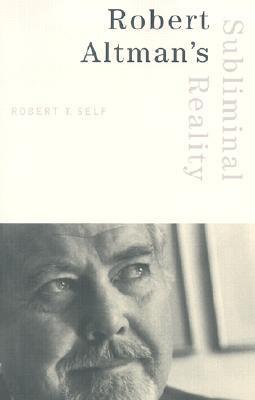
With his complex and unconventional films, Robert Altman often draws an impassioned response from critics but bafflement and indifference from the general public. Some audiences have dismissed his movies as insignificant, unsatisfying, and unreadable. Ironically, Altman might he makes films in order to challenge filmgoers' expectations of straightforward narratives and easily understood endings. In Subliminal Reality, Robert T. Self sheds light on Altman's work and provides the most comprehensive analysis of his films to date. With close readings of classics like MASH, McCabe and Mrs. Miller, and Nashville, and more recent films like The Player, Short Cuts, and Cookie's Fortune, Self asserts the value of Altman's work not only to film theory and the entertainment industry, but to American culture itself. In his analysis, Self identifies Altman's films particularly as they address issues of form, identity, and industry. He explains how Altman critiques moviemaking forms by using an open, fragmented mode of storytelling and by turning conventional Hollywood genres inside out. He examines Altman's characterization of social and individual identity as fragile and fragmentary and his depiction of antiheroic characters debilitated by their socially constructed gender roles. Finally, Self shows how Altman challenges the entertainment industry itself, questioning its methods and motives and critiquing its role in our cultural alienation. Self frames his analysis of Altman's work with a discussion of the director's efforts to create a "subliminal reality" in his narratives-to touch audiences on an unconscious level and to recognize the unspoken, and unspeakable, dimensions in human interactions. According to Self, this striving for "subliminal reality" makes Altman's films not only exemplary of the potential of art cinema narration, but instrumental in keeping such narrative alive. Robert T. Self is professor of English at Northern Illinois University.
Es una tesis doctoral sobre Altman realmente adecuada, con capítulos que examinan sus temas uniendo películas sin seguir un esquema lineal-ascendente-historicista. Así que muy bien en todo ello. Para mi, la parte más persuasiva está dedicada a Three Women, pero aún necesito ver muchas más películas del maestro (y rever otras) para poder releer entonces esta tesis.
Vidas cruzadas, de Robert Altman, podría interpretarse como una nueva versión de la práctica de Vertov. El universo de Altman es, de hecho, un universo de encuentros contingentes entre una multitud de series, un universo en el que series diferentes comunican y resuenan a nivel de lo que el propio Altman refiere como «realidad subliminal» (choques mecánicos, encuentros, intensidades impersonales que preceden al nivel del significado social). Debemos evitar la tentación de reducir a Altman a un poeta de la alienación americana que hace palpable la silenciosa desesperación de las vidas diarias: hay otro lado en Altman, su receptividad a felices encuentros contingentes. En la misma línea que la lectura que Deleuze y Guattari hacen del universo de Kafka –en el que la Ausencia del esquivo Centro trascendente (Castillo, Tribunal, Dios) delata la Presencia de múltiples pasajes y transformaciones–, existe la tentación de interpretar la «desesperación y ansiedad» altmaniana como el engañoso reverso de una inmersión más afirmativa en la multitud de las intensidades subliminales. Esto último es el comunismo de Altman, representado por la propia forma cinematográfica que contrarresta la deprimente realidad social que se describe.