

What do you think?
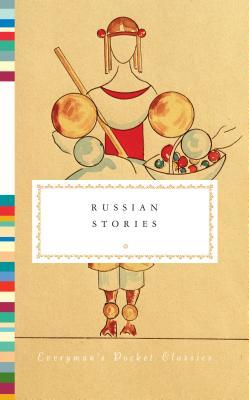
Russian Stories
Two centuries of short stories by twenty-five titans of Russian literature, from Pushkin and Gogol to Tatyana Tolstaya and Svetlana Alexievich--in the beautifully jacketed Pocket Classics series.
Russian Stories rounds up marvelous short stories by all the Russian heavyweights, including Pushkin, Gogol, Dostoevsky, Tolstoy, Turgenev, Chekhov, Bulgakov, and Nabokov, and continuing up to contemporary writers such as Tatyana Tolstaya and the recent Nobel Prize-winner Svetlana Alexievich. There is no similar one-volume collection of the best of the Russian greats in English, and especially none that include as many women as this one does, including a story by the recently rediscovered Teffi, who was widely hailed a century ago in Russia as "the female Chekhov." From the fate-changing storms that sweep through Alexander Pushkin's "The Blizzard" and Leo Tolstoy's "The Snow Storm" to the political whirlwind of perestroika that shapes Vladimir Sorokin's 1985 story "Start of the Season" to the aftermath of the collapse of the Soviet Union as experienced by ordinary people in Alexievich's "Landscape of Loneliness," these riveting stories chronicle not only the particular dramas and upheavals of the Russian people, but also the tribulations and triumphs of the human spirit.
Russian Stories rounds up marvelous short stories by all the Russian heavyweights, including Pushkin, Gogol, Dostoevsky, Tolstoy, Turgenev, Chekhov, Bulgakov, and Nabokov, and continuing up to contemporary writers such as Tatyana Tolstaya and the recent Nobel Prize-winner Svetlana Alexievich. There is no similar one-volume collection of the best of the Russian greats in English, and especially none that include as many women as this one does, including a story by the recently rediscovered Teffi, who was widely hailed a century ago in Russia as "the female Chekhov." From the fate-changing storms that sweep through Alexander Pushkin's "The Blizzard" and Leo Tolstoy's "The Snow Storm" to the political whirlwind of perestroika that shapes Vladimir Sorokin's 1985 story "Start of the Season" to the aftermath of the collapse of the Soviet Union as experienced by ordinary people in Alexievich's "Landscape of Loneliness," these riveting stories chronicle not only the particular dramas and upheavals of the Russian people, but also the tribulations and triumphs of the human spirit.
432 pages, Hardcover
Published April 9, 2019
About the author
Christoph Keller
131 books1 followerChristoph Keller—novelist, playwright, memoirist—is the Executive Assistant of the June M. Jordan Literary Estate Trust. With Jan Heller Levi, he co-edited We’re On: A June Jordan Reader, and has worked with foreign publishers on translations of Jordan’s work and books into German, French, Spanish, Polish, Portuguese, and Basque. Keller also edited a Bengali/English selection of poems entitled Only Our Hearts Will Argue Hard. Keller’s 2019 novel, The Ground Beneath Our Feet, won the Alemannic Literary Award; his memoir Jeder Krüppel ein Superheld (Every Cripple A Superhero) was published in Switzerland by Limmat Verlag in 2020.
Ratings & Reviews
Friends & Following
Create a free account to discover what your friends think of this book!
Community Reviews
Displaying 1 - 14 of 14 reviews

October 25, 2020
This was a frustrating book to read and is a frustrating book to review. In his introduction, Keller explains how he went out of his way to include stories by late 20th and 21st Century Women Russian/Soviet writers. There are good ones here by Tolstoya, Tsaetva, Petrushevskaya and Ullitskaya. Bravo. But another five women's stories here are slight and all about screwed up love. As a result, the first part of the collection with good and great stories by Pushkin, Lermontov, Tolstoy, Turgenev, Dostoevsky, Gogol, Chekhov seem even greater than they did before. Bunin's "The Gentleman From San Francisco" from 1915 in a translation I'd never read is more marvelous than ever. And Nabokov's "The Vane Sisters," is always a delight. But where is Kuprin, Gorky, Andreyev, Pasternak, Sholokov, Fedin, Solzshenitsyn? Any three of four of their works would have provided a fairer estimate of later Russian stories. Approach with care.

April 15, 2020
4.5*
Some of these were so good and then others I can now brag about having read but not really enjoyed... A good introduction to some of Russia's most prominent writers through time, ending with a bunch of female writers who outshine the classics. Can definitely recommend!
Some of these were so good and then others I can now brag about having read but not really enjoyed... A good introduction to some of Russia's most prominent writers through time, ending with a bunch of female writers who outshine the classics. Can definitely recommend!
August 8, 2019
The packaging of this book series, the small easily held pocket size, everything about this is a bibliophiles dream. Unfortunately, for me, the stories in this collection left a bit to be desired. Now, of course, in no collection are the stories all going to be loved by every reader, but in this case some of the stories chosen just did not work that well.
I will address here a few notes on selected stories.
Pushkin begins the collection promisingly with “ The Blizzard “ a story that follows a young couple eloping. The plan goes awry. Years later the almost widow discovers who it was she married that night and where he went.
I had read Gogol’s “ The Overcoat “ before and it holds up while Tolstoy tells “ The Snowstorm “ which follows an engineer staying in a village who is caught in a snowstorm with some overland wagon travelers and doubts he will be still alive in the morning.
Turgenev”s “ The Live Relic “ follows a crippled, almost embalmed village woman, unable to move who lives in a she’d still freely exercising her mind and finding no fault with her existence. Clearly a rebuke of those who can be satisfied never with all they need and more.
Chekhov’s “ The Bishop “ is a simple story, following the life of a village church leader and by the end making us wonder about the meaning of any single life.
Nina Berberova has a story called “ The Big City “ that works extremely well. This story is clearly and fully an allegory. It could be for a few things. Religion, Heaven, Socialism. Depending on one’s interpretation I suppose.
“ Start of the Season “ by Vladimir Sorokin is a more modern story and it has a twist that will shock you. A man is out in the woods with his hunting guide. They are excited to be in nature. The descriptions of the area, the surroundings brings Hemingway to mind. At the end of the story when the hunt is successful and our hunter has his kill we might have to review the story to see if we missed what was coming.
Another newer story that works is “ Sweet Shura “ by Tatyana Tolstoya. In this story we meet a narrator who tells us of an old woman she knows. Describing her story, her relationships, her three husbands. All paled in comparison to a man she loved however outside of her marriage, though during it. We read the story of how she let that one get away, through her own conscious decision making.
Some of the other stories have merit and work in part but they missed more than they reverberated for me.
I will address here a few notes on selected stories.
Pushkin begins the collection promisingly with “ The Blizzard “ a story that follows a young couple eloping. The plan goes awry. Years later the almost widow discovers who it was she married that night and where he went.
I had read Gogol’s “ The Overcoat “ before and it holds up while Tolstoy tells “ The Snowstorm “ which follows an engineer staying in a village who is caught in a snowstorm with some overland wagon travelers and doubts he will be still alive in the morning.
Turgenev”s “ The Live Relic “ follows a crippled, almost embalmed village woman, unable to move who lives in a she’d still freely exercising her mind and finding no fault with her existence. Clearly a rebuke of those who can be satisfied never with all they need and more.
Chekhov’s “ The Bishop “ is a simple story, following the life of a village church leader and by the end making us wonder about the meaning of any single life.
Nina Berberova has a story called “ The Big City “ that works extremely well. This story is clearly and fully an allegory. It could be for a few things. Religion, Heaven, Socialism. Depending on one’s interpretation I suppose.
“ Start of the Season “ by Vladimir Sorokin is a more modern story and it has a twist that will shock you. A man is out in the woods with his hunting guide. They are excited to be in nature. The descriptions of the area, the surroundings brings Hemingway to mind. At the end of the story when the hunt is successful and our hunter has his kill we might have to review the story to see if we missed what was coming.
Another newer story that works is “ Sweet Shura “ by Tatyana Tolstoya. In this story we meet a narrator who tells us of an old woman she knows. Describing her story, her relationships, her three husbands. All paled in comparison to a man she loved however outside of her marriage, though during it. We read the story of how she let that one get away, through her own conscious decision making.
Some of the other stories have merit and work in part but they missed more than they reverberated for me.

June 20, 2020
This book was a present, and it's absolutely beautiful. These stories were all new to me, although not all of the authors were. Like any collection of short stories, I preferred some over others. A few of the stories left me a little bewildered - as if the ending was a punchline I didn't quite get - and this may partly be a case of 'lost in translation'. There were several words/phrases I wasn't familiar with, but context made the general meaning clear, and I think notes might have broken the story's spell. A little unfamiliarity isn't a bad thing, reminding me of the spatial and temporal origins of the original stories.
On the whole, I loved the writing styles, which felt deliberate without being forced. My favourite thing (aside from the look of the book itself), however, is how memorable the stories are. They linger.
On the whole, I loved the writing styles, which felt deliberate without being forced. My favourite thing (aside from the look of the book itself), however, is how memorable the stories are. They linger.

December 12, 2025
I often ask myself why the classic Russian writers still stand so tall, why their words feel alive even after a century, while so much of modern writing already feels tired. This anthology gives a very simple answer—because the old masters wrote with a kind of moral fire that cannot be faked.
In these 26 stories, beginning with Pushkin and ending with Svetlana Alexievich, you can see the slow fading of that fire. The early writers speak with clarity, purpose, and a strange tenderness toward human weakness. Their sentences feel like they were carved, not written. By the time we reach the modern voices, the craftsmanship becomes uneven—sometimes thoughtful, sometimes wandering, sometimes simply dull. It is almost painful to watch the decline, like seeing a great oak turning into a thin, decorative plant.
In these 26 stories, beginning with Pushkin and ending with Svetlana Alexievich, you can see the slow fading of that fire. The early writers speak with clarity, purpose, and a strange tenderness toward human weakness. Their sentences feel like they were carved, not written. By the time we reach the modern voices, the craftsmanship becomes uneven—sometimes thoughtful, sometimes wandering, sometimes simply dull. It is almost painful to watch the decline, like seeing a great oak turning into a thin, decorative plant.
April 28, 2026
This is an excellent selection of stories, it evokes all sorts of emotions ranging from joy to less joy. Some very short stories in here don't make much sense to me, but I think they are more than covered up by the excellent and broad variety in everything else. I especially loved the one about the old woman and her past flings.
This was a very high effort read for me, mostly because I was annotating it for the girlfriend and I think for that it'll forever hold a special place in my heart. I thank the curators and the translators for serving this in one cutely sized book and obviously the writers I am always grateful for.
This was a very high effort read for me, mostly because I was annotating it for the girlfriend and I think for that it'll forever hold a special place in my heart. I thank the curators and the translators for serving this in one cutely sized book and obviously the writers I am always grateful for.

May 26, 2019
Worthwhile collection of 25 short stories from Russia's most famous writers. Really nice to get just a taste of the different styles and themes of Russian literature without having to crack open a whole novel, let alone a War and Peace style epic. Would recommend to anyone interested in Russian Lit like me, but doesn't quite know where to start. Only real critique was that a few of the stories required knowledge about Russian lit characters and stories that I didn't have, but overall very accessible

December 15, 2021
A beautiful hardcover books with a diverse array of Russian authors. The stories at the start of all the well-known authors were a true delight and a wonderful way to introduce myself to their work (to some, at least). The last 100/150 pages, though, were a bit of a disappointment, though Nabokov’s The Vane Sisters and Ludmila Ulitskaya’s Angel were a true delight. I discovered some stories I will forever love and for that, despite some disappointing stories, I will give this a well deserved four stars.

Read
February 1, 2026Tentative DNF @ 63%
The Blizzard - 5/5 stars
The Fatalist - 4/5 stars
The Overcoat - 4/5 stars
The Snow Storm - 2/5 stars
The Live Relic - 3.5/5 stars
The Dream of a Ridiculous Man - 3/5 stars
Elsa - 3/5 stars
The Bishop - 2/5 stars
The Gentleman from San Francisco - 2/5 stars
The Quiet Backwater - 3.5/5 stars
The Adventures of Chichikov - 3.5/5 stars
Music in Pavlovsk - 1/5 stars
Dolgushov’s Death - 1/5 stars
The Blizzard - 5/5 stars
The Fatalist - 4/5 stars
The Overcoat - 4/5 stars
The Snow Storm - 2/5 stars
The Live Relic - 3.5/5 stars
The Dream of a Ridiculous Man - 3/5 stars
Elsa - 3/5 stars
The Bishop - 2/5 stars
The Gentleman from San Francisco - 2/5 stars
The Quiet Backwater - 3.5/5 stars
The Adventures of Chichikov - 3.5/5 stars
Music in Pavlovsk - 1/5 stars
Dolgushov’s Death - 1/5 stars

November 30, 2020
This beautiful book became to me a portal into Russian Literature. What a treasure trove! I specifically appreciated that the stories were arranged in chronological order, so that the progression of time and changing expression was pronounced. Loved this collection!

November 11, 2025
The book is as good or mediocre as the stories included. For me, the pre-soviet era had too profound impact. Compared to that, later stories of 1950s and onwards were a total drag. Also, a few later stories were not even in Russian setting.

November 22, 2019
Wide variety of stories, exposed me to some authors/types of writing that I never would have read on my own. Enjoyed each one and read a few twice.

December 28, 2019
Spectacular writing by all the authors in this collection but thematically the stories follow all the same throughline and seem to run together.

Displaying 1 - 14 of 14 reviews