

What do you think?

Les épées de verre #1-4
玻璃剑1:复仇之刃
中古时代的大地上流传着一个预言:太阳将要熄灭,四把宝剑会从天而降,只有集齐这四把剑的人能够带领大家逃脱灭世的灾难。但是每把剑都有命定的持有者,其他人如果碰到剑都会变为玻璃。由于勇敢地站出来反抗压迫,小姑娘雅玛的母亲被恶霸强占,父亲被畏惧强权的村民害死。雅玛立誓复仇,她逃进森林,向有着神秘过往的米克洛斯拜师学艺。长大后,她拔出了*把玻璃剑。而她的仇人此时正在奴役更多的苦难人民,于是她和师父、伙伴一起踏上了手刃仇敌、为民除害,并寻找传说中的其他三把玻璃剑的征程。这是一篇反抗压迫、争取生命和自由的史诗。
102 pages, Hardcover
First published November 1, 2014
Ratings & Reviews
Friends & Following
Create a free account to discover what your friends think of this book!
Community Reviews
Displaying 1 - 30 of 52 reviews

July 13, 2017
Glass Half-Empty
a glorious science fantasy with striking Mesoamerican trappings and a compelling combination of Young Adult and Revenge Quest tropes... done dirty by atrocious dialogue and increasingly sloppy plotting. this is a French production so I was inclined to blame it all on an inept translation. but eventually the lack of narrative logic made me realize that I probably shouldn't be blaming anything on a hapless translator. writer Sylviane Corgiat herself appears to be the root of the problem. 2 stars, sigh.
Glass Half-Full
a gloriously illustrated science fantasy done in the classic European style. I imagine I am using "classic European style" as shorthand for describing art that is beguiling in its strangeness, more than competent in its linework (genuinely expressive faces! bodies that look like actual bodies!) and memorably vivid in its use of color, light, and shadow. I've noticed that the European style often makes use of many panels per page, so this is one of those rare comics that I probably should have read on my kindle so that I could magnify and appreciate the small details all the better. artist Laura Zuccheri does an especially wonderful job with this world's odd but endearing fauna. 4 stars, yahoo!
a glorious science fantasy with striking Mesoamerican trappings and a compelling combination of Young Adult and Revenge Quest tropes... done dirty by atrocious dialogue and increasingly sloppy plotting. this is a French production so I was inclined to blame it all on an inept translation. but eventually the lack of narrative logic made me realize that I probably shouldn't be blaming anything on a hapless translator. writer Sylviane Corgiat herself appears to be the root of the problem. 2 stars, sigh.
Glass Half-Full
a gloriously illustrated science fantasy done in the classic European style. I imagine I am using "classic European style" as shorthand for describing art that is beguiling in its strangeness, more than competent in its linework (genuinely expressive faces! bodies that look like actual bodies!) and memorably vivid in its use of color, light, and shadow. I've noticed that the European style often makes use of many panels per page, so this is one of those rare comics that I probably should have read on my kindle so that I could magnify and appreciate the small details all the better. artist Laura Zuccheri does an especially wonderful job with this world's odd but endearing fauna. 4 stars, yahoo!

July 23, 2022
7/10 ⭐⭐⭐⭐
Lo que más me ha gustado de este cómic es el fantástico "world building". Destacar las originales criaturas, ya sean bestias salvajes, animales domésticos o extraños compañeros de viaje de nuestros protagonistas. Los diferentes escenarios como bosques, ciudades o desiertos. El diseño de armaduras perteneciente al ejército del tirano de turno. Todo lo mencionado hasta ahora me ha parecido de diez y muy original. 👌
En cuanto al guión (Sylviane Corgiat), a pesar de que engancha y se disfruta, no es muy novedoso. Cuatro elegidos que serán los únicos capaces de empuñar unas mágicas espadas de cristal para salvar el mundo. Aún así lo he leído con mucho interés de principio a fin.
Dibujo (Laura Zucheri) más que notable para disfrutar del "world building" mencionado. "Zucheri" se lo pone fácil al lector ofreciéndole el mejor plano en cada viñeta. No importa que sean acciones de movimiento, expresiones o escenarios, ni el número de personajes que tengan que poner por viñeta, Zucheri dibuja el mejor plano que acompaña a la narrativa sin ninguna limitación.
Lo que más me ha gustado de este cómic es el fantástico "world building". Destacar las originales criaturas, ya sean bestias salvajes, animales domésticos o extraños compañeros de viaje de nuestros protagonistas. Los diferentes escenarios como bosques, ciudades o desiertos. El diseño de armaduras perteneciente al ejército del tirano de turno. Todo lo mencionado hasta ahora me ha parecido de diez y muy original. 👌
En cuanto al guión (Sylviane Corgiat), a pesar de que engancha y se disfruta, no es muy novedoso. Cuatro elegidos que serán los únicos capaces de empuñar unas mágicas espadas de cristal para salvar el mundo. Aún así lo he leído con mucho interés de principio a fin.
Dibujo (Laura Zucheri) más que notable para disfrutar del "world building" mencionado. "Zucheri" se lo pone fácil al lector ofreciéndole el mejor plano en cada viñeta. No importa que sean acciones de movimiento, expresiones o escenarios, ni el número de personajes que tengan que poner por viñeta, Zucheri dibuja el mejor plano que acompaña a la narrativa sin ninguna limitación.

January 19, 2020
Приклад того наскільки чудовим може бути малюнок і наскільки посередньою може бути історія. Лаура Цуккері зробила просто феноменальну роботу зі світом: прописаний кожен камінчик, елемент одягу, декору, флора й фауна, а також дивовижні створіння, що населяють цей світ. Художниця мала повну свободу для втілення своїх замислів, тому цей альбом можна спокійно брати для натхнення (особливом тим, хто працює у жанрі фентезі). Ба більше, Цуккері прекрасно передає візуально історію, робить гарно переходи з панелі в панель, відмінно прописує пропорції людського тіла, а також обирає часто незвичні ракурси й фокуси для висвітлення окремих сцен.
Здавалося б, усі передумови для шедевру, але Сільв'єн Коржіа жодним чином не використав блискучий талант Лаури Цуккері. Історія нагадує типовий фентезійний квест із пошуком артефактів, а головні герої настільки картонні, що вони запам'ятовуються лише завдяки візуальній складовій. Світ нерозроблений зовсім, тому складається просто із неймовірної кількості диковинних істот, які то виринають ні звідки, то туди ж зникають. Лише одна раса більш-менш прописана, але лише для умовного розкриття сюжету. Не скажу, що шкодую про витрачений час, але рекомендувати усім не можу. Хіба невиправним фанатам європейських графічних історій або фанатам філігранного малюнку. Або тим, хто тільки починає свій шлях у світі коміксів і хоче навчитись уникати помилок.
Здавалося б, усі передумови для шедевру, але Сільв'єн Коржіа жодним чином не використав блискучий талант Лаури Цуккері. Історія нагадує типовий фентезійний квест із пошуком артефактів, а головні герої настільки картонні, що вони запам'ятовуються лише завдяки візуальній складовій. Світ нерозроблений зовсім, тому складається просто із неймовірної кількості диковинних істот, які то виринають ні звідки, то туди ж зникають. Лише одна раса більш-менш прописана, але лише для умовного розкриття сюжету. Не скажу, що шкодую про витрачений час, але рекомендувати усім не можу. Хіба невиправним фанатам європейських графічних історій або фанатам філігранного малюнку. Або тим, хто тільки починає свій шлях у світі коміксів і хоче навчитись уникати помилок.

May 1, 2018
Изключително добре нарисуван комикс, разказващ една класическа история за отмъщение и избавление.
Пророчеството за Стъклените мечове трябва да бъде изпълнено или всички на тази екзотична планета неминуемо ще загинат.
Пророчеството за Стъклените мечове трябва да бъде изпълнено или всички на тази екзотична планета неминуемо ще загинат.

September 25, 2022
«El tiempo lo borra todo, incluso las páginas de los libros más hermosos».
En un mundo donde el sol está a punto de morir, cuatro espadas de otra dimensión caen en distintas partes del planeta. Cuatro espadas que solo podrán portar cuatro elegidos. El resto, perecerá al más mínimo contacto.
La profecía afirma que las espadas deberán unirse y que estas mostrarán el camino hacia el nuevo mundo, hacia la salvación de la humanidad. Un mundo nuevo sin catástrofes, lleno de vida y esperanza.
Este es el punto de partida de esta obra olvidada que me ha conquistado por el worldbuilding, el maravilloso dibujo y por esos personajes carismáticos que se ganan tu simpatía desde su primera aparición.
Es un cómic donde la naturaleza es un personaje más y donde la lucha por la libertad y la vida son las armas que guían a los personajes pese a la existencia de las espadas de cristal.
Una obra que, además, mezcla la fantasía medieval y la ciencia ficción de una manera natural y sublime, todo ello aderezado con una protagonista que enamora. Una niña que decide crecer y formarse para vengarse del hombre que arruinó la vida de su familia y su aldea.
Una maravilla que recomiendo encarecidamente. Hay joyitas olvidadas que no son novedad pero merecen un hueco en nuestras estanterías.
En un mundo donde el sol está a punto de morir, cuatro espadas de otra dimensión caen en distintas partes del planeta. Cuatro espadas que solo podrán portar cuatro elegidos. El resto, perecerá al más mínimo contacto.
La profecía afirma que las espadas deberán unirse y que estas mostrarán el camino hacia el nuevo mundo, hacia la salvación de la humanidad. Un mundo nuevo sin catástrofes, lleno de vida y esperanza.
Este es el punto de partida de esta obra olvidada que me ha conquistado por el worldbuilding, el maravilloso dibujo y por esos personajes carismáticos que se ganan tu simpatía desde su primera aparición.
Es un cómic donde la naturaleza es un personaje más y donde la lucha por la libertad y la vida son las armas que guían a los personajes pese a la existencia de las espadas de cristal.
Una obra que, además, mezcla la fantasía medieval y la ciencia ficción de una manera natural y sublime, todo ello aderezado con una protagonista que enamora. Una niña que decide crecer y formarse para vengarse del hombre que arruinó la vida de su familia y su aldea.
Una maravilla que recomiendo encarecidamente. Hay joyitas olvidadas que no son novedad pero merecen un hueco en nuestras estanterías.

August 26, 2017
This peculiarly enticing book is regrettably marred by uneven pacing and inconsistent character motivations. It seems as though the authors ran out of time and/or money and were forced to race to a conclusion after setting a deliberate pace for the first half of the book. The proceedings are very nearly saved by some unique world-building, stellar art rendered in a classic style reminiscent of old comic strips like Flash Gordon and Prince Valiant, and creature designs that rival those of Star Wars.

December 15, 2016
This one is completely enthralling and I honestly am looking forward to this writers next work. Story as per book description.

September 10, 2018
Jag har nog inte kommit i närheten av något lika fint tecknat sedan jag läste Blacksad: Arctic Nation för tio år sedan. The Swords of Glass är dessutom inte bara snygg att se på, utan innehåller dessutom en smart story med intressanta förvecklingar.

December 2, 2020
The Swords of Glass was originally published in four volumes. It tells the story of Yama, a little girl who's the daughter of the village chieftain. At the beginning of the story, four magical swords of glass come hurtling from the dying sun to land in various places around the world. One lands right outside Yama's village, sticking in the stone "Lizard God." The local warlord, a nasty fellow with lots of eyeshadow named Orland, comes looking for it.
Yama alone is able to touch the sword without being harmed. She runs off into the forest after Orland's men arrive, but everyone else who tries to grab the sword is turned into glass. Yama's father ends up getting stoned by terrified villagers (would-be rebels trying to foment an uprising and getting killed for their trouble is a recurring theme in this story), and Orland rides off with Yama's mother slung across his saddle. Yama disappears into the wilds, swearing vengeance. Fortunately, she meets an old hermit who turns out to be a swordmaster, and who also knows something about these glass swords.
Years pass...
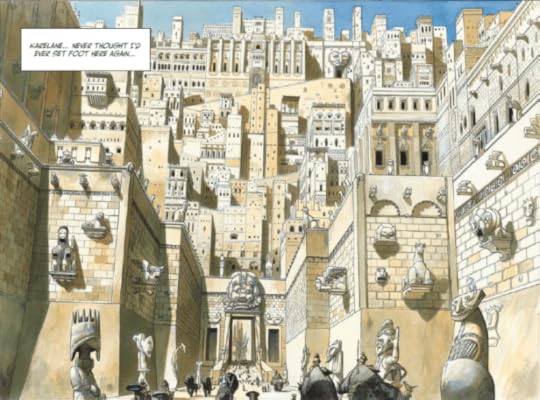
Swords of Glass is a Eurocomic, which has both a narrative and artistic style quite different either from American comics or manga. The world created by Sylviane Corgat and Laura Zuccheri is beautiful and fantastic and resembles a multicultural fantasy Meso-America with creatures created by Jim Henson. I loved the art, which was expressive both when depicting humans and their facial and body language, and the sweeping city panoramas.
The first arc is about Yama and her quest to become a swordswoman who can hunt down and kill Orland. Her mentor, Miklos, has his own secrets. As Yama grows up, she turns into a little hothead, and becomes increasingly frustrated at the fact that Miklos still sees her as a little girl.

In the second book, they travel to the great city of Karelane, seeking the other glass swords, because there's a prophecy about the four of them opening a gateway to another world to save the populace of this dying earth. Of course, they find that Orland has become the chief of Karelane's praetorian guards in Karelane, more powerful than ever. They also meet Orland's spoiled, scrappy son, Ilango.

As the series go on, we meet some of the other sword-wielders. Tigran was a blacksmith. One of the glass swords came right through the roof of his shop. His unfortunate wife grabbed it and was turned into a glass statue; Tigran doesn't want to save the world, he just wants to restore his wife.
As much as I appreciated the art, and scope of the story, the dialog is really clunky at times. Some of this could be chalked up to bad translation (the original series was in French), but some is just, well, bad. Characterization is inconsistent. Yama is sometimes impetuous and brave, sometimes just a whiny little brat, whose feelings about Miklos turn on a dime. Miklos's story involves a weird love triangle with an astrologer's wife that resulted in him and another general being exiled, with two glass swords. The world is dying, but parts still look lush and fertile. There are weeks of travel over arctic mountains, desert, and jungles that get covered in a few panels.

In the final volume, everything is resolved. Again, a little strangely, It's a very European science-fantasy ending. The ending also felt rather rushed. Four volumes of interpersonal relationships and feuds and factional alliances and warfare, and then the glass swords come together, and everything is fixed by .
An interesting saga, and I really did like the art, but the characterization and the dialog were just too uneven for me to really love the story.
Yama alone is able to touch the sword without being harmed. She runs off into the forest after Orland's men arrive, but everyone else who tries to grab the sword is turned into glass. Yama's father ends up getting stoned by terrified villagers (would-be rebels trying to foment an uprising and getting killed for their trouble is a recurring theme in this story), and Orland rides off with Yama's mother slung across his saddle. Yama disappears into the wilds, swearing vengeance. Fortunately, she meets an old hermit who turns out to be a swordmaster, and who also knows something about these glass swords.
Years pass...
Swords of Glass is a Eurocomic, which has both a narrative and artistic style quite different either from American comics or manga. The world created by Sylviane Corgat and Laura Zuccheri is beautiful and fantastic and resembles a multicultural fantasy Meso-America with creatures created by Jim Henson. I loved the art, which was expressive both when depicting humans and their facial and body language, and the sweeping city panoramas.
The first arc is about Yama and her quest to become a swordswoman who can hunt down and kill Orland. Her mentor, Miklos, has his own secrets. As Yama grows up, she turns into a little hothead, and becomes increasingly frustrated at the fact that Miklos still sees her as a little girl.
In the second book, they travel to the great city of Karelane, seeking the other glass swords, because there's a prophecy about the four of them opening a gateway to another world to save the populace of this dying earth. Of course, they find that Orland has become the chief of Karelane's praetorian guards in Karelane, more powerful than ever. They also meet Orland's spoiled, scrappy son, Ilango.
As the series go on, we meet some of the other sword-wielders. Tigran was a blacksmith. One of the glass swords came right through the roof of his shop. His unfortunate wife grabbed it and was turned into a glass statue; Tigran doesn't want to save the world, he just wants to restore his wife.
As much as I appreciated the art, and scope of the story, the dialog is really clunky at times. Some of this could be chalked up to bad translation (the original series was in French), but some is just, well, bad. Characterization is inconsistent. Yama is sometimes impetuous and brave, sometimes just a whiny little brat, whose feelings about Miklos turn on a dime. Miklos's story involves a weird love triangle with an astrologer's wife that resulted in him and another general being exiled, with two glass swords. The world is dying, but parts still look lush and fertile. There are weeks of travel over arctic mountains, desert, and jungles that get covered in a few panels.
In the final volume, everything is resolved. Again, a little strangely, It's a very European science-fantasy ending. The ending also felt rather rushed. Four volumes of interpersonal relationships and feuds and factional alliances and warfare, and then the glass swords come together, and everything is fixed by .
An interesting saga, and I really did like the art, but the characterization and the dialog were just too uneven for me to really love the story.

December 5, 2024
Tiene alguna idea original y el dibujo está bien, pero los diálogos me parecen bastante pobres

December 25, 2018
This takes place in what seems to be another dimension. An ancient world, populated by humans and miniature human-like beings, and the animals and plants are totally alien from ours. The story is about four swords that get separated around a landmass and one the central characters, Yama, is able to wield this sword without turning into glass. There’s an evil emperor, Orland, who is trying to get attain this sword for his on nefarious purposes. Yama, has to go on a journey, along with her trainer, Miklos, to find all four swords, before the end of the world beckons on humanity
I enjoyed reading this book, but I felt the story could have been longer. The story sounded like an epic, deserving of a much lengthier narrative. I felt the authors were moving things forward to quickly, without taking time to develop the characters and story. Despite this, it was decent story, which was elevated by the artwork.
The artwork is amazing. The colours used were rich and vibrant. It really brought the story to life. The illustrations gives a lot detail to the characters, scenery and objects.
I enjoyed reading this book, but I felt the story could have been longer. The story sounded like an epic, deserving of a much lengthier narrative. I felt the authors were moving things forward to quickly, without taking time to develop the characters and story. Despite this, it was decent story, which was elevated by the artwork.
The artwork is amazing. The colours used were rich and vibrant. It really brought the story to life. The illustrations gives a lot detail to the characters, scenery and objects.
May 5, 2017
The story was compelling and the art style was amazing.

March 29, 2017
El integral de los cuatro álbumes recopilado de forma lujosa por Yermo Ediciones nos cuenta la historia de la pequeña Yama, hija del jefe de la aldea. Un día, cuatro espadas de cristal caen del cielo en diferentes puntos del mundo, espadas con un poder especial y que hieren mortalmente a cualquier que intente blandirla. El tirano gobernante de la región quiere hacer con ella, pero frustrado por ser incapaz decide secuestrar a la madre de Yama y provocar la muerte de su padre. La niña huye jurando venganza, cuando se encontrará con Miklos, un guerrero retirado que la educará y entrenará para llevar a cabo su misión, y de paso, salvar el mundo siguiendo una vieja profecía.
La narrativa y el mundo fantástico creados por Corgiat es bueno, muy rico, con algunos toques interesantes y un giro final interesante que guían la historia a través de los manidos raíles del viaje del héroe. El ritmo, pese a ser muy bueno en los dos primeros capítulos, pierde algo de fuelle para remontar con una capítulo final que deja con ganas de más, aunque cierra coherentemente la historia. Añadir que el arte desplegado por Laura Zuccheri durante todo el integral es de absoluto lujo, con una cantidad ingente de detalles y un color suave que da una aire fantástico a la obra.
La narrativa y el mundo fantástico creados por Corgiat es bueno, muy rico, con algunos toques interesantes y un giro final interesante que guían la historia a través de los manidos raíles del viaje del héroe. El ritmo, pese a ser muy bueno en los dos primeros capítulos, pierde algo de fuelle para remontar con una capítulo final que deja con ganas de más, aunque cierra coherentemente la historia. Añadir que el arte desplegado por Laura Zuccheri durante todo el integral es de absoluto lujo, con una cantidad ingente de detalles y un color suave que da una aire fantástico a la obra.

January 27, 2021
A beautifully drawn old-style fantasy comic, with a set of rather different protagonists seeking to unlock the mystery of ancient swords coming from the skies themselves.
I frankly liked the story as a whole, and it managed to scratch an itch I had of late for fantasy stories.
Definitively reccomended for all the fans of Sword and Sorcery-style stories, but without overly grim tones. And want to see for once a female protagonist.
I frankly liked the story as a whole, and it managed to scratch an itch I had of late for fantasy stories.
Definitively reccomended for all the fans of Sword and Sorcery-style stories, but without overly grim tones. And want to see for once a female protagonist.

April 27, 2018
Definitely a good read though a bit patchy at times. The world and its fauna is spectacular! But quite some discrepancies between the 4 times. 3 stars in some places and 4 in others and in some down to 2. May be due to poor translation or to the writing but certain choices for dialogue do not make sense at all. evened out to 3 stars:
Note to self: Also... maybe I’m strange in the head but I found the artists choice to draw one of the main characters looking like Mel Gibson quite...argh! I kept hearing him speak with an albeit internal also very annoying Aussie accent. Go figure.
Note to self: Also... maybe I’m strange in the head but I found the artists choice to draw one of the main characters looking like Mel Gibson quite...argh! I kept hearing him speak with an albeit internal also very annoying Aussie accent. Go figure.

May 5, 2025
I'm amazed by how much I enjoyed this, to the point where I instantly forgive any flaws that I found with it (largely around the pacing towards the end, it's true). To tell a fantasy epic on this scale in 200 pages is quite an achievement, I honestly didn't anticipate such a satisfactory close considering the scope of the story.
The journey focuses on the growth of a young Yama, whose parents are cruelly taken from her at a young age as a result of a glass sword falling to earth - which we soon learn is one of four, which may only be pulled out by an equivalent number of 'chosen ones'. These swords combined will provide the key to surviving a dying Earth when they and their owners unite. Yama is one such chosen one, and an interesting character in that she is far more focused on her own goal of avenging her parents than on surviving the end of the world.
To tell a story of this scale in such a short span of time, sacrifices have to be made in our getting to know other characters outside of our heroes Yama and Miklos, whose relationship is rather strange. Yama and Miklos find each other in the woods after she runs away from her village as a child, and their 'are you my father figure or am I in love with you?' storyline is a little bit uncomfortable at points. They're great characters individually, though, although I wish the things Yama goes through during the story (particularly a big revelation on the truth of her family) affected her a little more. She never has any major character growth, but then - she went through a lot as a child, so her adamant attitude makes a degree of sense.
Other characters - even some of the chosen ones - we barely get to know more than their name. It's a shame, really, as people like Shona and Surian had a lot of promise but fall into the trap of 'these people need to exist for plot purposes, but we don't have time to do anything with them'. Incidentally, I would happily read an 800-page full novelization of this story if it meant getting to know some of these characters better, with the added bonus of spending more time in the genuinely interesting locales.
The scope of the world is, again, remarkable for such a short work. Cities are completely fleshed out in a single artwork, giving depth and originality immediately. Particularly Karelane, which had its own story that fit perfectly into the state of the world. Every single landmark was interesting to explore, and conveyed beautifully.
All in all, a surprising masterpiece, I will be holding onto my copy forever.
The journey focuses on the growth of a young Yama, whose parents are cruelly taken from her at a young age as a result of a glass sword falling to earth - which we soon learn is one of four, which may only be pulled out by an equivalent number of 'chosen ones'. These swords combined will provide the key to surviving a dying Earth when they and their owners unite. Yama is one such chosen one, and an interesting character in that she is far more focused on her own goal of avenging her parents than on surviving the end of the world.
To tell a story of this scale in such a short span of time, sacrifices have to be made in our getting to know other characters outside of our heroes Yama and Miklos, whose relationship is rather strange. Yama and Miklos find each other in the woods after she runs away from her village as a child, and their 'are you my father figure or am I in love with you?' storyline is a little bit uncomfortable at points. They're great characters individually, though, although I wish the things Yama goes through during the story (particularly a big revelation on the truth of her family) affected her a little more. She never has any major character growth, but then - she went through a lot as a child, so her adamant attitude makes a degree of sense.
Other characters - even some of the chosen ones - we barely get to know more than their name. It's a shame, really, as people like Shona and Surian had a lot of promise but fall into the trap of 'these people need to exist for plot purposes, but we don't have time to do anything with them'. Incidentally, I would happily read an 800-page full novelization of this story if it meant getting to know some of these characters better, with the added bonus of spending more time in the genuinely interesting locales.
The scope of the world is, again, remarkable for such a short work. Cities are completely fleshed out in a single artwork, giving depth and originality immediately. Particularly Karelane, which had its own story that fit perfectly into the state of the world. Every single landmark was interesting to explore, and conveyed beautifully.
All in all, a surprising masterpiece, I will be holding onto my copy forever.

July 31, 2017
A lot of people thought this graphic novel was so, so, but I LOVED IT! Perhaps because it is so very my kind of thing. Fantasy worlds complete with strange creatures - check, vast empires that aren't a carbon copy of European medieval cities of our past - check, adventure - check, mystery and magic - check, check. I'll admit that the characters aren't the greatest, but among everything else that was so wonderful, I easily let it go in favour of enjoying this fantastic world that Sylviane Corgaiat & Laura Zuccheri made. The artwork!!! It is beautiful and vivid and imaginative. Every frame is a smorgasbord of things to look at, from vast cities to lush forests and desert landscapes to snowy ones, it is a feast for the eyes. I want to re-read it and just take five minutes for each panel - its that detailed and beautiful. The imaginative world-building is top notch here too. Something that felt like it was somewhere between a Studio Ghibli film, Star Wars and Lord of the Rings, among many other sci fi and fantasy out there. Although it had a lot of obvious influences, it still manages its own unique world and story. I truly appreciated its effort to honor the fantasy and sci fi that has come before, but also forge its own path. Easily going to be among my favourites and I look forward to seeing what else these two ladies have to offer (at least the ones that have been translated).

June 4, 2020
The art was beautiful, but the story wasn't what I was hoping for. The dialog can be pretty cheesy or clunky at times, but that could be due to the translation. The pacing is a little strange. The story jumps around really fast between scenes/characters/locations. It can be a little jarring and hard to keep up with what's going on at times.
POTENTIAL SPOILER BELOW!!!
The premise of the story is exciting, but the execution wasn't great. It probably could have used another volume to better complete story lines. I was intrigued by Tigran's journey in volume 3, but it didn't really pay off like I had hoped. Same with Ilango. He was just sort of there and didn't have much of a purpose in volume 4. Yama and Miklos were fleshed out better, but I'm not completely satisfied with how everything turned out in volume 4.
I thought volumes 1 and 3 were better and 2 and 4 were weaker. Do I regret reading it? No, but it had great potential and could have been better.
To end on a high note, the art is gorgeous throughout the entire series. The character, location, and creature design is superb. I'd be interested in reading other works from the author/artist.
POTENTIAL SPOILER BELOW!!!
The premise of the story is exciting, but the execution wasn't great. It probably could have used another volume to better complete story lines. I was intrigued by Tigran's journey in volume 3, but it didn't really pay off like I had hoped. Same with Ilango. He was just sort of there and didn't have much of a purpose in volume 4. Yama and Miklos were fleshed out better, but I'm not completely satisfied with how everything turned out in volume 4.
I thought volumes 1 and 3 were better and 2 and 4 were weaker. Do I regret reading it? No, but it had great potential and could have been better.
To end on a high note, the art is gorgeous throughout the entire series. The character, location, and creature design is superb. I'd be interested in reading other works from the author/artist.

August 11, 2023
The artstyle is modern comic average, which isn't particularly bad, but also not particularly special or interesting.
That said, however, the visual design of the world presented inside Swords of Glass is fantastic. It has a sort of mix between Japanese samurai and old Pharaoh-Egyptian which is very unique. Exaggerated and weird.
Reminded me somewhat of Möebius' style.
The comic keeps telling us that Yama, the main character, was born to fight. She longs for a duel with a certain bad guy.
When the duel finally comes, however, she behaves extremely amateur, overextending, using too much force and being too easily distracted, which I thought was an odd choice.
That said, the actual fighting is some of the most realistic, well done and proper looking swordsmanship I've ever had the joy of laying my eyes on. The way the people move from picture to picture is easy to follow and makes sens
The human-like riding beast was truly a disturbing creation and will probably haunt my dreams for years to come.
That said, however, the visual design of the world presented inside Swords of Glass is fantastic. It has a sort of mix between Japanese samurai and old Pharaoh-Egyptian which is very unique. Exaggerated and weird.
Reminded me somewhat of Möebius' style.
The comic keeps telling us that Yama, the main character, was born to fight. She longs for a duel with a certain bad guy.
When the duel finally comes, however, she behaves extremely amateur, overextending, using too much force and being too easily distracted, which I thought was an odd choice.
That said, the actual fighting is some of the most realistic, well done and proper looking swordsmanship I've ever had the joy of laying my eyes on. The way the people move from picture to picture is easy to follow and makes sens
The human-like riding beast was truly a disturbing creation and will probably haunt my dreams for years to come.
March 15, 2020
Tässäpä vasta upean näköistä taidetta onkin, mutta myös todella persoonallinen maailmanrakennus vie mennessään. Naistiimin käsikirjoittama ja kuvittama sarjakuva sijoituu omituiseen, mesoamerikkalaisia piirteitä sisältävään fantasiamaailmaan, jossa auringosta on lähtenyt ja maahan iskeytynyt neljä taikuudella kyllästettyä "lasimiekkaa". Miekkoja voi käytellä vain rajattu sankareiden joukko, jotka sitten ryhtyvätkin kilpasille miekkojen omistajuudesta. Laura Zuccherin taide on ällistyttävän näyttävää kauttaaltaan, Sylviane Corgiatin maailmanrakennus ja hahmokäsikirjoitukset kiehtovia, mutta jotenkin lopputulos tuntuu, ehkäpä aika arvattavan tarinansa vuoksi, peräti pienemmältä kuin osiensa summa. Lasimiekkojen tarina on kuitenkin oikein ilahduttava yllätys ja tekijöiden tuotoksia täytyy seurata myös jatkossa.

June 2, 2023
This is a beautifully illustrated book, with wonderful worldbuilding and such fun, fun weirdos in it. It's impossible to believe that someone kept their art this consistently detailed, high quality, and wonderfully evocative for so many pages. The story was a bit of a mess, really, jumping from idea to idea without really letting anything develop in a way that I had hoped, and it felt like the author was trying to cram as many ideas and moments in as possible, rather than fixating on a single thing. But it's still fun to follow along with, and about on par with a lot of fiction I read as a teenager. My favourite kind of aesthetic, not my favourite kind of writing, but overall definitely worth a look!
April 21, 2024
This comic is a mess. The writing is congested, many times nonsensical, and it is without a single drop of humour. The story is just a massive cliche-fest, hastily told without love.
Regarding the drawings there are brilliantly drawn architecture, fantastical beasts and clothes, but the characters are lacking personality and the comic severly lacks movement/flow. It all feels very stale
Regarding the drawings there are brilliantly drawn architecture, fantastical beasts and clothes, but the characters are lacking personality and the comic severly lacks movement/flow. It all feels very stale

June 17, 2024
A lot of ideas that I liked in this story like four swords that need to come together to save the world from a dying sun, the living totems that share fear rhetoric, and the lizard god stone that held the first of the glass swords. I didn't like how rushed finding the last two swords were and how coincidental the whole series of events were even though prophecy can fill in those gaps well enough.

March 13, 2018
Laura Zuccheri's art carries this, and I'm convinced after reading this that her art could carry anything. Holy crap, beautiful. Interesting story overall, but still some flat or underdeveloped characters that made me wish this could have been longer.

May 10, 2017
Awesome illustrations... reminded me of fantasy books from the 80s/90s.

June 21, 2017
I really. really liked this Comic. The story is interesting, the art is great. I can't wait to read the next one.

July 5, 2017
Wild and gorgeous art. The story is a little lacking, but the art makes up for it--it's easy to become immersed in this bizarre, cartoonish world.
October 27, 2017
Good artwork.

April 16, 2018
Beautiful artwork and a cool premise but poor dialogue and bland characters let it down.

January 22, 2019
Zanimljiv dizajn svijeta, likovi koretno napisani, zaokružena priča o spašavanju svijeta.
Displaying 1 - 30 of 52 reviews