When America declared its independence in 1776, the new republic's journey to become one unified nation had just begun. Here is the unforgettable story of fifty-five Americans and the Constitution they created in 1787 to give the struggling new government a foundation that has held ever since.
With accurate historical information, this 48-page nonfiction picture book tells why and how the Constitution of the United States was created. A More Perfect Union includes a map and back matter with a table of dates and a summary of the Articles of the Constitution.
"A simple, attractive, informative book about a milestone in American history. The simplest and most accessible history of the Constitution to date."—School Library Journal
Before beginning her career in children's books, Betsy Maestro was a teacher. Her first book with Giulio Maestro was A Wise Monkey Tale published in 1975, and since then they have collaborated on more than one hundred books. Their on-going American Story series began with the highly acclaimed The Discovery of the Americas and continues to help young readers understand and appreciate our nations history.
The Maestros live with two cats and a goldfish in a converted cow barn in Old Lyme, Connecticut.
The Maestros do a wonderful job bringing important moments in history into view for the younger crowd. With the right amount of detail to keep it interesting and with full, colorful illustrations on each page spread, I haven't read a book of theirs I didn't like.
Ages: 7 - 12
**Like my reviews? Then you should follow me! Because I have hundreds more just like this one. With each review, I provide a Cleanliness Report, mentioning any objectionable content I come across so that parents and/or conscientious readers (like me) can determine beforehand whether they want to read a book or not. Content surprises are super annoying, especially when you’re 100+ pages in, so here’s my attempt to help you avoid that!
So Follow or Friend me here on GoodReads! You’ll see my updates as I’m reading and know which books I’m liking and what I’m not finishing and why. You’ll also be able to utilize my library for looking up titles to see whether the book you’re thinking about reading next has any objectionable content or not. From swear words, to romance, to bad attitudes (in children’s books), I cover it all!
This particular book covers the post-revolution compromises that brought about our unique form of government and the separation of powers. It was easy to read in one sitting and provided a good outline of the differences of opinions across the colonies and what would become our first states.
Author/illustrator team (and husband and wife) Betsy and Giulio Maestro explore the story of the U.S. Constitution in this work of picture book history. Opening in 1787, as the new country faced a crisis of noncooperation between the states, the book covers the Constitutional Convention in Philadelphia, and the major arguments and compromises made, before a new constitution was written and eventually ratified. These included the Connecticut or Great Compromise, which settled the question of whether congressional representation should be equally divided between the states or based upon population, as well as the passage of the first ten amendments to the Constitution, known collectively as the Bill of Rights, which secured the individual liberties of the American people. The book closes with extensive back matter, including a summary of the various sections of the Constitution and what they address, a list of signers of the Constitution, a table of dates, a note on the Connecticut Compromise, a list of interesting facts about the Constitution and delegates, the order and dates of state ratification, and a summary of the amendments to the Constitution...
Fairly or not, A More Perfect Union: The Story of Our Constitution suffers in comparison to the other volumes in the Maestro's picture book history series, The American Story, of which it is now a part. It was originally published in 1987, well before the first volume of that series, The Discovery of the Americas, which appeared in 1991, and despite predating the series, seems to have been added in after the fact. I'm not sure why it was placed fifth, before Liberty or Death: The American Revolution: 1763-1783, as it covers events subsequent to that book, but in any case, it clearly wasn't originally intended as part of this larger project. As a result, it is significantly less detailed than the preceding four books in the series, which I read first, and while it does offer a good overview of the subject, feels a little bit light in comparison to them. It's well organized, and is a good basic introduction, so I don't want to overstate the issue, but the simpler, shorter text immediately struck me, having read the other books in the series first. I was also struck by the fact that no mention was made in the main text of the Three-fifths Compromise, which counted enslaved people as being three-fifths of a person, when it came to determining population in states which had slavery. While reference is made to this in the back matter, in the section devoted to the Connecticut Compromise, I thought it was too passing a reference. One thing I have appreciated, in other Maestro titles, is the balance that has been shown, in addressing the less noble aspects of our history. While such issues and events—slavery, the treatment of Native Americans—have not being allowed to overtake the entire narrative, in ways they might have done in more recently published titles, they also haven't been omitted. Here I feel that this is not so much the case, and it is to the detriment of the book and its readers. If I were using this series for educational purposes with young people—and I do recommend the series for that purpose, both in classrooms and in home-schooling—I would feel some supplemental material would be in order for this title.
- Learn the wisdom of compromise for it is better to bend a little than to break.
-Compromise is not about losing. It is about deciding that the other person has just as much right to be happy with the end result as you do.
-A Leader, Once Convinced That A Particular Course of Action Is The Right One, Must Be Undaunted When The Going Gets Tough
-Every Worthwhile Accomplishment, Big Or Small Has It's Stages Of Drudgery And Triumph; A Beginning, A Struggle And A Victory.
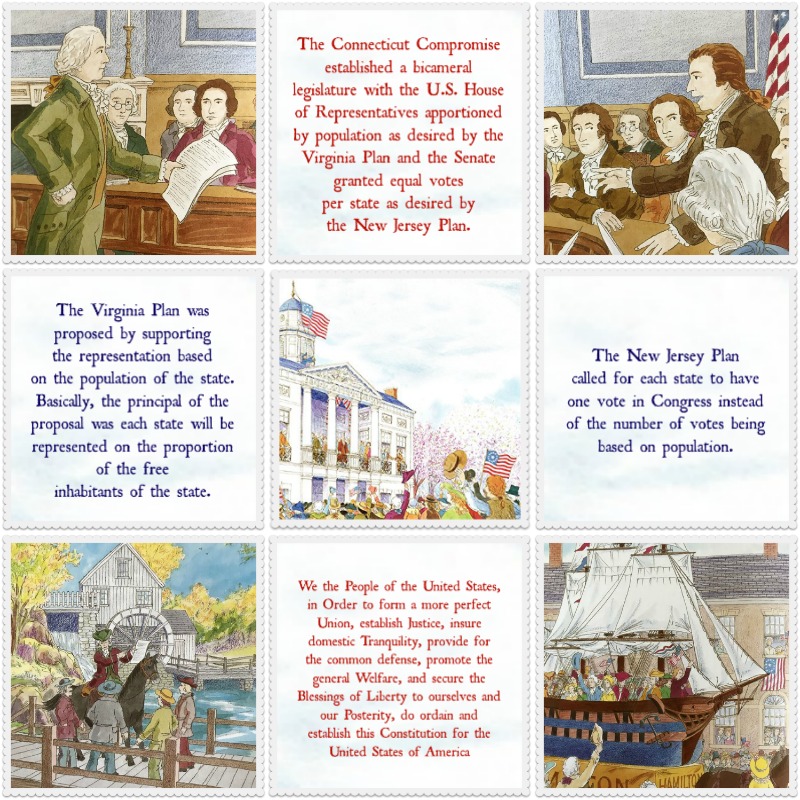
The Virginia plan was proposed by supporting the representation based on the population of the state. Basically, the principal of the proposal was each state will be represented on the proportion of the free inhabitants of the state.
The New Jersey Plan called for each state to have one vote in Congress instead of the number of votes being based on population.
The Connecticut Compromise established a bicameral legislature with the U.S. House of Representatives apportioned by population as desired by the Virginia Plan and the Senate granted equal votes per state as desired by the New Jersey Plan
We the People of the United States, in Order to form a more perfect Union, establish Justice, insure domestic Tranquility, provide for the common defense, promote the general Welfare, and secure the Blessings of Liberty to ourselves and our Posterity, do ordain and establish this Constitution for the United States of America.
TRAVELED TO // Philadelphia, Pennsylvania MET ALONG THE WAY // The Founding Fathers
A historical picture book, A More Perfect Union: The Story of Our Constitution by Betsy Maestro, illustrated by Giulio Maestro. An incredible way to introduce or provide another perspective on the writing of the United States Constitution. What I really enjoyed in this story, are the little details that were included within the story, things we do not think about. For example: it took delegates up to three weeks to arrive to Philadelphia due to poor weather and traveling by horseback, carriage, or ship; all of the arguing the delegates participated in, as they did not agree on plans; many stayed in the area for many months, not seeing their friends and family; and huge celebrations that took place in big cities when the Constitution became law, ratified by all 13 states.
At the end of the story, Maestro provides additional information about the Constitution: Preamble, Summary of the Articles of the Constitution, Signers of the Constitution, Table of Dates 1774-1791, Notes on the Connecticut Compromise, Interesting Facts about the Convention and the Delegates, Order and Dates of Ratification of the Constitution, and Summary of the Amendments to the Constitution. This additional information makes this book a useful reference for students to turn to when studying about the Constitution and can provide valuable information for a written or oral report.
This is a great history picture book explaining what happened after the war and the creation of the American Constitution. I tried to read this with my girls this year but I think it is better for elementary age. Great information presented in an easy to read and understand way! The art is also nice and helps the time period come alive! I love the additional information include at the end as well!
A thorough NF picture book recounting the Constitutional Convention. Text and pictures are not necessarily enthralling, but they are easy to understand and cover all the details without being too long. I think it would have been nice to have a page or two about how the constitution was ratified.
I like this book because it shows how the Government was created and made laws. And I like that the people are the ones who have the power and freedom of speech. And I think that every child can read this book.🍯🐶🫡🫡❤️😘
In 1787 people in our country could see that the government wasn't working very well. Delegates gathered in Philadelphia to try to fix the government and ended up creating the Constitution and the government we now have. This book conscientiously walks us through a top-level view of what happened that summer in Philadelphia.
Many of the delegates were late to the convention. The book spends a total of four pages, two two-page spreads, on the late start. Is it so important? George Washington was chosen as the leader of the convention. James Madison, according to the book, offered to write down everything that happened. The rest of the story continues on in the same rather uninteresting way.
The book recites the very basic facts of the summer of 1787 and the beginning job of putting the Constitution to work, such as electing a president. If a child needs an introduction to the writing of the Constitution, this would serve except that it's dull. There’s no clash of personalities. Only the broadest clash of ideas is presented in the argument made by small states about how they are represented in Congress. The book doesn't even mention how the argument was resolved.
The illustrations don't add to or subtract from the book. They are simply present. And basically, the book has the same relationship to the events of the summer of 1787. It doesn't try to make the event's exciting, nor does it try to make them dull, it is simply present.
The last few pages contain “Additional Information about the Constitution.” These are more valuable than the book itself. There’s a summary of the Articles of the Constitution, and a summary of the Amendments to the Constitution. Plus “Notes on the Connecticut Compromise and “Interesting Facts about the Convention and the Delegates.” These few pages make the book a great reference in a classroom learning about the Constitution.
The illustrations in this story are very colorful and detailed, often taking up the majority of the page; most of the pictures have rounded edges, with no defined frame, almost giving the illusion that part of the scene is omitted, I find this interesting considering all of the controversy concerning the origin of our country, which would obviously be omitted from a children’s book. The story of the birth of America’s constitution is very long and detailed, many details I feel, although important, could probably have been absent from this children’s book. The sentence structure and easy language is ideal for the age of the audience intended for this book, Maestro very eloquently simplifies a subject that is sometimes complex for even a mature audience to grasp. I feel that this top should be appealing for most children, as this event from our distant history influences the way we live today and the way they and their children will continue to live for years to come. This piece of literature would be good to use in a classroom when discussing the constitution, as it is simply stated and easy to understand.
Social Sciences/Social Emotional Learning Lesson Plan Idea: Have the students work in groups creating a classroom “constitution” and present their ideas to the class. Discuss if their rules would be beneficial to the classroom structure for years to come, why or why not.
This picture book in a brief, concise way, gives the history of fifty-five men brought together to create the document that would guide our nation. At the back of the book is a summary of the Articles of the Constitution, the names of the states and their representative signers, a chronology of dates pertaining to the document and finally a summary of amendments to the Constitution. It may be a children's book, but it is a wonderful resource for the basic facts that every American citizen should know.
"A More Perfect Union: The Story of Our Constitution" by Betsy Maestro is an informative book about how our country came to be. The illustrations are done in ink and pen to illustrate a story of how the constitution was made and ratified. It does a good job at teaching young students a major part of our history while being inviting to young readers with warm illustrations and pictures. The book even includes dates and specific events to give even more information to the reader. This book encourages young readers to learn more about the country that they live in.
Story of how our Constitution came to be, who was involved, and some of the debating and compromises that went into creating it. This would be a good addition to any school library or classroom where students are studying this important time in our nations history. Enough information in this book alone for a book report on this, the oldest written set of rules for running a country still in use today.
The book easily explains how America came to be. It talks about the skeleton of the Constitution. The book is a higher level of reading because it talks about how the government is divided in power. A lot of government words so this book is mainly for 4th-5th graders. Other than that, the pictures and the story are pretty good for a short version.
I would for sure use this book in a lesson on the United States Constitution. It would be a great lead-in book to begin a lesson, or a great "end of the lesson" book to summarize everything learned. It clearly explains political terms without throwing out difficult terms or ideas, and I believe is an easy/smooth read for most upper (3rd-5th) grades.
A historical book that explains the Constitution in such a way that is easy for young children to grasp. It tells the entire history of how it came to be. At the end of the book, there are a couple of tables that provide a table to dates, note on the Connecticut Comprise, interesting facts, and summary of the amendments. A very good book to kick off a lesson.
A historical book that explains the Constitution in such a way that is easy for young children to grasp. It tells the entire history of how it came to be. At the end of the book, there are a couple of tables that provide a table to dates, note on the Connecticut Comprise, interesting facts, and summary of the amendments. A very good book to kick off a lesson.
This beautifully illustrated picture book is a must-have in the classroom! Especially when looking at our nation's history, this book comes in handy. It tells the tale of how our nation came to be and what all went into the process of our Constitution. It's great especially for the younger kids when looking for a way to easily explain such a complex process.