

What do you think?
The Adventures of Otto
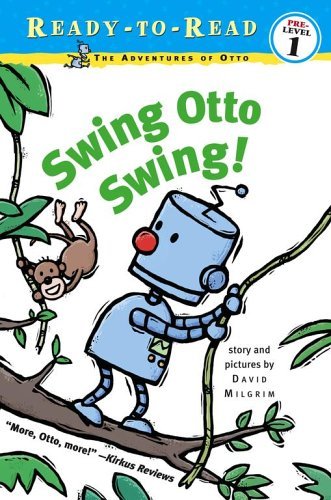
Swing Otto Swing!
Otto wants to be able to swing in the jungle like his monkey friends. But he keeps crashing. Then Otto comes up with an idea that will have everyone swinging!Recognizing Words
-Word repetition
-Familiar words and phrases
-Simple sentences
Starting to Read
-Simple stories
-Increased vocabulary
-Longer sentences
Reading Independently
-More-complex stories
-Varied sentence structure
-Paragraphs and short chapters
Reading Proficiently
-Rich vocabulary
-More-challenging stories
-Longer chapters
TO PARENTS AND TEACHERS:
Children learn to read in a variety of ways: through formal teaching in school, by being read aloud to at home, and reading on their own, using all the tools they've learned for making sense of letters and words. The process starts with a child's first awareness that letters on the page form words, which make sentences, which make stories. No one method of learning is right for every child, but all children need books they can read successfully.
Ready-to-Read books feature classic stories and interesting nonfiction by authors who really know how to write for this age group. They're grouped at four levels: Pre-Level One, with repetitive text and simple sentences for children who can recognize words; Level One, with an increased vocabulary and longer sentences for children who are just starting to read; Level Two, for those who are reading independently and are ready for slightly greater challenges; and Level Three, for children who can read fiction and nonfiction on their own, with fewer illustrations and longer texts. At each level, the books are all written, designed, and illustrated to suit the interests, needs, and abilities of new readers.
Children in preschool and the early elementary grades are universally fascinated with reading, and are already saying, "I'm ready to read." When they finish a Ready-to-Read book, we want them to say, "I am reading, and I like it!"
-Word repetition
-Familiar words and phrases
-Simple sentences
Starting to Read
-Simple stories
-Increased vocabulary
-Longer sentences
Reading Independently
-More-complex stories
-Varied sentence structure
-Paragraphs and short chapters
Reading Proficiently
-Rich vocabulary
-More-challenging stories
-Longer chapters
TO PARENTS AND TEACHERS:
Children learn to read in a variety of ways: through formal teaching in school, by being read aloud to at home, and reading on their own, using all the tools they've learned for making sense of letters and words. The process starts with a child's first awareness that letters on the page form words, which make sentences, which make stories. No one method of learning is right for every child, but all children need books they can read successfully.
Ready-to-Read books feature classic stories and interesting nonfiction by authors who really know how to write for this age group. They're grouped at four levels: Pre-Level One, with repetitive text and simple sentences for children who can recognize words; Level One, with an increased vocabulary and longer sentences for children who are just starting to read; Level Two, for those who are reading independently and are ready for slightly greater challenges; and Level Three, for children who can read fiction and nonfiction on their own, with fewer illustrations and longer texts. At each level, the books are all written, designed, and illustrated to suit the interests, needs, and abilities of new readers.
Children in preschool and the early elementary grades are universally fascinated with reading, and are already saying, "I'm ready to read." When they finish a Ready-to-Read book, we want them to say, "I am reading, and I like it!"
32 pages, Paperback
First published May 4, 2004
Ratings & Reviews
Friends & Following
Create a free account to discover what your friends think of this book!
Community Reviews
Displaying 1 - 30 of 45 reviews

June 13, 2009
Of all the books we've used to teach our kids to read the Otto & Pip books by David Milgrim are my favourite early reader books.
They teach fine lessons about perseverance and kindness without beating the children over the head with baseball bat moralizing; they use simple words and repetition to increase young reader confidence; they introduce slightly harder words to help children sound words out; and they are playful enough to keep kids motivated.
Of them all, Swing Otto Swing is my personal fave. I don't know whether I love it the most because I love gerunds or because Flip and Flop, Otto's monkey friends, are so damn cute, but I love reading it with Brontë and Milos -- and I love it even more when they read it to me.
Pick this up for your wee ones and you won't be disappointed. At least I don't think you will.
They teach fine lessons about perseverance and kindness without beating the children over the head with baseball bat moralizing; they use simple words and repetition to increase young reader confidence; they introduce slightly harder words to help children sound words out; and they are playful enough to keep kids motivated.
Of them all, Swing Otto Swing is my personal fave. I don't know whether I love it the most because I love gerunds or because Flip and Flop, Otto's monkey friends, are so damn cute, but I love reading it with Brontë and Milos -- and I love it even more when they read it to me.
Pick this up for your wee ones and you won't be disappointed. At least I don't think you will.

June 8, 2009
Brontë: I loved it, and I kind of hated it.
Papa: Why Brontë?
Brontë: Well...it's just because I remember when I was getting mad, so I thought it would be good if I said like that because if I get mad I hated it but kind of loved it by the end.
Papa: What was your favourite part?
Brontë: When poor Otto hurt his thingee. That was a sad thing for poor Otto. And the next one was that I like Flip and Flop. They're nice. And I really like when he kept trying again. And he's working hard; I know that. And the really bad part is that poor Otto had someone stand on him. It's Flip. Or it's Flop. Flip or Flop. I dunno.
Papa: Why Brontë?
Brontë: Well...it's just because I remember when I was getting mad, so I thought it would be good if I said like that because if I get mad I hated it but kind of loved it by the end.
Papa: What was your favourite part?
Brontë: When poor Otto hurt his thingee. That was a sad thing for poor Otto. And the next one was that I like Flip and Flop. They're nice. And I really like when he kept trying again. And he's working hard; I know that. And the really bad part is that poor Otto had someone stand on him. It's Flip. Or it's Flop. Flip or Flop. I dunno.

December 1, 2012
This early reader, of the same ilk as the Dick and Jane books, is surprisingly funny given the economy and repetitiveness of the words. This is an obvious choice for preschool or kindergarten kids, or for kids just starting to learn to read.
My nephew picked this one off the library shelf tonight, and he was quite pleasantly surprised with it. He laughed through the book, and asked me to read it to him again.
**UPDATE** My nephew had me read this book to him yet again over the weekend, and this time I tried a different approach with him. We used this book to identify letters, specifically G, S, and E (randomly chosen). Because the words were small and repetitive, he was able to easily identify these letters. He was amazed to learn that letters can show up anywhere in a word, beginning, middle, or end. What a great book for taking the first steps into the world of words and reading!
My nephew picked this one off the library shelf tonight, and he was quite pleasantly surprised with it. He laughed through the book, and asked me to read it to him again.
**UPDATE** My nephew had me read this book to him yet again over the weekend, and this time I tried a different approach with him. We used this book to identify letters, specifically G, S, and E (randomly chosen). Because the words were small and repetitive, he was able to easily identify these letters. He was amazed to learn that letters can show up anywhere in a word, beginning, middle, or end. What a great book for taking the first steps into the world of words and reading!

May 12, 2009
I love these early readers, written for those who only have a few words in their reading vocabulary. Much like the "See Jane run" stories, these books are very simple, but the main character is a robot from outerspace who crash landed on earth when he ran out of gas. Now he befriends the animals of the jungle.
Otto tries to swing with his monkey friends Flip and Flop, but he just can't keep a hold of the vine. He crashes every time. His monkey friends give him lessons, but he still doesn't learn. So Otto decides to find a new way to do things: he builds a swing.
Otto tries to swing with his monkey friends Flip and Flop, but he just can't keep a hold of the vine. He crashes every time. His monkey friends give him lessons, but he still doesn't learn. So Otto decides to find a new way to do things: he builds a swing.

August 12, 2010
Early Readers are either really bad or really good, this one is good! The whole Otto series is very humorous and engaging, requiring children to read not only the simple text, but to interpret the pictures as well.

June 25, 2017
While I personally found this to be a pretty funny book, it's supposed to be for emerging readers, and it's a very poorly designed early reader book.
January 29, 2026
I was a Children's Librarian for 35 years while raising four children of my own and now I am reading with my 4-year-old granddaughter. Believe me when I say that I have read readers to children! "The Adventures of Otto" series stands out from a crowded field. I have read 10 of them to my granddaughter by now and they are not only good "readers," but they also manage to tell funny and involving stories. Milgrim really gets young pre-readers' need for simplicity while spinning a good tale. If you are tasked with encouraging a young child to learn pre-reading skills, you really can't do better than the Otto series.

November 17, 2020
Flip and Flop easily swing through the trees. Otto tries, and fails. Flip and Flop try to help Otto swing successfully...but can a robot ever swing without ending in a crash?
I love Otto's perseverance and knowing when to try a different tactic. It's a great example for littles, and it creates a funny story. Milgrim is able to say so much with just a few words and his comical illustrations. Highly recommended for just beginning readers.
I love Otto's perseverance and knowing when to try a different tactic. It's a great example for littles, and it creates a funny story. Milgrim is able to say so much with just a few words and his comical illustrations. Highly recommended for just beginning readers.

September 3, 2017
This was listed as a Pre-level 1 reader, but I noticed that the librarian put a sticker over that label and made it a level B. It has a great story line and illustrations and very few words on a page, but again the words like some, again, learn and saw are not pre-level 1 in my opinion.
March 19, 2018
I did not really like this book. Even though it is an early reader, I did not think it was very engaging. It was a short story with very few words, but the illustrations were really well done.
July 20, 2018
Good entertaining picture book. Lots of repetition of the words for starting readers.

January 29, 2019
VERY easy to read and a funny story! Poor otto the robot is not good at swinging from vines like monkeys. Instead he builds a swingset.

November 25, 2020
Otto tries hard to learn to swing like the monkeys. Knocked down but not defeated, he comes up with a safer solution.

June 14, 2021
F & p level E

Read
June 27, 2021This book and the series is giving my niece confidence to learn reading. She thinks they’re fun and now wants to read all the time.

December 6, 2021
A fun update on the mid-century early readers, like, “See Dick. See Dick run,” only with a funny disconnect between the text and pictures. Great stuff.

March 29, 2025
My daughter enjoyed Flip and Flop.

August 28, 2026
The youngest read this outloud to all of us. *insert shiny heart eyes emoji*

March 5, 2017
Milgrim, David. The Adventures of Otto: Swing, Otto, Swing!, PICTURE. Simon Spotlight, 2016. $3.99.
Otto the robot wants to swing on vines just like his monkey friends. But, he is much too heavy and keeps snapping the vines from the tree and even when the monkeys try to give him instructions on how to swing, it just doesn’t work. So, Otto thinks of an alternative and builds himself a nice, sturdy swing set.
This is an leveled early reader. The text is sparse and simple, with a basic premise and pictures. It has a cute little ending and meets the purpose of an easy reader, but it’s nothing phenomenal.
PRE-K, EL (K-3)- OPTIONAL. Reviewed by Shay, School Librarian
Otto the robot wants to swing on vines just like his monkey friends. But, he is much too heavy and keeps snapping the vines from the tree and even when the monkeys try to give him instructions on how to swing, it just doesn’t work. So, Otto thinks of an alternative and builds himself a nice, sturdy swing set.
This is an leveled early reader. The text is sparse and simple, with a basic premise and pictures. It has a cute little ending and meets the purpose of an easy reader, but it’s nothing phenomenal.
PRE-K, EL (K-3)- OPTIONAL. Reviewed by Shay, School Librarian

February 23, 2017
Now that I've read three of these in a row I can say that they're very repetitive with simple words and easy plots.
October 16, 2010
Swing Otto Swing! is a Learn-to-Read book targeted for children at the Pre- Level 1 reading stage. Each page has six or fewer words, to help young readers build their fluency and comprehension skills. Otto is a robot who was watching two monkeys named Flip and Flop swing on vines in the forest one day. Otto was interested in swinging, too. He tried to copy Flip and Flop’s actions, but to no avail. Flip, being a good friend, offered Otto some tips. Otto gave it another try, but fell down once again. Flip and Flop offered more suggestions, but Otto got hurt yet again. Otto suddenly got a saw and string to build his own swing set. He cut wood and tied the wooden logs together to form a sturdy swing set. After several trial and errors, Otto was able to solve his own problem.
Young readers will notice Otto’s attempts at being a successful vine-swinger and can relate their own experiences with trial and error situations. This book is appropriately illustrated for beginning readers with its use of white space as background for easy reading of the text. The illustrations are outlined with bold black lines while the colors of the objects in the pictures are painted in watercolor with basic colors. The primary focus of this book is to help children use basic pictures to help them read the text. The illustrations do not cause a distraction to the reader, as they are drawn in a simple format. I would only use this book with Kindergarten and first graders since the content is primary and the words are at a low reading level. A discussion about how the illustrations can help a reader interpret the book would be helpful to beginning readers. In addition, a discussion about the content, specifically learning how to overcome obstacles and solve your own problems would be beneficial to students. Allowing students to read other books at their independent reading level would generate excitement about reading and offer students a way to problem solve new words as they read. I recommend this book to any student who is beginning to read.
Young readers will notice Otto’s attempts at being a successful vine-swinger and can relate their own experiences with trial and error situations. This book is appropriately illustrated for beginning readers with its use of white space as background for easy reading of the text. The illustrations are outlined with bold black lines while the colors of the objects in the pictures are painted in watercolor with basic colors. The primary focus of this book is to help children use basic pictures to help them read the text. The illustrations do not cause a distraction to the reader, as they are drawn in a simple format. I would only use this book with Kindergarten and first graders since the content is primary and the words are at a low reading level. A discussion about how the illustrations can help a reader interpret the book would be helpful to beginning readers. In addition, a discussion about the content, specifically learning how to overcome obstacles and solve your own problems would be beneficial to students. Allowing students to read other books at their independent reading level would generate excitement about reading and offer students a way to problem solve new words as they read. I recommend this book to any student who is beginning to read.

February 12, 2011
Swing Otto Swing, by David Milgrim, is the fourth book in a Ready-to-Read series about an adventurous robot named, Otto. In this story, with the help...moreSwing Otto Swing, by David Milgrim, is the fourth book in a Ready-to-Read series about an adventurous robot named, Otto. In this story, with the help and encouragement from his two monkey friends, Otto tries to learn to swing from tree vines in the jungle. Despite Otto’s repeated efforts, he falls again and again. However, Otto is persistent in his efforts to learn how to swing, ultimately coming up with a solution to his problem. This story has a lot to offer to the pre-level 1 reader. The pictures are very well done, colorfully capturing the engaging characters’ actions and emotions. In addition to the wonderful illustrations, the text in this story has been carefully written providing the early reader with large text, simple sentences, and word repetition. The Otto character in this series is sure to become a child’s favorite. I would recommend this story for preschool through grade 1. It is a good example of perseverance and problem solving.

February 17, 2016
Despite having zero interest in learning to read on his own (yet) and only passing interest in learning his letters and their sounds, my almost-four-year-old has started occasionally picking out early reader books at the library. I have to admit that sometimes I give a little inward groan when he does that because they aren't always the most fun books to read aloud. This one was great, though. Both of us were laughing at poor Otto as he tried to swing again and again. Seb only wanted to read it once, but it was definitely a fun read.

October 23, 2011
This was our first Otto book. It got us hooked. Audrey loves Otto and gets so excited every time we check one out from the library. The Otto books are funny for parents, almost making fun of the Dick and Jane books, and funny for kids too. The Otto books, and the Elephant and Piggie series by Mo Willems are what got Audrey to really start reading and loving it. I'm glad I discovered them and stopped checking out the Bob books!
October 23, 2014
It don't mean a thing if you ain't got that swing...which our beloved robot friend Otto of the Jungle has just found out to his mechanical peril. He tries to swing on vines like Tarzan. He's not having much success. So once again it's up to the animals of Africa to teach him to swing it. A simple yet fun read in the See Spot Run tradition, which older readers may find hard to swallow, but younger kids should have fun.

April 28, 2015
A great first-reader. Few words, repetition and simple phonics combined with engaging illustrations makes these books a winner for a child's first foray into reading. The humorous but sparsely worded story leaves a lot of room for parents to engage with additional commentary to track a child's comprehension. A favorite!

October 11, 2016
A beginning reader book in which a robot named Otto tries to swing from tree to tree just like Flip and Flop, his monkey friends.
Text is short and repeats a lot allowing readers a chance to practice and gain confidence in their skills. Humor is introduced in digital artwork and the story builds to a funny, inventive close.
Highly recommended for PreK-2.
Text is short and repeats a lot allowing readers a chance to practice and gain confidence in their skills. Humor is introduced in digital artwork and the story builds to a funny, inventive close.
Highly recommended for PreK-2.

November 5, 2016
Robots and monkeys do seem to go well together, don't they? And I'm not sure what the problem was with Otto. Was he not able to get a good grip on the vine, or what? He's a robot, so strength shouldn't be an issue. Maybe his hands are not so well designed...I wonder what he's doing in the jungle, anyway...

October 31, 2009
a great early reader, with only 2 or 3 words per page. I enjoyed the humor and the way the story carried you through the book. Plus, what a clever little robot, realizing that robots can't swing on vines like monkeys - so he built himself a wooden playground swing!
April 28, 2014
This book is a perfect example of the way art can carry a story. If you were to look at just the text, it would be nothing but a very simple reader. But the illustrations bring a humor and character out of the story that make it a 5 star book.
Displaying 1 - 30 of 45 reviews