

What do you think?

Our Towns: A 100,000-Mile Journey into the Heart of America
***NATIONAL BEST SELLER***
For five years, James and Deborah Fallows have travelled across America in a single-engine prop airplane. Visiting dozens of towns, the America they saw is acutely conscious of its problems--from economic dislocation to the opioid scourge--but it is also crafting solutions, with a practical-minded determination at dramatic odds with the bitter paralysis of national politics. At times of dysfunction on a national level, reform possibilities have often arisen from the local level. The Fallowses describe America in the middle of one of these creative waves. Their view of the country is as complex and contradictory as America itself, but it also reflects the energy, the generosity and compassion, the dreams, and the determination of many who are in the midst of making things better. Our Towns is the story of their journey--and an account of a country busy remaking itself.
For five years, James and Deborah Fallows have travelled across America in a single-engine prop airplane. Visiting dozens of towns, the America they saw is acutely conscious of its problems--from economic dislocation to the opioid scourge--but it is also crafting solutions, with a practical-minded determination at dramatic odds with the bitter paralysis of national politics. At times of dysfunction on a national level, reform possibilities have often arisen from the local level. The Fallowses describe America in the middle of one of these creative waves. Their view of the country is as complex and contradictory as America itself, but it also reflects the energy, the generosity and compassion, the dreams, and the determination of many who are in the midst of making things better. Our Towns is the story of their journey--and an account of a country busy remaking itself.
432 pages, Paperback
First published May 8, 2018
Ratings & Reviews
Friends & Following
Create a free account to discover what your friends think of this book!
Community Reviews
Displaying 1 - 30 of 361 reviews

November 14, 2018
Not compelling. And clunky.

May 14, 2018
So I loved the Atlantic article in which Fallows lays out the argument of the book, which is probably why the book was disappointing. And all the optimism about America I felt after reading that article is gone now because the book does not really support the thesis that American towns are doing great and are way better off than we think. While I tend to prefer well done ethnographies and think they can often reveal more than just data, this book had neither data or deep ethnographic research. It seems like they just flew into each town, had beer at the new fancy microbrewery and then met someone from the chamber of commerce who told them that their town was the next tech center and that their main street was totally in revival mode. I mean, some of the towns, I buy it, but others, seems like they were drinking a lot of the koolaid from the local tourist bureaus.
Some of the things that I did like was their focus on public libraries and public pools, which end up being really important community resources. Also, I liked their observations about immigrants and refugees and how the more a town has them the less they seem to be anti-immigrant.
The main point they made in the article is that Trump's America and the cable news hatred of immigrants is not what they saw. However, they wrapped up their travel before the election. Seems like they might need to do a follow-up to see how that's changed. All those people at those Trump rallies talking about building a wall have to live in some town right? Maybe they should go there?
Some of the things that I did like was their focus on public libraries and public pools, which end up being really important community resources. Also, I liked their observations about immigrants and refugees and how the more a town has them the less they seem to be anti-immigrant.
The main point they made in the article is that Trump's America and the cable news hatred of immigrants is not what they saw. However, they wrapped up their travel before the election. Seems like they might need to do a follow-up to see how that's changed. All those people at those Trump rallies talking about building a wall have to live in some town right? Maybe they should go there?

May 8, 2018
The only part I feel right in commenting on is the Erie, PA chapter because it hits close to home. While the parts devoted to the immigrant and refugee populations were well done, the rest of the chapter failed to get at the heart of both the positives and negatives in Erie. While the decline of industrialization certainly has had a major impact all across Northwestern Pennsylvania, it is not the only issue (and I would argue not even the main issue any longer) creating challenges. Poverty, incarceration, inequality, and especially drugs have decimated this area and political battles are being waged every day to stem the tide of loss. Donald Trump won here. Why? It's complicated. And while the Fallowses try to probe this complicated nature, ultimately it feels hollow.
Unfortunately for the authors, they end the chapter with mention of William Garvey and his status as "Erie legend and lifelong educator." While this is certainly due to their contractual obligations in finishing the narrative by a certain date, it is cringe-worthy to cap the chapter with mention of a man who has been exposed, after many decades of it being an open secret, for sexual assault and molestation of children.
There is certainly much to be optimistic about in Erie. A youthful infusion, new job opportunities, and immigration have built Erie into a different kind of place to be in the post-industrial era. However, in order to journey into the heart of America through the hearts of these cities and come away with an optimistic view, one needs a more nuanced, layered look at how we got to where we are in these locales - moreso than can be achieved with such a short glance.
Unfortunately for the authors, they end the chapter with mention of William Garvey and his status as "Erie legend and lifelong educator." While this is certainly due to their contractual obligations in finishing the narrative by a certain date, it is cringe-worthy to cap the chapter with mention of a man who has been exposed, after many decades of it being an open secret, for sexual assault and molestation of children.
There is certainly much to be optimistic about in Erie. A youthful infusion, new job opportunities, and immigration have built Erie into a different kind of place to be in the post-industrial era. However, in order to journey into the heart of America through the hearts of these cities and come away with an optimistic view, one needs a more nuanced, layered look at how we got to where we are in these locales - moreso than can be achieved with such a short glance.

November 7, 2018
I’m not sure what to make of this. It works okay as a travel book; the towns sound interesting, with appealing museums, restaurants, and parks. Travel, however, is of secondary concern to the authors, and they could have skipped their descriptions of the coffee shops and biking trails and just focused on civic development. The book might have been better with a title of something like Successful Strategies for Urban Revitalization, and an editorial focus on analyzing conditions of success and failure. It would also have been improved by spending some time looking at the other side of success, at the towns that have not been able to pull themselves out of their downward spiral, and what they plan to do about it.
In many of these places the local leaders felt they had to get creative about finding ways to restore downtowns and bring in good jobs. In better times this would have meant floating bonds and getting grants from the state, but many of these places are in deep-Red parts of the country, where those fine Christians would rather see poor people starve and sick children die than pay an extra dollar in taxes. As a result, many of the localities decided to use public-private partnerships, a euphemism for giving tax dollars to developers. Although these schemes can sometimes be successful, they are practically an invitation to fraud and corruption. They are especially suspect in that the national trend is away from suburban sprawl and toward a new urbanism, so the give-aways may not have been necessary at all.
A particularly egregious example seems to be the case of Allentown, Pennsylvania’s special tax zone. The city agreed to give up thirty years worth of tax receipts, and a part of those monies go into a fund to offset the builders’ construction costs, significantly reducing their risks but creating a huge ongoing hole in the tax base. It seems they could surely have negotiated a better deal if they had wanted to, but did they really want to? I was not surprised when I read that the mayor, who had been the driving force behind the deal, was indicted on fifty-four counts of corruption. The case had not gone to trial by the time the book went to press, but he was subsequently convicted of forty-seven of them. People of Allentown, I give you your tax dollars at work….
The book often has the feel of a carefully choreographed tour by the Chamber of Commerce, where the civic boosters relentlessly push the town’s positives. The good things take up pages, but when the bad things are mentioned at all, such as poverty and high rates of crime and drug abuse, they are dealt with in a couple of sentences. It started to remind me of visits to the Soviet Union back in the day, where government minders were careful to show only the triumphs of Communism, and visitors never got to see anything else.
In many of these places the local leaders felt they had to get creative about finding ways to restore downtowns and bring in good jobs. In better times this would have meant floating bonds and getting grants from the state, but many of these places are in deep-Red parts of the country, where those fine Christians would rather see poor people starve and sick children die than pay an extra dollar in taxes. As a result, many of the localities decided to use public-private partnerships, a euphemism for giving tax dollars to developers. Although these schemes can sometimes be successful, they are practically an invitation to fraud and corruption. They are especially suspect in that the national trend is away from suburban sprawl and toward a new urbanism, so the give-aways may not have been necessary at all.
A particularly egregious example seems to be the case of Allentown, Pennsylvania’s special tax zone. The city agreed to give up thirty years worth of tax receipts, and a part of those monies go into a fund to offset the builders’ construction costs, significantly reducing their risks but creating a huge ongoing hole in the tax base. It seems they could surely have negotiated a better deal if they had wanted to, but did they really want to? I was not surprised when I read that the mayor, who had been the driving force behind the deal, was indicted on fifty-four counts of corruption. The case had not gone to trial by the time the book went to press, but he was subsequently convicted of forty-seven of them. People of Allentown, I give you your tax dollars at work….
The book often has the feel of a carefully choreographed tour by the Chamber of Commerce, where the civic boosters relentlessly push the town’s positives. The good things take up pages, but when the bad things are mentioned at all, such as poverty and high rates of crime and drug abuse, they are dealt with in a couple of sentences. It started to remind me of visits to the Soviet Union back in the day, where government minders were careful to show only the triumphs of Communism, and visitors never got to see anything else.

abandoned-dnf
May 29, 2018Edited to fix typos because I should never ever try to write a review from my phone.
_______
I liked the idea of the book. I even like Fallows' magazine work. This, however, grated on me.
Affluent, WASP couple flies their private plane around the country, dropping into apparently random towns. They do a meet-and-greet with the mayor or town marketing person and get the latest dog-and-pony presentation about how the town's "revitalizing," try to blend in at the newest local coffee shop or microbrewery to get a few quotes from the proud citizens, then proceed to act like they know the town well enough to tell the rest of us what it's like there.
I've lived in enough small towns to know you don't begin to scratch the surface on understanding them until you live in them for a while. This book started to take the tone of a salesperson who doesn't know his product that well, but has memorized the sales brochure with its bullet points. I've never dealt favorably with sales presentations, so this is a DNF for me. While I appreciate his effort to paint "small town America" (as he defines it) in a positive light, I'd appreciate it more if I thought he really knew what he was talking about.
As for "the heart of America," I question his geography. From the map included, it looks more like the perimeter of America. You'd think there was nothing except Kansas between South Dakota and Texas or Missouri to California. I guess he had to fuel up somewhere, and Kansas was it. Other than that, the middle part of the country was literally a flyover zone.
_______
I liked the idea of the book. I even like Fallows' magazine work. This, however, grated on me.
Affluent, WASP couple flies their private plane around the country, dropping into apparently random towns. They do a meet-and-greet with the mayor or town marketing person and get the latest dog-and-pony presentation about how the town's "revitalizing," try to blend in at the newest local coffee shop or microbrewery to get a few quotes from the proud citizens, then proceed to act like they know the town well enough to tell the rest of us what it's like there.
I've lived in enough small towns to know you don't begin to scratch the surface on understanding them until you live in them for a while. This book started to take the tone of a salesperson who doesn't know his product that well, but has memorized the sales brochure with its bullet points. I've never dealt favorably with sales presentations, so this is a DNF for me. While I appreciate his effort to paint "small town America" (as he defines it) in a positive light, I'd appreciate it more if I thought he really knew what he was talking about.
As for "the heart of America," I question his geography. From the map included, it looks more like the perimeter of America. You'd think there was nothing except Kansas between South Dakota and Texas or Missouri to California. I guess he had to fuel up somewhere, and Kansas was it. Other than that, the middle part of the country was literally a flyover zone.

August 9, 2018
Everyone should read this book. It is full of information and examples on how to change a failing town or city into a prosperous one. It also shows that if you want to make any type of change in this world everyone cannot go into a city and hope to be noticed because very few ever are but going to places where you will truly be needed. Places where your work and skill will not only be appreciated (even if it is a long while after you accomplish whatever goals you set) but where the lives of others are changed. Fear is just another emotion to be conquered. We can all make an impact to the world around us. This book may help you realize how and what you can do for the world around you.
November 16, 2018
Our Towns: a 100,000-Mile Journey Into the Heart of America was a look at the heartland of America as authors James and Deborah Fallows traversed from mid-size town to mid-size town in their Cirrus single-engine aircraft over a period of four years, interviewing politicians, community and business leaders, city planners, health care providers, educators, students and residents of these diverse communities to determine if there was a common thread throughout the country as they dealt with the issues of immigration, unemployment, technological advances and economic changes. It was quite interesting to see the similarities and the differences across the United States but it was encouraging to see that many communities are in the process of reinventing themselves as they cope with the ever-changing landscape.
The beauty comes from the unending fascination of watching the American landscape unfurl below as you travel at low altitude. At the dawn of powered flight, a century ago, it was assumed that writers and painters would want to become aviators and vice versa--Charles Lindbergh, Amelia Earhart, and Ernest K. Gann were fliers who wrote; Beryl Markham, Antoine de Saint-Exupery, and Anne Morrow Lindbergh were writers who flew--because of the unique perspective on civilization and nature offered by the aerial view."
"After visits to dozens of public libraries from Maine to Arizona, from Mississippi to Minnesota, I saw that America's public libraries, the place people used to find books or do research, have become the heart and soul of American communities. I learned that in the library, I could discover the spirit of a town, get a feel for the people's needs and wants, and gauge their energy and mettle."
The beauty comes from the unending fascination of watching the American landscape unfurl below as you travel at low altitude. At the dawn of powered flight, a century ago, it was assumed that writers and painters would want to become aviators and vice versa--Charles Lindbergh, Amelia Earhart, and Ernest K. Gann were fliers who wrote; Beryl Markham, Antoine de Saint-Exupery, and Anne Morrow Lindbergh were writers who flew--because of the unique perspective on civilization and nature offered by the aerial view."
"After visits to dozens of public libraries from Maine to Arizona, from Mississippi to Minnesota, I saw that America's public libraries, the place people used to find books or do research, have become the heart and soul of American communities. I learned that in the library, I could discover the spirit of a town, get a feel for the people's needs and wants, and gauge their energy and mettle."

August 22, 2018
Journalists love bad news: “if it bleeds, it leads.” Conflicts, riots, political shenanigans, Donald Trump’s latest Twitter outrage. The Fallows take a more measured view. Since 2013, he and his wife Deborah have been touring small and mid-size towns and cities in the US that fell on hard times and then bounced back: asking questions, taking notes and reporting back on (mostly) positive stuff. When was the last time you heard news from Sioux Falls SD, Eastport ME or Greenville SC? In their new book, they report on 25 places where they spent some time, talked to people, and wrote stuff up. It’s all pretty interesting, though after awhile the places started to run together. Then I would take a break, come back, and read some more. Just as you might expect, some accounts and places were more interesting than others.
They came up with a list of eleven signs that a city will succeed:
https://www.theatlantic.com/magazine/... I recommend that you read it. The most unusual indicator: craft breweries! The worst sign: if no one could think of a town champion. Over and over, I was impressed with the power of an individual, or small group, to turn a town around.
Here’s the Fallows’ summary of their project, at the Atlantic:
https://www.theatlantic.com/magazine/...
Also worth reading, if you are on the fence about reading their book.
A few snippets, from my notes:
* The Fallows say that very seldom did national politics come up in their interview. They (deliberately) never asked.
* Bernie Sanders was once the mayor of Burlington, VT. By the Fallows account, he did a good job. “He just turned that city around,” one journalist said.
* Greenville, SC has an Elementary School of Engineering!
* Columbus, MS, center of the new “Golden Triangle,” has attracted some $6 billion in new capital investments, and 6,000 new, good-paying jobs. The Fallows give much of the credit to a white man, a black woman, and a guy from Kenya of Indian descent. This was (and in parts still is) a very poor area, littered with abandoned textile mills.
* Don Henley of the Eagles was largely responsible for creating a large nature preserve around Caddo Lake, the largest natural lake in Texas. And a wealthy philanthropist in Redlands, CA bought 38 sq. mi. near Point Conception, for $165 million, and gave it to the Nature Conservancy.
Most of their material was first published in the Atlantic or its website, and is archived there, but it’s nice to have everything edited and in one place. I liked the book a lot. 4+ stars.
The project continues. I don’t know who’s paying for all this.
Fallows American Futures website:
https://www.theatlantic.com/projects/...
They came up with a list of eleven signs that a city will succeed:
https://www.theatlantic.com/magazine/... I recommend that you read it. The most unusual indicator: craft breweries! The worst sign: if no one could think of a town champion. Over and over, I was impressed with the power of an individual, or small group, to turn a town around.
Here’s the Fallows’ summary of their project, at the Atlantic:
https://www.theatlantic.com/magazine/...
Also worth reading, if you are on the fence about reading their book.
A few snippets, from my notes:
* The Fallows say that very seldom did national politics come up in their interview. They (deliberately) never asked.
* Bernie Sanders was once the mayor of Burlington, VT. By the Fallows account, he did a good job. “He just turned that city around,” one journalist said.
* Greenville, SC has an Elementary School of Engineering!
* Columbus, MS, center of the new “Golden Triangle,” has attracted some $6 billion in new capital investments, and 6,000 new, good-paying jobs. The Fallows give much of the credit to a white man, a black woman, and a guy from Kenya of Indian descent. This was (and in parts still is) a very poor area, littered with abandoned textile mills.
* Don Henley of the Eagles was largely responsible for creating a large nature preserve around Caddo Lake, the largest natural lake in Texas. And a wealthy philanthropist in Redlands, CA bought 38 sq. mi. near Point Conception, for $165 million, and gave it to the Nature Conservancy.
Most of their material was first published in the Atlantic or its website, and is archived there, but it’s nice to have everything edited and in one place. I liked the book a lot. 4+ stars.
The project continues. I don’t know who’s paying for all this.
Fallows American Futures website:
https://www.theatlantic.com/projects/...

May 16, 2019
Let me start with a story.
Back in 2001, I worked for the U.S. Census Bureau. Many people don't know that the Census Bureau does much more than simply count the number of people in the US every ten years. There are ongoing surveys that Americans are asked to participate in. During my years with the Census Bureau, I went to people's homes and asked a list of questions for various government surveys about employment, housing starts, income, health, and many other important topics. The specific data about each person is confidential and I took an oath to always keep the data confidential, and, of course, I will always do that.
But the responses to one question on one health survey have always stuck with me. The question was: "Outside my immediate family, I have few close friends. True or false?" I administered this survey to exactly one hundred people and ninety-five said that statement was true.
Let me restate this to clarify: Ninety-five percent of the people I interviewed said they have few close friends.
This was astounding to me. I grew up in a small town, and, after I married, I raised my children in the same small town where my parents and in-laws and siblings and all of their extended families lived. I still live in this town. Over the years, I have met many, many people through my volunteer activities and work and church and my love of books outside my town as well, and I talk often to these people and I try to get together whenever I can. In short, I feel like I have many, many close friends.
But most people do not feel this way. Most people in America feel alienated, friendless, lonely, alone.

This continued to stick in my mind. In 2002, I read a book called Bowling Alone by Robert D. Putnam. Putnam gathered data from all across America and came to the same conclusions I'd come to after my stint with the Census Bureau:
Most people in America feel alienated, friendless, lonely, alone.
In more recent years I've become deeply disturbed by the climate here in America. During and after the last national election for president, I've been dismayed at the behavior of our leaders, especially our elected president. I was shocked when Donald Trump was elected as our president, and I've been horrified by the words he has spoken to others during his time as president. I don't watch television, but the bits of public life that have filtered down to me fill me with sadness and trepidation.

What is going on in my America?
I picked up three books at the recent library conference in Austin that I've been reading in tandem over the past weeks. These books have helped me understand the malaise of the American people. They have helped me think through ways that we can work to change the mood and behavior of the people of our country.
The three books I read are:
Alienated America: Why Some Places Thrive While Others Collapse by Timothy P. Carney
Our Towns: A 100,000 Journey Into the Heart of America by James M. and Deborah Fallows
Love Your Enemies: How Decent People Can Save America from the Culture of Contempt by Arthur C. Brooks
What have I learned from reading these books?
Timothy P. Carney looks at the hard, cold facts about America today, especially those who brought Trump into power. The places where Trump scored big are key to understanding why he was elected, Carney tells us. What are those places like?
"Employment is far worse (in these places).... Death rates, especially death by suicide and overdose, correlated with Trump's best counties....Educational attainment is lower in Trump Country. More people are on unemployment. More people are on disability. These economic indicators are devastating, and crucial. But more telling are the social indicators. More men have dropped out of the workforce. Marriage rates are lower. Illegitimacy is higher. Divorce is higher....(Members of this group) said religion was very important to them, but...they were the least likely to go to church."
I found this absolutely fascinating stuff. Trump scores well in places where people are unhappy and communities are weak.
To add to the problems, the right, Carney tells us, has steadily worked for big businesses over small businesses, deeply weakening community bonds.
On the other side, according to Carney, the left has been promoting ideas for years that also build community alienation, stressing overcentralized government programs that provide for the poor at the expense of individuals and local efforts to help the poor, and emphasizing individual freedoms at the expense of the stabilizing effects of marriage and family and church and community on each person.
Arthur C. Brooks, in Love Your Enemies, shares the destructive power of contempt by citing the work of social psychologist and relationship expert John Gottman. Gottman, Brooks tells us, has studied thousands of married couples. After watching a couple interact for just one hour, Gottman can predict with 94 percent accuracy whether a couple will divorce within three years. What is this based on? It isn't the amount of anger a couple expresses, but, instead, it is the amount of contempt one member shows for another. And it is this contempt for one another in political matters that is currently making it impossible for opposing political parties to work together.
So where are we now? Yelling and screaming at each other from positions far to the left or right of our common ground. Cutting off friendships and family connections based on these extreme political positions.
In short, a mess.
Here is where Arthur C. Brooks takes up the struggle. In his book, Love Your Enemies, Brooks writes: "Deep down, we all know that the polarization we are experiencing in our politics today is toxic. We hate the fighting, the insults, the violence and disrespect."
Brooks shares a powerful story of the rare coming together of political opponents. Black Lives Matter protesters were confronting a group of Trump supporters in Washington, DC. Confrontation was rapidly accelerating into possible violence.
But then the organizer of the rally unexpectedly offered two minutes of time to the leader of Black Lives Matter. And everything changed. See for yourself what happened: https://youtu.be/xoXwgfYAJFU .
Wow, I thought. Wow. There is hope.
Brooks shares four rules Gottman offered for bringing people back together. Because we are in such a desperate situation, and because these rules can have a dramatic effect on changing things, I'm sharing them here:
"1. When others are upset about politics, listen to them respectfully. Try to understand their point of view before offering your own. Never listen only to rebut.
2. In your interactions with others, particularly in areas of disagreement, adopt the 'five-to-one rule,' which he gives couples. Make sure you offer five positive comments for every criticism.
3. No contempt is ever justified, even if, in the heat of the moment, you think someone deserves it. It is unjustified more often than you know, it is always bad for you, and it will never convince anyone that she is wrong.
4. Go where people disagree with you and learn from them. That means making new friends and seeing out opinions you know you don't agree with. How to act when you get there? See rules 1 to 3!"
Brooks uses the rest of the book to expand upon these rules and share oodles of great advice for our world, and I'd encourage you to get the book and read it carefully for yourself.
How does Our Towns fit into my study of America? James Fallows and Deborah Fallows spend four years and travel 100,000 miles to visit towns and cities across America to see what is going on in our country. Their book is also a book of hope. In every town and city where they find good things going on, they first see people working together for common goals, both economic and social, building up local businesses, building up local communities, building up schools, rethinking the whats and hows but keeping the whys, and taking pride in what is happening. The two Fallowses offer "10 1/2 Signs of Civic Success" as their takeaway from this adventure. Key to a local community's success is that "people work together on practical local possibilities, rather than allowing bitter disagreements to keep them apart...."
So I've ranted long enough, I think, and it's time for me to start working in my local community to make things better. I feel like I have some solid ideas to work from after reading these three books.
I welcome any thoughts you have about my thoughts here; I'd love to open this into a conversation. Let's move forward, shall we? And can we please move forward together?
Back in 2001, I worked for the U.S. Census Bureau. Many people don't know that the Census Bureau does much more than simply count the number of people in the US every ten years. There are ongoing surveys that Americans are asked to participate in. During my years with the Census Bureau, I went to people's homes and asked a list of questions for various government surveys about employment, housing starts, income, health, and many other important topics. The specific data about each person is confidential and I took an oath to always keep the data confidential, and, of course, I will always do that.
But the responses to one question on one health survey have always stuck with me. The question was: "Outside my immediate family, I have few close friends. True or false?" I administered this survey to exactly one hundred people and ninety-five said that statement was true.
Let me restate this to clarify: Ninety-five percent of the people I interviewed said they have few close friends.
This was astounding to me. I grew up in a small town, and, after I married, I raised my children in the same small town where my parents and in-laws and siblings and all of their extended families lived. I still live in this town. Over the years, I have met many, many people through my volunteer activities and work and church and my love of books outside my town as well, and I talk often to these people and I try to get together whenever I can. In short, I feel like I have many, many close friends.
But most people do not feel this way. Most people in America feel alienated, friendless, lonely, alone.
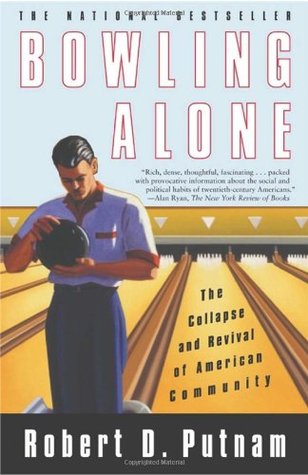
This continued to stick in my mind. In 2002, I read a book called Bowling Alone by Robert D. Putnam. Putnam gathered data from all across America and came to the same conclusions I'd come to after my stint with the Census Bureau:
Most people in America feel alienated, friendless, lonely, alone.
In more recent years I've become deeply disturbed by the climate here in America. During and after the last national election for president, I've been dismayed at the behavior of our leaders, especially our elected president. I was shocked when Donald Trump was elected as our president, and I've been horrified by the words he has spoken to others during his time as president. I don't watch television, but the bits of public life that have filtered down to me fill me with sadness and trepidation.
What is going on in my America?
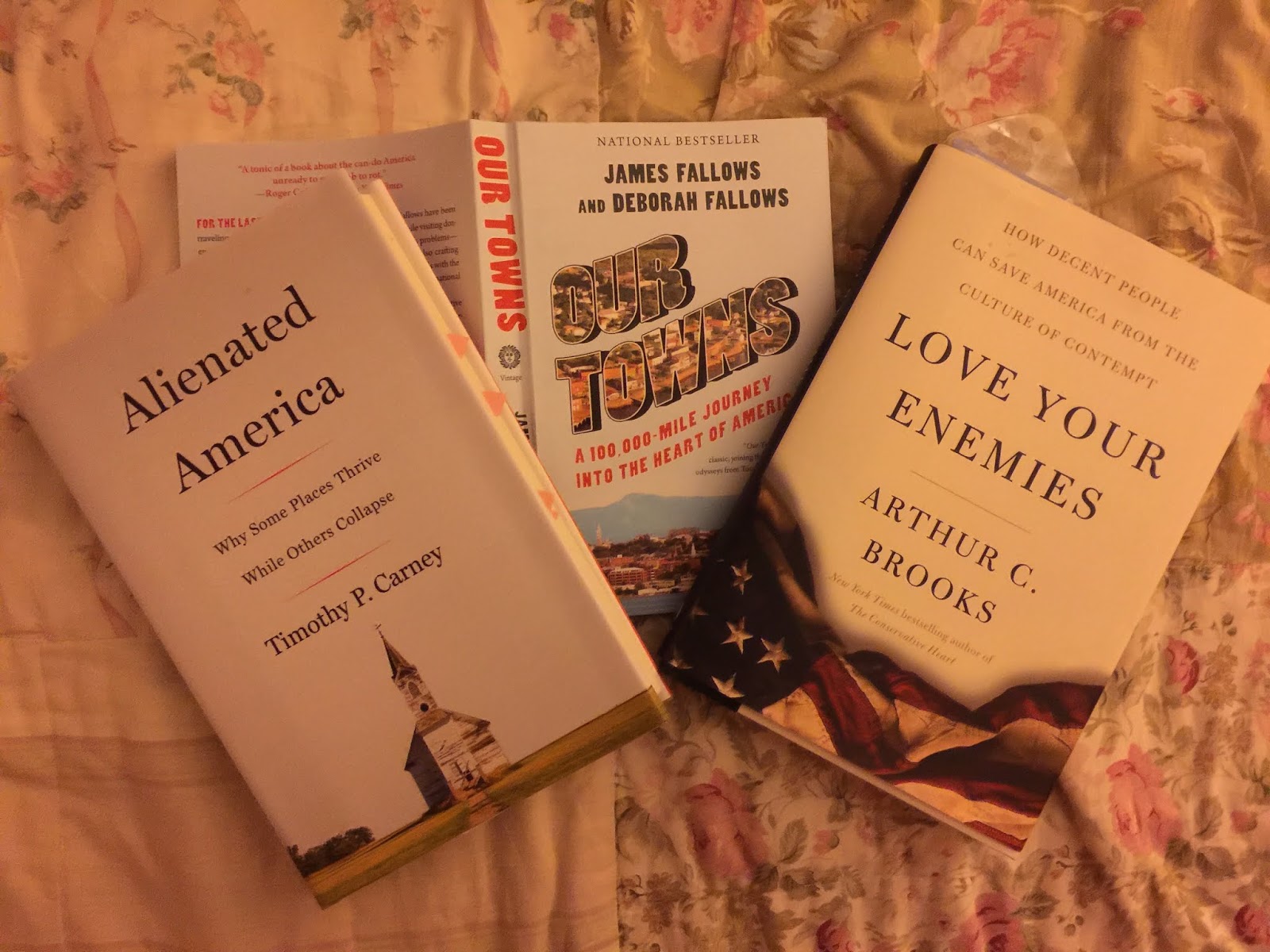
I picked up three books at the recent library conference in Austin that I've been reading in tandem over the past weeks. These books have helped me understand the malaise of the American people. They have helped me think through ways that we can work to change the mood and behavior of the people of our country.
The three books I read are:
Alienated America: Why Some Places Thrive While Others Collapse by Timothy P. Carney
Our Towns: A 100,000 Journey Into the Heart of America by James M. and Deborah Fallows
Love Your Enemies: How Decent People Can Save America from the Culture of Contempt by Arthur C. Brooks
What have I learned from reading these books?
Timothy P. Carney looks at the hard, cold facts about America today, especially those who brought Trump into power. The places where Trump scored big are key to understanding why he was elected, Carney tells us. What are those places like?
"Employment is far worse (in these places).... Death rates, especially death by suicide and overdose, correlated with Trump's best counties....Educational attainment is lower in Trump Country. More people are on unemployment. More people are on disability. These economic indicators are devastating, and crucial. But more telling are the social indicators. More men have dropped out of the workforce. Marriage rates are lower. Illegitimacy is higher. Divorce is higher....(Members of this group) said religion was very important to them, but...they were the least likely to go to church."
I found this absolutely fascinating stuff. Trump scores well in places where people are unhappy and communities are weak.
To add to the problems, the right, Carney tells us, has steadily worked for big businesses over small businesses, deeply weakening community bonds.
On the other side, according to Carney, the left has been promoting ideas for years that also build community alienation, stressing overcentralized government programs that provide for the poor at the expense of individuals and local efforts to help the poor, and emphasizing individual freedoms at the expense of the stabilizing effects of marriage and family and church and community on each person.
Arthur C. Brooks, in Love Your Enemies, shares the destructive power of contempt by citing the work of social psychologist and relationship expert John Gottman. Gottman, Brooks tells us, has studied thousands of married couples. After watching a couple interact for just one hour, Gottman can predict with 94 percent accuracy whether a couple will divorce within three years. What is this based on? It isn't the amount of anger a couple expresses, but, instead, it is the amount of contempt one member shows for another. And it is this contempt for one another in political matters that is currently making it impossible for opposing political parties to work together.
So where are we now? Yelling and screaming at each other from positions far to the left or right of our common ground. Cutting off friendships and family connections based on these extreme political positions.
In short, a mess.
Here is where Arthur C. Brooks takes up the struggle. In his book, Love Your Enemies, Brooks writes: "Deep down, we all know that the polarization we are experiencing in our politics today is toxic. We hate the fighting, the insults, the violence and disrespect."
Brooks shares a powerful story of the rare coming together of political opponents. Black Lives Matter protesters were confronting a group of Trump supporters in Washington, DC. Confrontation was rapidly accelerating into possible violence.
But then the organizer of the rally unexpectedly offered two minutes of time to the leader of Black Lives Matter. And everything changed. See for yourself what happened: https://youtu.be/xoXwgfYAJFU .
Wow, I thought. Wow. There is hope.
Brooks shares four rules Gottman offered for bringing people back together. Because we are in such a desperate situation, and because these rules can have a dramatic effect on changing things, I'm sharing them here:
"1. When others are upset about politics, listen to them respectfully. Try to understand their point of view before offering your own. Never listen only to rebut.
2. In your interactions with others, particularly in areas of disagreement, adopt the 'five-to-one rule,' which he gives couples. Make sure you offer five positive comments for every criticism.
3. No contempt is ever justified, even if, in the heat of the moment, you think someone deserves it. It is unjustified more often than you know, it is always bad for you, and it will never convince anyone that she is wrong.
4. Go where people disagree with you and learn from them. That means making new friends and seeing out opinions you know you don't agree with. How to act when you get there? See rules 1 to 3!"
Brooks uses the rest of the book to expand upon these rules and share oodles of great advice for our world, and I'd encourage you to get the book and read it carefully for yourself.
How does Our Towns fit into my study of America? James Fallows and Deborah Fallows spend four years and travel 100,000 miles to visit towns and cities across America to see what is going on in our country. Their book is also a book of hope. In every town and city where they find good things going on, they first see people working together for common goals, both economic and social, building up local businesses, building up local communities, building up schools, rethinking the whats and hows but keeping the whys, and taking pride in what is happening. The two Fallowses offer "10 1/2 Signs of Civic Success" as their takeaway from this adventure. Key to a local community's success is that "people work together on practical local possibilities, rather than allowing bitter disagreements to keep them apart...."
So I've ranted long enough, I think, and it's time for me to start working in my local community to make things better. I feel like I have some solid ideas to work from after reading these three books.
I welcome any thoughts you have about my thoughts here; I'd love to open this into a conversation. Let's move forward, shall we? And can we please move forward together?
July 1, 2018
The premise of this book offers so much potential. Its execution feels like rote memorization of a standard outline, covering the more banal topics of our towns- economic development councils, schools, tech start ups. By town three, each chapter started to sound the same instead of offering details of what makes these towns unique and desirable destinations. With each chapter on repeat, there were few/no transitions, wrapped up with an unnecessary summary that basically offers the outline of what the authors decided to cover for each town, even sharing that they had developed a methodology for how they standardized this approach to their reporting coverage (no surprise to any reader). The book is like Bill Bryson insult; a multi year road trip to small town America, without absolutely any charm, humor, or wit.
August 1, 2018
I was hoping this would be Charles Kuraltesq. Traveling around American and really connecting with people. However, I'm not buying a ticket to visit any of the cities/towns or taking out my checkbook to write a check to any of the organizations that were mentioned. It was dryly written and lacked an emotional pull. Maybe pictures would have helped me connect or fewer cities and more in depth stories about the towns and people.

July 31, 2018
The first 100 pages of this book grated on me. I felt that the authors were not being critical enough of the towns they were visiting and the reporting seemed to mostly involve going to towns and picking up the local tourism pamphlet. And Jim kept going on and on about microbreweries.
But in time, I realized that to view this as not reporting was to miss the point of the book. The authors are showing the reader how hope (and really, capital investment) can help turn around towns or at least imbue the local population with a sense of hope. It was what each of these things they were seen (the attempts at incubators, the investment in microbrews and distilleries) represented. And because this book was started before the 2016 election, its reporting can seem prescient. They show readers that in places that are considered stereotypical "Trump country", people are open, thoughtful, hard-working, and like all of us, a pile of contradiction.
However, to only view this book through the lens of the 2016 would be to do it a disservice. By the end of the book, the authors concede that everything they have thus far shown the reader is tenuous. Some of the towns they visited will have succeeded, others will have failed. But the authors have marvelously captured a moment in this nation's history. At a time where folks all around the country bemoan the noise around us, this book serves as a reminder that the solutions are often much closer to home. And though they may not be easy, it is worthwhile to pursue them because as we all know, this country was not built overnight.
But in time, I realized that to view this as not reporting was to miss the point of the book. The authors are showing the reader how hope (and really, capital investment) can help turn around towns or at least imbue the local population with a sense of hope. It was what each of these things they were seen (the attempts at incubators, the investment in microbrews and distilleries) represented. And because this book was started before the 2016 election, its reporting can seem prescient. They show readers that in places that are considered stereotypical "Trump country", people are open, thoughtful, hard-working, and like all of us, a pile of contradiction.
However, to only view this book through the lens of the 2016 would be to do it a disservice. By the end of the book, the authors concede that everything they have thus far shown the reader is tenuous. Some of the towns they visited will have succeeded, others will have failed. But the authors have marvelously captured a moment in this nation's history. At a time where folks all around the country bemoan the noise around us, this book serves as a reminder that the solutions are often much closer to home. And though they may not be easy, it is worthwhile to pursue them because as we all know, this country was not built overnight.
December 11, 2018
My wife borrowed this book from the library. I had no expectations. Honestly, I didn't even have a notion about what this book was going to be about. I found myself intrigued by and invested in the stories unfolding in each town the couple visited.

January 18, 2020
Look at those divergent reviews! What I really want to know is - can I believe that these ppl, almost 'limousine liberal' people, really know anything about the towns that they profile?
Fascinating and tedious, also encouraging and worrisome, all at the same time. Every town they visited is almost the same story of hope... but I'm not sure how many will be successes. A lot of the businesses the new downtowns are attracting aren't sustainable in any uncertain times, much less during this pandemic of course, as they're too niche, too focused on people with extra money. Most of these towns seem to believe in the motto that 'a rising tide lifts all boats' but just because there's a new high-end hotel downtown doesn't mean the housekeepers for it are going to be able to afford health insurance.
And the Fallows never asked the next question(s). For example, they mention 'mostly white' towns and 'mostly Latino' neighborhoods, but don't investigate the implications of that. "Poorer and less white" is a correlation they express time and again. If it's accurate, why is it true? Address the challenges that are holding whole groups of people back, and you'll go a long way towards 'fixing' your town without having to attract exotic outsiders.
Much less do they investigate how safe other minorities feel, for example atheists, Jews, Muslims, LGBTQ+, Native, etc. They talked mostly to civic leaders, school principals, business owners, only occasionally to the actual laborers, staff, students. They don't go to many of the truly small towns.
And they equate Greenville SC and Burlington VT as if all that matters is that the Chamber of Commerce members are happy. That's not true. I am now living in a politically 'red' community and I gotta tell you, even though I'm white and pass for straight, it sucks and I am looking forward to my next move to a more diverse, liberal, interesting town... even though it's not likely to have a 'thriving downtown' with condos above kitschy coffee-houses and maker spaces.
San Bernadino's focus on scaffolding programs in the public schools looks likely to be very effective. The twist there, of course, is that the most successful students will go away to college or university, and not necessarily come back.
Dodge City: The Fallows admire the citizens for voting for an additional 1% sales tax increase. A booster brags that they may be 'red' but that they're 'progressive.' No. A sales tax hits the poor the hardest... it is by definition regressive... and it is relatively easy to pass, compared to a property or income tax increase, which would be more egalitarian.
And this was published before Trump got elected. Most of his supporters are not better off because of him, so I suspect that a lot of these towns are still struggling. The authors don't seem to have set themselves up to do much follow-up... and there's no back matter advising us that they have plans to do so and inviting us to visit them online. No photos, index, references, list of further reading.
Speaking of Duluth. As of June 2019, my visit there, the downtown is still torn up for reconstruction. The businesses there are difficult to access and not all doing well. Parking is in paid lots (uncommon in smaller towns in the Midwest). Libraries are not open on Saturday.
So, yeah, I now understand the divergent reviews. If you really want to hear some good news, and can buy the promotional talk from the boosters, you'll love the book. If you're more cynical, you're not likely to. I should've just skimmed it, and read the last chapter. Ultimately, it's really not worth it imo.
Fascinating and tedious, also encouraging and worrisome, all at the same time. Every town they visited is almost the same story of hope... but I'm not sure how many will be successes. A lot of the businesses the new downtowns are attracting aren't sustainable in any uncertain times, much less during this pandemic of course, as they're too niche, too focused on people with extra money. Most of these towns seem to believe in the motto that 'a rising tide lifts all boats' but just because there's a new high-end hotel downtown doesn't mean the housekeepers for it are going to be able to afford health insurance.
And the Fallows never asked the next question(s). For example, they mention 'mostly white' towns and 'mostly Latino' neighborhoods, but don't investigate the implications of that. "Poorer and less white" is a correlation they express time and again. If it's accurate, why is it true? Address the challenges that are holding whole groups of people back, and you'll go a long way towards 'fixing' your town without having to attract exotic outsiders.
Much less do they investigate how safe other minorities feel, for example atheists, Jews, Muslims, LGBTQ+, Native, etc. They talked mostly to civic leaders, school principals, business owners, only occasionally to the actual laborers, staff, students. They don't go to many of the truly small towns.
And they equate Greenville SC and Burlington VT as if all that matters is that the Chamber of Commerce members are happy. That's not true. I am now living in a politically 'red' community and I gotta tell you, even though I'm white and pass for straight, it sucks and I am looking forward to my next move to a more diverse, liberal, interesting town... even though it's not likely to have a 'thriving downtown' with condos above kitschy coffee-houses and maker spaces.
San Bernadino's focus on scaffolding programs in the public schools looks likely to be very effective. The twist there, of course, is that the most successful students will go away to college or university, and not necessarily come back.
Dodge City: The Fallows admire the citizens for voting for an additional 1% sales tax increase. A booster brags that they may be 'red' but that they're 'progressive.' No. A sales tax hits the poor the hardest... it is by definition regressive... and it is relatively easy to pass, compared to a property or income tax increase, which would be more egalitarian.
And this was published before Trump got elected. Most of his supporters are not better off because of him, so I suspect that a lot of these towns are still struggling. The authors don't seem to have set themselves up to do much follow-up... and there's no back matter advising us that they have plans to do so and inviting us to visit them online. No photos, index, references, list of further reading.
Speaking of Duluth. As of June 2019, my visit there, the downtown is still torn up for reconstruction. The businesses there are difficult to access and not all doing well. Parking is in paid lots (uncommon in smaller towns in the Midwest). Libraries are not open on Saturday.
So, yeah, I now understand the divergent reviews. If you really want to hear some good news, and can buy the promotional talk from the boosters, you'll love the book. If you're more cynical, you're not likely to. I should've just skimmed it, and read the last chapter. Ultimately, it's really not worth it imo.

March 14, 2022
Birthday gift from Lauren. Story of an elderly couple who fly around the country visiting overlooked places in US. Published post Trump and pre pandemic, it emphasized unity and bipartisanship, presenting examples of public private partnerships in places like Greenville, SC or Allentown, PA. It did seem a bit over optimistic but perhaps that’s my coastal, liberal, elitist pessimism 🤷♂️
September 27, 2018
I knew I wanted to read this book when I heard the authors on a podcast. Deb and Jim Fallows spent three years traveling around America in their small plane, looking for small cities and large towns where interesting economic, educational, and artistic things are happening, and they found many.
Make no mistake; this is a very capitalist book. If you can't get behind "public-private partnerships," this is not for you. And I am extremely skeptical about this approach. Nonetheless, the Fallows saw a myriad of interesting things, and they are good writers and clear analysts. The most important takeaway for me, and perhaps for them, is that the extreme polarization of America is a top-down phenomenon. They went to cities as politically distinct as Burlington, Vermont and Columbus, Mississippi between 2014 and 2016. They say that almost no one talked to them about national politics, even when Trump was surging in the polls. They tell repeated tales of people whose signifiers indicate that they voted for Trump, but who are also supporting Hispanic and Muslim students in the schools, helping figure out how to bring more people of color into job-training programs, and stating freely that the immigrants and refugees in their community are necessary to its health and future.
You could ask "then why do they vote the way they do?" and it's a great question, but it's not the Fallows' question. Their questions are "who makes this town go?" "what interesting things are happening in your schools?" and "why do people want to live here." The book paints a rich, diverse, and appealing picture of how and why smaller communities can attack their own instances of nationwide problems, what makes downtowns livable (and what makes destroyed downtowns become livable again), what kinds of approaches people can take to civic, educational, and economic challenges.
Want to feel just a little bit better about America? If you live in a big metropolitan area, want to wonder what keeps you there? Read this book.
Make no mistake; this is a very capitalist book. If you can't get behind "public-private partnerships," this is not for you. And I am extremely skeptical about this approach. Nonetheless, the Fallows saw a myriad of interesting things, and they are good writers and clear analysts. The most important takeaway for me, and perhaps for them, is that the extreme polarization of America is a top-down phenomenon. They went to cities as politically distinct as Burlington, Vermont and Columbus, Mississippi between 2014 and 2016. They say that almost no one talked to them about national politics, even when Trump was surging in the polls. They tell repeated tales of people whose signifiers indicate that they voted for Trump, but who are also supporting Hispanic and Muslim students in the schools, helping figure out how to bring more people of color into job-training programs, and stating freely that the immigrants and refugees in their community are necessary to its health and future.
You could ask "then why do they vote the way they do?" and it's a great question, but it's not the Fallows' question. Their questions are "who makes this town go?" "what interesting things are happening in your schools?" and "why do people want to live here." The book paints a rich, diverse, and appealing picture of how and why smaller communities can attack their own instances of nationwide problems, what makes downtowns livable (and what makes destroyed downtowns become livable again), what kinds of approaches people can take to civic, educational, and economic challenges.
Want to feel just a little bit better about America? If you live in a big metropolitan area, want to wonder what keeps you there? Read this book.

June 27, 2018
I enjoyed this book on a couple levels. First, it was a great travel book. I learned a lot about the history and geography of the cities and regions profiled in the book. More importantly, I enjoyed learning about how the profiled towns were trying to make their communities a better place to live. There were many common themes: public-private partnerships, innovative schools, revitalized downtowns, civic leaders. Book could have been a little shorter, but that would have required leaving out some of the cities they visited. Finally, reading a book about solution-oriented Americans is refreshing, given today’s often antagonistic political atmosphere at the national level. I felt better about America after finishing this book.

June 6, 2018
What makes some small towns in America thriving, energetic, vibrant communities? This book takes on that far-reaching question, as the authors visit a variety of towns across America, talking with the movers and shakers, and asking the hard questions.
This timely book looks at the renaissance going on across small town America, and invites the reader to take a hard look at the reader's small town, to see the good and the bad, and to wonder how the reader's community can move forward.
I'm sharing this book with the local Chamber of Commerce staff, and recommending to my friends who are working to reinvigorate my corner of the world.
This timely book looks at the renaissance going on across small town America, and invites the reader to take a hard look at the reader's small town, to see the good and the bad, and to wonder how the reader's community can move forward.
I'm sharing this book with the local Chamber of Commerce staff, and recommending to my friends who are working to reinvigorate my corner of the world.
June 30, 2018
While attempting to put a pretty face on the state of America's smaller cities I doth feel that they oversimplified the forces that are acting to further separate the populace in the US. Many of the essays relating to particular cities were encouraging but they were stretching the points about local education efforts aiding the economic rejuvenation.
I did enjoy their description of the flights and approaches to the cities.
I did enjoy their description of the flights and approaches to the cities.

December 27, 2018
This was a big, dense book that took me a long time to read, even though I loved every minute of it. One friend told me it made her fall in love with America again, and I can truly understand why.
I will return with a longer review soon. I have to digest this one for a while.
I will return with a longer review soon. I have to digest this one for a while.

May 31, 2018
just what it says on the tin: inspiring stories of urban rejuvenation across America.

May 31, 2020
James and Deborah Fallows are journalists. They devoted four years to criss-crossing the United States, investigating “Our Towns” across America to see what is working and what is not at the most basic level of civic government. They logged 100,000+ miles in their small airplane.
The book is interesting enough; the chapters short enough, and chapter divisions often enough that this is a good book to read in short bites, like at bedtime. In fact, if read for too long a time at one sitting, the progression of towns starts to feel alike: Jim and Deb meet interesting townsfolk in the local brewpub and find out what makes their town tick—or not.
What makes so many of the towns tick: local folks passionate about saving their town. Some made their money elsewhere and then returned home to revitalize their home towns. Some stayed and made their money. A research university nearby was helpful, but not necessary to every successful town. Innovative educational institutions were extremely necessary. The towns which were succeeding were all revitalizing their downtowns; investing in education; encouraging immigrants to settle there; had all kinds of small-business start-ups and small tech industries. AND THEY ALL HAD MICRO-BREWERIES.
Apparently, in the Fallows’ opinion, micro-breweries were a de rigeur requirement for a town to come back from the brink. OK then.
Not a bad book, but it could have made its point in 100 fewer pages.
The book is interesting enough; the chapters short enough, and chapter divisions often enough that this is a good book to read in short bites, like at bedtime. In fact, if read for too long a time at one sitting, the progression of towns starts to feel alike: Jim and Deb meet interesting townsfolk in the local brewpub and find out what makes their town tick—or not.
What makes so many of the towns tick: local folks passionate about saving their town. Some made their money elsewhere and then returned home to revitalize their home towns. Some stayed and made their money. A research university nearby was helpful, but not necessary to every successful town. Innovative educational institutions were extremely necessary. The towns which were succeeding were all revitalizing their downtowns; investing in education; encouraging immigrants to settle there; had all kinds of small-business start-ups and small tech industries. AND THEY ALL HAD MICRO-BREWERIES.
Apparently, in the Fallows’ opinion, micro-breweries were a de rigeur requirement for a town to come back from the brink. OK then.
Not a bad book, but it could have made its point in 100 fewer pages.

January 22, 2020
This was a great book all about many of the different towns and cities in the US. I learned a lot about how cities grow, what makes them who they are, what their strengths and weakness are and what we can learn from them all.
August 19, 2019
It has some interesting parts and is generally readable, but this book is frustratingly superficial in its examination of these towns and cities. There are simultaneously big discrepancies from city to city (some entries are more than 20 pages, while some, especially as the book goes on, are 5 pages), and there's a flat, repetitive quality to their impressions of most of the places they go. The authors tend to parrot the boosterish information they get from the local entrepeneurs/mayors/chamber of commerce (one person they talk to shows a lot more self-awareness than the authors when he says, "but of course I'd say that--I'm from the Chamber of Commerce!") and don't really look beyond that information to consider how redevelopment might have uneven impacts across a community, or how there might be multiple ways to strengthen an economically depressed place. I'm not saying this book needed to be a searing expose, but it's so celebratory of the idea of public-private partnerships and so unwilling to consider the idea that there might be debate within a community about how to move forward and because of that it misses an opportunity to have more substance. The book declares (in an attempt to reassure us?) that it's not focused on politics, and that politics doesn't come up very much in the authors' conversations, and that local politics in conservative places are often less conservative than national voting patterns--but this proudly apolitical stance on the part of the authors makes the book seem weak and myopic.
Lastly, this wasn't such a big deal but the book is suffused with strange digressions based on the authors' personal interests. They travel from place to place in their small plane, and there are several chapters about flying a plane that don't really connect to the larger project of the book. At one point they recount the story of a woman pilot from Columbus, Ohio, but there's no obvious reason why. The wife is a linguist and sometimes that leads to reasonable discussion of the regional variations in the way people speak, but sometimes it leads to truly wacky observations--in Allentown, PA, the authors seem to have been unable to distinguish between a waffle and a funnel cake and asked multiple people to explain it to them, and come away thinking that the notion that these are totally different foods is a Pennsylvania quirk.
Lastly, this wasn't such a big deal but the book is suffused with strange digressions based on the authors' personal interests. They travel from place to place in their small plane, and there are several chapters about flying a plane that don't really connect to the larger project of the book. At one point they recount the story of a woman pilot from Columbus, Ohio, but there's no obvious reason why. The wife is a linguist and sometimes that leads to reasonable discussion of the regional variations in the way people speak, but sometimes it leads to truly wacky observations--in Allentown, PA, the authors seem to have been unable to distinguish between a waffle and a funnel cake and asked multiple people to explain it to them, and come away thinking that the notion that these are totally different foods is a Pennsylvania quirk.
July 23, 2019
I had a high expectation for this book: 1. I always enjoyed reading James Fallows' Atlantic pieces. 2. I also liked a few "Our Towns" stories when they appeared on Kai Ryssdal's Marketplace.
Unfortunately, the expectation was too high and exceeded this audiobook.
First, the audiobook delivery: while Kai Ryssdal and Marketplace delivered stories with an active pace, strong momentum, and a desire to hear more, the authors' narration strangely felt lukewarm and even indifferent to their own stories. A town's booming stories is almost the same as its earlier doom, the narrators’ attention seems drifting elsewhere. Narrating seems to take different skills from writing well.
Second, the content was loose like an unedited travel-journal: meandering from a city's public library, how its present day customers liked its function, to a mayor's personal back story, to his success in turning around the downtrodden city, to his refusal to seek for 4th term re-election, back to library, who paid for the library's initial construction and architectural details, and oh there was a special school by the library, which somehow had a mysterious fire that people suspected wrongdoing ... there were so many leads but most did not lead anywhere. I was often left head-scratching, why do you need to tell me of a mysterious fire that people suspected foul (with no evidence or any further discussion)?
(The interspersed parts about small plane aviation could be interesting for people into that topic.)
The book is a fine idea: the audiobook delivery could be more interested, and the content more focused.
Unfortunately, the expectation was too high and exceeded this audiobook.
First, the audiobook delivery: while Kai Ryssdal and Marketplace delivered stories with an active pace, strong momentum, and a desire to hear more, the authors' narration strangely felt lukewarm and even indifferent to their own stories. A town's booming stories is almost the same as its earlier doom, the narrators’ attention seems drifting elsewhere. Narrating seems to take different skills from writing well.
Second, the content was loose like an unedited travel-journal: meandering from a city's public library, how its present day customers liked its function, to a mayor's personal back story, to his success in turning around the downtrodden city, to his refusal to seek for 4th term re-election, back to library, who paid for the library's initial construction and architectural details, and oh there was a special school by the library, which somehow had a mysterious fire that people suspected wrongdoing ... there were so many leads but most did not lead anywhere. I was often left head-scratching, why do you need to tell me of a mysterious fire that people suspected foul (with no evidence or any further discussion)?
(The interspersed parts about small plane aviation could be interesting for people into that topic.)
The book is a fine idea: the audiobook delivery could be more interested, and the content more focused.

September 11, 2018
This is an interesting book, written over several years, both before and during the Trump presidency.
I decided to read this book as it was reviewed as showing the strengths of "local America" - and it was called out by some commenters as showing that America was doing well and Trump not so severely effecting everyone.
This book took a long time to read as it is hard to go to several towns or cities in one day.
It is somewhat inspiring in what people are accomplishing in various town and shows to some extend variations in values in America. However Americans have always been flexible and opportunistic (not necessarily immorally or amorally) which is maybe a result of the constant flow of immigrants we have had through most of our history.
So it is an interesting book about America - but I was always thinking how long would this continue with the expanding national debt we will encounter with the new tax laws and the environmental and health problems we will face as the EPA is changed and emasculated. Much as we must appreciate and admire the local officials and entrepreneurs we should realize that the infrastructure and supports that have existed for the last few decades are being stripped away.
I decided to read this book as it was reviewed as showing the strengths of "local America" - and it was called out by some commenters as showing that America was doing well and Trump not so severely effecting everyone.
This book took a long time to read as it is hard to go to several towns or cities in one day.
It is somewhat inspiring in what people are accomplishing in various town and shows to some extend variations in values in America. However Americans have always been flexible and opportunistic (not necessarily immorally or amorally) which is maybe a result of the constant flow of immigrants we have had through most of our history.
So it is an interesting book about America - but I was always thinking how long would this continue with the expanding national debt we will encounter with the new tax laws and the environmental and health problems we will face as the EPA is changed and emasculated. Much as we must appreciate and admire the local officials and entrepreneurs we should realize that the infrastructure and supports that have existed for the last few decades are being stripped away.

November 9, 2018
This travelogue is a non-fiction antidote for the civically depressed who are exhausted by the bad news of national politics. Written by a couple of married journalists who traveled around the country in their tiny plane and reported on this country's up and coming towns, it's optimistic and contains a wealth of information for those looking for bright side, or looking for a new place to live. Who knew that the presence of craft beer breweries were such an accurate sign of an economically-growing or thriving town?

March 6, 2020
Many, many years ago, I began reading and looking forward to Mr. Fallows' writings on his life in Japan, back when Japan was at the peak of its economic importance. These were typically short- to medium-length essays that appeared in The Atlantic or The New Yorker or someplace similar. But this book explains why reading a couple dozen essays back-to-back doesn't make for a good book, in my view -- each chapter could be compelling on its own, but the sheer repetitiveness and lack of any sort of overall progress in the book made me abandon it halfway through.
Oh, another note, this was co-written by Mr and Mrs Fallows, and their voices are so similar that (except when discussing a few specific subjects) it was difficult to tell the two apart. That's an observation and not a complaint.
Oh, another note, this was co-written by Mr and Mrs Fallows, and their voices are so similar that (except when discussing a few specific subjects) it was difficult to tell the two apart. That's an observation and not a complaint.

November 15, 2019
Our Towns is both a lucid, detailed examination of the policies, programs, politics, institutions, and public-private partnerships that are working or not working so well in cities large and small all across the United States and a loving, heartfelt snapshot of our neighbors all around the country. James M. Fallows and Deborah Fallows are straightforward, down-to-earth, compassionate lovers of people everywhere and from all walks of life, and they are wonderful guides on this epic journey. If you're interested in learning what makes Americans tick in this young 21st century, read this book.

August 26, 2018
I thoroughly enjoyed this journey around my country described by James and Deborah Fallows. I used my laptop to add to my experience and let me see images of the various cities and especially the libraries which were mentioned in such positive terms by the authors. I hope that they continue doing this sort of travel and exploration and write another book about it. It is wonderful to hear that some communities have been able to make very positive changes in their hometowns after they have suffered from the many changes that have negatively impacted them.
Displaying 1 - 30 of 361 reviews