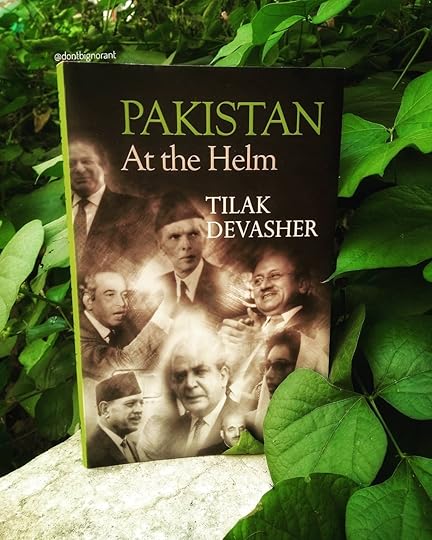
Tilak Devasher’s tome is one of those works that arrives wearing the quiet confidence of deep research, the stance of someone who has spent decades staring directly at the subcontinent’s fault lines without once blinking. It’s not written with the theatricality of a political thriller or the smug certainty of a “know-it-all” think tank veteran.
Instead, it unfurls like a long, slow exhale — the voice of a man who has watched the smoke rise across borders, listened to the subtle tremors beneath official statements, and traced the silhouettes of leaders whose choices have shaped one of the most complicated states of the modern world.
The book’s real strength is that it neither demonises nor romanticises: it attempts to understand the men who led Pakistan, and in doing so, reveals a nation whose crises, paradoxes, and aspirations remain entangled in its political DNA.
Reading Devasher today, in a world where geopolitics feels like a badly moderated group chat — unstable alliances, abrupt betrayals, back-channel whispers — you realise just how prescient his lens is.
Pakistan, in 2025, is not merely an internal story. It is a ripple point in the global strategic ocean: the tenuous US–Pakistan tango, the uneasy China–Pakistan embrace through CPEC, India’s wary observation, the Gulf’s shifting patronage, and the quiet pressure of IMF strings pulling at the national fabric.
Every leader Devasher examines — from Jinnah to Bhutto to Zia to Musharraf to the more recent civilian contestants — becomes a prism through which we understand the present international anxieties about extremism, debt, nuclear control, regional instability, and identity politics.
But before the world enters the frame, Devasher’s book insists that we dwell on the individuals: men pushed “to the helm,” often unprepared, occasionally visionary, frequently conflicted. Leadership in Pakistan, he suggests, isn’t just a political role — it is an exercise in existential improvisation. The Geeta says, “Karmany evadhikaraste ma phaleshu kadachana” — you have the right to action, not to the fruits thereof.
In Pakistan’s case, the fruits have almost always been bitter, but the actions of its leaders — taken under duress, under illusions, or under the influence of military shadow — reveal how a nation’s destiny can be shaped by men in rooms too dimly lit for the rest of us to see clearly.
Shakespeare would have adored Pakistan’s political theatre. “Uneasy lies the head that wears a crown,” he writes in Henry IV, a line that could serve as the epigraph to this book. Devasher shows us that every leader at the helm wore that crown not as a symbol of legitimacy but as a burden — a hotspot for coups, clerical pressures, foreign interference, internal factionalism, ideological dissonances, and the perpetual dilemma of holding together a nation whose founding fears often outweighed its founding dreams.
Comparatively, when we look at the postcolonial trajectories of other artificially carved states — Israel, South Sudan, even Myanmar’s modern identity struggles — we see echoes of Pakistan’s initial dissonance: a nation created by rhetoric, shaped by trauma, and forced to stabilise before it could define itself.
But Pakistan’s story is uniquely turbulent because of the military’s early arrival as the “guardian,” a role that froze political evolution and converted leadership into a revolving performance of negotiation with invisible referees.
Devasher does something few analysts manage: he humanises without excusing. His portraits of leaders are textured — Ayub’s authoritarian developmentalism, Zulfikar Ali Bhutto’s flamboyant populism, Zia’s austere Islamisation project, Musharraf’s swaggering modernism — each one a study in contrasts. And inevitably, when you view them side by side,
Pakistan’s national narrative becomes a kind of Möbius strip: the same ideological tensions looping endlessly, the same institutions colliding, the same anxieties finding new vocabulary.
This is where the global perspective becomes unavoidable. Pakistan is not a sealed laboratory; it is a node in the world’s geopolitical nervous system. China’s Belt and Road ambitions transformed the country's economic and infrastructural landscape but also bound Pakistan into a relationship that oscillates between dependence and strategic necessity.
To read Devasher now, with CPEC’s debt burdens becoming more visible, is to feel Kautilya whispering from the Arthashastra: “A king with impoverished subjects is like a barren cow — neither yields milk nor gives pleasure.” Leadership, Kautilya says, must secure prosperity before pride. Pakistan’s leaders often reversed the formula.
In contrast, India’s economic and diplomatic rise has further destabilised Pakistan’s regional positioning. The asymmetry has grown too vast to ignore, shaping political decisions inside Islamabad and Rawalpindi with a defensive logic.
Afghanistan’s uncertainties after the Taliban’s return in 2021 have also pushed Pakistan into a vortex of cross-border militancy, diplomatic embarrassment, and internal blowback.
Devasher’s analysis of leaders looks eerily prophetic in this light — he identifies precisely how certain ideological choices planted seeds that would sprout decades later, becoming the thorny bushes of modern policy paralysis.
When Devasher discusses leaders like Zia-ul-Haq, the world intrudes immediately. Zia’s Islamisation project, supported by the U.S. during the Soviet-Afghan war, didn’t merely change Pakistan; it changed global extremism. The consequences echo across continents today — from counterterrorism strategies in Europe to refugee crises in America.
And when Devasher examines later leaders attempting to “correct” that trajectory, one realises how nation-building can become a generational tug-of-war, with each faction trying to restore a version of Pakistan that may never have existed beyond an ideological dreamscape.
There are moments in the book that feel almost tragic in a Shakespearean sense — the irony, the hubris, the miscalculations. Bhutto’s downfall could have been staged by Shakespeare himself: ambition, betrayal, charisma, downfall, the crowd cheering one moment and deserting the next.
Musharraf’s era reads like modern political theatre: the global war on terror, the tightrope walk between Washington and the Islamists, the swagger of a general-turned-modernizer who underestimated the strength of Pakistan’s political undercurrents.
When Devasher writes about leaders struggling to escape the military’s shadow, we hear echoes of Macbeth: “I dare do all that may become a man; who dares do more is none.” In Pakistan, to do more than a civilian leader should — or less than a military leader expects — is to invite catastrophe. Leadership is not merely a role. It is a negotiation with destiny.
And in the 2025 global landscape, that negotiation has become perilous. Pakistan’s economic crisis has placed it firmly in the orbit of IMF restructuring, which often comes with political fragility. Inflation and unemployment fuel street movements. The judiciary’s independence oscillates like a pendulum caught in crosswinds.
Civilians rise and fall in news cycles, while the security establishment quietly recalibrates behind the scenes.
Devasher’s book, though published earlier, almost anticipates this moment: a Pakistan caught between global expectations and internal contradictions. The strategic partnership with China is no longer a simple “all-weather friendship.” It is a complex ledger of debts, security guarantees, and mutual anxieties about the future.
The U.S., which once relied on Pakistan as a Cold War and War-on-Terror ally, now engages with more caution, more distance. Saudi Arabia’s shifting investments reflect a region slowly diversifying its friendships, no longer treating Pakistan as the automatic recipient of bailouts.
And India’s growing diplomatic clout has made Pakistan’s habitual strategies — rhetorical, military, ideological — less effective on the world stage.
Comparatively, when you place Pakistan’s leadership trajectory against nations like Turkey, Iran, or even Egypt, patterns emerge: the struggle between military and civilian legitimacy, the use of religion as political glue, the reliance on external patrons, the cyclical economy of crisis and bailout.
Devasher’s achievement is that he shows these patterns without collapsing individuals into caricatures. Each leader is a product of their time, but also an agent shaping the next era’s challenges.
The Geeta offers an unsettlingly apt line here: “When adharma rises and dharma declines, I reappear.” In Pakistan’s context, “reappearance” is not divine — it is institutional. When political dharma weakens, the military reappears. When ideological extremism rises, a new leader emerges promising moderation.
When economic collapse looms, the state resurrects external alliances. It’s a karmic cycle of political reincarnation, grimly predictable yet endlessly surprising in its manifestation.
By the end of Devasher’s book, you don’t walk away thinking Pakistan is a doomed project. Instead, you see it as a nation trapped in a maze whose walls are historical, ideological, institutional, and psychological. Each leader tried, in their own way, to carve a path through this maze — some by breaking walls, some by painting new ones, some by pretending the maze didn’t exist.
And the world watched, sometimes amused, sometimes alarmed, always invested because Pakistan has never been just another country. It has been a geopolitical hinge — a nation whose internal oscillations affect strategic balances far beyond South Asia.
Reading Pakistan: At the Helm today is to understand not just Pakistan, but the global fault lines that define 21st-century politics: extremism, economic fragility, military-civilian tussles, identity crises, strategic dependencies, and the perpetual tug-of-war between nationalism and globalisation. Devasher’s book becomes a mirror through which we see how nations struggle to define themselves amid pressures both internal and external.
It’s also a reminder of something Kautilya said with chilling clarity: “The king shall consider as good not what pleases him but what pleases his subjects.” In Pakistan, leaders often did the opposite — and the nation still pays the price.
Shakespeare might have shrugged and said, “The fault, dear Brutus, is not in our stars, but in ourselves.” Devasher, in his quiet analytical way, suggests exactly that: Pakistan’s destiny has always been shaped not by cosmic forces but by the choices, insecurities, ambitions, and blind spots of the people at the helm.
And the world, still very much entangled with Pakistan’s future, cannot afford to look away.
Recommended.