

What do you think?

Now, Now, Louison
'Bourgeois speaks to herself in fragments and snatches; we’re in her head. We see her desire to speak, her reluctance to speak, her moments of rage, her self-possession when faced with overwhelming feelings'. Louise Bourgeois as I Knew Her, Jean Frémon, Granta, 31 May 2018
‘The spider woman, the intellectual, the rebel, the sly enchantress, and the good girl sing together in this exuberant, lithe text beautifully translated by Cole Swensen. There is something uncanny at play in this small book, something I don’t fully grasp, but I suspect that elusive, haunted excess may be exactly why I love it. ’ Siri Hustvedt
‘Now, Now Louison draws the reader in with all of the monstrous elegance of a spider, capturing us in the fine web of the creative process, and revealing, with biting wit and lyrical style, the ego, and sacrifices it takes to make monumental work.’ Preti Taneja, author of We that are young
‘The life of Louise Bourgeois is rendered in ellipsis, quick brush strokes, and a mix of associations of ideas
and of sensations waltzing with chronology. A highly original, sensitive text.’– Libération
‘Jean Frémon brings Louise Bourgeois close up into a fascinating and moving proximity.’– ArtPress
‘Jean Frémon is a wholly singular artist, a writer who lives in the radiant zone where poetry, philosophy and storytelling meet.’ – Paul Auster
Louise Bourgeois (1911-2010) talks, talks to herself, reviewing the scraps of her long life in all their disorder.
This is the portrait, from memory, of a woman who devoted her life to her art, a life that was also the life
of the century. The art world’s grande dame and its shameless old lady, spinning personal history into works of profound strangeness, speaks out with her characteristic insolence and wit, through a most discrete, masterful writer. From her childhood in France to her exile and adult life in America, to her death; through the moods, barbs, resentments, reservations and back, at full speed – this is a phosphorescent poem-in-prose describing Bourgeois’s inner life as only one artist regarding another can.
· An ideal short text to introduce readers to one of the greatest artists of our time
and reveal her to those who know her work already.
· A deeply feminist book by a seventy-two-year-old male author.
‘The spider woman, the intellectual, the rebel, the sly enchantress, and the good girl sing together in this exuberant, lithe text beautifully translated by Cole Swensen. There is something uncanny at play in this small book, something I don’t fully grasp, but I suspect that elusive, haunted excess may be exactly why I love it. ’ Siri Hustvedt
‘Now, Now Louison draws the reader in with all of the monstrous elegance of a spider, capturing us in the fine web of the creative process, and revealing, with biting wit and lyrical style, the ego, and sacrifices it takes to make monumental work.’ Preti Taneja, author of We that are young
‘The life of Louise Bourgeois is rendered in ellipsis, quick brush strokes, and a mix of associations of ideas
and of sensations waltzing with chronology. A highly original, sensitive text.’– Libération
‘Jean Frémon brings Louise Bourgeois close up into a fascinating and moving proximity.’– ArtPress
‘Jean Frémon is a wholly singular artist, a writer who lives in the radiant zone where poetry, philosophy and storytelling meet.’ – Paul Auster
Louise Bourgeois (1911-2010) talks, talks to herself, reviewing the scraps of her long life in all their disorder.
This is the portrait, from memory, of a woman who devoted her life to her art, a life that was also the life
of the century. The art world’s grande dame and its shameless old lady, spinning personal history into works of profound strangeness, speaks out with her characteristic insolence and wit, through a most discrete, masterful writer. From her childhood in France to her exile and adult life in America, to her death; through the moods, barbs, resentments, reservations and back, at full speed – this is a phosphorescent poem-in-prose describing Bourgeois’s inner life as only one artist regarding another can.
· An ideal short text to introduce readers to one of the greatest artists of our time
and reveal her to those who know her work already.
· A deeply feminist book by a seventy-two-year-old male author.
128 pages, Paperback
First published January 1, 2016
Ratings & Reviews
Friends & Following
Create a free account to discover what your friends think of this book!
Community Reviews
Displaying 1 - 30 of 47 reviews

July 20, 2022
The portrait is built up of tiny strokes, one added upon another, like dashes of pencil. — I think this passage depicts best the technique Jean Frémon used while writing Now, Now Louison, a book about Louise Bourgeois (1911-2010), a French artist, famous for her mind-blowing sculptures and installations. 'Sculptures' are not a precise term, actually: They call them sculptures because they’re made of marble or iron or wood, but they’re really yarns, brief stories from the past that got stuck in your throat.
Continuing the theme of inadequate terms, the word 'biography' is pretty useless here. Imagine a pile of various elements, like shards, pebbles, pieces of fabric — memories, extracts from songs, fleeting thoughts, observations, spider trivia, quotes — which you are supposed to arrange to your liking, as if you were creating a collage, installation or sculpture, just like Bourgeois herself. The task is pretty challenging because Louise, a complex, contradictory, unpredictable character according to Frémon, defies any attempt to pigeonhole. By the way, there is such an ironic contrast between Louise's conservative-sounding surname and the originality of her eccentric, shocking works.
Now, Now Louison is a rare example of second-person narration and it makes you understand why authors seem to feel quite reluctant to use it. I had the impression it feels slightly artificial and gimmicky although I appreciate Frémon’s idea to render the tone and rhythm of Louise’s inner monologues: as intended, we’re in her head indeed.
The book is short, only 128 pages, but it took Jean Frémon over 20 years to write it. He met Louise Bourgeois in person and the connection and sympathy are palpable: Any painter will tell you that making a good portrait requires more than just a model to pose for you. You need much more — you need a deep familiarity that can only develop over a long period of time, the ability to put a hundred portraits into one. Which is why so many painters only do portraits of the people close to them. On the other hand, bad painters think they can do a portrait from a photograph... Jean Frémon's book definitely is not a portrait from a photograph.
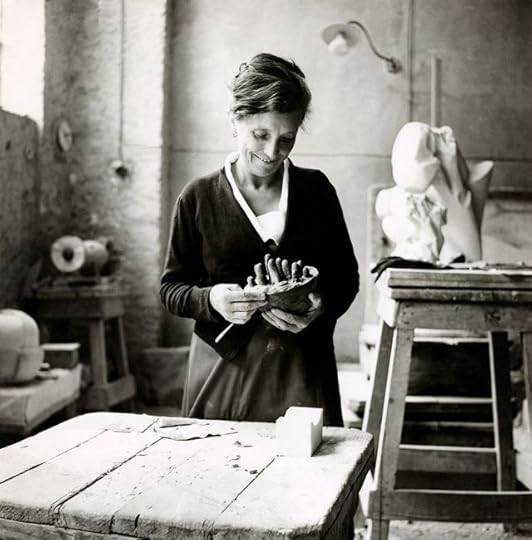
Louise Bourgeois.
Continuing the theme of inadequate terms, the word 'biography' is pretty useless here. Imagine a pile of various elements, like shards, pebbles, pieces of fabric — memories, extracts from songs, fleeting thoughts, observations, spider trivia, quotes — which you are supposed to arrange to your liking, as if you were creating a collage, installation or sculpture, just like Bourgeois herself. The task is pretty challenging because Louise, a complex, contradictory, unpredictable character according to Frémon, defies any attempt to pigeonhole. By the way, there is such an ironic contrast between Louise's conservative-sounding surname and the originality of her eccentric, shocking works.
Now, Now Louison is a rare example of second-person narration and it makes you understand why authors seem to feel quite reluctant to use it. I had the impression it feels slightly artificial and gimmicky although I appreciate Frémon’s idea to render the tone and rhythm of Louise’s inner monologues: as intended, we’re in her head indeed.
The book is short, only 128 pages, but it took Jean Frémon over 20 years to write it. He met Louise Bourgeois in person and the connection and sympathy are palpable: Any painter will tell you that making a good portrait requires more than just a model to pose for you. You need much more — you need a deep familiarity that can only develop over a long period of time, the ability to put a hundred portraits into one. Which is why so many painters only do portraits of the people close to them. On the other hand, bad painters think they can do a portrait from a photograph... Jean Frémon's book definitely is not a portrait from a photograph.
Louise Bourgeois.

April 18, 2019
I wanted to love this slim collage because I love Louise Bourgeois and the author knew her well - but Frémon's piecing together of voices (first mingled with second), anecdotes, and songs was willfully opaque. This is a book of lovely paragraphs that never quite congeal - the fabulous Bourgoisian spiders lurk in the background, and are given short shrift.

October 16, 2018
Now, now Louison. You're getting all worked up.
Longlisted for the 2019 Republic of Consciousness Prize
The judges' citation:
I was on the jury that shortlisted their Blue Self-Portrait, translated by Sophie Lewis from Noémi Lefebvre's 2009 French original L’autoportrait bleu, for the Republic of Consciousness Prize in 2018 (my review https://www.goodreads.com/review/show...), and this book will, I'm sure, feature strongly in the 2019 prize.
Now, Now, Louison is translated by Cole Swanson from the French original by Jean Fremon, a gallerist as well as a writer, known for his 'hybrid genre of art-historical fictional essays' of which this is one, where he takes a real-life artist as a character in his novel. And while Fremon is a male not female author, this is very much a feminist book.
The subject of this novel(la), a portrait in words and from memory, is the French-American artist Louise Bourgeois (https://en.wikipedia.org/wiki/Louise_...), born in 1911 and who was active into her 90s, dying aged 98 in 2010, indeed her greatest artistic fame came towards the end of her life.
And distinctively Fremon writes in the second person - the novel is essentially narrated by (the fictional) Bourgeois talking to herself. As Fremon has explained in an interview in Granta (https://granta.com/louise-bourgeois-a...) that:
She’s always been in my drawings, in the form of a spider. People don’t usually like spiders – they’re afraid of them. Women leap onto stools and scream, and men step on them with the self-satisfaction of having done a good deed.
But you, you love spiders. They’re beautiful, they’re clean, and they manage to be simultaneously both quick and calm. They wait, motionless, in corners, never flustered, never obsessive, never hysterical; they’re serene beings, holding themselves apart, watching. With an animal patience. And they destroy various things that make life unbearable, such as flies and mosquitoes. Ah! the mosquitoes in Easton! How we could have used a good herd of spiders! And it must be said that they take good care of their young. You watch them, in the garden, in the attic, on the stairway, in the basement. They’re not all the same. You identify them and describe their varied behavior. Once on a trip to Paris, you found an encyclopedia of the spiders of the world at Boubée & Co. and brought it back. You have your favorites – more on that later – you don’t need it all at once; have a little patience, dears.
Molly, the woman who comes in twice a week to try to restore a little order, just doesn’t understand. She’s not allowed to touch a thing, and above all, not the spiders or the spiderwebs. She pushes the vacuum cleaner vaguely around in the center of the rooms, avoiding the corners. ‘Raising spiders – good Lord – that’s not Christian. If spiders aren’t the Devil himself, they’re at least his ambassadors,’ she declares. In the large house where you now live alone, they spread out, proliferating from the cellar to the attic. You think of Mother watching over her brood. There she is; you see her in the corner, watchful, on the lookout, ready for sacrifice. You never get tired of drawing her; you’re drawing Mother.
Mother was also a kind of weaver. She was in charge of repairing the tapestries that Father bought on his routine visits to castles in the vicinity. ‘Visits’ was the term he used; it seemed apt – and each time, a new affair. Once the tapestries were restored, he sold them in New York, Boston, or Philadelphia. All the while, Mother was hunched over her work, wielding her needle. Petit point. How you admired her patience, her application.
and excerpts from the encyclopedia of spiders also appear throughout
At the stationers on 7th Avenue, you bought a notebook, a lined one like children use in school, and on the cover, you wrote The Spider Book. In it, you noted your observations and copied out passages from J. H. Fabre, adding a few ideas and drawings. You could have called it The Book of My Mother, but that already existed, so this one had to be The Book of the Spider, or The Spider Book. Burying yourself in it after a long day’s work gave you the same sense of well-being that a child gets from a stamp collection.
...
Some species of the Cyclosa and Uloborus adorn their webs with a fake spider or two whipped up from their silk and the remains of their prey—the tough, stringy bits that don’t taste good. They sculpt doubles of themselves and place them on the web so that predators will attack this bait instead of them. Ah, that’s my favorite, the spider-sculptor . . . making its own decoys.
As a mathematician myself, I was fascinated that Bourgeois originally studied geometry at the Sorbonne, and in the novel her appreciation for spider's webs reflects their mathematical perfection:
The web, a marvel of design. You loved the logarithmic spiral obliquely intersecting the vectors radiating out from the center, getting ever closer to it without ever reaching it, endlessly circling in, tighter and tighter, barely discernible. Glory to the universal geometer. And in the morning, with the dew on it, what light . .
Another feature of the novel is the inclusion of snatches of songs (albeit one that worked a little less well for the English speaker less familiar with the originals), for example Charles Trenet's (https://www.youtube.com/watch?v=T_uvg...
♩♫ Que reste-t-il de nos amours
Que reste-t-il de ces beaux jours
Une photo, vieille photo
De ma jeunesse
Que reste-t-il de tout cela
Dites-le-moi ♫♩
As Fremon explains in the Granta interview:
Longlisted for the 2019 Republic of Consciousness Prize
The judges' citation:
An immersive and profoundly satisfying engagement with the artist Louise Bourgeois. Gorgeously translated, it is full of illuminating observations on a remarkable life and tremendous body of work, from the striking opening to the final poignant evocation of gathering darkness.Les Fugitives is another of the UK’s wonderful small independent presses, one with a very specific remit: to publish "Short, new writing by award-winning francophone female authors previously unavailable in English or in the UK."
I was on the jury that shortlisted their Blue Self-Portrait, translated by Sophie Lewis from Noémi Lefebvre's 2009 French original L’autoportrait bleu, for the Republic of Consciousness Prize in 2018 (my review https://www.goodreads.com/review/show...), and this book will, I'm sure, feature strongly in the 2019 prize.
Now, Now, Louison is translated by Cole Swanson from the French original by Jean Fremon, a gallerist as well as a writer, known for his 'hybrid genre of art-historical fictional essays' of which this is one, where he takes a real-life artist as a character in his novel. And while Fremon is a male not female author, this is very much a feminist book.
The subject of this novel(la), a portrait in words and from memory, is the French-American artist Louise Bourgeois (https://en.wikipedia.org/wiki/Louise_...), born in 1911 and who was active into her 90s, dying aged 98 in 2010, indeed her greatest artistic fame came towards the end of her life.
And distinctively Fremon writes in the second person - the novel is essentially narrated by (the fictional) Bourgeois talking to herself. As Fremon has explained in an interview in Granta (https://granta.com/louise-bourgeois-a...) that:
It would be presumptuous of me to say that I knew Louise Bourgeois well. She was a complex, contradictory, unpredictable character, who really did live several lives. And yet I saw her regularly over a period of thirty or more years. And I witnessed her progressive but fairly rapid transition from a 70-year old artist with a large body of work behind her, but almost completely unknown to the general public, to an international star that the entire world wanted to meet. That transformation doesn’t appear in the book, because it didn’t change her way of being and speaking, and those alone are the things that I wanted to render – not precisely what she said, but again, her tone, her rhythm. And the best way to do that seemed to be to use the second person. Bourgeois speaks to herself in fragments and snatches; we’re in her head. We see her desire to speak, her reluctance to speak, her moments of rage, her self-possession when faced with overwhelming feelings. The portrait is built up of tiny strokes, one added upon another, like dashes of pencil.Perhaps Bourgeois's best known works are her various spider sculpture installations - see e.g. https://www.tate.org.uk/art/artworks/... - and these feature heavily in the text. The sculptures were in many respects a tribute to her mother, and her reflections on her relationship with her mother, and her unfaithful father Louis, after whom she was named and who always called her Louison, are one key to the text.
She’s always been in my drawings, in the form of a spider. People don’t usually like spiders – they’re afraid of them. Women leap onto stools and scream, and men step on them with the self-satisfaction of having done a good deed.
But you, you love spiders. They’re beautiful, they’re clean, and they manage to be simultaneously both quick and calm. They wait, motionless, in corners, never flustered, never obsessive, never hysterical; they’re serene beings, holding themselves apart, watching. With an animal patience. And they destroy various things that make life unbearable, such as flies and mosquitoes. Ah! the mosquitoes in Easton! How we could have used a good herd of spiders! And it must be said that they take good care of their young. You watch them, in the garden, in the attic, on the stairway, in the basement. They’re not all the same. You identify them and describe their varied behavior. Once on a trip to Paris, you found an encyclopedia of the spiders of the world at Boubée & Co. and brought it back. You have your favorites – more on that later – you don’t need it all at once; have a little patience, dears.
Molly, the woman who comes in twice a week to try to restore a little order, just doesn’t understand. She’s not allowed to touch a thing, and above all, not the spiders or the spiderwebs. She pushes the vacuum cleaner vaguely around in the center of the rooms, avoiding the corners. ‘Raising spiders – good Lord – that’s not Christian. If spiders aren’t the Devil himself, they’re at least his ambassadors,’ she declares. In the large house where you now live alone, they spread out, proliferating from the cellar to the attic. You think of Mother watching over her brood. There she is; you see her in the corner, watchful, on the lookout, ready for sacrifice. You never get tired of drawing her; you’re drawing Mother.
Mother was also a kind of weaver. She was in charge of repairing the tapestries that Father bought on his routine visits to castles in the vicinity. ‘Visits’ was the term he used; it seemed apt – and each time, a new affair. Once the tapestries were restored, he sold them in New York, Boston, or Philadelphia. All the while, Mother was hunched over her work, wielding her needle. Petit point. How you admired her patience, her application.
and excerpts from the encyclopedia of spiders also appear throughout
At the stationers on 7th Avenue, you bought a notebook, a lined one like children use in school, and on the cover, you wrote The Spider Book. In it, you noted your observations and copied out passages from J. H. Fabre, adding a few ideas and drawings. You could have called it The Book of My Mother, but that already existed, so this one had to be The Book of the Spider, or The Spider Book. Burying yourself in it after a long day’s work gave you the same sense of well-being that a child gets from a stamp collection.
...
Some species of the Cyclosa and Uloborus adorn their webs with a fake spider or two whipped up from their silk and the remains of their prey—the tough, stringy bits that don’t taste good. They sculpt doubles of themselves and place them on the web so that predators will attack this bait instead of them. Ah, that’s my favorite, the spider-sculptor . . . making its own decoys.
As a mathematician myself, I was fascinated that Bourgeois originally studied geometry at the Sorbonne, and in the novel her appreciation for spider's webs reflects their mathematical perfection:
The web, a marvel of design. You loved the logarithmic spiral obliquely intersecting the vectors radiating out from the center, getting ever closer to it without ever reaching it, endlessly circling in, tighter and tighter, barely discernible. Glory to the universal geometer. And in the morning, with the dew on it, what light . .
Another feature of the novel is the inclusion of snatches of songs (albeit one that worked a little less well for the English speaker less familiar with the originals), for example Charles Trenet's (https://www.youtube.com/watch?v=T_uvg...
♩♫ Que reste-t-il de nos amours
Que reste-t-il de ces beaux jours
Une photo, vieille photo
De ma jeunesse
Que reste-t-il de tout cela
Dites-le-moi ♫♩
As Fremon explains in the Granta interview:
The songs that appear in the text are not necessarily the ones she sang herself. The story needs the words of certain songs to achieve its tenor, and so I put these words into her mouth. The words are there to draw a tune into the reader’s mind, along with the pathos each singer – Edith Piaf, Charles Trenet, or Jean Sablon – sang those words with. The songs add a bit of color to the drawing. They relax the tensions, calm things down, open a space for provisional reconciliations.Overall, a wonderful portrait of an artist, and another excellent book from one of my favourite publishers.

January 19, 2019
Longlisted for the 2019 Republic of Consciousness Prize
This is the first book I read purely because it has been included in the RofC longlist, though I had already read four of the others before the longlist was announced.
It is a fascinating poetic miniature in which Frémon imagines his way into the head of his friend, the late artist Louise Bourgeois, to tell her story.
I am not sure how much of it I understood, but I found it an enjoyable read.
This is the first book I read purely because it has been included in the RofC longlist, though I had already read four of the others before the longlist was announced.
It is a fascinating poetic miniature in which Frémon imagines his way into the head of his friend, the late artist Louise Bourgeois, to tell her story.
I am not sure how much of it I understood, but I found it an enjoyable read.

November 6, 2018
Re-read following its long listing for the 2019 Republic of Consciousness Prize.
This book is published by Les Fugitives, a wonderful small publisher “dedicated to publishing short works by award-winning francophone female authors previously unavailable in English”. I was delighted to be one of the judges that shortlisted their Blue Self Portrait by Noemi Lebefevre and Sophie Lewis (translator) for the 2018 Republic of Consciousness Prize.
-----------------------------------------------------------------------------------------------------------------------------
My knowledge of its subject – the French-American artist Louise Bourgeois (https://en.wikipedia.org/wiki/Louise_...) is extremely limited – I have only previously come across her as someone discussed in Rachel Cusk’s Goldsmith shortlisted “Kudos” in the section when Faye and an interviewer are chatting as a sound check ahead of a television interview, the passage begins:
Interestingly, when Rachel Cusk recently read from her book at the University of Goldsmith for the shortlist readings, it was this passage that she chose to start her reading.
I will finish my Goldsmith comments by noting that Olivia Laing in her own shortlisted novel “Crudo”, has her Kathy Acker/I narrator reading a New Yorker article about another author and decrying that author’s concentration on bourgeois lives – that author (with some quick Googling) turning out to be Rachel Cusk. Cusk’s brief concentration on a Bourgeois life was my only real base for exploring this novel.
-----------------------------------------------------------------------------------------------------------------------------
Jean Frémon, the author of this book, by contrast, knew Louise Bourgeois over a period of thirty years.
He commissioned her first European exhibition in 1985 – three years after the MoMA retrospective on her work bought her into the art mainstream at the age of 70 (see the first sentence in Rachel Cusk’s passage as well as the Wikipedia entry for details).
This book (translated by Cole Swensen) is his imagined life of Louise, written from Frémon’s own memories of her, but written as though told by her in a, mainly second person (but occasionally first person), interior monologue looking back across her life as she lives in New York at the end of it.
I feel that the key to what Frémon is attempting is to allow Louise to interpret her own work – and to place it in the context of her life and particularly her upbringing – this self-interpretation is in contrast the French art world who “ignored you for fifty years, and when they finally noticed you existed .. couldn’t wait to tell you what you’d been doing” and the rooting of her work in her upbringing a contrast to the “refreshing” Americans who “see everything as if for the first time” .
Frémon, through his interior Bourgeois draws on the image of the hare and the tortoise, and of a contrast between those who are artistically “gifted” (or, my interpretation, who are immediately recognised as such by the arts establishment) and those who are “ungifted” (my interpretation – less immediately recognised) and whose work gains force from the substitution of immediate recognition and instantaneous interpretation with a measured, retrospective examination of their message – something which of course applies in an extreme way to an artist whose work was only really appreciated after her 70th year.
Frémon via his Louise-interior monologue draws out some of the foundational themes that created Louise’s work:
He examines her love of her mother – who died when she was still young (having been unwillingly left by her “mere” Louise took refuge in “la mer” with a failed suicide-by-drowning attempt and then a trip across the sea to America to form a new life).
He further discusses her representation of her mother in the form of a spider – for Louise the spider, far from the threatening, sinister representation it has in much of Western art, is instead a symbol of protection (shielding mankind from disease carrying flies), of resourcefulness, of watchfulness and most importantly of maternal care.
In terms of Greek mythology, Louise’s interpretation is that Minerva punished Arachne (and turned her into a spider) for “her insolence in accurately depicting the turpitudes of the Olympian Gods” , their “mischief and duplicity” and seduction of nymphs – a role that Louise herself happily embraces – exposing via the figures in her work the hypocrisy of her father, his incessant affairs (particularly that with Louise’s governess), so undermining and denouncing his false claims to authority and the wider issue of patriarchy
He also looks at her love of mathematics – studying it at the Sorbonne and finding its absolute truth and unarguable worldview acted as a counter to patriarchal systems that seek to reinforce themselves by imposing a subjective worldview as an objective one – this love, particularly of geometry, finding expression in her work:
On the back cover, no less a figure than Siri Hustvedt comments “There is something uncanny at play in this small book, something I don’t fully grasp, but I suspect that elusive, haunted excess may be exactly why I love it”
I suspect that Siri Hustvedt grasped much more of the book than I did – but it is one that I really enjoyed, and one that made me happy to read or to quote from the book and Louise’s reaction to some art:
Replay the major scene; get on top of it. Take your life into your own hands. Your past belongs to you. Explode the ambient discourse: spit in their soup, which was already pretty murky. Weave your monologue my dear, that’s what I told myself”
“you can always carve wood, mold clay, or polish marble better than anyone, but what good is it if you don’t tell your own story … [which] is not the one they’ve told you, the one they wanted to make you believe”
This book is published by Les Fugitives, a wonderful small publisher “dedicated to publishing short works by award-winning francophone female authors previously unavailable in English”. I was delighted to be one of the judges that shortlisted their Blue Self Portrait by Noemi Lebefevre and Sophie Lewis (translator) for the 2018 Republic of Consciousness Prize.
-----------------------------------------------------------------------------------------------------------------------------
My knowledge of its subject – the French-American artist Louise Bourgeois (https://en.wikipedia.org/wiki/Louise_...) is extremely limited – I have only previously come across her as someone discussed in Rachel Cusk’s Goldsmith shortlisted “Kudos” in the section when Faye and an interviewer are chatting as a sound check ahead of a television interview, the passage begins:
“The artist Louise Bourgeois, for example, was suddenly all the rage in her last years and finally allowed to come out of the closet and be seen, when her male counterparts had been on the public stage all along, entertaining people with their grandiose and self-destructive behaviour. Yet if one looked at the work of Louise Bourgeois, one saw that it concerned the private history of the female body, its suppression and exploitation and transmogrifications, its terrible malleability as a form and its capacity to create other forms ….
Interestingly, when Rachel Cusk recently read from her book at the University of Goldsmith for the shortlist readings, it was this passage that she chose to start her reading.
I will finish my Goldsmith comments by noting that Olivia Laing in her own shortlisted novel “Crudo”, has her Kathy Acker/I narrator reading a New Yorker article about another author and decrying that author’s concentration on bourgeois lives – that author (with some quick Googling) turning out to be Rachel Cusk. Cusk’s brief concentration on a Bourgeois life was my only real base for exploring this novel.
-----------------------------------------------------------------------------------------------------------------------------
Jean Frémon, the author of this book, by contrast, knew Louise Bourgeois over a period of thirty years.
He commissioned her first European exhibition in 1985 – three years after the MoMA retrospective on her work bought her into the art mainstream at the age of 70 (see the first sentence in Rachel Cusk’s passage as well as the Wikipedia entry for details).
This book (translated by Cole Swensen) is his imagined life of Louise, written from Frémon’s own memories of her, but written as though told by her in a, mainly second person (but occasionally first person), interior monologue looking back across her life as she lives in New York at the end of it.
I feel that the key to what Frémon is attempting is to allow Louise to interpret her own work – and to place it in the context of her life and particularly her upbringing – this self-interpretation is in contrast the French art world who “ignored you for fifty years, and when they finally noticed you existed .. couldn’t wait to tell you what you’d been doing” and the rooting of her work in her upbringing a contrast to the “refreshing” Americans who “see everything as if for the first time” .
Frémon, through his interior Bourgeois draws on the image of the hare and the tortoise, and of a contrast between those who are artistically “gifted” (or, my interpretation, who are immediately recognised as such by the arts establishment) and those who are “ungifted” (my interpretation – less immediately recognised) and whose work gains force from the substitution of immediate recognition and instantaneous interpretation with a measured, retrospective examination of their message – something which of course applies in an extreme way to an artist whose work was only really appreciated after her 70th year.
“The ungifted tend not to like themselves very much, and they often don’t like their work either. And so they work feverishly in an unconscious attempt to flee success when they glimpse it, unwittingly protecting their work. Their power to touch viewers, to say something, stays more alive by being constantly put off until later. And it’s precisely in this later that their force resides, Later may well never arrive, but it retains a potential that right now quickly exhausts”
Frémon via his Louise-interior monologue draws out some of the foundational themes that created Louise’s work:
He examines her love of her mother – who died when she was still young (having been unwillingly left by her “mere” Louise took refuge in “la mer” with a failed suicide-by-drowning attempt and then a trip across the sea to America to form a new life).
He further discusses her representation of her mother in the form of a spider – for Louise the spider, far from the threatening, sinister representation it has in much of Western art, is instead a symbol of protection (shielding mankind from disease carrying flies), of resourcefulness, of watchfulness and most importantly of maternal care.
In terms of Greek mythology, Louise’s interpretation is that Minerva punished Arachne (and turned her into a spider) for “her insolence in accurately depicting the turpitudes of the Olympian Gods” , their “mischief and duplicity” and seduction of nymphs – a role that Louise herself happily embraces – exposing via the figures in her work the hypocrisy of her father, his incessant affairs (particularly that with Louise’s governess), so undermining and denouncing his false claims to authority and the wider issue of patriarchy
“all fathers are vain braggarts and vacillators, particularly mine and all presidents of absolutely anything .. are ineffectual and pretentious, strutting about … all Don Quixotes … All .. who flaunt their authority, who hide behind their authority, who constantly convince themselves of the sold basis of their authority are ridiculous balloons that we pop like the plump paunches that constitute their entire catechism”
He also looks at her love of mathematics – studying it at the Sorbonne and finding its absolute truth and unarguable worldview acted as a counter to patriarchal systems that seek to reinforce themselves by imposing a subjective worldview as an objective one – this love, particularly of geometry, finding expression in her work:
“As an adolescent, you developed a passion for geometry. To be mentally present at the unfurling of a curve, at the turning of a sphere, at the intersection of a plane and a figure filled you with calm. Above all you wanted an abstract character, all affect stripped away, all passions hidden, just geometry. As well as security, with everything predictable, a code that nothing could disrupt, happiness. It’s a domain beyond authority – paternal, professorial, social …”
On the back cover, no less a figure than Siri Hustvedt comments “There is something uncanny at play in this small book, something I don’t fully grasp, but I suspect that elusive, haunted excess may be exactly why I love it”
I suspect that Siri Hustvedt grasped much more of the book than I did – but it is one that I really enjoyed, and one that made me happy to read or to quote from the book and Louise’s reaction to some art:
“It’s a cultivated, refined, intelligent happiness, at that – with references to the history of art and sciences [my note – I would substitute “geometry”] thrown in”

April 11, 2022
The Hayward Gallery currently has on the brilliant first retrospective of Louise Bourgeois' late work with fabrics and textiles; an exhibition that brings together what I consider the artist's material memoirs of her experience of girlhood, trauma, motherhood, loss, and healing. It costs five pounds to enter and I've been thrice. It is strangely, profoundly intimate even as it spreads over and across the gallery's three storeys, and offers a lingering, beautiful look at the artist's work and (through?) her interior life.
Now, Now, Louison is only about a 100 pages long, hardly comparable to the exhibition I have described above, but I daresay it is a project of the same scale. Moreover, although the words in it are her friend's, it seems almost to ventriloquise Bourgeois, marked with and radiating her voice and mind in much the same way as her own artistic labours.
Indeed, this portrait of the artist, sketched out in short, feverish vignettes from memory, seems less a novella and more a cupful of the lifelong, life-affirming stream-of-thought which once flowed through her own mind. Bourgeois' spider-mother, her hoarding germ, her fondness for mathematical precision and a good, full bottle of Guerlain's Shalimar are all here to the effect that she seems truly realised, leaping off the page, reanimated. And yet, the grain of the writing feels so unmistakably original that one is left with no certainty on which of the two—Frémon, or Bourgeois—we must devote our admiration once we've turned the last page. If you're a fan of either, this will feel like a gift. If you're not, it's still poetry.
Now, Now, Louison is only about a 100 pages long, hardly comparable to the exhibition I have described above, but I daresay it is a project of the same scale. Moreover, although the words in it are her friend's, it seems almost to ventriloquise Bourgeois, marked with and radiating her voice and mind in much the same way as her own artistic labours.
Indeed, this portrait of the artist, sketched out in short, feverish vignettes from memory, seems less a novella and more a cupful of the lifelong, life-affirming stream-of-thought which once flowed through her own mind. Bourgeois' spider-mother, her hoarding germ, her fondness for mathematical precision and a good, full bottle of Guerlain's Shalimar are all here to the effect that she seems truly realised, leaping off the page, reanimated. And yet, the grain of the writing feels so unmistakably original that one is left with no certainty on which of the two—Frémon, or Bourgeois—we must devote our admiration once we've turned the last page. If you're a fan of either, this will feel like a gift. If you're not, it's still poetry.

January 16, 2019
My Goodreads friends (we occasionally meet irl, too), Paul and Gumble’s Yard have posted excellent reviews of this book:
Paul
Gumble’s Yard
Now, Now, Louison comes to use from Les Fugitives and is now long listed for the 2019 Republic of Consciousness Prize. Both Paul and Gumble’s Yard make mention of the fact that they were part of the judging panel for the 2018 RoC which shortlisted a stablemate of this book, Blue Self-Portrait by Noemi Lefebvre.
I should mention at this point that I also was part of that judging panel. This is relevant to my review because I didn’t “get” Blue Self-Portrait on first reading but then read it again for the prize judging and completely changed my mind about it. It is quite possible, therefore, that something similar could happen with this book which I can see is well written and well translated but which somehow didn’t engage me as much as I expected it to.
The author has described this book as an “imagined biography” of Louise Bourgeoise. I know very little about Bourgeoise, but she and the author knew one another for over 30 years, so he has a good foundation for imagining a biography. And he goes into some detail on some fairly intimate areas of her life: examples are having children, her relationship with her father and her treatment by the art world. On the final one of these we read
They ignored you for fifty years, and when they finally noticed that you existed, they couldn’t wait to tell you what you’d been doing.
It is interesting to compare the covers of different editions. The US edition features a spider's web. Bourgeoise was famous for her spider sculptures and spiders play an important part in the narrative here both as spiders and as metaphors. The UK edition I read has blank musical staves on the cover and the narrative contains song excerpts (in French, but my French skills were just about up to the task) which I think would add to the experience for readers who know the tunes and the singers being quoted. I could translate the words on the page, but I don't know the tunes and I don't know who sang them. This was a bit frustrating.
The structure and feel of the book is summed up by an analogy used towards the end
The film is broken everywhere, and the fragments file by out of order. It’s kind of fun, like an avant-garde novel, everything has exploded
And this means it takes some getting used to the narrative style. It should be a book that I really like given my penchant for books that work by creating an impression or atmosphere rather than telling a story. We effectively listen in as the imagined Bourgeoise reviews her life: on the inside back cover the author says Louise Bourgeoise talks, talks, talks to herself, reviewing the scraps of her long life in all their disorder.
On the outside back cover, there is a lengthy quote from Siri Hustvedt which ends
There is something uncanny at play in this small book, something I don’t fully grasp, but I suspect that elusive, haunted excess may be exactly why I love it
But Hustvedt wrote The Blazing World, so she has a bit of an unfair advantage (I was reminded of that book several times as I read this one). Mere mortals like me need a bit more time to get to grips with it.
3.5 stars rounded down for now. I probably ought to read it again.
-------------
UPDATE: I have now re-read this book and increased the rating to 4 stars. It is only a short book (just 111 small pages) and can easily be read in a single sitting. I would suggest that this is the best way to read the book if you can, because it works by creating a collage or a mental image of its subject rather than by telling a story. If you can read it all in one go, the whole of it is there when you finish and I think you get a better view of the intended picture.
In an interview with Granta, the author said:
“This book takes great liberties with reality, so it’s not by that measure that it should be judged. It cites no sources and is not encumbered by references.” He also questions the extent to which one can ever truly “know” someone, despite the closeness of a friendship: “It would be presumptuous of me to say that I knew Louise Bourgeois well. She was a complex, contradictory, unpredictable character, who really did live several lives.”
This interview is quoted in a review at asymptotejournal.com which you can read here: https://www.asymptotejournal.com/crit.... It is worth reading this for the discussion on translation.
I'm not a fan of Louise Bourgeois' work, but I worked hard on this second reading to put that to one side as I think it coloured my view of the book on first reading. As a piece of literature, this is excellent and, if you are a fan of the artist's work, I would think it is fascinating from that point of view, too.
Paul
Gumble’s Yard
Now, Now, Louison comes to use from Les Fugitives and is now long listed for the 2019 Republic of Consciousness Prize. Both Paul and Gumble’s Yard make mention of the fact that they were part of the judging panel for the 2018 RoC which shortlisted a stablemate of this book, Blue Self-Portrait by Noemi Lefebvre.
I should mention at this point that I also was part of that judging panel. This is relevant to my review because I didn’t “get” Blue Self-Portrait on first reading but then read it again for the prize judging and completely changed my mind about it. It is quite possible, therefore, that something similar could happen with this book which I can see is well written and well translated but which somehow didn’t engage me as much as I expected it to.
The author has described this book as an “imagined biography” of Louise Bourgeoise. I know very little about Bourgeoise, but she and the author knew one another for over 30 years, so he has a good foundation for imagining a biography. And he goes into some detail on some fairly intimate areas of her life: examples are having children, her relationship with her father and her treatment by the art world. On the final one of these we read
They ignored you for fifty years, and when they finally noticed that you existed, they couldn’t wait to tell you what you’d been doing.
It is interesting to compare the covers of different editions. The US edition features a spider's web. Bourgeoise was famous for her spider sculptures and spiders play an important part in the narrative here both as spiders and as metaphors. The UK edition I read has blank musical staves on the cover and the narrative contains song excerpts (in French, but my French skills were just about up to the task) which I think would add to the experience for readers who know the tunes and the singers being quoted. I could translate the words on the page, but I don't know the tunes and I don't know who sang them. This was a bit frustrating.
The structure and feel of the book is summed up by an analogy used towards the end
The film is broken everywhere, and the fragments file by out of order. It’s kind of fun, like an avant-garde novel, everything has exploded
And this means it takes some getting used to the narrative style. It should be a book that I really like given my penchant for books that work by creating an impression or atmosphere rather than telling a story. We effectively listen in as the imagined Bourgeoise reviews her life: on the inside back cover the author says Louise Bourgeoise talks, talks, talks to herself, reviewing the scraps of her long life in all their disorder.
On the outside back cover, there is a lengthy quote from Siri Hustvedt which ends
There is something uncanny at play in this small book, something I don’t fully grasp, but I suspect that elusive, haunted excess may be exactly why I love it
But Hustvedt wrote The Blazing World, so she has a bit of an unfair advantage (I was reminded of that book several times as I read this one). Mere mortals like me need a bit more time to get to grips with it.
3.5 stars rounded down for now. I probably ought to read it again.
-------------
UPDATE: I have now re-read this book and increased the rating to 4 stars. It is only a short book (just 111 small pages) and can easily be read in a single sitting. I would suggest that this is the best way to read the book if you can, because it works by creating a collage or a mental image of its subject rather than by telling a story. If you can read it all in one go, the whole of it is there when you finish and I think you get a better view of the intended picture.
In an interview with Granta, the author said:
“This book takes great liberties with reality, so it’s not by that measure that it should be judged. It cites no sources and is not encumbered by references.” He also questions the extent to which one can ever truly “know” someone, despite the closeness of a friendship: “It would be presumptuous of me to say that I knew Louise Bourgeois well. She was a complex, contradictory, unpredictable character, who really did live several lives.”
This interview is quoted in a review at asymptotejournal.com which you can read here: https://www.asymptotejournal.com/crit.... It is worth reading this for the discussion on translation.
I'm not a fan of Louise Bourgeois' work, but I worked hard on this second reading to put that to one side as I think it coloured my view of the book on first reading. As a piece of literature, this is excellent and, if you are a fan of the artist's work, I would think it is fascinating from that point of view, too.

January 31, 2019
This tiny novel pushed all the right buttons for me. It’s gorgeously written in short vignettes that benefit from close scrutiny – it’s pretty much poetry in prose.
In many ways, it’s interesting to contrast Jean Frémon’s novel with Alex Pheby’s Lucia, also longlisted for the Republic of Consciousness Prize. Both are written by male authors who write about women who in turn have harmful men in their lives; are pseudo-biographical each their own way; have a strong link to France and French culture; contain stunning prose; and whereas Pheby’s novel ends with a beautiful scene involving a spider, Now, Now, Louison is permeated with its web:
The web, a marvel of design. You loved the logarithmic spiral obliquely intersecting the vectors radiating out from the center, getting ever closer to it without ever reaching it, endlessly circling in, tighter and tighter, barely discernible. Glory to the universal geometer. And in the morning, with the dew on it, what light…
In many ways, it’s interesting to contrast Jean Frémon’s novel with Alex Pheby’s Lucia, also longlisted for the Republic of Consciousness Prize. Both are written by male authors who write about women who in turn have harmful men in their lives; are pseudo-biographical each their own way; have a strong link to France and French culture; contain stunning prose; and whereas Pheby’s novel ends with a beautiful scene involving a spider, Now, Now, Louison is permeated with its web:
The web, a marvel of design. You loved the logarithmic spiral obliquely intersecting the vectors radiating out from the center, getting ever closer to it without ever reaching it, endlessly circling in, tighter and tighter, barely discernible. Glory to the universal geometer. And in the morning, with the dew on it, what light…

February 14, 2019
I think I'm tiring of novels about real life people I know nothing about.
Read
April 8, 2025I’ve read this because it was a little book of fragments devoted to the author’s late friend, the famous artist Louise bourgeois. I know a bit about her life from “Parade”, recent work by Rachel Cusk. And these fragments add to the picture of her life and work. I think it would be beneficial if I would know her work better (apart from the giant spiders). The author defines this book as “trans-genre”: it contains little vignettes about spiders habits and subspecies, for example. Personally I call such type of books a “coffee book”. It means that it is a smart, but not very challenging, charming and slim piece of writing I can normally read on a leisurely morning with a cup of coffee. I never know which one of those books would stay with me for long and which would disappear from my memory with the last drops of the aromatic liquid.

August 25, 2019
A rare case in which a book written primarily in the second person really works! This unconventional portrait of artist Louise Bourgeois delighted me. As the author, a longtime friend of Bourgeois, describes in the afterward, it is a portrait "made from memory moving through time. The movement and the time are both integral parts; together they create rhythm, the rhythm of the body and of the voice. They allow rhythm, texture, the tone of the model's imaginary voice, to emerge by themselves."

April 13, 2020
What an extraordinary and wonderful book. An evocation of artist Louise Bourgeoise by Jean Fremon, who knew her. More than a biography, an act of clairvoyance or ventriloquism.

January 5, 2019
”to want and to desire are not the same thing, and they don’t have the same object. i want my will to oppose my desire”

May 4, 2019
Any fan of Louise Bourgeois will love this strange little book; this imagined memoir, this fragmentary novel that weaves between first- and second-person with grace, using bits and pieces from Bourgeois' life while managing to keep the book interesting to those with only a passing interest in the artist. It reminds me a bit of Duras' THE LOVER, another book that walks the line between fiction and memoir, wending through multiple PsOV, tracking the aging of a talented, fascinating woman.
In light of Bourgeois' relatively recent death, I found this passage particularly moving with regard to Frémon's choice to write her life:
"How do we sculpt absence? It's hard enough to make a presence visible, but an absence? Suggest it... but the surrounding tension. No small feat!"
The translation by Cole Swenson is really delightful. I don't have the original French, so I don't know how much of this is Swenson's own choices and how much of it is following Fremon's original sound, but her occasional use of alliteration is weirdly and compellingly whimsical-- witness:
"All the celebrated, the decorated, the honored by the powers invested in me etc., etc., all who flaunt their authority, who hide behind their authority, who constantly convince themselves of the soli basis of their authority are ridiculous balloons that we pop like the plump paunches that constitute their entire catechism."
A delight!
In light of Bourgeois' relatively recent death, I found this passage particularly moving with regard to Frémon's choice to write her life:
"How do we sculpt absence? It's hard enough to make a presence visible, but an absence? Suggest it... but the surrounding tension. No small feat!"
The translation by Cole Swenson is really delightful. I don't have the original French, so I don't know how much of this is Swenson's own choices and how much of it is following Fremon's original sound, but her occasional use of alliteration is weirdly and compellingly whimsical-- witness:
"All the celebrated, the decorated, the honored by the powers invested in me etc., etc., all who flaunt their authority, who hide behind their authority, who constantly convince themselves of the soli basis of their authority are ridiculous balloons that we pop like the plump paunches that constitute their entire catechism."
A delight!

February 11, 2019
I read this book as part of the 2019 Republic of Consciousness Longlist. It is one of 4 books on the prize list this year that are somewhat based on an actual person, in this case the artist Louise Bourgeois. As usual, I didn’t read any of the other reviews of the book before reading it myself. I did read the Wiki entry to learn a bit about her actual life and artwork (the most famous piece being a giant sculpted spider)
Though all the RofC books seem quite complex on the first reading, this one seemed more so (even than MURMUR!). The narrator’s use of second person became confusing for me and I was completely lost several times.
I will definitely give this book another try now that I have read the excellent recent reviews by other members of the RofC reading group, and hopefully be back to change my rating and write about it with more understanding!📚
Though all the RofC books seem quite complex on the first reading, this one seemed more so (even than MURMUR!). The narrator’s use of second person became confusing for me and I was completely lost several times.
I will definitely give this book another try now that I have read the excellent recent reviews by other members of the RofC reading group, and hopefully be back to change my rating and write about it with more understanding!📚
August 7, 2019
One of the most unique books I've ever read. Spellbinding, intricate, subtle and technically complex. I would recommend this to anyone interested in art and literature.

October 29, 2022
The narrator of this novella is not identified until halfway through, and only then does the narrator start focusing on the creation of art. I was fortunate enough to forget the subject of the book, so I read the first half in happy ignorance. But the subject is identified in the back cover copy and elsewhere.
In any event, it’s a wonderfully fresh little book, one of the few exceptions to the rule that second-person narration is not a good thing to do to readers. This is largely because the “you” is the narrator herself. It prevented the novel being about I, I, I, I, I. There's also, happily, no dialogue. And for arachnophobes out there, all the talk about spiders didn't get me anxious at all.
In any event, it’s a wonderfully fresh little book, one of the few exceptions to the rule that second-person narration is not a good thing to do to readers. This is largely because the “you” is the narrator herself. It prevented the novel being about I, I, I, I, I. There's also, happily, no dialogue. And for arachnophobes out there, all the talk about spiders didn't get me anxious at all.

November 18, 2025
penso que aquest llibre està pensant per llegir-lo ràpid i seguit, sense pausa. el ritme esta bé i la prosa poètica es absolutament preciosa. les referències estan super bé també. ja després quan vaig saber qui era ho vaig entendre tot.

January 2, 2019
I was so excited to read this novel (novella? not-quite-biography?) of one of my favourite artists. I love Louise Bourgeois' work but purely from a perspective of a passer-by in a gallery, not with any particularly well-researched wealth of knowledge. I already want to reread this book and try to decipher some more of it. It's really well written/well translated, and so interesting, and despite being written by a man from the persepective of a woman, it doesn't have the weird feeling I thought it might.

January 26, 2019
A pretty book full of lovely prose and captures reflections of the mind but at the end of it all..what was it to do to the reader? It felt superficial or an elongated poem.
August 18, 2019
Full Review Here
Now, now, Louison, calme-toi, because it was your friend, Jean, Jean Frémon, remember him?, who wrote this biographical novel, and not some random journalist who built your story out of interviews, because we all know you were quite reserved and didn’t speak much, I know that according to your friend Jean, Jean Frémon, you know who I’m talking about, right?, who thankfully didn’t write a lengthy and traditional memoir, that I’m positive you would’ve hated, because they can be such a drag sometimes, can’t they?, but instead tells your story in snippets, in a not-so-chronological manner, and shares your fondness for spiders—to each her own, I guess—and your obsession for mathematical precision, so don’t worry about anything, my dear Louison, because even though your friend Frémon does occasionally fall into some biographical traps—he mentions your childhood, of course, and connects your father’s severity and mother’s early death with your creativity—it is a respectful account of your life and art, that made me find out more about your work, so, now, now, Louison, don’t you worry, ma chérie, it’s all good.
Now, now, Louison, calme-toi, because it was your friend, Jean, Jean Frémon, remember him?, who wrote this biographical novel, and not some random journalist who built your story out of interviews, because we all know you were quite reserved and didn’t speak much, I know that according to your friend Jean, Jean Frémon, you know who I’m talking about, right?, who thankfully didn’t write a lengthy and traditional memoir, that I’m positive you would’ve hated, because they can be such a drag sometimes, can’t they?, but instead tells your story in snippets, in a not-so-chronological manner, and shares your fondness for spiders—to each her own, I guess—and your obsession for mathematical precision, so don’t worry about anything, my dear Louison, because even though your friend Frémon does occasionally fall into some biographical traps—he mentions your childhood, of course, and connects your father’s severity and mother’s early death with your creativity—it is a respectful account of your life and art, that made me find out more about your work, so, now, now, Louison, don’t you worry, ma chérie, it’s all good.

June 21, 2025
I don't remember where or how I acquired this book, but what I know now is that I will remember this for a long, long time.
Frémon uses this novel to write about Louise Bourgeois. An artist writing about an artist. How delightful.
Her inner monologue/life is explored. It felt kind of intrusive to read this, but since it's a work of fiction, it feels justifiable.
The use of second person writing woven in with songs and spiders (so many spiders) feels perfect. Opaque, maybe, but it's handled well. Such a big novel for taking up less than 130 pages.
Frémon uses this novel to write about Louise Bourgeois. An artist writing about an artist. How delightful.
Her inner monologue/life is explored. It felt kind of intrusive to read this, but since it's a work of fiction, it feels justifiable.
The use of second person writing woven in with songs and spiders (so many spiders) feels perfect. Opaque, maybe, but it's handled well. Such a big novel for taking up less than 130 pages.

September 16, 2021
There’s something lovely, and poetic about this book, I met Louise once, was part of her Sunday gatherings, and though it took me some time to get used to the form of this book in the end it left me with a beautiful memory of my own as well as all these memories shared, which yes, tend to be opaque and often interpretive to a great extent, it’s poetry! I loved this book, made me want to write a book in this form.

December 23, 2019
A completely surprising and innovative book. Fremon has managed to seemingly capture the essence of Louise Bourgeois, artist, in such a way that her life shines incandescently with her ghostly presence. I flat out loved it.

May 6, 2019
Louisonspeaks
This poetic biography invokes the physical and emotional presence of Louise Bourgeois. The book is short and powerful, and leaves nothing of importance out.
This poetic biography invokes the physical and emotional presence of Louise Bourgeois. The book is short and powerful, and leaves nothing of importance out.

July 29, 2020
I read this in one sitting, and I anticipate reading it again and again. Beautiful book.
(Probably a tricky read if you are not already pretty familiar with Louise Bourgeois’ life and art)
(Probably a tricky read if you are not already pretty familiar with Louise Bourgeois’ life and art)

June 1, 2021
One of the most bizarre, yet, interesting, books I’ve read in a long time.

December 7, 2019
La araña gigante que hay en la entrada del Guggenheim de Bilbao está hecha de bronce, acero inoxidable y mármol. Mide 9 metros y se llama ‘Maman’. Es obra de la artista francesa Louise Bourgeois y este libro son unas memorias ficticias que Jean Frémon, su marchante y mayor confidente durante más de 30 años, ha escrito a partir de numerosas e interminables conversaciones íntimas con ella.
Las esculturas de Louise son su biografía; son el resultado de aceptar, asumir y comprender el trauma y la herencia genética. Podría considerarse resiliencia plástica: arañas, escaleras, falos, celdas. Toda una vida reconstruida con sus manos.
Me ha gustado especialmente un pasaje en el libro en el que Louise pela una manzana. Quiere comérsela y la corta en trozos. Después en trozos más pequeños que de nuevo corta hasta que el plato termina lleno de trocitos diminutos de manzana. Son arañas y bichos en los que encuentra a su madre, a su padre, a sus hijos, a los primos con los que vivió de pequeña, a ella misma. Las lágrimas y la culpa le impiden comer. Todo es peso y dolor. Todo es buscarse y no encontrarse. "Tu historia no es la que te han contado. La que han querido que creyeses, costase lo que costase. Somos relatos, estratos de relatos que cuentan otros, los padres, los mayores".
Todo fue intensidad para Louise y este libro es un viaje que recomiendo leer acompañándolo de todas las fotos de Louise y sus esculturas que podáis encontrar en Internet. Todo lo que la ha rodeado siempre es extrañamente fascinante.
"¿Es posible que dentro de mí exista una explicación a mis actos? Demasiado tarde. No vale la pena buscarla, como antaño con Lowenfeld. Yo escucho a mis células, y ya está. Me parece oír los miles de millones de células y bacterias que se ayudan en mi interior. Qué escándalo. Todo un mundo prehistórico. La araña también es prehistorica, ya ven que tenemos connivencias.
Así que yo apilo, recorto, tuerzo, construyo, excavo, tallo, vuelco, cincelo, pulo, separo. Soy lo que hago, nada más. Hago, deshago, rehago. Hago emerger."
Las esculturas de Louise son su biografía; son el resultado de aceptar, asumir y comprender el trauma y la herencia genética. Podría considerarse resiliencia plástica: arañas, escaleras, falos, celdas. Toda una vida reconstruida con sus manos.
Me ha gustado especialmente un pasaje en el libro en el que Louise pela una manzana. Quiere comérsela y la corta en trozos. Después en trozos más pequeños que de nuevo corta hasta que el plato termina lleno de trocitos diminutos de manzana. Son arañas y bichos en los que encuentra a su madre, a su padre, a sus hijos, a los primos con los que vivió de pequeña, a ella misma. Las lágrimas y la culpa le impiden comer. Todo es peso y dolor. Todo es buscarse y no encontrarse. "Tu historia no es la que te han contado. La que han querido que creyeses, costase lo que costase. Somos relatos, estratos de relatos que cuentan otros, los padres, los mayores".
Todo fue intensidad para Louise y este libro es un viaje que recomiendo leer acompañándolo de todas las fotos de Louise y sus esculturas que podáis encontrar en Internet. Todo lo que la ha rodeado siempre es extrañamente fascinante.
"¿Es posible que dentro de mí exista una explicación a mis actos? Demasiado tarde. No vale la pena buscarla, como antaño con Lowenfeld. Yo escucho a mis células, y ya está. Me parece oír los miles de millones de células y bacterias que se ayudan en mi interior. Qué escándalo. Todo un mundo prehistórico. La araña también es prehistorica, ya ven que tenemos connivencias.
Así que yo apilo, recorto, tuerzo, construyo, excavo, tallo, vuelco, cincelo, pulo, separo. Soy lo que hago, nada más. Hago, deshago, rehago. Hago emerger."

November 21, 2021
A fictional biography of Louise Bourgeois that is mostly pleasing, but with one sour note: the author, who knew and worked with Bourgeois, started writing this before her death and never told her. Most likely because she would have disliked the idea, at best. At worst, she probably would have bitten his head off.
The result is a dreamy, Mrs. Dalloway-style portrait of a troubled life, the woman with a vision and a difficult father, a love of spiders, a keen longing for her mother, and a beautiful mind. And I liked it very much! But if the author's telling is true to her personality, Bourgeois hated to be caged or pinned down, which is ironic, and makes me feel as if I'd rather hear her tell her own story, rather than have it filtered through a man.
And yet, given that it leads me back to the artist's life and works for further study, it's fair to call it a successful project. An optional purchase for most public libraries, of interest for large collections where either art or fiction in translation are popular.
The result is a dreamy, Mrs. Dalloway-style portrait of a troubled life, the woman with a vision and a difficult father, a love of spiders, a keen longing for her mother, and a beautiful mind. And I liked it very much! But if the author's telling is true to her personality, Bourgeois hated to be caged or pinned down, which is ironic, and makes me feel as if I'd rather hear her tell her own story, rather than have it filtered through a man.
And yet, given that it leads me back to the artist's life and works for further study, it's fair to call it a successful project. An optional purchase for most public libraries, of interest for large collections where either art or fiction in translation are popular.
November 7, 2019
I found the constant abrupt shifts in point of view between the narrator saying “you” did such and such and “I” did... very confusing for most of the book. Perhaps because it took me several days to get through it despite its being very short. I also found it disturbing that the whole books is a series of thoughts, supposedly of Louise Bourgeois, but it wasn’t taken from journals or interviews or other writing. And the author knew her but avoided telling her that he was writing about her - so she didn’t have the opportunity to read it and say, “What the hell?” I wouldn’t expect this for something similar written about someone who lived 100 years ago by a writer who never met the author, but it bothers me when about someone so recently alive by someone who actually knew her and could have asked for her input.
To be fair, I have seen interviews with the artist and this seems the sort of odd format and content that she would have liked - but maybe not.
To be fair, I have seen interviews with the artist and this seems the sort of odd format and content that she would have liked - but maybe not.
Displaying 1 - 30 of 47 reviews