Jump to ratings and reviews
Rate this book

The Artificial Silk Girl

Rate this book
Doris is going to be a big star. Wearing a stolen fur coat and recently fired from her office job, she takes an all-night train to Berlin to make it in the movies. But what she encounters in the city is not fame and fortune, but gnawing hunger, seedy bars, and exploitative men - and as Doris sinks ever lower, she resorts to desperate measures to survive. Very funny and intensely moving, this is a dazzling portrait of roaring Berlin in the 1920s, and a poignant exploration of the doomed pursuit of fame and glamour.

The Artificial Silk Girl was a huge bestseller in Weimar Germany before the Nazis banned it, and is today Keun's best-loved book in Germany. Funny, fresh and radical in its dissection of the limited options available to working women, it is a novel that speaks to our times.

144 pages, Paperback

First published January 1, 1932

319 people are currently reading
9723 people want to read

About the author

Irmgard Keun

28 books148 followers
Irmgard Keun (1905 – 1982) was a German novelist. She is noted for her portrayals of the life of women in the Weimar Republic as well as the early years of the Nazi Germany era. She was born into an affluent family and was given the autonomy to explore her passions. After her attempts at acting ended at the age of 16, Keun began working as a writer after years of working in Hamburg and Greifswald. Her books were eventually banned by Nazi authorities but gained recognition during the final years of her life.


Ratings & Reviews

What do you think?
Rate this book

Friends & Following

Create a free account to discover what your friends think of this book!

Community Reviews

5 stars
1,157 (20%)
4 stars
2,060 (37%)
3 stars
1,585 (28%)
2 stars
538 (9%)
1 star
210 (3%)
Displaying 1 - 30 of 593 reviews
Profile Image for Lisa.
1,108 reviews3,290 followers
January 7, 2020
You know those funny books that make you laugh while you read them, but they leave you sad and melancholy afterwards, for the bitter truths that you glimpse through the lighthearted banter?

This is a Charlie Chaplin film on paper, in a way. It is easy to follow, it moves through the strange world of the early 1930s, and it approaches the evil through the perspective of a young woman whose only wish is to become a star despite her dialect and generally uneducated background.

How do you go about it?

Sexuality is the sword you fight with and also the knife that hurts you. Doris sums it up as follows:

"The principles: Men are entitled to it and women are not. Now I am asking myself how men are supposed to carry out their entitlement without the women? Idiot."

Of course the men have a solution to that small issue. They never marry the women they sleep with, as they lose all respect for them and want something "pure" for the altar. By disrespecting the women who play by the same rules they do themselves they can keep the principles intact and the world in their hands. Thus Doris learns how to navigate starvation and deprivation, and to distinguish between what she wants for herself and what she has to avoid at any (ANY!) cost. She does NOT want to be a woman who is respectable for keeping a household and offering her body to the same (significantly older) man each night while having zero input on personal choices. Then being straightforwardly paid is better and leaves more freedom.

She does not want to waste away in a dull job where the boss has the right to take advantage of her (body) by threatening to fire her if she doesn't comply. And she doesn't want to have to guess which political opinion (and religious affiliation) she needs to adapt in order to be "racially" attractive in the scary times of surging nationalism in Germany. Hers is a world on the edge of catastrophe, and all she sees and hears and learns is deeply shocking, yet familiar.

What is so funny about this, you may ask!

Doris is! Her entirely subjective, egocentric point of view, weighing "morals" and "needs", calculating the pleasure of ice cream and wine (from the top or from the bottom of the menu!), her stolen coat which/who becomes her best friend, and her hopeless love for a man who lost his heart before he met her, all of her existence is a film that she is constantly rewriting and editing and contemplating for effect.

Doris may be "fake-silk", but she is the real thing!
Profile Image for Steven Godin.
2,782 reviews3,375 followers
July 5, 2019
It was all thanks to the German feminist movement in the late 1970s that this novel got rediscovered and reissued decades after being blacklisted by the Nazis back in the early thirties. Keun was one of many writers (including Stefan Zweig and Joseph Roth) who were in exile from their homelands in Belgium and the Netherlands, from where she published three more novels, before returning to Germany, riding out the war in hiding, and only getting minor success thereafter before her early novels resurfaced. This is apparently one of the last novels of normal everyday life in the Weimar Republic before the Nazis rise to power, and it does show all the hallmarks of a society who are clueless about politics and just don't take any interest, because they are too busy living it up in the Golden Twenties. One such person is Doris, the narrator here, a material girl who worked on the small stage in Cologne before leaving for the glitz of Berlin, dreaming of being the next screen idol. But the life she had hoped for didn't exactly arrive on a nice silver platter, as her desires for materialistic things and her frantic search for romance somewhat derailed those big ambitions.

Doris is sucked in by the daily papers and glossy magazines mandating her to mould a life after many a glamorous movie star. She is constantly searching for happiness, but generally ends up drunk, broke, and waking up in the wrong bed. Being obsessed with personal appearance is turning her into an emotional wreck, with the odd spot, even on her derrière, causing her a great deal of grief. She believes the only life worth living is the one being sold in the media: flawless, beautiful, and famous. Although culturally things may have moved on, the message is the same, that women have entered the professional world and are expected to stand on their own two feet, but that standard of high living and acceptance still depended on getting a man to commit long term. For Doris, finding that Mr. Right with a big fat wallet was proving to be the stumbling block to success.

None of her various bed-hopping affairs pay off, and she considers walking the streets as a prostitute. Her most consistent candidate for true love is a man named Hubert, but he just wanders in and out of her life whenever it suits him. Doris then gives life in the theatre a go, before a problematic love affair ends that particular venture. Doris's feverish and frank, sometimes rude, sometimes outrageous comments on the shortcomings of her various suitors was the novel's high point, that did at least keeping things entertaining for a while, but over time I found the story started to wear thin.
I wanted to feel more for Doris, as the down on their luck / unlucky in love type of character, especially women, like the ones portrayed by say Jean Rhys, I usually take to heart stronger. But this time it didn't work quite as well. I would have given her a quick drink and sent her on her way, rather than offer my warm and sympathetic company. She was just a little too sheepish for my liking.


Profile Image for Roman Clodia.
2,897 reviews4,650 followers
March 1, 2021
If a young woman from money marries an old man because of money and nothing else and makes love to him for hours and has that pious look on her face, she's called a German mother and a decent woman. If a young woman without money sleeps with a man with no money because he has smooth skin and she likes him, she's a whore and a bitch.

Published in 1932, set in the dying days of the doomed Weimar Republic, and banned by the Nazis, Keun's novel was rediscovered in the 1970s and offers an intriguing insight into the life of a lower-class, uneducated but smart young woman (Doris is 18) navigating a landscape that is hostile to her because of her gender, her class, her lack of money and her transgressive embracing of female ambition and sexual desire.

With a disappointed mother and a brutal, alcoholic stepfather who takes part of her hard-earned office salary to drink away his unemployment woes, Doris is bright and willing to use her sexual attractiveness - her only asset - to her best advantage. Until, that is, her pimply-faced boss goes too far and she slaps him. Set adrift, she steals a fur coat, the only thing that loves her back unconditionally, and sets off for Berlin.

Doris is, in lots of ways, the archetypal 'material girl' and is self-consciously modelled on Lorelei from Gentlemen Prefer Blondes. But Berlin on the eve of the Nazi power-grab is not America, and the faux-naiveté of Doris reveals the dark side both of the era, but also of the position of single women pressured by the constructs of patriarchy, excluded economically through lack of education, and trying desperately to stay on the right side of that thin line between sleeping with a 'protector' and becoming a pimp's streetwalker.

The irreverence of Doris' narrative may be fluffy and bright, at least in the first section, but there's always a darkness waiting to subdue and overcome her, whether the sexualised violence of men or the conservative economics that leave her, at times, literally starving ('There's a scale in the bathroom. I weight 97 pounds. My ribs are sticking out') and, at one point, sleeping on a cold park bench in the Tiergarten.

The subversion from what might appear at first glance to be a frothy tale of a star-struck girl with loose morals comes precisely from the way in which she flouts those pillars of patriarchal and bourgeois respectability, in German kirche, küche, kinder, which didn't originate with Hitler but which did become central to the Nazi rhetoric on German womanhood.

With prescient comments on anti-Semitism (Doris pretends to be Jewish because she naively thinks that's what a man she's with wants only to find him turn hostile: 'So stupid! At first they pay you all sorts of compliments and are drooling all over you - and then you tell them: I'm a chestnut! - and their chin drops: oh, you're a chestnut - yuk, I had no idea. And you are exactly the way you were before but just one word has supposedly changed you.'), with a 'from the mouth of babes' approach to axioms ('... because if you have money you have connections, and then you don't have to pay. You can really live on the cheap, if you're rich), and a wide-eyed outlook that hides a more knowing understanding of how power circulates, this is deeper and angrier than might initially appear.

And, without spoilers, that third section and *that ending* is a pretty powerful emotional kick. Beneath all the wannabe glitz, is a story of female survival and of a young woman just managing to hold on by her fingernails to a sense of optimism and hope.
Profile Image for Jim.
422 reviews108 followers
March 5, 2017
I am sure that I will read this book again. In fact, I will probably buy a copy...hopefully some entity like Folio Society will publish this gem!

Written in the 1930s, this book could only have been published in Europe, North American social mores and sexual repression being what they were. Some of the thoughts expressed herein concern frank and open (but not specific) sexuality, particularly from the female viewpoint. Female desire and sexual fulfillment...who knew such things existed! So the book was published in Germany and was very popular for a couple of years until it was banned by the Nutzies. Thereafter it was a regular feature at German street bonfires. It seems that the fascists were opposed to sex and also took issue with the protagonist's mild criticism of the state of affairs prevalent in Germany at that time.

This book is presented as the rambling monologue or memoir of a girl who has assumed the name of Doris. There is little likable about her: she is a thief, a liar, and she'll screw you for a sandwich. She uses men to get by as she pursues her dream of becoming a star. A dream that, the reader realizes, is unlikely to come to fruition. In spite of all that, it is impossible to dislike Doris. There is something a little off about her...unhinged...maybe mentally challenged. I couldn't put my finger on the reason for this exactly, but while reading it I was constantly thinking of Sylvia Plath and Louise Brooks' Lulu from Pandora's Box. She is instinctive but not overly bright, making her way through decadent and impoverished Berlin as best she can. I couldn't help but root for her, a sad and lonely underdog merely wanting to be noticed. Eventually she gets a chance at love, but you'll have to read the book to see how that turns out.

I don't know why Keun is not more widely known: every page was a delight to read, and Doris is a poet and philosopher without knowing it...hell, without even knowing what it means. I'll leave you with a favourite quote (there are Many):

So they have courses teaching you foreign languages and ballroom dancing and etiquette and cooking. But there are no classes to learn how to be by yourself in a furnished room with chipped dishes, or how to be alone in general without any words of concern or familiar sounds. (p.118)
Profile Image for Friederike Knabe.
400 reviews188 followers
May 21, 2018
There is nothing fake or artificial about the heroine of this surprising work of fiction. First published in 1932 in Germany, it was followed very quickly by its English translation in 1933. It was an immediate hit for a young author's second novel; praised for its pointed sense of humour as well as the underlying critique of society. The story, written in the form of the central character's musings and diary, blends a young woman's daily struggles to make ends meet with an at times sarcastic yet always witty commentary on daily life among the working classes during the dying days of the Weimar Republic. Irmgard Keun cleverly uses her memorable character - Doris - who is as naïve as she is shrewd - to convey her own astute observations and critique of social and economic conditions of the time. While many aspects of the impending political disaster could not be predicted, Keun conveys her presentiments through Doris's experiences. Despite the less than rosy picture it draws for Doris, the story is written in a deceptively light-hearted style, using the regional and working class colloquial language of her character with some Berliner phraseology and idioms thrown in. Keun's vivid imagery and metaphors are unexpected as they are hilarious. Not having read (yet) the new English translation, I cannot comment on the way in which Keun's peculiar language, grammatical mistakes and all, is being conveyed in another language.

Running out of options to subsidize her meagre income as a less than competent typist, Doris dreams of making it big in the movies. "I want to be a shine" (Ich will ein Glanz sein) is her ambition. She has the looks for it and her choice of boyfriends is aimed at having them provide the necessary accessories for her status as a glamour girl. Options appear to open when she lands a one-line action part against stiff competition. Unfortunately she gets carried away with her brief moment of "Glanz", and walks off with a fur coat that "wants me and I want it - and now we have each other". Sensuality is prominent when Doris describes fabric, often linking it to smell, objects and the people she meets. Her closeness and loyalty to her former colleague and friend Therese is touching, relying on her as much as wanting to support her in turn. To escape being discovered with the fur coat, she leaves her mid-size town for Berlin, the centre of fashion, the arts and the movie business. Her luck goes up and down, depending on the circumstances and generosity of the current boyfriend. All the while she pines for her first and only love, Hubert. As soon as she feels settled into an almost "normal" life of some luxury with one partner, events force her to leave quietly or secretly. Yet, unflinchingly, she pursues her dream and the search for a Mister Right. Will she find him? As we follow Doris through a year's seasons, we realize that we take in much more: Keun's rich and detailed portrayal of Berlin and brilliant characterization of some of its multi-faceted people, always seen, of course, from Doris's perspective.

Not surprisingly, given Keun's topics and social critique, Keun's books were blacklisted and all available copies confiscated in 1933. No longer able to publish Keun went into exile to Holland, where she continued to enjoy great popularity among other German exile friends. When Holland was invaded in 1940 she had to flee again. Reports of her suicide enabled her to return under cover to Germany, where she survived until the end of the war. Unfortunately, Keun could not rekindle the public's interest in her writing; she died in 1982, lonely and poor. Her books were rediscovered decades later and have also benefited from recent re-translations. Read today, The Artificial Silk Girl (Das kunstseidene Mädchen) has lost nothing of its charm and relevance as a portrait of a working girl's life then (and now?).
Profile Image for Steve.
441 reviews581 followers
Read
May 26, 2018


Irmgard Keun (1905-1982), around 1928


I've made no report of my rapt exploration of the culture, history and literature of the Weimar Republic (which I have been anxiously scanning for parallels to the current rise of antidemocratic forces in the USA and Europe partially motivated - or at least enabled - by a serious, global economic setback) since last December,() but most definitely not because I haven't found anything worthwhile.

However, an extremely funny and perceptive novel told from the first person perspective of an eighteen year old daughter of a thoroughly proletarian family in the last years of the Republic is sufficiently unique to motivate me to pull out the keyboard and propel another unnecessary missive into the electronic ethers.

Like her first, Gigli, eine von uns (1931), Irmgard Keun's second novel Das kunstseidene Mädchen (1932, available in English translation under the title The Artificial Silk Girl) was a bestseller in a Germany teetering on the brink of a nightmare set to last twelve years and cost millions of people their lives. In fact, it was the last of Keun's novels to be published in Germany until long after the war; the Nazis burnt her books ("Asphaltliteratur mit antideutscher Tendenz") and she fled into exile where her subsequent texts were released by refugee publishing houses in Amsterdam.(*)


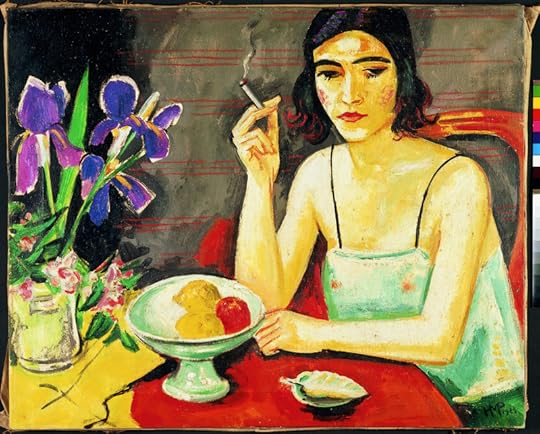
Max Pechstein, 1925

One might think that a young girl whose ambition is

Ich will so ein Glanz werden, der oben ist. Mit weißem Auto und Badewasser, das nach Parfüm riecht, und alles wie Paris. Und die Leute achten mich hoch, weil ich ein Glanz bin.

[I want to be such a shine, way above. With white car and bath water that smells like perfume and everything like Paris. And the people respect me because I'm a shine.]

might be of rather limited interest, but not only is Doris' simultaneous naiveté and shrewdness completely convincing, as is her mixture of vulnerability and resolve; her courageous and desperate efforts to flourish in a world designed to keep persons of her gender and class on the street corners or in the factories very engaging; and her matter-of-fact attitude towards sex, shorn of all moralistic and romantic idealizations, quite unexpected in a text from the 1930's; but the entire text is told in Doris' voice, and her clumsy and colorful German, oftentimes becoming quite telegraphic, is a remarkable spice in a book already full of strong flavors. As Doris scrambles and slips time and again on the nearly vertical walls erected by the patriarchy, the monied and the educated, one realizes how subliminally critical Das kunstseidene Mädchen actually is.

Despite Graham Greene's now laughable assertion that "In five years’ time it will be unreadable," Das kunstseidene Mädchen is being read again,(**) and it is good enough that I've moved two of her other books close to the top of my TBR pile.


() When I wrote about Erich Maria Remarque's Der schwarze Obelisk.

(*) Remarkably, after her untimely death was prematurely reported in the European press, Keun returned to Germany with false papers in 1940 and lived quietly with her mother in Cologne until the end of the war!

(**) Keun's collected works have been recently published in Germany, but Keun wasn't rediscovered until the late 1970's, too late to be of much use to her personally. Her last decades were spent in financial desperation, alcoholism and, for a time, in a psychiatric institute.
Profile Image for Peter.
398 reviews234 followers
February 17, 2023
Doris ist dumm, das heißt sie kommt aus, wie wir heute sagen würden, bildungsfernen Schichten einer Provinzstadt. Sie weiß das, aber sie ist jung, mutig, nicht auf den Mund gefallen und sieht leidlich gut aus. Sie will auch Teil habe an der Glimmerwelt der Schönen und Reichen, sie will ein Glanz werden. Dazu scheut sie auch vor Diebstahl (ein Fuchsmantel) und Verleumdung (der Theaterdirektor sei ihr Liebhaber) zurück. Sie sonnt sich in diesem Rampenlicht wohl wissend, dass ihr Lügengebäude bald zusammenbricht. Als es soweit ist. flüchtet sie sich in die Hauptstadt.

Da ihre Fähigkeiten nicht einmal zur Stenotypistin reichen, stürzt sie sich in die (Halb)Welt der Tanzcafés und Nachtbars. Kurzzeitig hat sie Teil am Luxus als Geliebte eines Großindustriellen Wieder in eine Hinterhofwohnung zurückgekehrt kümmert sie sich eine Zeit lang um ihren blinden Nachbarn und verspürt die Freude der Nächstenliebe. Als sie auch diese Bleibe verliert, steht sie kurz davor sich zu prostituieren. Ein einfacher Angestellter liest sie auf, und zwischen den beiden entwickelt sich so etwas wie eine Liebesbeziehung und Lebensgemeinschaft. Doch auch diese scheitert, und Doris ist wieder ganz unten. Wird sie die Kraft haben sich noch einmal aufzurappeln?

Beim Hören dieses Romans kamen mir zwei andere Schriftstellerinnen in den Sinn: Françoise Sagan und ihr Erstling "Bonjour Tristesse", in dem sie ähnlich autobiographisch und offenherzig einige Monate im Leben einer jungen Frau beschreibt und Mascha Kaleko, deren Gedichte eine ähnliche, wenn auch mehr kleinbürgerliche Atmosphäre im Berlin der Zwischenkriegsjahre beschreiben.

Glücklicherweise habe ich mich für das congenial von Fritzi Haberlandt eingelesene Hörbuch entschieden. Anderenfalls wäre mir vermutlich - wie anderen Mitgliedern meiner Lesegruppe - die Mischung aus Proleten- und 20er-Jahre-Jugendsprache des Romans auf die Nerven gegangen. So aber war es ein unterhaltendes und bereicherndes Stück Literatur.

Profile Image for Classic reverie.
1,847 reviews
June 18, 2018
Why I decided on Irmgard Keun's The Artificial Silk Girl for my next reading is because when reading Bobby Underwood's "I Died Twice"; he had mentioned a book "After Midnight" by Martha Albrand which I looked up and came across Irmgard Keun's book by the same title. I decided to read her first novel but read the second one thinking it was her first. I find it extremely fascinating reading books from the past especially during certain times in history. In this book written in 1932 which is fiction yet it is not; because Irmgard Keun describes to us Germany through Doris' eyes. This is not a political book but it has politics noted because really life has a tinge of politics everywhere.
The forward quote below basically says this.

"While there can be no doubt about Keun’s anti-Nazi sentiment, her “artificial silk girl” doesn’t really have any political convictions. In fact, she is completely clueless when it comes to politics, and therefore a perfect example for so many Germans of that time who realized what they had gotten caught up in only when it was too late to do much about it. In that sense, The Artificial Silk Girl can be read as an historical document, an entertaining and disturbing account of what it was like to be a young woman in Berlin as the Golden Twenties were drawing to a close. "

The translator's note in this edition I must disagree with something she stated about "Doris features a predecessor of Bridget Joneses, the Carrie Bradshaws, and the shopaholic Rebecca Bloomwoods of our day." First of all Doris' circumstances are dire as many during that time post world war 1 in Germany. Yes, the modern times of today with regard to sex are so whatever you want. I will not get into my thoughts on modern times regards to this but Doris was not just looking for fun with men but looking to obtain things that she needed. She was not the so called "material girl" or "bystander" as the translator noted. Yes, Doris wants to have a watch or have some nice clothes to wear and how to get them but through the men she meets. She does not seem just any man but takes what she can. She works but the income is small and certain amount must go to her parents. She uses sex to obtain things and fun is not the factor. She is not living the high life but trying to survive with some respect. I think this story is more akin to Ayn Rand's "We the Living". Even though the countries are different, poverty and many circumstances are similar but the ending in Keun's has hope.

Doris sees prostitutes and thinks how terrible that situation is but what she does could be counted as such. Yes, she gets to chose but she is still selling herself. I suppose she needs to think there is a difference because otherwise she would think she is sinking deeper into loss of self respect.

"And yesterday I was with a man who came on to me and took me for something that I’m not — that I’m not, even now. But there are whores standing around everywhere at night — so many of them around the Alex, so many, along the Kurfürstendamm and Joachimsthaler Strasse and at the Friedrichstrasse Station and everywhere. And they don’t always look the part at all either, they walk in such a hesitant way. It’s not always the face that makes a whore — I am looking into my mirror — it’s the way they walk, as if their heart had gone to sleep."

This story is told by Doris who writes all that happens to her in this book and even though she does not want to show her inner feelings like a diary would, she shows use glimpses of herself. Her writing is stream of consciousness which goes off into another subject but returns to her main story. I found it quite interesting but with a sadness that almost every word emits and I feel it too!

Her friendship with the neighbor who was blinded during world war 1 told us about the differences from someone that lived before the war and someone born during and after. She told him what she saw in Germany and after taking him to many places and describing, he does not see as she does in excitement but a gloomy depressing time. She knows only this and after his reaction she starts to see a little differently.

“The city isn’t good and the city isn’t happy and the city is sick,” he says — “but you are good and I thank you for that.” I don’t want him to thank me. I just want him to like my Berlin. And now everything looks so different to me —"

The story- we follow Doris and all that happens to her before she leaves Cologne and after she arrives in Berlin. We get to see Berlin and the people through her eyes and the disappointments and her change of attitude from all that happens to her.
Profile Image for Jess.
381 reviews406 followers
August 25, 2020
'He was tall and slender. And he had a dark face like a powerful fairy tale.'

The Artificial Silk Girl exists awkwardly between exquisite stream of consciousness with evocative images that transcend the language barrier, and clunky idioms and demi-monde jargon that have been distorted by translation.

Please, please ignore the marketing slogan ‘Before there was Bridget Jones or Sex in the City or Girls, there was The Artificial Silk Girl’. To say this is to affiliate a devastating tale of poverty and dashed hopes with the trivial documentation of the mating habits of middle class women. Doris is disillusioned and shallow, granted - she blackmails her boss to follow the specious attraction of Berlin, convinced she can make it big at Ufa and happily using her erotic services to get there. She aims to seduce influential men to work her way into the privileged social scene. She’s different from the censured prostitutes that patrol the Friedrichstrasse. But as she gets more desperate, the lines begin to blur. She ends up sleeping rough in a wintry Tiergarten, on the brink of being forced into prostitution. But she’s snappy, observant and can prove compassionate in the most unlikely times.

Doris admits that she has no interest in politics. Fair enough. Her focus is the cinematic glamour of Weimar Germany - perhaps she is a forerunner to Isherwood’s Sally Bowles in that sense. But unlike The Berlin Novels, Keun provides very little by way of political insight or engagement, something which may prove frustrating for a modern reader with the benefit of hindsight. She pays no attention to the rise of right wing extremists, or the consequences of the Depression. She does however capture a feverish, materialistic world on the brink of ruin, dreaming of a life far more liberated than her scorned ‘hausfrau’ mother - and ultimately fails to attain it. One cannot help but ache for Doris and her mislaid plans, her hunger and her poverty. In a way, she speaks for many like minded women, craving emancipation and determined to improve their lives in the Golden Twenties, many of whom failed to do so. The Artificial Silk Girl is a heartbreaking depiction of a young woman (Doris is only eighteen, for God’s sake) chasing a rainbow.

Unsurprisingly, the Nazis were not amused by Keun’s vision of Weimar Germany, and so blacklisted her work. She actually tried to sue the Gestapo for loss of earnings - brilliant, eh?!

I’m sad to say that some of the novel's authority and power was lost in translation. But that does not go to say that the novel does not emanate the crippling disappointment of so many young women, a lament for lost opportunities and a bygone era.
Profile Image for Kansas.
813 reviews486 followers
May 18, 2025
https://kansasbooks.blogspot.com/2025...

“Pienso que es bueno escribirlo todo, porque soy extraordinaria. No me refiero a un diario, eso es ridículo para una chica de dieciocho años y además de mi nivel. Pero deseo escribir como si todo fuera una película porque mi vida es eso y lo será todavía más. Más tarde cuando lo lea, todo será como en el cine, me veré en imágenes.
(…)
Me he comprado un grueso cuaderno negro y he pegado en la tapa palomas blancas recortadas. Me gustaría comenzar así: Me llamo Doris, bautizada y nacida cristiana. Corre el año 1931. Mañana continuaré.”


Ya cuando leí Después de medianoche de esta autora me quedó claro que lo más relevante de su novela había sido la mirada en primera persona de la protagonista, no solo sobre la naturaleza humana, sino sobre el contexto en el que se encontraba Alemania en pleno 1935. Una mirada de una muchacha que todavía no había cumplido los veinte años y que sin embargo ya era capaz de ver más allá de las apariencias. La chica de seda artificial es una novela anterior, la segunda de la autora, publicada en 1932, en plena República de Weimar y aquí la mirada hay momentos en que casi me parece documental. Mientras la leía me vino a la mente "Gente en domingo" (una conexión, un flash repentino) de Siodmak y Ulmer, esa luminosa película muda que capturaba tan bien la visíon del Berlin de la era de Weimar, sobre todo porque en esta película de 1930 había una particular y adelantada fusión entre documental y ficción, gente joven en un domingo conociéndose, enamorándose, teniendo relaciones sexuales y sobre todo era una película que capturaba tan bien la atmósfera de las calles, el bullicio, la gente. Ya digo que fue una película adelantada por esa factura documental. La comparo a lo que hace aquí Irmgard Keun no solo porque están reflejando la misma época, sino porque la voz en primera persona de Doris, la protagonista femenina parece en un momento dado salida de esta película, y nosotros, los lectores, convertidos en esa cámara en mano que la sigue por las calles berlinesas. Por la película que es de 1930 y revisitada parece no haber pasado el tiempo por lo fresca, y por esta novela, ambientada entre 1931/32 tampoco, en ningún momento parece anticuada esto es gracias a la voz de Doris, que pasará por penalidades aunque para nada la convierten en una novela dramática ni oscura, sino más bien tragicómica con una jovencita pateándose las calles, callejeando y viendo más allá gracias a su ingenio lingüístico. Y aunque es una novela nada política, los nacionalsocialistas la banearon, la colocaron en su lista de libros prohibidos, no solo porque la imagen de la protagonista no se correspondía con la imagen ideal de mujer alemana que ellos esperaban, sino también intuyo, porque Irmgard Keun, desenmascaraba comportamientos que años después empezaron a ser tan evidentes que llevaron a Alemania y Europa casi a la autodestrucción. “Dice que hoy en día todo se rompe y se destruye, y cualquiera que sea sincero admitirá que se encuentra desorientado, y que una persona, por muy culta que sea, no puede hacer nada, pues todo está en el aire. Añade que el mundo entero es inseguro y la vida y el futuro y las antiguas convicciones y las actuales, y que el trabajo ya no produce verdadera alegría, porque uno siempre siente mala conciencia por la gran cantidad de desempleados que hay.”


“Amo Berlin, pero me tiemblan las rodillas y no sé si comeré mañana. Pero me da igual. Todo el mundo lee periódicos, incluso extranjeros, con importantes titulares, pero parecen tranquilos, allí sentados, como si todo les perteneciera, porque pueden pagarlo. Hoy yo también.“


“Hay que esforzarse tanto para ser una estrella. El esfuerzo es terrible y por todas partes se ven mujeres con cara de fatiga. No obstante es buena cosa ser desgraciada, porque cuando eres feliz no progresas." Doris es una jovencita de dieciocho que vive en la pobreza con sus padres en un pueblo de Renania y su trabajo como taquígrafa no es capaz de llenar su vacío ya que desea convertirse en actriz. La novela está contada en primera persona en la que ella misma comenta que es demasiado joven para escribir un diario, que no tiene sentido pero sí que tiene un afán por mejorar, por salir de la vida de pobreza, y casi que ve la vida como un gran plató en el que ella acabará triunfando como actriz. Doris es lo suficientemente espabilada para saber que no tiene formación y que la única forma que tendrá de alcanzar la fama será a través de los hombres “Si una quiere tener suerte con los hombres, es preciso hacerse la tonta”. A partir de aquí, Irmgard Keun nos embarcará en la aventura de Doris por conocer el mundo, un mundo que se circunscribe a una Alemania en la que el nacionalsocialismo empezaba a causar estragos, aunque claro, Doris lo irá percibiendo a través de una mirada primero inocente, y más tarde, mucho más consciente. El talento de esta autora convierte una novela aparentemente costumbrista en un híbrido en la que se combinan diferentes factores: por un lado es literatura totalmente contemporánea donde Doris en primera persona expone el contexto social en el que vive; por otra parte, se convierte en la novela sobre una ciudad, Berlin, y es aquí dónde entra ese tono documental que tanto me recordó a Gente en Domingo; una ciudad emocionante, bulliciosa, llena de locales nocturnos a pesar de que la economía estaba en ruinas, y finalmente esta será una novela muy feminista, con un tono reivindicativo en la voz en primera persona de Doris, en la que espera de la vida algo más que subsistir de los hombres: “Cuando una mujer joven con dinero se casa con un hombre viejo por dinero y solo por dinero, y hace el amor con él durante horas y tiene cara de mojigata, es una genuina madre alemana y una mujer decente. Cuando una mujer joven y sin dinero se acuesta con un tipo sin dinero porque tiene la piel suave y le gusta, es una puta y una guarra.” Es una voz poderosa la de Doris, porque en su deambular encontrándose con muchos personajes, la situación de la mujer es casi siempre muy precaria dado que llas se verán abocadas a la prostitución y a malvivir. Doris es ingenua y astuta al mismo tiempo y siempre insistirá en ser respetada. El sueño de una vida de glamour pronto se irá a pique y tendrá que luchar por subsistir pero sin dejar de ser ella misma, reconociendo la hipocresía burguesa, la doble moral masculina y el segundo plano en el que se veía la mujer, en la que si era rubia (aunque fuera teñida) de alguna forma prometía la pureza de la raza.


“Y el gran empresario me pregunta si yo también soy judía. Por todos los santos claro que no lo soy. Sin embargo pensé: Si es lo que le apetece por qué no…
- Por supuesto, respondo, - La semana pasada sin ir más lejos mi padre se torció el pie en la sinagoga.
Y él se vuelve gélido conmigo y resultó ser un nazi ario, la raza es un problema, y a continuación se tornó hostil. Todo esto es muy complicado. Lo había hecho justo al revés. Pero me pareció muy estúpido volverme atrás y además un hombre debería saber antes si una mujer le gusta o no. Primero se deshacen en cumplidos y se emocionan contigo y qué sé yo qué cosas más. Pero si de pronto dices: ¡Soy morena!, abren la boca de par en par: Vaya, así que eres morena...Puaj, no lo sabía. Y sin embargo, sigues siendo la misma que antes, pero una palabra parece haberte transformado”.


La mirada de Irmgard Keun hace desfilar por la novela la representación social de los hombres de la era Weimar, desde los de clase media alta pasando por los proxenetas, funcionarios, productores de compañías teatrales, empleados de oficina, aquellos que sufrieron las consecuencias de la Primera Guerra Mundial quedando inválidos e incluso pasando por los escritores que ya no tenían nada que hacer en este nacionalsocialismo emergente, al mismo tiempo que saca a relucir a nazis, comunistas, socialistas y descreidos. Así que a través de esta representación social Irmgard Keun está describiendo el estado de Alemania, el antisemitismo, las tensiones sociales y la polarización política, todo esto a través de los hombres que Doris irá conociendo, donde además hará hincapie casi continuamente en el estado de vulnerabilidad constante en el que se encontraban las mujeres:


“En cierta ocasión le pregunté a mi madre por qué siendo una mujer de bandera se casó con un don nadie, y en en lugar de soltarme un bofetón se limitó a contestar: -A alguien hay que pertenecer.- A pesar de que lo dijo muy tranquila, estuve a punto de echarme a llorar, no sé por qué, pero lo entendí.”


Irmgard Keun creó en Doris un personaje complejo porque su aparente ingenuidad y viveza esconde algo más, un poso de tristeza por verse limitada por su falta de educación. Desde el primer momento es consciente de que su astucia natural no se puede comparar a tener una verdadera educación que podría alejarla de tener que depender económicamente de los hombres. La novela que utiliza un lenguaje muy vivo, casi en ningún momento decae por esas impresiones en primera persona de una chica que está descubriendo la vida y que en su recorrido va siendo cada vez más consciente de que sus sueños no dejan de ser artificio en una Alemania que caía en picado. Todos los personajes parecen estar desesperados por salir de ese agujero negro en que se estaba convirtiendo su país y el camino de Doris es de alguna forma un viaje hacia el autodescubrimiento, y de eso sabía mucho Irmgard Keun, solo hay que bucear un poco en su biografía.


“Durante un breve instante me vi envuelta en una nube de tristeza, porque en mi vida hay continuamente cosas que ignoro y siempre tengo que comportarme como si las supiera y a veces me canso de tanto atender, y siempre me averguenzo cuando me topo con palabras y cosas que desconozco, y la gente nunca es buena como para atreverme a decirles: Ya sé que soy tonta, pero tengo memoria, si me explican, me esfuerzo por retenerlo.
(…)
Padre nuestro, haz además un milagro y dame una buena educación. Lo demás puedo conseguirlo sola con un poco de maquillaje.”


♫♫♫ Nothing is real but the girl - Blondie ♫♫♫

description
description
description
Menschen am Sonntag (People on sunday), 1930, Robert Siodmak / EdgarUlmer
Profile Image for Kathleen.
Author 1 book264 followers
March 2, 2021
“Berlin descended on me like a comforter with a flaming floral design.”

It’s hard to explain what I loved so much about this, but I think it’s that it’s driven by the narrator’s most distinct descriptions: of a city, of loneliness, of sexual desire, of a woman looking at her future and wanting to control it.

It’s written as a diary, and that structure can get a little old, but whenever my interest started to dip, along came a stunning line to draw me back in.

“The air felt like a round dumpling and you couldn’t swallow it.”

It’s Germany in the early 1930’s, before the Nazis rose to power. Doris is young, but wise for her age. She comes from Cologne, where the women in her life are mostly miserable; where she learned she can get out of re-typing legal manuscripts if she just gave her lawyer bosses her “Marlene Dietrich face;” where she discovered she wanted to be an actress; where she fell in love with a fur coat, a coat that matched her vision of herself. This is the story of how she set out for Berlin to make that vision a reality.

“There is a subway; it’s like an illuminated coffin on skis …”

I haven’t read Isherwood’s Goodbye to Berlin yet, but Cabaret is one of my favorite films. I also love Breakfast at Tiffany's, the film and the Truman Capote story. Doris could be compared to both Sally Bowles and Holly Golightly, and this book has a breezy melancholy similar to those stories. Doris wants to be a star like Sally, and to live the good life like Holly, but Doris gives us her cinematic view of the world in this novel, a view she records in her diary, the little black notebook she covered with cut-out white birds, and in which she relays the highlights of her ups and downs as she searches for a way to create the life she deserves.

“… the music is covered with flowers like a chiffon dress which tears very easily …”

With Doris, we have a very strong female viewpoint. She tells us what it’s like to be young and full of hope, to be lonely, to have no good options, to make the best of the options you have. She is very articulate about the men in her life--the ones that are attractive to her and the ones that aren’t, and how one can turn into the other. A practical but touchingly generous soul lives in Doris’s ambitious body.

“And she smiles at her man like a stone in a graveyard that’s been hit by a ray of sun.”

I’m so happy to have read this unique little gem.
Profile Image for Nigeyb.
1,475 reviews404 followers
February 23, 2021
Irmgard Keun was born in Berlin in 1905 and her first three novels (Gilgi, One of Us (1931), The Artificial Silk Girl (1933) and After Midnight (1937)) shone a light on a new generation of ordinary young women in 1920s and 1930s Germany who, along with the majority, had been crushed by the financial collapse of Weimar Germany.

Doris, the narrator of The Artificial Silk Girl, is ambitious, somewhat naive, shrewd, dishonest, possibly with mental health issues, and keen to improve her prospects by using her looks and the stupidity of the men she meets. She is the quintessential material girl. Maximum gain for minimal effort.

"I want to be at the top. With a white car and a bubble bath that smells of perfume, and everything just like in Paris"

Irmgard Keun took inspiration from Anita Loos's Gentlemen Prefer Blondes and the debt is very obvious to anyone who has read both books.

The narrative is written like a journal, albeit one without timescales and written in a stream of consciousness manner. It variously consists of her desperate attempts to become a theatrical star and/or find a suitable man to give her money and gifts.

I had high hopes for The Artificial Silk Girl as I am fascinated by Berlin and Weimar Germany and, whilst it was interesting to read about experiences from a young woman's perspective some of which were presumably based on Irmgard Keun's own life, I was often confused and even bored by the style, and the repetitive nature of the plot.

The Artificial Silk Girl was a bestseller and it's easy to see why given its frank and open discussion of female sexuality. It was predictably later banned by the Nazis.

3/5


In 1931, a young woman writer living in Germany was inspired by Anita Loos's Gentlemen Prefer Blondes to describe pre-war Berlin and the age of cinematic glamour through the eyes of a woman. The resulting novel, The Artificial Silk Girl, became an acclaimed bestseller and a masterwork of German literature, in the tradition of Christopher Isherwood's 'Berlin Stories' and Bertolt Brecht's 'Three Penny Opera'. Like Isherwood and Brecht, Keun revealed the dark underside of Berlin's "golden twenties" with empathy and honesty.

Unfortunately, a Nazi censorship board banned Keun's work in 1933, and destroyed all existing copies of The Artificial Silk Girl. Only one English translation was ever published, in Great Britain, before the book disappeared in the chaos of the ensuing war. Today, more than seven decades later, the story of this quintessential "material girl" remains as relevant as ever, as an accessible new translation brings this lost classic to light once more.
Profile Image for Wal.li.
2,545 reviews68 followers
July 27, 2025
Eigene Vorstellungen

Im Jahr 1930 könnte die achtzehnjährige Doris froh sein, einen Job als Sekretärin zu haben. Doch ihr Chef ist manchmal übergriffig und sie mag ihn eh nicht. Doris hat andere Träume. Sie möchte ein mondänes Leben führen, am besten als Schauspielerin oder Künstlerin oder so. Und das Tüpfelchen auf dem I wäre Berlin. Berlin, die Stadt, in der alles möglich ist. Doris schafft es dorthin, auch wenn es eine Art Flucht ist. Und sie versucht es, ihr Ziel zu erreichen. Am Rande der erhofften Kreise treibt sie durch die Stadt. Mal ist ihr ein kurzes Glück vergönnt, doch meist bleibt sie zurück.

Der Roman ist in der Zeit angesiedelt, in der die Autorin ihn geschrieben hat. Dadurch ist er zeitgeschichtlich sehr aktuell. Doris ist ein modernes Mädchen, das sich die Freiheiten, die ihr zustehen, auch nimmt. Noch kann sie ihr Leben so führen. Manchmal ist sie ein wenig altklug, aber sie erweckt den Eindruck, dass sie das Leben grundsätzlich und die Männer im Besonderen weitgehend durchschaut. Trotzdem sucht sie nach dem Glück, von dem sie anfangs nicht mal weiß, dass es doch auch konventionell sein könnte. Ihre Suche ist von kurzen Erfolgen gekrönt, aber eine gesicherte Stellung kann sie sich nicht verschaffen.

Es gibt ja immer mal so Listen von den besten Büchern, die man mit Neugier liest, um wie wenige man davon gelesen hat. Natürlich hat man etwas anderes erwartet. Aber so kann die Gelegenheit genutzt werden, den Horizont zu erweitern. Es stöhnt die Wunschliste und es freut sich die Bücherei, die in Sachen ewige Bestenlisten zum Glück gut sortiert ist. Und so lernt man Doris kennen, die aus heutiger Sicht betrachtet überraschend modern und abgeklärt ist mit ihren Achtzen Jahren. Manchmal wirken ihre Gedanken ein wenig verworren, doch meist bringt sie einen zum Schmunzeln oder sie berührt einen. Wie lange mag das noch gutgehen, mag man sich fragen. Man erfährt es nicht. Man erfährt, das Doris zu echter Größe fähig ist. Und wenn auch nur in Nebensätzen spürt man, dass das Leben als moderne Frau so in dieser Zeit nicht mehr lange weitergehen wird. Auch damals schlugen die alten weißen Männer zurück. Die Welt wird wohl niemals lernen. Eine sehr gute Empfehlung der Bestenliste.
Profile Image for Leah Mayes.
11 reviews8 followers
September 11, 2011
Why is this hailed as a window to pre-Nazi Berlin when the narrator's observations are not especially insightful, about her environs or about the times in general? Why is this hailed as feminist literature when Doris defines herself in terms of how desirable she is to men and chooses to remain blithely ignorant of the world around her unless it involves increasing her desirability and odds of finding a man to take care of her? There is validity in the comparisons to "Sex and the City" and "Bridget Jones's Diary" and in deeming Doris "the original material girl," but that's not necessarily a good thing, and it certainly doesn't make for an interesting novel. Doris is a shallow, judgmental, petty girl whose ambition is to become famous and wear fabulous clothing and be surrounded by the best of all consumer goods despite lacking the intelligence, skills, or work ethic that would merit such rewards on her own. She is not particularly clever or witty. She is proud of the fact that she lacks interest in politics or social affairs but is crafty and manipulative and tends to land on her feet because she knows how to stretch the truth (or lie) to get what she wants and is attractive enough to appeal to men's baser instincts. Her downward spiral is the result of the theft of a fur coat, and hanging on to that stolen coat is the primary motivation for a series of bad decisions she makes. I don't find that a particularly sympathetic plight.

I have no problem with stream of consciousness or faked memoirs that ramble and give half-thoughts in an attempt to seem realistic, but the writing is often incoherent and confusing. This edition is riddled with disgraceful typos that render things even more tricky to follow. (There are a lot of opening quotation marks with no closing quotation marks, so it is difficult to know when there has been a change in the speaker of dialogue.) I'm not sorry I read the book, but I can't say I enjoyed it. I am relieved, though, that it was a fast read and that I had checked it out from the library rather than purchased it.
Profile Image for Alwynne.
940 reviews1,596 followers
November 12, 2020
Like her debut Gilgi Irmgard Keun’s bestselling, 1932 novel focuses on the so-called ‘new woman’; young women who entered Germany’s job market in large numbers after WW1. The superficial image of the ‘new woman’ was that of an hedonistic, party girl, rather like Lulu in Pabst’s Pandora’s Box. But Pabst’s film's essentially a morality tale and very much a male perspective on women; Lulu’s harshly punished for her 'transgressions', her sexual freedom’s represented as a threat to society which must be suppressed, ultimately bringing about her downfall. Keun’s women also suffer but their difficulties aren't the outcome of their individual failings but the limited options available to them in the restrictive social, and faltering economic, environment of Weimar Germany in its final years.

The heroine of The Artificial Silk Girl is Doris and the novel's an account of her everyday life; she starts out as an office worker in Cologne, dodging her harassing boss, flirting in cafes and dreaming of a glamorous future as a movie star. On the surface Doris is a nonchalant, fashion-obsessed young woman who’s out for what she can get from her many male admirers but her air of would-be sophistication and feigned indifference to the world are quickly revealed to be a façade; jilted by her first love for a chaste heiress, she’s learnt that romantic love is not to be trusted, and that where sex is concerned double standards abound,

“So he gets all red in his face and embarrassed, and that already gets me up in arms, ‘When a man marries he wants a virgin, and I hope, my little Doris…’ and he was talking as if he had licked out an entire can of cold cream: ‘My dear child,’ he said, ‘I hope you’ll become a decent girl, and as a man, I can only advise you not to sleep with a man until you’re married to him…"

I have no idea what else it was he wanted to say, because something came over me as he was blowing himself up, so impressed with himself, with his chest pushed out, and his shoulders pulled back, like a general talking from the pulpit. To tell me that! To me who had seen him in his underwear and less almost 300 times – with his freckled belly and his hairy bow legs. At least he could have told me as a good friend that he wanted money, and that’s why he didn’t want me. But to wallow in his own morality, not because I’m too poor but because I’m not decent enough…”

Doris moves to Berlin to pursue her ambitions but her already precarious existence becomes even more so, as she sinks lower and lower.

Penguin’s marketing for their edition of Keun’s novel is highly misleading, pitching it as a forerunner to Bridget Jones’ Diary and Sex and the City; unlike those conservative, consumerist tracts this is a far more political, deeply feminist work, it’s not surprising that her writing was banned by the National Socialists, and most copies of her work destroyed. Previous comparisons to Jean Rhys are more apt here, Doris reminded me of any one of Rhys’s heroines living out their days in rented rooms, eking out their dwindling resources, although, like Gigli before her, Doris strives against lapsing into fatalism; like Lorelei in Loos's Gentlemen Prefer Blondes Doris lives by her wits, and her blunt, uninhibited observations are often wryly amusing.

This is an absorbing story, surprisingly frank in its recognition of female ambition and sexual desire; a sometimes unnerving, and often moving, depiction of women’s struggle against misogyny and their limited choices in a particular historical moment.
Profile Image for Kim.
426 reviews540 followers
July 5, 2013

I first encountered Irmgard Keun when I read After Midnight, her critique of Nazi Germany expressed in the first person narrative of Sanna, a young German woman who doesn't overtly criticise the Nazis at all. In this, Keun's first novel, the protagonist is Doris, another naïve young German woman. First published in 1931, Keun wrote the novel with the idea that it would be a German version of the hugely successful Gentlemen Prefer Blondes. The novel is mostly set in Berlin in the late 1920s, where working class Doris heads from her hometown after she steals a fur coat. Doris longs for love, fame and fortune - preferably as a movie star - and tells the story of her life in Berlin in the first person. Less a journal and more a series of almost stream of consciousness scenes from her life, Doris goes from one sexual relationship to another in an effort to survive and to succeed.

The work provides an interesting insight into the glitziness and superficiality of Berlin in the late 1920s. Doris is an endearing character, who retains vulnerability and compassion despite the desperate circumstances in which she lives. It's particularly poignant to read about Doris knowing what was to come for people like her and those she cared about in a few short years. And knowing that Keun's work went on to be banned by the Nazis, it's instructive to read something she wrote both before they came to power. However, for all of the strengths of the work and its inherent interest as a historical artifact, I didn't connect with Doris as I did with Sanna in After Midnight and her plight didn't move me as much as I wanted it to. Neither Doris nor the glimpses of Berlin in the 1920s she gave me were enough to keep me really engaged. That said, I still want to read some more of Keun's work.
Profile Image for Anina e gambette di pollo.
78 reviews33 followers
January 20, 2018
Giretto in libreria, è lunedì, pioviggina, ma la poltroncina è comoda e mi faccio quattro chiacchiere con la signora.
Entra un signore brevilineo sui cinquanta con telefono all’orecchio.
Prende un libro al volo, lo posa sul banco davanti alla signora, mette la mano (ha solo una mano in uso) in tasca, tira fuori 20 euro (preciso preciso il costo del libro) e mette pure quelli sul banco.
La signora batte, scarica, infila il libro in una busta non biodegradabile e la porge all’uomo che la prende e se ne va. Ovviamente senza perdere né linea né battuta.

Anche in questo romanzo ci sono molti uomini i cui rapporti umani sono simili a quello instaurato dal brevilineo.

Secondo ritratto femminile dopo Gilgi.
Anche questa è una ragazzina nel Berlino del 1932, ma non ha molti sogni. Vive le giornate e le nottate che si susseguono uguali e diverse. Doris è come il tessuto a cui si deve adeguare chi non ha molti mezzi e che è destinato a stropicciarsi, al contrario della vera seta.
Chissà se Capote lesse questo romanzo, perché Doris ricorda un poco Holly Golightly. Una Holly europea in una città che all’epoca brillava della luce smagliante di una stella morente, prima che venga il buio.
Il racconto è in prima persona e la scrittura è ancora più interessante dell’altro romanzo. Un tono leggero sempre in bilico tra commedia e dramma, con belle immagini e piccoli commenti fulminanti. Tra incontri occasionali, brevi miserie, rapporti senza sorprese e insospettabili relazioni passa una giovinezza che sembra non sgualcirsi e della quale non sapremo il futuro.
Tiffany? Qui non c’è, ma c’è il suo pellicciotto adorato, morbido rifugio nel freddo della città.

16.01.2018
Profile Image for Stephen Durrant.
674 reviews170 followers
December 1, 2017
I only recently came across this book when I became aware that an acquaintance of mine required it for a class he teaches on the Weimar Republic. It is a remarkable book. The narrator, Doris, is a working class girl and a bit of a ditz who narrates her story and describes her surroundings in a way that appears shallow and laughable even as it reveals both insight and folksy wisdom. Doris has stolen a fur coat and finds herself alone in Berlin just trying to get by. That means that she mostly mooches off men, whom see invariably sees through: “If you want to strike it lucky with men, you have to let them think you’re stupid” (60). Through Doris’s camera-like observations, we begin to get a picture of the decadent, sometimes cruel society around her and even glimpse the political currents swirling about, currents that leave Doris for the most part baffled. For example, a man asks Doris if she is a Jew, and thinking he hopes for a positive response, she says, “Yes.” He then drops her, which leaves her entirely baffled: “After all, a man should know in advance whether he likes a woman or not. So stupid! At first they pay you all sorts of compliments and are drooling all over you—then you tell them: I’m a chestnut!—and their chin drops: oh, you’re a chestnut—yuk, I had no idea. And you are exactly the way you were before, but just one word has supposedly changed you” (38). The German novelist Irmgard Keun was a major talent. It’s too bad she is not better known.
Profile Image for Kathrin Passig.
Author 51 books475 followers
May 18, 2019
Es fing sehr gut an und war am Ende etwas lahmer, aber immer noch sehr okay. Eichhörnchen kamen vor. Und wie oft passiert es in der Literatur, dass eine junge und vergnügungswillige Frau mit vielen Männern ins Bett geht, OHNE schwanger zu werden? In "Goodbye, Berlin" jedenfalls schon mal nicht.
Profile Image for Tosh.
Author 14 books776 followers
May 29, 2019
Looking for something to read for a long plane trip, I picked up this book not knowing the author, nor did I know the novel. "The Artificial Silk Girl" is a remarkable book on being a woman and in Berlin during the early 1930s. Irmgard Keun has wit and incredible eye on the life of that city.
Profile Image for Evan.
1,086 reviews903 followers
July 5, 2016
"Tilli says, 'Men are nothing but sensual and they only want one thing.' And I say: 'Tilli, sometimes women too are sensual and want only that one thing.'"

A soufflé with a dash of hard liquor at its center, The Artificial Silk Girl is a sly, charming surprise; an undeservedly obscure, lesser-carat literary gem that is nonetheless priceless as a vivid peek into the lives of bohemian poverty and amoral decadence in Germany on the cusp of Hitler's dark age.

The protagonist of this odyssey is an arresting young woman, Doris, who has stolen a mink coat and gone off to Berlin with a vague notion of somehow becoming a star. Doris is vivacious and slightly ditzy, street smart and vacuous, sensitive and callous, materialistic and altruistic, and who, in everything she does, drinks in life like champagne.

She is a survivor, readily aware of the power of her charms. Men can't keep their hands off her, yet she uses that power to her advantage. After losing a steady office job in a law firm for rebuffing an amorous boss (whom she consciously plays like a fiddle), she lands a short-lived job as an extra at a theater, where she applies a devilish sense of human psychology and office politics to hilariously wreak havoc before leaving town with the hot mink on her shoulders.

Once in Berlin, she spends the last of her funds and turns to prostitution for sustenance, straddling the worlds of wealth and want. Rather than mope about her condition, Doris keeps an upbeat, dreamy outlook; dazzled by the lights, sounds, movement and possibilities of Germany's manic capital city. Berlin, for her, is one big party, and her approach is one of joie de vivre. She is the original polyamorous woman, adopting a philosophy of tit for tat; everyone wants something, and everyone transacts.

It's this attitude -- along with some explicit criticisms of the German domestic social order and marriage -- that undoubtedly got this book banned by the Nazis and its author ostracized. In fear for her life, Irmgard Keun went into hiding in Germany and elsewhere in Europe for the entirety of the war to avoid punishment. Fortunately, she survived, but was thereafter unproductive, and, sadly, refused all attempts by biographers to chronicle her amazing life until she died in 1982.

The book's style is deceptively simple, and I think deceptively is the operative word. Keun actually shows great sophistication in creating her portrait of a seemingly simple character and her naive dreams. Doris relates her tale in the first-person, ostensibly as a diary but also as material for an imagined screenplay about her life, a screenplay that will be in demand, once she is famous, of course. Doris' tale is told with staccato breathlessness, wrought as real stream-of-consciousness thought and real-time conversation; including interrupted and resumed thoughts.

One of the weird criticisms I've read about the book is that Doris is too shallow, or that her concerns are too slight to be of use to those interested in feminism or early feminist lit. But Keun is obviously smarter than her lead character. It requires great skill to "write down" to capture the voice of a girl simpler than the writer. And the book includes plenty of explicit and implicit criticisms of the patriarchy and its oft-fascist tendencies, as well as power issues in male-female relationships. Even though Doris complains about being nonpolitical throughout the book, it's clear that her everyday observations reveal the state of things and the seeds of fascism all around. Of course, Keun and her character were not third-wave feminists; expecting them to be is anachronistic and unreasonable. But Doris does represent a form of fledgling liberation, outsmarting men within the context of her limited options.

In its tone and its more surface concerns, The Artificial Silk Girl has been compared, somewhat accurately, to Sex and the City (and Doris, to Capote's Holly Golightly or Isherwood's Sally Bowles). Doris is a gal who flaunts her style and uses her wiles to survive, while seeking some kind of love or attaining some kind of goal while engaged in the flow of life. Doris mixes lovely little insights between frets about how her shoes and attire match her skin tone and hair color.

The most amazing section of the book, for me, occurs about halfway through the story, when Doris comforts an upstairs neighbor, a blind war veteran who is confined to a wheelchair and mistreated by his wife for being useless. The section is remarkable for two reasons:

1.) Up to this point in the story, Doris has not described herself physically in any clear way, though we know she is pretty and irresistible. Keun's strategy for rectifying this is ingenious. Doris is attracted to the neighbor, Herr Brenner, and allows him to stroke her silky legs while his wife is away. At the same time, Brenner asks Doris to describe herself. She starts out with a clinical description, assuming the theoretical position of a medical doctor; then, as she writes and her voice becomes more her own, her description morphs without apparent consciousness back into the first-person "I". It's bloody marvelous.

2.) Captivated by Doris' tales, Herr Brenner goads her, for page after page, to keep describing what she has seen and done in Berlin. At this point, Keun's Doris is given free reign to dish out a vivid, breathless, impressionistic kaleidoscope of Berlin nightlife. It's a beautiful passage that one could read over and over.

The only thing in the book that rang false for me pertains to some aspects of the translation. To capture the original spirit of a book and put it into proper context, it seems most correct to me to find words that serve as rough equivalents to words that would have been used in translations that would have been made at the time of publication. There are some points in the book -- not many, but enough to give me pause -- where some of the original German words have been translated into English words or phrases that seem too contemporary. At one point, for instance, Doris refers to being drunk as being "hammered," a term I think is of fairly recent origin. It's not enough to dismiss the book by a long shot, but is something to consider. There is an earlier English translation out there, somewhere, but it is not available for me to make the comparison.

Although I really think this is, at best, a four-star book, I'm rating it higher because it is in many ways a rare bird -- its voice and style are highly individual -- and because I think almost anyone can enjoy and appreciate it. It deserves to have a wider readership.

(KevinR@Ky 2016)

(*Post-review addendum:
I'm re-reading the second half of the book, and perhaps feeling less indecisive; I'm inclined to give this an unqualified five-star review).

Profile Image for lise.charmel.
524 reviews194 followers
January 10, 2022
Questo romanzo racconta la storia di Doris, una giovane donna che cerca fortuna a Berlino tra il 1931 e il 1932. il suo unico capitale è il suo bell'aspetto, che lei cerca di mettere a frutto facendosi mantenere dagli uomini che incontra, ma le cose non vanno quasi mai bene. la miseria appare a ogni angolo, la disoccupazione, la fame, il degrado sono tutti elementi che non possono sfuggire al lettore. ciononostante lei non si abbatte e cerca ogni volta di risalire dal fondo. sembra un romanzo squallido, raccontato così, ma in realtà Doris è una ragazza brillante, piena di risorse e anche spiritosissima, in più di una volta mi ha fatto scoppiare in sonore risate.
grazie a L'Orma per aver recuperato le opere di questa pregevole scrittrice che rischiava di cadere nel dimenticatoio.
Profile Image for Ray.
698 reviews152 followers
November 20, 2020
I enjoyed reading this unsettling little book.

It tells the tale of a young girl in Berlin in Weimar Germany. She scrapes by, using her wits and her body to survive. Life for her is a relay race from brief encounter to brief encounter, hustling for food and a place to sleep. Exploited by men but also using them. She is clear that she is not a prostitute, as money is rarely involved, but in truth there is little difference - barter instead of banknotes. Her life is precarious and she fears dropping further into the void as her looks fade and her options narrow.

Desperately sad in places, the book is also rich with humour, and the heroine steadfastly refuses to give up. She sees her situation as a positive life choice, albeit one tinged with danger and worry.

I will look out for more books by this author
Profile Image for Claire Fuller.
Author 14 books2,499 followers
October 17, 2019
3.5 really. I really enjoyed the voice of the 18 year old narrator Doris, who is writing her 'book' - a journal where she puts down all the problems she has when she leaves her home town in Germany having stolen a fur coat, and goes to Berlin. She was witty and flighty and funny, and it was sad at times, but the story was very slight, and it was definitely long enough.
Profile Image for Marica.
411 reviews210 followers
November 14, 2022
Germania 1932
Irmgard Keun ha scritto un romanzo in perfetto accordo con lo spirito del tempo e quello che in un altro contesto poteva essere chick lit è invece un libro interessante. Il primo dopoguerra tedesco fu segnato da una grossa crisi economica e da un'elevata percentuale di disoccupazione, la gente non aveva di che vivere e quello che racimolava lo spendeva spesso per ubriacarsi. In questa atmosfera di insicurezza e spavento si fa strada il nazismo. La protagonista Doris viene appunto da una famiglia il cui padre è disoccupato e incalza moglie e figlia per avere i soldi da spendere in alcolici. Doris è una diciottenne carina che invece della dattilografa vorrebbe fare la stella dello spettacolo, così lascia la provincia e va a Berlino, avvolta in una pelliccia “presa in prestito”. Temeraria e spregiudicata, vive come può e scopre di avere un cuore quando le va in pezzi.
Il libro ebbe l'onore di essere considerato inopportuno dalla censura nazista, dato che le qualità di Doris erano più rivolte alla solidarietà fra gli sfortunati che alla moralità della fraulein dell'istituto della Propaganda e l'autrice finisce addirittura in prigione, dalla quale esce su cauzione ed poi espatria.
Lo stile è perfetto per quello che è il libro, il diario di una ragazzina, colloquiale, pieno di voli fantastici e cadute nella realtà deprimente. Non è un capolavoro della letteratura ma è interessante nel racconto in presa diretta della Germania anno 1932 e sincero nella rappresentazione della psicologia di Doris. E' un personaggio credibile, fatto di sogni, generosità, spirito di competizione, mezzucci, tentativi di autoinganno, incapacità di rivelare i propri sentimenti, sacrificio finale.
Profile Image for Kaya.
305 reviews70 followers
April 19, 2022
2 polyester stars…

This started off on such a high note for me.
Doris is an overly confident 18-year old with a hustle mentality around dating and a taste for the finer things in life. She’s witty and real, but these characteristics are overshadowed by her naiveté and failure to plan ahead. She steals a fur coat and runs away to Berlin. She wants to be a star but has no plan. She lusts for a plush life but doesn’t want to work or attach herself to anyone.

“I want to be at the top. With a white car and a bubble bath that smells of perfume, and everything just like in Paris.”

The Artificial Silk Girl was blacklisted by the Nazis in the early thirties and was rediscovered/reissued thanks to the German feminist movement in the late seventies. I thought this could be THE book - the one I markup, reread, travel with, gift to everyone, hunt down a first edition, the whole works. I loved this novel before I even read it, which only set me up for heartbreak.

WHY DO YOU BUILD ME UP, KEUN BABY, JUST TO LET ME DOWN.

I’m all for stream-of-consciousness narrative style but Doris’ ramblings are pedestrian and unvaried, and didn’t amount to much in the end. I was hoping for more character development and a deeper transformation. I wanted to reconnect with my younger self through Doris’ adventures, but the connection never came. It had its moments though and is very modern for a book published in the thirties.
Profile Image for Monica Carter.
75 reviews11 followers
June 8, 2011
Tilli says: "Men are nothing but sensual and they only want one thing." But I say: "Tilli, sometimes women too are sensual and want only one thing." And there's no difference. Because sometimes I only want to wake up with someone in the morning, all messed up from kissing and half dead and without any energy to think, but wonderfully tires and rested at the same time. But you don't have to give a hoot otherwise. And there's nothing wrong with it, because both have the same feeling and want the same thing from the other.


I hope I can express my fondness for this book so that people will actually go to find it at a bookstore or library, and read it. It was published in Germany in 1933. Shortly thereafter, the Nazis banned Keun's work and destroyed all remaining copies. Fortunately, a British translation survived and Other Press has chosen wisely chosen to republish it. After all, Keun was a contemporary of Alfred Doblin who encouraged her to write. Thus, we have a story of a young woman who moves from a small German town to Berlin to lake it as a an actress only to encounter homeless, poverty and bouts with prostitution. Now there's a summer read.

Translated to perfection by Kathie von Ankum, this is a novel worth reading and savoring for Keun's uncanny ability with description and to portray a woman, whether likable or not, by what she sees and does without a moment of self-pity. Written in some way similar to a mock memoir, The Artificial Silk Girl gives a first -person account of Doris, a young German woman using her looks and charm to succeed. She makes no excuses and shows no regret. There's something so utterly captivating about a woman who knows what she is, how she is perceived but doesn't care what others think of her. She isn't afraid to use manipulation or deceit, but it is never without warrant. Rather she uses it as a reaction to the pretentious or dishonest behavior of other people.

Doris is not very educated nor socially savvy, and although her cynicism is often hilarious, Keun makes her seem good at heart in a touching way that avoids being mawkish. The voice is so well-developed that I could understand how, in Germany at that time, it would have become a bestseller and in turn create a scandal with its blunt honesty. What I found interesting and cloying is that in the introduction by Harvard professor Maria Tatar, which overall is excellent, is that she uses The Artificial Silk Girl as a precursor to Bridget Jones' Diary and Sex and the City. As if sex and female independence are the currency used in all eras of feminism and The Artificial Silk Girl is merely an early form of chick lit. I understand perhaps the inclination to couch it that way to the modern reader, but I cringed when I read this because Keun's work is unique in voice and it's original appearance was a form of political, historical and gender resistance whereas Bridget Jones and Sex and the City seem more like a reflection of the current times. I am obviously not a Harvard professor so forgive if my ignorance is showing, but I couldn't help but think of Lynn Freed's The Mirror or even the works of Jean Rhys as a more appropriate parallel with their bleakness and female characters beyond redemption.

When the novel opens, Doris is working in a lawyer's office as a secretary. From the opening pages, Keun's gift for description is unmistakeable:

And for every comma that's missing, I have to five that old beanstalk of an attorney - he hasp pimples too, and his skin looks like my old yellow leather purse without a zipper.


Or later when she describes a woman in a cafe who's "...not all that young anymore and has boobs like a swimming belt." Doris knows she is about to be fired and pulls out every trick of sensuality she has, but in the end, she gets fired. Doris has a softness with certain people that saves her from being harsh. She has Therese from the office, Tilli with whom she shares an apartment with in Berlin and Herr Brenner, the blind man she offers sex to because she gets to use her eyes to describe the world to him:

"I saw - men standing at the corners selling perfume, without a coat and a pert face and a gray cap on - and posters with naked and rosy girls on them and nobody looking at them - a restaurant with more chrome than an operating room - they even have oysters there - and famous photographers with photos in showcases displaying enormous people without any beauty. And sometimes with."


Again, later, when she is describing the scene at a Russian Restaurant in Berlin for Herr Brenner:

"...a handsome man just kissed a woman as a fat as a tadpole - old men are kissing each other - the music goes one-two, one-two - there are lamps hanging from the ceiling that look like Paul's starfish collection stuck together - the music is covered with flowers like a chiffon dress which tears very easily - let me tell you, Herr Brenner, a woman should never wear artificial silk when she's with a man. It wrinkles too quickly, and what are you going to look like after seven real kisses? Only pure silk, I say - and music -"


Doris' demise is miserable but in the end there is an overwhelming and welcome sense of hope for her future. Even though Doris may have facets that are materialistic, vain and shallow, Keun also created a woman of depth which manifests through Doris' cinematic view of the world and her empathy for humanity. The back of the book makes a comparison to Christopher Isherwood, (I can only imagine it must be The Berlin Stories) which is much more apt than a somewhat dismissive designation to chick lit. If you need a read that is both intelligent, honest, entertaining and original, please read The Artificial Silk Girl. It's the presence so needed of female writer's of the past who dared to talk of sex and independence at a time when it wasn't accepted by society as easily as a Sex and the City sequel.
Profile Image for Alexis Hall.
Author 59 books15k followers
Read
July 3, 2019
Wow, this book was completely fascinating. It made me laugh and moved me greatly, and I feel awkwardly ignorant to have not been aware of it before now, especially because Isherwood is kind of who we talk about when it comes to accounts of Weimar Berlin. Anyway, as far as I understand it, The Artificial Silk Girl was originally published in Germany in 1933, and then banned by the Nazis. And is now available in a very modern-sounding translation that seems to fit the subject matter—which is a kind of peculiar blend of Gentlemen Prefer Blondes and The Berlin Stories—perfectly.

The book takes the form of a diary, almost a stream of consciousness really, written by the main character, a young woman called Doris who, having been fired from her job and stolen a fur coat, flees to Berlin in search of love and stardom.

Doris herself is delightful: silly and naive and charming and vulnerable and simultaneously self-deluding and self-aware. There’s something oddly subversive in spending time with a heroine who is allowed such liberty to be promiscuous, shallow and apolitical, especially given when and where the book is set. I honestly ended up adoring her, largely because she seems so unconcerned with being likeable. At least in her diary. The rest of the time she very, very conscious of status as sexual commodity and very comfortable with using the power it gives her. There’s very refreshing about her sexual frankness—the way she treats it as both transaction and as pleasure, and is equally unashamed of both.

Tilli says: “Men are nothing but sensual and they only want one thing.” But I say: “Tilli, sometimes women too are sensual and want only one thing.” And there’s no difference. Because sometimes I only want to wake up with someone in the morning, all messed up from kissing and half dead and without any energy to think, but wonderfully tires and rested at the same time. But you don’t have to give a hoot otherwise. And there’s nothing wrong with it, because both have the same feeling and want the same thing from the other.


It seems unlikely, at least on the surface, that Doris could be seen as any sort of feminist heroine (she hates, for example, the idea of working for a living and is at her happiest when keeping house for a man) but, while I definitely not claiming to be any authority on identifying feminist heroines, I felt very keenly how she was caught between the values of the 19th and 20th centuries – wanting above all, I think freedom to choose, even if what she chooses is a commitment to ultimately quite 19th century ideas about the roles of men and women. The important thing for Doris, I think, is not whether it’s right or wrong to work for your living or spend your life taking care of a man but the capacity to live for your own happiness, and to be able to seek it without judgement, rejection or restriction. This is what Doris’s journey really comes down to: she ends the book with a much better understanding of herself and what she wants, though it’s bittersweet at the same time because growing up is simultaneously victory and defeat. And, also, WWII is about to kick off so … yeah … that’s a thing.

One of the highlights of the book for me is a section in the middle where Doris has a love affair of sorts with a blind, married veteran of the previous war. She describes Berlin to him for about ten Joycean pages and I was absolutely entranced:

blockquote>I see myself — mirrored in windows and when I do, I like the way I look and then I look at men that look back at me — and black coats and dark blue and a lot of disdain in their faces — that’s so important — and I see — there’s the Memorial Church with turrets that look like oyster shells — I know how to eat oysters, very elegant — the sky is a pink gold when it’s foggy out — it’s pushing me toward it — but you can’t get near it because of the cars — and in the middle of all this, there’s a red carpet, because there was one of those dumb weddings this afternoon — the Gloria Palast is shimmering — it’s a castle, a castle — but really it’s a movie theater and a café and Berlin W — the church is surrounded by black iron chains — and across the street from it is the Romanisches Café with long-haired men! And one night, I passed an evening there with the intellectual elite, which means ‘selection,’ as every educated individuality knows from doing crossword puzzles. And we all form a circle. But really the Romanisches Café is unacceptable. And they all say: ‘My God, that dive with those degenerate literary types. We should stop going there.’ And then they all go there after all.

Anyway: highly engaging, highly recommended. And, in case it isn’t obvious, I am very in love with Doris. I would buy her all the fur coats she wants.
Profile Image for Dani Dányi.
631 reviews81 followers
June 16, 2024
Hozzám egy viszonylag új angol fordításban jutott el a könyv, de magyarul is megjelent 1933-ban "A műselyemlány", egy évvel a német eredeti után - amit, miután előbb nagy sikerkönyv lett, 1936-ra be is tiltottak. Nyilván a náci ideológiával nem kompatibilis tartalom miatt - pedig az elbeszélő, ahogy feltehetően a kortárs közeg nagy része, egészen ideológiamentes, tudatlan, bizonyos értelemben naív (bár Doris más tekintetben számító és manipulatív egoista).
Ugyanis Doris lentről jön, egy terhelt, szegény, vidéki családból, ahová keresetéből hazaad, alkoholista munkanélküli apukája ebből és az anya ruhatárosi keresetéből iszik. Doris pedig ragyogást, glamúrt, luxust és sok pénzt akar, ennek egyetlen rendelkezésére álló eszköze pedig, reálisan, a megfelelő férfiak hülyítése. Nagyon fiatal, nagyon buta, másfelől elképesztőan nagyratörő aranyásó sztárjelölt - és amilyen instabil, olyan elszántan all-in törtető. Fiatalos, ön- és közveszélyes, jóra, vagy legalábbis jobbra való - viszont irtózik a megállapodástól, a kiszolgáltatottságtól, az öregedéstől, mindentől, ami a fiatal nagyzás karnevál-fílingből lerángatná. Munkahely pedig köszöni, de inkább nem. (Mit mondjak erre? Helyes következtetés, bár a kiindulások rémesek.)
Végig is kísérjük önírásában rögzített, szubjektív, keresetlen lenaplózott történetét, kalandos és szívszorító vergődés ez a kiszolgáltatott nosztalgia, álnok intrikázás, és morális útkeresés útján. Németország körülötte gazdasági és morális válságban van, így Doris nem csak magára utalt, de egész politikai és egzisztenciális aknamezőn kényszerül femme fatale pályafutást rögtönözni magának, kisvárosból nagyvárosba, csöbrökből vödrökbe.
Finom egyensúly-játék ez, morálisan is, egzisztenciálisan is: éhezik, de nem taszul igazi nyomorba, éjszakai pillangó ugyan, de nyíltan nem prostituálja magát, mert igyekszik megőrizni a maga korrupt módján a becsületét. Doris vergődő, útkereső, sérült és veszélyeztetett alak, akit ide-oda dobál a szerencse és szerencsétlenség. Ahhoz eléggé antipatikus, hogy ne tudjon az ember igazán drukkolni neki, ahhoz viszont eléggé gyerekesen álnok-ártatlan, hogy ne lehessen igazán megutálni. A jó fordulatokat nem sajnálja tőle az olvasó, a rossz fordulatok pedig, mivel a főhős egy gátlástalan manipulátor, hát legalábbis ambivalens érzéseket keltenek.
Mindeközben a naplója (mert hogy azt olvasunk, bármit is maszatol össze Doris erről az írásról) egészen hihetetlen belátásokat is ad, viszonylag egyszerű, időnként líraian tömör villanásokat. Ha a szocio-vonallal nem is, akkor ezekkel viszont nagyon erősen megragad a szöveg.
Figyelemreméltó, sőt klasszikusan örökérvényű útkereső könyv ez. Időtállónak hat (bár az angol fordítás néhol gyanús - a fordító botlik-e, vagy a félművelt illetve alkalmasint tajtrészeg naplóíró?), nem is tudom, miért nem hallunk erről a könyvről többet. Stílszerű, hogy szinte véletlen bukkantam rá.
Displaying 1 - 30 of 593 reviews

Can't find what you're looking for?

Get help and learn more about the design.