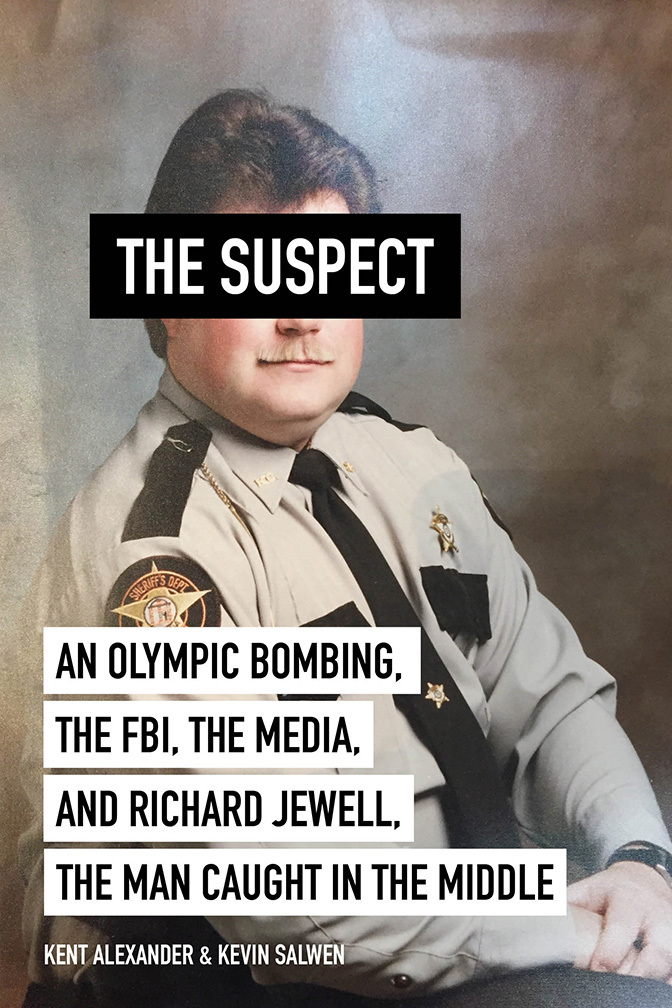
“Standing less than ten feet from the bench, [Richard] Jewell watched [FBI Bomb Technician Bill] Forsyth and [ATF Agent Steve] Zellers study the package. Forsyth dropped to his knees for a better look. Penlight in hand, he crawled on his stomach toward the pack. His training was clear: Do not touch the bag. The flap or buckles could be booby-trapped. But sometimes bomb techs go with their gut. Forsyth broke protocol and peered inside. In the flashlight beam, there was no missing the danger. Wiring. Pipes. End caps. Timing device. Forsyth froze for a second, then jumped back. He froze again, waiting for an explosion…”
- Kent Alexander & Kevin Salwen, The Suspect: An Olympic Bombing, the FBI, the Media, and Richard Jewell, the Man Caught in the Middle
On July 27, 1996, a bomb exploded in Atlanta’s Centennial Olympic Park, killing one person directly, killing a second indirectly via a heart attack, and wounding hundreds.
Though it’s been twenty-seven years, I’ll never forget hearing about it for the first time. I was halfway through my first summer with a full-time job, working at a candy-and-tobacco warehouse. The job was nowhere near as fun as it sounds – I mostly put tax stamps on cigarettes – and it required me to get up real early. The night before, I’d gone to sleep watching the Olympics, and had set my television to wake me up at 5:30 a.m. When it turned on, the darkness in my room filled with the flashing lights of rescue vehicles, and the sound of breathless reporters speculating like mad.
Driving to work that morning, I listened to more news on the radio. Over the next few days, I’d learn – along with the rest of the world – that a portly security guard named Richard Jewell had spotted a suspicious backpack under a park bench, and set in motion a response that likely saved dozens of lives.
With the schoolyear approaching, my attention waned, and though I probably heard – at some point – that Jewell had become the suspect, I cannot really recall. By the time Jewell was convicted by the media, and then cleared by the FBI, I had moved on with my life, assuming I had most of the details.
After reading Kent Alexander and Kevin Salwen’s The Suspect, it turns out I didn’t really know much at all, entirely unaware of this tale’s myriad twists and turns and meanings.
The Suspect provides a comprehensive account of an all-American true crime story – told with the benefit of hindsight and reflection – and is worthwhile on that level alone. But it is also a trenchant examination of myopic law enforcement, an out-of-control media, and the collision of well-intentioned but deeply flawed individuals.
***
Whatever else there is to say about The Suspect, it is thorough. Alexander and Salwen do not simply recount the bombing and its aftermath, but delve into the process whereby the Olympics came to Atlanta in the first place, present biographical sketches of the main players, and eventually cut away from the main storyline to follow Eric Rudolph, the domestic terrorist who actually planted the bomb that the FBI tried to pin on Richard Jewell.
One of the best compliments I can give to The Suspect is that when I finished, I didn’t have any lingering questions. To the contrary, it answered questions that hadn’t even occurred to me.
***
Structurally speaking, The Suspect unfolds how you’d expect. It begins with a teaser prologue set on the fateful night, which ends just as the bomb is discovered. From there, Alexander and Salwen jump back in time to show us how we got to that moment.
The writing is crisp and engaging. The subject matter is fascinating, though often in horrifying ways. The research is extensive. Events are shown from all sides, with the differing perspectives contrasted meaningfully. As an added bonus, Alexander was a United States Attorney in the Northern District of Georgia in 1996, and actually played a role in the proceedings. In terms of reporting and readability, The Suspect is beyond solid.
***
Alexander and Salwen’s great inspiration is to run the narrative through the lives of three very distinct individuals.
The first, of course, is Richard Jewell, the wannabe-cop-turned-security guard whose lifelong overzealousness regarding police work paid off in a remarkable way. At the time of the Olympic bombing, Jewell had lived an unremarkable existence. Having always wanted a career in law enforcement, he’d blown his opportunities through a series of poor decisions, and was living with his mother. Given this failure to launch, I fully expected Jewell’s biographical sections to be a slog of useless minutiae. Instead, Alexander and Salwen show in exacting detail the acute relevance of his background. Jewell’s past experiences not only made him vigilant enough to spot the bomb, but it provided a false motive that led others to think he might have planted it.
The second is FBI agent Don Johnson, who came to suspect Jewell was the bomber, and refused to let go of that notion, even as similar bombs started exploding elsewhere. He is, in short, a stark illustration of confirmation bias, a man who’d made a choice, and saw every circumstantial scrap of information as supporting it. Johnson’s spotty track record in the Bureau, his toeing of the ethical/legal line, and his ultimate wrongheadedness could have made him an outright villain of the piece. It is a testament to Alexander and Salwen’s humanizing touch that it does not happen.
The final character is Atlanta Journal-Constitution reporter Kathy Scruggs, who broke the news that Jewell was a suspect. Scruggs comes across as a throwback to the old-school journalist: hard-drinking, hard-living, and leaning hard on her sources. Had she been a man, she might have been celebrated for these traits. Because she was a woman, just the opposite occurred.
This is best illustrated by Clint Eastwood’s film, Richard Jewell, where Eastwood implies that Scruggs slept with an FBI agent for her story. Had Scruggs been alive – she died young, in 2001 – this would’ve been actionable slander. Instead, it’s just morally repugnant. The fact that Scruggs is identified by name, but allegedly has sex with a fictional composite character, aptly demonstrates the misogynistic premises of the filmmakers.
The main reason I mention this is that The Suspect was one of two different works that served as a basis for Eastwood’s movie. Importantly, Alexander and Salwen make no such claim.
***
One big advantage of The Suspect is that it was published in 2019, meaning that it can provide the full picture with the benefit of time, contemplation, and archival access.
One big disadvantage of The Suspect is that it was published in 2019, meaning that all three of the major participants – Jewell, Scruggs, and Johnson – were already dead, Scruggs at 42, Jewell at 44, and Johnson at 57. Only Rudolph – the deluded, bug-eating bomber – still breathed, and he refused to talk. This meant that backstories had to be filled-in by family and friends.
While I’m certain vivid impressions were formed, science tells us that old memories are fallible. A memory is not a photograph that captures an instant; it is a piece of furniture that gets moved around a room, with the room itself changing. One stark example occurs when Alexander and Salwen quote a witness to the bombing who stated that – upon seeing the bodies – his “mind flashed to the movie Saving Private Ryan, with its vivid, brutal scenes of battle.”
Saving Private Ryan, of course, would not be released until the summer of 1998, two years after the Centennial Park Bombing.
***
The Suspect achieves a rare kind of balance. It is searing in its critique of systems, especially an FBI loathe to admit mistakes, and a profit-driven media that doesn’t care if mistakes are made.
It also puts us in the shoes of Jewell, Scruggs, Johnson, and others, to show us how the situation looked to them as they were living it, not knowing that they were becoming a small yet painful part of history, and that their actions would be scrutinized for years afterward, even after they were dead.