What do you think?
Rate this book

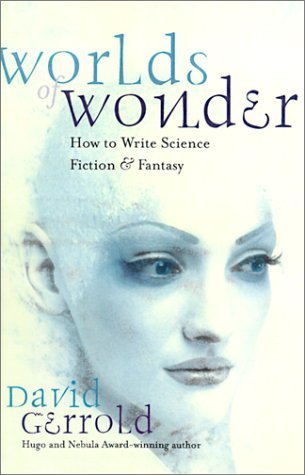
246 pages, Paperback
First published January 1, 2001
F u ck! This book took me basically a year to get into.
I will preface this by saying I picked this up knowing nothing of David Gerrold, his works or his achievements. I am on a quest to explore as many authors' perspective on writing as possible, regardless of my interest in their work. As part of this adventure I've read thoughts on writing and writing technique by Le Guin, Stephen King, Roy Peter Clark etc etc. The title of this book ("Worlds of Wonder") seemed intriguing enough. The cover reads "Hugo and Nebula Award-winning author". According to the blurb, he "is one of the most popular science fiction writers working today". I don't read much sci-fi (besides some classics I read years ago like Asimov and some stuff by Le Guin because I love her) so I accepted based on this that he is a well-established author who knows what he's talking about.
WRONG!
The only reason I'm giving this a 1.7 instead of a single star is because it infuriated me so much I kept thinking about writing this man a long letter explaining to him why he is wrong and why he needs to get his head out of his ass. He is now an old man and I'm not too sure what his works look like now, so I'm not actually going to do it, but it felt rather refreshing to get this engaged in a non-fiction book, for which I am grateful.
What is my gripe with this man? Well. He is a know-it-all. And he thinks he got jokes. Example:
What bugs me is this man truly thinks he's an intellectual, and therefore not part of the ignorant, irrational masses who never trained their critical thinking. Throughout this book he demonstrates how surface-level his way of approaching the art of writing is, and how distanced he is from it in all the ways that actually matter (I do understand this is subjective and influenced by my way of viewing books; everyone has their own opinions on writing and art in general). He seems to always be looking for a trick or technique, and focuses on extremely cliched pieces of advice that a rookie might consider panacea in their idealized, inexperienced approach to the craft, but that you'd expect a seasoned writer to have already ruminated upon and discarded when faced with the real task of writing (or after extracting from them the little bits of usefulness). Parts of this book feel like they could've been written by someone who never actualy wrote anything. There is a lack of substance and self-awareness.
Speaking of which, there are two chapters that discuss sex and love scenes, and from the intro you would think this man knows how to write the most perfect, mouth-watering, lovely scene that showcases the relationship between two characters in a way that is appropriate to the story and satisfying to read, and then he inserts a piece of his own writing (which he does in this book quite a bit), that is pages upon pages of the most godawful sex/love scene I've ever read (and I was on Wattpad in my teens so that says something). It is unrealistic, it is embarrassing to read, it is simply ridiculous. I could not believe this man put this specific scene to demonstrate his point there. If anything, it should be an example of what to avoid. I will not quote it here but please read it if you care for a good laugh.
He seems very self-satisfied with this sad excuse of a sex scene, even going so far as to describe a "breathless" fan who is presumably trembling with passion after having read this scene.
There are also a couple of instances in the book where he says something and then almost immediately says the opposite, or, more accurately, the explanations/examples he uses to clarify his points tend to miss the mark. I take personal offence at this line on the "Simile" chapter:
"Similes are like garlic. They should be used sparingly. Otherwise, they leave a terrible taste in the mouth".Whatever, man. I don't care too much for similes either, but I've never in my life used garlic sparingly. Garlic is the basis of a bajillion cuisines around the world and it's delicious. Absolutely tasteless.
At some point he advises aspiring writers to "eschew obfuscation". I do agree with this point somewhat, but I feel like his own writing suffers for it. If I had to describe his writing (from whatever he added to this book as examples of good writing) I would say it's corny and unoriginal. Writing is art, and I don't think writers should be scared of making the reader work for it. Using your brain is certainly not a negative point of reading. Otherwise I'd also be part of those horrifying "untrained" ignorant masses. Egad!
He spends a chapter talking about metric prose as if it's a novel concept. If you've ever written even a bit, you immediately realize the important of the flow of language. I cannot imagine how this would be newfound information for a published author. I can kind of look past this though, in the grand scheme of things.
Then there is a chapter on "memes" (not the memes you're thinking of) which is almost interesting, but actually gets nowhere. He starts with the concept of ideas and how we use language to define ideas etc; "We cannot define ourselves except through language- and when our language-identity is threatened, we jump to defend it much quicker than we leap to defend our actual selves". This is actually a solid point, and he goes on to explain how language is power and the writer understands it better than anyone. He also talks about how education seems to be all about rote memorization and surface-level understanding of concepts which are thrown out when no longer needed; "This is not education; this is bulimia." This one was kinda gaggy, I have to say. But then he says some bs about how English is the most powerful language in the world because it conceptualizes things that don't exist (?) in other languages. Okay, sure. Whatever. I think he was trying to say something profound here, or he was trying to make the reader think that something profound has been said (there hasn't been anything of the sort).
There's some casual transphobia in one of the examples he gives on first-person narration:
"She was telling everyone lies about my mom-so one day I just came right out and asked her if her sex change had cost so much that she couldn't afford tits...".Based on context, this is talking about an actual trans person. This book was written in the very early 2000s so I'm not being super strict with it, but it feels strange to see this, and then have an entire chapter on pronouns a couple chapters later (a chapter which is actually interesting).
Another thing that bothers me is the absoluteness of it all. Like, man, it depends! Not everything is black and white. Towards the end of the book, we have this: "If you haven't written a million words [...] you're still practicing". Okay. Reader, if you're not ready to take in this incredible piece of wisdom, fear not, for you will see it typed again. And again. Four times in one page, in fact.
Now, this book does have some interesting bits here and there. There were a couple pages i took note of for exercise/warm-up purposes. There are also some good pieces of advice in here, if not a bit too generic, as well as, perhaps, motivational words.
Generally, I wouldn't say I regret picking this up. It was interesting to see my own thoughts and ideas on writing as a response to this text and how they might differ completely from those of actual published writers. Would I read anything from this man, just out of curiosity? Probably not. I have more important things to read. Maybe if I had a lot of free time and no job and nothing else to do.