

What do you think?
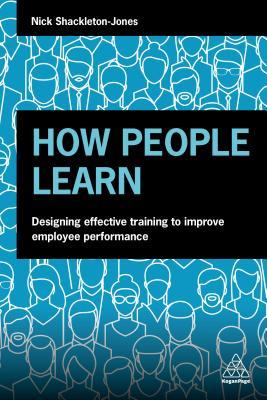
How People Learn: Designing Education and Training that Works to Improve Performance
What if we have been wrong about learning? Learning may have more in common with marketing than we thought.
Looking at marketing and learning's common root, How People Learn shows L&D professionals a new way of thinking about learning by exploring what happens when we learn. It considers applications from AI, marketing and ethics and is informed by psychology and contemporary neuroscience in order to show L&D professionals how to design training with their employees in mind so that training makes a real difference to skills, capabilities, performance and development, rather than being a waste of time, money and resources.
Using the author's '5Di model', How People Learn demonstrates how to define, design and deploy training in a user-centred way so it works both for and with employees. It also includes guidance on what training resources to create when employees are actively searching for learning content. Using this book, L&D practitioners will be able to use pull and push techniques to provide content that people use and experiences that transform their behaviour. From how to use simulations, storytelling and anticipation to the importance of observation and status, this book gives L&D professionals everything they need to build effective training programmes and learning experiences. With a foreword by Dr Roger Schank, the Chairman and CEO of Socratic Arts and Executive Director of Engines for Education, and case studies from companies such as BP and the BBC, this is an urgent read for learning professionals.
Looking at marketing and learning's common root, How People Learn shows L&D professionals a new way of thinking about learning by exploring what happens when we learn. It considers applications from AI, marketing and ethics and is informed by psychology and contemporary neuroscience in order to show L&D professionals how to design training with their employees in mind so that training makes a real difference to skills, capabilities, performance and development, rather than being a waste of time, money and resources.
Using the author's '5Di model', How People Learn demonstrates how to define, design and deploy training in a user-centred way so it works both for and with employees. It also includes guidance on what training resources to create when employees are actively searching for learning content. Using this book, L&D practitioners will be able to use pull and push techniques to provide content that people use and experiences that transform their behaviour. From how to use simulations, storytelling and anticipation to the importance of observation and status, this book gives L&D professionals everything they need to build effective training programmes and learning experiences. With a foreword by Dr Roger Schank, the Chairman and CEO of Socratic Arts and Executive Director of Engines for Education, and case studies from companies such as BP and the BBC, this is an urgent read for learning professionals.
264 pages, Paperback
Published May 28, 2019
Ratings & Reviews
Friends & Following
Create a free account to discover what your friends think of this book!
Community Reviews
Displaying 1 - 14 of 14 reviews

January 30, 2021
I'm very picky about business books because they can be expensive and take copious amounts of shelf space when really I could have got the gist from the first and last chapters, cutting out relentless charts, data, and really annoying anecdotes of yet another CEO the author was "chatting" with, as you do, or stories of young, promising employees who, once the author successfully relieved them of some limiting belief or another, went on to become the next "disruptor" or CXO of Whatever-Corp. This book is different.
I was recently reminded of Nick by a stranger and stifled a laugh because I remembered him as "the ball pool" guy from a HR Learning conference I once attended. The story went, he and his team put ball pools in areas of their corporate client's head office in an effort to change culture and break the stiffness in interactions across company hierarchy. I've since had this ball pool image in many corporate situations (sometimes really inappropriate but dead funny) and I usually find a way to incorporate a ball or balls in learning experiences because they really are an effective (playful) way to get people thinking. At the very least they wake up, lest they get hit in the face with one.
Nick's book is equally entertaining and a useful read. Based on neuroscience & psychology and written persuasively he lays out key ideas that will make my work as an early professionals "performance coach" and group Learning Leader more effective. Good to see that my current practice is not far off, even if our terminology may differ. And if you need the words, models, theory and a few salient examples for changing education to learning and performance, then this is the place to start. And linger for a good while.
Happy to give the shelf space to this, especially as I can actually use every chapter as a reference for what I'm doing at work.
I was recently reminded of Nick by a stranger and stifled a laugh because I remembered him as "the ball pool" guy from a HR Learning conference I once attended. The story went, he and his team put ball pools in areas of their corporate client's head office in an effort to change culture and break the stiffness in interactions across company hierarchy. I've since had this ball pool image in many corporate situations (sometimes really inappropriate but dead funny) and I usually find a way to incorporate a ball or balls in learning experiences because they really are an effective (playful) way to get people thinking. At the very least they wake up, lest they get hit in the face with one.
Nick's book is equally entertaining and a useful read. Based on neuroscience & psychology and written persuasively he lays out key ideas that will make my work as an early professionals "performance coach" and group Learning Leader more effective. Good to see that my current practice is not far off, even if our terminology may differ. And if you need the words, models, theory and a few salient examples for changing education to learning and performance, then this is the place to start. And linger for a good while.
Happy to give the shelf space to this, especially as I can actually use every chapter as a reference for what I'm doing at work.

August 15, 2025
There is an amusing bit in this where he describes a training session he conducted. You need to start off by knowing that he doesn’t think very much of training sessions – and thinks they are mostly a waste of time. Before the lecture type session, he has stuck bananas under some people’s chairs. As he is going along he asks people to feel under their chairs and those who have bananas to come up to the stage. They do, and he gets them to peel and eat the bananas in sync with each other. Not the sort of thing you might expect at a training session, I guess. After this is all over, he tells the audience that soon all they would be able to remember of the session – and the conference too – was the banana eating. And that, pretty much, is the point of this book.
Not that I’m saying you shouldn’t bother reading this book – you really should. His point is that most of what passes for education isn’t really about learning. How we learn and how we go about educating people are two quite different things. Education is mostly about trying to stuff information into unreceptive heads. As the author says, it is a bit ironic that he ended up a lecturer at a university, because for the most part he was bored out of his mind at school. He says that education is mostly about getting a piece of paper that then allows you to get a job where you actually do some learning – if you are lucky. He quotes that line from Maya Angelou about people forgetting what you say or do, but never forgetting how you made them feel. A lot of this is about the part emotions play in learning. And the fact that we mostly learn stories, since stories are most likely to make us feel.
He sees most education as being what he calls ‘content dumping’. And this is also true of most workplace training. How do we give learners all of the content they might one day need to do things they might one day need to do? And there is the problem. Since the learners have no idea what they might one day need to know and because they have been through endless content dumping education before, they are unlikely to retain any of what they are being told. You can ‘fix’ this by giving them the threat of there being an exam at the end. This is highly effective in getting people to remember stuff right up to five minutes after the exam. Otherwise, it is virtually a complete waste of time.
So, is there a better way? He definitely thinks there is. He talks about a range of courses where people are expected to work together to solve real life problems. In these problems they have to learn how to firstly work together, but also to learn what they don’t know. And since the learning is situated in what they will do in real life, they are not only more motivated to engage, but they are not learning an endless dump of content, but rather things that are to the point of what they need to learn. This isn’t about dropping them in the middle of a war zone and seeing if they can make it out alive – as a kind of Squid Game, where you are given no assistance at all. Rather, you are given just enough assistance so that you don’t end up stuck, but not enough that you get frustrated and give up. That is, you learn the way you do in real life – tackling real life problems and getting assistance when you need it, but not so much assistance that you let the teacher do the work for you.
This reminded me of so many training sessions I’d been through. In one we were shown how to modify some base level computer program that managed our corporate server. The person running the course asked me why I wasn’t doing the task he had set me. I told him that if my organisation was stupid enough to get me to do this task – when they had a perfectly well functioning IT department – they must be even stupider than I generally gave them credit for. There was literally zero chance I was ever going to do what he was teaching me to do – and it wasn’t even something I would ever want to do.
In another training workshop I attended, we were asked to organise a deck of cards from ace to king. Someone had gone the opposite way. We had to do all this in a very short amount of time and hand the cards back to the trainer. The person who had stuffed up the exercise simply put the bottom card on the top of the deck and handed up them. One card was in the right order – every other card not. I learned more from that than I was expecting – that is, never work with that person if I needed things to be ‘right’.
Again, this is the author’s point. Too much of what we ‘learn’ is so superficial and so tangential to our real lives, we hardly care what we do, as long as it mostly looks sort of right.
He has nice things to say about a book I read years ago called The Checklist Manifesto. And since I’ve forgotten most of the book, it reinforces this guy’s point to say what I do remember of it – that is, that using checklists was applied in hospitals and it had a huge impact on reducing injuries and deaths from forgetting to do things. This is great if what you are doing is a well-documented procedure, probably less so if it is something you need to be creative in – or as Hannah Arendt might say, good for labour – which is repetitive and almost mindless, but not so good for work, which requires close concentration and thinking on your feet.
His point is that different genres of ‘useful’ materials to help us do what we want to do have different purposes and those should be developed to match what people are likely to want to do with them. So, if it is a step-by-step procedure, perhaps a step-by-step guide is the best thing. If it is something that might involve a tricky manipulation, perhaps a video would be best. But we have all experienced watching a how-to video on YouTube where the person gives you their life history before they show you how to change a washer. The desire to scream at them, ‘Just show me!!!’ is overwhelming.
He also makes the point that too few training sessions begin by asking what those being trained want to know. Admittedly, sometimes they might not know what they need to know – but as is made clear repeatedly throughout this, we are much more likely to learn things we feel we need to know and that we can put into practice than stuff we might possibly need at some undefined time in the future.
The bottom line being that learning ought to be about changing behaviour – and if you are going to do that, then you basically need to know what behaviour is normal now, and what you want to change that behaviour to. That so little of what we ‘learn’ is like that – again, being much more likely to be a content bump instead – is a deeply curious fact about our world. I really enjoyed this book.
Not that I’m saying you shouldn’t bother reading this book – you really should. His point is that most of what passes for education isn’t really about learning. How we learn and how we go about educating people are two quite different things. Education is mostly about trying to stuff information into unreceptive heads. As the author says, it is a bit ironic that he ended up a lecturer at a university, because for the most part he was bored out of his mind at school. He says that education is mostly about getting a piece of paper that then allows you to get a job where you actually do some learning – if you are lucky. He quotes that line from Maya Angelou about people forgetting what you say or do, but never forgetting how you made them feel. A lot of this is about the part emotions play in learning. And the fact that we mostly learn stories, since stories are most likely to make us feel.
He sees most education as being what he calls ‘content dumping’. And this is also true of most workplace training. How do we give learners all of the content they might one day need to do things they might one day need to do? And there is the problem. Since the learners have no idea what they might one day need to know and because they have been through endless content dumping education before, they are unlikely to retain any of what they are being told. You can ‘fix’ this by giving them the threat of there being an exam at the end. This is highly effective in getting people to remember stuff right up to five minutes after the exam. Otherwise, it is virtually a complete waste of time.
So, is there a better way? He definitely thinks there is. He talks about a range of courses where people are expected to work together to solve real life problems. In these problems they have to learn how to firstly work together, but also to learn what they don’t know. And since the learning is situated in what they will do in real life, they are not only more motivated to engage, but they are not learning an endless dump of content, but rather things that are to the point of what they need to learn. This isn’t about dropping them in the middle of a war zone and seeing if they can make it out alive – as a kind of Squid Game, where you are given no assistance at all. Rather, you are given just enough assistance so that you don’t end up stuck, but not enough that you get frustrated and give up. That is, you learn the way you do in real life – tackling real life problems and getting assistance when you need it, but not so much assistance that you let the teacher do the work for you.
This reminded me of so many training sessions I’d been through. In one we were shown how to modify some base level computer program that managed our corporate server. The person running the course asked me why I wasn’t doing the task he had set me. I told him that if my organisation was stupid enough to get me to do this task – when they had a perfectly well functioning IT department – they must be even stupider than I generally gave them credit for. There was literally zero chance I was ever going to do what he was teaching me to do – and it wasn’t even something I would ever want to do.
In another training workshop I attended, we were asked to organise a deck of cards from ace to king. Someone had gone the opposite way. We had to do all this in a very short amount of time and hand the cards back to the trainer. The person who had stuffed up the exercise simply put the bottom card on the top of the deck and handed up them. One card was in the right order – every other card not. I learned more from that than I was expecting – that is, never work with that person if I needed things to be ‘right’.
Again, this is the author’s point. Too much of what we ‘learn’ is so superficial and so tangential to our real lives, we hardly care what we do, as long as it mostly looks sort of right.
He has nice things to say about a book I read years ago called The Checklist Manifesto. And since I’ve forgotten most of the book, it reinforces this guy’s point to say what I do remember of it – that is, that using checklists was applied in hospitals and it had a huge impact on reducing injuries and deaths from forgetting to do things. This is great if what you are doing is a well-documented procedure, probably less so if it is something you need to be creative in – or as Hannah Arendt might say, good for labour – which is repetitive and almost mindless, but not so good for work, which requires close concentration and thinking on your feet.
His point is that different genres of ‘useful’ materials to help us do what we want to do have different purposes and those should be developed to match what people are likely to want to do with them. So, if it is a step-by-step procedure, perhaps a step-by-step guide is the best thing. If it is something that might involve a tricky manipulation, perhaps a video would be best. But we have all experienced watching a how-to video on YouTube where the person gives you their life history before they show you how to change a washer. The desire to scream at them, ‘Just show me!!!’ is overwhelming.
He also makes the point that too few training sessions begin by asking what those being trained want to know. Admittedly, sometimes they might not know what they need to know – but as is made clear repeatedly throughout this, we are much more likely to learn things we feel we need to know and that we can put into practice than stuff we might possibly need at some undefined time in the future.
The bottom line being that learning ought to be about changing behaviour – and if you are going to do that, then you basically need to know what behaviour is normal now, and what you want to change that behaviour to. That so little of what we ‘learn’ is like that – again, being much more likely to be a content bump instead – is a deeply curious fact about our world. I really enjoyed this book.

June 11, 2019
I work in L&D and I think this was one of the most useful work related book I read.
It was full of great ideas and it help to understand how people learn and what to expect.
A great and fascinating read.
Highly recommended!
Many thanks to the publisher and Netgalley for this ARC, all opinions are mine.
It was full of great ideas and it help to understand how people learn and what to expect.
A great and fascinating read.
Highly recommended!
Many thanks to the publisher and Netgalley for this ARC, all opinions are mine.

Read
February 9, 2023It wasn’t the first time I got into a discussion with someone who claimed to be an instructional designer. It wasn’t even the first time I encountered someone with a PhD in instructional design. It was also not the first time that I shuddered to think about the training industry. It was a comment that pushed the project to more abstraction, greater complexity, and less emotional salience – and it was more than I could take.
Read more
Read more

June 2, 2019
This interesting statement from the book is how I feel about it: "the dilemma we face today with learning and education: it doesn’t matter how smart you are – if you start with the wrong assumptions you won’t be able to get to the answer." It resonates with me a lot! I wanted to read this book because education today is my deep interest and focus. Learning combined with how we feel or emotional context of what we learn creates longer memorization. This is an amazing book offering great concepts in how to improve education system and corporate learning.

February 24, 2025
This was an interesting read and I definitely feel like a learned quite a bit, but I felt like he ranted a bit too much about our educational system. I understood what he was getting at, but it felt like he just kept harping on it and as a parent of small children I didn’t fully grasp how his plan would workin current society.
Other than the education rant, I felt like there was a lot that I could put into practice. I appreciated his case studies and the personal experiences that he shared.
Other than the education rant, I felt like there was a lot that I could put into practice. I appreciated his case studies and the personal experiences that he shared.

June 25, 2025
The Affective Concept Model seems like a nice technique to use in coaching/mentoring, however it would be unfeasible to use in any situation where you have complex learning environments with many learners with learning needs and intentions. Definitely not a definitive book on 'How People Learn'.

July 5, 2019
British author who wrote a book about theories of learning. The country of origin is important due to stories told and some phrasing. I found it engaging and very interesting.

December 1, 2019
Might have to re-think lots about my learning career!
January 10, 2020
So so good! Incredibly helpful for any learning designer. And itself a resource-I put it on my desk when thinking through what to do with workshops...
Longer review soon.
Longer review soon.

December 27, 2021
Provoking and inviting to reflect on your assumptions about learning. Absolutely worth reading.

October 14, 2022
Jam packed with value if you are a professional in this space. Super interesting if you are even a bit curious about learning.
Nick gets right what so many others get wrong; and he’s going to tell you that more than once 😂
Nick gets right what so many others get wrong; and he’s going to tell you that more than once 😂

January 14, 2024
You can’t make people learn things they don’t care about. They might cream for an exam the night before, recite what you want to hear, then forget all about it. What they really need, they will learn on the job.
So you have to find a way to make people care about the learning experiences you design for them. This book shows you how (though it’s less hands-on than Training from the Back of the Room).
So you have to find a way to make people care about the learning experiences you design for them. This book shows you how (though it’s less hands-on than Training from the Back of the Room).
September 10, 2019
A must read
If you work in any form of L&D this is a must read. Take your time, re-read it, use it as a reference resource. But don't forget what it's key message is. People learn, we in L&D do not create learning. This book will help you understand how people learn and how we in L&D can support them.
If you work in any form of L&D this is a must read. Take your time, re-read it, use it as a reference resource. But don't forget what it's key message is. People learn, we in L&D do not create learning. This book will help you understand how people learn and how we in L&D can support them.
Displaying 1 - 14 of 14 reviews