Jump to ratings and reviews
Rate this book

Life in a Medieval Castle

Rate this book
Alternate Cover Edition can be found here

A widely respected academic work and a source for George R.R. Martin’s Game of Thrones, Joseph and Frances Gies’s bestselling Life in a Medieval Castle remains a timeless work of popular medieval scholarship.

Focusing on Chepstow, an English castle that survived the turbulent Middle Ages with a relative lack of violence, the book offers an exquisite portrait of what day-to-day life was actually like during the era, and of the key role the castle played. The Gieses take us through the full cycle of a medieval year, dictated by the rhythms of the harvest. We learn what lords and serfs alike would have worn, eaten, and done for leisure, and of the outside threats the castle always hoped to keep at bay.

For medieval buffs and anyone who wants to learn more about this fascinating era, Life in a Medieval Castle is as timely today as when it was first published.

208 pages, Kindle Edition

First published November 1, 1974

836 people are currently reading
3689 people want to read

About the author

Joseph Gies

37 books41 followers
Joseph Gies and his wife Frances were historians and writers. They both collaborated on a number of books about the Middle Ages, and each also wrote individual works. Joseph Gies graduated from the University of Michigan in 1939.

Ratings & Reviews

What do you think?
Rate this book

Friends & Following

Create a free account to discover what your friends think of this book!

Community Reviews

5 stars
523 (22%)
4 stars
978 (42%)
3 stars
656 (28%)
2 stars
124 (5%)
1 star
17 (<1%)
Displaying 1 - 30 of 163 reviews
Profile Image for Nataliya.
985 reviews16.1k followers
September 30, 2023
I decided to read this since I have an unhealthy love of castles and because I really enjoy the idea of imagining what the actual life in the depths of history was like. But maybe it wasn’t the best idea to read this one in parallel with one of Ian Mortimer’s books about British history since it inevitably led to comparisons, and at least for me Mortimer’s style wins. And that’s just not fair to the Gies writing duo as the styles are just very different.
“But the final role of the European medieval castle seems to be that of tourist attraction. In Britain, France, Germany, Spain, Italy, and elsewhere, with the aid of a guide or a guidebook and some imagination, one can stand in the grassy bailey and re-people the weathered stone ramparts and towers and the vanished wooden outbuildings with archers and knights, servants, horses, and wagoners, the lord and lady and their guests, falcons and hunting dogs, pigs and poultry—all the unkempt, unsafe, unsavory but irresistibly appealing life of the thirteenth century.”
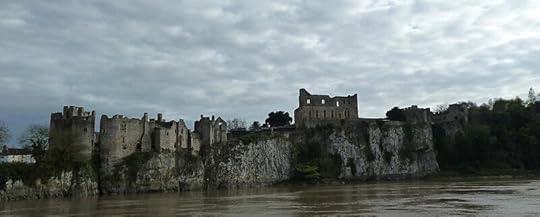

Don’t expect (as I had) that it will focus just on the day-to-day castle life in the Medieval times. First there is quite a bit of a background on feudal relationships, inheritance, and some of the history of the family which owned Chepstow castle — the castle that’s used as an illustration here. It takes a bit to get to the actual life in the castle, but once you do you will also learn about the details of training a falcon (which is harder than I ever thought it would be) as well as a bit of a village life, hunting details and royal forests, the evolution of castle fortifications (from moat and bailey to the familiar castle shape, from rectangular to circular, with ever-thickening walls to withstand evolving attack methods), different roles involving in maintenance of daily castle routine (no, I never though about where chamberlains and haywards and woodwards and stewards came from), and eventual decline in castle role after political changes and preference of the nobility to live in more modern comforts.
“The rushes were replaced at intervals and the floor swept, but Erasmus, noting a condition that must have been true in earlier times, observed that often under them lay “an ancient collection of beer, grease, fragments, bones, spittle, excrement of dogs and cats and everything that is nasty.”

It’s written in a somewhat dry style, especially if comparing to easy banter of Ian Mortimer (again, reading his book and this one in sync was not the best choice), and it made it too easy to put it aside for a few days at a time. And the photos are clearly from 1970s edition (seriously, publishers, would it have killed you to update those so that I wouldn’t need to constantly search online for images that look like anything but grey grainy blobs?).

And yet I’m still interested enough in the approach this writing duo took to the Middle Ages to check out their books on the life in medieval city and medieval village.

3.5 stars.

——————

Also posted on my blog.
Profile Image for BAM doesn’t answer to her real name.
2,040 reviews457 followers
September 10, 2018
Most fascinating was the section on training falcons, it I learned a little something from every chapter from foods (which actually sounded quite digestible in this day and age) to clothing to jousts and chivalry. Every aspect I could think of about living in a castle was touched upon. On to Life in a Medieval Village!
Profile Image for Karen Brooks.
Author 16 books744 followers
May 22, 2011
A funny thing happened to me with this book. I was reading it on a plane when the gentleman next to me exclaimed, 'That would have to be the most boring book I have ever read!' Having been so engrossed in the book, I'd failed to notice he was reading over my shoulder and first assumed he must be referring to the novel he'd fallen asleep reading. But when he continued with, 'why, there's no torture or dungeons in it or anything!' I realised he WAS reading my book. I was so lost in the narrative, in the unfolding of history, of the way Joseph and Frances Gies bring life in a medieval castle to... well, life,that I'd forgotten my recent surgeon's appointment (reason I was on the plane), the take-off, fellow passengers, and ride, because I was utterly captivated. All of which just goes to demonstrate how subjective the reading experience is - this man's pain was my pleasure. (I should add, I quickly dispelled him of the idea it was boring and he could only have read a few pages anyhow. The reason I know this is because up until a short period before he spoke to me, he'd been snoring like a roadside drill).

The Gies' compelling non-fiction work takes the reader back in time, depositing us firmly in the midst of the life and times of the castle - not the ones you see on television or in too many films, all scrupulously clean and with everyone tidy and far too accomplished with weapons, food preparation and all sorts of other duties; or the type filled to the brim with aristocrats and where servants are largely absent or so in the background you barely notice them. No, these castles, mainly in England, but also abroad, are filled with pantlers, bottlers (where the term 'butler' originates from), slaughterers, smiths, grooms, carters, brewers and all manner of servants. There are also the requisite lord and lady, squires and knights, but also seneschals and other administrative people. Taking us through the various roles - within the castle and village surrounds, what people ate, wore, celebrated - from Lammas to tournaments, how the castles were built, altered, the manner in which they were defended or attacked as well as simply lived in and around, this book is a fascinating and beautifully written (and translated) insight into a period of time that's all too easily misrepresented and romanticised in popular culture (not that there's anything wrong with that, unless you're a dinky-di history buff and want more than constant spit and polish). It also explains why the castle declined and provides a comprehensive list of castles to visit throughout the UK and Europe as well as a terrific glossary at the back.

Far from boring, I devoured this book and am looking forward to tackling the others in the series.
Profile Image for E.
191 reviews12 followers
June 12, 2025
I liked this small book. Published in the early 70s.
It has only. black and white photos, maps and some illustrations.

It centers on Chepstow Fortress on the Welsh border.
The book has plenty of information on the inner workings of a castle.

The appearance of William Marshall, the most famous knight in the service of Henry II and three of his sons, was a nice surprise when he showed up for a visit at Chepstow Fortress.

It is a bit of a fun old book.
Profile Image for Hon Lady Selene.
579 reviews85 followers
February 28, 2020
From my notes:

1. Sometimes, instead of a city causing a castle to be built, the reverse was true, as craftsmen and merchants settled close by for protection and to serve the household. Several such examples are the castle-originated cities of Newcastle-Upon-Tyne, Ghent, Bruges. Chepstow is one of the few Anglo-Norman castles not sited to command an important town.

2. The rectangular shaped castle had many disadvantages, especially around the corners. The Byzantines and Saracens were the first to build in a circular pattern.

3. Machicolations are the openings through which missiles and boiling liquid could be dropped on the enemy.

4. Some of the most powerful castles in the world were built in between 1280-1320 in Wales by Edward I.

5. Carpets were only employed as floor coverings in the 14th century. Previously, floors were covered with hay, basil, lavender, marjoram, fennel, mints, violets. Even though these were replaced in intervals and the floors swept, there was always an ancient collection of beer, grease, bones, spittle, dog excrement under the sweet smelling herbs.

6. All tables in the great hall were covered with white cloths.

7. Only the lord and lady of the castle would sit in chairs, to emphasise status. Everyone else sat on benches.

8. The ancestor of the fireplace is the central open hearth, used in Saxon times.

9. In the bailey near the kitchen was the garden with fruit trees, herbs, flowers (poppies, roses, lilies) and a fish pond.

10. Colour scheme was frequently green, gold and red, with murals covering the walls.

11. Tapestries hanging off the wall served an important purpose of checking for drafts.

12. Any private chamber is called a solar.

13. Apart from kitchen passages, medieval castles rarely contained interior corridors. Rooms opened into each other or were joined by a spiral staircases. Covered passageways called pentices joined a chamber to a chapel or wardrobe. (see Restormel Castle, Cornwall).

14. When the lord traveled, his private bath tub accompanied him, along with a bathman who prepared the baths. Important 13th century castles had permanent bathrooms. Henry III’s palace at Westminster had hot and cold water running in the bathhouse. Edward II had tiled floor in his bathroom, with mats to protect feet from the cold.

15. Education of girls evidently compared favourably with that of the brothers, as marriage was nothing but business.

16. The steward was the servant in charge of the great hall. The chaplain was in charge of the chapel. The chamberlain was responsible for the great chamber.

17. Beginning with the reign of Henry III, a regular course in estate management was taught by the masters at Oxford.

18. Mustard was a favourite ingredient used by the gallon.

19. Meals were announced by a horn blown to signal the time for hand washing.

20. The word ‘manor’ came to England with the Normans.
Profile Image for Fox12345.
47 reviews2 followers
March 6, 2024
Відгуки на цю книжку дуже різні. Від "це так нудно, що неможливо читати", до "це неймовірно цікаво". Можу себе віднести до другої категорії. Так вийшло, що книгу книгу я купила випадково. І лише потім дізналась, що її рекомендував Дж. Мартін, славнозвісний автор "Ігри престолів". Він згадував, що саме вона допомогла йому докладніше описати життя своїх героїв.

Для мене ж, це напрочуд цікава книга, яка в легкій формі оповідає про життя в замку 11-14 століття. Чому замки були політично і економічно вигідними? Які насправді були права жінок і перших леді? Як це відрізнялось від романів. Як жили, що їли і у що одягались середьновічні селяни, багатії і лицарі. І, зрештою, яким бачили своє кохання і шлюб.

Ця книга вам стане в нагоді, якщо ви плануєте написати роман про середні віки. А також дозволить провести день у середньовічному замку і в ретроспективі побачити як змінювались звички, традиції і життя загалом, протягом кількох століть.

Задаючи собі питання, чи залишила б я цю книгу в своїй бібліотеці, можу однозначно відповісти, що так.
Profile Image for denudatio_pulpae.
1,589 reviews34 followers
October 6, 2022
Jak wyglądało życie człowieka w średniowieczu? Temat ten dla wielu osób, w tym dla mnie, jest interesujący. Frances i Joseph Gies postanowili opisać, jak funkcjonował średniowieczny zamek i w jaki sposób organizowano w nim życie codzienne.

Najpierw trochę uściślijmy – chodzi o życie głównie w średniowiecznym angielskim zamku. Wiadomo, że pewna część informacji jest uniwersalna dla epoki, ale jednak autorzy skupiają się głównie na swoim podwórku.

Spragnionych wyłącznie ciekawostek dotyczących życia codziennego spotka rozczarowanie. Ja z chęcią przeczytałam rozdziały dotyczące architektury średniowiecznych fortec oraz ich militarnej funkcji, relacjach feudalnych i sytuacji kobiet w tym systemie, rycerskich tradycjach i rytuałach czy o problemach chłopów. W książce znajdziemy oczywiście rozdziały dotyczące tych bardziej przyziemnych spraw, takich jak mieszkanie w zamku, prowadzenie gospodarstwa domowego, gotowanie potraw, ubiór, rozrywki, polowania, jednak można odczuwać pewien niedosyt informacji.

Nie był to czas stracony, ale chciałoby się czegoś więcej!
6/10
Profile Image for Nicola Michelle.
1,868 reviews16 followers
April 9, 2020
This book came as a recommendation to a previous book I had read on a similar topic and when I saw it was based on Chepstow Castle (a place I love and have visited before) I was excited to give this a read.

At first I found this hard to get into and struggled to keep my attention in the first few chapters as it didn’t really draw me in initially. I found it a more a detached non-personal account of life in a medieval castle in comparison with others I have read which make it a little harder to engage in to start with but there was plenty of sound, great information throughout. Some great pictures which I found helped reinforce the descriptions in the text.

I found it more of a reeling of facts and information and from this I found it a bit further removed from the lives of those who lived in the period but it was a very interesting topic and I loved reading about the history of castles and the lives of those in and around them.
Profile Image for Богдана Заровна.
94 reviews9 followers
January 27, 2025
Я так хотіла цю книжку, от щиро вже навіть бачила в себе в голові, що я хочу побачити на сторінках... Так хотіла, що це бажання та очікування зіграло зі мною злий жарт. Я отримала те, що хотіла і те, чого явно не бажала.

Я отримала купу інформації, яку не знала. Купу цікавих фактів про життя в замку, біля замку, про тих, хто жив в замку, як там економічно все складалось і працювало... А ще вияснила, що в мене не прогалина в знанні Європейської історії, а ціле провалля. Всі Генріхи ХІ-ХІІІ сторіччя змішалися в моїй голові, їх вассали, лицарі, війни і закони, релігія і турніри... Бо подача матеріалу авторів от зовсім не для мене. Мені місцями було ну дуже нудно, місцями, я перечитувала абзаци, бо втратила розуміння того, що читала... Мені не вистачило якоїсь художності чи що 🤷🏻‍♀️ Все подано сухо, фактами.

6/10 Можливо, якщо видадуть, я все ж прочитаю "Життя в середньовічному місті", бо інформація крута, а її подача мені не сподобалась.
Profile Image for Jaime.
1,801 reviews309 followers
August 14, 2022
Full of information about Medieval times & what it took to survive, thrive, and protect yourself, your family, and those who depend on you. I would suggest all authors who write stories set in Medieval times take the time to read this book.
Profile Image for Lorraine.
1,161 reviews87 followers
March 29, 2015
I like this book. This book explains how the castle changed from motte and bailey to stone. It also explains the roles of lord, lady, household, and villagers in relation to the castle. The authors discuss what a 'day in the castle' was like. WOW! Many people and so much to do. Knights, squires, apprentices were all present and practicing or learning military training. The castle and the Knights were tied closely together. Then the authors explain what is was like when the castle was at peace and at war. They conclude with the decline of the castle. Chepstow, a fortress on the Welsh border and its lord, William Marshall appear throughout the book with the authors tying the story of each to the book so the reader can comprehend better Life in a Medieval Castle. One thing that I would like to mention is the photographs in this edition are too dark. Thus, it is difficult for the reader to see the castles to which the authors refer.
Profile Image for Anna Mussmann.
422 reviews77 followers
October 24, 2020
When life gets busy and stressful, few retreats are more soothing than time spent with some nice, dry, detailed history. This book fit the bill. Life in a Medieval Castle isn’t as lively as something by a writer like David Mccullough--mostly because the authors don’t weave in an abundance of primary source quotations and personal details in the same way--but it’s quite interesting nonetheless.

Apparently, medieval nobility bathed a lot more often than popular rumor would have us believe. In fact, it was quite common to install sinks with water pipes at the entrance to the Great Hall (a useful feature for a culture whose etiquette required diners to use their hands on other folks’ food during a meal).

I will definitely keep an eye out for the Gies’ other books.
Profile Image for Linda Callahan.
45 reviews
September 5, 2020
Historically true

This is a fascinating look at the rise and fall of castles. This alone would have been enough to make it an interesting read, but this book rounds out history with historical people. The festivals, everyday life and even the evolution of knights. I couldn’t have asked for more!
Profile Image for  Linda (Miss Greedybooks).
350 reviews107 followers
July 14, 2012
I would keep these (all by Gies books) next to me while reading historical fiction books that I like. I would look up castles or other items of interest. fantastic books!
Profile Image for Tracey Allen at Carpe Librum.
1,154 reviews125 followers
July 18, 2021
Life in a Medieval Castle was originally published in 1974 and reissued in 2015, and was used by the author George R. R. Martin as a primary resource when writing his A Song of Ice and Fire series, upon which the legendary A Game of Thrones adaptation is based. Authors Joseph Gies and Frances Gies were both historians and published many books focussed on medieval history and the Middle Ages, before the married couple passed away in 2006 and 2013 respectively.

I learned a great deal reading this non fiction title which was broken down into many chapters, including 'The Castle Comes to England', 'A Day in the Castle' and 'The Castle at War'. I will say that the black and white photos were terrible and I could hardly make out what was pictured, which is disappointing given the opportunity to include better photography in the reprinting stage in 2015. This is best rectified by having Google Images at your disposal while reading, which is how I enjoyed this title.

There's nothing better than getting down into the nitty gritty of everyday life, and I knew that castle floors were strewn with rushes and herbs which were regularly replaced, but this quote from Erasmus in the book was gold. Erasmus observed that often under the rushes lay:

"an ancient collection of beer, grease, fragments, bones, spittle, excrement of dogs and cats and everything that is nasty." Page 60

Gross! It was interesting to learn on page 76 that the medieval feminine ideal was "blonde, delicate, fair-skinned, boyish of figure." That was a bit of a surprise, although I guess it's not that different to the lean and flat chested ideal in women's fashion in the 1920s.

I love learning about the different roles in households from different eras, and discovered that the role of butler (or bottler) originally worked in the buttery where beverages were kept in butts or bottles. A completely new job title to me was the pantler, who was the servant in charge of the pantry and the bread. I also enjoy identifying surnames that survive today that originate in the duties the person once would have held, like: Archer, Baker, Carter, Cook, Cooper, Chandler, Gardener, Knight, Miller, Smith, and Thatcher to name a few. Joseph Gies and Frances Gies were able to introduce me to a few new ones in Hayward, who was in charge of the haie, and repairing the hedges and fences; and the Woodward, who had charge of the lord's woods and was elected by his fellow villagers.

The descriptions of the food eaten in the period set the taste buds watering, although I don't think I'd like this dish:

"In addition to roasting and stewing, meat might be pounded to a paste, mixed with other ingredients, and served as a kind of custard." Page 112

The authors managed to take the reader through many facets of the medieval castle, focussing on Chepstow as their case study or best example. I think they best summarise the appeal of castles and castle ruins to tourists and wannabe tourists like me in their following conclusion to the book:

"In Britain, France, Germany, Spain, Italy, and elsewhere, with the aid of a guide or a guidebook and some imagination, one can stand in the grassy bailey and re-people the weathered stone ramparts and towers and the vanished wooden outbuildings with archers and knights, servants, horses, and wagoners, the lord and lady and their guests, falcons and hunting dogs, pigs and poultry - all the unkempt, unsafe, unsavoury but irresistibly appealing life of the thirteenth century." Page 224

Life in a Medieval Castle by Joseph Gies and Frances Gies is recommended for readers with an interest in history, castles (obviously) the Middle Ages and the medieval way of life.
Profile Image for Tymciolina.
242 reviews92 followers
November 5, 2019
Akademicki przykład jak nie należy pisać książek popularnonaukowych.

"Życie w średniowiecznym zamku" zaledwie dotyka tytułowej problematyki. Codzienności mieszkańców średniowiecznych fortec poświęcono aż jeden (!) rozdział. O czym jest reszta książki? Właściwie to nie wiadomo. Trochę nieistotnych i nudnych informacji o władcach zamku w Chepstow, powtórzony z "Życia w średniowiecznej wsi" (a wręcz przepisany słowo w słowo) rozdział dotyczący chłopów, mnóstwo informacji na poziomie podstawówki o stosunkach feudalnych. Osoby liczące tak jak ja na poszerzenie wiedzy w zakresie życia powszedniego w zamkowych murach mogą się srogo zawieść.

Nie polecam. Lektura fascynująca jak podręcznik do historii.
Profile Image for Tamara Rumiantseva.
83 reviews7 followers
June 18, 2025
Цікава книга, яка дає історичні відомості про будівництво середньовічних замків, про побут людей в них (як знаті, так і гарнізону, і інших мешканців), а також причини їх занепаду.

Мені особисто був дуже цікавий розділ про логіку будівництва замку. Він мені пояснив, чому замкові башти стали "круглими", чому бійниці вужчі з внутрішнього боку і ширші зі сторони зов��ішньої стіни, звідки взялось слово "dungeon" в англійській мові і чому "темницю" стали називати саме dungeon. Також, в кінці книги є прям список середньовічних замків з їх особливостями, цілий путівник, яким можна озброїтись, якщо шукаєш, що відвідати в Європі.

Єдине, чого мені не вистачало, то це карт, які б пояснювали трохи того, про що розповідають історичні відомості: де саме знаходиться замок, про який мова, куди хто які набіги робив, але це вже особисте, це б мені дозволило краще "розкласти по поличках" те, що я прочитала.

Тим не менш, цікава книга, яка розширила мої знання про середньовічні замки та їх побут.
100 reviews
February 20, 2022
An easy read about life in medieval times. Unlike the book about the city, this one was more of a description of the rich ruling class and their way of life but with reference to a castle. A castle in a way, is a community of lots of people from the top to the many at the bottom. For the title, I would have wanted to know more about a life in a medieval castle than what was presented. Having said all of that, it was an interesting read and hence the 5*.
Profile Image for Andrew Humphrey.
116 reviews2 followers
September 15, 2022
A pleasant little book - Gies plainly adores the subject matter. I was genuinely fascinated by many of the chapters (falconry and mealtimes especially), but wish there had been much more detail.
Profile Image for Autumn Slaght.
Author 6 books31 followers
August 19, 2023
The writing style was just okay. It was really easy to lose focus. But the book had a lot of very useful information! It's hard to read straight through but the chapters are divided up by topic so it makes great reference!
Profile Image for Candice Clark.
212 reviews2 followers
January 8, 2024
Exactly what it says on the tin; detailing the history of the castle, from Norman origins to today’s tourist attraction. No stone is left unturned, literally.
Profile Image for Mac.
476 reviews9 followers
September 14, 2025
Buy.

Accomplishes exactly what it sets out to do.
113 reviews1 follower
March 27, 2025
Цікаво описується різні аспекти середньовічного життя. Дуже легко читається
22 reviews1 follower
June 29, 2018
Good if somewhat uneven and occasionally not well structured introduction to the subject.
Profile Image for Ievgen Mochalov.
15 reviews3 followers
January 3, 2025
Гарний приклад історії повсякдення епохи, уявлення про яку викривив кінематограф та література. Доба постів і карнавалів української науковиці Стефанії Демчук - дає більш повну картину, але замок як оптична точка спостереження за епохою, теж не погане рішення. Легке, історичне і українською - що ще треба
Profile Image for Kilian Metcalf.
986 reviews24 followers
June 30, 2016
Neither romantic nor hardnosed, this book lays out a realistic picture of what day-to-day life was like in a medieval castle. One myth I had to let go of was the idea that the peasants worked themselves to death with no respite. Life was hard work (when hasn't it been), but it wasn't deadly. For one thing all the frequent church holidays and holy days meant rest periods. There were times as well when the lord of the manor was obliged by custom to provide food and drink for the celebration. The 12 days of Christmas (from December 25 to Jan 6) were stretched into a 2-week period of playfulness, gift giving and receiving, and entertainment provided by the local lord, all nicely adjusted to the station of each person in the household. Tenants of Glastonbury Abbey received bread, broth, beer, and two kinds of meat. Maskers, mummers and wandering entertainers appeared to provide diversion for all before moving on.

I liked this book a lot and found it engrossing.
Displaying 1 - 30 of 163 reviews

Can't find what you're looking for?

Get help and learn more about the design.