

What do you think?

Lands of Lost Borders: Out of Bounds on the Silk Road
"Every day on a bike trip is like the one before--but it is also completely different, or perhaps you are different, woken up in new ways by the mile."
As a teenager, Kate Harris realized that the career she most craved--that of a generalist explorer, equal parts swashbuckler and philosopher--had gone extinct. From her small-town home in Ontario, it seemed as if Marco Polo, Magellan and their like had long ago mapped the whole earth. So she vowed to become a scientist and go to Mars.
To pass the time before she could launch into outer space, Kate set off by bicycle down a short section of the fabled Silk Road with her childhood friend Mel Yule, then settled down to study at Oxford and MIT. Eventually the truth dawned on her: an explorer, in any day and age, is by definition the kind of person who refuses to live between the lines. And Harris had soared most fully out of bounds right here on Earth, travelling a bygone trading route on her bicycle. So she quit the laboratory and hit the Silk Road again with Mel, this time determined to bike it from the beginning to end.
Like Rebecca Solnit and Pico Iyer before her, Kate Harris offers a travel narrative at once exuberant and meditative, wry and rapturous. Weaving adventure and deep reflection with the history of science and exploration, Lands of Lost Borders explores the nature of limits and the wildness of a world that, like the self and like the stars, can never be fully mapped.
As a teenager, Kate Harris realized that the career she most craved--that of a generalist explorer, equal parts swashbuckler and philosopher--had gone extinct. From her small-town home in Ontario, it seemed as if Marco Polo, Magellan and their like had long ago mapped the whole earth. So she vowed to become a scientist and go to Mars.
To pass the time before she could launch into outer space, Kate set off by bicycle down a short section of the fabled Silk Road with her childhood friend Mel Yule, then settled down to study at Oxford and MIT. Eventually the truth dawned on her: an explorer, in any day and age, is by definition the kind of person who refuses to live between the lines. And Harris had soared most fully out of bounds right here on Earth, travelling a bygone trading route on her bicycle. So she quit the laboratory and hit the Silk Road again with Mel, this time determined to bike it from the beginning to end.
Like Rebecca Solnit and Pico Iyer before her, Kate Harris offers a travel narrative at once exuberant and meditative, wry and rapturous. Weaving adventure and deep reflection with the history of science and exploration, Lands of Lost Borders explores the nature of limits and the wildness of a world that, like the self and like the stars, can never be fully mapped.
300 pages, Paperback
First published January 30, 2018
About the author
Kate Harris
4 books236 followersI’m a writer with a knack for getting lost and a grudge against borders. Condé Nast Traveller named me one of the "world’s most adventurous women” for various ill-advised escapades on bikes and skis and foot. But my main adventure these days is staying put, in an off-grid log cabin in the Canadian subarctic, where I've been learning how to fly a small plane. My first book was Lands of Lost Borders. My second, coming out in June 2027, is Falling to Earth.
Ratings & Reviews
Friends & Following
Create a free account to discover what your friends think of this book!
Community Reviews
Displaying 1 - 30 of 823 reviews

March 29, 2018
The end of the road was always just out of sight. Cracked asphalt deepened into night beyond the reach of our headlamps, the thin beams swallowed by the blackness that receded before us no matter how fast we biked. Light was a kind of pavement thrown down in front of our wheels, and the road went on and on. If you ever reach the end, I remember thinking, I’ll fly off the rim of the world. I pedaled harder.Some lights shine brighter. The sky is full of stars, all with their distinct glow, color, and twinkle. But there can be no denying that, as breathtaking as are all the lights we can see after sunset, some call your attention at least a bit more. There are some on which you fixate. Kate Harris is one of those. She burns radiantly with obvious intellectual brilliance, which combines with a broad knowledge of science and humanities, glows with an impressive poetic gift for descriptive language, and is possessed of an incredible store of determination.

Lands of Lost Borders is Kate Harris’s telling of a bike trip she took with her from-pre-teen-years bff Melissa Yule. Nothing much, really, just a leisurely jaunt across the Silk Road. Be home in time for dinner, dear. Ten months and ten thousand biking kilometers later, they were. Actually, the journey was broken up into two trips, (so, back in time for lunch?) and took over a year in total. This book focuses on the longer chunk of their ride.
I wanted to bike the Silk Road as an extension of my thesis at Oxford: to study how borders make and break what is wild in the world, from mountain ranges to people’s minds, and how science, or more specifically wilderness conservation, might bridge those divides.There is drive and then there is DRIVE!!! Most of us have it in modest quantities, sometimes in spikes, sometimes it barely registers. Mine has been of the spike sort. Finding, on occasion, a target, something that fills or I thought would fill a need, I found the wherewithal to make it happen. One, when I was still a teen, was tracking down a young lass I had seen at a frat party. Another was finding a study abroad program when I was tending to a broken heart, and was looking to heal somewhere far away, a third was plotting a cross country trip in an old Postal truck with a small group of peers. Not exactly riding the Silk Road, but maybe a small taste of the joys to be had when what has been dreamt of crosses the border into reality. Of course, once across that frontier, the new land in which one finds oneself may or may not be what one had imagined. But getting from here to there, setting and accomplishing a goal is a glorious experience. One that I expect all of us have had, to one degree or another. And hopefully one that we all nurture and renew at least somewhat through the course of our lives. There are some people, however, who set their sights slightly higher, sometimes beyond the bell curve, outside the box, off the beaten path.

Happiness is a red Hilleberg tent pitched among snowy mountains - Image from Harris’s FB pix
The higher we climbed onto the Tibetan Plateau, the better I could breathe. I felt a strange lightness in my legs, an elation of sorts. Each revolution of the pedals took me closer to the stars than I’d ever propelled myself, not that I could see them by day, when the sky was blue and changeless but for a late-morning drift of clouds. The shadows they cast dappled the slopes of mountains like the bottom of a clear stream, so that climbing the pass felt like swimming up towards the surface of something, a threshold or a change of state. Earth to sky, China to Tibet.Harris writes of her early upbringing, hanging with her brothers, moving several times, particularly enjoying remote places. It did not take long for her to set her sights beyond the horizon, well, beyond the planet, actually. She had decided as a teen that she wanted to go to Mars, under the impression that all of her home planet had already been pretty much explored. She gained some notice from the Mars Society after she sent a letter to dozens of world leaders urging them to support a manned (womaned?) mission to the Red Planet. She went on a few Outward Bound adventures, and translated her particular gift for grant writing into third-party funding for projects of various sorts across the world. Toss in an early passion for biology as well.
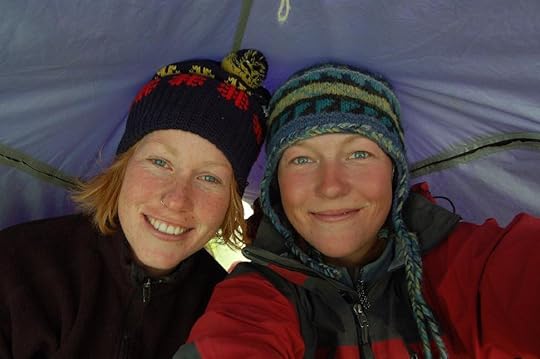
Melissa Yule and Kate Harris - image from Explore-mag.com
Harris and Yule had been teaming up for sundry adventures since they were classmates as pre-teens. Science fair projects eventually gave way to other pursuits. They ran in the NYC marathon, on a whim, according to their bios in CyclingSilk.com. Who does that? These two, apparently. They also biked across the USA in 2005 and rode bikes across Tibet and Xinjiang in 2006. (the earlier piece of the Silk Road trip.) I guess they were just getting warmed up. In 2011, three Masters degrees between them later, Harris’s from Oxford and MIT, they combined their endurance-athlete inclinations, a permanent desire for adventure, and an interest in protecting imperiled landscapes and ways of life to try to ride the entire Silk Road, or at least as much as was possible, beyond what they had already ridden. Some borders are real, though, defended by people with guns, and require one to set off in an unplanned direction. So, there were interludes that had them on trucks, buses, trains, and planes.
Longing on a large scale,” says novelist Don DeLillo, “is what makes history.” And longing on a smaller scale is what sends explorers into the unknown, where the first thing they do, typically, is draw a map.There are passages throughout the book on nature conservation, and the irrelevance of political borders to biological realities, but I got the feeling that this was far secondary to the ecstasy of adventuring. It seemed to me that Kate’s prodigious talent at writing grant applications, and no doubt Mel’s as well, had secured necessary funding (a $10K grant, plus considerable other support) for their odyssey, but reporting on conservation along the ride, while constituting the labor required to justify the grant, was something less than a passion. ( I was smitten with wildness, and only incidentally with science.) Of course, it could be that Harris and Yule’s reports back to their sponsors on the more scientific details of the pair’s extended field trip was the channel for most of that material. This book focuses on the adventure of exploration and, remaining true to the title, a consideration of borders, literal and figurative.

From Harris’s Facebook pages
The more I learned about the South Caucasus, with its closed borders and warring enclaves, the more the place seemed like a playground game of capture-the-flag turned vicious, all in the dubious name of nationalism. And yet political fortunes, while sometimes solid as brick, are finally only as strong as shared belief.Harris provides spot-by-spot descriptions of the places through which they travel. She notes the sorts of things you would expect, the landscape, the architecture, the weather, the physical conditions of the area, the traffic, the colors and textures, the friendliness (or not) of the locals and the pair’s interactions with them. The history of the places they traverse comes in for a bit of a look. The origins of the word “Tibet,” for example, a consideration of whether Marco Polo actually traveled as far as he claimed, and disappointment that his motivation was solely mercantile and not exploratory. One source of inspiration was an intrepid female explorer from the late 19th and early 20th centuries, Fanny Bullock Workman, a mountaineer and explorer also fond of the bicycle.
this particular stretch of salt and wind, nearly uninhabited and widely dismissed as a wasteland, is one of the most contested territories in Asia. Tibetan by cultural heritage, Indian by treaty claim, and Chinese by possession, the Aksai Chin is caught in this territorial tug-of-war owing to its strategic location between nations. It all began when China furtively build a road across it in 1957, the very dirt track we were on, roping like a slow-burning fuse for more than 1,600 kilometres over the emptiness of the plateau. India only clued in to Highway 219’s existence half a decade later, and their discovery detonated a war over the borderland.

image from NatureNeedsHalf.org
She fills us in on some of the logistical challenges involved, the hurdles to be jumped in getting the correct papers to cross from here to there, the difficulty of communicating when there is no common language, the struggle to find food, water and shelter, replacements for lost or broken pieces of this or that. One surprise was the absence of any reports of serious sexual predation, although she does report on the need to move quickly at times to evade potential unpleasantness. There are several reports of wonderful, warm experiences, as locals take the pair under their wings for a meal and a warm place to sleep. They are even joined for a time by a stray dog, and are swarmed by a herd of Tibetan antelope.
Anyone can recognize wildness on the Tibetan Plateau; the challenge is perceiving it in a roadside picnic area in Azerbaijan.Harris’s telling is not just the travelogue of seeing this, then that, but includes ongoing philosophical meanderings, about her own experiences and the wider human variety, about not only the political borders with which people must contend, but personal edges, where they begin and end, or don’t. Her intellectual explorations are bolstered by a rich trove of quotes from literary classics, both prose and poetry, and from some of the authors you would expect, like Thoreau and Muir, Wallace, Darwin, and Carl Sagan. But finally, it is Harris’s gift for language that elevates this book to Himalayan heights. Combining intellectual heft with an inquiring mind is amazing enough, but to be able to communicate both the inner and outer journeys with such sensitivity and beauty is a rare accomplishment indeed.
After being on an achievement bender most of my life, the prospect of withdrawal, of doing anything without external approval, or better yet acclamation, kept me obediently between the lines I couldn’t even recognize as lines. Isn’t that the final, most forceful triumph of borders? They make us accept as real and substantial what we can’t actually see?
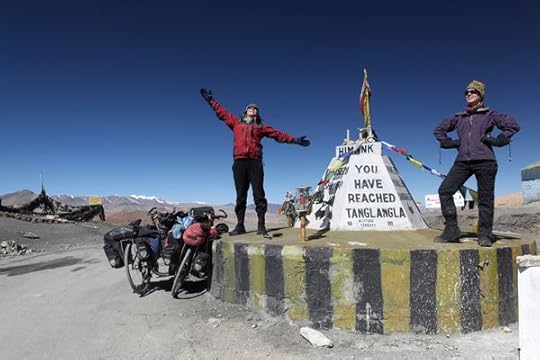
image from NatureNeedsHalf.org
I would not want you get through this review without at least a few roadblocks. I really wanted for each chapter to include a map of the travels contained therein. There is a map provide at the beginning, but chapter-by-chapter additions would have been most welcome. I would have liked a bit more science in the book, even if it added a fair number of pages to the total. A quibble. I wonder, though, if Harris was aware of the issues faced by Fanny Bullock Workman, who also wrote of her travels, having greater popular success with work that focused more on the travel than the scientific findings.
Whether buttressed with dirt roads or red tape, barbed wire or bribes, the various walls of the world have one aspect in common: they all posture as righteous and necessary parts of the landscape.This is not your summer trip to Europe. You will not be familiar with most of the places these two riders visit. The larger entities, sure, country names, some mountain ranges, but most of the local place names will be unfamiliar. Part of the fun of reading this book is that it sends you off on a journey of discovery of your own, looking up this town, that river, or an unheard-of plain or valley. In this, the book very much succeeds in sparking a bit of the exploratory impulse in most readers. You may or may not want to schedule a trip to many of the places she notes, but you will definitely want to learn more about them.
The true risks of travel are disappointment and transformation: the fear you’ll be the same person when you go home, and the fear you won’t. Then there’s the fear, particularly acute on roads in India, that you won’t make it home at all.
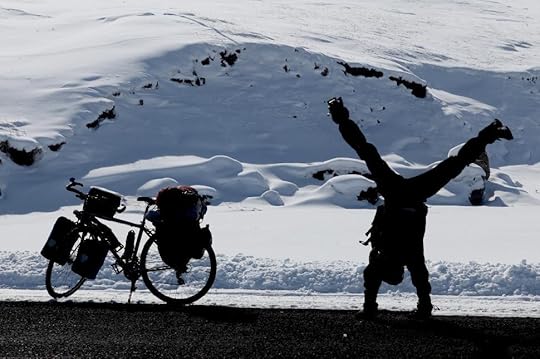
image from Explore Magazine – shot by Kate Harris
It may be grueling, surprising, filled with up and downs, demoralizing, exhilarating, exciting, stunningly beautiful, and rich with landscape, exterior and interior. Lands of Lost Borders may not wear out your arms or legs, your back, or any other muscle group, (ok, maybe the muscles that control your eyes) but it will stimulate your mind, lift up your spirit, and stimulate your need to pedal through darkness into knowing. Lands of Lost Borders is a stunning literary memoir you will not soon forget.
Exploration, more than anything, is like falling in love: the experience feels singular, unprecedented, and revolutionary, despite the fact that others have been there before. No one can fall in love for you, just as no one can bike the Silk Road or walk on the moon for you. The most powerful experiences aren’t amenable to maps.
Review first posted – April 6, 2018
Publication date – August 21, 2018
=============================EXTRA STUFF
Links to the author’s personal, Twitter and FB pages
Melissa Yule’s Twitter page. Yule holds a Master’s degree in International Development from the University of Guelph. Her interests include community development and environmental science. Here is her profile on the CyclingSilk.com site.
There is a lot of information available at Cycling Silk. I strongly advise you to check out the site.
A brief (11:43) video of their trip
In case you missed the link in the body of the review, it is worth checking out Fanny Bullock Workman, one of Harris’s heroes.
The Golden Record – it was sent on the Voyager mission to let far-away civilizations know we are here. Harris talks about it a fair bit at one point in the book

What’s on it - image from Wiki
The Harper Book Queen included a bit on this book in her TBR Tuesdays FB live broadcast from 8/21/18 - at 11:47
Interviews
-----The Globe and Mail - In a tiny B.C. cabin, Kate Harris penned tales of travel along the Silk Road - by Marsha Lederman - 2/15/18
-----Explore Magazine - The Way of the Wolf: Lands of Lost Borders, With Author Kate Harris
What was the hardest part of the journey?
Coming home and writing about it. Mel and I spent over a year total biking the Silk Road on two different trips. Writing a book about the journey took me half-a-decade. And while I love the exposure to new places and new people that you get by travelling by bicycle, I find there’s as much (or even more) intensity and thrill and a sense of discovery when I’m sitting back at my desk, trying to put those experiences to words. Words and the world go very much hand-in-hand for me: I traveled vicariously through books long before I had the chance to travel anywhere myself, so I wanted to write something worthy, I hope, of the books that galvanized me out the door in the first place.
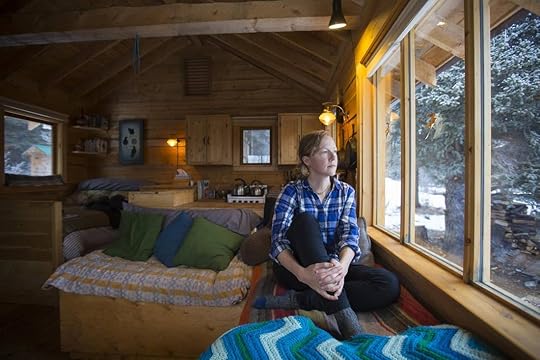
The Harris Mansion - image from the Globe and Mail article
400 sq ft of paradise in Atlin, B.C. suits the author just fine. Not surprising that she is comfy in what most of us might consider roughing-it quarters. She is a descendant of William Clark, of Lewis and Clark fame.
Sorry, I could not help it. There were just so many quotes from the book that I wanted to use. But it was not possible to fit them all in. So off we go to EXTRA EXTRA STUFF right below here in Comment #1
September 24, 2018
What a disappointing book. Kate came across as incredibly privileged. I wouldn't have minded reading a book about a woman who biked across Asia and read about her journey from start to finish. I would have loved reading about a woman who travels off the beaten path and makes deep meaningful relationships with people and their cultures. Reading her boast for pages and pages about how she's an explorer and destined for greatness, chronicling her Oxford and MIT experiences didn't wow me. Was it supposed to? At one point she has an interaction with a local and he asks what she does. She doesn't have an answer for him, because what it seems she does is get degrees and live a life of travel and adventure with no mention of work. If it had been a great description of remote cultures I would have put that aside. But it's a kid who gets to travel and feel entitled. The writing isn't even that great. Not impressed.

May 22, 2021
WOW!!! I really enjoy riding with Kate and Mel!!!
I was looking for something adventurous to read after being stuck in the house for a long time. I read Will Byrnes' review and was hooked. I liked the beginning of the book best. Kate growing up and deciding what to do with her life. Her college days and planning for the trip. I was not looking for the historical background, so much.
I was not encouraged enough to pump up the tires on my mountain bike. I did buy some nice trekking poles and I'm ready for some walking and hiking.
I was looking for something adventurous to read after being stuck in the house for a long time. I read Will Byrnes' review and was hooked. I liked the beginning of the book best. Kate growing up and deciding what to do with her life. Her college days and planning for the trip. I was not looking for the historical background, so much.
I was not encouraged enough to pump up the tires on my mountain bike. I did buy some nice trekking poles and I'm ready for some walking and hiking.

July 7, 2018
Beyond avenging my childhood ideals of explorers, and figuring out how to be one myself, I wanted to bike the Silk Road as a practical extension of my thesis at Oxford: to study how borders make and break what is wild in the world, from mountain ranges to people's minds, and how science, or more specifically wilderness conservation, might bridge those divides. So there I was, rich in unemployable university degrees, poor in cash, with few possessions to my name beyond a tent, a bicycle, and some books. I felt great about my life decisions, until I felt terrified.
Always an overachiever, Kate Harris took a rural Ontario child's dream about going to Mars and endeavored to become an astronaut by obtaining an undergrad degree at UNC, earning a Rhodes Scholarship to Oxford, and starting a doctorate at MIT. Along the way, Harris set off on many adventures by bicycle, and when the lab work became too stifling, she enlisted her longtime friend, Mel Yule, to join her in finishing a quest they had started some years before: biking the Silk Road from Istanbul to its terminus in the Himalayas. On Harris' website devoted to this trip, you can watch a highlights video described as “showcasing ten months, ten countries, and ten thousand kilometers of the Silk Road...in roughly ten minutes”. And while the video does capture something of the punishing conditions the women biked through and the lovely people that the pair met along the way, it does nothing to showcase the power of Harris' written word in this book: the narrative is simply a delight to read, filled with personal anecdotes, historical perspectives, and an academically informed tying-together of the disparate bits; all written in the awe-filled voice of someone who has witnessed the ragged ends of the Earth and was changed by that wildness. Lands of Lost Borders is a rare and true pleasure.
The root word of the word explorer is ex-plorare, with ex meaning “go out” and plorare meaning “to utter a cry”. Venturing into the unknown, in other words, is only half the job. The other half, and maybe the most crucial half for exploration to matter beyond the narrow margins of the self, is coming home to share the tale.
The obstacles that Harris and Yule faced on this trip are fascinating to read about, but not wholly unexpected: the physical challenge of carrying everything you might need – tent and sleeping bag, dry goods and cooking stove, clothes and spare bicycle parts – on the frame of your bike as you pedal down roads of varying stability; the weather that ranged from a month of sleet in a Turkish winter, to the punishing heat of a desert plain, to snow and thin air in the world's highest mountain range; attempting to interact with locals in an everchanging string of languages you don't understand; arranging visas to enter countries legally, or sneaking around the barriers to those areas that are barred to foreigners – as an adventure tale, there is much to inspire the imagination. And while I sometimes found the romanticism of Harris' writing to be a bit indulgent, I decided to submit to it as an honest expression of her own sense of wonder:
• We savoured nubs of chocolate all the sweeter for their smallness as the sun sank behind the mountains, and when it was too dark to read birdflight into speech anymore, even the silence was like something winged.
• As the sun rose it tugged gold out of the ground and tossed it everywhere, letting the land's innate wealth loose from a disguise of dust.
• Just another night on the Silk Road, with silence settling over the fields and the crickets resuming their own strange incantations, spells that conjured beads of dew from blades of grass and lulled us to sleep under a smoke of stars.
When Harris was at Oxford, she focussed on the history of science, and in particular, was interested in the Siachen Glacier in the Himalayas; a region of Kashmir claimed by both India and Pakistan which is not only the world's highest battleground, but has become the world highest and biggest garbage dump. It was such places of fuzzy and disputed borders along the Silk Road – like the Aksai Chin (Tibetan by cultural heritage, Indian by treaty claim, and Chinese by possession), or the Nagorno-Karabakh Autonomous Oblate (majority Armenian population, claimed by Azerbaijan because of imposed Soviet era borderlines) – that Harris and Yule sought out along the way, and because they had secured some funding for their trip from wilderness conservation groups, they meet up with local experts and guides periodically to discuss those species who choose to ignore mankind's imaginary boundaries. This kind of anti-nationalism becomes the undercurrent of the narrative, and along with other progressive truisms (I don't know about calling out North America and Western Europe as the world's biggest contributors to climate change while on a road that straddles India and China), there's an anti-capitalist bent to Harris' desire to avenge her childhood ideal of explorers (as quoted in the first passage). It was the adventure tales of Charles Darwin and Marco Polo that had first sparked Harris' wanderlust when she was a child, but as an adult, she learned that all her idols had feet of clay: Charles Darwin suffered a pitiable “withdrawal from wonder” as he spent his later years close to home, churning his data in theory; turns out, Marco Polo was never a true explorer, just a greedy capitalist who was looking for trade routes; the Wright Brothers gained the sky but sold their plane to the highest bidding military (a fact Harris had taken in at Oxford “like a knife to the heart”). Even the astronauts who once so inspired Harris were never sent on missions of pure exploration:
Astronauts rave about how they can't see any borders from low Earth orbit, yet the whole enterprise of space exploration is fuelled by a rabid nationalism. The same loyalty that sparked the Cold War also launched humans to the moon. How does cynical ambition, the capacity for mutually assured destruction, give rise to something as wondrous as a stroll on the Sea of Tranquility?
My natural inclination has been to push back against someone who uses her position within the wealth and stability of western civilisation to attempt to tear down that civilisation, but Harris has studied more and seen more than I ever will and I find myself unwilling to criticise her conclusions too harshly: if Harris can really see a way towards easing deadly border disputes through cooperative conservation efforts, more power to her.
Ride far enough and the road becomes strange and unknown to you. Ride a little farther and you become strange and unknown to yourself, not to mention your travelling companion.
Ultimately, beyond the political, this journey reads as one of self-discovery for Kate Harris. For anyone who was enchanted by, say, Cheryl Strayed's Wild, I would say read Land of Lost Borders: it's more serious and reflective, better written, and challenging of worldviews. I loved this book, cover to cover.

April 29, 2018
Edit: I'm revisiting this review a few years later because now I know the term "pick-me". The TLDR is: Kate Harris, pick-me-extraordinaire, wrote a book that was supposed to be about biking but was actually about being not like other girls.
Reading can be such a wonderful conduit for 'travel'. Good literature transports its readers in time and space, widening perspectives and broadening horizons.
However, too often, travel literature is antithetical to 'traveling through reading'. People who write books (or even worse, blogs) on their travels are often suffering from two conditions that go hand in hand: an inflated sense of self, and a condescending (in this case, distinctly orientalist) view of the rest of the world. I wanted Kate Harris to be different. Unfortunately, nobody wants Kate Harris to be different as much as Kate Harris wants that. So much of this book functioned as a compilation of quotes about being different and untamed and enjoying the wilderness. As if nobody else in the world enjoys trees and the night sky or whatever.
I managed to grit my teeth and push through most of the book, making excuses for Harris. She's obviously a bright woman, adventurous, self-assured, and eager to push her boundaries. It just got too weird and annoying for me when she got to Turkey. She mistranslated the word in Turkish for foreigner, which is yabancı. She wrote that the word for foreigner is gavûr - a pretty nasty slur. I can't imagine how deeply unpleasant someone would have to be to exist as a blonde, Western woman in the Middle East and be called that (there, Kate, you are different after all).
Reading can be such a wonderful conduit for 'travel'. Good literature transports its readers in time and space, widening perspectives and broadening horizons.
However, too often, travel literature is antithetical to 'traveling through reading'. People who write books (or even worse, blogs) on their travels are often suffering from two conditions that go hand in hand: an inflated sense of self, and a condescending (in this case, distinctly orientalist) view of the rest of the world. I wanted Kate Harris to be different. Unfortunately, nobody wants Kate Harris to be different as much as Kate Harris wants that. So much of this book functioned as a compilation of quotes about being different and untamed and enjoying the wilderness. As if nobody else in the world enjoys trees and the night sky or whatever.
I managed to grit my teeth and push through most of the book, making excuses for Harris. She's obviously a bright woman, adventurous, self-assured, and eager to push her boundaries. It just got too weird and annoying for me when she got to Turkey. She mistranslated the word in Turkish for foreigner, which is yabancı. She wrote that the word for foreigner is gavûr - a pretty nasty slur. I can't imagine how deeply unpleasant someone would have to be to exist as a blonde, Western woman in the Middle East and be called that (there, Kate, you are different after all).

January 16, 2021
Not my cup of tea, unfortunately.
July 5, 2019
I had been craving a good travel memoir for some time now - Kate Harris' Lands of Lost Borders not only hit the spot, it completely exceeded my expectations...
Packed with historical, geographic and scientific facts, literary references and philosophical wisdom, this book is an impressive debut and well deserving the recognition. Harris' passion, curiosity, and love for mountainous landscapes and vast spaces are contagious. Though I've never felt particularly drawn to Central Asia as a travel destination, nor compelled to hop on an almost yearlong bike trip, her courage and determination certainly are envious. As is her ability to recount her journey, and share her experiences...
The words are put together so perfectly on the pages, I was definitely along for the adventure. And I did not want it to end. I feel as though the magic of the Silk Road, its incredible stories and people met along the way, are now also a part of me... Unexplainably beautiful. Kate Harris is a rockstar explorer, and an extremely gifted writer.
Packed with historical, geographic and scientific facts, literary references and philosophical wisdom, this book is an impressive debut and well deserving the recognition. Harris' passion, curiosity, and love for mountainous landscapes and vast spaces are contagious. Though I've never felt particularly drawn to Central Asia as a travel destination, nor compelled to hop on an almost yearlong bike trip, her courage and determination certainly are envious. As is her ability to recount her journey, and share her experiences...
The words are put together so perfectly on the pages, I was definitely along for the adventure. And I did not want it to end. I feel as though the magic of the Silk Road, its incredible stories and people met along the way, are now also a part of me... Unexplainably beautiful. Kate Harris is a rockstar explorer, and an extremely gifted writer.

January 14, 2018
I received an advance reader's copy fro a Goodreads giveaway.
You can't hep but admire the determination of Ms. Harris and her companion Mel to complete the bicycle journey along the Silk Road. This journey took over a year in conditions varying from freezing to scorching temperatures, and very little in the way of creature comforts along the way.
I really enjoyed her descriptions of the terrain, and the many of the historical references to the locations she travelled through, especially in the determination of the geographical borders between countries is established and the routes of some of the traders/explorers such as Marco Polo who had traveleld along the route in the past.
Ms. Harris also give an overview of her own history, and what ultimately led to her taking this journey.
I did feel that there were some unneeded side stories that I skimmed through, especially recounting Darwin's travels and adventures. having actually read Darwin's own accounts, I had no need revisiting them.
You can't hep but admire the determination of Ms. Harris and her companion Mel to complete the bicycle journey along the Silk Road. This journey took over a year in conditions varying from freezing to scorching temperatures, and very little in the way of creature comforts along the way.
I really enjoyed her descriptions of the terrain, and the many of the historical references to the locations she travelled through, especially in the determination of the geographical borders between countries is established and the routes of some of the traders/explorers such as Marco Polo who had traveleld along the route in the past.
Ms. Harris also give an overview of her own history, and what ultimately led to her taking this journey.
I did feel that there were some unneeded side stories that I skimmed through, especially recounting Darwin's travels and adventures. having actually read Darwin's own accounts, I had no need revisiting them.
July 1, 2020
I let myself lure into this ... "on the Silk Road" fueled my curiosity and made me think of past travels of my own.
But, while I do share the wanderlust and some of the restlessness of the author, we would never have gotten along as travel companions.
I admire the determination and the achievement, it really does take a special kind of guts to bike from Istanbul to India, the sharing of the experience just doesn´t satisfy my curious mind.
Thinking of the parts of the Silk Road I have travelled, the rich cultural and social experiences I enjoyed, something is missing in this tale of two bikers on the loose.
If you want to share, make sure there is some substance besides the endless intake of cup noodles, mending inner tubes and setting up camp.
But, while I do share the wanderlust and some of the restlessness of the author, we would never have gotten along as travel companions.
I admire the determination and the achievement, it really does take a special kind of guts to bike from Istanbul to India, the sharing of the experience just doesn´t satisfy my curious mind.
Thinking of the parts of the Silk Road I have travelled, the rich cultural and social experiences I enjoyed, something is missing in this tale of two bikers on the loose.
If you want to share, make sure there is some substance besides the endless intake of cup noodles, mending inner tubes and setting up camp.

April 21, 2021
A good travel memoir, and a fine debut for this new-to-me writer. I read it pretty much in one sitting. A remarkable trip (actually, two trips). OMG, the saddle-sores! I skimmed most of the philosophical stuff. Some hard traveling, here. Good thing she and her bff were both young and strong! Recommended for those who dream of such a trip -- or, like me, just enjoy reading about it.
Jo Walton's mini-review, 2019, which led me to read the book. I doubt I would have had I not seen her write-up. Thanks, Jo!
"I loved this and couldn’t put it down. Harris is a Canadian who biked the silk road, going from Turkey to China, through Tibet, while being open and reflective about herself, about history, science, her own dreams, the planet, the environment, tourism, the desire for wilderness, the people she meets and their cultures, and most of all on borders, their reality, permeability, and mutability. Brilliant, enjoyable, and thought provoking. Almost everyone would enjoy this, even if it’s not the kind of thing they normally read."
Jo Walton's mini-review, 2019, which led me to read the book. I doubt I would have had I not seen her write-up. Thanks, Jo!
"I loved this and couldn’t put it down. Harris is a Canadian who biked the silk road, going from Turkey to China, through Tibet, while being open and reflective about herself, about history, science, her own dreams, the planet, the environment, tourism, the desire for wilderness, the people she meets and their cultures, and most of all on borders, their reality, permeability, and mutability. Brilliant, enjoyable, and thought provoking. Almost everyone would enjoy this, even if it’s not the kind of thing they normally read."

November 17, 2018
The mystique of the Silk Road (a name given by Westerners to the trade routes across Central Asia) has long fascinated me for its rich history and the way the route crosses cultures, religions, and environments, so I had really hoped for more depth on those aspects of this area of the world. While Harris does address some of these things, I had the feeling that maybe she hadn't done quite as much research into the area before traveling or really prepared herself for encountering the people there. Yes, the book is more about her bike journey with her good friend Mel and the challenges they faced along the way, but I had real concerns at the beginning about her blind spots about her own privilege and Western attitudes. While she did acknowledge some of those along the way, I still cringed at some of the descriptions of their encounters. Above all, I came away from the book feeling that perhaps "explorer" is not necessarily a great occupation or avocation in itself, as it seems to carry overtones of pre-conceived notions and conquering, instead of learning and humility.

July 20, 2021
Tipično severnoameričko nerazumevanje teme kojom se bavi i nezainteresovanost za sve osim opravdanja svog narativa. Autorka nadasve deluje kao slavohlepna privilegovana belkinja s vrha piramide zapadnjačke civilizacije, koja očito misli da je dovoljno da ne bude Amerikanka već Kanađanka (izem ti razliku) da bi bila s jedne strane lišena odgovornosti za to što je njena silna učenost i obrazovanost - kao i činjenica da može sebi da priušti potucanje po svetskim vukojebinama - očito posledica rođenja i odrastanja u društvima razvijenog kapitalizma, koja su svoj osnovni kapital stekla kolonizacijom, genocidom i robovlasništvom (pri čemu ga i dalje stiču na suštinski isti način) a s druge strane mogla da soli pamet "opresivnim" društvima kojima su njeni preci do pre stotinak godina u najboljem slučaju šenlučili i zulumćarili, ali zamislite samo - u tim društvima danas ne cveta demokratija.
Ovoliko licemerje odraz je društvenih vrednosti "progresivne" i "liberalne" strane Zapada, koja je i odgovorna što su autoritarne vansistemske mečke počele da im razvaljuju vrata i prozore i upadaju u skupštine. Činjenica da je ovakav naslov aktuelan samo govori u prilog tome da se ta "leva elita" još nije osvestila niti postala svesna svoje uloge u odvijajućoj apokalipsi, pošto sva srećna ide ruku pod ruku s raznim neofašistima i nacistima a sve u cilju opravdanja svog iščašenog svetonazora i uveravanja sebe i drugih u ulepšanu i našminkanu sliku o sebi.
1*
Ovoliko licemerje odraz je društvenih vrednosti "progresivne" i "liberalne" strane Zapada, koja je i odgovorna što su autoritarne vansistemske mečke počele da im razvaljuju vrata i prozore i upadaju u skupštine. Činjenica da je ovakav naslov aktuelan samo govori u prilog tome da se ta "leva elita" još nije osvestila niti postala svesna svoje uloge u odvijajućoj apokalipsi, pošto sva srećna ide ruku pod ruku s raznim neofašistima i nacistima a sve u cilju opravdanja svog iščašenog svetonazora i uveravanja sebe i drugih u ulepšanu i našminkanu sliku o sebi.
1*
November 21, 2018
Disclaimer: I did not receive a free copy of Land of Lost Borders: A Journey on the Silk Road; I paid full price for it at the bookstore and I am so glad that I did. Kate Harris really is a wonderful writer and even more than that she is a wonderful thinker. Her ability to make connections between her lived and inner experiences and the wider, wilder, world are what make this book fulfilling. There are so many books out there about journeys alone the Silk Road that it would seem as though one more wouldn't be necessary. Ms. Harris has written a necessary book. Her thoughtfulness about the bigger issues such as wilderness, borders, exploration challenge the reader to think of these concepts in new ways. A great finish to my 2018 reading challenge.

April 10, 2019
1.5 stars
At my last book club meeting, when we were trying to decide on our next read, I was fully behind this story. The blurb sounded interesting and I was hoping for a story that would speak to me, the way Cheryl Strayed’s Wild inspired me to want to do more. I’m not at all pleased to admit that I had to force myself to finish this book. I did not enjoy but a few bits and pieces.
Kate Harris’ tale started strong; I was very optimistic after just the first chapter. Things quickly went downhill from there for me, though. The writer came across as entitled to me, although there is nothing in particular that she wrote about her formative years that would make me think that. It wasn’t until the last chapter or two of this book before it became somewhat clear that she did actually care about the people she came across in her travels. In most cases, I felt that they were all just a means to an end. Even her travelling companion, Mel, didn’t seem all that important to her. Ms. Harris came across as a “me, me, me” type of person. Where I admire that she had a goal in mind and wanted to reach that goal, she never acknowledged that the people that helped her along the way with food and/or lodging were taking a HUGE financial hit when they did so. The people on her path live with very little, but are amazingly generous and welcoming. I’m sure it would have upset them if she had refused their hospitality. Yet it seems she never reciprocated their kindness, either financially or with helping in other little ways. Perhaps she did but didn’t write about that, but if that’s the case I feel she left the humanity aspect out of her story.
I don’t feel I got to know the author in any deep way with this book…which is odd for an memoir. I’m sure the reason I find her to be entitled, condescending, and selfish is that she doesn’t let the reader see her real self. What was she thinking while on this journey? She tells about other people, historical figures, that have taken the same journey and written about their travels. She gives bits and pieces of history of some of the areas she passes through, like an old history professor who cannot keep his train of thought going in one direction. It comes across and dry and lacking feeling.
There are very few personal anecdotes about things that happen to her along the way or the people and places she visits. The handful of times the author tells her personal stories (such as in the first chapter) are wonderful, there just aren’t enough of these gems in a book that’s over 300 pages long. I’m not asking her to make stuff up. But if there wasn’t more that happened on this trip, why bother writing about the journey? The thing is, I feel there were a lot of stories to be told. They were alluded to here and there, but never fleshed out to a satisfactory tale. Instead, Ms. Harris would go off on a tangent about Marco Polo or some other explorer.
Sometimes, after discussing a book at book club, I can start seeing facets of a story I didn’t see on my own. Maybe that will happen with this one. We shall see.
This full review, as well as insight from other members of my book club, can be found at All In Good Time.
At my last book club meeting, when we were trying to decide on our next read, I was fully behind this story. The blurb sounded interesting and I was hoping for a story that would speak to me, the way Cheryl Strayed’s Wild inspired me to want to do more. I’m not at all pleased to admit that I had to force myself to finish this book. I did not enjoy but a few bits and pieces.
Kate Harris’ tale started strong; I was very optimistic after just the first chapter. Things quickly went downhill from there for me, though. The writer came across as entitled to me, although there is nothing in particular that she wrote about her formative years that would make me think that. It wasn’t until the last chapter or two of this book before it became somewhat clear that she did actually care about the people she came across in her travels. In most cases, I felt that they were all just a means to an end. Even her travelling companion, Mel, didn’t seem all that important to her. Ms. Harris came across as a “me, me, me” type of person. Where I admire that she had a goal in mind and wanted to reach that goal, she never acknowledged that the people that helped her along the way with food and/or lodging were taking a HUGE financial hit when they did so. The people on her path live with very little, but are amazingly generous and welcoming. I’m sure it would have upset them if she had refused their hospitality. Yet it seems she never reciprocated their kindness, either financially or with helping in other little ways. Perhaps she did but didn’t write about that, but if that’s the case I feel she left the humanity aspect out of her story.
I don’t feel I got to know the author in any deep way with this book…which is odd for an memoir. I’m sure the reason I find her to be entitled, condescending, and selfish is that she doesn’t let the reader see her real self. What was she thinking while on this journey? She tells about other people, historical figures, that have taken the same journey and written about their travels. She gives bits and pieces of history of some of the areas she passes through, like an old history professor who cannot keep his train of thought going in one direction. It comes across and dry and lacking feeling.
There are very few personal anecdotes about things that happen to her along the way or the people and places she visits. The handful of times the author tells her personal stories (such as in the first chapter) are wonderful, there just aren’t enough of these gems in a book that’s over 300 pages long. I’m not asking her to make stuff up. But if there wasn’t more that happened on this trip, why bother writing about the journey? The thing is, I feel there were a lot of stories to be told. They were alluded to here and there, but never fleshed out to a satisfactory tale. Instead, Ms. Harris would go off on a tangent about Marco Polo or some other explorer.
Sometimes, after discussing a book at book club, I can start seeing facets of a story I didn’t see on my own. Maybe that will happen with this one. We shall see.
This full review, as well as insight from other members of my book club, can be found at All In Good Time.

January 28, 2019
I've been struggling with what to say about this book for days. Can Harris turn phrases that make me wish I'd thought of them first? Certainly. Lines like "I don't just appreciate huge, head-clearing horizons; I need them like a crutch, the sort of hard contours I can grab onto and heave myself up with to behold the vastness out of which we came and to which we all return" feel like something I'd have jotted down on my bike journeys. Harris can clearly write, when she isn't getting in her own way, that is.
There's a difference between gathering experiences and gaining perspective, and unfortunately, Harris all too often seems to be compiling the former without adding the latter. Nor did her editors do her any favors; it regularly seems clear that no one from any of the countries through which she rode had any input regarding how their countries and cultures were portrayed.
As a result, Harris herself comes off as rather unlikable and unfortunately overprivileged while also being incredibly underwhelming when it comes to showing perspective or wisdom. In her defense, she's young...but no one, no matter their age, should get a pass from editors.
Also? The narrative form here didn't help her. As a series of essays, this might have worked a little better, as the essay form could have helped shape and tighten the places where her privilege and lacking perspective detract. As a straight narrative, though? This didn't work for me.
[1.5 stars for the moments where Harris got out of her own way and let the experiences speak for themselves, rather than ruin them with her judgment and snobbery.]
There's a difference between gathering experiences and gaining perspective, and unfortunately, Harris all too often seems to be compiling the former without adding the latter. Nor did her editors do her any favors; it regularly seems clear that no one from any of the countries through which she rode had any input regarding how their countries and cultures were portrayed.
As a result, Harris herself comes off as rather unlikable and unfortunately overprivileged while also being incredibly underwhelming when it comes to showing perspective or wisdom. In her defense, she's young...but no one, no matter their age, should get a pass from editors.
Also? The narrative form here didn't help her. As a series of essays, this might have worked a little better, as the essay form could have helped shape and tighten the places where her privilege and lacking perspective detract. As a straight narrative, though? This didn't work for me.
[1.5 stars for the moments where Harris got out of her own way and let the experiences speak for themselves, rather than ruin them with her judgment and snobbery.]

December 22, 2020
What a trash dump of a book - confusing, self absorbed and privileged.
It's not a travelogue but rather a juvenile diary of someone with an unhealthy obsession with being an "explorer". A third of this book is devoted to uninteresting personal context, a third goes to random stories that have nothing to do with her journey and the remaining is an incoherent mess. The trip itself is the author's Plan B after abandoning her ambitions to go to Mars, mostly fueled by a deep fetish for Tibet. She despises Marco Polo but makes the entire trip about him. She has no interest in the places themselves - the people, their culture or their history. Instead she passes oversimplified judgements on every country, some which will make your teeth grind. Even her tirade about unnecessary borders is poorly informed, ignorant of the fact that most exist due to Western Imperialism.
Avoid this book like the plague (and ignore the make believe awards it has received). Read "In Xanadu" or "Empires of the Indus" instead.
It's not a travelogue but rather a juvenile diary of someone with an unhealthy obsession with being an "explorer". A third of this book is devoted to uninteresting personal context, a third goes to random stories that have nothing to do with her journey and the remaining is an incoherent mess. The trip itself is the author's Plan B after abandoning her ambitions to go to Mars, mostly fueled by a deep fetish for Tibet. She despises Marco Polo but makes the entire trip about him. She has no interest in the places themselves - the people, their culture or their history. Instead she passes oversimplified judgements on every country, some which will make your teeth grind. Even her tirade about unnecessary borders is poorly informed, ignorant of the fact that most exist due to Western Imperialism.
Avoid this book like the plague (and ignore the make believe awards it has received). Read "In Xanadu" or "Empires of the Indus" instead.
September 29, 2018
Lands of Lost Borders: A Journey on the Silk Road is a delightful memoir by author Kate Harris. Inspired as a child when she found an illustrated and abridged book, belonging to her mother, and highlighting Marco Polo's travels on the Silk Road. Combine that with an adventurous spirit and the dream of one day, pursuing science and perhaps going to Mars, Harris talks a childhood friend, Mel, in accompanying her cycling the fabled and historic Silk Road. What follows is an exciting adventure and a testament to these women and the friendships along the way as they crossed and successfully navigated many political borders. As a former long-distance cyclist (although not to that extreme), I loved this book.
"Traveling by bicycle is a life of simple things taken seriously: hunger, thirst, friendship, the weather, the stutter of the world beneath you."
"It was one of those rare moments in life when you measurably accelerate into a new version of yourself. . . That I'd pedaled to an altitude I'd only previously visited in airplanes, and that I could still breathe, was a revelation. . . I'd always hoped we'd make it to the Tibetan Plateau, still technically a few passes away, each higher than the last, but now, for the first time, I believed it."
"Tibet I often romantically evoked as the roof of the world. . . What the plateau truly presents is not refuge but a new frame of reference: from those dizzying heights, you can glimpse the real roof of our world, the faint swaddling of oxygen and nitrogen that holds us back from the heavens, or the heavens back from us."
"This particular enormity of slow-flowing ice, I learned was the Siachen Glacier, one of the last unexplored gaps on the map until the early twentieth century, when the redoubtable Mrs. Fanny Bullock Workman hitched up her tweed petticoat and hiked onto its base. In her mittened hand she gripped a sign declaring--not asking, thank you very much--'Votes For Women.'"
"Traveling by bicycle is a life of simple things taken seriously: hunger, thirst, friendship, the weather, the stutter of the world beneath you."
"It was one of those rare moments in life when you measurably accelerate into a new version of yourself. . . That I'd pedaled to an altitude I'd only previously visited in airplanes, and that I could still breathe, was a revelation. . . I'd always hoped we'd make it to the Tibetan Plateau, still technically a few passes away, each higher than the last, but now, for the first time, I believed it."
"Tibet I often romantically evoked as the roof of the world. . . What the plateau truly presents is not refuge but a new frame of reference: from those dizzying heights, you can glimpse the real roof of our world, the faint swaddling of oxygen and nitrogen that holds us back from the heavens, or the heavens back from us."
"This particular enormity of slow-flowing ice, I learned was the Siachen Glacier, one of the last unexplored gaps on the map until the early twentieth century, when the redoubtable Mrs. Fanny Bullock Workman hitched up her tweed petticoat and hiked onto its base. In her mittened hand she gripped a sign declaring--not asking, thank you very much--'Votes For Women.'"

October 14, 2024
Lands of Lost Borders is a travel memoir that recounts Kate Harris’s bicycle journey along the Silk Road with her friend Mel Yule. They traverse the remote regions of Central Asia, from Turkey to Tibet. Along the way, Harris reflects on her fascination with exploration and drive to live life to the fullest. Their journey takes them through diverse landscapes, such as deserts, mountains, isolated villages, the Steppe, Tibetan Plateau, and hot and humid regions of India. They face numerous challenges such as bureaucracy, governmental restrictions, checkpoints, complex visa processes, suspicious border guards, cultural issues, equipment failures, and adverse weather conditions.
From a young age, Harris was captivated by the idea of discovering new worlds, and even aspired to join a trip to Mars one day. Her narrative emphasizes that exploration is not solely about crossing geographical borders but about challenging the limitations we impose on ourselves. Harris and Yule’s journey as female travelers is another important aspect of the book. It portrays two capable women in what has historically been a male-dominated field. Quite a few people they meet are surprised that two women would even attempt such a crossing.
The narrative is nonlinear at times, weaving together present-day experiences on the Silk Road with memories from Harris’s earlier life and reflections on the history of exploration. The structure is episodic, with each chapter focusing on a different stage of the journey or a different theme. I enjoyed it as an example of someone who pushes boundaries and seeks new experiences. While I would never attempt such a journey, I always enjoy learning more about our world from those who do.
From a young age, Harris was captivated by the idea of discovering new worlds, and even aspired to join a trip to Mars one day. Her narrative emphasizes that exploration is not solely about crossing geographical borders but about challenging the limitations we impose on ourselves. Harris and Yule’s journey as female travelers is another important aspect of the book. It portrays two capable women in what has historically been a male-dominated field. Quite a few people they meet are surprised that two women would even attempt such a crossing.
The narrative is nonlinear at times, weaving together present-day experiences on the Silk Road with memories from Harris’s earlier life and reflections on the history of exploration. The structure is episodic, with each chapter focusing on a different stage of the journey or a different theme. I enjoyed it as an example of someone who pushes boundaries and seeks new experiences. While I would never attempt such a journey, I always enjoy learning more about our world from those who do.
November 21, 2017
I won an advanced copy of Lands of Lost Borders from the publisher and it arrived just as I got sick with the first bad cold of the winter. I was so excited to delve right in to this delicious read and escape my misery! This book is part memoir, part adventure travel guide, part history lesson and part science fiction (at least for me). Harris had always dreamed of traveling to Mars but found herself instead cycling from Istanbul, Turkey to Leh, India.. roughly 10,000 km in 1o months. For me, her story might as well have taken place on Mars. It seemed as remote, unfamiliar and at times, as inhabitable, as life on another planet. I can't say her story inspired me to want to live on instant noodles for months at a time or sneak across any border check points- but it did make me want to be a more daring and inquisitive traveler. I thought a lot about what I would give up or what hardships were worth enduring in order to have some of the experiences I dream of having, as a traveler and in life in general. Harris is a true explorer with a broad knowledge of science, history and literature. As a writer, she weaves this knowledge and experience together with musings on her past relationships and choices, her quirky childhood passions (Mars and Marco Polo), her honest reflections on the people she meets along her journey and wraps it all up with a sense of humour and incredibly beautiful and original descriptions... all while inspiring the reader to question and perhaps cross the perceived borders in their own lives.
July 16, 2019
I feel compelled to write my first ever review on Goodreads for this book, because it was so utterly disappointing. It was difficult to get into and I chose to stop reading it three quarters of the way through.
There seems to be a total disconnect and lack of interest by the author when it comes to local people, culture, and way of life. Instead of diving into this human side of the Silk Road, she focuses on certain historical aspects, technicalities of trip planning/logistics, and repeatedly referencing her academic background, which quickly became boring.
Half way through reading this I was still unclear on the need for the book at all because there was little insight provided by the author on anything other than Marco Polo and Mars. I found her effort to distinguish herself as a "traveller" rather than a "tourist" pretty elitist and laughable. This is ultimately what drove the book into the 2 star zone - the sense of privilege, entitlement, and condescension the author presents throughout, particularly in her interactions with locals.
There seems to be a total disconnect and lack of interest by the author when it comes to local people, culture, and way of life. Instead of diving into this human side of the Silk Road, she focuses on certain historical aspects, technicalities of trip planning/logistics, and repeatedly referencing her academic background, which quickly became boring.
Half way through reading this I was still unclear on the need for the book at all because there was little insight provided by the author on anything other than Marco Polo and Mars. I found her effort to distinguish herself as a "traveller" rather than a "tourist" pretty elitist and laughable. This is ultimately what drove the book into the 2 star zone - the sense of privilege, entitlement, and condescension the author presents throughout, particularly in her interactions with locals.

March 16, 2019
I've traveled a few times along the Silk Road. Ok, I did it from the comfort and safety of my favorite reading chair, but I've tagged along vicariously. This trip perhaps wasn't my favorite, although I did enjoy a lot of it, and I think Harris is a good writer. A little too much memoir for my taste, and maybe I would have liked a little more visual description, but she wrote it the way she wanted to. I certainly couldn't have achieved this tip, by bicycle or any other means of transportation, I think, and that is why I read these books. I certainly would love to see these places in person, though.
October 2, 2018
I couldn't tolerate the pretentiousness of the writer.
September 10, 2018
When I rate books, I try to stick with a bell shaped curve so most of the books I enjoy I give a 3 star. I rarely give a 1 or 5 star and every month or so I give a 2 or 4.
I generally try to only read books that have an average rating of 4 star or higher because it helps me weed out the bad or boring books. This book is fairly new and I think I read about it in a popular women’s magazine which is usually code for some publisher really pushing it so as I am writing this review it still has over a 4 star rating. No one has really given the book a negative review so I felt the need to explain my 2 star rating.
This book sounded like it would be so exciting and interesting. What a great adventure Kate and Mel must have had but it certainly didn’t seem like it from the 300 pages I read. It took me over 9 days to read this book because every time I thought about reading it, I found all sorts of other things I would rather do. I usually read 3 books in this same time frame. I suppose Kate was a decent writer but she seemed like such a boring person. She shared no clever or amusing stories about any of the people she met along her journey. Her attempts at “finding herself” along the Silk Road made for a very boring book.
Note: I am a math person who happens to enjoy reading but rarely writes so please excuse any poor grammar or incomplete thoughts.
I generally try to only read books that have an average rating of 4 star or higher because it helps me weed out the bad or boring books. This book is fairly new and I think I read about it in a popular women’s magazine which is usually code for some publisher really pushing it so as I am writing this review it still has over a 4 star rating. No one has really given the book a negative review so I felt the need to explain my 2 star rating.
This book sounded like it would be so exciting and interesting. What a great adventure Kate and Mel must have had but it certainly didn’t seem like it from the 300 pages I read. It took me over 9 days to read this book because every time I thought about reading it, I found all sorts of other things I would rather do. I usually read 3 books in this same time frame. I suppose Kate was a decent writer but she seemed like such a boring person. She shared no clever or amusing stories about any of the people she met along her journey. Her attempts at “finding herself” along the Silk Road made for a very boring book.
Note: I am a math person who happens to enjoy reading but rarely writes so please excuse any poor grammar or incomplete thoughts.

June 8, 2020
Sigh. I wanted to like this book, I really did. I was looking for an armchair travel adventure to enjoy during the Covid-19 lockdown. Sadly, Lands of Lost Borders did not deliver. Biking along the Silk Road with Harris in the comfort of my own home started out well. Harris's descriptions of the landscapes were wonderful, and made me want to see them for myself. However, her descriptions of the people she encountered made me angry. They made me dislike her book, and I could barely finish it. Here's a couple of examples:
"When the mother - an ample, exuberant woman whose breasts practically sagged into her pockets - put a kettle on the stove, I snuck a peek under a floor carpet."
"People were stacked in bunks like produce on shelves, some fresh, some overripe, most way past expiration."
The book was riddled with descriptions like this, passages that described the people who live in central Asia so negatively, totally ignoring their humanity and dignity. I mean, come on. Surely Harris could have mustered some kinder, more graceful descriptions of the people, especially those who took her into their homes and fed and sheltered her. I can't believe her editors let this fly.
"When the mother - an ample, exuberant woman whose breasts practically sagged into her pockets - put a kettle on the stove, I snuck a peek under a floor carpet."
"People were stacked in bunks like produce on shelves, some fresh, some overripe, most way past expiration."
The book was riddled with descriptions like this, passages that described the people who live in central Asia so negatively, totally ignoring their humanity and dignity. I mean, come on. Surely Harris could have mustered some kinder, more graceful descriptions of the people, especially those who took her into their homes and fed and sheltered her. I can't believe her editors let this fly.

November 2, 2017
From small town Ontario, Kate Harris went on to study at Oxford as a Rhodes scholar, and earned science degrees from UNC and MIT. The passion driving her was space exploration but once she ended up in a lab she took off to explore the Silk Road by bicycle and reinvented herself as a nature and travel writer. Her writing style, powers of observation and academic background, along with her thirst for exploration, are such that this memoir deserves to sit with authors like Rory Stewart, Pico Iyor and the sort of classics that Harris includes in her select bibliography. And beyond its considerable entertainment value for the armchair traveler, it should be noted that this book very much does what the best of the genre does: it makes you want to get outside and explore.

May 16, 2020
As a child, Kate Harris wanted to be an explorer, to discover parts of the world that had not been seen by any human. It was as a teenage though that she realised that this dream was almost impossible as almost everywhere had been mapped and explored. As our planet had been so extensively explored, she decided to become a scientist and follow her dreams and explore Mars.
The appeal of seeing some of this planet first grew on her after trips to Italy and hearing the Dali Lama talk. Reading about the Himalaya’s brought out the desire to travel even more and decided to write her thesis about the Siachen Glacier. Knowing that a good result in this would mean she could qualify for her doctorate that she wanted to do, she poured her heart and soul into the work but feared for her marks after a conversation with her tutor. MIT beckoned… Her new tutor was not that keen on fieldwork, preferring to work in the lab, so she was dispatched to Yellowstone with some others. But all the time she was there, the silk road beckoned, and one day she decided that she wanted to cycle along it again.
Departing from Istanbul with her friend, Mel, they hear a young lad tell them not to crash. They choose to ignore him, preferring to savour the smell of the spices in the bazaar and head to the boat to cross the Bosporus where a chance meeting with a really old school friend means they miss their stop. Quickly resolved, they climb onto their bikes and set off. Turkey was a bit of a mixed bag, lovely people and food, but dirty and busy roads tarnished their opinion of it.
Passing from Turkey into the countries of the Caucasus is a reminder that this is an unsettled region and often subject to closed borders and warring enclaves. It is a change they can feel too, as they go from paved road to a cratered and potholed road and their speed drops accordingly. As they pass through Tbilisi in early March, the winter is just starting to lose its grip, trees were just showing the first buds and the light increased day by day.
They couldn’t cycle all parts of the journey, various sections were passed in trains or other transport, but they relish the time that they spend cycling, moving in the early morning to avoid the heat of the desert, deciding that they are too tired to wave at every driver that passes and trying to find somewhere to camp on the Tajikistan and Afghanistan border. The thing that they still don’t know is if they will be able to ride up onto the Tibetan Plateau to be able to complete their journey.
Our bicycles cast long cool shadows that grew and shrank with the desert’s rise and fall, its contours so subtle that we needed those shadows to see them. The severity of the land, the softness of the light – where opposites meet is magic.
Harris is not a bad writer and I thought this was a reasonable book overall. Sit feel like she is an observer of the people that she meets rather than fully engaging with them. There are lots of lovely little details and descriptions of the towns and villages they pass through. It was a shame that they couldn’t complete the whole journey by bicycle, but other factors made that almost impossible. Just didn’t have that extra something to lift this though.
The appeal of seeing some of this planet first grew on her after trips to Italy and hearing the Dali Lama talk. Reading about the Himalaya’s brought out the desire to travel even more and decided to write her thesis about the Siachen Glacier. Knowing that a good result in this would mean she could qualify for her doctorate that she wanted to do, she poured her heart and soul into the work but feared for her marks after a conversation with her tutor. MIT beckoned… Her new tutor was not that keen on fieldwork, preferring to work in the lab, so she was dispatched to Yellowstone with some others. But all the time she was there, the silk road beckoned, and one day she decided that she wanted to cycle along it again.
Departing from Istanbul with her friend, Mel, they hear a young lad tell them not to crash. They choose to ignore him, preferring to savour the smell of the spices in the bazaar and head to the boat to cross the Bosporus where a chance meeting with a really old school friend means they miss their stop. Quickly resolved, they climb onto their bikes and set off. Turkey was a bit of a mixed bag, lovely people and food, but dirty and busy roads tarnished their opinion of it.
Passing from Turkey into the countries of the Caucasus is a reminder that this is an unsettled region and often subject to closed borders and warring enclaves. It is a change they can feel too, as they go from paved road to a cratered and potholed road and their speed drops accordingly. As they pass through Tbilisi in early March, the winter is just starting to lose its grip, trees were just showing the first buds and the light increased day by day.
They couldn’t cycle all parts of the journey, various sections were passed in trains or other transport, but they relish the time that they spend cycling, moving in the early morning to avoid the heat of the desert, deciding that they are too tired to wave at every driver that passes and trying to find somewhere to camp on the Tajikistan and Afghanistan border. The thing that they still don’t know is if they will be able to ride up onto the Tibetan Plateau to be able to complete their journey.
Our bicycles cast long cool shadows that grew and shrank with the desert’s rise and fall, its contours so subtle that we needed those shadows to see them. The severity of the land, the softness of the light – where opposites meet is magic.
Harris is not a bad writer and I thought this was a reasonable book overall. Sit feel like she is an observer of the people that she meets rather than fully engaging with them. There are lots of lovely little details and descriptions of the towns and villages they pass through. It was a shame that they couldn’t complete the whole journey by bicycle, but other factors made that almost impossible. Just didn’t have that extra something to lift this though.

November 27, 2017
This book was phenomenal. Filled with imagery that transports you across continents and historical knowledge that flings you through time, Harris' delightful – if saddle sore – journey through Asia's ancient Silk Road will make you swear to take your own trip. And swear off it on the next page. Freezing weather, rain, snow, terrifying traffic, washboard roads (when there were roads at all), an eternity of living on instant noodles, instant coffee, and instant oatmeal. Harris manages to communicate her deep joy and gratitude for this experience, for every bleak vista she cycles by, while not holding back her about exhaustion, aching muscles, illnesses, and fear of detention travelling through countries with restrictive and byzantine tourism policies. In every line her brilliant writing and lyrical imagery shines through, carrying you along with her on the back of her bicycle. I feel truly privileged to have gotten a chance to read this book pre-release, having won it in a draw, and I highly recommend it to any fans of travel writing looking for new lands to explore. Coming to a bookstore near you in January 2018.
December 4, 2017
After reading the 4-page prologue I wanted to cancel all of my plans and just keep on reading. After reading 10 more pages I wanted Kate Harris to be my new best friend. Kate and her friend Mel (Melissa) spent almost a year cycling along Marco Polo’s Silk Road from Istanbul to the Himalayas. They didn’t know anyone, didn’t know the languages, and had barely useful maps. They were up for adventure, and adventure is what they got. They snuck past border guards; rode through searing heat, snow, and rain and mud; damaged and temporarily lost their bikes; and Kate even had her only pair of biking shorts stolen by a monkey. They were rewarded by the kindness of strangers who fed them and gave them places to sleep. Most remarkable of all, at the end of it all Kate and Mel were still good friends. Interesting. Well written. It almost makes me want to visit some of those hard to get to places. It definitely makes me want to read whatever Ms. Harris writes next.

August 10, 2018
Finished this book the same week that bicyclists were murdered in Tajikistan. I can only imagine how horrified and sad this must have made the author.
I don't know why it took me so long to read Lands of Lost Borders. My unfamiliarity with the area made it more slow-going, as did the lack of maps (and my laziness not looking up the countries or looking for more resources that the author has available). That said, it is very very good and I hope to read it again in the future after I lend it to my many biking and traveling friends who will undoubtedly love it.
I can't add anything to Will Byrnes' fabulous review on Goodreads, so I will finish with the mandated acknowledgement that I received a free copy of the Advance Reader's Edition.
I don't know why it took me so long to read Lands of Lost Borders. My unfamiliarity with the area made it more slow-going, as did the lack of maps (and my laziness not looking up the countries or looking for more resources that the author has available). That said, it is very very good and I hope to read it again in the future after I lend it to my many biking and traveling friends who will undoubtedly love it.
I can't add anything to Will Byrnes' fabulous review on Goodreads, so I will finish with the mandated acknowledgement that I received a free copy of the Advance Reader's Edition.

September 5, 2020
This book will go down as one of the best books I have read, of all times.
Through her words, Harris took me along with her on the Silk Road, sneaking into the Tibet, going through the bureaucratic processes in the 'stan' countries, riding in the high lands and the steppes - and through this amazing journey I took from my couch, Harris gave me enough backstories about a few real world problems and how they are affecting us.
Though I will never have the stamina, ability and willpower to undertake a trip of this size, and the ability to write so beautifully about it, seeing Harris' views on wildness vs wilderness (one being a type of place, another the state of mind), tourists claiming wanderlust towards the exotic and ignoring the everyday, that one can travel wildly anywhere should one want to, love for nature, mountains and the untouched, freedom, borders, her own privilege which opened up so many roads for her, a viewpoint where we seek risk on our travels whilst the natives go through them everyday etc made me feel on multiple occasions that it could be me writing these - I felt a strange sense of validation in Harris's writing, that most of my opinions are not exclusively mine in a gratifying way - I am glad it is in writing!
I think this love for the author, and hence her words and experiences started when I read her implicit views about Tibet and the Chinese oppression there as she refuses to enter Tibet legally; and then it only grew as she spoke about how borders are irrelevant in places like Siachen and yet there they are, soldiers guarding it night and day; continuing on to see her impeccable achievements in school, Oxford and MIT; the fact that she is a fellow Pacific North Westerner; her love for books, referring various authors and the sheer beauty of her words as she is giving you a glimpse into her emotions; the motivation to ride down the Silk Road, which is to see beyond the borders - a job she does really well through that one year.
I learnt a lot about the world as I read about Fanny Bullock Workman and her expedition to Siachen; the skirmish at Mt. Ararat (a place that I have always wanted to go because of the Noah mythology ) , the Turks and Armenians; the saints and rules and the rich civilization that came from the 'stans'; the life of Tibetans in Tibet vs in India; the concrete roads by the Black Sea and the ecology destruction there; caviar diplomacy and so many other nuggets of information which have made me more aware.
We need more such books to be written - books which talk about the joy of feeling free when one is going about the world; where travel is not glorified as THE ONLY THING that matters but that exploration is important to expand our horizons; where travel is not for Instagram but for the self; which intersperse, lest we forget, memoirs with travel experiences with local life - all said as a matter of fact, and not by taking sides.
Need I say more, I LOVED every single word in this book!
(And I was so glad to see it was blurb-endorsed by my other favorite author, Pico Iyer)
Through her words, Harris took me along with her on the Silk Road, sneaking into the Tibet, going through the bureaucratic processes in the 'stan' countries, riding in the high lands and the steppes - and through this amazing journey I took from my couch, Harris gave me enough backstories about a few real world problems and how they are affecting us.
Though I will never have the stamina, ability and willpower to undertake a trip of this size, and the ability to write so beautifully about it, seeing Harris' views on wildness vs wilderness (one being a type of place, another the state of mind), tourists claiming wanderlust towards the exotic and ignoring the everyday, that one can travel wildly anywhere should one want to, love for nature, mountains and the untouched, freedom, borders, her own privilege which opened up so many roads for her, a viewpoint where we seek risk on our travels whilst the natives go through them everyday etc made me feel on multiple occasions that it could be me writing these - I felt a strange sense of validation in Harris's writing, that most of my opinions are not exclusively mine in a gratifying way - I am glad it is in writing!
I think this love for the author, and hence her words and experiences started when I read her implicit views about Tibet and the Chinese oppression there as she refuses to enter Tibet legally; and then it only grew as she spoke about how borders are irrelevant in places like Siachen and yet there they are, soldiers guarding it night and day; continuing on to see her impeccable achievements in school, Oxford and MIT; the fact that she is a fellow Pacific North Westerner; her love for books, referring various authors and the sheer beauty of her words as she is giving you a glimpse into her emotions; the motivation to ride down the Silk Road, which is to see beyond the borders - a job she does really well through that one year.
I learnt a lot about the world as I read about Fanny Bullock Workman and her expedition to Siachen; the skirmish at Mt. Ararat (a place that I have always wanted to go because of the Noah mythology ) , the Turks and Armenians; the saints and rules and the rich civilization that came from the 'stans'; the life of Tibetans in Tibet vs in India; the concrete roads by the Black Sea and the ecology destruction there; caviar diplomacy and so many other nuggets of information which have made me more aware.
We need more such books to be written - books which talk about the joy of feeling free when one is going about the world; where travel is not glorified as THE ONLY THING that matters but that exploration is important to expand our horizons; where travel is not for Instagram but for the self; which intersperse, lest we forget, memoirs with travel experiences with local life - all said as a matter of fact, and not by taking sides.
Need I say more, I LOVED every single word in this book!
(And I was so glad to see it was blurb-endorsed by my other favorite author, Pico Iyer)
Displaying 1 - 30 of 823 reviews