Jump to ratings and reviews
Rate this book

Two Arms and a Head: The Death of a Newly Paraplegic Philosopher

Rate this book
The journal of a man paralyzed from the chest down, who died of a self-inflicted wound as he finished the final entry. Through a series of thought experiments and literary allusions, Atreus explores the nature of freedom and the ethics of suicide.

http://2arms1head.com

(No information is available online regarding the author, who may have used a false name. If anyone has more information, you are welcome to edit this description.)

ebook

Published February 24, 2008

15 people are currently reading
314 people want to read

About the author

Clayton Atreus

1 book1 follower

Ratings & Reviews

What do you think?
Rate this book

Friends & Following

Create a free account to discover what your friends think of this book!

Community Reviews

5 stars
87 (54%)
4 stars
51 (32%)
3 stars
14 (8%)
2 stars
6 (3%)
1 star
1 (<1%)
Displaying 1 - 30 of 40 reviews
Profile Image for Sol.
703 reviews35 followers
Read
March 17, 2024
I have strong reason to believe that this book is a genuine account, authored by and about a real person who experienced the things described therein. As the book has been linked in various places disconnected from its origins, the story of its provenance has become harder to find for the casual reader (though not that hard), and I have seen some people express skepticism about it, and suggest it's merely an in-depth creative writing exercise. This is not the case. Clayton was a real person with lots of verifiable information about him, and he wrote this. More on that below.

The Book

Now read primarily at the website http://www.2arms1head.com, Two Arms and a Head is a book length (66 thousand words) and format suicide note by one Clayton Schwartz, written under the pseudonym Clayton Atreus, completed in February 2008 shortly before his death. He was involved in a motorcycle accident in Mexico in 2006, which left him completely paralyzed below the chest.

I attempted to find a quote which might encapsulate the whole text, but as I was reading I was picking up more than a dozen possible contenders. Clayton had a talent for wrapping up his ideas in easily digestible chunks, so I chose one for each of what I saw as his three main goals.

How do you feel about reading all of this? Do you find me disgusting or tasteless for not simply leaving it out? Maybe I have a sick desire to degrade and humiliate myself by opening the curtain and exposing facts that are better untouched by daylight? Surely it does not indicate human greatness to go on at length about such things. Sorry but you’ve got me wrong. I’m just telling you how it is.

First, to communicate his experience of being paraplegic, physically, emotionally, and socially, including what he saw as uncomfortable and unspoken truths.

I can say something like “I can’t have sex anymore.” Then instead of sympathizing with my pain, they pretend like they don’t know what I’m talking about. No sympathy, because it threatens their security. If your child was lying dead on the ground in front of you and you cried out “My baby is gone!” they would say “What do you mean? He’s right there in front of you.”

Second, to attack and discredit what he saw as the lies and delusions of the disability community, who he blames for blocking and decreasing support for cures for paralysis and legalization of assisted suicide.

In a sense my suicide is an affirmation of life because through the act I renounce an inferior life and affirm the life I loved, which is now impossible for me.

Third, to explain and justify his suicide as the actions of a man in a sound state of mind who found his existence intolerable, and saw no prospect of it ever improving or himself becoming accepting of it.

Clayton's style ranges from philosophic to intensely personal and confronting, and can move from one to the other very quickly. The chapters likewise range widely in length and tightness of focus. Chapter 4, "Time", for example, covers only the fact that his disability makes every action of his take far longer than it did before his injury. Chapter 7, "The Trial", by contrast, is very long and shifts in purpose as it goes. It starts with Clayton attempting to explain how he has experienced a feeling of being "on trial" whenever he tries to express his true feelings about his disability, then moves to trying to delineate various rhetorical fallacies the disabled tend to use. Finally it becomes a succession of quotes from disabled activists and other platitudes which he mocks for their meaninglessness. The general thrust of the chapter is that Clayton believes many of the severely disabled have had to delude themselves so powerfully that their lives aren't worse than the able, that they may as well be considered mentally mutilated as well as physically. There seems to be a certain spiteful satisfaction in saying things socially unacceptable, having moved past life, and getting the last word in, as he will never be confronted with any response to his writing.

To be clear, he does not hate all disabled people. He thanks Mike Utley for personally contacting him, praises the accomplishments of Rick Hansen, and claims that other paraplegics have echoed his feelings in private. What he hates is the culture of the majority of the disabled, which makes his expression of his suffering socially unacceptable, because it draws attention to things the disabled would rather deny or not think about. As an outsider, it's difficult to say whether he was being too harsh. As Clayton wrote, I probably wouldn't be jumping to correct someone in a wheelchair who said something about their abilities that was not literally true. What would be the point? But Clayton makes a high virtue of truth, whereas I see delusion as a generally necessary part of human life. I don't think anyone could withstand the full force of the terror of death every second of the day. We need to be able to deny, forget, to lie to ourselves. We just aren't such noble creatures that we can survive on only truth. Clayton's truth may have preserved what he saw as his virtue and integrity, but it lead him to death. Paraplegics do have a high suicide rate, but it isn't inevitable. If delusion can help someone to cope, is it really so bad? It's ultimately a question of values, which Clayton and I both agree is a personal question. His love of truth must come in conflict with the majority who want to live, even at the cost of the integrity of their beliefs. This a contradiction that runs throughout the book, his veneration of truth combined with his dismissal of metaphysical values such as morality.

Many parts of the book are shocking and disquieting, especially his physical descriptions of the daily indignities he is subjected to, but the hardest part by far is the description of his thoughts and feelings leading up to his suicide, including a description of the act. I think anyone with the slightest feelings of compassion would find it difficult. Clayton writes that the one thing he really wanted was that he didn't have to die alone. But it was impossible. Not only would his loved ones try to stop him, it almost certainly wouldn't be legal to watch him kill himself and not intervene. So he suffers a double tragedy, not only has he been driven to the ultimate despair, he can't even alleviate his final moments. I hope that writing this gave some small measure of relief to him. I was touched by his message to his loved ones that there was absolutely nothing they could have done, or failed to do to save him, and that it was solely his injury that led to his suicide. He maintained until the end, that if he could have been miraculously cured, he would have ran for joy in the streets, and returned to his old life. Unfortunately, even 14 years later, spinal cord regeneration remains impossible. His assessment of his chances of healing were right.

The Investigation

But, is it true? The site links nowhere and has no other content than the book. The WHOIS information associated with the domain shows only that it was registered 23 December 2010, with a Florida company named Respect My Privacy providing all registrant information. Googling the domain name or the title of the book brings up nothing on the first page of Google other than people reviewing and talking about the book. Googling "Clayton Atreus", however, does. At the bottom of the first page is a blogspot blog. The site contains three posts, all posted 1 November 2008. The first contains the text of the book, the second a link to a motorcycle forum, and the third an article about discrimination against employing the disabled by the legal profession. The third doesn't even claim to be written by Clayton, and indeed attributes part of his despair to something not mentioned at all in the book. The account that made the blog has three other blogs, one which has no posts, the other two each having one post equally unrelated to anything Clayton wrote. The link to the adrider.com forum, however, is enlightening.

Started by a user "OZYMANDIAS" on 7 May 2006, he describes his plan to motorcycle from Seattle to Argentina, links to a now defunct and unarchived personal site, www.houseofatreus.net, and signs the post as "Clayton". He updates the thread several times describing his travels, and another user posts several pictures after meeting him, now lost. In the 39th post on 7 June 2006, things take a turn for the worse. He describes a collision with a donkey matching the account in the book, and copies an email from his mother, last name Schwartz, asking for donations to help with medical expenses. On 24 June 2006, an account "Ozy'sMom" makes its first post in a different thread about Clayton's accident, telling the users that Clayton is undergoing physical therapy in Houston Texas, and thanks the users for their financial and emotional support. On 26 June 2006, Blanche Evans posts an article on realtytimes.com describing the accident.

Clayton posts sporadically up to August 2006, relating his difficulties, and his plans to continue going to law school in Nashville. He posts a few more times in October 2006, posting his journal of the trip, as he will never be able to use the material in a book he had originally planned to write. One year later, 13 September 2007, he tells the thread that he has finished the first year of law school.

On 25 February 2008, a new user informs the users of Clayton's death by suicide and says memorial information will follow. On 26 February a user relates Clayton's obituary from his parents, which matches the obituary published in The Atlanta Journal-Constitution. The obituary states that he was born 20 September 1975, grew up in Katonah, New York, attended John Jay High School and SUNY Potsdam College, was attending Vanderbilt Law School in Nashville, was injured in May 2006 and died 24 February 2008, with a memorial on 29 February. On that day a user describes attending the memorial and describing the feelings and condolences of the forumgoers. On 2 March, another user posts a message describing Clayton's memorial service, purportedly from Clayton's mother, as she had apparently lost her log-in information.

On 4 March, a user posts three messages containing what purport to be excerpts from Clayton's writings, some of which match passages from Two Arms and a Head. An administrator resets the password of Clayton's mother's account, and on 15 March she describes reading "Clayton's book". 15 November, a user chastises another for linking to a blog (link now deleted), which he describes as "pushing an agenda that you believe is related to Clayton", while another writes "I hope to Hell you talked to Ozy Mom before you did this. I hope you got their permission or blessing to use their son's name for a blog." This is enough for me to say with certainty that what was linked was the blogspot blog containing Two Arms and a Head above. Clayton's mother confirms it on 16 November when she writes "I did not fully understand till this very minute that what Carl did was put Clay's book up onto the site. Oh, dear God, I did not want that. He had no right to do that." She continues posting on the forum for several years, and writes on Feb 27 2010 that she had hoped to use his book in a lecture series for the Christopher Reeve Foundation, but his words are too unpalatable to inspire most people. On 23 December 2010, a user "ApostateAbe" (Clayton refers to a friend he calls "Honest Abe" in the book, whether this is the same person is unknown) posted a link to www.2arms1head.com, the same date the site was registered. Finally, on May 4 2013, a user posts what purports to be a message from Clayton's mother, explaining that it was not the leak of the book that caused her to leave the forum, but that it was painful to continue viewing it, and that regarding the book, she has "since accepted that there is no such thing as keeping that kind of power covert."

Now, this would seem to be enough evidence that the book is real. The account of Clayton's mother was created before Clayton left the forum, and at least one user claimed to go to the memorial and talk to his mother about the forum. But still, there are holes. The Ozy'sMom account had its password lost, which introduces a problem with the chain of provenance. It was after Clayton's death, and there is little hard evidence that Clayton's mother was actually operating the account after his death, and no direct proof that the other user visited the memorial. Fake obituaries have occurred, though I would hope a newspaper would at least attempt to corroborate a report of death. It's possible, though very unlikely, that the book, Ozy'sMom account, and the obituary is an extreme and morbid fraud perpetrated by the creator of the blogspot blog.

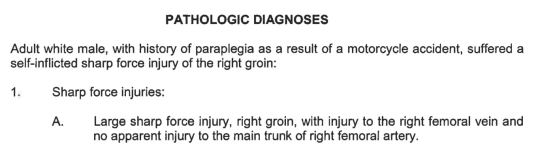
I did find evidence that seals the deal for me, however. While in the early stage of my research, I found an online database of vital records for all of Tennessee up to 2014. There I found that Clayton's date of death was officially 25 February 2008. Only a small discrepancy with the 24 Feb date listed in his obituary, and understandable if his death occurred overnight. From there I thought that if he did die by suicide, it's likely an autopsy was performed. I found that autopsy forms are freely available in Tennessee. I filled out the information from the vital records database, and they got back to me the next day, saying that reports before 2012 that had never been requested before had not yet been digitized, and they would send me a digital copy if the report could be located. Two weeks later they sent me a PDF file containing the autopsy report, which confirmed the method of death described in Two Arms and a Head:


And even more particularly, confirmed a telling detail that he was wearing two sweaters when he was found dead:


All in all, given that the report was apparently not digitized due to never being requested by a member of the public, and the report's agreement with details of the book, I believe wholeheartedly that it and the posts by Ozy'sMom are genuine. The only people who could have known the details of his fatal injury would be his discoverers and immediate family members and whoever they told. The fact that Clayton's mother calls out "Carl" by name does leave the slim possibility that he was a personal friend of Clayton who used his knowledge of his death to write the book, but I discount this. The book is similar in style to Clayton's posts before the injury, showing intelligence and education, an outgoing and emotive style, and a tendency to long paragraphs but short sentences. As far as I'm concerned, it's 100% real.

However, there is one odd part. The report records his time of injury as unknown, his time of death as 9:30 a.m. 25 February 2008, but his time of discovery as 8:00 a.m., suggesting he wasn't completely dead when he was found. However, Two Arms and a Head claims that the wound was inflicted around 8:50 p.m. 24 February. I have no medical training beyond a middle school babysitting course, but I would expect dying of a fatal arterial wound wouldn't take a full 12 hours. [I have been informed this is a venous injury, which are slower.] Assuming both the autopsy report and the book are accurate, I think there is a way to reconcile them. Clayton writes that since he didn't sit slouched over, he needed to hold his body upward using an arm all of the time, and that without his arms he would flop over involuntarily. Combined with his claim of being surprised with the slow rate of bleeding, I believe it's possible that after he passed out from blood loss, he flopped forward, which combined with the sweaters he was wearing provided enough pressure on the wound to slow but not fully stop the rate of bleeding, thus causing the bleeding to take several hours longer than one would expect. The report makes no comment on the body position he was in when he was found.

Additionally, Clayton wrote many posts on carecure.net, a forum for sufferers of neurologic illnesses/injuries. I lost the exact posts they were linked from in the advrider thread, but I believe the links were all posted after his death, so it's unknown if his loved ones were aware of them before he died. Running out of characters, so here is one link. The rest of his posts are on his profile.

https://www.carecure.net/forum/sci-co...
1 review1 follower
October 17, 2022
His name was Clayton Schwartz. He was a real person and his book was 100% his actual experience, including his suicide. I know this for a fact, because Clayton was my friend. Find his obituary online. Google Clayton Schwartz motorcycle

I met Clayton when I was 18. I moved into a shared house that he was managing in Seattle's University District. My room was across the hall from his and we hung out a lot. He was actually sort of a mentor to me. He taught me how to exercise, introduced me to YouTube, and talked about philosophy. Yes, he was a bit of a macho man who thought highly of himself, but he walked the walk. Everyone has their flaws, he was honest about some of his.

Clayton had a huge passion for life. Everything he said was true. When he lost his ability to move freely he lost everything. After his accident he would call me and talk for hours about wanting to die. I wasn't surprised at all. I knew he could never be happy with 2 arms and a head.

I didn't read his book until recently. I recieved an email of the book after his death, but I couldn't read it. After finally reading the book years later, I realize even more what a unique and interesting man Clayton was. I miss our smash parties where we would go to the back alley and smash people's thrown out items to let off steam. I miss laughing at Salad Fingers and dancing while Clayton sang This Charming Man as loud as he could. I miss his goofy gap tooth smile and large inquisitive eyes. He was truly one of a kind and I hope to never forget him.

My biggest takeaway from the book is that everyone should have the right to die with dignity. No one should be forced to live a life of pain and suffering, because of other people's moral issues. I wish I could've been there with him, cracking jokes til the end, telling him he had an impact and would be missed and remembered. He deserved that goodbye. He deserved to have his last hurrah. Instead he was so alone, because he had to hide. What a tragedy. What a shame. What a horror.
Profile Image for Andrew Foote.
33 reviews8 followers
March 17, 2020
I read this online at http://www.2arms1head.com/. It's basically a suicide note by a guy who was made paraplegic by a motorbike accident, describing why he considers his life no longer worth living. It's a highly analytical text, though also quite polemical and emotionally charged. Definitely worth reading for anybody who wants to examine their attitudes towards death and disability (which should be everybody, since everybody will die and most people will become disabled to some extent at least towards the end of their life).

I disagree with it utterly. But then again, I'm a "lifer", to use the word the author uses---somebody who has been disabled from birth. My disability is nothing like paraplegia, it's of a wholly different nature (mental, not physical) and probably somewhat less severe than paraplegia if you had to compare the two, although I think a lot of people underestimate exactly how profoundly it affects me. But there is quite a lot I can relate to in the author's description of what life is like for him as a disabled person. What I can't relate to is his value system which makes him believe that this sort of life is unbearable, and must be ended. The author knows that "lifers" generally disagree with his ideas---his argument is that we are basically a different species from other people in terms of values; our morals have been warped by our need to cope with our disability and have become something alien, which society in general is free to ignore. Well, that may be, but I am what I am. Anyway, I don't think society disagrees with us as much as the author thinks. Mainly I just don't think society has a fully coherent value system, and maybe it doesn't need to. We disabled people are edge cases, and a system doesn't necessarily need to account for all edge cases. I accept that the author had to die, because of the combination of his disability, and his particular value system, whose existence and immutability he made clear, which meant that this disability implied death for him. And I would support making assisted suicide legal, so that he could have been spared some of the difficulty he had in accomplishing his suicide. But he was wrong in his belief that everybody like him ought to die, or that it wasn't worthwhile for people to try to argue with him about his choice, to try and question and flesh out his beliefs and values in the hope that the tragedy might not be inevitable.
Profile Image for Eric Herboso.
68 reviews30 followers
March 17, 2021
Two days ago, I held Jasper in my arms as he died. My grief at his sudden death has overwhelmed me, and I've struggled to find ways to deal with it.

My latest method, apparently, has been to read this book-length suicide note by Clayton Atreus. I wouldn't say that it has helped much with my reaction to Jasper's passing, but I did find Two Arms and a Head compelling reading. Atreus became paraplegic in a tragic accident, and he ultimately disvalued the resulting life afterward so significantly that he committed suicide.

I doubt that I would have gotten along with Atreus, had I met him in his prime. His experience of life differs greatly from mine, and, to be quite honest, feels a bit shallow. But he is correct when he says that we are our own arbiters of our own value, and the fact that he values differently than I is not a good reason to dismiss his point of view.

Atreus gives a defense of his sanity in choosing to die prematurely, explaining his disagreements with other persons with a similar disability. He provides a cogent argument, even if in the process of doing so he shows just how different his values are from what I would consider the norm. Several times, he makes claims that I completely disagree with; I would certainly, for example, live 25 years in what he called a "head garden", as a full quadriplegic, rather than die immediately, and perhaps I fall prey to the same typical mind fallacy as he does when I say that I believe there are many who would agree with me rather than with him about this. Nevertheless, these disagreements are ultimately ones of personal value, and they do not harm the greater argument that he makes in his suicide note.

His disrespect for the larger community of activists with disabilities like his is tough to read. Rather than just argue against them, he uses derogatory terms for them that I find particularly distasteful. But, in a way, I almost want to forgive him for this, as from his perspective their actions certainly seem to have caused him a lot of unnecessary pain.

It's hard rating a text like this so highly. I can't stress how much I doubt I would have gotten along with someone as shallow as he in his prime. I find it utterly surprising that he can't even admit the possibility that people might not be lying when they say that they honestly can find life fulfilling and meaningful even with a major disability. I wonder if he would have been receptive to the argument that future humans might very well (in a post-singularity existence, for example) have access to abilities and experiences that we cannot currently imagine. Compared to these future specimens, our most thriving exemplars of humanity might be considered severely disabled. Yet we thrive nevertheless! And so could he, if he allowed himself to enjoy other things.

Then again, I imagine Atreus replying: that would not be me. And I suppose he'd be right, as he appears to define himself in just such a way that would make him impervious to this kind of argument. How convenient for him.

Jasper's death a few days ago was done as a form of euthanasia. The doctor put him to sleep, then stopped his heart. My heart broke in the process, too. Maybe it wasn't the best idea to seek out an essay that argues, in part, for allowing euthanasia of this kind. It hasn't helped me in any real way. But reading Atreus' words did help me to connect with Clayton Atreus, in an odd way, at least for the few hours that his text had me spellbound.

If you're interested in also connecting with him, I recommend the book. It's available in full at www.2arms1head.com. Atreus is smart, writes well, is kind of an asshole, and he lacks sufficient epistemic humility. But his suicide note is worth reading, even if it uses unnecessary derogatory terms in several places. I'm going to go ahead and give him a break on that, given the fact that he's doing it while in the process of preparing to end his own life.

Note: While Two Arms and a Head is recommended, I didn't bother reading his contemporary account of the accident, which he also posted on forums as it happened here: advrider.com/f/threads/seattle-to-arg...
2 reviews2 followers
Read
May 6, 2020
Several months before reading this, I ran across Harriet McBryde Johnson's piece 'Unspeakable Conversations' in the New York Times [1]. It's a disability-rights criticism of Peter Singer that I found interesting. The author had a congenital condition that was very disabling, requiring her to use a wheelchair. I was interested by her claim that disabled people self-report significantly higher quality of life than abled people (including doctors) would report on their behalf; this led me to reconsider how I think about becoming disabled and the life satisfaction for the disabled.

This book is about as close to the opposite of Harriet's piece as I could imagine. Clayton strongly criticizes Not Dead Yet, the organization Harriet is affiliated with, and their beliefs. The fact that Clayton was paralyzed as an adult versus Harriet's congenital condition surely play as much a role in his position as Clayton's individual personality and circumstances. I found this book particularly interesting to consider in light of reading Harriet's piece. Seeing NDY essentially partner with Christian pro-life groups doesn't endear me to them, but strange bedfellows I guess.

I think assisted suicide should be fully legal for anyone, so I agree with Clayton that assisted suicide should be available to the disabled. Among the benefits of this approach would be having a process that could force people to attempt different types of therapy and counseling to see if their minds can be changed with dedicated work, and allowing them a dignified, painless exit with support from friends or family otherwise.

I disagree with several claims Clayton makes about resources spent on disabled care (e.g. about the 'head gardens'). They are very zero-sum and don't reflect that such resources are comparatively tiny in the world. It's hard to disentangle how much those statements are products of his depression and frustration with parts of the disability community or an intrinsic belief that 'head quads' could not lead internally meaningful lives (which I would disagree with.)

I also think Clayton's machismo, as seen across the book (his self-assuredness, "When I look at my lower body it looks meek, almost feminine in its passivity", comments about fighting), could very well have contributed to his depression and inability to see a meaningful life as a disabled man.

Though Clayton brings up the higher rate of suicide among people who experience a severe spinal cold injury, from trying to find information online I believe the overall number is still below 10%. That is not to discount Clayton's position or what I perceive as his human right to allow him to end his life with dignity, but to Harriet's point it may indicate that many become accustomed to their limitations and find ways to live their lives despite it. I suppose in the case of high quadriplegics they may not have such an option--I'd be interested to learn more about comparative suicide rates. I was surprised, but understood, when I found that numerous papers that try to estimate disability weights for calculating disability-adjusted life years treated severe spinal cord injury as more severe than blindness.

The book deals with physical disability, though I think navigating assisted suicide with mental impairment (persistent vegetative states, dementia, Alzheimer's, etc.) is even more difficult to comprehend, especially as no state allows living wills/advance medical directives to make that decision on behalf of your future self. When I read Harriet's article I could understand her argument in the context of physical disability, but I identify 'myself' with 'my mind' and would not want to continue to be kept alive if that had gone. I'd run across disability-rights criticism of discounting the living value of the severe mentally impaired, but at least in my own case I would not want to be kept alive.

These were my thoughts as I read this book, I have no idea how to honestly review it beyond that.

[1] https://www.nytimes.com/2003/02/16/ma...
Profile Image for Brainard.
Author 13 books17 followers
February 16, 2020
A very disturbing and important book to read. A provoking exploration of suffering and mortality not unlike Job, except this revolves around a collective misunderstanding of what it means to be a “crippled” or disabled person. We the living are lucky this book was written, please read it if you can. It can be found online for free in pdf form and is about 200 pages or so.
Profile Image for Nicholas Z..
5 reviews5 followers
September 25, 2020
Powerful, true, momentous. It changed my way of looking at the issue, changed the way I think about myself and by that I mean it reinforced how I appreciate my health but also the fear I have of losing it. I wish there were more books like this.
Profile Image for haotian.
34 reviews2 followers
Read
January 5, 2026
impossible to rate, all i can say is i have never encountered anything even remotely like this before
Profile Image for Daniel Frank.
312 reviews57 followers
Read
December 15, 2021
Clayton Schwartz was a 29 year old kid motorcycling from Seattle to Argentina before starting his first year of law school at top ranked Vanderbilt University until he biked into a Donkey and woke up a Mexican hospital unable to feel anything below his upper chest.

At first, Clayton has positive spirits (you can read the original forum post after the accident: https://advrider.com/f/threads/seattl... where Clayton was documenting his whole trip) but by the time the book begins, Clayton just weeks after finishing rehab and beginning law school, is having a really difficult time adjusting to life as a quadriplegic.

This book progresses to be more and more depressing from there as Clayton decides his life is not worth living. The rest of the book consists of Clayton expressing how horrible life is as a quadriplegic in general and how horrible his life is specifically.

This book provides insights into two different conditions: 1) those who experience severe disability; and 2) those who want their life to be a certain way and can't live with anything other than that.

The biggest issue for Clayton is not that he is a quadriplegic qua quadriplegic but that due to his physical limitations, he cannot be the Clayton he used to be (and wants to be).

I think about this a lot. People who are so committed to living their lives a certain way that they choose death rather than compromise.

In the winter of 2021 I became interested and followed the first winter ascent of K2. I didn't know very much about mountaineering at the time but one of the things that surprised me most is how casual most climbers treated death. It didn't matter the climbers had spouses and children; and freezing to death or falling off a cliff sound awful -the climbers have no choice but to climb (and were often quite dumb about it). The climbers were compelled to do this and death was preferable to life without it. The same is true for Clayton. He could have lived a life that to many would have been worth living, but for him, it was not.

This book is depressing, tragic and awful in so many ways but made me think a lot. I'm not sure I'm better for it and don't think I can comfortably recommend this book to anyone. Unfortunately, this book will almost certainly be turned into a movie at some point in the future and create a huge controversy due to subject matter/ending.
Profile Image for Aaron Gertler.
232 reviews73 followers
January 9, 2019
Someone with nothing to hide writes honestly about his experience.*

His experience is horrible, and he ends his life at the end of this book/essay/memoir. He never tries to cover the despair with any kind of silver lining; he calmly explains over and over again that the things he cares about most were taken away from him and will never be restored. The writing is raw, bitter, often seething with contempt, and also brilliant:

"I am Horowitz with no fingers. Phiddipides with no legs, Shakespeare with no pen. Michelangelo with no chisel or paintbrush. I am not what I am."

Atreus' experience may be highly atypical among people with disabilities, but it is still his experience, and I suspect that a perspective like his would be difficult to find in any published book.

"I cannot understand what is happening to me because so many things in my brain are dying off and disappearing all the time. A vast number of habits. Skills. Rehearsed, ingrained behaviors that have had their patterns laid down in the brain since childhood. Left to atrophy and disappear from my brain forever. My behaviors, personality, slowly being decimated. Slowly, surely, huge parts of me dying off and I will never even be aware of a great deal of it. Is it reassuring that I will never even realize it, or is it terrifying?"

This is a tragic story. Nothing about it is pleasant to read even for a moment. I'm still glad I made it to the end.

*As far as I can tell; I haven't been able to verify the author's identity, and almost nothing has been written online about the story.
118 reviews8 followers
March 2, 2021
Boy howdy I need to spend less time on the internet. Feels weird rating and reviewing a book-length suicide note.

I had no idea what to expect going into this. Somewhat disappointed that a more constructive / direct account of his philosophy of the aesthetic life was not stated, but can't really blame him. His dismissal of Buddhism seemed ill-informed; any time you quote Nietzsche's remarks on the Buddha, you are probably making a mistake.

Strong Nietzsche influence apparent throughout; I was reminded of a remark I once heard on Nietzsche, that it would take a sickly man to so idolize strength.

I was a little disappointed that for all of his quoting of philosophers, the ancients were neglected. Democritus' line, "People are fools who yearn for long life without having pleasure in long life. People are fools who hate life yet wish to live for fear of death", would have been appropriate. It would also have been interesting to see Atreus wrestle with the Stoics (though many of his arguments against Frankl would probably apply).

I basically agree with Atreus' conclusions on the right to die well, though, so I am quibbling about details.

One of my main takeaways was that I should probably read Frankl, whose quoted remarks about "provisional existence" seem timely for life under intermittent lockdown.
478 reviews36 followers
January 12, 2020
Disturbing and hard to read at many points, but powerful. Very thought provoking for thinking about a variety of ethical (and meta-ethical) questions. There are many points I want to disagree with him or where he rubs me the wrong way (mostly in terms of arrogance and incorrectness I perceive in his pre-injury life philosophy), but I want to be cautious in my criticism because he anticipates many of them and he helps open my thinking on the topics.
Profile Image for Hayden.
2 reviews
August 16, 2025
On one hand, you can appreciate this read because Clayton is very frank about his ongoings and how his life works as a paraplegic. There is, of course, plenty of food for thought. This could be eye-opening for people with little to zero exposure to disabilities and MAID (and/or philosophy as an aside since he was heavily influenced by it).

On the other, he is arrogant and insufferable even for someone in his condition. He acts as if he is the only paraplegic or disabled person to ever exist, like he is the sole arbiter of knowledge about the topic, and in his view, everyone else is simply being brainwashed about it all if they look at things positively. He isn't interested in seeking help from others due to his own pride. He took his previous life (his status, fitness, attractiveness, etc) for granted and refused to cope now that things were different. His bitter and totally inflexible mindset about his ""values"" seem to be his complete undoing more than the injury itself ever was.

There is plenty to be said about toxic positivity in regards to disabled folks, but Clayton lost his right to complain when he self-isolated and was much more interested in keeping his pride intact. I shouldn't criticize a man who went through what he did so heavily, but his headspace was clearly the issue. This doesn't even get into the fact that medicine has come so far since this was written; who knows what could have become available to him in that time.
Profile Image for Joseph.
117 reviews22 followers
Read
November 4, 2024
Not a happy or an inspirational book, but a very frank glimpse into a very different existence.

I have very mixed feelings about this book. I like how honest the author is. At the same time, he also seems like a douchebag. I imagine he is the kind of guy who based most of his personality on his physical appearance, and who would feel a lot of resonance with traditional status symbols of masculinity. A few choice quotations:
- “I am young, strong, extremely intelligent, and generally far more capable than the vast majority of paraplegics.”
- “I have been Buddha a few times in my life so I know what he is like, but I never tried to move toward being a Buddha permanently.”
- “There is no problem with my reasoning powers. They are probably far better than yours.“
- “There are any number of people in this world that are far harder than me in some ways. I know this. But I also know that I generally have far more fortitude than the vast majority of human beings around me. Get serious! Half of them don’t even have the “courage” or “strength” necessary to brave the pain of keeping their pudgy hands off of a Big Mac for a day.”
- "I was good with girls and a lot of them liked me. I could see in their eyes how badly they wanted me. They would look me in my eyes, or make gestures with their bodies that said “You can have me if you want.”"
- “I’ve fought about fifty other guys. I’ve had the living shit beaten out of me a number of times, been knocked unconscious, put in the hospital to get stitched up more than once, and been punched and kicked in the face more times than I can count. I’ve also put other guys in hospitals for stitches, broken their bones, knocked them out, given them concussions, and so on. So I have a right to talk about fighting and honestly most people have no idea.”


At the same time, I also have great appreciation for the authors blunt honesty. He was honest about how people looked at him differently. He was honest about the physical tedium. He was honest about how much he cared for the approval of others. I especially appreciate that he honestly described the foolish and empty hope that some people have (something that I would probably label as toxic positivity). It can come across as a bit harsh at times, but I am okay with that in the context of this book.

There were also many questions left in my mind, mostly of the what if variety. Some of what he mentions makes me wonder about age and stage of life, and how he might have viewed his situation differently if this happened at 45 or 50 instead of 30, if he had had a solid family and social support network. This is a situation that is intensely more challenging to handle alone. One of the reasons why he finds his situation so horrendous is the social embarrassment of not being able to control his bodily functions, and there are multiple mentions of being in restaurants or being with pretty girls. I wonder how much of his arrogance is just generic young American man over-confidence. If this had happened to him at age 50 instead of age 30, would he still make such impressive claims about himself?

Another factor is the use of some kind home health aid, or part-time caretaker. Many of the challenges would be far less challenging with an aid or caretaker of some sort. Still not fun, still not great. But a hell of a lot better. He writes about the incredible ordeal of getting dressed, making breakfast, bathing himself, and getting out the door. That seems like something that another person's help would make much more manageable. So an obvious takeaway: if you have lots of resources (either financial or reputational) you can get lots of help.

Some of his life aspirations strike me as a bit naïve. A law degree would give him the ability to have fun and exciting jobs all over the world? He would take months off at a time? A life in prison wouldn’t be worth living? I can see how all of these make sense in a superficial way to a young person without much life experience, but thinking about the details of any of these reveals them to be quite flawed.

I also wonder how much of his frustration and bitterness is due to not having found his “people” or his “tribe.” He writes about illogical statements, cutesy slogans, and thought-terminating clichés (he doesn’t use that phrase, but I think it is aptly applied), which I remember being common in my early life growing up in the Midwest. Things like “everything happens for a reason” or “when god closes a door he opens a window.” The author rants for a while about the inanity of these phrases. And I could see myself being similarly frustrated if I was in an environment where these were often used. But geography and time both contribute to how easy or hard it is to mind like minds. If he had gone through his experiences from 2016-2018 rather than 2006-2008, would it have been different? The internet developed a lot in that time. If he lived in San Francisco or Chicago or New York instead of Tennessee, would he have felt less frustration? One can’t easily find a community of critical thinking college-educated progressive atheists in Tennessee as one can in San Francisco. As a rough analogy, think of being a gay man in Tennessee a decade or two ago, and think of being a gay man in one of the US’s largest metro areas at some point from 2015 to 2025. There are hardships involved in both scenarios, but the hardships seem far fewer in the second scenario. Community, camaraderie, friendship, understanding, and a sense of belonging can be found more easily when 1) the local culture supports it, 2) there is a large enough population that non-mainstream subcultures have a critical mass, and 3) technology has advanced enough and penetrated enough to allow people to find each other.

Much of the writing feels somewhat sophomoric. He quotes Russian writers and European philosophers often. He writes with disdain about ‘normies’ (he doesn’t use that word, but I imagine that if he were alive in 2024 he would use it) and about how people to take solace in lies (”how deluded people are about where they stand in relation to others. Like for instance when 90% of incoming law students predict they will be in the top 10% of their classes.”). I can practically feel the disdain and the sense of intellectual/moral superiority wafting off the page. But… how would I fair in his circumstance? I feel insecurity and jealousy and (yes, even some disdain) thinking about unfair/unjust things in my own life, and no hardship I have ever faced comes anywhere close to his circumstance. I think it is fair to say that if I had his motorcycle accident I might very well be just as self-righteous and bitter in my writing. Maybe my own writings would be far more sophomoric than his. It doesn’t strike me as particularly mature writing, but of course it shouldn’t be. It can’t be. It was written by a 30-year old man with limited life experience who had such a horrifying existence that his best option was suicide.

Overall, it is worth reading. It is a tough read, with a lot of bitterness and melancholy. I probably would find the author insufferable if I sat down for a conversation with him. But it is both honest enough to justify reading, and it is different enough (from the vast majority of books available) to justify reading. I believe that there is value in exploring other perspectives, and I don't know if I will ever encounter a book that offers this kind of perspective: a frank and revealing glimpse into how much shame and suffering is involved in an able-bodied person suddenly an unexpectedly becoming two-arms-and-a-head.
Profile Image for Richard Kemp.
114 reviews4 followers
June 6, 2021
This was a brilliant read, very illuminating. I had always suspected many of the things Atreus says about disabled "youcanstillers" putting a brave face on their condition, but it is good to have the attitude explained, and an honest perspective given to accompany it. This is by far the most raw, personal, honest piece of philosophy-adjacent writing that I've read.


"Just because I want that to be very clear, I’m going to say it again. Disabled people are compelled to display certain attitudes because doing so helps them satisfy profoundly human, very legitimate needs, like having the love, support, and acceptance of other human beings. But in so doing, they allow the world to view paraplegia, and spinal cord injuries in general, as something other than horrible, unthinkably nightmarish injuries that devastate and profoundly diminish the quality of hundreds of thousands of people’s lives. And when the world does not see the situation as an emergency, it does not respond like it would if it knew the truth. That’s the tragedy, and that’s the reason truth is important and valuable here. And that’s why even though what I’m writing is in many ways terribly unattractive, it is worth ten-thousand times more than all lies in the world."


“The vile thing about the youcanstillers is that they don’t let you mourn.”
This entire review has been hidden because of spoilers.
Profile Image for Stephanie Hardin-speciale.
28 reviews
June 1, 2021
This book is devastating and DARK. Read at your own risk. The writing was profound, but I didn't enjoy the content (if that makes sense).
Profile Image for Romany Arrowsmith.
376 reviews41 followers
January 15, 2023
...waiting for the terror it caused me to fade, the mere emotionally pornographic effect, so that I can think on the lessons from it more clearly. Some immediately obvious ones: what can I do to be more helpful the disabled people I meet, both the ones who land on the side of "want to live" and those on the side of "want to die" on the life-death continuum? What plan can I make to help my loved ones if they need help to die, and can I prepare in advance the fortitude to do the act and live with the guilt? If/when the cage (of old age or crippling or anything else) falls around me, how can I prepare myself to "get out of the habit of not killing myself"? Securing a supply of life-ending drugs seems wise, as well as preparing a living will with my partner so we can help each other if the time comes to do so.

Many, many ideas parallel and orthogonal to his text struck me, but two in particular I'd like to note here.

One: for many people becoming two-arms-one-head would not be so different from their life before, especially if it consisted of doing desk work all day and then going home and watching Netflix. And that is horrible. To me it seems a deep wickedness to be one such as this, given all that Clayton knew himself to have lost, the pleasure of using his body to its fullest. There is something immoral about it, though I can't yet fully explain why, and maybe don't need to. The instinct of immorality is enough. In a kind of inspiration-via-negation (there must be a word for this but I don't know it) the knowledge of this story must necessarily force someone like me to take the maximum delight in my body while I still have its full use and not scrimp on pushing it, honing it, connecting with it, and using it to connect with others.

Two, this quote:

Speaking of laughing in scorn, I will tell you something personal. There are people out there who laugh at foolishness. They openly deride and others they think are stupid, or who they just don’t like for whatever reason, and they get pleasure from it. My confession is that I have long somewhat envied those people. The reason is that I often feel so frustrated and disappointed with people that I wonder if it wouldn’t offer me some relief from being so patient with them. True, I run my mouth quite a bit in this book, but somewhat like Nietzsche my writings and who I am are two different things. It might surprise you, but his contemporaries said things about him like “I have never met a more genteel man in my life. Never!” I feel that in trying to care for people I took on a great burden because since I would not allow myself any joy in their folly, I suffered from them very much. It seemed ugly to me to enjoy another person’s shortcomings, so I resisted. Greatness of soul revels in what is great, not in what is otherwise, so I tried to embody that ideal. The things I write here have a lot more to do with how I relate to myself than how I relate to other people. At bottom, apart from the few excellent human beings I have known, I find people quite sadly disappointing. I wanted so badly for them to be better and I think maybe that was my own piece of false hope I clung to. I needed them to be something they weren’t, so I put all of my faith and effort and patience into them, trying to take as much responsibility upon myself as I could for their improvement. Why? Because without meaningful and deep relationships with others, the universe was too lonely for me to bear. And without others striving to embody the ideals I loved with all my heart, the world was lonelier and my biggest fear was loneliness.

It has little to do with his disability out of context but the context does not matter. This thought struck me as a noble way of treating others and what we consider "others' folly". It's probably obvious to most that laughing at other people's folly is not productive for anyone, but "putting all...faith and effort and patience into them, trying to take as much responsibility...for their improvement" even when they bore and frustrate you is so far beyond simply "not deriding". It appears to me a beautiful, heroic, Sisyphean, difficult-to-get-right work, and I want to do this better, approach people in this manner.
Profile Image for Mavrik McMeekan.
45 reviews
December 5, 2025
Deeply pessimistic, harrowing, and grotesque, Two Arms and Head seems destined to become an internet cult classic.

In 2006, 30-year-old Clayton Schwartz set off on a solo motorcycle trip from Seattle to Argentina. The plan was to make the journey in 3 months, then return to the U.S. to begin law school. He never finished the trip. Halfway through Mexico, a donkey ran in front of his bike and sent him hurtling into a ditch at 60 miles per hour. When he came to, he was paralyzed from the chest down.

Schwartz does not pull punches on the reality of his condition. He has nothing but contempt for disabled people who claim they can do anything an able-bodied person can. He spends pages detailing the day-to-day realities of his life. Everything from the intricacies of waste management to the peculiarities of sex is presented to further Schwartz's ultimate argument: that disabled people should be permitted to die with dignity via physician assisted suicide. Finally, in the book's final chapter, Schwartz describes the minute-by-minute updates as he stabs himself to death in front of his computer.

Two Arms and a Head is, without a doubt, a powerful read. The final chapter is one of the most viscerally arresting I've ever read. The only problem is that the work as a whole is often unfocused and long winded. It seems bizarre, nitpicking a man's suicide note, but Schwartz is constantly dancing between his pessimistic laments, wistfully recalling his able-bodied physical prowess, and quoting Nietzsche. These set pieces rarely contribute to his argument and, instead, read as a 66,000 word tirade. Couple this with the page's terrible formatting, and the book is incredibly difficult to get through.

This is among the darkest books I've ever read, so I would not recommend it to anyone. It is a difficult read due to the emotional content and because of Schwarz's long, meandering arguments. But it must be praised for its unflinching documentation of what it means to be suffering and suffering deeply. If you are in a good enough headspace, it may be worth trying.
This entire review has been hidden because of spoilers.
Profile Image for Dan.
558 reviews
Read
May 5, 2025
The thing you might need above all else in reading this book is an imagination.  I will be showing you the Grand Canyon through a drinking straw at times.  I will paint some broad strokes but at other times will try to describe very poignant and unusual experiences and if you do not stop and follow me with your imagination, the words are liable to skip across your consciousness like a rock across a pond.  I am no literary genius and don’t expect everything I say to be understood, but if you would like to know what my experiences have been like, and what I am like, I will try my best to show you.


Two Arms and a Head is a novel-length suicide note by a law student after suffering a motorcycle accident. The book discusses disability and its devastation on the daily affairs. This is about a life and how the author chose to end it. It is raw, angry, and sad.

I am two arms and a head, attached to two-thirds of a corpse.  The only difference is that it’s a living, shitting, pissing, jerking, twitching corpse.  To visualize this, wrap a towel around yourself the height of your nipples and look in a mirror.  What is above the towel is what I am.  What is below the line is the inert, onerously heavy, dead slab of waste-excreting meat I am fated to lug around forever.  I sometimes look at people and draw that imaginary line in my mind.  Do it yourself and look at how much is below it.  What was once my beloved body is now a _thing._  I am a brutally, unthinkably mutilated human being.  If you think people’s legs and genitals being ground off or smashed into paste approach the outer limits of what is gruesome, you have not pushed your imagination far enough to comprehend something far more horrific.  If you think those types of things are worse than paraplegia, you are being fooled by the illusion.
Profile Image for Chris Sek.
5 reviews1 follower
April 6, 2025
I started reading the book out of morbid curiosity toward the unimaginable torture he was going through. I kept on reading because it was refreshing to hear the perspective of someone so unapologetically honest, as he will soon die and has nothing left to lose.

The book offers a raw look inside his mind and his thoughts on a wide range of topics, leaving as little to the imagination as anything I’ve ever read. He makes it heartbreakingly clear how deeply he loved life—and how, now that he’s lost it, all he can do is end the suffering.

One interesting insight is the catch-22 disabled people are in: the human need to be social means they need to positive enough so as not to alienate people. But that means they can never truly get to know you and empathize with how you feel — so you stay isolated, misunderstood and alone. Another consequence of that on a larger scale is that the society vastly underestimates the suffering of disabled people, because they’re all forced to mask it.

The last few paragraphs of the book were written in real time as he was dying which makes for an incredibly emotionally powerful read.
Profile Image for Divya.
157 reviews
Read
January 26, 2024
I cannot rate this. How do you rate a suicide note. This isnt even remotely close to the books I read. I dont read philosophy, I dont read a philosopher's suicide note. I dont read books that make me analyse. I read for fun. I have enough shit going on in my life to be in someone else's head. Right? I can write what I actually think about this because it involves personal life. All I can say is, I felt my thoughts shift around as I took in his words. And he was absolutely right. He wasnt depressed, no, he speaks facts with clarity. I dont think he wouldve benefitted from therapy either because he's just making a decision, it wasnt not harmones. He deserved someone beside him while he died. It sucks that it's not possible in this day and age. On whole, what happened to him happened and I would absolutely wouldnt blame him or say he's a coward for choosing this path because let's admit it, we're all bunch of cowards and very very negligible amount of people would live through what he did.
75 reviews
Read
January 20, 2026
rating this feels profane and completely unnecessary, so i'll just share my thoughts. the fact that it's been close to two decades since he died and the conditioning around paraplegia and suicide remains the same is insane. i didn't know him in life, but this 200-page window into his mind allowed me to understand him in death. his brashness, humor, philosophy and ideology about the human condition, rage, fear, love, loss, and final acceptance spilled out of the screen and into my room. to the point that, even as an "honest atheist", i felt him around me; really, it was just his words reaching a hand across time and space.
Profile Image for Michalis.
32 reviews1 follower
March 5, 2025
This is a unique account of the phases that a young man went through after becoming severely disabled. Bitter and raw. A brutally honest testimony, giving an unpopular perspective on disabilities, assisted suicide and how society handles those.
His cry for help was not heard though, simply because others disagreed with his view (of his own life)! Let's see how many centuries it will take for humanity to move forward on these topics, instead of enforcing people to live against their will, based on what religions, governments or, in general, "others" have to say about it.
Profile Image for Lauren B.
33 reviews2 followers
January 20, 2023
I do not endorse this guy's personal worldview/philosophy in any way (it seems borderline fascistic at times), but this was a gripping read, a convinced me of a couple things: Being a paraplegic (and by extension a quadriplegic) is truly horrific in many subtle ways that able-bodied people usually don't take the time to consider, and assisted suicide should absolutely be legal (If you sit and think about it for even a little bit it's incredibly cruel that it's NOT legal).
9 reviews
May 31, 2024
Clayton Atreus was kinda informed about philosophy. The quality? Not much but it's there. This book-length suicide note is more or less a self-indulgent pretentious affirmation. It's discrete and seemingly irrational at times. Some of the insights are refreshing but for the most part, it's about how his able-bodied's principles and ideology inhibit his ability to comprehend life after the accident.
Profile Image for Kit Forsman.
14 reviews
January 5, 2026
Narcissist jock asshole does jock asshole shit and turns into two arms and head.

Interesting, but a rather flat and repetitive account of someone who has recently become a paraplegic. The person in question is highly unlikeable and very American and after two hundred pages of him taking himself too seriously I honestly couldn't wait for him to finish the act.
This entire review has been hidden because of spoilers.
Profile Image for Nick Parry-jones.
14 reviews2 followers
Read
July 22, 2020
I don't usually review books but this guy is a weak noob.

Compare him to another paraplegic author, Bill Peace. Bill knew his life was full of shit but got on with it, if nothing else to stick it to the man. What a legend.
Profile Image for Eme.
46 reviews
August 23, 2022
profoundly affecting. i wish i could tell clayton how important his writing was. i think this has changed my life.
Profile Image for Gavin.
Author 3 books628 followers
September 27, 2023
One of the rawest things ever written. (That's not praise per se.)

Exercise caution.
Displaying 1 - 30 of 40 reviews

Can't find what you're looking for?

Get help and learn more about the design.