
What do you think?
Rate this book


Guardian pick as one of the biggest and most interesting books of the year
The story of the father who inspired the phenomenon
For over twenty years, Ziauddin Yousafzai has been fighting for equality – first for Malala, his daughter – and then for all girls throughout the world living in patriarchal societies. Taught as a young boy in Pakistan to believe that he was inherently better than his sisters, Ziauddin rebelled against inequality at a young age. And when he had a daughter himself he vowed that Malala would have an education, something usually only given to boys, and he founded a school that Malala could attend.
Then in 2012, Malala was shot for standing up to the Taliban by continuing to go to her father's school, and Ziauddin almost lost the very person for whom his fight for equality began.
Let Her Fly is Ziauddin’s journey from a stammering boy growing up in a tiny village high in the mountains of Pakistan, through to being an activist for equality and the father of the youngest ever recipient of the Nobel Peace Prize, and now one of the most influential and inspiring young women on the planet.
Told through intimate portraits of each of Ziauddin’s closest relationships – as a son to a traditional father; as a father to Malala and her brothers, educated and growing up in the West; as a husband to a wife finally learning to read and write; as a brother to five sisters still living in the patriarchy – Let Her Fly looks at what it means to love, to have courage and fight for what is inherently right. Personal in its detail and universal in its themes, this is a landmark book from the man behind the phenomenon, and shows why we must all keep fighting for the rights of girls and women around the world.
164 pages, Kindle Edition
First published November 8, 2018


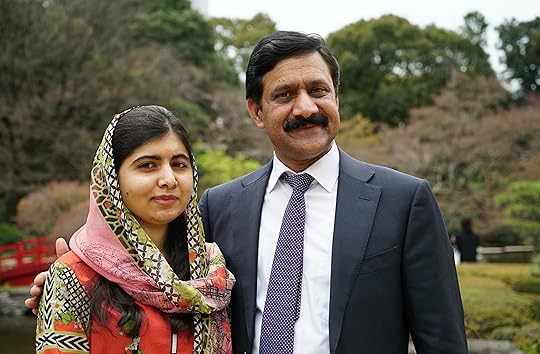
"When I say "I did not clip her wings" in relation to Malala, what I mean is that when she was small, I broke the scissors used by society to clip girl's wings."
"We were so thankful to God that Malala had survived. Pekai would say, "We are here, we are alive, we are together."
"I began to see that he was flawed. We are all flawed, but it is a powerful moment when you realize that about your parents. Still, I loved him no less for it. I know I have flaws, and my children are free to realize this and make their own corrections."
Whenever anybody has asked me how Malala became who she is, I have often used the response "Ask me not what I did but what I did not do. I did not clip her wings."The Yousafzai family members each have a quality of gratefulness that is so attractive, allowing each one to occasionally take a supporting role to another's exceptionalism. That less-lauded role is equally difficult to perform. The entire family deserves credit for surviving with such strength of character, but that specialness may stem from the leadership of Ziauddin Yousafzai, which is why this book is about him.
Weapons may bring immediate power, or immediate change, but it is not the long-lasting kind. The long-lasting change is what you stand for, believe in.


