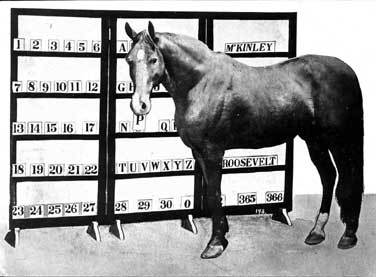
Beautiful Jim Key was a remarkable horse who performed at the turn of the century. His venues included the Tennessee Centennial Exposition (1897) at the Tabernacle in Nashville (later to be renamed Ryman Auditorium, and finally in 1943 the Grand Ole' Opry); the Boston Food Fair (1901) where he was examined by a panel of Harvard University professors selected by its president, Charles Eliot, and the Louisiana Purchase Exposition (1904) where he entertained Alice Roosevelt and Nicholas Longworth. His performances were legendary. They included spelling demonstrations, the solving of arithmetic problems, making change from his own cash register, answering questions (with a nod of “yes” or “no”) and touches of showmanship that made him a beloved celebrity rather than a mere performing animal. He was trained by an even more remarkable man, William (Doc) Key, who lived from 1833 to 1909.
Doc Key was born a slave, probably a cousin of his owner, John Key. He was treated as part of the family and even home schooled, but his ownership passed to John's brother-in-law, Jeptha, in payment of some debts. William had a talent for dealing with animals, even as a child, and was leased out as a horse trainer and self-taught animal doctor. The exposure to a wider world shaped both his perceptions and his ambitions. In 1852 his ownership was transferred back to the Key family, and when the Civil War broke out, he followed the young Key boys, Merit and Alexander, to the front determined to keep them safe from harm. At the same time, he was able to help fugitive slaves escape to the north. After the war he became a successful entrepreneur. He started a veterinary practice, developed and hawked a medicinal liniment, bought property, paid off the mortgage on the Keys Farm, and made generous civic and educational donations. His friends included Booker T. Washington and the mayor of Nashville, Richard Houston Dudley. He was already 56 years old by the time Beautiful Jim Key was born.
The question author Mim Eichler Rivas begins with is how did this remarkable story become lost? So skillfully has she researched her subject that we can almost hear the cheering of the crowds, and see the sepia toned photos come to life. There's also a subtle sense of nostalgia – not for that particular time, but for a time when oral histories were kept alive by closely connected extended families repeating the lore from generation to generation. (It's the antithesis of something like BUDDHA IN THE ATTIC where the 3rd generation doesn't even speak the language of the first). In it's place we seem to have evolved into a world where myth and legend have deeper roots than the printed word in our collective memory, and in the process, much of value has been lost. Who looks at those yellowed newspaper clips so attentively coveted and collected by publicists of the past? Fifteen minutes of fame or even 50 are a paltry summation of a lifetime. So, I cherished this personal history, and am grateful for the author's patient scrutiny of letters, pamphlets, newspaper articles, memorabilia, and conversations that recreate these beautiful lives.
I began this book as a skeptic. Eichler Rivas, herself, contributes to that doubt, choosing to open with Beautiful Jim Key's triumph in St. Louis. She then adopts a voice worthy of the Arabian Nights to tell the story of Beautiful Jim's mother, Lauretta Queen of the Horses, an Arabian mare abducted from a sheikh by an English adventurer named Jack Randall, and sold to the circus of P.T. Barnum. Her story continues with a voice that often reflects the smooth country drawl of the Doc as he narrates his story to Albert Rogers, his future business partner and impresario extraordinaire. Her own narrative voice becomes more prominent as Beautiful Jim and Doc achieve fame, and she is able to weave in a variety of historic contexts: The practice of racism, the capricious business of entertainment, the brief hey-day of the great world fairs, and most important, the public's attitude toward the humane treatment of animals. This is the real reason for remembering these people. Doc Key and Albert Rogers formed a lifelong friendship based on a vision: Beautiful Jim Key would change the world's attitude toward animals. They succeeded in attracting the attention of the great philanthropist George Thorndike Angell, president of the American Humane Association, and worked tirelessly to promote the theme of kindness and patience toward animals. (It is a bitter irony that some Tennessee Walking Horse trainers resort to the practice of soring, given that the breed and Beautiful Jim Key share the same origins – Shelbyville, Tennessee in Bedford County).
I began this book as a skeptic and finished as a convert. Beautiful Jim Key was, in fact, an amazing horse. Eichler Rivas' most moving chapter is “After History,” where she finally adopts the first person voice to recount her own journey to Shelbyville. The only physical evidence is a stone marker: “Famous Arabian Hambletonian Educated Horse: Beautiful Jim Key 1889-1912 – Be Kind to Animals – Kindness, Justice, and Mercy to All Creatures.” She writes: “The most telling feature of the site is the headstone with its engraved caption, 'Jim's Dear Friends,' underneath the three photographic inlaid porcelain cameos of Dr. William Key, Albert Rogers, and the scruffy stray dog Monk (shown in the plaque riding Jim). Their various gazes seem to peer at you from the past, asking you to seek out the truth of their existence, to know more, to piece together their journey here in this life; to remember them.”