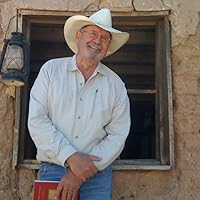
The Old Cattleman has many tales to tell of the days when the Wild West was truly wild, having spent his entire life in Wolfville--a time when desperadoes and mule-skinners, outlaws and lawmen, runaways and rawhiders, ran the town. Original.
American investigative journalist, lawyer, Western novel writer, editor, and short story writer.
During the late 19th century, he wrote muckraker articles for Cosmopolitan. As an investigative journalist, Lewis wrote extensively about corruption in New York politics.
He also wrote biographies about Richard Croker and Andrew Jackson.
As a writer of genre fiction, his most successful works were in his Wolfville series of Western fiction.
Lewis pretty accurately transcribed the complex southwestern tobacco-jawed accents of the major characters, which makes this book REALLY fun to read out loud. I found this transcription to be challenging to internally read - as in, I found myself having to reread sentences to figure out what the character is trying to communicate. Maybe it would be an easier task for someone more familiar with the accent, but I just got tired of having to decipher what in the hell they are trying to say and gave up. I’m sure it has great stories, but the first few chapters weren’t engaging enough to deal with the mental linguistic gymnastics.
Lewis, a turn of the century cowboy, attorney, and storyteller, lifts his narrative above the common herd with unique degenerates and faulted players with smart, hilarious dialogue. A collection of short stories with slang lingo and unique spellings requiring the reader to slow down: “For myse’f I shuns all sech.” A participant and an observer in real time, Lewis presents a proper introduction to the dandyism of the cowboy. “Your cowboy at that time was a person of thrill and consequence pinched between wire and the farm.” His talent for heady thoughts and pure observation go beyond the picturesque and romantic with vivid descriptive passages—a harbinger of today’s graphic novels. --Tom Van Dyke, Author/Screenwriter
I had read the Wolfville series on the recommendation by none other than playwright David Mamet. Otherwise, like just almost everyone, I would have never heard of it. And that's a damned shame. I do not know why Alfred Henry Lewis is not regularly mentioned among the great American humorists. But I do have my suspicions:
There is considerable racist content. I've seen the reviews here and for the other books in the series, and a few always mention it. This concerned me, also, in the beginning. They not only disparaged blacks, Hispanics, and native Americans but were also misogynistic (finding most women formidable rather than inferior). One was expected to be an alcoholic. Gambling is so prevalent that most metaphors use poker or faro terminology. They favored lynchings in general unencumbered by "law-sharps" (lawyers and judges) and don't give the impression that human life itself was that valuable. But, if somehow you expected Arizona cowboys at the turn of the century to be woke, you don't need to be reading these books.
All stories are related to an interviewer by the Old Cattleman and center around a group of characters in the town of Wolfville. It is this way for every book in the series. As the series progresses, the characters become increasingly more distinctive and almost predictable. What I find to be extremely charming is the use of vocabulary by each character. Although the dialect is severe and the grammar atrocious, they still intersperse more intellectual words here and there. "'You-all's nacherally a somber, morose party,' says Doc Peets this time, 'an' nothin' jocose or jocund about you. Your disp'sition, Jaybird, don't no more run to jokes than a prairie dog's."
Welcome to Wolfville, Arizona, where the inhabitants take their drinking and card-playing seriously, and dispense their own justice and charity with a folksy off-handedness synonymous with the spirit of the Wild West.
Our guide is the crusty Old Cattleman, who has a story for every topic and occasion, which he is more than happy to pass along in his rambling, vernacular-filled idiom ('kyards' for cards, 'yere' for here, 'speshul' for special etc).
They arrange their affairs via a 'vig'lance committee', unofficially led by Old Man Enright and much influenced by the opinion of one Doc Peets. The latter is revered for his smarts. His simple outlook on life is that the best towns are those where you can "finds the most lynchin's".
In an early story, the wise heads of this committee - or as it is commonly called, the 'Stranglers' - almost erroneously hang one of their own members on suspicion of being a stage coach robber by dint of the flimsiest of circumstantial evidence.
Sound like fun posse?
Well pardner, they should have been, and were at times, but I nearly decided to leave the trail entirely within the first five chapters.
In these, the good ol' people of Wolfville proudly condescended to use 'niggers' for digging graves, kindly explained and demonstrated how they were 'averse to Greasers', and refered to a Chinese laundryman as a 'slothful Mongol' as they ran him out of town to make way for a woman from Tucson.
All of the tales were on the comic side, but it's not so easy to see the humor in racism and cursory hangings. That said, a couple of the later stories, one featuring two road runners and a rattlesnake, the other an almighty rave up with a rival town, were pretty funny, and the last story featured a classic epitaph joke.
Written by a journalist in the first years of the 20th century and likely culled from authentic sources who had lived in those self-governed frontier towns like Wolfville fifty years before, the contemporary audience were no doubt supposed to revere these stupid, xenophobic, pistol-fixated pioneers of the Old American West.
The Old Cattleman was allowed to spin his casually racist yarns without the slightest intervention from his listener. I didn't doubt the authenticity of the Old Cattleman's narrative voice, nor did I dislike his turn of phrase. I just didn't care for the author's slavish silence where he should have been satirising.
Entertaining in parts, but difficult for a modern reader to go all yippee-ki-yay over.