Jump to ratings and reviews
Rate this book

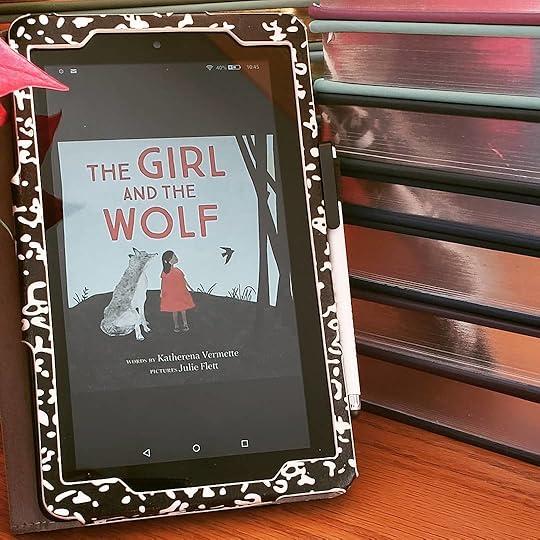
The Girl and the Wolf

Rate this book
While picking berries with her mother, a little girl wanders too far into the woods. When she realizes she is lost, she begins to panic. A large grey wolf makes a sudden appearance between some distant trees. Using his sense of smell, he determines where she came from and decides to help her. Through a series of questions from the wolf, the little girl realizes she had the knowledge and skill to navigate herself--she just needed to remember that those abilities were there all along.

32 pages, Hardcover

First published February 5, 2019

6 people are currently reading
845 people want to read

About the author

Katherena Vermette

35 books1,306 followers
Katherena Vermette is a Canadian writer, who won the Governor General's Award for English-language poetry in 2013 for her collection North End Love Songs. Vermette is of Metis descent and from Winnipeg, Manitoba. She was a MFA student in creative writing at the University of British Columbia.

Her children's picture book series The Seven Teachings Stories was published by Portage and Main Press in 2015. In addition to her own publications, her work has also been published in the literary anthology Manitowapow: Aboriginal Writings from the Land of Water. She is a member of the Aboriginal Writers Collective of Manitoba, and edited the anthology xxx ndn: love and lust in ndn country in 2011.

Vermette has described her writing as motivated by an activist spirit, particularly on First Nations issues. The title of her book refers to Winnipeg's North End.

Ratings & Reviews

What do you think?
Rate this book

Friends & Following

Create a free account to discover what your friends think of this book!

Community Reviews

5 stars
246 (33%)
4 stars
308 (42%)
3 stars
154 (21%)
2 stars
18 (2%)
1 star
7 (<1%)
Displaying 1 - 30 of 147 reviews
Profile Image for Miranda Reads.
1,797 reviews165k followers
December 9, 2020
description

"Don't go too far," her mother called. "It's going to be dark soon."
"Okay," the girl said but kept running.
The wolf is the big-bad in just about every fairytale.
But why? How fair is that?


Vermette creates a new take on the "bad wolf" trope with her her little girl in the woods.

I really enjoyed this book.

It was short, sweet and had a different, older feel than many modern storybooks I've read.

I liked the inclusion of the older elements (i.e. leaving a gift for the wolf) and the illustrations were really well done.

This feels like the perfect book for a sleepy night.

YouTube | Blog | Instagram | Twitter | Facebook | Snapchat @miranda_reads
Profile Image for Betsy.
Author 11 books3,285 followers
April 4, 2019
There was a time, not long ago at all, when a call for “diverse voices” in a children’s library would have led you to a particular location: The folktale and fairytale section. Many a well-meaning librarian would hear your request for books reflecting the experience of one group or another and direct you to the 398.2s. Why? Because for a long time those were the rare books that even acknowledged that other races, ethnicities, religions, etc. existed in the world. But if you’d followed the librarian’s advice and perused the section, it wouldn’t have taken you very long to realize that the bulk of the books there were written by white people. Before #ownvoices was even a gleam in the public’s eye, white people would merrily write outside their lived experiences without a second thought. Sometimes they’d do the proper research, but a lot of the time it was, to put it mildly, loosey goosey. Nowhere was this more evident than when it came to books about Indigenous spiritual tales. We’re talking appropriation on a pretty massive scale, to say nothing of the fact that, adding insult to injury, they’d be labeled “folktales” to boot. Now walk over to the 398.2s these days and all those books are still there. Fortunately, thanks to efforts by publishing companies like Inhabit Media, Theytus Books, and others, we’re seeing a marked increase in the number of Indigenous authors and illustrators every year. The Girl and the Wolf by Métis author Katherena Vermette and Cree- Métis artist Julie Flett, is one of these; an original fairytale in the purest sense of the term. Essentially, it takes a European idea and flips it on its head. A book that cracks the limitations of the fairy tale form wide open.

While her mother picks berries, a young girl “helps”. Which is to say, runs about as fast as her legs can take her. Forgetting her mother’s advice not to stray too far she soon finds that she has become lost in the woods, and nighttime is descending. To her surprise, a wolf presents himself but he does not seem intent on harming the child. Instead, he asks her questions that get her thinking. “Do you know how to hunt?” “What are you going to do?” When she says she doesn’t know the wolf snaps her out of her self-pity and urges her to take in her surroundings. In doing so she not only finds food to eat, but a way out of her predicament. Soon she is in her mother’s arms once more. Later, she leaves tobacco for the wolf by way of thanks.

As a young librarian, I was taught some very strict guidelines regarding fairytales. When working on New York Public Library’s annual 100 Books for Reading and Sharing list, I was told in no uncertain terms that books to be taken seriously had to be based on real folk and fairytales and not just something someone made up. Never mind that every story, at its core, is just something someone made up, or that part of the charm of these books is how each author and artist puts their own spin on the proceedings. It was only when I left NYPL that I began to relax my own parameters a bit. As far as I’m concerned, fractured fairytales can get a bit samey after a while, but books where the tale is shifted and seen in a whole new light, THAT is worthy of consideration.

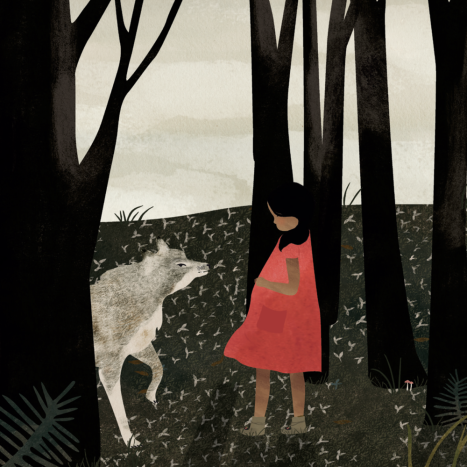
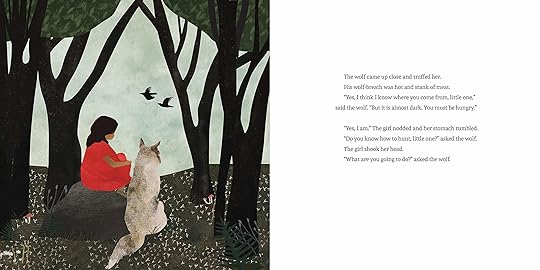
On first glance the biggest difference between this story and any European one you can name is that the wolf is not the antagonist in the tale. That doesn’t mean that Vermette doesn’t play up the danger. The wolf may not be threatening but that doesn’t mean he isn’t wild. The first time he appears he is described as “a tall grey wolf with big white teeth…” When he sniffs the girl, “His wolf breath was hot and stank of meat.” Even Flett plays this up, subtly. Here is an animal, the tips of his teeth visible as he approaches. When it becomes clear that he means the child no harm, the book seems poised to make him into a protector or guardian. Instead, he’s a guide to the child. He provides no answers, only the questions that calm the girl and allow her to think critically. Under his guidance she can feed herself and locate places that look familiar. Their relationship is an empowering one, the wolf helping the girl to clear her head and find her own answers. The wolf is, then, like an ideal parent. Guiding the child but never giving away the answers outright.

Recently I was reading my daughter Louise Erdrich’s novel Birchbark House and we kept coming across instances when characters would give thanks using tobacco in some way. Many is the child of the 21st century that associates tobacco with cigarettes and is repulsed by its existence. And really, until I read The Girl and the Wolf I’d not encountered it in any other children’s titles. In the book, after she is safe home once more, the girl leaves some tobacco in red cloth at a bush’s edge, “Because she didn’t know a better way to say thank you.” In context this could be interpreted, but I liked that Vermette included a note about the tobacco in her Author’s Note at the end. Not only does it explain succinctly tobacco’s role in times of gratitude, but it allows this book to be nicely paired with Erdrich’s. I’m a librarian, so pairing books together is basically my favorite part of my job.

I’ve encountered the art of Julie Flett over the years, but usually when her books make it into the American marketplace they’re in board book form. In The Girl and the Wolf Flett limits her color palette to earthy tones and hues. There are great subtleties to her work, like the gently mottled fur on the wolf’s back, or the silhouette of grasses against a grey/blue sky in the fading light. Because the book takes place at twilight, Flett has to capture the time of day when you feel daylight waning, mere minutes before the dusk. Only the girl’s bright shock of red, her dress, provides any kind of striking color. Then there’s her physical attitude. I think that when some young children read picture books where they can relate directly (and what could be more relatable than losing the person who is supposed to take care of you?) they can get anxious and take their cues from the characters’ physical attitudes. Flett’s girl is anxious, but physically she matches the wolf in demeanor. There’s a steady thrum of calm to these pictures, even as the situation starts to feel dire.

Children’s librarians are constantly asked to provide books full of “girl power” where the female characters have impetus and drive and are in charge of their own destinies. Such books often sport bright, eye-popping colors, and wild untamed girls that do battle with society’s mores and win. To these strong girl books I’d add The Girl and the Wolf. It’s not flashy or sparkly like the others. The girl in this book doesn’t work in a STEM field or break any barriers. Instead, she does something far more relatable. When caught in a stressful situation she takes stock, listens to sound advice, and thinks her way out of her predicament. That she does all this within the confines of what at first appears to be a Red Riding Hood-esque storyline just makes it all the more impressive. A clever twist on an old staple, and a much needed breath of fresh air for fairytale collections everywhere.

For ages 4 and up.
Profile Image for Chad.
10.4k reviews1,060 followers
February 21, 2020
The Girl and the Wolf is a picture book that takes a fresh look at the storybook relationships between lost, little girls and wolfs they meet in the woods. Julie Flett's illustrations are pretty great as is this quick little story.
Profile Image for Mir.
4,975 reviews5,329 followers
December 8, 2019
I love the illustrations and will certainly look for more by this artist.
I'm not sure how I feel about the story, but I think overall positive.
Profile Image for Manybooks.
3,825 reviews100 followers
November 24, 2019
While many reviews seem to consider (and perhaps even with a bit of justification) Katherena Vermette's The Girl and the Wolf a First Nations and Métis inspired variant of the universally known Little Red Riding Hood story (except that the so called big bad wolf actually and of course ends up being legitimately helpful in this case and thus not evilly cunning), I for one actually simply do tend to consider the author's original tale, I for one find Vermette's The Girl and the Wolf simply a delightful story (and indeed without all of the Little Red Riding Hood comparisons) of a little girl lost in the woods who is then helped by a large wolf (and not by the wolf in any way leading the girl home or by the wolf finding food for the little girl but by him acting as a kind of tutor and guide so that the girl uses her own wits to both survive in the woods and then to find her way home through observation and knowledge, such as for example locating berries that are safe to eat and later discovering the remnants of her family's campsite, from where she ended up lost in the first place).

Accompanied by Julie Flett's always wonderful artwork (and in The Girl and the Wolf, in particular Flett's interplay of red and grey/black is both an aesthetic delight and really also does majorly accentuate and make both the little lost girl and her wolf helper visually stand out), I have truly very much enjoyed both my reading and yes also my viewing experience with regard to The Girl and the Wolf. And really, the only reason why my rating for The Girl and the Wolf is not yet a full five stars is that yes indeed, even though I do realise that Katherena Vermette's story is an original albeit First Nations, Métis inspired tale, I do still wish that in her otherwise so informative author's note, Vermette had also listed at least some of the traditional stories of where the wolf was not portrayed as the villain and which she claims have been the inspiration for her own and original tale of The Girl and the Wolf.
Profile Image for Trish.
2,395 reviews3,749 followers
February 21, 2020
Almost everyone has heard the fairytale of Red Riding Hood and the big bad wolf. This story instead shows that the dark woods and creatures living there can be helpers.

The titular little girl (who happens to wear a red dress) runs too far away from her mother one day and ends up in the deep woods. She's lost and soon gets frightened. But then a wolf appears, takes pity and talks to her. Being a wolf, he can smell where she came from and thus take her back, but he decides to do more than that. The questions he asks and how he asks them lead the girl to find food and water and, ultimately, her way home. Therefore, the wolf reconnects the girl with her own roots, letting her discover all the things she knows since she is part of nature, too, enabling her to find her own way.

I found the moral of this story to be rather wonderful. The author herself is of Metis descent and from Winnipeg, Manitoba, so I'm not surprised about her wonderful take on reconnecting with nature.

Completing the reading experience are Julie Flett's illustrations that are rather cute, simplistic and - especially because of the latter - spot on.


Wonderful addition to my shelf and a really coolbook for young and old to challenge expectations and enjoy the art.
Profile Image for KC.
2,618 reviews
June 8, 2019
While gathering berries in the woods with her mother, a young girl loses her way but is befriended by a gray wolf who helps her use her skills and senses to find her way back. Beautiful illustrations.
Profile Image for Kathleen.
1,089 reviews
September 19, 2020
The Girl and the Wolf written by Katherena Vermette and pictures by Julie Flett tells the story of a little girl running around while her mother picks berries.
"Don't go too far," her mother called. "It's going to be dark soon."
"Okay," the little girl said but kept running.
She gets lost and a big grey wolf helps her.
Julie's pictures make the story come alive.
I recommend this empowering indigenous twist on a classic wolf tale.
4.5 stars
Profile Image for Milton Public Library.
908 reviews23 followers
January 9, 2023
A little girl wanders too far from her mother and gets lost in the woods. That's where she runs into "a tall grey wolf with big white teeth", but the wolf isn't the bad guy in this story. I loved the story and the illustrations.

Find it on our: SHARE Catalog today!

Jayme A. / Milton Public Library #CheckOutMPL
Profile Image for Chinook.
2,336 reviews19 followers
November 1, 2019
I loved this retake on Little Red Riding Hood.

Instead of being a story about danger, it’s a story about using your skills when you have the problem. The wolf advises the girl to be calm, look around and use what she knows to get back to her mom when she gets lost in the bush.

The illustrations were really lovely as well.
Profile Image for Marquise.
1,956 reviews1,442 followers
October 21, 2020
Cutesy and unrealistic plotline, rather obviously written as a response to the Big Bad Wolf trope in "Little Red Riding Hood," but whilst the author wants to drive across the point that not all wolves are bad and don't deserve their reputation, she doesn't quite know how to pull it and ends up contradicting herself. For a start, if this wolf is a spirit animal, one of the "good" wolves, then it's rather baffling that his big fangs and his breath stinking of meat are stressed on as if he were to follow his wolfish nature any moment now, only to have him turn out to be so gentle and guide the girl to berries and a path out of the forest. His behaviour runs against wolfish nature, so it must be either a spirit or a dream. I'm inclined to think that the girl dreamt this up all by herself when she fell asleep in the forest à la Alice, which would make more sense than trying to fix the holes in this storyline.

Besides, if this was a response to LRRH, then the central metaphor stays is smashed: the girl disobeys parental counsel and ends up in trouble, ultimately paying for her folly (this is why the Big Bad Wolf eats Red), but here, this girl still disobeys parental counsel and instead of paying the consequences, a spirit appears from the heavesn to get her out of trouble and he just so happens to be in the shape of a predator? Come on!
Profile Image for Danielle.
Author 2 books268 followers
March 3, 2019
A girl, a helpful wolf that guides her toward her own resourcefulness, a thank you. Life-affirming with beautiful illustrations from Julie Flett.
Profile Image for Rod Brown.
7,400 reviews284 followers
March 1, 2020
This Little Red Riding Hood riff is odd and creepy in tone but compelling, especially if you think of the wolf as metaphorical. ("But Oz never did give nothing to the Tin Man that he didn't, didn't already have.") The ending gesture left me baffled though until it was explained in the Author's Note.
Profile Image for Adele.
1,162 reviews29 followers
February 28, 2020
Interesting, satisfying story with a helpful wolf and a brave, capable little girl. I did not know going in the creators of The Girl and the Wolf were Indigenous Peoples. The story succeeds on its own merits and representation is a bonus on top of that, but I did also notice differences in tone and style from what I commonly find in current popular picture books that enhanced my enjoyment. The author's note at the end did just what I would want an author's note to do - explained the one story element I had questions about and added perspective without overwhelming the story itself.
21 reviews2 followers
October 14, 2020
I found this book on the 2020 Outstanding International Literature Book List by USBBY. I picked this book because I thought the book looked interesting and wondered if it was similar to "Little Red Riding Hood" I was able to read the book on youtube.

The Girl and the Wolf is a book about believing in yourself. The little girl gets lost from her mother in the woods and the wolf helps her find her way. She is scared and is unsure that she will ever find her mom. But with a little courage and guidance anything is possible.

I would use this story as a read aloud book with my elementary students when talking about courage and bravery.
Profile Image for Lindsay.
3,058 reviews95 followers
August 20, 2022
I liked the spin on a scary fairy tale to a happier one.
2,728 reviews
Read
January 14, 2020
I liked the artwork but not the story, which was too sinister for me (despite the ending).
Profile Image for Jenny.
3,374 reviews39 followers
October 21, 2019
A young girl gets lost in the woods. She can't find her mother. A wolf appears and gently helps her to find her way back to her mom. Her mom tells her that she has heard stories of helpful wolves. The young girl leaves the wolf a gift of appreciation and gratitude.
Profile Image for Kris.
3,577 reviews69 followers
October 22, 2019
A little girl dressed in red, lost in the woods, meets a wolf. But you don't know this story. Such a great take on the typical Red Riding Hood fare, with Julie Flett's always wonderful illustrations and a smart indigenous protagonist.
Profile Image for Connie T..
1,594 reviews8 followers
May 28, 2019
At first I thought this was going to be another take on Little Red Riding Hood and I kept waiting for something bad to happen. After all, the wolf's sharp teeth and hot breath stinking of meat are pointed out. However when it became obvious that this was a good wolf, I felt it was a spirit animal sent to guide the lost girl. The wolf doesn't solve the girl's problems but reminds her that she already knows what to do if she is calm and focused.

The artwork is fairly simple. Since the story takes place in late afternoon, not a lot of details are seen. As "everything got quiet and dark" the wolf shows up. (I particularly liked his stippled fur.) When "everything was quieter and darker" the sky is a nice mottled gray color. When they are at the stream, it was "pretty dark." Then, in all the following spreads, the sky is the same color as when the story started. That doesn't make sense. I also didn't like the way the text was broken up to look like poetry on the two pages when it was quiet and dark and quieter and darker. I don't see the logic of this. Finally, the very last "sentence" is really a fragment, which I feel just hangs there, especially since it's set off as its own paragraph. The author could've just added "to say thank you" to the previous sentence. Fortunately, an author's note explains the importance and significance of the tobacco.

We need diverse books and Indigenous cultures need to be heard. However, I find this book somewhat disappointing.
Profile Image for Cindy Mitchell *Kiss the Book*.
6,031 reviews219 followers
October 31, 2019
The Girl and the Wolf by Katherena Vermette, illustrated by Julie Flett. PICTURE BOOK. Theytus Books (Schchechmala), 2019. $20. 9781926886541

BUYING ADVISORY: EL (K-3) - OPTIONAL

AUDIENCE APPEAL: AVERAGE

On a camping trip, a young girl walks away from her mom and becomes lost. She is prompted by a kind wolf to take a breath and look around and search for clues. This gives the girl the peace and confidence she needs to find her mom again.

The writing in this picture book feels like a first draft. It may be mimicking old folk tales in its simplicity, but I found the lack of details and imagery in the writing boring and uninviting. The message of this tale is also illusive, and it seems that the message should be important given its folk tale tone.

Jen Wecker, HS English Teacher
https://kissthebookjr.blogspot.com/20...
Profile Image for Elizabeth.
2,086 reviews69 followers
March 6, 2019
Love this! I'm a big fan of both Julie Flett and Katherena Vermette, so hearing that this book even existed made me pretty happy. I actually put it on hold when my library ordered it so I could read it right away.

The art is gorgeous as always, I would never expect less from Julie Flett. Vermette's storytelling is on point here with a really nicely done retelling of Red Riding Hood with the wolf as a helper.

I definitely enjoyed this and would recommend it.
Profile Image for Michelle (FabBookReviews).
1,053 reviews39 followers
March 6, 2019

A gorgeous, still and reflective story that breaks the expected devious wolf narrative with a focus on capability, problem-solving, and showing sincere appreciation to the animal world. As ever, Julie Flett's artwork is breathtaking and the collaboration between Flett and award-winning author Katherena Vermette is tremendous.
Profile Image for Jennie MC.
54 reviews
April 18, 2022
I bought this book because the wolf looked like my pooch. This ended up being a very sweet story and I'm glad I purchased!
Profile Image for V.
988 reviews22 followers
February 13, 2019
Why we chose this book:
So apparently T is telling people, "They don't teach us anything at farm school. We have to figure it out ourselves." Self-reliance and problem solving are skills we want to encourage, and the description explained this as a goal of the book. Orca Books provided a review copy.

Mom's Review (V)

A little girl runs into the woods while her mother is picking berries, only to become lost almost immediately. A wolf appears, but in a reversal of Little Red Riding Hood, the wolf helps the girl calm down and find her way home. The wolf does not lead her home, however, but asks the girl what she will do. She answers, "I don't know." The wolf reassures her that she does, indeed, know. He encourages her to close her eyes and take a breath before trying again to determine her course of action. Each time (she has more than one problem), she realizes that she does know what to do. When she returns to her camp, she finds the wolf gone. The Girl and the Wolf ends with the girl leaving a gift at the edge of the woods to thank the wolf.

What I like about this story so much is the way the wolf and girl demonstrate techniques for calming down to solve problems. I often help T calm by practicing breathing exercises; he quickly identified with the girl when the wolf had her do the same. The wolf also sets an example for parents; rather than solving the girl's problem for her, he provides support and assurance while encouraging her to apply her knowledge to a given situation. Just like at T's farm school, he doesn't teach her anything, she has to figure it out for herself. And just like at T's farm school, he is there for her, guiding and helping along the way.

I'd also like to point out that the girl is never named, nor does she have distinctive features. She could be anyone. And any child could imagine himself or herself in the girl's place or following her example. It is also worth noting that this also allows readers to identify with a First Nations character.

The back reads: "An empowering indigenous twist on a classic wolf tale." And I wholeheartedly agree.

Son's Review (T)
(Age: almost 4)
Before reading:
Mom: I think you're really going to like this. It's about a helpful wolf, like the opposite of the one in the 3 Little Pigs.

Son: It's also the opposite of Little Red Riding Hood.

After reading:
Son: I want to read it again!

Mom: I really liked the wolf, but I felt nervous at the beginning. How did you feel?

Son: I really liked it. I felt pretty happy.

Mom: How would you tell the wolf, "Thank you"?

Son: Put flowers and acorns with a leaf wrapped up - with them wrapped up in a leave. And I would give it to the wolf. And that's what I wanted to do tomorrow!

Mom: And would you leave it in the woods for some animals?

Son: Oh gosh no. Bring it in!

Mom: And would you want to play with the little girl? What would you say to her?

Son: Yes. "Did the wolf hurt you or not?"

Mom: I think you know the answer to the question already. Did the wolf hurt her?

Son: Yeah, but if I met her... No.

Mom: The wolf was helping her calm down. Do I help you calm down? How? Does that sound like anything we read?

Son: Yeah. Take a deep breath. The wolf.

Mom: If you got lost in the woods and couldn't find me, what would you do?

Son: I would knock and say, "Open the back door," and you would.

Mom: Well, if you couldn't find me, you could knock on the neighbor's door. Which house could you go to?

Son, pointing to the closest house: That house!
___________________________________________
Son: I would want to be friends with the wolf.

Mom: What do you think it would be good to do together? Do you think the wolf would want to read books?

Son: No. I would make books out of leaves. I would stick a leaf together and I would write words on them and I would draw pictures on them and I would read it to the wolf.

Mom: What kind of stories would you tell the wolf?

Son: Animal stories with wolfs in them or just wolf stories or just people stories.

Mom: Would you also want to be friends with the little girl?

Son: Yeah, but most of all I'd just like to be friends with the wolf.

Mom: What advice might she give to someone who has to solve a problem?

Son: "Go to my friend the wolf."

Mom: And when is it a good time to read The Girl and the Wolf?

Son: When someone is lost.

Mom: What did you like most?

Son: That the wolf helped her.

Extra
I love finding smaller and specialty presses, and Theytus is a new one for me. Here's a bit about it, from their website: "Theytus Books is a leading North American publisher of Indigenous voices...
As the oldest Indigenous publishing house in Canada, Theytus Books is recognized and respected internationally for its contributions to Aboriginal literature."
http://www.theytus.com/About-Us
Profile Image for Leslie.
1,100 reviews36 followers
March 8, 2019
Out with her mother picking berries, the girl ran too far and as the night draws closer, she found she was lost. A “tall grey wolf with big white teeth” appears. What follows is a quiet and steady calm in an otherwise fraught situation. A girl dressed in red, alone and lost, the wolf reassures her that she can find what she needs, food and water…and her encampment. There’s a remarkable tenderness in the way the wolf interacts with her.

I’m certain the illustrations help; the wolf isn’t looming, but kept companionably close. Julie Flett’s signature red of the girl’s dress vibrant, powerful, young mutes the grey of the wolf, brings a stillness and wisdom to its stature. Maybe the text does that. Such is the atmospheric interplay of Vermette and Flett partnership.

“What are going to do?” asked the wolf.
“I don’t know,” she said sadly.
“Yes you do,” the wolf told her. “Take a deep breath. Close your eyes, then look. What do you see?
The girl did what he said, and when she opened her eyes she saw something that made her feel better.

Upon returning, the girl tells her mother and the others of the wolf. Her mother’s reply is an intriguing glimpse of the real in what has read like a fairytale thus far.

“Real wolves can hurt people, but I’ve heard old stories of wolves who help lost children too.” The girl smiled. She was glad the wolf had been the helping kind.

The balance of vulnerability and empowerment is marvelous. That The Girl and the Wolf is a Tale that is situated in reality is powerful: That the girl is capable is Real, the reminder that she is is cloaked in a Tale, or a red dress with pockets.

I can’t love this story enough. I kinda wanna call up my 18 year old in college to read it to her; maybe I’ll buy her a copy. Little girl in a red dress running because you like to run, full of life, vivid against the landscape; and in trouble, “What are you going to do?” “I don’t know” “Yes you do.” “Take a deep breath. Close your eyes, then look.” The wolf and the girl’s relationship provides us with what reads like a mantra.

I love that the girl was so well-equipped, of course she was, she knew what berries were good, that the water was sound, had observed her surroundings. She didn’t run because she was bratty, but that her youth is understood. I love that she takes time and thought to express her gratitude; and that it is the last scene, the girl leaving the wolf a gift (with no wolf in sight). The “Author’s Note” tells us that the gift, “Tobacco is one of four sacred medicines.” There is a depth of understanding in her gratitude…not only, I think, that the wolf was a “helping kind,” that the natural world (of which she is a part) can be merciful and patient, but of what the wolf reminded her about herself and what she’d been taught.

Recommended for all the libraries and lovers of Tales…For not only mothers and daughters; and I think this will be an inspiring story for lovers of the out-of-doors, and maybe the anxious.

https://contemplatrix.wordpress.com/2...
Profile Image for Tasha.
4,165 reviews137 followers
April 19, 2019
When a little girl wanders too far from her mother while they are picking berries, she finds herself lost in the woods. Unable to figure out how to return home, she starts to panic. Suddenly, a large gray wolf appears and using his nose, figures how where she comes from. But night is falling, so the wolf asks the girl a series of questions that demonstrate how much she really knows. He encourages her to take a deep breath, close her eyes, and then look. When the girl does this, she realizes that she can see berries that are safe to eat and water that is safe to drink. She eats and drinks, then the wolf encourages her to breathe deeply again. Now she recognizes the stand of trees nearby and finds her way back to her mother who explains that she has heard of wolves that help lost children. The little girl later leaves a gift of thanks for the wolf’s aid.

This book is a complete re-imagining of the Little Red Riding Hood story into one with a First Nation spin. Vermette is a Metis writer from Treaty One territory in Winnipeg. She has entirely turned Little Red Riding Hood into a story of the strength of a little girl who only needs help to figure out that she had the ability all along. The quiet and encouraging wolf is such a shift from European stories, energizing the entire picture book with his presence.

Flett’s illustrations keep the little girl in red, clearly tying this new story to its origins. The wolf is almost as large as the girl, making his threatening presence strong when he first appears but also offering a real sense of strength as he is better understood as the tale unfolds. The art is filled with strong shapes and rich colors.

An entirely new telling of Little Red Riding Hood, this is one to share when learning about independence and mindfulness. Appropriate for ages 3-5.
Profile Image for SandyF.
20 reviews
April 30, 2020
The Girl and the Wolf is book about a little girl that gets lost from her mother while picking berries. She starts to panic, and a wolf helps her find her way. This book reminded me of Little Red Riding Hood as the character is dressed in a red dress but in this story the wolf is not bad, he is a nice and helpful wolf. Her mother did say that wolves are dangerous but has heard stories of wolves helping in the past. At the end the little girl wanted to thank the wolf by putting tobacco in a bag and placed in the bushes for the wolf. I do not think this is appropriate, but maybe it’s a cultural thing and appropriate in other countries. In the United States I’d be careful when reading this book as you may have to discuss what tobacco is. Maybe she could have left him berries as a thank you instead.

The illustrations were beautiful. You can see the beauty of nature. This book is appropriate for 8-12year olds. I listened to this book through an audio on YouTube. I believe it was great. The reader did an excellent job reading the text and zooming in and out of the illustrations. It made the book come to life for me. This book was chosen from the www.usbby.org website. It made the 2020 Outstanding International book list.

Profile Image for Rachel.
1,180 reviews28 followers
May 12, 2019
The Girl and the Wolf starts out like a Red Riding Hood tale with a young First Nations girl ignoring the warnings of her mother and getting lost in the woods. There she meets a wolf. This is where the narrative takes a sweet turn. As she makes her way back, the wolf asks the girl what she will do, and when she says no, the wolf responds yes you do, and before long she arrives home. While this tale is inspired by traditional stories, it is original, and expresses the good nature of the often vilified wolf. This means that there is a new moral ingrained. During the course of their interaction, the girl learns that before panic strikes, it is important to pause and assess the situation. The wolf's wisdom helps her to make wise decisions. Our initial caution, is quickly soothed by Vermette's story, and the calming effect of Flett's minimalist style. Both creators have delivered another great read for youth.
Displaying 1 - 30 of 147 reviews

Can't find what you're looking for?

Get help and learn more about the design.